FAULT TOLERANT
ARCHITECTURES
Presented by
D.S.MYDHEESWARAN
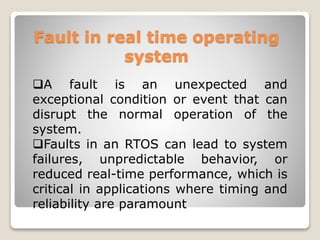
Fault in real time operating
system
A fault is an unexpected and
exceptional condition or event that can
disrupt the normal operation of the
system.
Faults in an RTOS can lead to system
failures, unpredictable behavior, or
reduced real-time performance, which is
critical in applications where timing and
reliability are paramount
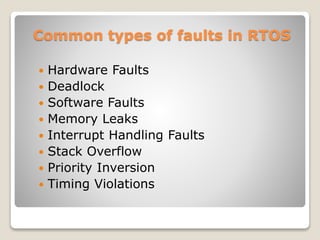
Common types of faults in RTOS
 Hardware Faults
 Deadlock
 Software Faults
 Memory Leaks
 Interrupt Handling Faults
 Stack Overflow
 Priority Inversion
 Timing Violations
Fault tolerance mechanisms
 Fault tolerance mechanisms are strategies
and techniques used to ensure that the
RTOS and the embedded systems running
on it can continue to function reliably in
the presence of faults, errors, or
unexpected failures.
 The goal is to maintain the system's real-
time behavior and meet its timing
constraints even when faults occur.
Fault injection testing
 Fault injection testing in a real time operating
system is a controlled and deliberate process
of introducing simulated faults, errors, or
abnormal conditions into the RTOS and the
embedded system it manages.
 The primary goal of this testing technique is
to assess how the RTOS and the entire
system respond to these injected faults,
evaluate their fault tolerance mechanisms,
and determine the system's resilience under
adverse conditions.
Interrupt handling faults
 Interrupt handling faults are refer to
situations where the RTOS encounters
errors or issues while processing
hardware or software interrupts.
 Interrupts are mechanisms used by the
operating system to respond to external
events, such as hardware device signals,
timers, or software-triggered events.
Fault masking
 Fault masking is refers to a situation
where a fault or error occurs within the
system but is not immediately detected or
reported because of the RTOS's ability to
continue normal operation without
apparent disruption.
 This can give the illusion of a fault-
tolerant system, but it may hide
underlying issues that can lead to
problems later on.
Fault tolerant architectures
 Fault tolerant architectures in real time
operating systems are design strategies and
mechanisms implemented to ensure that an
embedded system can continue to operate
correctly and reliably in the presence of
hardware or software faults, errors, or
failures.
 These architectures are crucial for systems
where reliability and availability are
paramount, such as safety critical systems,
aerospace applications, medical devices, and
industrial control systems.
Hardware Redundancy
 This approach involves duplicating critical
hardware components (e.g., CPUs,
memory, power supplies) to create a
redundant system.
Software Redundancy
 Redundancy can also be applied at the
software level, where multiple copies of
the same application or task run
concurrently on separate processors.
 In the event of a fault in one instance,
another can take over.

Fault-tolerant architectures in real-time operating systems

  • 1.
  • 2.
    Fault in realtime operating system A fault is an unexpected and exceptional condition or event that can disrupt the normal operation of the system. Faults in an RTOS can lead to system failures, unpredictable behavior, or reduced real-time performance, which is critical in applications where timing and reliability are paramount
  • 3.
    Common types offaults in RTOS  Hardware Faults  Deadlock  Software Faults  Memory Leaks  Interrupt Handling Faults  Stack Overflow  Priority Inversion  Timing Violations
  • 4.
    Fault tolerance mechanisms Fault tolerance mechanisms are strategies and techniques used to ensure that the RTOS and the embedded systems running on it can continue to function reliably in the presence of faults, errors, or unexpected failures.  The goal is to maintain the system's real- time behavior and meet its timing constraints even when faults occur.
  • 5.
    Fault injection testing Fault injection testing in a real time operating system is a controlled and deliberate process of introducing simulated faults, errors, or abnormal conditions into the RTOS and the embedded system it manages.  The primary goal of this testing technique is to assess how the RTOS and the entire system respond to these injected faults, evaluate their fault tolerance mechanisms, and determine the system's resilience under adverse conditions.
  • 6.
    Interrupt handling faults Interrupt handling faults are refer to situations where the RTOS encounters errors or issues while processing hardware or software interrupts.  Interrupts are mechanisms used by the operating system to respond to external events, such as hardware device signals, timers, or software-triggered events.
  • 7.
    Fault masking  Faultmasking is refers to a situation where a fault or error occurs within the system but is not immediately detected or reported because of the RTOS's ability to continue normal operation without apparent disruption.  This can give the illusion of a fault- tolerant system, but it may hide underlying issues that can lead to problems later on.
  • 8.
    Fault tolerant architectures Fault tolerant architectures in real time operating systems are design strategies and mechanisms implemented to ensure that an embedded system can continue to operate correctly and reliably in the presence of hardware or software faults, errors, or failures.  These architectures are crucial for systems where reliability and availability are paramount, such as safety critical systems, aerospace applications, medical devices, and industrial control systems.
  • 9.
    Hardware Redundancy  Thisapproach involves duplicating critical hardware components (e.g., CPUs, memory, power supplies) to create a redundant system.
  • 10.
    Software Redundancy  Redundancycan also be applied at the software level, where multiple copies of the same application or task run concurrently on separate processors.  In the event of a fault in one instance, another can take over.