CONTENTS
• Introduction
• Definition
•Single edentulous arch
• Problems associated with single complete denture
• Diagnosis and treatment planning
• Various combinations of single complete denture
3.
• Common occlusaldisharmonies
• Methods used to achieve harmonious
• balanced occlusion
• Occlusal materials for single complete denture
• Changes caused by RPD opposing maxillary complete denture
• Conclusion
• References
4.
INTRODUCTION :
• Thesingle complete denture opposing all or some
of the natural dentition is not an uncommon
occurrence.
• Causes for the loss of teeth from the dental
arches like periodontal problems, dental caries
and trauma.
• The incidence of tooth loss is more in maxillary
arch compared to mandibular arch
The single complete denture should be given for
reasons like mastication and esthetics.
5.
DEFINITION :
• Singlecomplete denture is a prosthesis
which replaces the lost natural teeth and
its associated structures functionally and
esthetically as a single unit which opposes
all or some of the natural teeth.
The primary consideration for continued denture
success with a single conventional complete
denture is the preservation of that which remains
7.
Indications
Natural teeth thatare sufficient in number not
to necessitate a fixed or removable partial
denture.
A partially edentulous arch in which the
missing teeth have been or will be replaced by
a fixed partial denture.
A partially edentulous arch in which the
missing teeth have been or will be replaced by
a removable partial denture.
An existing complete denture
8.
Single edentulous arch:
• Prevalence of the condition where edentulous
arch opposes a natural or restored dentition is
quite common
The reason for the loss of the maxillary teeth
prior to the mandibular teeth are unclear and
are influenced by a combination of factors
9.
Diagnosis and treatmentplanning:
• The commonly sited long term goal in
Prosthodontics is the preservation of that
which remains.
• This demands an appreciation of occlusal
mechanics.
10.
Problems:
1. Occlusal forces
2.Occlusal form of the natural teeth
3. Support for the denture base
4. Inter maxillary relations:
12.
1. Occlusal forces
•These forces have been recorded as high as
198 lbs on a single molar tooth.
• This is in contrast with the forces which a
complete denture - 26 lbs
13.
2. Occlusal formof the natural
teeth
• The occlusal form of the remaining natural
teeth will dictate the occlusion of the
denture
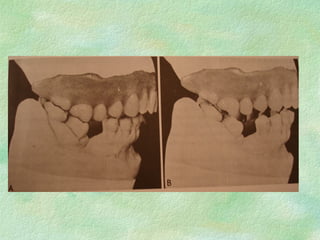
• The natural teeth may be over erupted or
tilted and there cusps may be high and
sharp.
• Denture will constantly be thrust or dragged
horizontally on the ridge.
15.
3. Support forthe denture base:
• Denture base should have the maximum
extension within the functional anatomic
limits
• Lower complete denture opposing upper
natural teeth should be normally avoided.
16.
4. Inter maxillaryrelations:
• When upper complete denture is being made to
occlude with lower natural teeth, an error may
be made in recording the vertical dimension
• The labio- lingual thickness of the wax rim, will
usually not allow the lower incisor to close
beyond the occlusal surface
• Increased vertical dimension may be recorded
17.
COMBINATIONS:
• Upper singlecomplete denture opposing complete set
of lower natural teeth.
• Lower single complete denture opposing complete set
of upper natural teeth.
• Single complete denture opposing natural teeth with
a removable partial denture.
• A single complete denture opposing natural teeth
with a fixed partial denture.
• A single complete denture opposing an already
existing complete denture
18.
Single complete denture(Maxillary) to
oppose natural mandibular teeth:
• More frequently encountered than the single
mandibular denture
• The occlusal forms of the natural teeth act as a
guide in selecting the occlusal form for the
maxillary posterior teeth
• However if the natural teeth are abraded
monoplane form may be the choice
20.
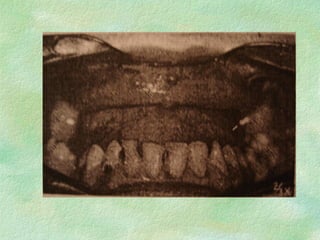
• The mandibulararch may present two
planes of occlusion,
• An anterior plane and
• A posterior plane
The posterior teeth have extruded and inter
ridge space would be less.
21.
• To preparethis mouth it requires extensive
restorative procedures in mandibular arch
and possibly surgery in the maxillary arch.
• To proceed with complete maxillary
denture procedures without first preparing
the environment into which the artificial
teeth will be placed is to invite trouble.
23.
Mandibular denture tooppose
natural maxillary teeth:
• It usually happens as a result of either surgical or
accidental trauma i.e. irradiation or accident or
gunshot.
• Three factors in particular must be carefully
evaluated.
Preservation of the residual alveolar ridge
Necessity for retaining maxillary teeth
Mental trauma
24.
Preservation of theresidual alveolar
ridge
• The force of jaw closure with natural teeth
is greater than that with complete denture
and greater the force the more the
pressure which a contributing factor to
bone resorption
25.
Necessity for retainingmaxillary
teeth:
• The maxillary dentition may be needed to retain
prosthesis.
• This situation is usually associated with
congenital defects such as cleft palate or stoma
resulting from surgical or accidental trauma.
26.
Mental trauma
• Amental state exists when the patient loses the
mandibular teeth, removal of the remaining
maxillary teeth may be more than he or she can
endure mentally.
• One circumstance in which a lower complete
denture opposing upper natural teeth is acceptable
is for the patient with a class III jaw relationship.
27.
Complete maxillary dentureto oppose a
partially edentulous mandibular arch with
fixed or removable prosthesis :
• First it must be determined if the fixed restorations
are acceptable if they can be made acceptable or if
they must be rejected.
• When the restorations are acceptable one must
then decide what occlusal concept will be pursued
• Teeth in single complete denture are on a movable
base and even though they function against natural
teeth they will function as a unit.
28.
When there isa removable partial denture, it
must be evaluated critically.
• The occlusal plane
• Tooth arrangement for occlusion
• Esthetics and material composition of the
teeth
Treatment plan is or should be formulated for
both arches at the same time
29.
Single complete dentureto oppose
an existing complete denture:
• In this situation this following factors
must be considered.
Duration of existing denture
Was the denture an immediate insertion at
the time of teeth removal
These two factors are directly related to the
extent of bone resorption.
30.
Does the denturemeet the requirements of an
acceptable denture?
Condition of opposing arch in relation to the
existing denture.
A most serious consideration is the fact that the
dentist assumes the responsibility for both
dentures as soon as he accepts the patient for
treatment of the single complete denture.
31.
COMMON OCCLUSAL
DISHARMONIES
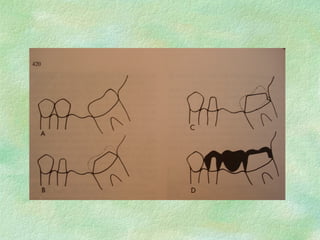
• Themost common occlusal adjustments involve the anterior
teeth and the last molar
• Frequently natural lower incisors and cuspids are very long and
there should be ground as much as is practicable
• If the molars are not severely lilted they may be reshaped by
selective grinding
34.
Methods used toachieve
harmonious balanced occlusion:
Many techniques have been described but
all of them basically fall into two
categories.
Functional chew in techniques:
Articulator equilibration technique:
35.
Functional chew intechniques:
• Stransbury described the first functional chew in
technique in 1928
• He suggested using a compound maxillary
occlusal rim trimmed buccally and lingually so
that the occlusion is free in lateral excursions.
• Carding wax is then added to the compound rim
and the patient is instructed to perform eccentric
chew movements.
36.
• The cardingwax as slowly molded to the
functional movements while the compound in the
central fossa act as a guide to preserve the vertical
dimension.
• The generate occlusal rim is now removed from
the mouth and stone is vibrated into the wax paths
of the cusps and without separating them both are
mounted on the articulator
• The denture teeth are set according to the lower
cast of the patients teeth
37.
• After theesthetics has been approved at the try-in,
the lower cast is removed and lower chew in
record is secured to the articulator
• All interfering spots are carefully ground until the
incisal guide pin prevents further closure.
• Thus in centric and eccentric movements
maximum bilateral balanced occlusion will have
been established.
38.
Articulator equilibration
technique:
• Ifthe denture bases lack stability or if the patient
is physically unable to perform a chew in record
the articulator equilibration method is preferred
• First the upper cast is mounted on the articulator
using a face bow with an orbital pointer
• The lower cast is related to the upper by a centric
inter occlusal record at an acceptable vertical
dimension.
39.
• If thedenture teeth apex to be placed too far to
buccal when articulated with the lower buccal
cusp, they are rest to oppose the lingual cusps.
• Once the holding cusps have been selected the
inclines of the remaining cusps are reduced and
vice-versa
• This allows for a cusp to fossa relationship
between the upper and lower teeth in centric .
41.
• At thetime of wax try in eccentric records are
made and the condylar inclinations are set on the
articulator
• The upper posterior teeth are arranged to be as
close to being balanced as is possible at this time.
42.
Types of teeth:
Themost important aspects are to transmit the
occlusal forces vertically.
• Non – anatomic teeth
• Anatomic teeth
43.
Non – anatomicteeth
• If the cusps of the natural teeth have been reduced
either naturally or artificially to such a degree that
their occlusal surface are fairly flat, then non
anatomic teeth maybe used on the denture.
• These teeth have flat occlusal surfaces with
fissures and spillways carved into them which
help to provide an effective masticating surface.
44.
Anatomic teeth:
• Ifthe cuspal form of the lower teeth has been
retained anatomic teeth can be used
• These should be arranged with a cusp to fossa
relation.
• A small space distal to the cuspid looks quite
natural in an upper denture, spaces between the
posterior teeth provide extra channel for the
escape of food from the occlusal surfaces
45.
Artificial tooth materials
•The materials available for occlusal
posterior tooth forms are
Porcelain
Acrylic teeth
Gold
Acrylic resin with amalgam stop
IPN
46.
• Porcelain teethwear slowly therefore the
occlusal vertical dimension is maintained
however they are predisposed to fracture and
chipping when opposed by natural teeth and are
more difficult to equilibrate.
• Also they cause rapid wear of opposing natural
teeth.
Porcelain teeth:
47.
Acrylic resin teeth
•Since acrylic resin teeth cause no wear of the
opposing natural teeth they are the easiest to
equilibrate
• They are the teeth of choice.
• The major disadvantage of resin teeth is there
wear, which result in loss of vertical dimension
48.
Gold occlusal:
• Thebest material for an artificial occlusion
opposing the natural teeth is gold
• A technique described by Wallace in 1964
• The occlusal surfaces of the posterior acrylic
denture teeth are then reduced by about 1mm and
a central channel is cut posteriorly along them
• The wax patterns are cast in gold and cemented
with self cure acrylic resin.
50.
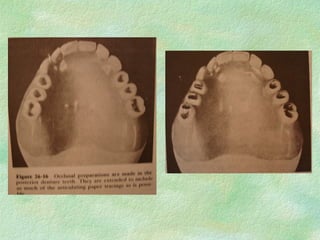
Acrylic resin withamalgam stops:
• This method is established by Frank R. Lauciello.
• After the acrylic teeth have been balanced,
occlusal preparation are made in the acrylic teeth,
extending it include as much of the articulating
paper tracing as is possible.
• Amalgam is condensed into the preparation and
the articulator is gently closed, going side to side
and back and forth until the incisal guide pin is
again flush with the guide table.
51.
• This materialconsist of an unfilled,
highly cross linked inter penetrating
polymer network.
• A three year clinical study by ogle and his
colleagues, has determined the wear of new
material to be significantly less when
compared to acrylic resin teeth.
Inter penetrating polymer net work
(IPN)
52.
Changes caused bymandibular removable
partial denture apposing maxillary
complete denture:
• Another problem is combination syndrome.
• The syndrome is characterized by
Maxillary anterior ridge resorption
Palatal papillary hyperplasia
Enlargement of maxillary tuberosities
Supra eruption of lower anterior teeth
Resorption of mandibular posterior ridge
53.
CONCLUSION:
The problems involvedin providing comport,
function, proper esthetics and retention is a
vigorous challenge for practicing dentist. The
damage to the edentulous ridge and inability to
wear the denture may be avoided by good
prosthetic treatment which includes adequate
denture base, correct jaw relation record and
proper occlusion.
54.
REFERENCES :
• Prosthodontictreatment for edentulous patients - Boucher
• Essentials of complete denture Prosthodontics – 2nd edn.
Sheldon Winkler
• Syllabus of complete denture – Heartwell
• Complete denture Prosthodontics – Sharry
• Changes caused by a mandibular RPD opposing a
maxillary C.D. – Ellsworth Kelly J. Prosthet. D. 27; 140-
150: 1972.
• Single complete denture – Charles W. Ellinger J.
Prosthetic. D. 26 ; 4-10 : 1971.
55.
• CD’s opposingnatural teeth - Robert W. Bruce JPD 26;
448 –55: 1971.
• Occlusion and single denture – Kenneth D. Rudd JPD 30;
4-10: 1973.
• The maxillary CD opposing natural teeth: the problems
and some solutions – Alex Koper JPD 57; 704 –07: 1987.
• The maxillary CD opposing mandibular bilateral distal
extension partial denture – Sounder RT JVD 41(2); 124-
28: 1979.
• Diagnosing functional CD fractures – Schineder L. Robert
54; 804-14: 1985.























![SINGLE COMPLETE DENTURES sam [Autosaved] (1).pptx](https://cdn.slidesharecdn.com/ss_thumbnails/singlecompletedenturessamautosaved1-250109094738-6d16d65c-thumbnail.jpg?width=640&height=640&fit=bounds)


