Under the supervision of Sir Dr.Gaurav singh.
By Abhishek singh (bds final year student ,dr.zadc amu)
 Definition: A single complete denture is a complete denture that
occludes against-
 some or all of the natural teeth,
 a fixed restoration, or
 a previously constructed removable partial denture or
 a complete denture.
 The mandibular canines are retained four time longer than other teeth.
 After this longest lasting teeth are mandibular incisors.
 So maxillary single complete denture opposing lower natural teeth is a
more frequent occurrence
Edentulous arch: This is evaluated similar to any complete edentulous
situation.
Dentulous arch: The teeth are evaluated for the following:
• Number of teeth present.
• Position and condition of teeth to assess, endodontic, restorative and
periodontal condition.
 Treating the natural teeth.
 The occlusal plane is assessed and corrected.
Indications
• Malposed teeth
• Severely tipped teeth
• Supraerupted teeth
• Irregular occlusal plane
• Less space for teeth
Swenson’s technique
• Maxillary and mandibular casts are mounted at an acceptable VD
with a CR record.
• The teeth are arranged and the occlusal discrepancies are corrected
and marked with pencil on the diagnostic cast.
• With this as a guide, the natural teeth are modified.
• The stone cast is modified to a
more acceptable occlusal relationship
and the modifications are marked
with a pencil.
• Necessary alterations are done on
the natural teeth using this as a
guide.
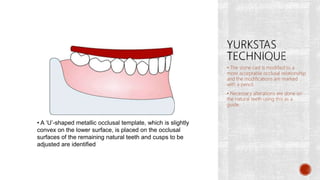
• A ‘U’-shaped metallic occlusal template, which is slightly
convex on the lower surface, is placed on the occlusal
surfaces of the remaining natural teeth and cusps to be
adjusted are identified
Stone model with occlusal discrepancies
Reduction of occlusal discrepancies in the cast.
Acrylic template made from altered stone model.
Try-in of template in patient mouth.
Reduction of natural teeth using template as a guide.
Occlusal plane correction – the maxillary porcelain teeth
will remove the interferences of the mandibular natural
teeth.
• For the edentulous arch- same as complete denture impression making.
• For the dentulous arch, impressions are made with irreversible
hydrocolloid, following occlusal plane correction.
• Jaw relations are recorded using the techniques described for
complete dentures.
Advantages
• Maintains vertical dimension.
• Wears very slowly.
Disadvantages
• Fracture, wearing and chipping of
natural teeth.
• Difficult to equilibrate.
• Cannot be used when interocclusal
distance is less.
Advantages
 Does not wear opposing natural
teeth.
 Easy to equilibrate.
Disadvantages
 Loss of vertical dimension.
 Poor wear resistance.
Advantage
 Best to oppose natural teeth.
Disadvantage
 More time consuming and expensive.
• Has better wear resistance than
acrylic.
Acrylic resin teeth with amalgam stops.
 Consists of an unfilled highly cross-linked, interpenetrating polymer
network.
 Has good wear resistance.
Causes:
 Irradiation therapy
 Trauma
 Difficult to stabilize lower denture
 Mandible is the movable member
 Proximity to tongue
 More resorption than maxilla
 Limited availability of good quality mucosa
 Combination syndrome
 Wear of natural teeth
 Fracture of denture
An edentulous maxilla is opposed by natural mandibular
anterior teeth.
(1) Bone resorption in anterior maxilla.
(2) Papillary hyperplasia of hard palate.
(3)Enlarged maxillary tuberosities.
(4) Supraeruption of lower anteriors.
(5) Bone loss under distal extension prosthesis.
 Loss of vertical dimension.
 Occlusal plane discrepancy.
 Anterior spatial repositioning of the mandible.
 Loss of stability and refabrication of the existing dentures.
 Epulis fissuratum.
 Periodontal problems of the remaining teeth.
Systemic considerations
 diabetes and osteoporosis increase
the rate of resorption of the bone.
Dental considerations
 In case of class III jaw relationships,
there will be increased pressure in the
anterior maxilla.
 When lower anteriors are retained for
a long time, the patient is accustomed
to biting in the anterior region.
 Presence of parafunctional habits
increases bone resorption.
 Type of occlusal scheme also has
direct effect on the development of
the syndrome.
 Prevention of rapid resorption of the bone under the lower removable prosthesis by
increasing stability through extension up to retromolar pad.
 Prevention of excessive load in the anterior region by providing a stable occlusal
scheme.
 Posterior occlusion free of interfering contacts during centric and eccentric
movements.
 Minimum contact in the anterior region even in protrusive movement.
 Anterior teeth to be used only for phonetics and aesthetics.
 Education of the patient
 Retaining weaker posterior teeth by using combined endodontic and periodontal
techniques.
 Fabricating a fixed prosthesis in the lower posterior region using endosseous
implants.
 Planning for tooth-supported overdenture in the lower arch.
 Regular recall visits and checks with frequent relining to
compensate for the resorption especially in the lower distal extension prosthesis.
Single complete denture

Single complete denture

  • 1.
    Under the supervisionof Sir Dr.Gaurav singh. By Abhishek singh (bds final year student ,dr.zadc amu)
  • 2.
     Definition: Asingle complete denture is a complete denture that occludes against-  some or all of the natural teeth,  a fixed restoration, or  a previously constructed removable partial denture or  a complete denture.
  • 4.
     The mandibularcanines are retained four time longer than other teeth.  After this longest lasting teeth are mandibular incisors.  So maxillary single complete denture opposing lower natural teeth is a more frequent occurrence
  • 7.
    Edentulous arch: Thisis evaluated similar to any complete edentulous situation. Dentulous arch: The teeth are evaluated for the following: • Number of teeth present. • Position and condition of teeth to assess, endodontic, restorative and periodontal condition.
  • 8.
     Treating thenatural teeth.  The occlusal plane is assessed and corrected.
  • 9.
    Indications • Malposed teeth •Severely tipped teeth • Supraerupted teeth • Irregular occlusal plane • Less space for teeth
  • 10.
    Swenson’s technique • Maxillaryand mandibular casts are mounted at an acceptable VD with a CR record. • The teeth are arranged and the occlusal discrepancies are corrected and marked with pencil on the diagnostic cast. • With this as a guide, the natural teeth are modified.
  • 11.
    • The stonecast is modified to a more acceptable occlusal relationship and the modifications are marked with a pencil. • Necessary alterations are done on the natural teeth using this as a guide. • A ‘U’-shaped metallic occlusal template, which is slightly convex on the lower surface, is placed on the occlusal surfaces of the remaining natural teeth and cusps to be adjusted are identified
  • 12.
    Stone model withocclusal discrepancies
  • 13.
    Reduction of occlusaldiscrepancies in the cast.
  • 14.
    Acrylic template madefrom altered stone model.
  • 15.
    Try-in of templatein patient mouth.
  • 16.
    Reduction of naturalteeth using template as a guide.
  • 17.
    Occlusal plane correction– the maxillary porcelain teeth will remove the interferences of the mandibular natural teeth.
  • 18.
    • For theedentulous arch- same as complete denture impression making. • For the dentulous arch, impressions are made with irreversible hydrocolloid, following occlusal plane correction. • Jaw relations are recorded using the techniques described for complete dentures.
  • 20.
    Advantages • Maintains verticaldimension. • Wears very slowly. Disadvantages • Fracture, wearing and chipping of natural teeth. • Difficult to equilibrate. • Cannot be used when interocclusal distance is less.
  • 21.
    Advantages  Does notwear opposing natural teeth.  Easy to equilibrate. Disadvantages  Loss of vertical dimension.  Poor wear resistance.
  • 22.
    Advantage  Best tooppose natural teeth. Disadvantage  More time consuming and expensive.
  • 23.
    • Has betterwear resistance than acrylic. Acrylic resin teeth with amalgam stops.
  • 24.
     Consists ofan unfilled highly cross-linked, interpenetrating polymer network.  Has good wear resistance.
  • 25.
  • 26.
     Difficult tostabilize lower denture  Mandible is the movable member  Proximity to tongue  More resorption than maxilla  Limited availability of good quality mucosa
  • 27.
     Combination syndrome Wear of natural teeth  Fracture of denture
  • 28.
    An edentulous maxillais opposed by natural mandibular anterior teeth.
  • 31.
    (1) Bone resorptionin anterior maxilla. (2) Papillary hyperplasia of hard palate. (3)Enlarged maxillary tuberosities. (4) Supraeruption of lower anteriors. (5) Bone loss under distal extension prosthesis.
  • 32.
     Loss ofvertical dimension.  Occlusal plane discrepancy.  Anterior spatial repositioning of the mandible.  Loss of stability and refabrication of the existing dentures.  Epulis fissuratum.  Periodontal problems of the remaining teeth.
  • 33.
    Systemic considerations  diabetesand osteoporosis increase the rate of resorption of the bone. Dental considerations  In case of class III jaw relationships, there will be increased pressure in the anterior maxilla.  When lower anteriors are retained for a long time, the patient is accustomed to biting in the anterior region.  Presence of parafunctional habits increases bone resorption.  Type of occlusal scheme also has direct effect on the development of the syndrome.
  • 34.
     Prevention ofrapid resorption of the bone under the lower removable prosthesis by increasing stability through extension up to retromolar pad.  Prevention of excessive load in the anterior region by providing a stable occlusal scheme.  Posterior occlusion free of interfering contacts during centric and eccentric movements.  Minimum contact in the anterior region even in protrusive movement.  Anterior teeth to be used only for phonetics and aesthetics.  Education of the patient
  • 35.
     Retaining weakerposterior teeth by using combined endodontic and periodontal techniques.  Fabricating a fixed prosthesis in the lower posterior region using endosseous implants.  Planning for tooth-supported overdenture in the lower arch.  Regular recall visits and checks with frequent relining to compensate for the resorption especially in the lower distal extension prosthesis.