REFERENCE FRAME THEORY
• Introduction
• Reference frames
1. Abc frame
2. αβ frame
3. Dq frame
• Transformations
• Advantages of transformation
• Clarke and inverse clarke
transformations
• Park and inverse park
transformations
• Abc to dq transformation
Introduction
Reference frame theory is a
mathematical framework used to analyze
and control the behavior of a permanent
magnet synchronous motor (PMSM). It
provides a convenient way to transform the
motor's three-phase variables into two
orthogonal axes, simplifying the analysis
and control of the motor. The reference
frame is a coordinate system used to
represent the electrical variables of the
motor.
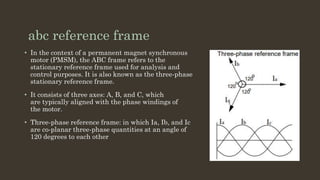
abc reference frame
• In the context of a permanent magnet synchronous
motor (PMSM), the ABC frame refers to the
stationary reference frame used for analysis and
control purposes. It is also known as the three-phase
stationary reference frame.
• It consists of three axes: A, B, and C, which
are typically aligned with the phase windings of
the motor.
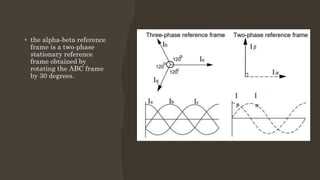
• Three-phase reference frame: in which Ia, Ib, and Ic
are co-planar three-phase quantities at an angle of
120 degrees to each other
α-β-0
reference
frame
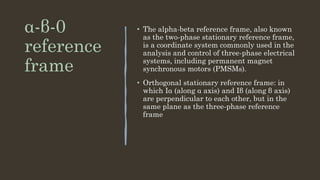
• The alpha-beta reference frame, also known
as the two-phase stationary reference frame,
is a coordinate system commonly used in the
analysis and control of three-phase electrical
systems, including permanent magnet
synchronous motors (PMSMs).
• Orthogonal stationary reference frame: in
which Iα (along α axis) and Iβ (along β axis)
are perpendicular to each other, but in the
same plane as the three-phase reference
frame
• the alpha-beta reference
frame is a two-phase
stationary reference
frame obtained by
rotating the ABC frame
by 30 degrees.
d-q reference frame
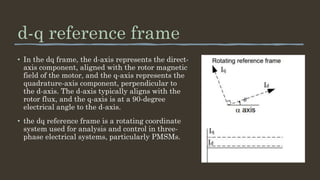
• In the dq frame, the d-axis represents the direct-
axis component, aligned with the rotor magnetic
field of the motor, and the q-axis represents the
quadrature-axis component, perpendicular to
the d-axis. The d-axis typically aligns with the
rotor flux, and the q-axis is at a 90-degree
electrical angle to the d-axis.
• the dq reference frame is a rotating coordinate
system used for analysis and control in three-
phase electrical systems, particularly PMSMs.
• The combined
representation of the
quantities in all
reference frames is
shown in Figure
Transformation
• The process of replacing one set of variables by another related set of variables is
called transformation.
• In the study of power systems and electric machine analysis,
mathematical transformations are often used to decouple variables, to facilitate the
solution of difficult equations with time-varying coefficients or to refer all variables to
a common reference frame.
• There are mainly two types of transformation.
1. Clarke transformation
2. Park transformation
Advantages of reference frame
transformation
• By transforming variables into these reference frames, engineer
can decouple the stator and rotor dynamics and analyze and control the
electric machine efficiently.
• The number of voltage equations are reduced
and time varying voltage equations become time invariant ones.
• It enables the application of techniques such as field-oriented control(FOC) where
machine variables are controlled along the d-q axes, allowing independent
of control of torque and flux.
Clarke transformation
• The Clarke Transformation converts the time-domain components of a three-phase system in an
abc reference frame to components in a stationary ɑβ0 reference frame..
• This can preserve the active and reactive powers of the system in the abc frame.
• In order for the transformation to be invertible, a third variable, known as the zero-
sequence component, is added.
• The resulting transformation equation is given by
[ fαβ0 ] = T αβ0 [ fabc ]
Where f represents voltage, current, flux linkage or electric charge
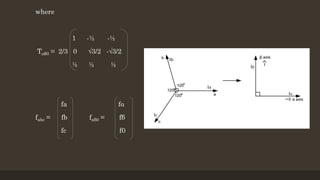
where
1 -½ -½
Tαβ0 = 2/3 0 √3/2 -√3/2
½ ½ ½
fa fα
fabc = fb fαβ0 = fβ
fc f0
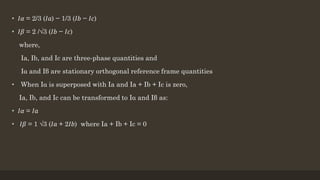
• 𝐼𝛼 = 2/3 (𝐼𝑎) − 1/3 (𝐼𝑏 − 𝐼𝑐)
• 𝐼𝛽 = 2 /√3 (𝐼𝑏 − 𝐼𝑐)
where,
Ia, Ib, and Ic are three-phase quantities and
Iα and Iβ are stationary orthogonal reference frame quantities
• When Iα is superposed with Ia and Ia + Ib + Ic is zero,
Ia, Ib, and Ic can be transformed to Iα and Iβ as:
• 𝐼𝛼 = 𝐼𝑎
• 𝐼𝛽 = 1 √3 (𝐼𝑎 + 2𝐼𝑏) where Ia + Ib + Ic = 0
Inverse clarke transformation
• The transformation from a two-axis orthogonal stationary reference frame to a three-
phase stationary reference frame is accomplished using Inverse Clarke
transformation a. The Inverse Clarke transformation is expressed by the following
equations:
[ fabc ] = T αβ0
-1 [ fαβ0 ]
1 0 1
Where Tαβ0
-1 = -½ √3/2 1
-½ -√3/2 1
Park's transformation
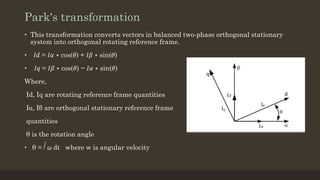
• This transformation converts vectors in balanced two-phase orthogonal stationary
system into orthogonal rotating reference frame.
• 𝐼𝑑 = 𝐼𝛼 ∗ cos(𝜃) + 𝐼𝛽 ∗ sin(𝜃)
• 𝐼𝑞 = 𝐼𝛽 ∗ cos(𝜃) − 𝐼𝛼 ∗ sin(𝜃)
Where,
Id, Iq are rotating reference frame quantities
Iα, Iβ are orthogonal stationary reference frame
quantities
θ is the rotation angle
• θ = ω dt where w is angular velocity
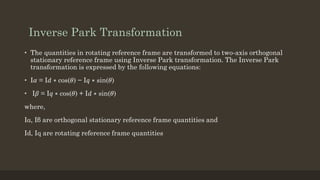
Inverse Park Transformation
• The quantities in rotating reference frame are transformed to two-axis orthogonal
stationary reference frame using Inverse Park transformation. The Inverse Park
transformation is expressed by the following equations:
• I𝛼 = I𝑑 ∗ cos(𝜃) − I𝑞 ∗ sin(𝜃)
• I𝛽 = I𝑞 ∗ cos(𝜃) + I𝑑 ∗ sin(𝜃)
where,
Iα, Iβ are orthogonal stationary reference frame quantities and
Id, Iq are rotating reference frame quantities
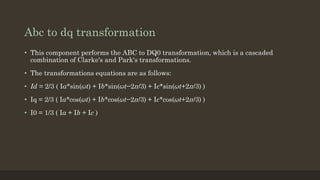
Abc to dq transformation
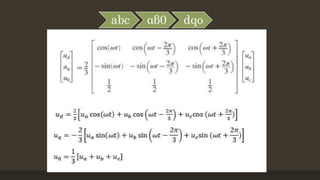
• This component performs the ABC to DQ0 transformation, which is a cascaded
combination of Clarke's and Park's transformations.
• The transformations equations are as follows:
• Id = 2/3 ( Ia*sin(ωt) + Ib*sin(ωt−2π/3) + Ic*sin(ωt+2π/3) )
• Iq = 2/3 ( Ia*cos(ωt) + Ib*cos(ωt−2π/3) + Ic*cos(ωt+2π/3) )
• I0 = 1/3 ( Ia + Ib + Ic )
abc αβ0 dqo
theory of reference frames and its types

theory of reference frames and its types

  • 1.
  • 2.
    • Introduction • Referenceframes 1. Abc frame 2. αβ frame 3. Dq frame • Transformations • Advantages of transformation • Clarke and inverse clarke transformations • Park and inverse park transformations • Abc to dq transformation
  • 3.
    Introduction Reference frame theoryis a mathematical framework used to analyze and control the behavior of a permanent magnet synchronous motor (PMSM). It provides a convenient way to transform the motor's three-phase variables into two orthogonal axes, simplifying the analysis and control of the motor. The reference frame is a coordinate system used to represent the electrical variables of the motor.
  • 4.
    abc reference frame •In the context of a permanent magnet synchronous motor (PMSM), the ABC frame refers to the stationary reference frame used for analysis and control purposes. It is also known as the three-phase stationary reference frame. • It consists of three axes: A, B, and C, which are typically aligned with the phase windings of the motor. • Three-phase reference frame: in which Ia, Ib, and Ic are co-planar three-phase quantities at an angle of 120 degrees to each other
  • 5.
    α-β-0 reference frame • The alpha-betareference frame, also known as the two-phase stationary reference frame, is a coordinate system commonly used in the analysis and control of three-phase electrical systems, including permanent magnet synchronous motors (PMSMs). • Orthogonal stationary reference frame: in which Iα (along α axis) and Iβ (along β axis) are perpendicular to each other, but in the same plane as the three-phase reference frame
  • 6.
    • the alpha-betareference frame is a two-phase stationary reference frame obtained by rotating the ABC frame by 30 degrees.
  • 7.
    d-q reference frame •In the dq frame, the d-axis represents the direct- axis component, aligned with the rotor magnetic field of the motor, and the q-axis represents the quadrature-axis component, perpendicular to the d-axis. The d-axis typically aligns with the rotor flux, and the q-axis is at a 90-degree electrical angle to the d-axis. • the dq reference frame is a rotating coordinate system used for analysis and control in three- phase electrical systems, particularly PMSMs.
  • 8.
    • The combined representationof the quantities in all reference frames is shown in Figure
  • 9.
    Transformation • The processof replacing one set of variables by another related set of variables is called transformation. • In the study of power systems and electric machine analysis, mathematical transformations are often used to decouple variables, to facilitate the solution of difficult equations with time-varying coefficients or to refer all variables to a common reference frame. • There are mainly two types of transformation. 1. Clarke transformation 2. Park transformation
  • 10.
    Advantages of referenceframe transformation • By transforming variables into these reference frames, engineer can decouple the stator and rotor dynamics and analyze and control the electric machine efficiently. • The number of voltage equations are reduced and time varying voltage equations become time invariant ones. • It enables the application of techniques such as field-oriented control(FOC) where machine variables are controlled along the d-q axes, allowing independent of control of torque and flux.
  • 11.
    Clarke transformation • TheClarke Transformation converts the time-domain components of a three-phase system in an abc reference frame to components in a stationary ɑβ0 reference frame.. • This can preserve the active and reactive powers of the system in the abc frame. • In order for the transformation to be invertible, a third variable, known as the zero- sequence component, is added. • The resulting transformation equation is given by [ fαβ0 ] = T αβ0 [ fabc ] Where f represents voltage, current, flux linkage or electric charge
  • 12.
    where 1 -½ -½ Tαβ0= 2/3 0 √3/2 -√3/2 ½ ½ ½ fa fα fabc = fb fαβ0 = fβ fc f0
  • 13.
    • 𝐼𝛼 =2/3 (𝐼𝑎) − 1/3 (𝐼𝑏 − 𝐼𝑐) • 𝐼𝛽 = 2 /√3 (𝐼𝑏 − 𝐼𝑐) where, Ia, Ib, and Ic are three-phase quantities and Iα and Iβ are stationary orthogonal reference frame quantities • When Iα is superposed with Ia and Ia + Ib + Ic is zero, Ia, Ib, and Ic can be transformed to Iα and Iβ as: • 𝐼𝛼 = 𝐼𝑎 • 𝐼𝛽 = 1 √3 (𝐼𝑎 + 2𝐼𝑏) where Ia + Ib + Ic = 0
  • 14.
    Inverse clarke transformation •The transformation from a two-axis orthogonal stationary reference frame to a three- phase stationary reference frame is accomplished using Inverse Clarke transformation a. The Inverse Clarke transformation is expressed by the following equations: [ fabc ] = T αβ0 -1 [ fαβ0 ] 1 0 1 Where Tαβ0 -1 = -½ √3/2 1 -½ -√3/2 1
  • 15.
    Park's transformation • Thistransformation converts vectors in balanced two-phase orthogonal stationary system into orthogonal rotating reference frame. • 𝐼𝑑 = 𝐼𝛼 ∗ cos(𝜃) + 𝐼𝛽 ∗ sin(𝜃) • 𝐼𝑞 = 𝐼𝛽 ∗ cos(𝜃) − 𝐼𝛼 ∗ sin(𝜃) Where, Id, Iq are rotating reference frame quantities Iα, Iβ are orthogonal stationary reference frame quantities θ is the rotation angle • θ = ω dt where w is angular velocity
  • 16.
    Inverse Park Transformation •The quantities in rotating reference frame are transformed to two-axis orthogonal stationary reference frame using Inverse Park transformation. The Inverse Park transformation is expressed by the following equations: • I𝛼 = I𝑑 ∗ cos(𝜃) − I𝑞 ∗ sin(𝜃) • I𝛽 = I𝑞 ∗ cos(𝜃) + I𝑑 ∗ sin(𝜃) where, Iα, Iβ are orthogonal stationary reference frame quantities and Id, Iq are rotating reference frame quantities
  • 17.
    Abc to dqtransformation • This component performs the ABC to DQ0 transformation, which is a cascaded combination of Clarke's and Park's transformations. • The transformations equations are as follows: • Id = 2/3 ( Ia*sin(ωt) + Ib*sin(ωt−2π/3) + Ic*sin(ωt+2π/3) ) • Iq = 2/3 ( Ia*cos(ωt) + Ib*cos(ωt−2π/3) + Ic*cos(ωt+2π/3) ) • I0 = 1/3 ( Ia + Ib + Ic )
  • 18.