CONTENTS
• INTRODUCTION
• ABSTRACT
• LITRATURE REVIEW
• COMPONENS
• EXISTING PROJECT
• PROPOSED PROJECT
• PROJECT VIDEO
• CONCLUSION
• FUTURE SCOPE
• REFERENCE
ABSTRACT
Solar panels, while a promising source of renewable energy, have inherent
limitations. Fixed solar panels can only capture optimal sunlight when the sun is
directly overhead, leaving significant energy potential untapped during other
times of the day. In this project by tracking the sun's movement throughout the
day, we aim to maximize energy generation and minimize waste, ultimately
contributing to a more sustainable and energy-efficient future
INTRODUCTION
Solar tracking is a fascinating technology that maximizes the efficiency of solar panels by orienting them
towards the sun throughout the day.
By using the power of sunlight more efficiently, we reduce our dependence on non-renewable energy sources
and mitigate environmental impact.
The key component of this project is the Light Dependent Resistor (LDR), which senses changes in light
intensity. Arduino, a versatile microcontroller, processes the LDR data and controls the movement of solar
panels accordingly.
S.NO TITLE AUTHOR PUBLISHED YEAR SUMMARY
1. Design of Phase
Compensation for
Solar Panel
Systems for
Tracking Sun
Ali H. Almukhta 2013 By incorporating
phase
compensation
techniques, I aim to
enhance the
efficiency of my
solar tracking
system, allowing it
to harness more
sunlight uding LDR
2. Two-Axis Solar
Tracker Analysis
and Control for
Maximum Power
Generation
S. Ozcelik, H.
Prakash, R. Challoo
2011 By adapting their
techniques and
incorporating LDR
sensors, the project
aim to enhance the
efficiency of solar
panels by precisely
LITRATURE REVIEW
LITRATURE REVIEW
S.NO TITLE AUTHOR PUBLISHED YEAR SUMMARY
3. Design and
Development of an
Automatic Solar
Tracker
Jerin Kuriakose
Tharamutta ,
Andrew Keong Ng
2017 This innovative
idea involves
creating a system
that automatically
adjusts solar panels
to follow the sun’s
path, optimizing
energy generation.
4. Single axis
automatic trackin
system based on
PILOT scheme to
control the solar
panel to optimize
solarenergy
extraction
Mostefa Ghassoul 2018 Tracking System
based on PILOT
scheme revolves
controlling
orientation of solar
panels. By adapting
this concept, I aim
to enhance the
efficiency of my
COMPONENTS
The four main components used in solar tracking system using LDR are ..
 SOLAR PANEL
 ARDUINO UNO - ATmega328P
 LDR (Light Dependent Sensor)
 SERVO MOTOR
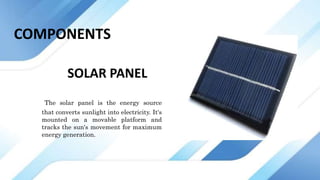
SOLAR PANEL
The solar panel is the energy source
that converts sunlight into electricity. It's
mounted on a movable platform and
tracks the sun's movement for maximum
energy generation.
COMPONENTS
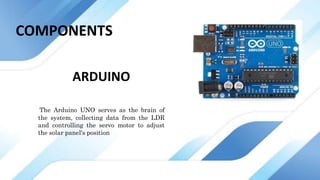
ARDUINO
The Arduino UNO serves as the brain of
the system, collecting data from the LDR
and controlling the servo motor to adjust
the solar panel's position
COMPONENTS
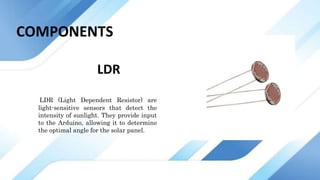
LDR
LDR (Light Dependent Resistor) are
light-sensitive sensors that detect the
intensity of sunlight. They provide input
to the Arduino, allowing it to determine
the optimal angle for the solar panel.
COMPONENTS
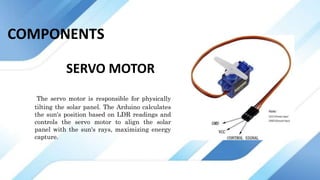
SERVO MOTOR
The servo motor is responsible for physically
tilting the solar panel. The Arduino calculates
the sun's position based on LDR readings and
controls the servo motor to align the solar
panel with the sun's rays, maximizing energy
capture.
COMPONENTS
EXISTING PROJECT
The existing project involves a solar tracking panel system built
using Arduino, LDR (Light Dependent Resistor), and RTC (Real-
Time Clock) modules. This setup allows the solar panel to follow the
sun's movement, optimizing energy capture throughout the day. The
LDR senses light intensity, while the RTC module maintains
accurate time, enabling precise solar tracking.
PROPOSED PROJECT
Here this project had made significant changes by replacing the RTC. Now, the
system operates exclusively between 9 am and 4 pm, aligning the solar panel
with the sun's position during this time frame. This modification eliminates
the need for real-time clock synchronization and simplifies the control logic
and reducing system complexity.
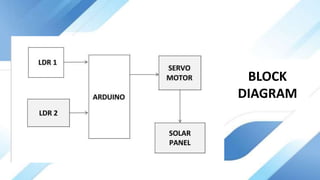
BLOCK
DIAGRAM
CONCLUSION
The project aimed to develop a solar tracker system using LDR to
optimize solar panel orientation, reducing the need for complicated
mechanisms present in existing solar trackers.
Unlike traditional solar trackers that rely on motorized mechanisms,
our system utilized LDRs to detect light intensity changes.
This reduced mechanical complexity and potential points of failure,
leading to a more reliable and cost-effective solution.
The LDR-based tracking system consistently adjusted the solar
panel’s angle to maximize sunlight exposure, leading to improved
energy efficiency.
CONCLUSION
We incorporated an RTC to schedule tracking based on predefined time periods,
reducing the need for continuous monitoring.
This feature is an improvement over manual or fixed tracking systems.
By minimizing mechanical components and utilizing inexpensive sensors, our
project provided a cost-effective alternative to traditional solar trackers.
The system’s ability to adapt to changing light conditions led to significant
energy savings and increased the overall energy yield of the solar panel.
By maximizing energy production, the project contributes to reducing the carbon
footprint, making it an environmentally friendly solution
FUTURE SCOPE
Some of the future Scopes for Solar Tracker Using LDR are
Developing a Incorporate real-time weather data for optimal tracking on
sunny days. Develop a system to adjust for increased cloud cover. Use AI to
adapt tracking based on historical data. Implement sensors for self-cleaning or
maintenance alerts. Create a user-friendly app for control and monitoring.
Integrate with batteries for excess energy storage. Feed surplus energy back
into the grid. Use IOT for smart home integration. Provide detailed
performance reports. Consider precise vertical tracking. Allow scalability and
expansion.
Focus on eco-friendly design and materials.
These future directions will enhance solar tracker efficiency and
sustainability.
REFERENCE
1. Amine Riad , Mouna Ben Zohra , Abdelilah Alhamany , Mohamed
Mansouri Bio-sun tracker engineering self-driven by thermo-mechanical
actuator for photovoltaic solar systems.
2. F_abio Moacir Hoffmann, Rolf Fredi Molz, Jo~ao Victor Kothe, Elpidio
Oscar Benitez Nara*, Leonel Pablo Carvalho Tedesco Monthly profile
analysis based on a two-axis solar tracker proposal for photovoltaic
panels2017
3. Ali H. ALmukhtar, Design of Phase Compensation for Solar Panel Systems
for Tracking Sun2013
4. Design and Development of an Automatic Solar Tracker Jerin Kuriakose
Tharamuttam,Andrew Keong Ng 2017
5. S. Ozcelik, H. Prakash, R. Challoo Two-Axis Solar Tracker Analysis and
Control for Maximum Power Generation 2011

Solar Tracking System for renewable energy system

  • 1.
    CONTENTS • INTRODUCTION • ABSTRACT •LITRATURE REVIEW • COMPONENS • EXISTING PROJECT • PROPOSED PROJECT • PROJECT VIDEO • CONCLUSION • FUTURE SCOPE • REFERENCE
  • 2.
    ABSTRACT Solar panels, whilea promising source of renewable energy, have inherent limitations. Fixed solar panels can only capture optimal sunlight when the sun is directly overhead, leaving significant energy potential untapped during other times of the day. In this project by tracking the sun's movement throughout the day, we aim to maximize energy generation and minimize waste, ultimately contributing to a more sustainable and energy-efficient future
  • 3.
    INTRODUCTION Solar tracking isa fascinating technology that maximizes the efficiency of solar panels by orienting them towards the sun throughout the day. By using the power of sunlight more efficiently, we reduce our dependence on non-renewable energy sources and mitigate environmental impact. The key component of this project is the Light Dependent Resistor (LDR), which senses changes in light intensity. Arduino, a versatile microcontroller, processes the LDR data and controls the movement of solar panels accordingly.
  • 4.
    S.NO TITLE AUTHORPUBLISHED YEAR SUMMARY 1. Design of Phase Compensation for Solar Panel Systems for Tracking Sun Ali H. Almukhta 2013 By incorporating phase compensation techniques, I aim to enhance the efficiency of my solar tracking system, allowing it to harness more sunlight uding LDR 2. Two-Axis Solar Tracker Analysis and Control for Maximum Power Generation S. Ozcelik, H. Prakash, R. Challoo 2011 By adapting their techniques and incorporating LDR sensors, the project aim to enhance the efficiency of solar panels by precisely LITRATURE REVIEW
  • 5.
    LITRATURE REVIEW S.NO TITLEAUTHOR PUBLISHED YEAR SUMMARY 3. Design and Development of an Automatic Solar Tracker Jerin Kuriakose Tharamutta , Andrew Keong Ng 2017 This innovative idea involves creating a system that automatically adjusts solar panels to follow the sun’s path, optimizing energy generation. 4. Single axis automatic trackin system based on PILOT scheme to control the solar panel to optimize solarenergy extraction Mostefa Ghassoul 2018 Tracking System based on PILOT scheme revolves controlling orientation of solar panels. By adapting this concept, I aim to enhance the efficiency of my
  • 6.
    COMPONENTS The four maincomponents used in solar tracking system using LDR are ..  SOLAR PANEL  ARDUINO UNO - ATmega328P  LDR (Light Dependent Sensor)  SERVO MOTOR
  • 7.
    SOLAR PANEL The solarpanel is the energy source that converts sunlight into electricity. It's mounted on a movable platform and tracks the sun's movement for maximum energy generation. COMPONENTS
  • 8.
    ARDUINO The Arduino UNOserves as the brain of the system, collecting data from the LDR and controlling the servo motor to adjust the solar panel's position COMPONENTS
  • 9.
    LDR LDR (Light DependentResistor) are light-sensitive sensors that detect the intensity of sunlight. They provide input to the Arduino, allowing it to determine the optimal angle for the solar panel. COMPONENTS
  • 10.
    SERVO MOTOR The servomotor is responsible for physically tilting the solar panel. The Arduino calculates the sun's position based on LDR readings and controls the servo motor to align the solar panel with the sun's rays, maximizing energy capture. COMPONENTS
  • 11.
    EXISTING PROJECT The existingproject involves a solar tracking panel system built using Arduino, LDR (Light Dependent Resistor), and RTC (Real- Time Clock) modules. This setup allows the solar panel to follow the sun's movement, optimizing energy capture throughout the day. The LDR senses light intensity, while the RTC module maintains accurate time, enabling precise solar tracking.
  • 12.
    PROPOSED PROJECT Here thisproject had made significant changes by replacing the RTC. Now, the system operates exclusively between 9 am and 4 pm, aligning the solar panel with the sun's position during this time frame. This modification eliminates the need for real-time clock synchronization and simplifies the control logic and reducing system complexity.
  • 13.
  • 14.
    CONCLUSION The project aimedto develop a solar tracker system using LDR to optimize solar panel orientation, reducing the need for complicated mechanisms present in existing solar trackers. Unlike traditional solar trackers that rely on motorized mechanisms, our system utilized LDRs to detect light intensity changes. This reduced mechanical complexity and potential points of failure, leading to a more reliable and cost-effective solution. The LDR-based tracking system consistently adjusted the solar panel’s angle to maximize sunlight exposure, leading to improved energy efficiency.
  • 15.
    CONCLUSION We incorporated anRTC to schedule tracking based on predefined time periods, reducing the need for continuous monitoring. This feature is an improvement over manual or fixed tracking systems. By minimizing mechanical components and utilizing inexpensive sensors, our project provided a cost-effective alternative to traditional solar trackers. The system’s ability to adapt to changing light conditions led to significant energy savings and increased the overall energy yield of the solar panel. By maximizing energy production, the project contributes to reducing the carbon footprint, making it an environmentally friendly solution
  • 16.
    FUTURE SCOPE Some ofthe future Scopes for Solar Tracker Using LDR are Developing a Incorporate real-time weather data for optimal tracking on sunny days. Develop a system to adjust for increased cloud cover. Use AI to adapt tracking based on historical data. Implement sensors for self-cleaning or maintenance alerts. Create a user-friendly app for control and monitoring. Integrate with batteries for excess energy storage. Feed surplus energy back into the grid. Use IOT for smart home integration. Provide detailed performance reports. Consider precise vertical tracking. Allow scalability and expansion. Focus on eco-friendly design and materials. These future directions will enhance solar tracker efficiency and sustainability.
  • 17.
    REFERENCE 1. Amine Riad, Mouna Ben Zohra , Abdelilah Alhamany , Mohamed Mansouri Bio-sun tracker engineering self-driven by thermo-mechanical actuator for photovoltaic solar systems. 2. F_abio Moacir Hoffmann, Rolf Fredi Molz, Jo~ao Victor Kothe, Elpidio Oscar Benitez Nara*, Leonel Pablo Carvalho Tedesco Monthly profile analysis based on a two-axis solar tracker proposal for photovoltaic panels2017 3. Ali H. ALmukhtar, Design of Phase Compensation for Solar Panel Systems for Tracking Sun2013 4. Design and Development of an Automatic Solar Tracker Jerin Kuriakose Tharamuttam,Andrew Keong Ng 2017 5. S. Ozcelik, H. Prakash, R. Challoo Two-Axis Solar Tracker Analysis and Control for Maximum Power Generation 2011