SINGEING
BY
B. VENKATESH
ASST.PROFESSOR
DEPT. OF TEXTILE FASHION TECH
VFSTR UNIVERSITY
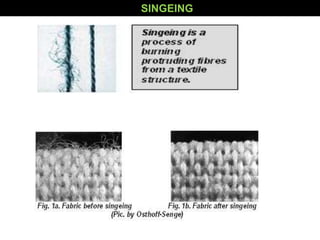
Technically, singeing refers to the burning-off of loose fibres not firmly bound into the
yarn and/or fabric structure.
Singeing is an important part of pretreatment.
 This is the burning off of protruding fiber ends from the surface of the fabric.
If not done properly, unclear print patterns, mottled fabric surfaces, and pilling results.
Textiles materials are most commonly singed in woven or knitted fabric form or in yarn
form.
INTRODUCTION
 Singeing of a fabric is done in order to obtain a clean fabric surface which
allows the structure of the fabric to be clearly seen.
Fabrics, which have been singed, soil less easily than un-singed fabrics.
The risk of pilling, especially with synthetics and their blends, is reduced in
case of singed fabrics.
Singed fabrics allow printing of fine intricate patterns with high clarity and
detail.
 Potruding fibres are removed in singeing which could cause diffused reflection
of light.
Objectives of Singeing:
To produce a smooth surface finish on fabrics made from staple fibers
 first the fabric surfaces are brushed lightly to raise the unwanted fiber
ends.
Then the fabric is singed with or passed over heated copper plates or open
gas flames. The fiber ends burn off.
 The fabric is moved very rapidly, and only the fiber ends are destroyed.
As soon as the fabric leaves the singeing area, it enters a water bath
or desizing bath.
This stops any singeing afterglow or sparks that might damage the cloth.
Singeing Process:
SINGEING
Singeing of textile materials is necessary for the following reasons:
1. Cotton materials are valued for their smooth appearance. After the
formation of fabric it has a fuzzy or hairy appearance due to
projecting fibers, thus affecting the luster and smoothness cotton is
known for.
2. Unsigned fabrics are soiled easily
3. The protruding fibers obstruct the subsequent dyeing and printing
process
4. Goods which are to be mercerized are signed to maximize the luster
5. In fabrics of polyester and cellulosic fiber blends singeing is the best
method to control pilling, sometimes double singeing is done to
minimize the pilling.
NECESSITY OF SINGEING IN TEXTILE
There are three main types of singeing machines:
1. Plate singeing machine,
2. Rotary-cylinder or Roller singeing machine
3. Gas singeing machine,
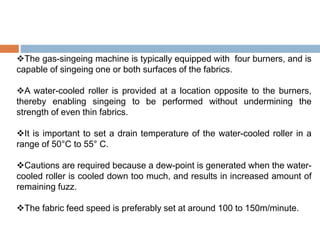
TYPES OF SINGEING MACHINES
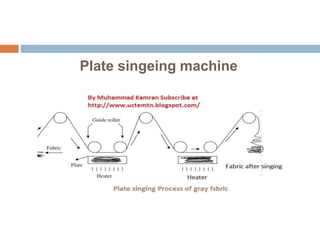
1.Plate Singeing:
 In this type of singeing machine, plates are heated to bright redness by a
suitable burning arrangement of gas mixed with air
 Then cloth passes over and in contact with these plates at a speed ranging
from 150 to 250 yards per minute.
 Thickness of these plates ranges from 1-2 inches.
 The passage of the cloth can be arranged in such a manner that one or
both sides of the fabric may pass over and in contact with the heated
plate(s)
 In order to avoid local cooling of a certain part of the plate(s) by constant
passage of cloth over it, an automatic traversing mechanism is fitted to the
machine.
 This mechanism brings the cloth into contact with a constantly changing
part of the plate(s), not only to avoid local cooling but also local wearing of
the plate(s)
Plate singeing machine
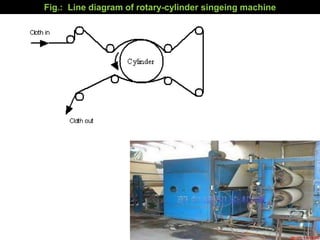
 In this type of singeing machine, the cloth passes over and in
contact with a heated rotary cylinder made of copper or cast
iron.
 The rotary cylinder has internal firing and revolves slowly so that
constantly a fresh surface of the roller comes in contact with the
cloth.
 The direction of rotation of the cylinder is opposite to the direction
of the fabric so that the protruding fibres or nap of the fabric is
raised.
 This type of machine is particularly suitable for the singeing of
velvets and other pile fabrics.
 If the singeing of both sides of the fabric is required, then
two cylinder are employed, one for each side of the fabric.
ROTARY-CYLINDER OR ROLLER
SINGEING
Fig.: Line diagram of rotary-cylinder singeing machine
RESULTS OF ROLLER SINGEING M/C :
Rotary-cylinder singeing results in removal of protruding fibers from the
fabric surface when it passes over, and in contact with a heated rotary
cylinder.
3. GAS SINGEING:
 In this type of singeing machine, the fabric passes over a
burning gas flame at higher speeds
 Only the protruding fibres burn and the main body of the
fabric is not damaged by the flame.
 This is the most common type of machine used for
singeing fabrics as well yarns.
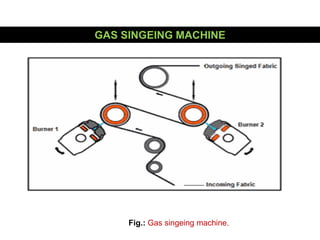
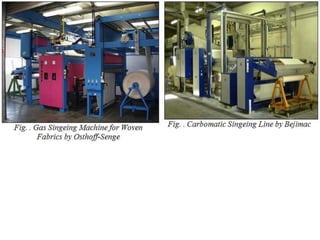
GAS SINGEING MACHINE
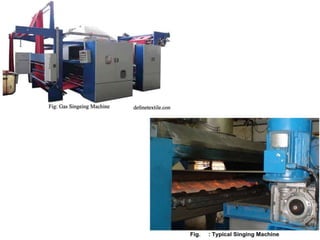
Fig.: Gas singeing machine.
The gas-singeing machine is typically equipped with four burners, and is
capable of singeing one or both surfaces of the fabrics.
A water-cooled roller is provided at a location opposite to the burners,
thereby enabling singeing to be performed without undermining the
strength of even thin fabrics.
It is important to set a drain temperature of the water-cooled roller in a
range of 50°C to 55° C.
Cautions are required because a dew-point is generated when the water-
cooled roller is cooled down too much, and results in increased amount of
remaining fuzz.
The fabric feed speed is preferably set at around 100 to 150m/minute.
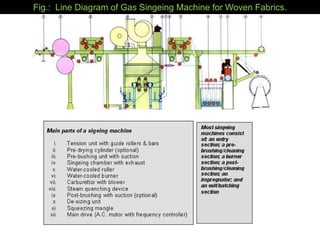
Fig.: Line Diagram of Gas Singeing Machine for Woven Fabrics.
1. Both sides singeing in this process.
2. It is a standard process and ideal singeing.
3. It is a continuous process.
4. Fabric becomes very suitable for subsequent process.
ADVANTAGE OF GAS SINGEING
1. Not suitable for synthetic fibre.
2. Dirty burner can produce spot on the fabric.
DISADVANTAGE OF GAS SINGEING
Following are the important gas singeing parameters:
1. Flame intensity,
2. Fabric speed,
3. Singeing position,
4. Distance between flame burner and fabric,
5. Flame Width.
IMPORTANT GAS SINGEING
PARAMETERS
1. Flame Intensity
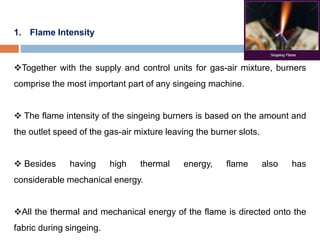
Together with the supply and control units for gas-air mixture, burners
comprise the most important part of any singeing machine.
 The flame intensity of the singeing burners is based on the amount and
the outlet speed of the gas-air mixture leaving the burner slots.
 Besides having high thermal energy, flame also has
considerable mechanical energy.
All the thermal and mechanical energy of the flame is directed onto the
fabric during singeing.
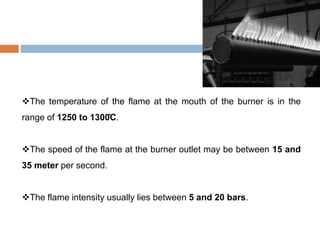
The temperature of the flame at the mouth of the burner is in the
range of 1250 to 1300̊C.
The speed of the flame at the burner outlet may be between 15 and
35 meter per second.
The flame intensity usually lies between 5 and 20 bars.
2. Fabric Speed
The fabric speed in the singeing machine is usually in
the range of 50-160 m/min depending on
 fabric (gram per square meter) weight and
 fibre blend.
For heavier fabrics, the speed is kept slower as
compared to lighter weight fabrics.
3. SINGEING POSITION
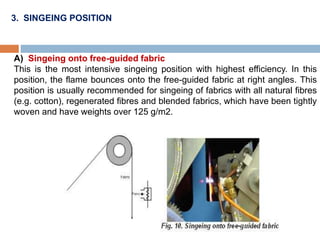
A) Singeing onto free-guided fabric
This is the most intensive singeing position with highest efficiency. In this
position, the flame bounces onto the free-guided fabric at right angles. This
position is usually recommended for singeing of fabrics with all natural fibres
(e.g. cotton), regenerated fibres and blended fabrics, which have been tightly
woven and have weights over 125 g/m2.
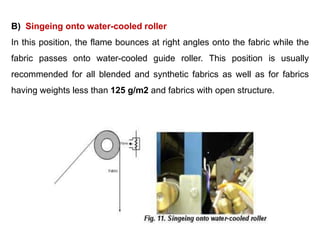
B) Singeing onto water-cooled roller
In this position, the flame bounces at right angles onto the fabric while the
fabric passes onto water-cooled guide roller. This position is usually
recommended for all blended and synthetic fabrics as well as for fabrics
having weights less than 125 g/m2 and fabrics with open structure.
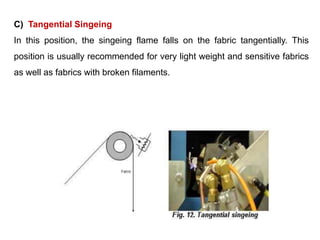
C) Tangential Singeing
In this position, the singeing flame falls on the fabric tangentially. This
position is usually recommended for very light weight and sensitive fabrics
as well as fabrics with broken filaments.
4. Distance between Flame Burner and Fabric
The distance between the burner and the fabric is usually in the range of 6-
8mm but it can be adjusted in a range from 6-20mm.
5. Flame Width
All good singeing machines come with a provision of flame width
adjustment according to the width of the fabric. This is essential to optimize
the gas economy.
Following are three essential conditions for good singeing:
1. A flame with high mechanical & thermal energy to quickly burn
thermoplastic protruding fibres (e.g. polyester) without any molten
beads formation.
2. A homogeneous flame with uniform mechanical & thermal energy to
result in uniform singeing
3. An optimal flame/fabric contact time to neither results in incomplete not
over-singeing.
ESSENTIAL CONDITIONS FOR GOOD GAS SINGEING
Common problems in GAS singeing and their causes
A. Incomplete Singeing
1. The most common causes of incomplete singeing are as follows:
2. Too low flame intensity
3. Too fast fabric speed
4. Too far distance between the fabric and the burner
5. Inappropriate (i.e. less severe) singeing position
6. Too much moisture in the fabric incoming for singeing.
If the fabric incoming for singeing has too much moisture in it, a significant
amount of thermal energy will be used up in evaporating the fabric moisture
rather than burning the protruding fibres, resulting in incomplete singeing.
B. Uneven Singeing Across the Fabric Width
The most common causes of widthways uneven singeing are as follows:
1. Non-uniform moisture content across the fabric width
2. Non-uniform flame intensity (uneven flame height) across the fabric
width
3. Uneven distance between the burner and the fabric
This may be due to misalignment or improper setting of the guide
rollers
4.Uneven smoke evacuation over the burners
C. Uneven Singeing Along the Fabric Length
1.The most common causes of lengthways uneven singeing are as follows:
2.Non-uniform moisture content along the fabric length
3.Non-uniform flame intensity along the fabric length
• Variation in gas-air mixture supply
• Increasing or decreasing thermal energy of the flames during
production
4.Change in fabric speed during singeing
5.Change in the distance between the fabric and the burner along the length
D. Horizontal Singeing Stripes
The most common causes of horizontal singeing stripes are as follows:
1.Rollers with an un-centred rolling action
2.Sudden fabric tension increase
E. Vertical Singeing Stripes
This may be caused by:
1.Total or partial blockage of flame outlet
Common problems in GAS singeing and their causes
F. Over-singing or Thermal Damage of the Fabric
The most common causes of over-singeing or thermal damage of the
fabric are as follows:
1. Too high flame intensity
2. Too slow fabric speed or too long contact time between fabric and
flame
3. Too close distance between the fabric and the burner or too deep
penetration of the singeing flame into the fabric
4. Inappropriate (i.e. too severe) singeing position
G. Formation of Small Beads of Molten Material
This may be cause by:
1.Insufficient energy supply, when the thermal energy is not supplied
quickly enough to be able to ignite the thermoplastic fibre rather than
melting it.
Common problems in GAS singeing and their causes
Some of the precautions to be taken in considerations during singeing:-
1. The fabric to be singed should be dry as wet fabric tend to scorch more
readily than dry.
2. Uneven singeing may cause streaks on fabric or bubbles when the
fabric is finished.
3. Improper singeing may lead to loss of 75 % loss in tensile strength loss
in warp direction.
4. The fabric should not contain any acid releasing salt, which may
release acid on heating and tender the fabric.
5. Stopping the machines may cause bars on the fabrics.
6. Singeing may cause hardening of the size thus leading to difficulty in
its removal.
7. Possibility of thermal damage to temperature sensitive fabrics.
8. The burning characteristics of fibers must be taken into account when
this process is applied, as heat-sensitive fibers melt, forming tiny balls
on the surface of the fabric. These balls interfere with dye absorption,
so that, as a general rule, heat sensitive fibers would be singed after
dyeing or printing.
PRECAUTION DURING SINGEING
TUBULAR FABRIC SINGEING
MACHINE
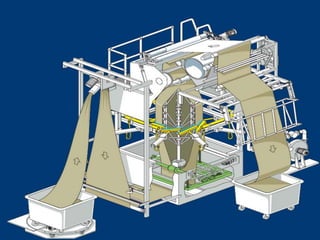
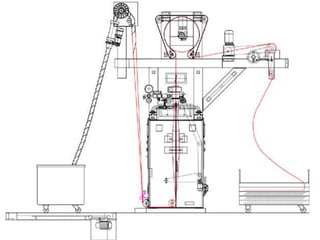
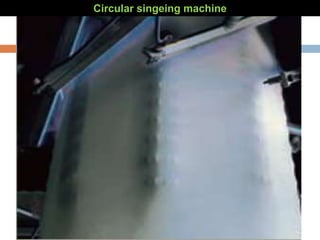
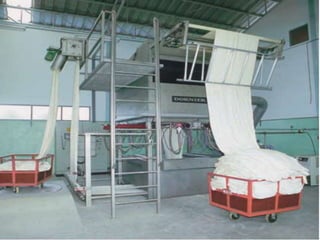
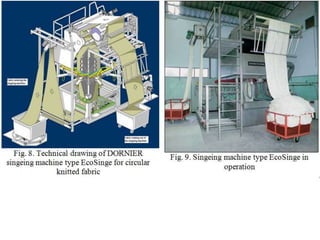
Circular singeing machine
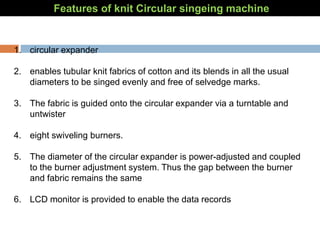
Features of knit Circular singeing machine
1. circular expander
2. enables tubular knit fabrics of cotton and its blends in all the usual
diameters to be singed evenly and free of selvedge marks.
3. The fabric is guided onto the circular expander via a turntable and
untwister
4. eight swiveling burners.
5. The diameter of the circular expander is power-adjusted and coupled
to the burner adjustment system. Thus the gap between the burner
and fabric remains the same
6. LCD monitor is provided to enable the data records
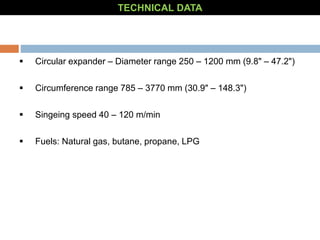
 Circular expander – Diameter range 250 – 1200 mm (9.8" – 47.2")
 Circumference range 785 – 3770 mm (30.9" – 148.3")
 Singeing speed 40 – 120 m/min
 Fuels: Natural gas, butane, propane, LPG
TECHNICAL DATA
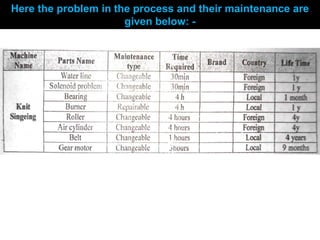
Here the problem in the process and their maintenance are
given below: -
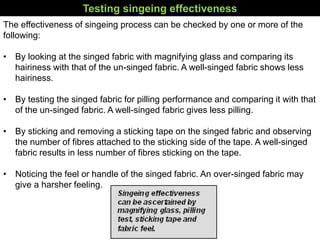
Testing singeing effectiveness
The effectiveness of singeing process can be checked by one or more of the
following:
• By looking at the singed fabric with magnifying glass and comparing its
hairiness with that of the un-singed fabric. A well-singed fabric shows less
hairiness.
• By testing the singed fabric for pilling performance and comparing it with that
of the un-singed fabric. A well-singed fabric gives less pilling.
• By sticking and removing a sticking tape on the singed fabric and observing
the number of fibres attached to the sticking side of the tape. A well-singed
fabric results in less number of fibres sticking on the tape.
• Noticing the feel or handle of the singed fabric. An over-singed fabric may
give a harsher feeling.
Yarn Singeing Machine
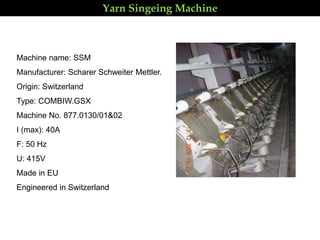
Machine name: SSM
Manufacturer: Scharer Schweiter Mettler.
Origin: Switzerland
Type: COMBIW.GSX
Machine No. 877.0130/01&02
I (max): 40A
F: 50 Hz
U: 415V
Made in EU
Engineered in Switzerland
Yarn Singeing Machine
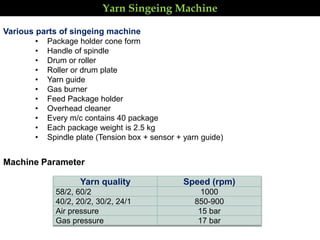
Various parts of singeing machine
• Package holder cone form
• Handle of spindle
• Drum or roller
• Roller or drum plate
• Yarn guide
• Gas burner
• Feed Package holder
• Overhead cleaner
• Every m/c contains 40 package
• Each package weight is 2.5 kg
• Spindle plate (Tension box + sensor + yarn guide)
Machine Parameter
Yarn quality Speed (rpm)
58/2, 60/2 1000
40/2, 20/2, 30/2, 24/1 850-900
Air pressure 15 bar
Gas pressure 17 bar
Yarn Singeing Machine
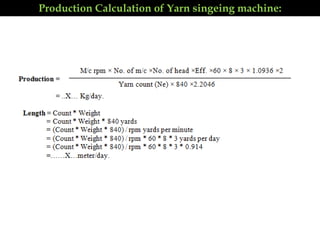
Production Calculation of Yarn singeing machine:
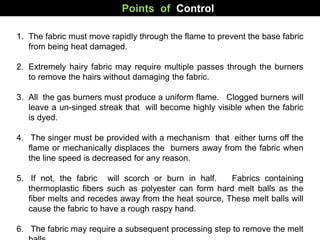
Points of Control
1. The fabric must move rapidly through the flame to prevent the base fabric
from being heat damaged.
2. Extremely hairy fabric may require multiple passes through the burners
to remove the hairs without damaging the fabric.
3. All the gas burners must produce a uniform flame. Clogged burners will
leave a un-singed streak that will become highly visible when the fabric
is dyed.
4. The singer must be provided with a mechanism that either turns off the
flame or mechanically displaces the burners away from the fabric when
the line speed is decreased for any reason.
5. If not, the fabric will scorch or burn in half. Fabrics containing
thermoplastic fibers such as polyester can form hard melt balls as the
fiber melts and recedes away from the heat source, These melt balls will
cause the fabric to have a rough raspy hand.
6. The fabric may require a subsequent processing step to remove the melt
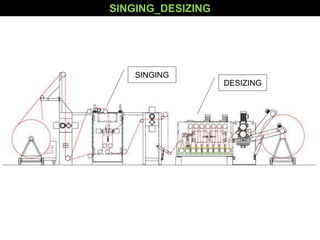
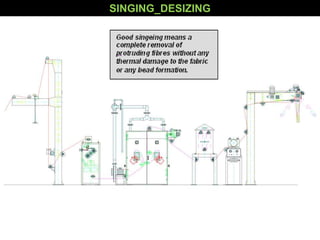
SINGING_DESIZING
SINGING
DESIZING
SINGING_DESIZING
THANK YOU