Andy Fawkes
8th SMi Annual Land Forces Simulation and Training Conference
London - 14 February 2017
Simulation
Are We There Yet?
Presentation Themes
• Where do we want to be?
• Where have we come from?
• Get there faster?
Presentation Influences
Training Context
• Asymmetrical & Symmetrical Ops
• Joint/Coalition Operations
• New C4ISTAR and Network Capabilities
• Growing Cyber Threat
• More Remote and Autonomous Systems
• Pressure on Funding
• Technology not Waiting for the Military
• Recruit Expectations
SISO/US Army – ENGTAM Group
(Exploration of Next Generation Technology Applications to Modeling and Simulation)
• Gaming Technology
– The games-derivative simulation software is already used in many areas of training
and is extending into the image generator and mission rehearsal spaces.
• Virtual Reality
– VR may find its way into a number of new applications in the military training space
where immersion and physical space are significant or limiting factors.
• Augmented Reality.
– AR may become increasingly more prevalent in training as the technology becomes
more robust and most probably making its way into the operational space too.
• Cloud and Streaming
– Future simulation and other training and education services may be streamed across
the enterprise over a private secure cloud and network.
• Wearables/IoT
– In the military domain it will be possible to monitor and interact with all military people
and equipment with value in both training and operations.
• Big Data and Data Analytics
– The ability to monitor, record and learn from training data will be enhanced.
• Artificial Intelligence
– AI will impact on operations but also training through improved AI in simulations and
intelligent tutoring.
https://www.sisostds.org/StandardsActivities/StudyGroups/ENGTAMSG.aspx
US Army Synthetic Training Environment
(STE)
• IOC of 2023 and FOC 2029
• Building a single synthetic environment that can
handle virtual/gaming and constructive.
• Incorporate the US Army’s one-world terrain project
which maps the entire globe, both geographically
and socio-politically.
• Deliver training to the point of need.
• Create artificial intelligence to reduce the need for
human role players in exercises and offer intelligent
enemy forces.
• Intelligent tutors for computer-based training.
• Utilize big data for analytics and visualization.
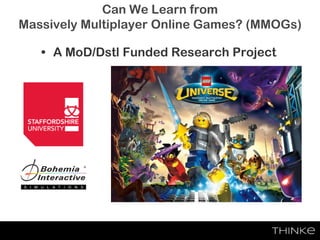
Can We Learn from
Massively Multiplayer Online Games? (MMOGs)
• A MoD/Dstl Funded Research Project
• Persistent interactive world that can
be accessed 24/7
• Millions of Concurrent Users
• Player data that tracks and rewards
performance
• In game communication and
interaction with other players
• Online Communities and Support
• Supports thin client approach
• Secure login
• Ranked/Unranked Worlds
Typical MMOG Characteristics
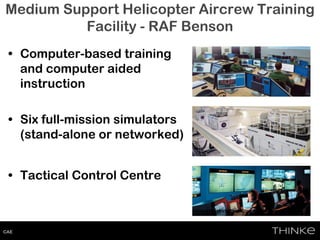
Medium Support Helicopter Aircrew Training
Facility - RAF Benson
• Computer-based training
and computer aided
instruction
• Six full-mission simulators
(stand-alone or networked)
• Tactical Control Centre
CAE
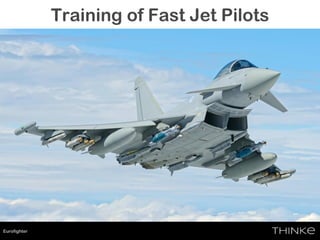
Training of Fast Jet Pilots
Wikimedia
Eurofighter
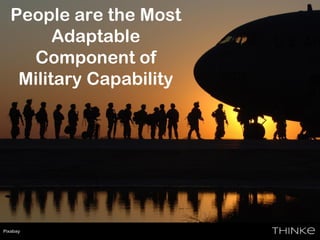
People are the Most
Adaptable
Component of
Military Capability
Pixabay
Where do we want to be?
The Destination?
A Training and Simulation Recipe
• Learning Focused - Analytics Drawing on Both Live and
Simulated Training
• Quantified Human
• Training at the Point of Need
• Range of Devices to Consume and Interact with Media
• Individual Collective Training Boundary Blurred
• Fewer but More Empowered Instructors
• Sharable and Discoverable Content
• Persistent Networked Training Environment Instantly
Scalable from Individual, through Team, Collective, Joint and
Coalition
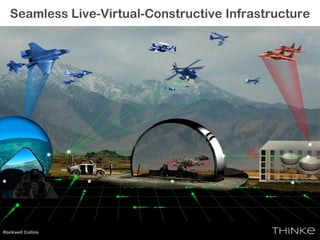
• Seamless Live-Virtual-Constructive Infrastructure
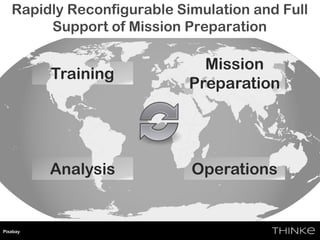
• Rapidly Reconfigurable and Full Support of Mission
Preparation
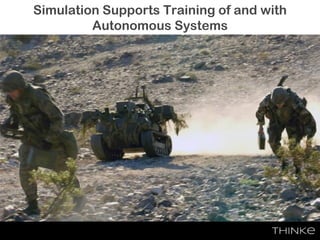
• Supports Training of and with Autonomous Systems
• Affordable
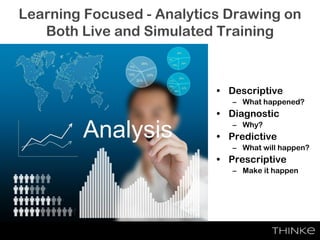
Learning Focused - Analytics Drawing on
Both Live and Simulated Training
• Descriptive
– What happened?
• Diagnostic
– Why?
• Predictive
– What will happen?
• Prescriptive
– Make it happen
Quantified Human
• Wearables for All
Training at the Point of Need
Time is Money and has an Opportunity Cost
Max Pixel
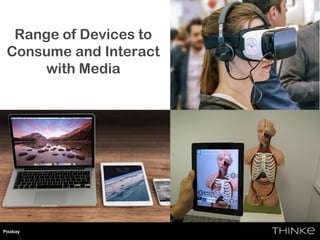
Range of Devices to
Consume and Interact
with Media
Pixabay
Individual Collective Training Boundary Blurred
Pixabay
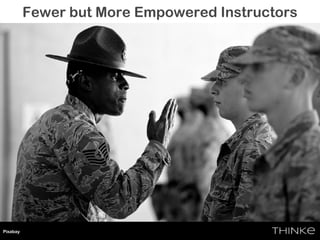
Fewer but More Empowered Instructors
• Instructor Driven but Minimise Need for
Human
Pixabay
Sharable and Discoverable Content
• Sharable Content
Pixabay
Persistent Networked Training Environment
Instantly Scalable from Individual, through Team,
Collective, Joint and Coalition
• Effortlessly Scalable from Individual, through
Team, Collective, Joint and Coalition
Pixabay
Seamless Live-Virtual-Constructive Infrastructure
• LVC
Rockwell Collins
Rapidly Reconfigurable Simulation and Full
Support of Mission Preparation
Mission
Preparation
Pixabay
Analysis
Training
Operations
Simulation Supports Training of and with
Autonomous Systems
• Supports Training of and with Autonomous
Systems
Affordable
• Affordable
Pixabay
A Little History
Where Have We Come From?
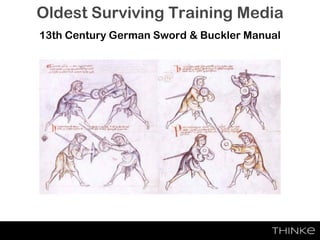
Oldest Surviving Training Media
13th Century German Sword & Buckler Manual
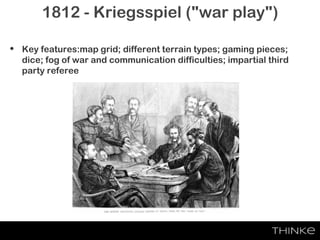
1812 - Kriegsspiel ("war play")
• Key features:map grid; different terrain types; gaming pieces;
dice; fog of war and communication difficulties; impartial third
party referee
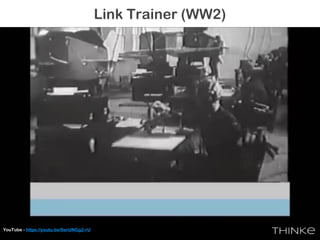
Link Trainer (WW2)
YouTube - https://youtu.be/SerUNGg2-rU
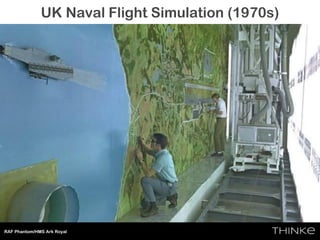
UK Naval Flight Simulation (1970s)
RAF Phantom/HMS Ark Royal
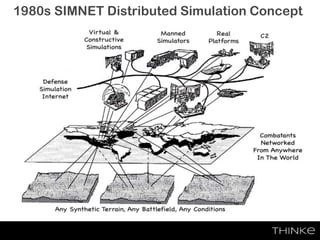
1980s SIMNET Distributed Simulation Concept
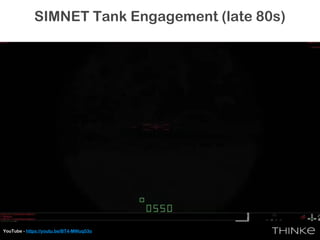
SIMNET Tank Engagement (late 80s)
YouTube - https://youtu.be/BT4-MWuq53o
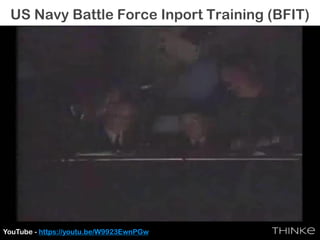
US Navy Battle Force Inport Training (BFIT)
YouTube - https://youtu.be/W9923EwnPGw
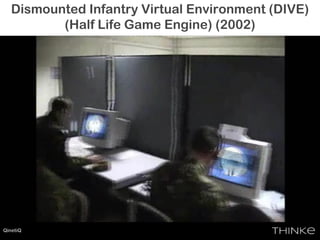
Dismounted Infantry Virtual Environment (DIVE)
(Half Life Game Engine) (2002)
QinetiQ
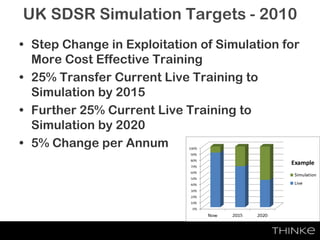
UK SDSR Simulation Targets - 2010
• Step Change in Exploitation of Simulation for
More Cost Effective Training
• 25% Transfer Current Live Training to
Simulation by 2015
• Further 25% Current Live Training to
Simulation by 2020
• 5% Change per Annum
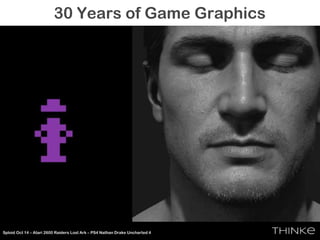
30 Years of Game Graphics
Sploid Oct 14 – Atari 2600 Raiders Lost Ark – PS4 Nathan Drake Uncharted 4
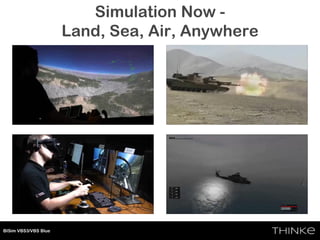
Simulation Now -
Land, Sea, Air, Anywhere
BISim VBS3/VBS Blue
Get There Faster?
Glass Half Full?
or
Glass Half Empty?
Wikimedia
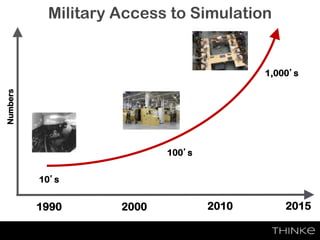
Military Access to Simulation
1990 2000
Numbers
10’s
100’s
1,000’s
2010 2015
Human Factors and
Training often the
Last Among Equals
in Defence Procurement
Wikimedia
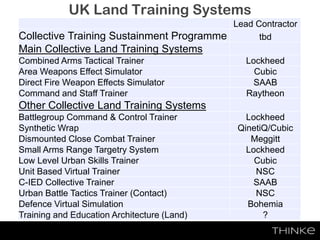
UK Land Training Systems
Lead Contractor
Collective Training Sustainment Programme tbd
Main Collective Land Training Systems
Combined Arms Tactical Trainer Lockheed
Area Weapons Effect Simulator Cubic
Direct Fire Weapon Effects Simulator SAAB
Command and Staff Trainer Raytheon
Other Collective Land Training Systems
Battlegroup Command & Control Trainer Lockheed
Synthetic Wrap QinetiQ/Cubic
Dismounted Close Combat Trainer Meggitt
Small Arms Range Targetry System Lockheed
Low Level Urban Skills Trainer Cubic
Unit Based Virtual Trainer NSC
C-IED Collective Trainer SAAB
Urban Battle Tactics Trainer (Contact) NSC
Defence Virtual Simulation Bohemia
Training and Education Architecture (Land) ?
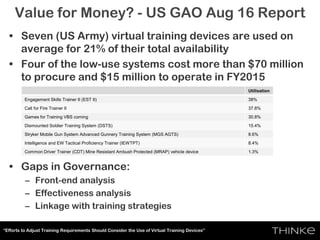
Value for Money? - US GAO Aug 16 Report
• Seven (US Army) virtual training devices are used on
average for 21% of their total availability
• Four of the low-use systems cost more than $70 million
to procure and $15 million to operate in FY2015
• Gaps in Governance:
– Front-end analysis
– Effectiveness analysis
– Linkage with training strategies
“Efforts to Adjust Training Requirements Should Consider the Use of Virtual Training Devices”
Utilisation
Engagement Skills Trainer II (EST II) 38%
Call for Fire Trainer II 37.8%
Games for Training VBS coming 30.8%
Dismounted Soldier Training System (DSTS) 15.4%
Stryker Mobile Gun System Advanced Gunnery Training System (MGS AGTS) 8.6%
Intelligence and EW Tactical Proficiency Trainer (IEWTPT) 8.4%
Common Driver Trainer (CDT) Mine Resistant Ambush Protected (MRAP) vehicle device 1.3%
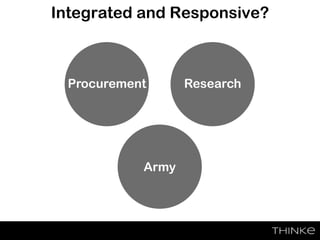
Integrated and Responsive?
Army
Procurement Research
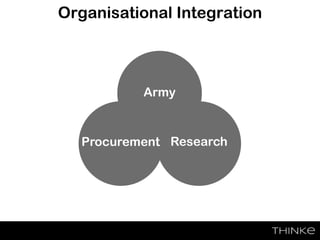
Organisational Integration
Army
Procurement Research
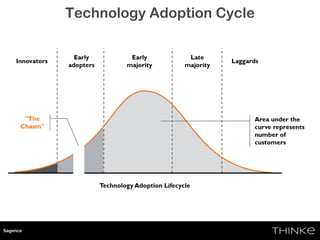
Technology Adoption Cycle
Sagence
Beyond the Hype –
Exploiting Technology
• Minimise the need for behavioural change
for the military customer
• Demonstrate and prove quantitatively the
technology’s cost effectiveness
• Marketing aimed at a pragmatic customer
not a technology enthusiast or laggard
Questions?

Simulation - Are We There Yet?

  • 1.
    Andy Fawkes 8th SMiAnnual Land Forces Simulation and Training Conference London - 14 February 2017 Simulation Are We There Yet?
  • 2.
    Presentation Themes • Wheredo we want to be? • Where have we come from? • Get there faster?
  • 3.
  • 4.
    Training Context • Asymmetrical& Symmetrical Ops • Joint/Coalition Operations • New C4ISTAR and Network Capabilities • Growing Cyber Threat • More Remote and Autonomous Systems • Pressure on Funding • Technology not Waiting for the Military • Recruit Expectations
  • 5.
    SISO/US Army –ENGTAM Group (Exploration of Next Generation Technology Applications to Modeling and Simulation) • Gaming Technology – The games-derivative simulation software is already used in many areas of training and is extending into the image generator and mission rehearsal spaces. • Virtual Reality – VR may find its way into a number of new applications in the military training space where immersion and physical space are significant or limiting factors. • Augmented Reality. – AR may become increasingly more prevalent in training as the technology becomes more robust and most probably making its way into the operational space too. • Cloud and Streaming – Future simulation and other training and education services may be streamed across the enterprise over a private secure cloud and network. • Wearables/IoT – In the military domain it will be possible to monitor and interact with all military people and equipment with value in both training and operations. • Big Data and Data Analytics – The ability to monitor, record and learn from training data will be enhanced. • Artificial Intelligence – AI will impact on operations but also training through improved AI in simulations and intelligent tutoring. https://www.sisostds.org/StandardsActivities/StudyGroups/ENGTAMSG.aspx
  • 6.
    US Army SyntheticTraining Environment (STE) • IOC of 2023 and FOC 2029 • Building a single synthetic environment that can handle virtual/gaming and constructive. • Incorporate the US Army’s one-world terrain project which maps the entire globe, both geographically and socio-politically. • Deliver training to the point of need. • Create artificial intelligence to reduce the need for human role players in exercises and offer intelligent enemy forces. • Intelligent tutors for computer-based training. • Utilize big data for analytics and visualization.
  • 7.
    Can We Learnfrom Massively Multiplayer Online Games? (MMOGs) • A MoD/Dstl Funded Research Project
  • 8.
    • Persistent interactiveworld that can be accessed 24/7 • Millions of Concurrent Users • Player data that tracks and rewards performance • In game communication and interaction with other players • Online Communities and Support • Supports thin client approach • Secure login • Ranked/Unranked Worlds Typical MMOG Characteristics
  • 9.
    Medium Support HelicopterAircrew Training Facility - RAF Benson • Computer-based training and computer aided instruction • Six full-mission simulators (stand-alone or networked) • Tactical Control Centre CAE
  • 10.
    Training of FastJet Pilots Wikimedia Eurofighter
  • 11.
    People are theMost Adaptable Component of Military Capability Pixabay
  • 12.
    Where do wewant to be?
  • 13.
  • 14.
    A Training andSimulation Recipe • Learning Focused - Analytics Drawing on Both Live and Simulated Training • Quantified Human • Training at the Point of Need • Range of Devices to Consume and Interact with Media • Individual Collective Training Boundary Blurred • Fewer but More Empowered Instructors • Sharable and Discoverable Content • Persistent Networked Training Environment Instantly Scalable from Individual, through Team, Collective, Joint and Coalition • Seamless Live-Virtual-Constructive Infrastructure • Rapidly Reconfigurable and Full Support of Mission Preparation • Supports Training of and with Autonomous Systems • Affordable
  • 15.
    Learning Focused -Analytics Drawing on Both Live and Simulated Training • Descriptive – What happened? • Diagnostic – Why? • Predictive – What will happen? • Prescriptive – Make it happen
  • 16.
  • 17.
    Training at thePoint of Need Time is Money and has an Opportunity Cost Max Pixel
  • 18.
    Range of Devicesto Consume and Interact with Media Pixabay
  • 19.
    Individual Collective TrainingBoundary Blurred Pixabay
  • 20.
    Fewer but MoreEmpowered Instructors • Instructor Driven but Minimise Need for Human Pixabay
  • 21.
    Sharable and DiscoverableContent • Sharable Content Pixabay
  • 22.
    Persistent Networked TrainingEnvironment Instantly Scalable from Individual, through Team, Collective, Joint and Coalition • Effortlessly Scalable from Individual, through Team, Collective, Joint and Coalition Pixabay
  • 23.
  • 24.
    Rapidly Reconfigurable Simulationand Full Support of Mission Preparation Mission Preparation Pixabay Analysis Training Operations
  • 25.
    Simulation Supports Trainingof and with Autonomous Systems • Supports Training of and with Autonomous Systems
  • 26.
  • 27.
    A Little History WhereHave We Come From?
  • 28.
    Oldest Surviving TrainingMedia 13th Century German Sword & Buckler Manual
  • 29.
    1812 - Kriegsspiel("war play") • Key features:map grid; different terrain types; gaming pieces; dice; fog of war and communication difficulties; impartial third party referee
  • 30.
    Link Trainer (WW2) YouTube- https://youtu.be/SerUNGg2-rU
  • 31.
    UK Naval FlightSimulation (1970s) RAF Phantom/HMS Ark Royal
  • 32.
    1980s SIMNET DistributedSimulation Concept
  • 33.
    SIMNET Tank Engagement(late 80s) YouTube - https://youtu.be/BT4-MWuq53o
  • 34.
    US Navy BattleForce Inport Training (BFIT) YouTube - https://youtu.be/W9923EwnPGw
  • 35.
    Dismounted Infantry VirtualEnvironment (DIVE) (Half Life Game Engine) (2002) QinetiQ
  • 36.
    UK SDSR SimulationTargets - 2010 • Step Change in Exploitation of Simulation for More Cost Effective Training • 25% Transfer Current Live Training to Simulation by 2015 • Further 25% Current Live Training to Simulation by 2020 • 5% Change per Annum
  • 37.
    30 Years ofGame Graphics Sploid Oct 14 – Atari 2600 Raiders Lost Ark – PS4 Nathan Drake Uncharted 4
  • 38.
    Simulation Now - Land,Sea, Air, Anywhere BISim VBS3/VBS Blue
  • 39.
  • 40.
    Glass Half Full? or GlassHalf Empty? Wikimedia
  • 41.
    Military Access toSimulation 1990 2000 Numbers 10’s 100’s 1,000’s 2010 2015
  • 42.
    Human Factors and Trainingoften the Last Among Equals in Defence Procurement Wikimedia
  • 43.
    UK Land TrainingSystems Lead Contractor Collective Training Sustainment Programme tbd Main Collective Land Training Systems Combined Arms Tactical Trainer Lockheed Area Weapons Effect Simulator Cubic Direct Fire Weapon Effects Simulator SAAB Command and Staff Trainer Raytheon Other Collective Land Training Systems Battlegroup Command & Control Trainer Lockheed Synthetic Wrap QinetiQ/Cubic Dismounted Close Combat Trainer Meggitt Small Arms Range Targetry System Lockheed Low Level Urban Skills Trainer Cubic Unit Based Virtual Trainer NSC C-IED Collective Trainer SAAB Urban Battle Tactics Trainer (Contact) NSC Defence Virtual Simulation Bohemia Training and Education Architecture (Land) ?
  • 44.
    Value for Money?- US GAO Aug 16 Report • Seven (US Army) virtual training devices are used on average for 21% of their total availability • Four of the low-use systems cost more than $70 million to procure and $15 million to operate in FY2015 • Gaps in Governance: – Front-end analysis – Effectiveness analysis – Linkage with training strategies “Efforts to Adjust Training Requirements Should Consider the Use of Virtual Training Devices” Utilisation Engagement Skills Trainer II (EST II) 38% Call for Fire Trainer II 37.8% Games for Training VBS coming 30.8% Dismounted Soldier Training System (DSTS) 15.4% Stryker Mobile Gun System Advanced Gunnery Training System (MGS AGTS) 8.6% Intelligence and EW Tactical Proficiency Trainer (IEWTPT) 8.4% Common Driver Trainer (CDT) Mine Resistant Ambush Protected (MRAP) vehicle device 1.3%
  • 45.
  • 46.
  • 47.
  • 48.
    Beyond the Hype– Exploiting Technology • Minimise the need for behavioural change for the military customer • Demonstrate and prove quantitatively the technology’s cost effectiveness • Marketing aimed at a pragmatic customer not a technology enthusiast or laggard
  • 49.