1. Define verb
2. Identify the tenses of
verbs
3. Give examples of verb in
different tenses
• Tells when an action occurs.
1. Simple Present Tense
2. Simple Past Tense
3. Simple Future Tense
• The action is happening at the present time or
habitually/regularly done.
• It is also used to describe habits, unchanging
situations, general truths, and fixed
arrangements.
Basic rules:
1. Singular subjects, add “s” or “es” to the verb
2. Plural subjects, take the base form of the verb
3. 1st and 2nd Person (pronouns, I & You), also take
the base form of the verb
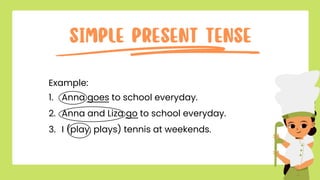
Example:
1. Anna goes to school everyday.
2. Anna and Liza go to school everyday.
3. I (play, plays) tennis at weekends.
I swim.
You swim.
We swim.
They swim.
He swims.
She swims.
It swims.
We form Present Simple Positive like this:
Third person
singular
subjects take
-s, -es or -ies.
I don't eat meat.
You don't eat meat.
We don't eat meat.
They don't eat meat.
He doesn't eat meat.
She doesn't eat meat.
It doesn't eat meat.
We form Present Simple Negative like this:
Third person
singular
subjects take
doesn't.
Do I sleep?
Do you sleep?
Do we sleep?
Do they sleep?
Does he sleep?
Does she sleep?
Does it sleep?
We form Present Simple Question like this:
Third person
singular
subjects take
does.
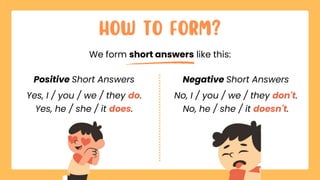
Positive Short Answers
We form short answers like this:
Yes, I / you / we / they do.
Yes, he / she / it does.
Negative Short Answers
No, I / you / we / they don't.
No, he / she / it doesn't.
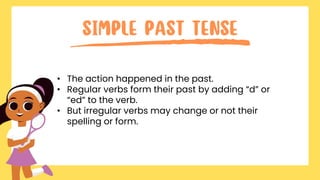
• The action happened in the past.
• Regular verbs form their past by adding “d” or
“ed” to the verb.
• But irregular verbs may change or not their
spelling or form.
Examples:
1. Anna went to school yesterday.
2. Anna and Liza went to school last week.
3. I (played, plaied) tennis at weekends.
• The action is yet to happen.
• Use the auxiliary verb “will” or “shall” plus the
base form of the verb.
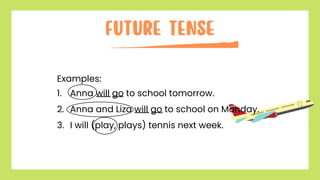
Examples:
1. Anna will go to school tomorrow.
2. Anna and Liza will go to school on Monday.
3. I will (play, plays) tennis next week.
Encircle the verb and identify if
it is in the present, past or
future tense.
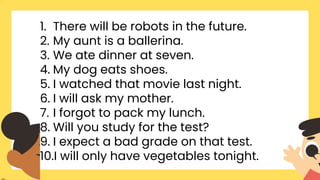
1. There will be robots in the future.
2. My aunt is a ballerina.
3. We ate dinner at seven.
4. My dog eats shoes.
5. I watched that movie last night.
6. I will ask my mother.
7. I forgot to pack my lunch.
8. Will you study for the test?
9. I expect a bad grade on that test.
10.I will only have vegetables tonight.

Simple Tenses.pptx

  • 3.
    1. Define verb 2.Identify the tenses of verbs 3. Give examples of verb in different tenses
  • 4.
    • Tells whenan action occurs. 1. Simple Present Tense 2. Simple Past Tense 3. Simple Future Tense
  • 5.
    • The actionis happening at the present time or habitually/regularly done. • It is also used to describe habits, unchanging situations, general truths, and fixed arrangements.
  • 6.
    Basic rules: 1. Singularsubjects, add “s” or “es” to the verb 2. Plural subjects, take the base form of the verb 3. 1st and 2nd Person (pronouns, I & You), also take the base form of the verb
  • 7.
    Example: 1. Anna goesto school everyday. 2. Anna and Liza go to school everyday. 3. I (play, plays) tennis at weekends.
  • 8.
    I swim. You swim. Weswim. They swim. He swims. She swims. It swims. We form Present Simple Positive like this: Third person singular subjects take -s, -es or -ies.
  • 9.
    I don't eatmeat. You don't eat meat. We don't eat meat. They don't eat meat. He doesn't eat meat. She doesn't eat meat. It doesn't eat meat. We form Present Simple Negative like this: Third person singular subjects take doesn't.
  • 10.
    Do I sleep? Doyou sleep? Do we sleep? Do they sleep? Does he sleep? Does she sleep? Does it sleep? We form Present Simple Question like this: Third person singular subjects take does.
  • 11.
    Positive Short Answers Weform short answers like this: Yes, I / you / we / they do. Yes, he / she / it does. Negative Short Answers No, I / you / we / they don't. No, he / she / it doesn't.
  • 12.
    • The actionhappened in the past. • Regular verbs form their past by adding “d” or “ed” to the verb. • But irregular verbs may change or not their spelling or form.
  • 14.
    Examples: 1. Anna wentto school yesterday. 2. Anna and Liza went to school last week. 3. I (played, plaied) tennis at weekends.
  • 15.
    • The actionis yet to happen. • Use the auxiliary verb “will” or “shall” plus the base form of the verb.
  • 16.
    Examples: 1. Anna willgo to school tomorrow. 2. Anna and Liza will go to school on Monday. 3. I will (play, plays) tennis next week.
  • 17.
    Encircle the verband identify if it is in the present, past or future tense.
  • 18.
    1. There willbe robots in the future. 2. My aunt is a ballerina. 3. We ate dinner at seven. 4. My dog eats shoes. 5. I watched that movie last night. 6. I will ask my mother. 7. I forgot to pack my lunch. 8. Will you study for the test? 9. I expect a bad grade on that test. 10.I will only have vegetables tonight.