Tenses
Easily explained
Presenttenses
01
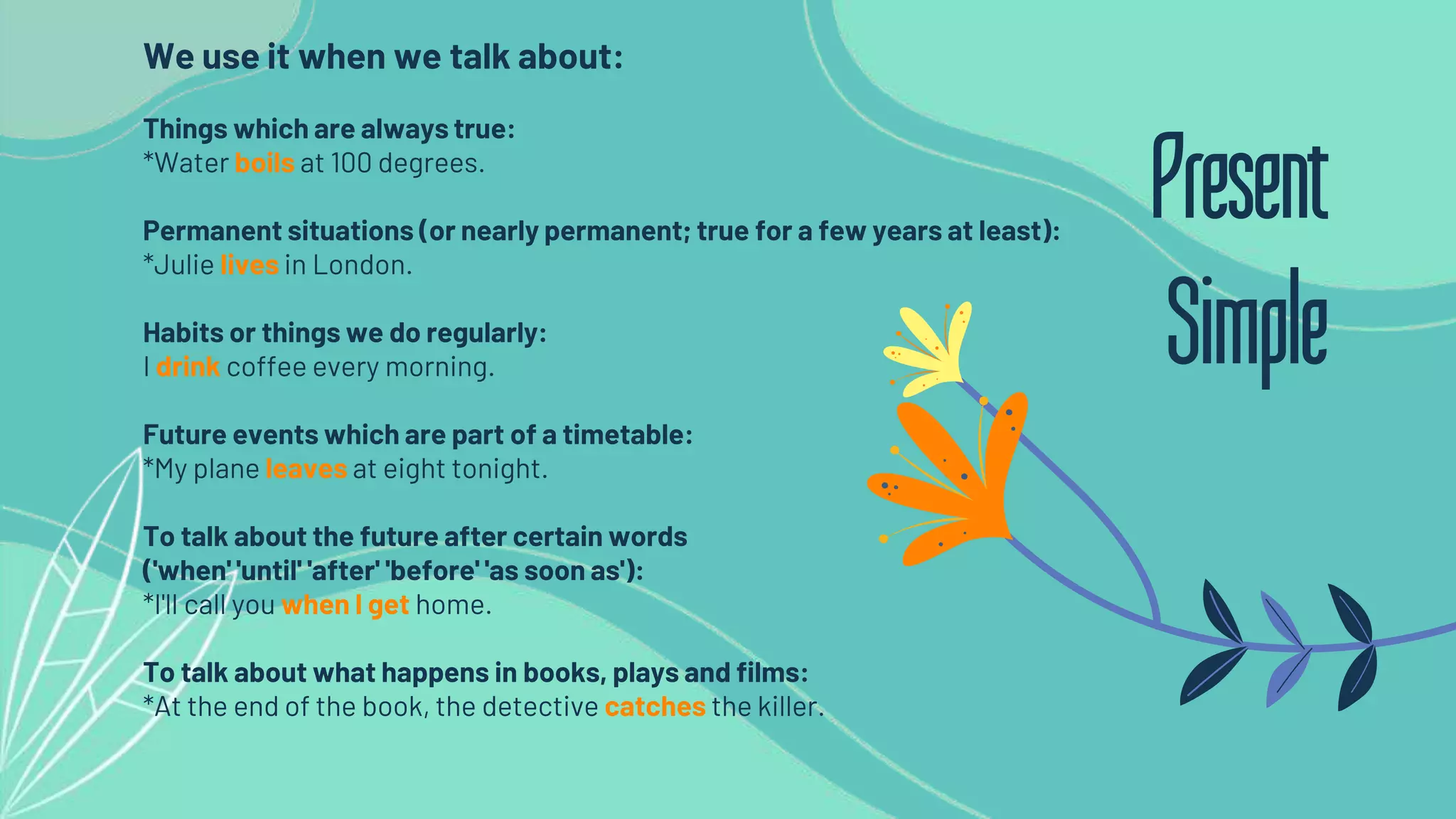
We use it when we talk about:
Things which are always true:
*Water boils at 100 degrees.
Permanent situations (or nearly permanent; true for a few years at least):
*Julie lives in London.
Habits or things we do regularly:
I drink coffee every morning.
Future events which are part of a timetable:
*My plane leaves at eight tonight.
To talk about the future after certain words
('when' 'until' 'after' 'before' 'as soon as'):
*I'll call you when I get home.
To talk about what happens in books, plays and films:
*At the end of the book, the detective catches the killer.
Present
Simple
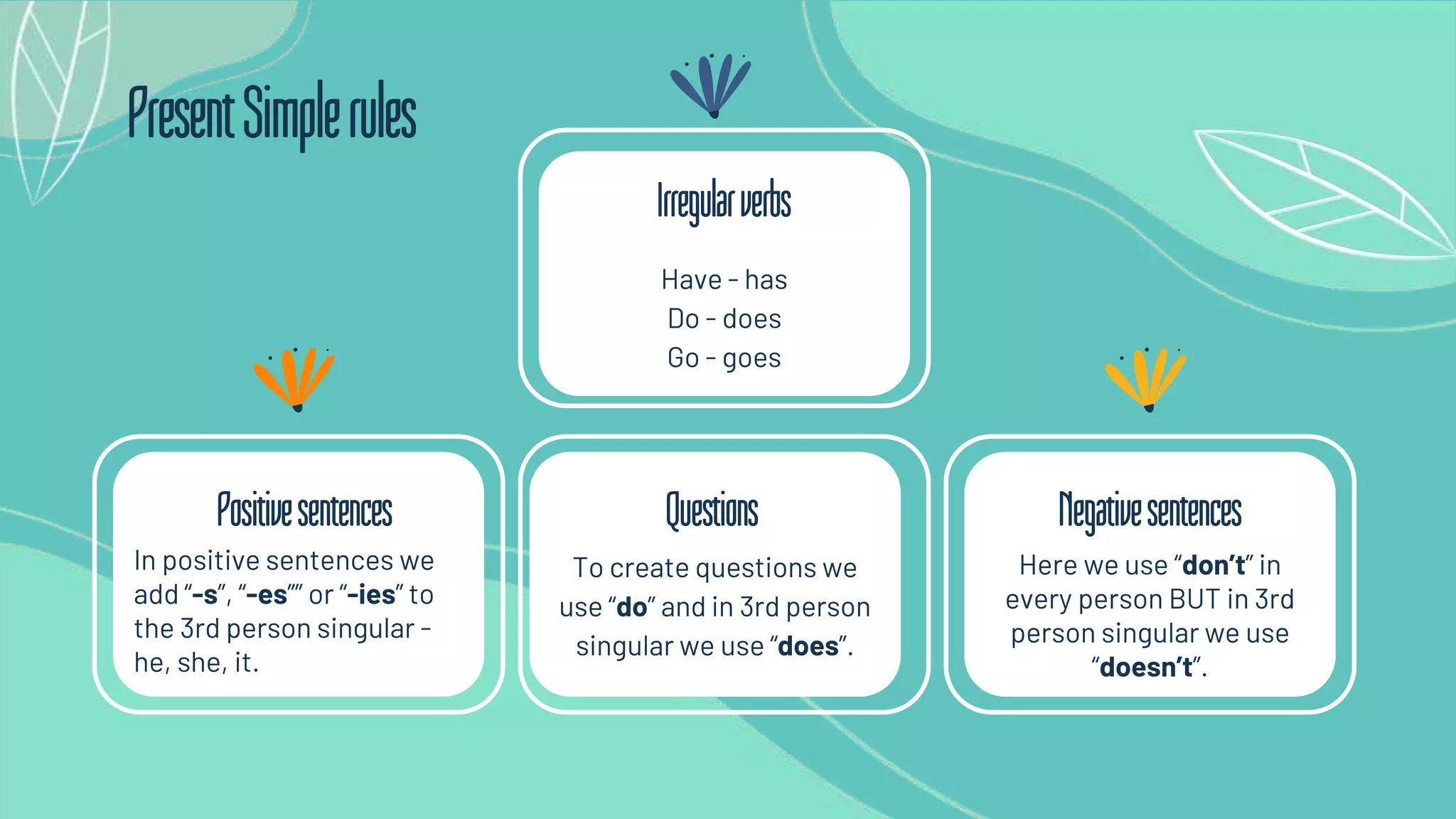
Negativesentences
Positivesentences
Here we use “don’t” in
every person BUT in 3rd
person singular we use
“doesn’t”.
In positive sentences we
add “-s”, “-es”” or “-ies” to
the 3rd person singular -
he, she, it.
PresentSimplerules
To create questions we
use “do” and in 3rd person
singular we use “does”.
Have - has
Do - does
Go - goes
Questions
Irregularverbs
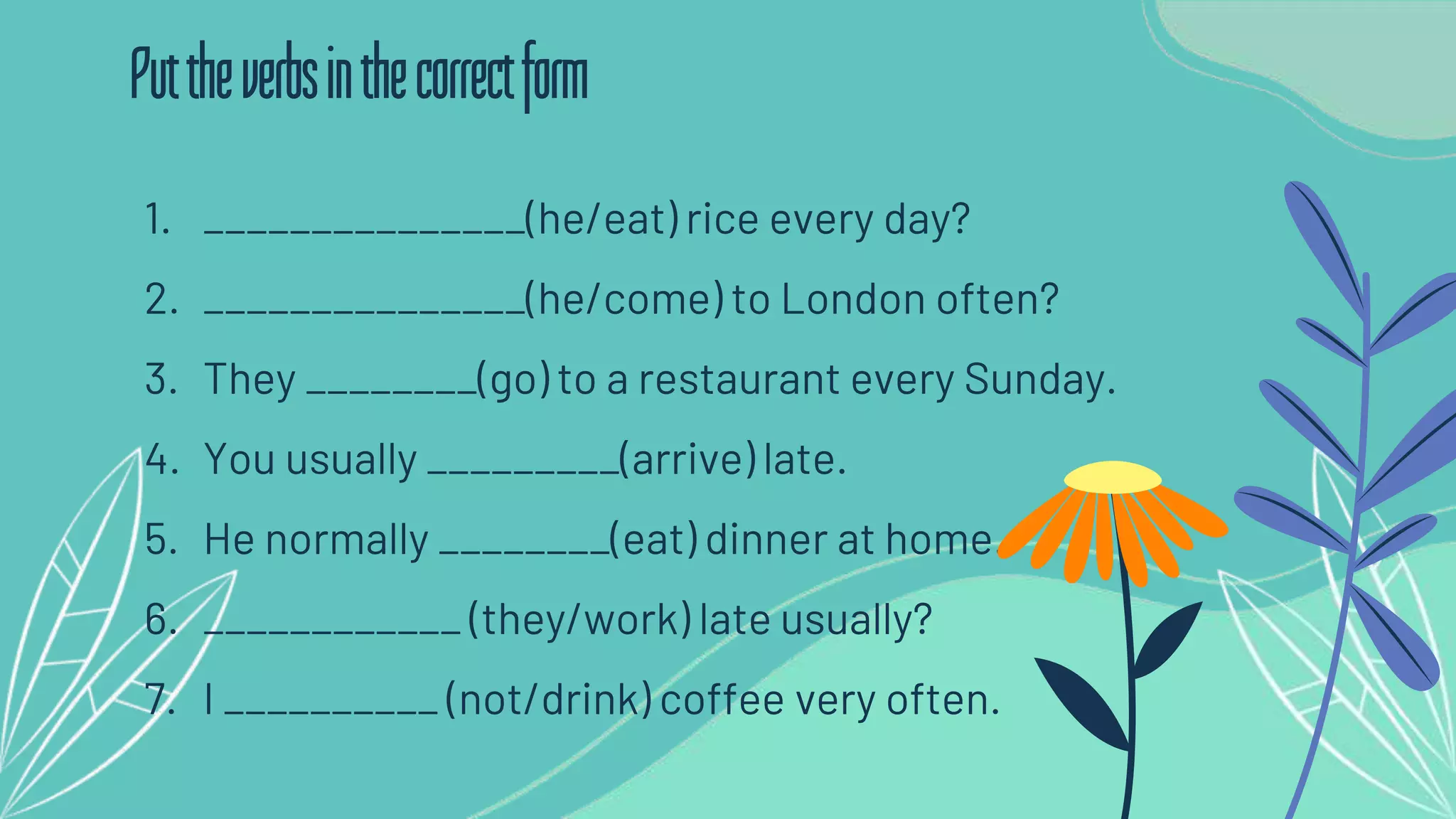
1. _______________(he/eat) rice every day?
2. _______________(he/come) to London often?
3. They ________(go) to a restaurant every Sunday.
4. You usually _________(arrive) late.
5. He normally ________(eat) dinner at home.
6. ____________ (they/work) late usually?
7. I __________ (not/drink) coffee very often.
Puttheverbsinthecorrectform
We use it when we talk about:
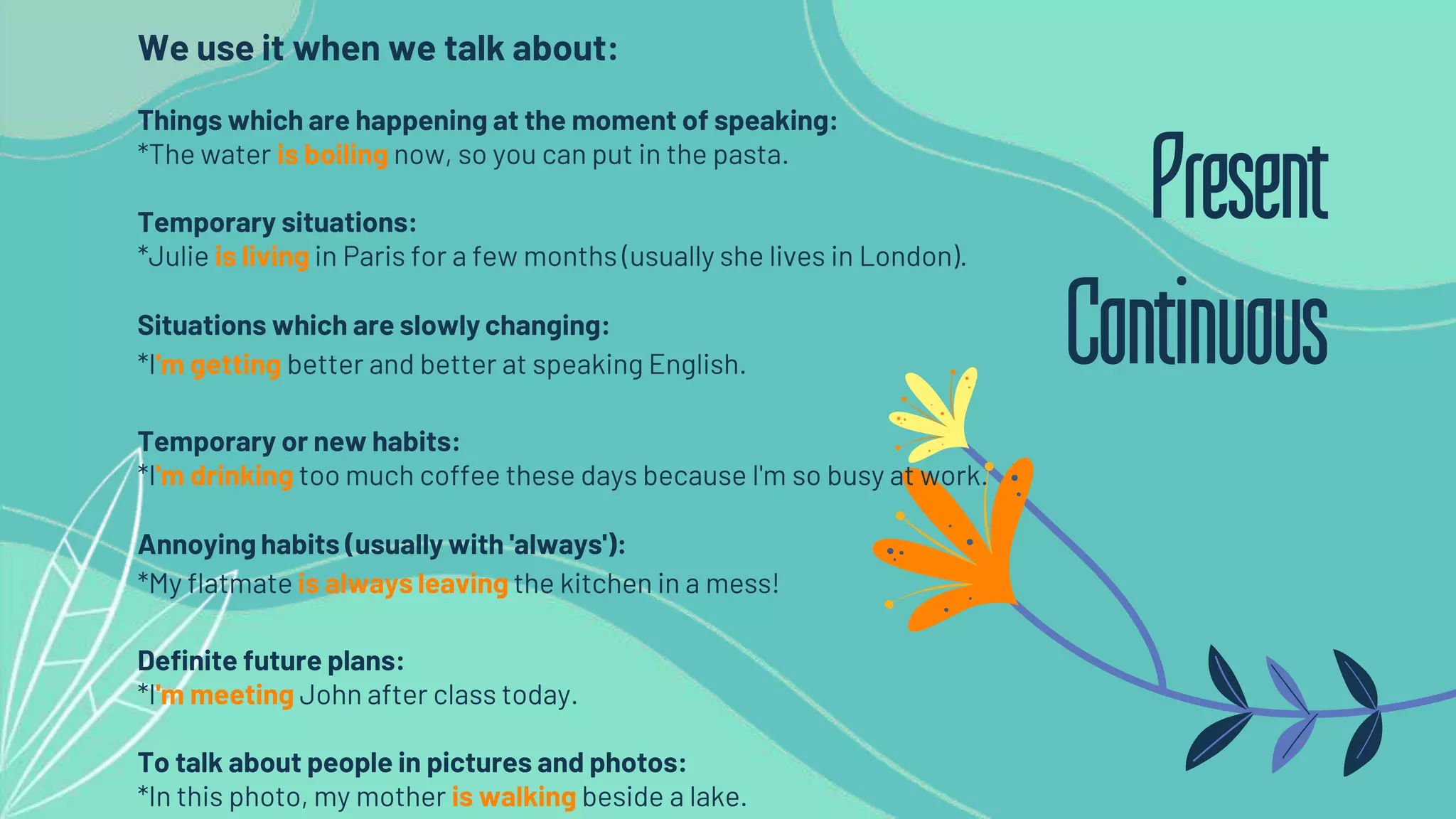
Things which are happening at the moment of speaking:
*The water is boiling now, so you can put in the pasta.
Temporary situations:
*Julie is living in Paris for a few months (usually she lives in London).
Situations which are slowly changing:
*I'm getting better and better at speaking English.
Temporary or new habits:
*I'm drinking too much coffee these days because I'm so busy at work.
Annoying habits (usually with 'always'):
*My flatmate is always leaving the kitchen in a mess!
Definite future plans:
*I'm meeting John after class today.
To talk about people in pictures and photos:
*In this photo, my mother is walking beside a lake.
Present
Continuous
Negativesentences
Positivesentences
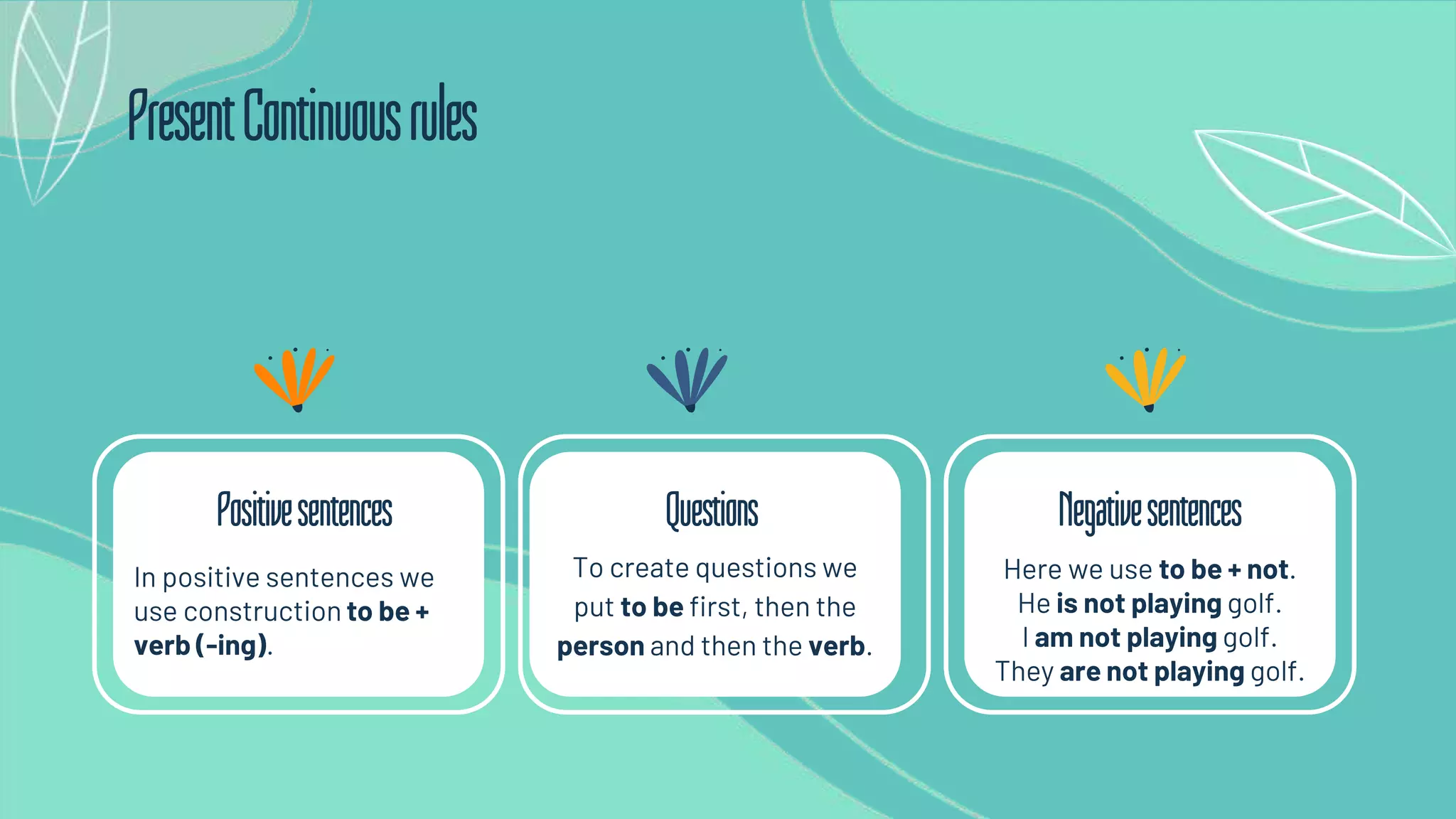
Here we use to be + not.
He is not playing golf.
I am not playing golf.
They are not playing golf.
In positive sentences we
use construction to be +
verb (-ing).
PresentContinuousrules
To create questions we
put to be first, then the
person and then the verb.
Questions
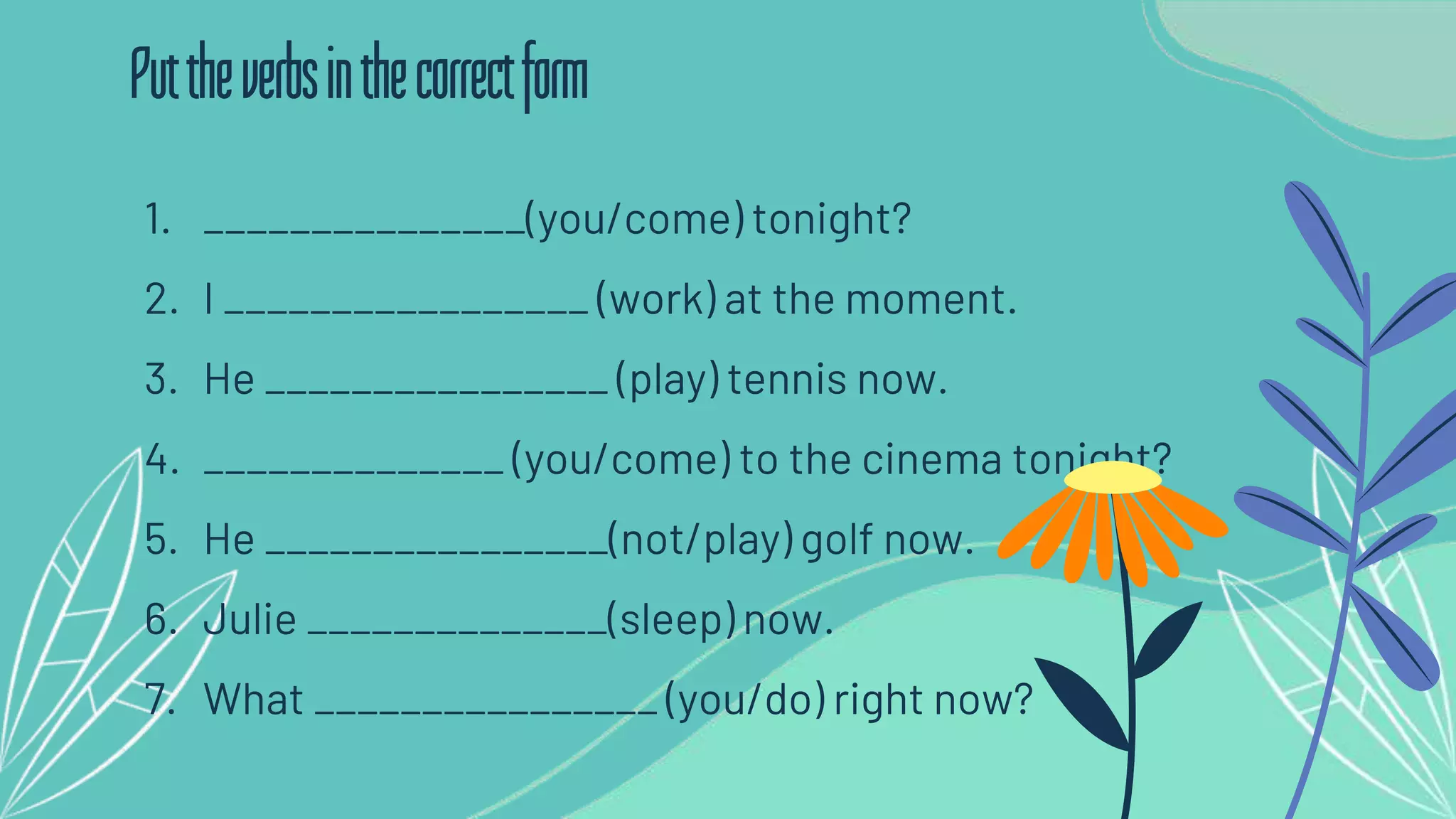
1. _______________(you/come) tonight?
2. I _________________ (work) at the moment.
3. He ________________ (play) tennis now.
4. ______________ (you/come) to the cinema tonight?
5. He ________________(not/play) golf now.
6. Julie ______________(sleep) now.
7. What ________________ (you/do) right now?
Puttheverbsinthecorrectform
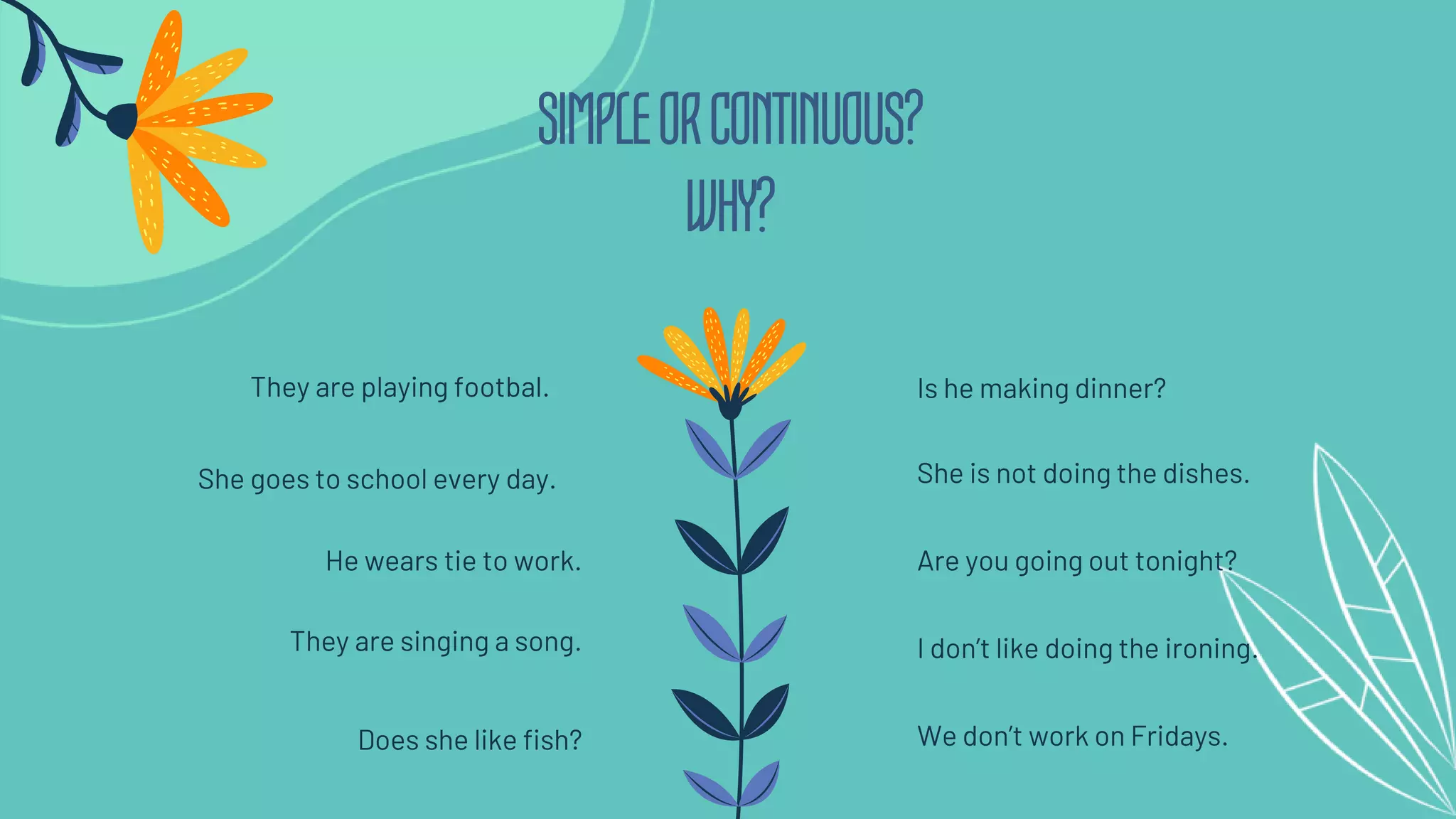
SIMPLEORCONTINUOUS?
WHY?
She goes to school every day.
They are playing footbal.
Are you going out tonight?
Is he making dinner?
He wears tie to work.
They are singing a song.
Does she like fish?
She is not doing the dishes.
I don’t like doing the ironing.
We don’t work on Fridays.
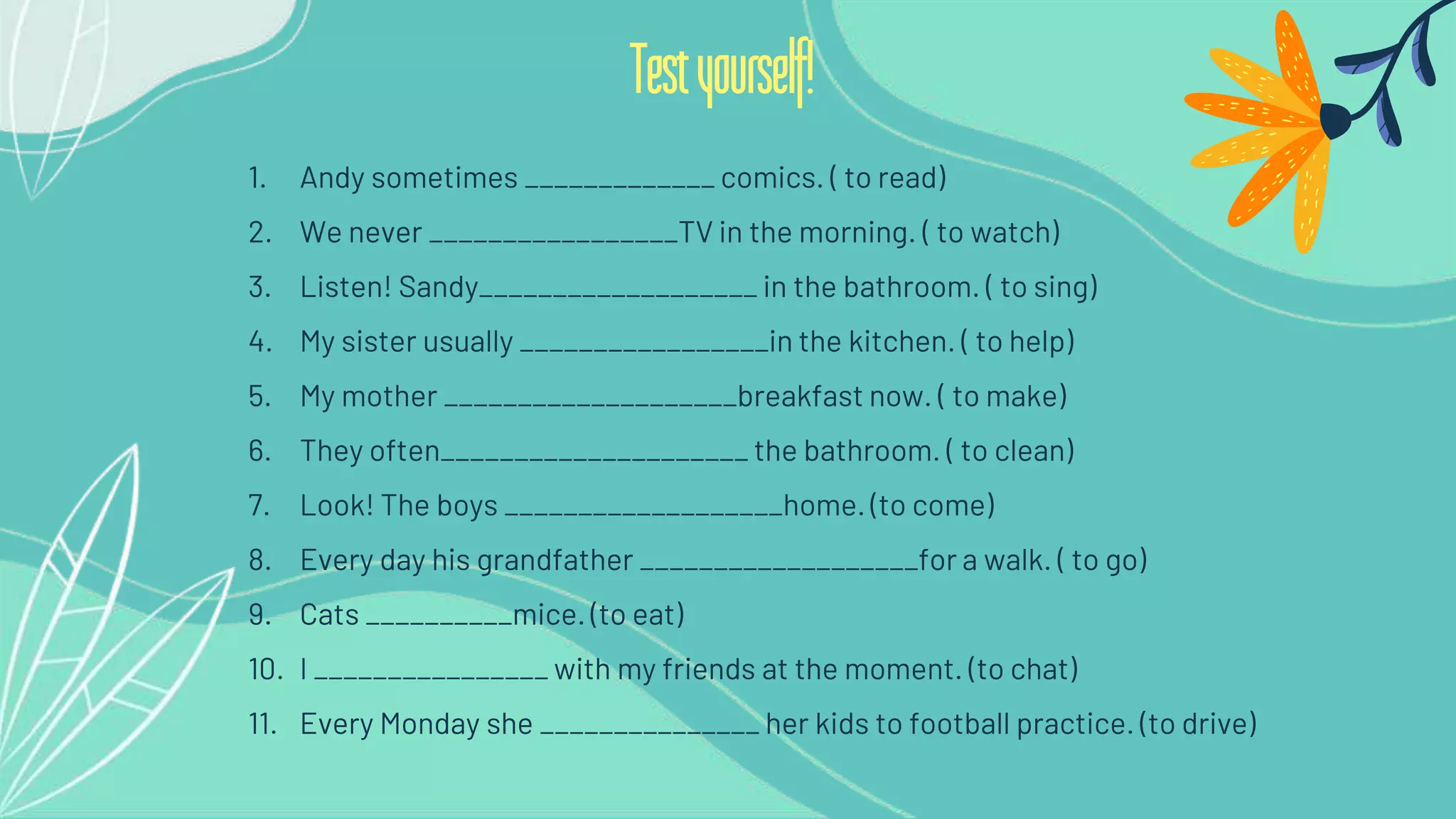
1. Andy sometimes _____________ comics. ( to read)
2. We never _________________TV in the morning. ( to watch)
3. Listen! Sandy___________________ in the bathroom. ( to sing)
4. My sister usually _________________in the kitchen. ( to help)
5. My mother ____________________breakfast now. ( to make)
6. They often_____________________ the bathroom. ( to clean)
7. Look! The boys ___________________home. (to come)
8. Every day his grandfather ___________________for a walk. ( to go)
9. Cats __________mice. (to eat)
10. I ________________ with my friends at the moment. (to chat)
11. Every Monday she _______________ her kids to football practice. (to drive)
Testyourself!
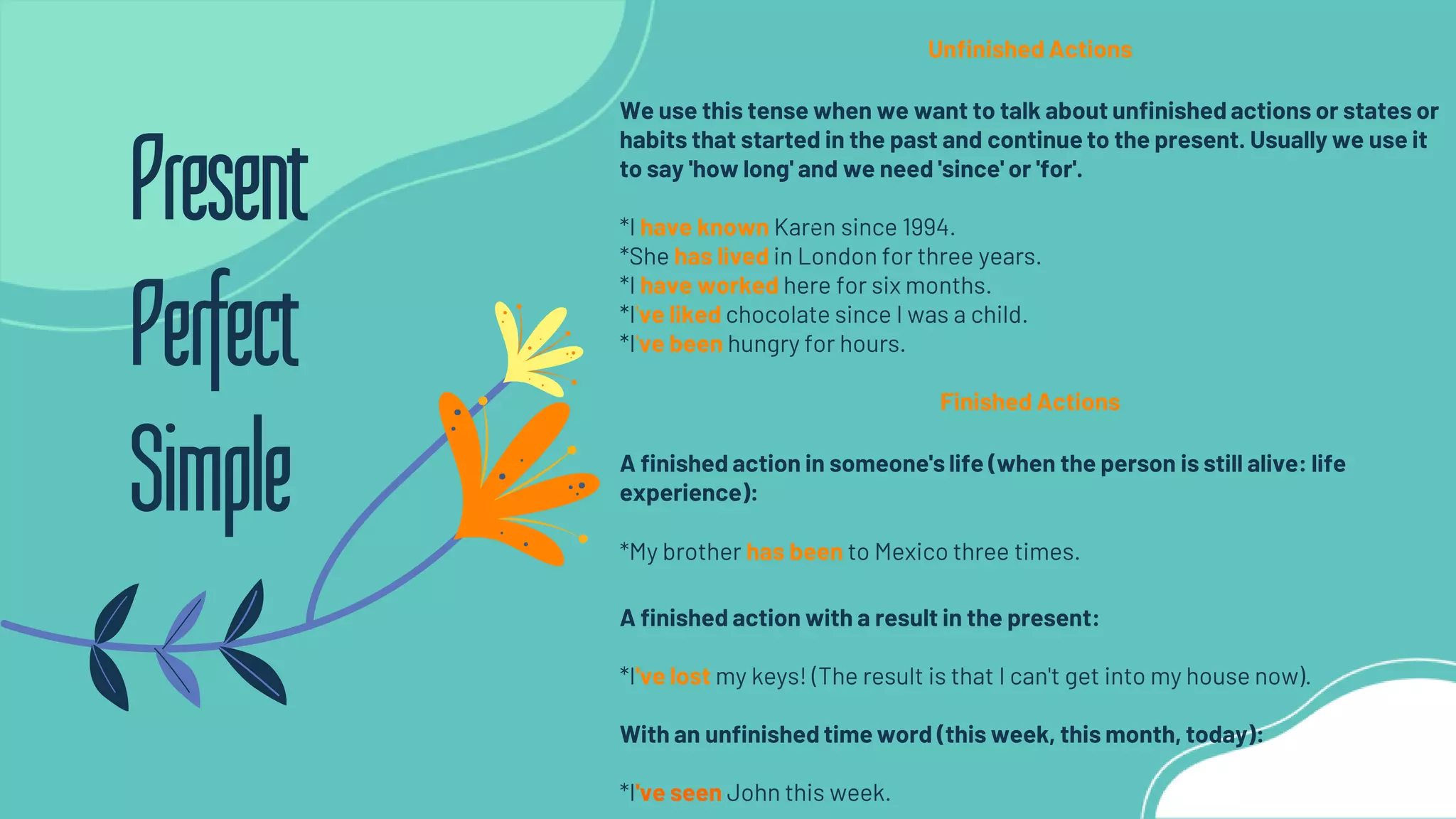
Unfinished Actions
We use this tense when we want to talk about unfinished actions or states or
habits that started in the past and continue to the present. Usually we use it
to say 'how long' and we need 'since' or 'for'.
*I have known Karen since 1994.
*She has lived in London for three years.
*I have worked here for six months.
*I've liked chocolate since I was a child.
*I've been hungry for hours.
Finished Actions
A finished action in someone's life (when the person is still alive: life
experience):
*My brother has been to Mexico three times.
A finished action with a result in the present:
*I've lost my keys! (The result is that I can't get into my house now).
With an unfinished time word (this week, this month, today):
*I've seen John this week.
Present
Perfect
Simple
Negativesentences
Positivesentences
Person + haven’t/hasn’t +
verb in 3rd form
She hasn’t done her
homework.
person + have/has + verb in
3rd form
She has done her homework
PresentPerfectSimplerules
Have/has + person + verb in
3rd form
Has she done her
homework?
Questions
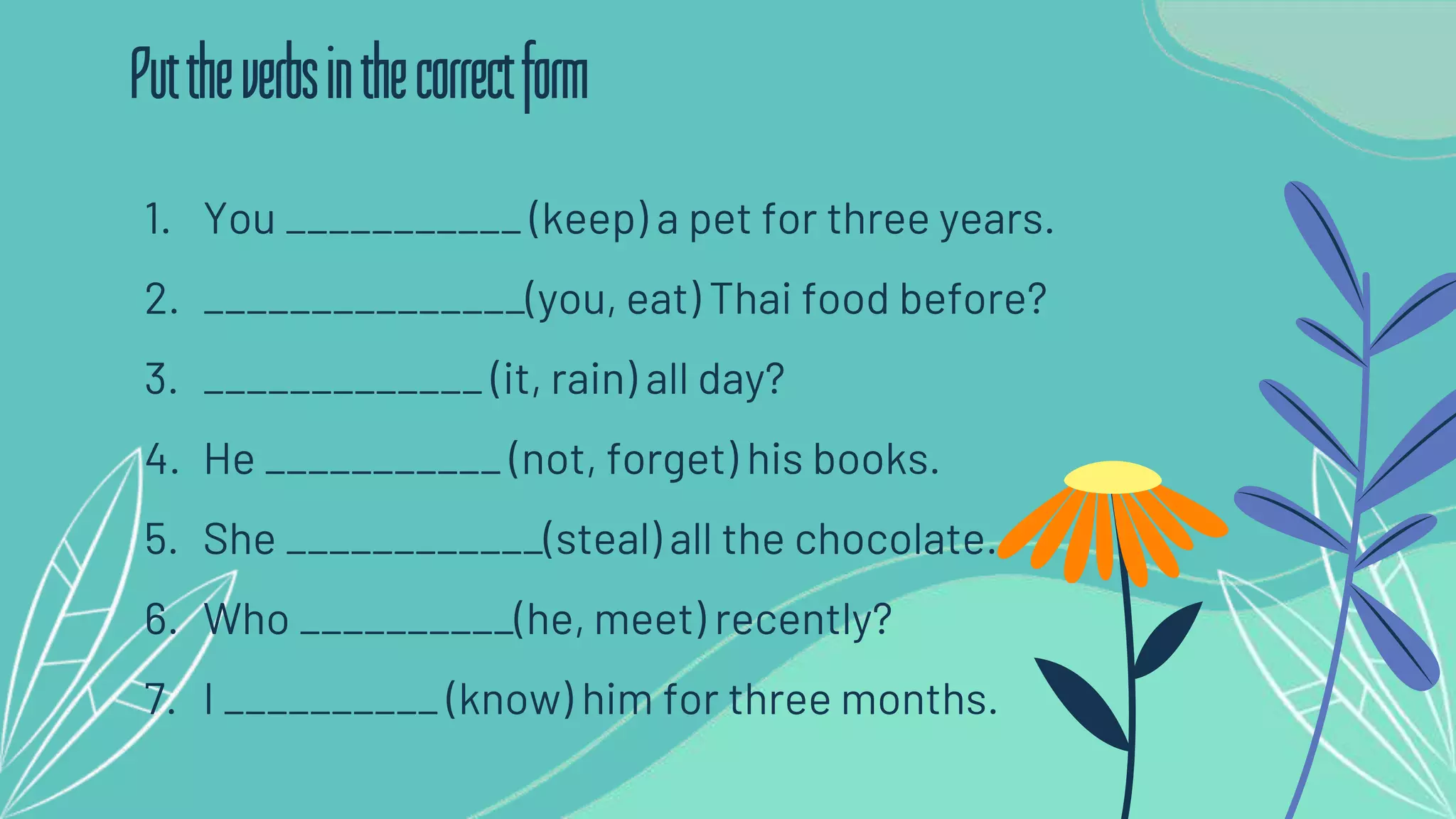
1. You ___________ (keep) a pet for three years.
2. _______________(you, eat) Thai food before?
3. _____________ (it, rain) all day?
4. He ___________ (not, forget) his books.
5. She ____________(steal) all the chocolate.
6. Who __________(he, meet) recently?
7. I __________ (know) him for three months.
Puttheverbsinthecorrectform
Unfinished actions
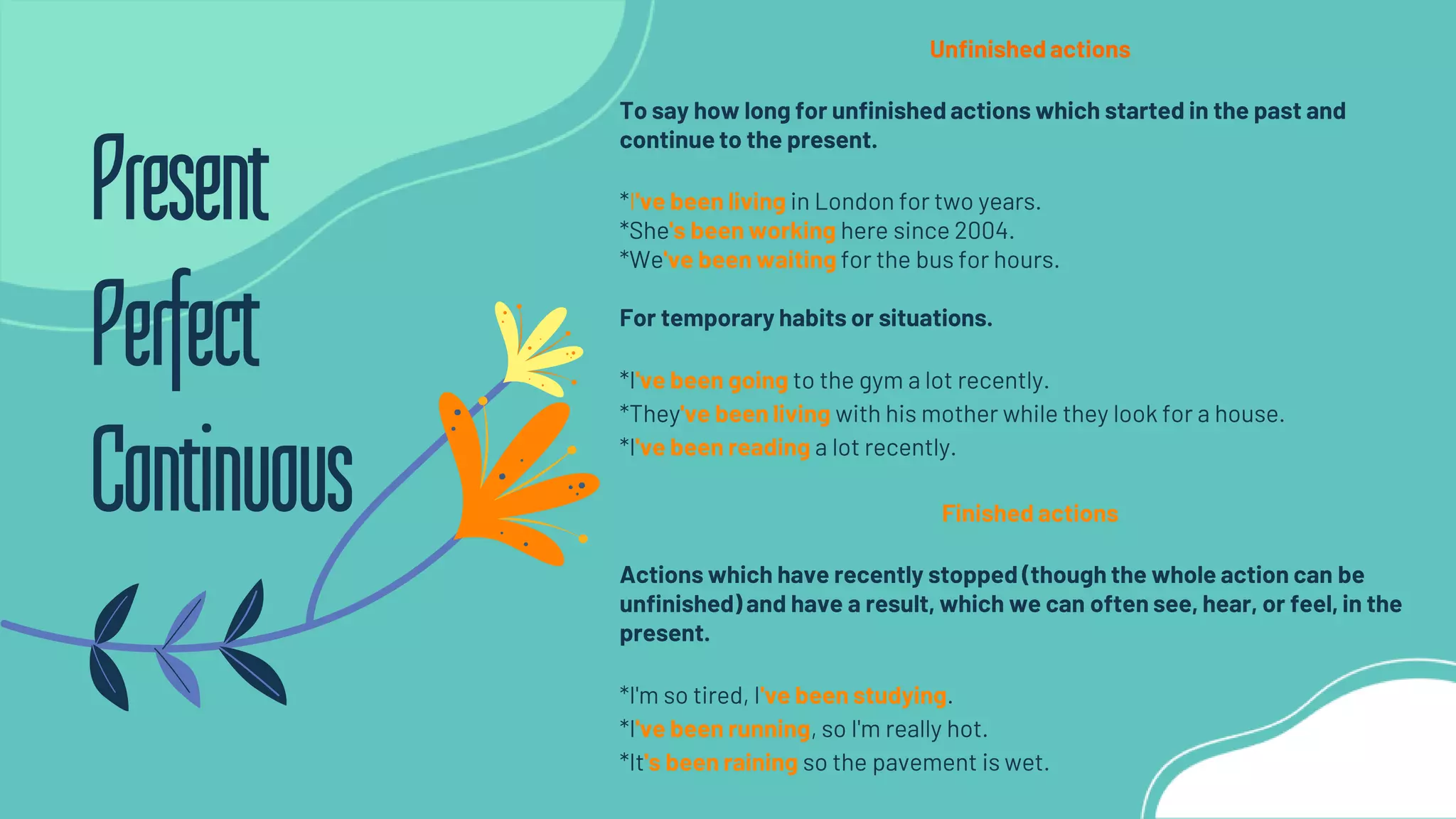
To say how long for unfinished actions which started in the past and
continue to the present.
*I've been living in London for two years.
*She's been working here since 2004.
*We've been waiting for the bus for hours.
For temporary habits or situations.
*I've been going to the gym a lot recently.
*They've been living with his mother while they look for a house.
*I've been reading a lot recently.
Finished actions
Actions which have recently stopped (though the whole action can be
unfinished) and have a result, which we can often see, hear, or feel, in the
present.
*I'm so tired, I've been studying.
*I've been running, so I'm really hot.
*It's been raining so the pavement is wet.
Present
Perfect
Continuous
Negativesentences
Positivesentences
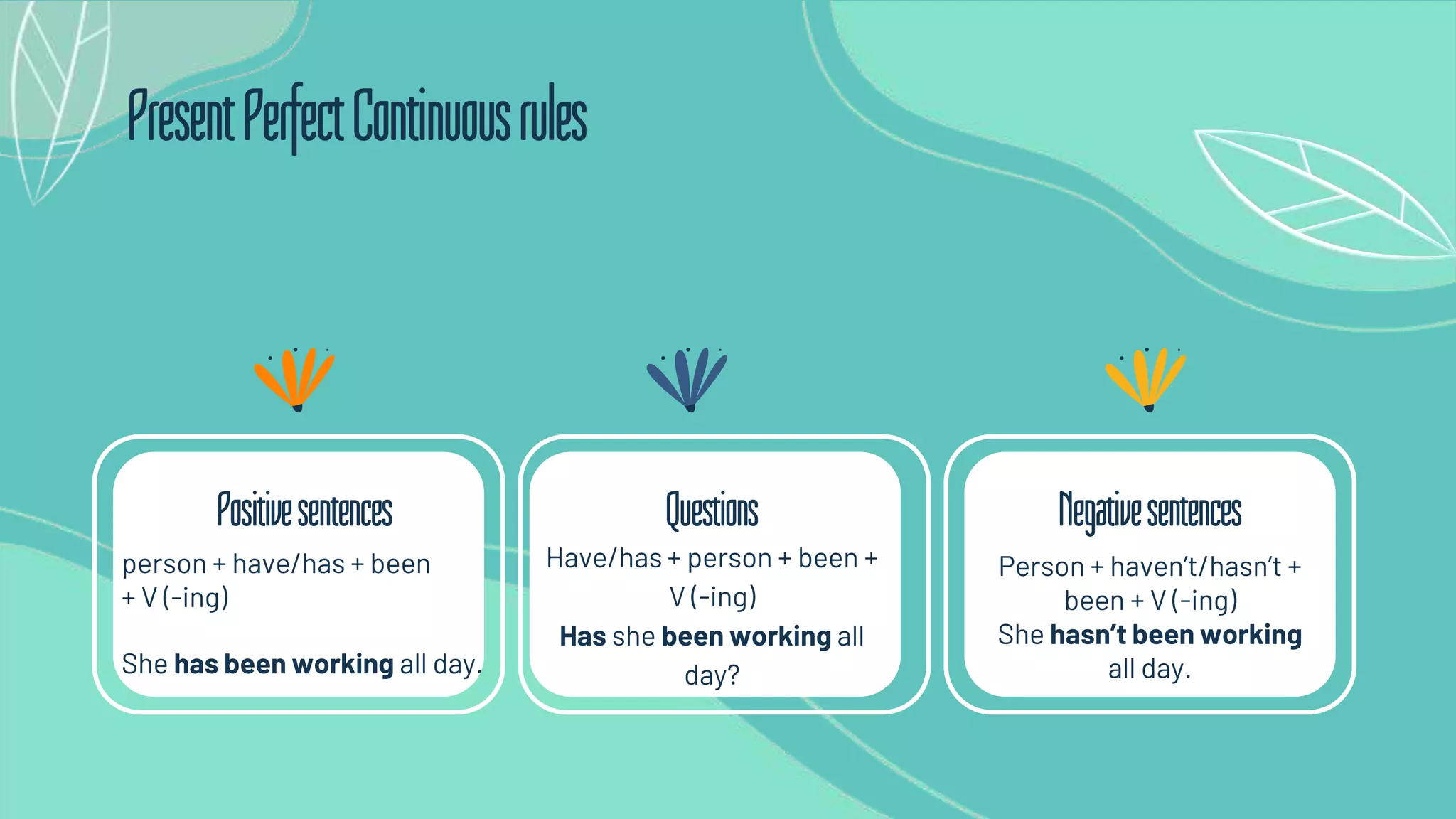
Person + haven’t/hasn’t +
been + V (-ing)
She hasn’t been working
all day.
person + have/has + been
+ V (-ing)
She has been working all day.
PresentPerfectContinuousrules
Have/has + person + been +
V (-ing)
Has she been working all
day?
Questions
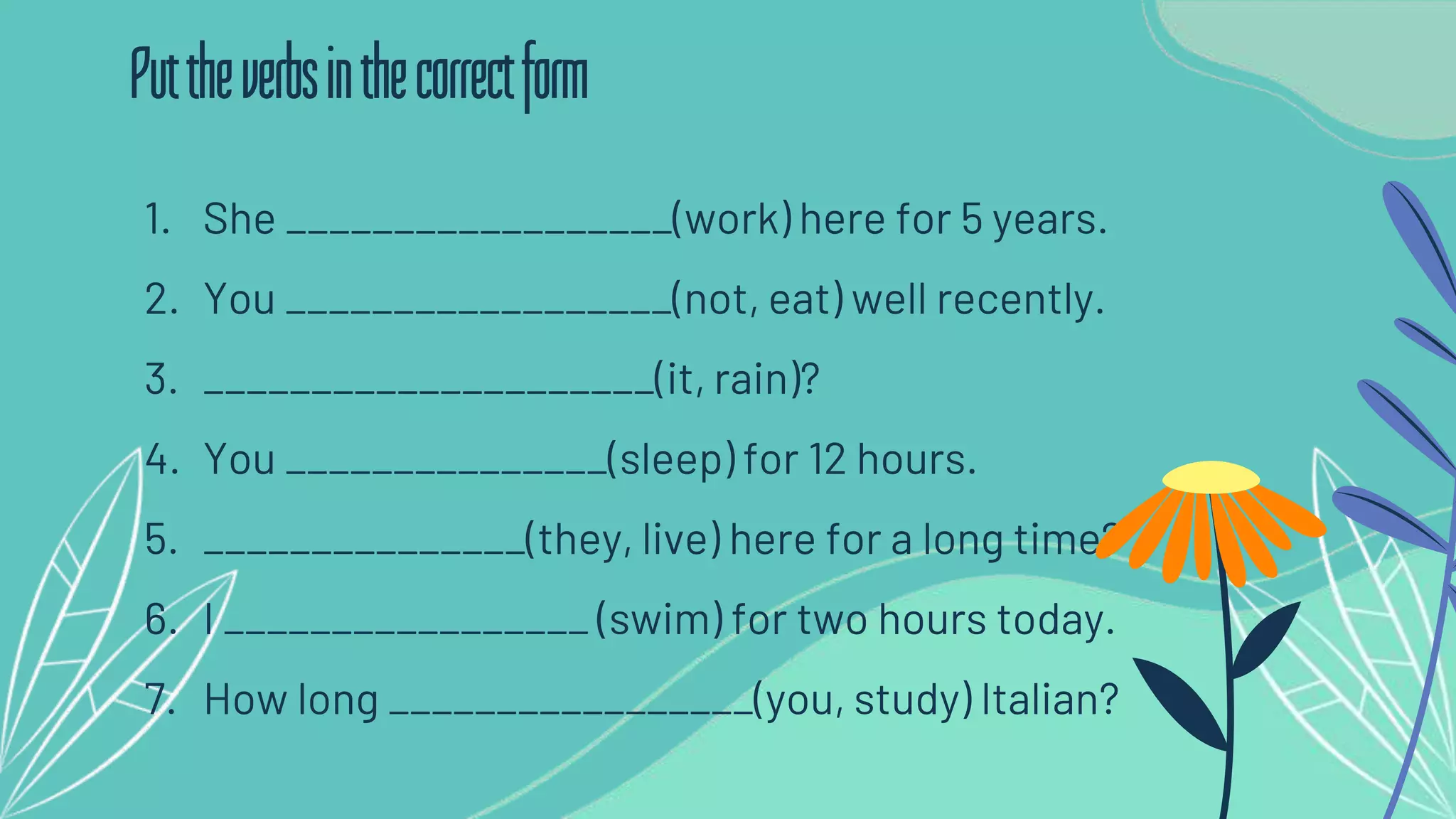
1. She __________________(work) here for 5 years.
2. You __________________(not, eat) well recently.
3. _____________________(it, rain)?
4. You _______________(sleep) for 12 hours.
5. _______________(they, live) here for a long time?
6. I _________________ (swim) for two hours today.
7. How long _________________(you, study) Italian?
Puttheverbsinthecorrectform
Presenttenses
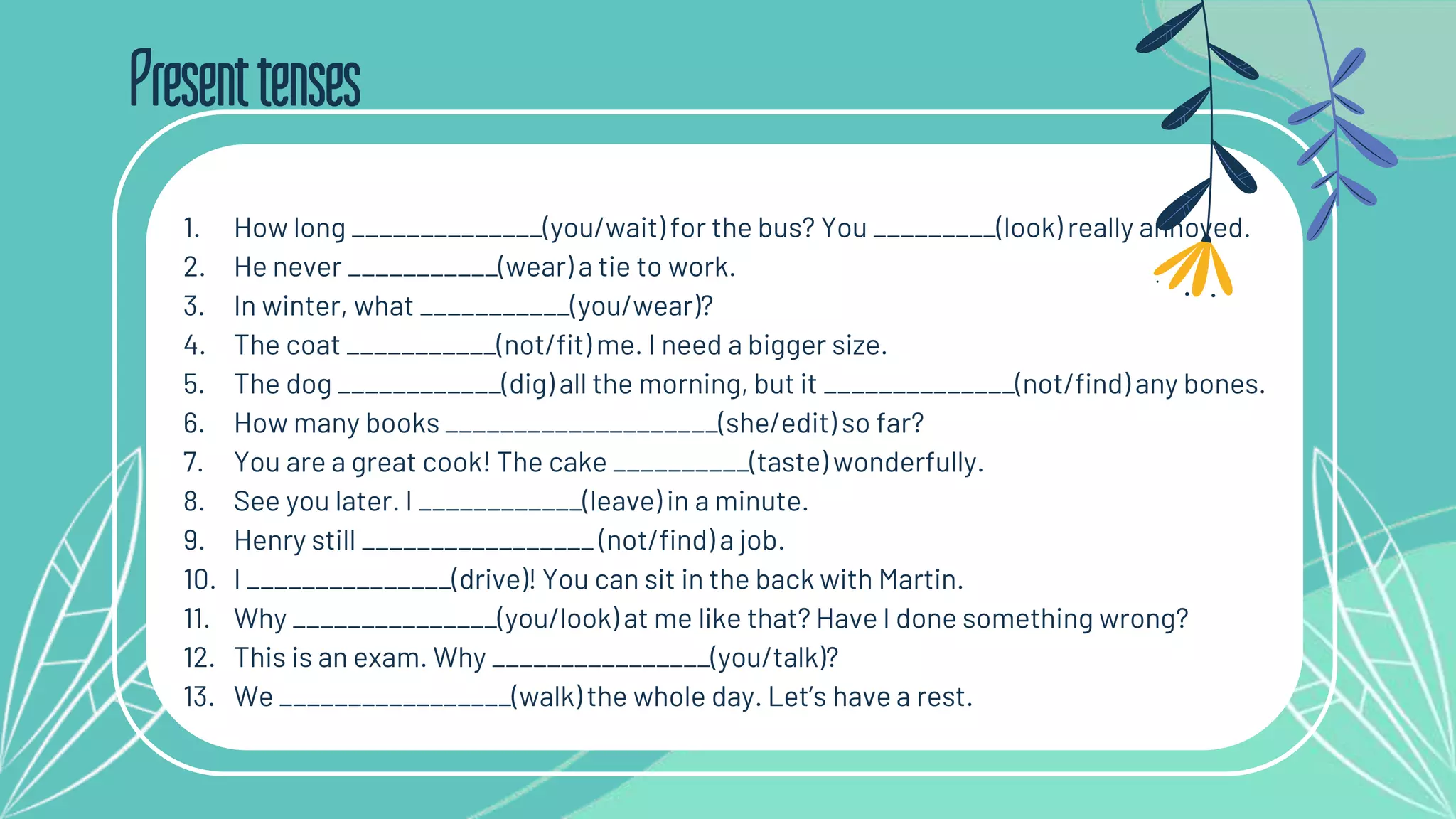
1. How long ______________(you/wait) for the bus? You _________(look) really annoyed.
2. He never ___________(wear) a tie to work.
3. In winter, what ___________(you/wear)?
4. The coat ___________(not/fit) me. I need a bigger size.
5. The dog ____________(dig) all the morning, but it ______________(not/find) any bones.
6. How many books ____________________(she/edit) so far?
7. You are a great cook! The cake __________(taste) wonderfully.
8. See you later. I ____________(leave) in a minute.
9. Henry still _________________ (not/find) a job.
10. I _______________(drive)! You can sit in the back with Martin.
11. Why _______________(you/look) at me like that? Have I done something wrong?
12. This is an exam. Why ________________(you/talk)?
13. We _________________(walk) the whole day. Let’s have a rest.
Pasttenses
02
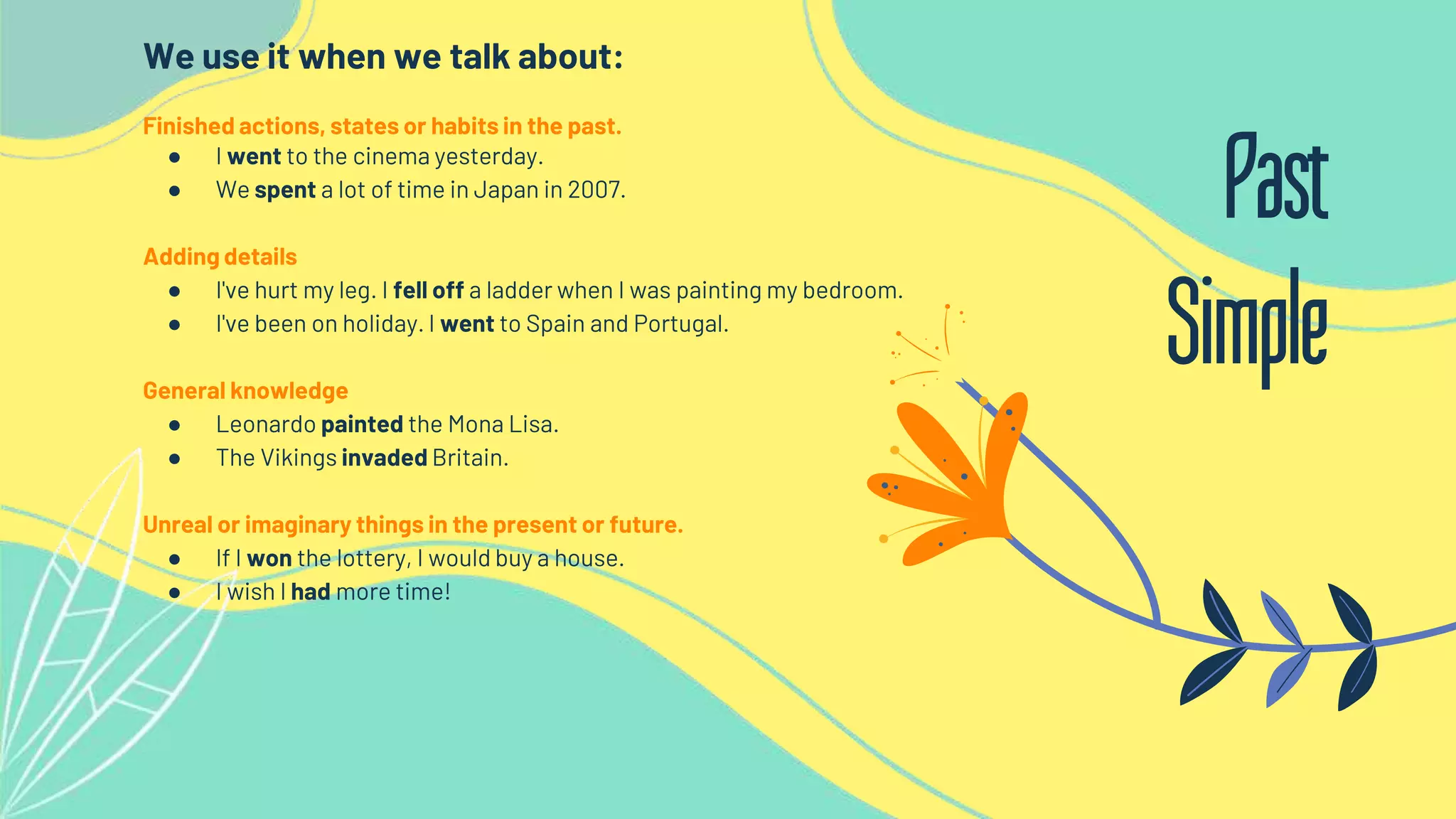
We use it when we talk about:
Finished actions, states or habits in the past.
● I went to the cinema yesterday.
● We spent a lot of time in Japan in 2007.
Adding details
● I've hurt my leg. I fell off a ladder when I was painting my bedroom.
● I've been on holiday. I went to Spain and Portugal.
General knowledge
● Leonardo painted the Mona Lisa.
● The Vikings invaded Britain.
Unreal or imaginary things in the present or future.
● If I won the lottery, I would buy a house.
● I wish I had more time!
Past
Simple
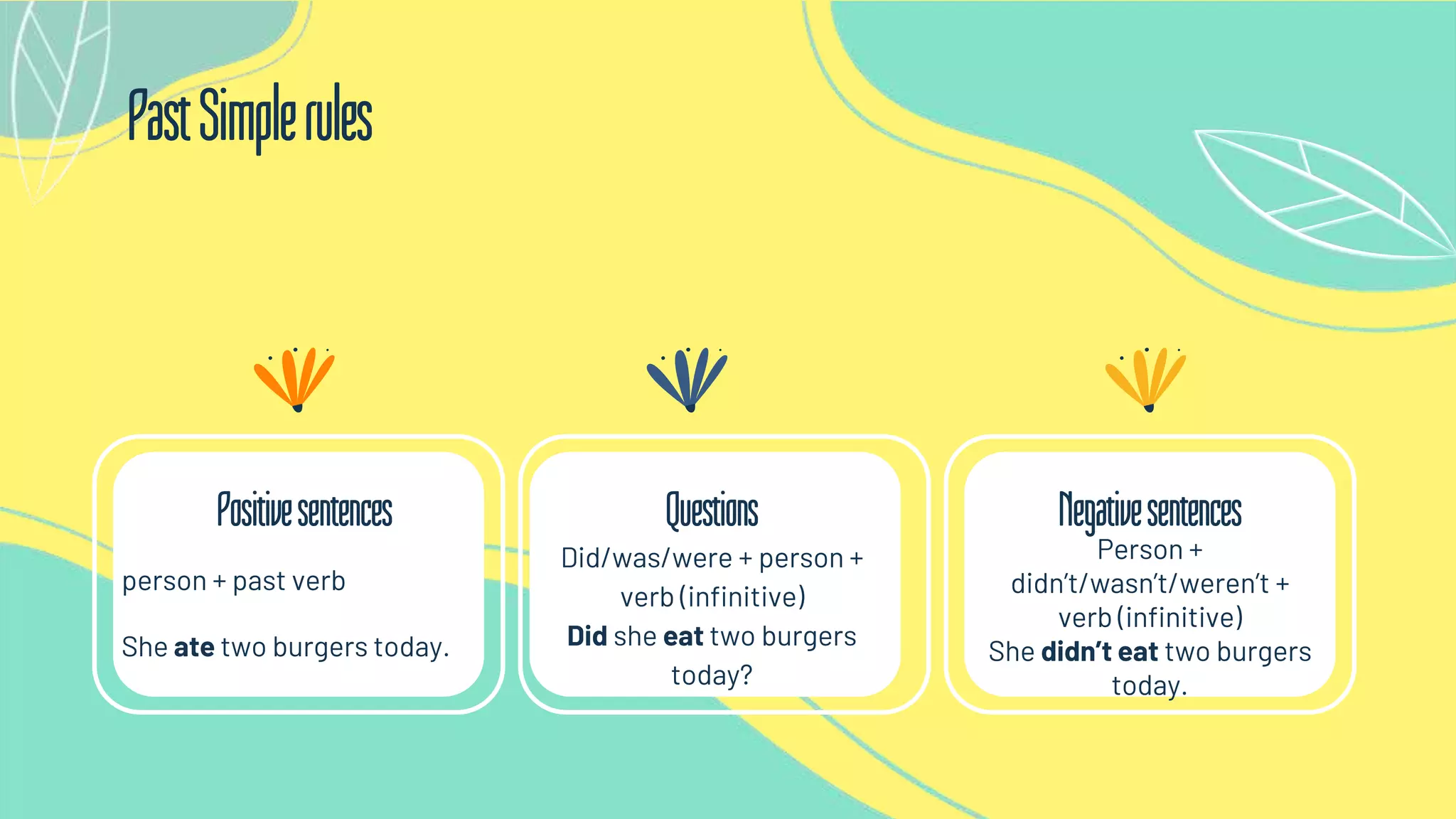
Negativesentences
Positivesentences
Person +
didn’t/wasn’t/weren’t +
verb (infinitive)
She didn’t eat two burgers
today.
person + past verb
She ate two burgers today.
PastSimplerules
Did/was/were + person +
verb (infinitive)
Did she eat two burgers
today?
Questions
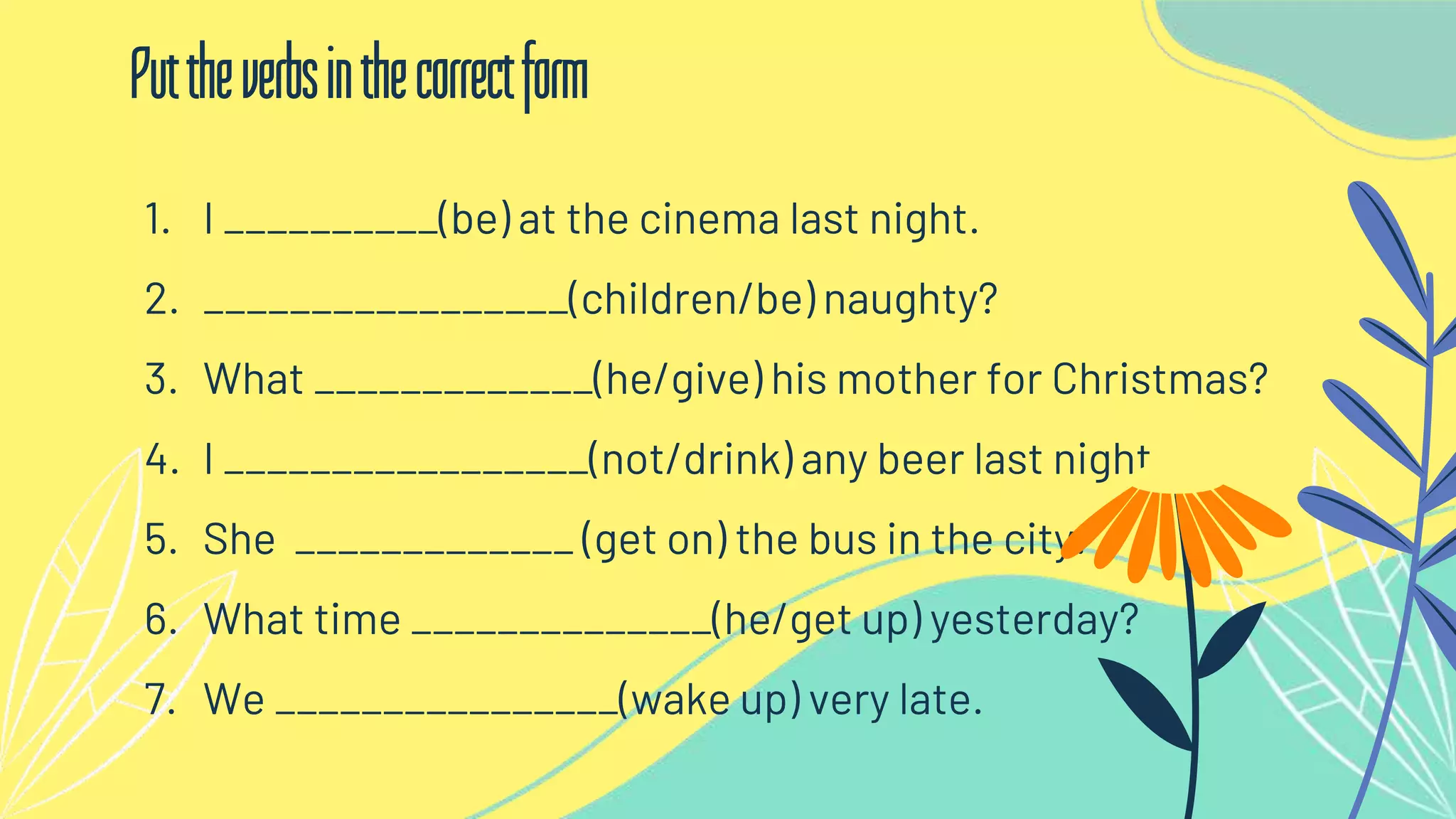
1. I __________(be) at the cinema last night.
2. _________________(children/be) naughty?
3. What _____________(he/give) his mother for Christmas?
4. I _________________(not/drink) any beer last night.
5. She _____________ (get on) the bus in the city.
6. What time ______________(he/get up) yesterday?
7. We ________________(wake up) very late.
Puttheverbsinthecorrectform
We use it when we talk about:
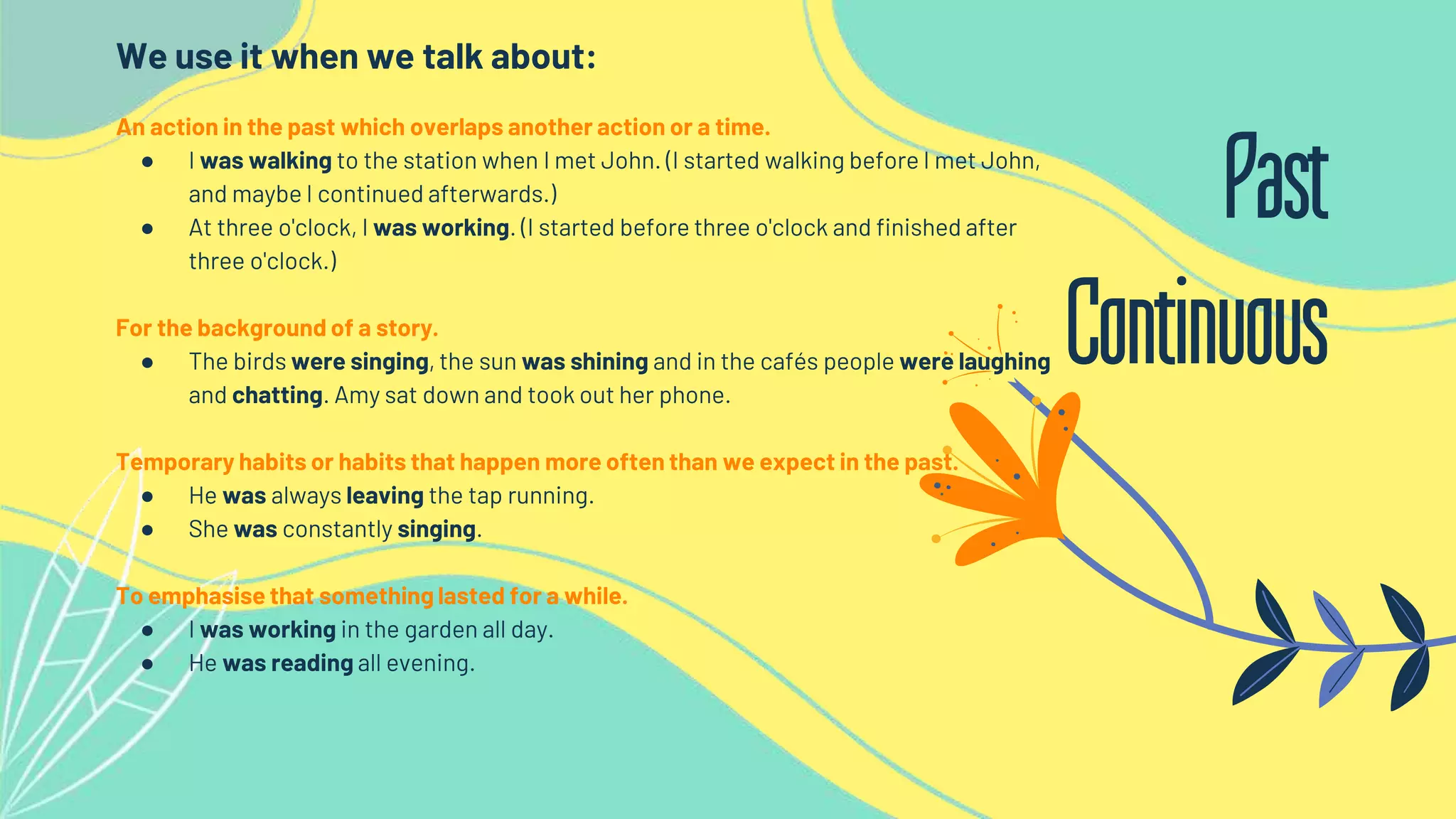
An action in the past which overlaps another action or a time.
● I was walking to the station when I met John. (I started walking before I met John,
and maybe I continued afterwards.)
● At three o'clock, I was working. (I started before three o'clock and finished after
three o'clock.)
For the background of a story.
● The birds were singing, the sun was shining and in the cafés people were laughing
and chatting. Amy sat down and took out her phone.
Temporary habits or habits that happen more often than we expect in the past.
● He was always leaving the tap running.
● She was constantly singing.
To emphasise that something lasted for a while.
● I was working in the garden all day.
● He was reading all evening.
Past
Continuous
Negativesentences
Positivesentences
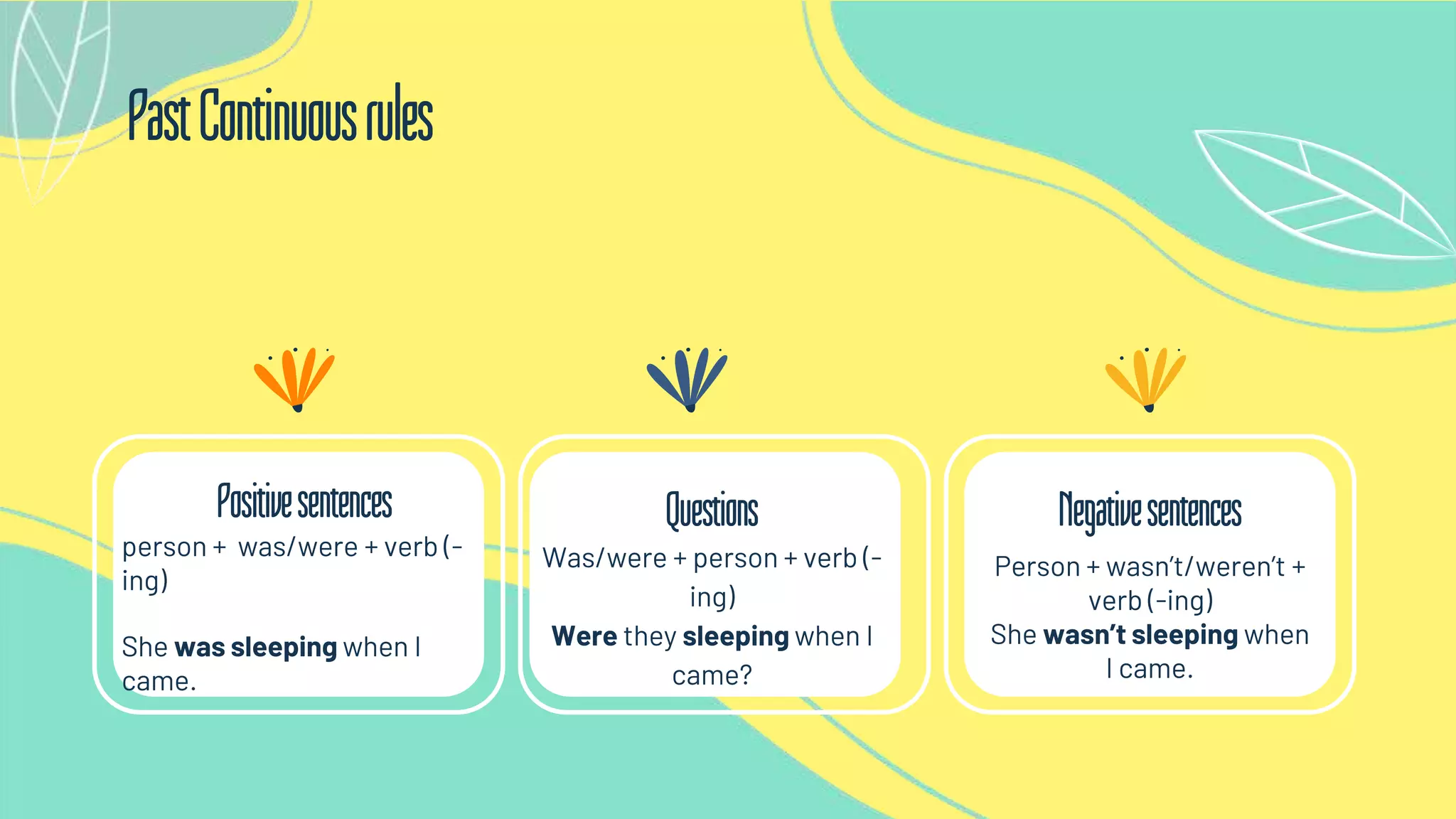
Person + wasn’t/weren’t +
verb (-ing)
She wasn’t sleeping when
I came.
person + was/were + verb (-
ing)
She was sleeping when I
came.
PastContinuousrules
Was/were + person + verb (-
ing)
Were they sleeping when I
came?
Questions
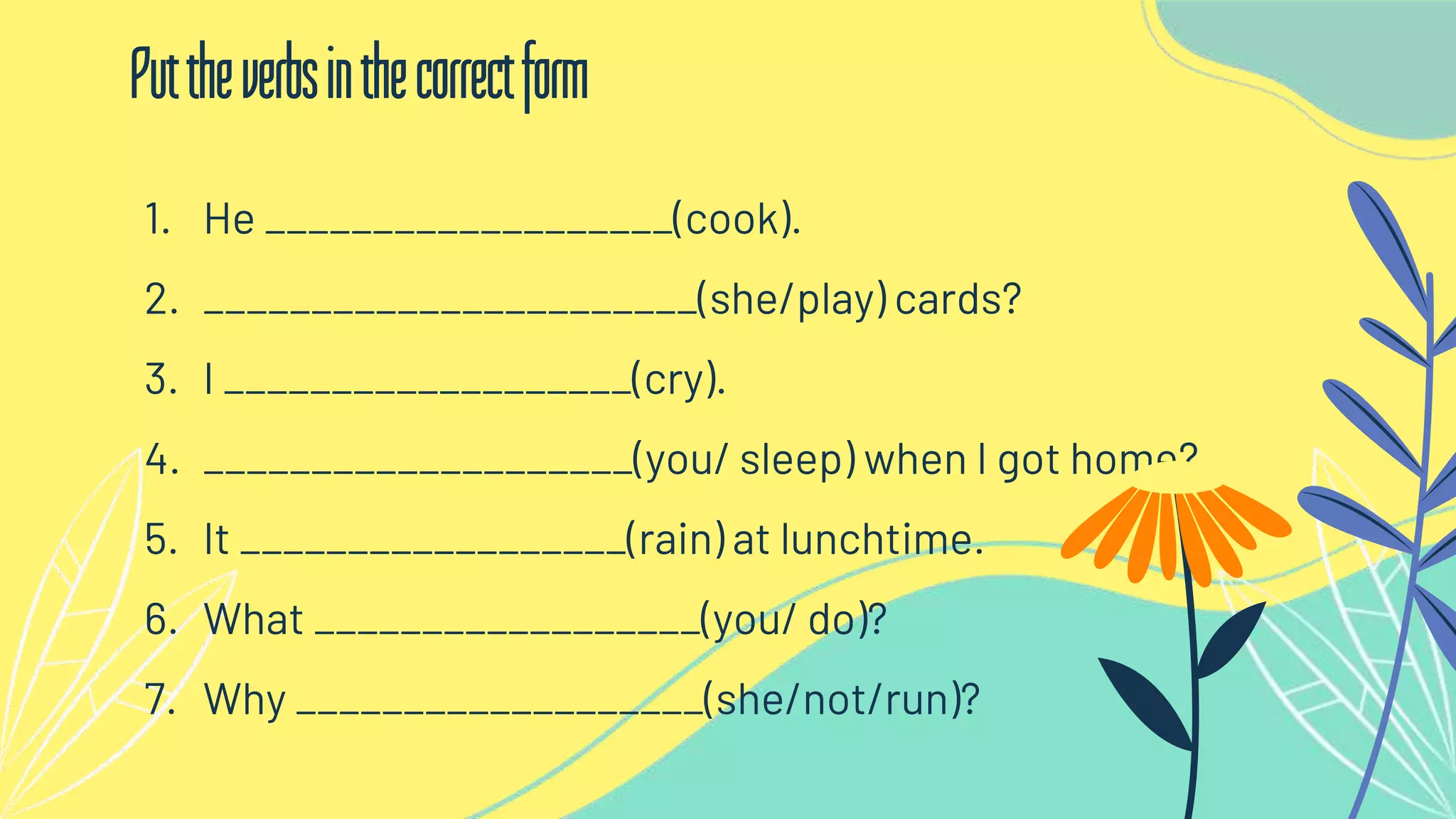
1. He ___________________(cook).
2. _______________________(she/play) cards?
3. I ___________________(cry).
4. ____________________(you/ sleep) when I got home?
5. It __________________(rain) at lunchtime.
6. What __________________(you/ do)?
7. Why ___________________(she/not/run)?
Puttheverbsinthecorrectform
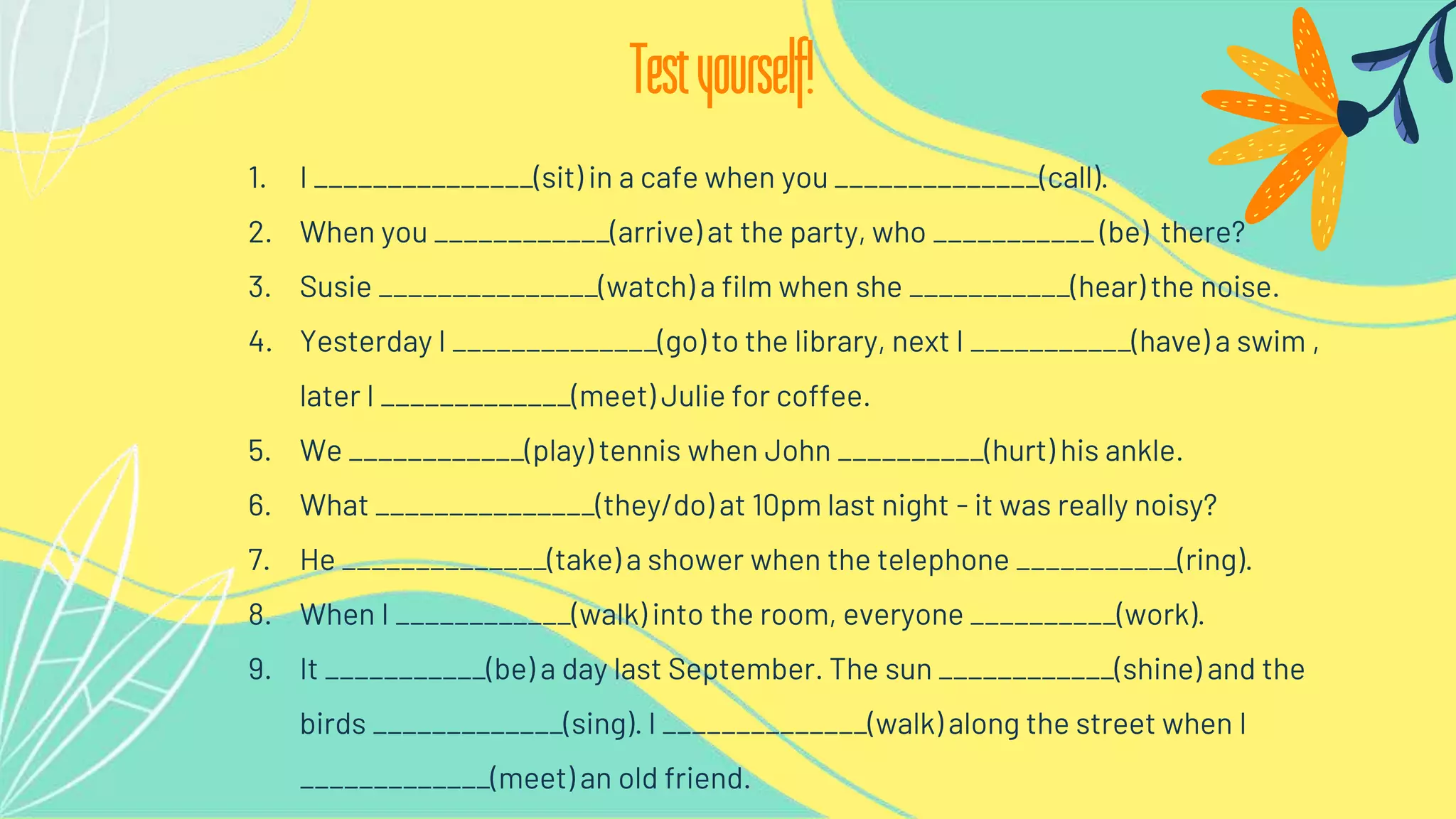
1. I _______________(sit) in a cafe when you ______________(call).
2. When you ____________(arrive) at the party, who ___________ (be) there?
3. Susie _______________(watch) a film when she ___________(hear) the noise.
4. Yesterday I ______________(go) to the library, next I ___________(have) a swim ,
later I _____________(meet) Julie for coffee.
5. We ____________(play) tennis when John __________(hurt) his ankle.
6. What _______________(they/do) at 10pm last night - it was really noisy?
7. He ______________(take) a shower when the telephone ___________(ring).
8. When I ____________(walk) into the room, everyone __________(work).
9. It ___________(be) a day last September. The sun ____________(shine) and the
birds _____________(sing). I ______________(walk) along the street when I
_____________(meet) an old friend.
Testyourself!
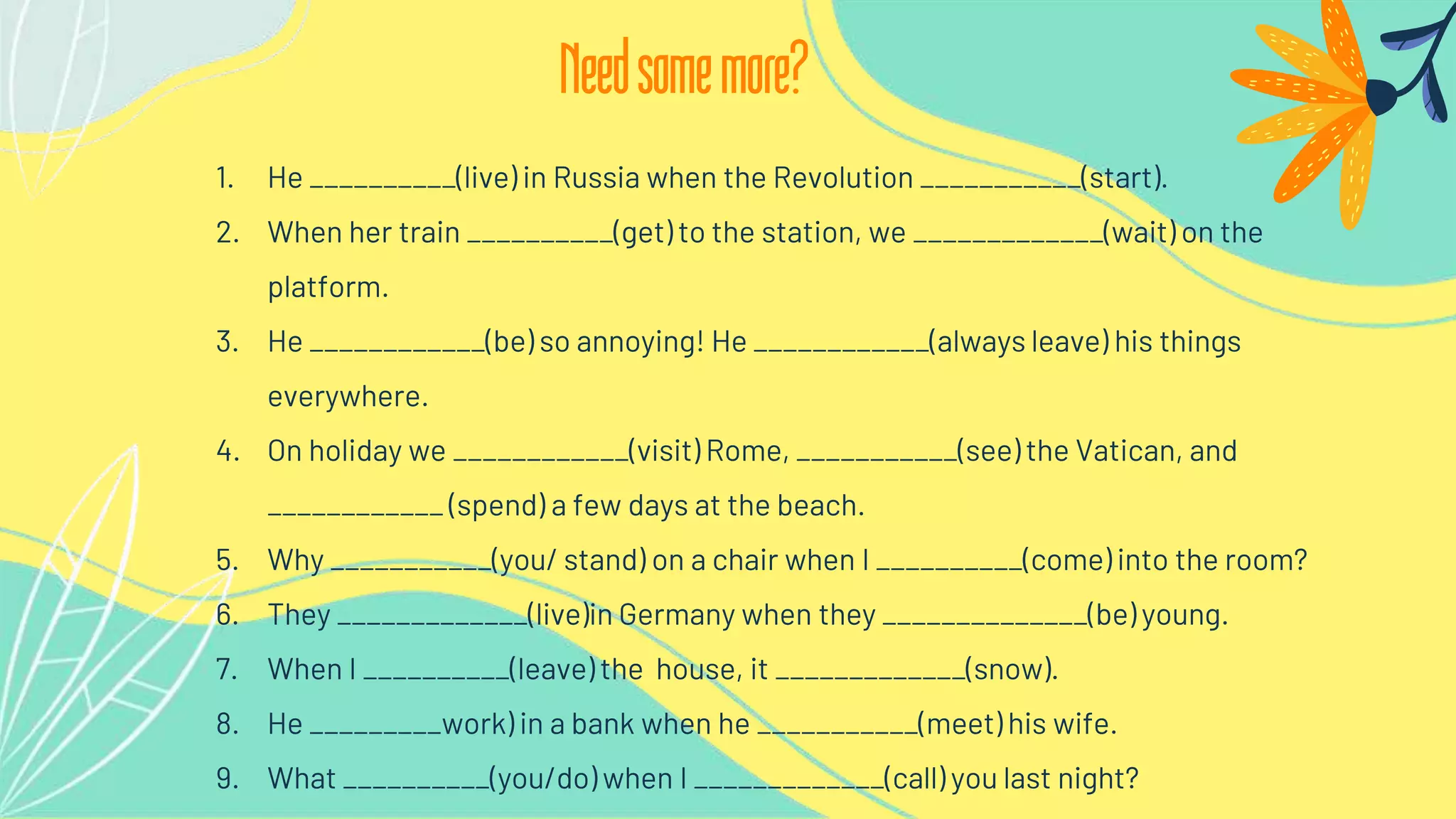
1. He __________(live) in Russia when the Revolution ___________(start).
2. When her train __________(get) to the station, we _____________(wait) on the
platform.
3. He ____________(be) so annoying! He ____________(always leave) his things
everywhere.
4. On holiday we ____________(visit) Rome, ___________(see) the Vatican, and
____________ (spend) a few days at the beach.
5. Why ___________(you/ stand) on a chair when I __________(come) into the room?
6. They _____________(live)in Germany when they ______________(be) young.
7. When I __________(leave) the house, it _____________(snow).
8. He _________work) in a bank when he ___________(meet) his wife.
9. What __________(you/do) when I _____________(call) you last night?
Needsomemore?
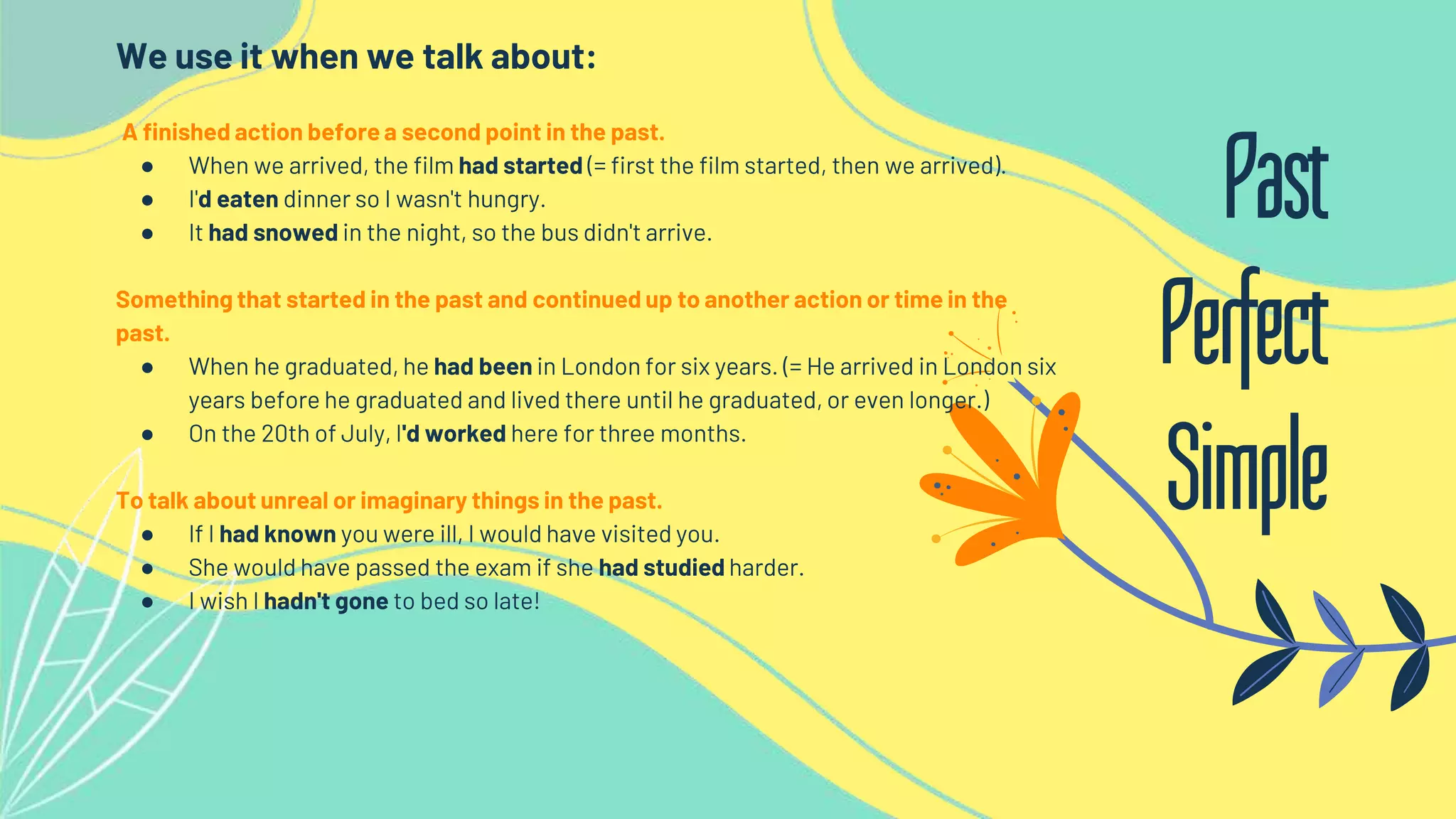
We use it when we talk about:
A finished action before a second point in the past.
● When we arrived, the film had started (= first the film started, then we arrived).
● I'd eaten dinner so I wasn't hungry.
● It had snowed in the night, so the bus didn't arrive.
Something that started in the past and continued up to another action or time in the
past.
● When he graduated, he had been in London for six years. (= He arrived in London six
years before he graduated and lived there until he graduated, or even longer.)
● On the 20th of July, I'd worked here for three months.
To talk about unreal or imaginary things in the past.
● If I had known you were ill, I would have visited you.
● She would have passed the exam if she had studied harder.
● I wish I hadn't gone to bed so late!
Past
Perfect
Simple
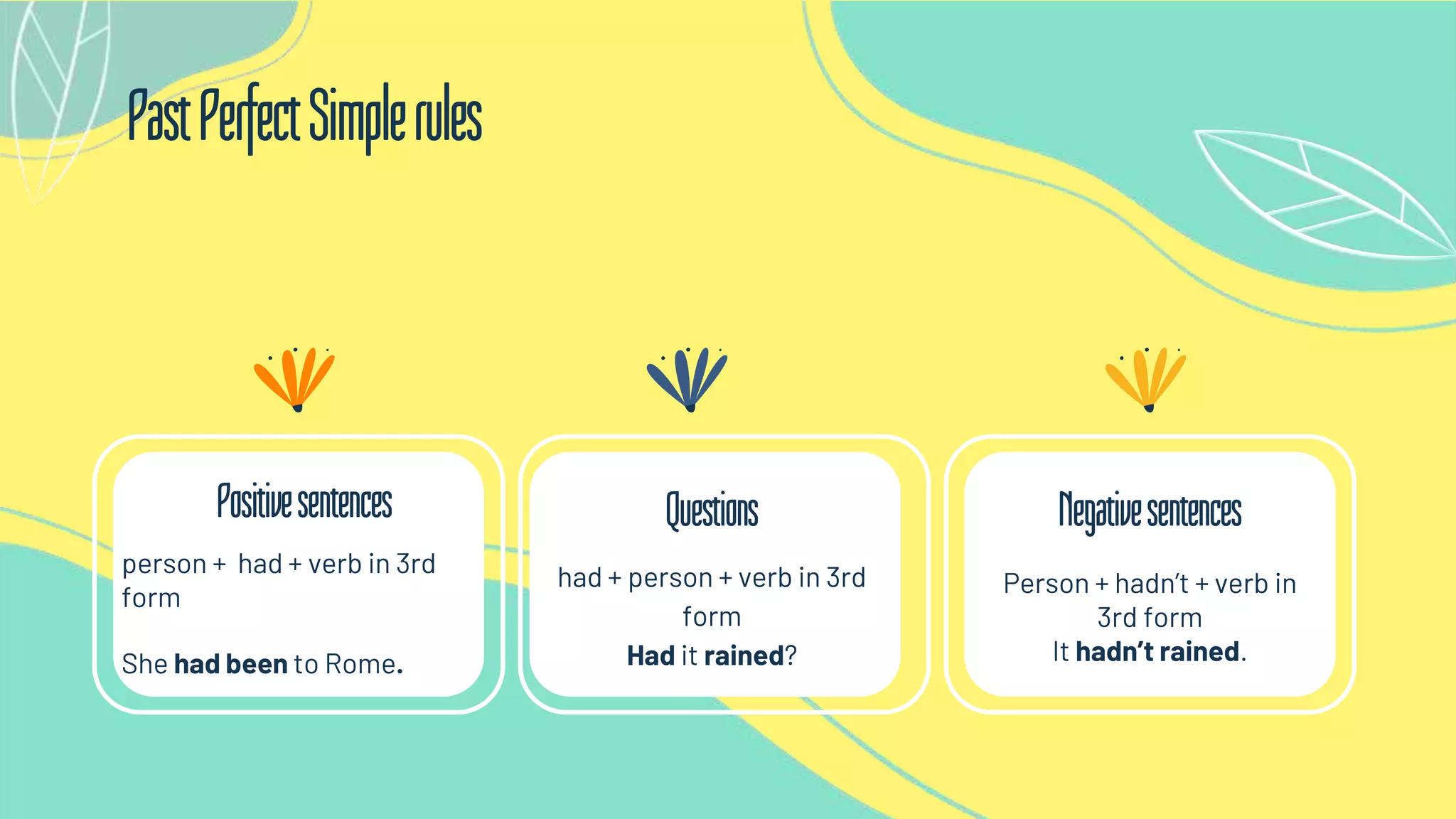
Negativesentences
Positivesentences
Person + hadn’t + verb in
3rd form
It hadn’t rained.
person + had + verb in 3rd
form
She had been to Rome.
PastPerfectSimplerules
had + person + verb in 3rd
form
Had it rained?
Questions
1. When I arrived at the cinema, the film ______________(start).
2. After they _____________(eat) the shellfish, they began to
feel sick.
3. If you ____________(listen) to me, you would have got the job.
4. Julie didn’t arrive until after I __________(leave).
5. _____________(I/read) the book before the class?
6. ______________(it/be) cold all week?
Puttheverbsinthecorrectform
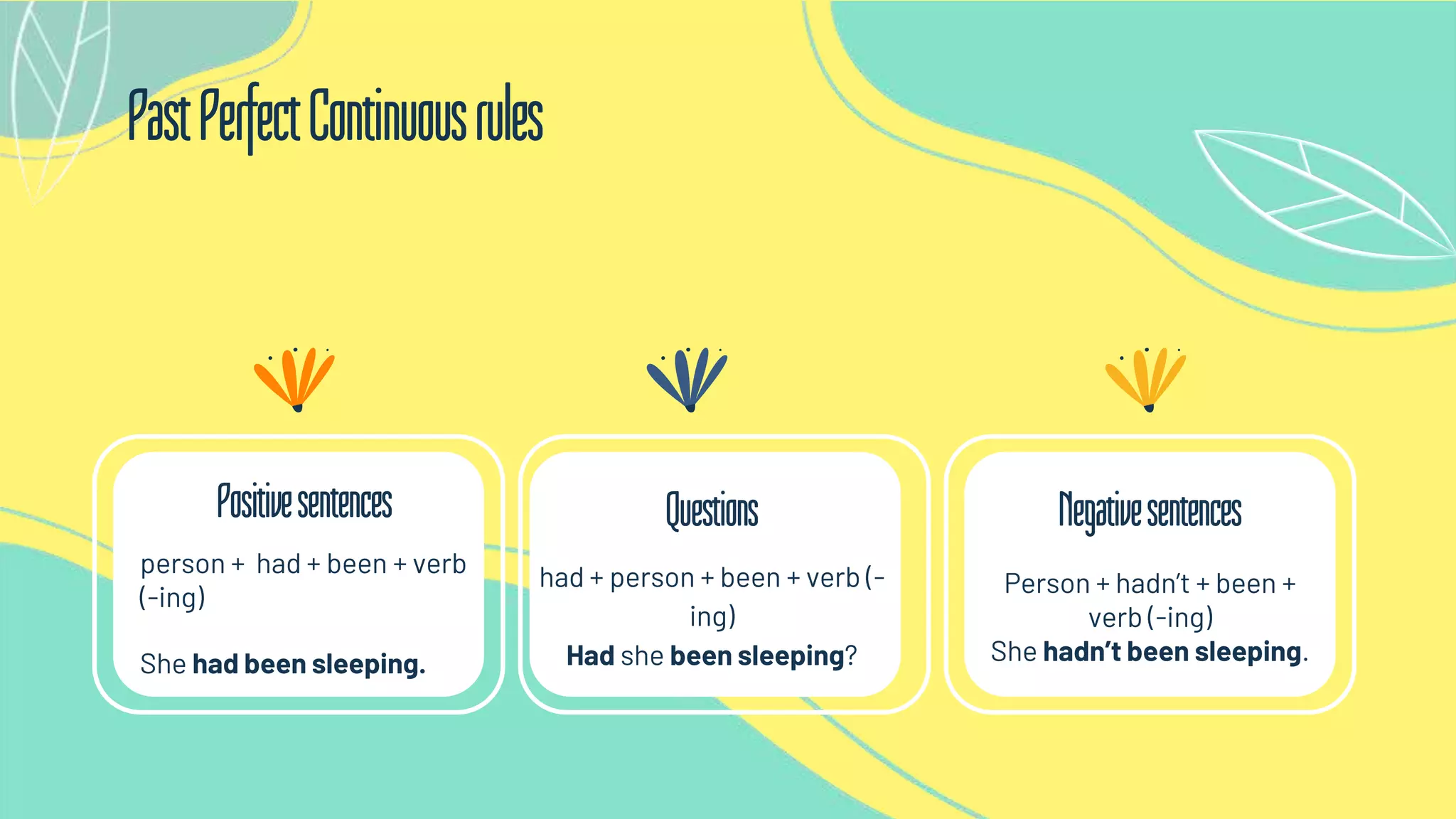
Negativesentences
Positivesentences
Person + hadn’t + been +
verb (-ing)
She hadn’t been sleeping.
person + had + been + verb
(-ing)
She had been sleeping.
PastPerfectContinuousrules
had + person + been + verb (-
ing)
Had she been sleeping?
Questions
1. I ____________________(work) all day, so I didn’t want to go out.
2. She _________________(not/work) but she was tired anyway.
3. _____________________(it/rain) when you left the restaurant?
4. We __________________(eat) all day, so we felt a bit ill.
5. He was in trouble with the teacher becase he ________________
(not/go) to classes.
6. There was water everywhere. What
________________________(the children/do)
Puttheverbsinthecorrectform
1. We had already eaten when John _________________(come) home.
2. I opened my handbag to find that I ________________(forget) my wallet.
3. When we ____________(arrive) at the station, the train had already left.
4. We got home to find that someone _____________(break) into our the house.
5. They ______________(study) all day so when we ___________(meet) them they
were exhausted.
6. The bos ______________(talk) to clients on Skype for hours so she
___________(want) to take a break.
7. I _______________(drink) coffee all morning. By lunchtime, I
_____________(feel) really strange!
8. I opened the fridge to find that someone _____________(eat) all my chocolate.
Testyourself!
Pasttenses
1. By the time we ________(get) to the theatre, the play ________________(already, start).
2. Last night I ___________(dream) about going to the Moon.
3. When Ginny __________(see) me yesterday, I _____________(cross) the street.
4. My dad _____________(paint) the room before my brother __________(come) to help
him.
5. As Claire _____________ (dust) the furniture, she ____________(break) her mum’s vase.
6. My sister ____________________(never, be) to the circus before.
7. Pam and I _______________________(study) for the history exam when the lights
_____________(go) off.
8. You _____________(not/sleep) when I ______________(return) last night.
9. When ___________________(they/visit) you last time?
10. Yesterday at this time, Karen ______________________(write) a letter to her mum.
11. When we ______________________(go) out for a walk last Sunday, the sun
________________(shine) and it __________(be) quite warm.
Futuretenses
03
We use it when we talk about:
Future facts and things that are less certain.
● The sun will rise at 7am.
● I think the Conservatives will win the next election.
Promises / requests / refusals / offers.
● I'll help you with your homework.
● Will you give me a hand?
● I won't go!
We use the simple future with 'will' in the first conditional, and in other sentences
that have a conditional feeling.
● If it doesn't rain, we'll go to the park.
● Let's arrive early. That will give us time to relax.
Future
Simple
Moreexamples
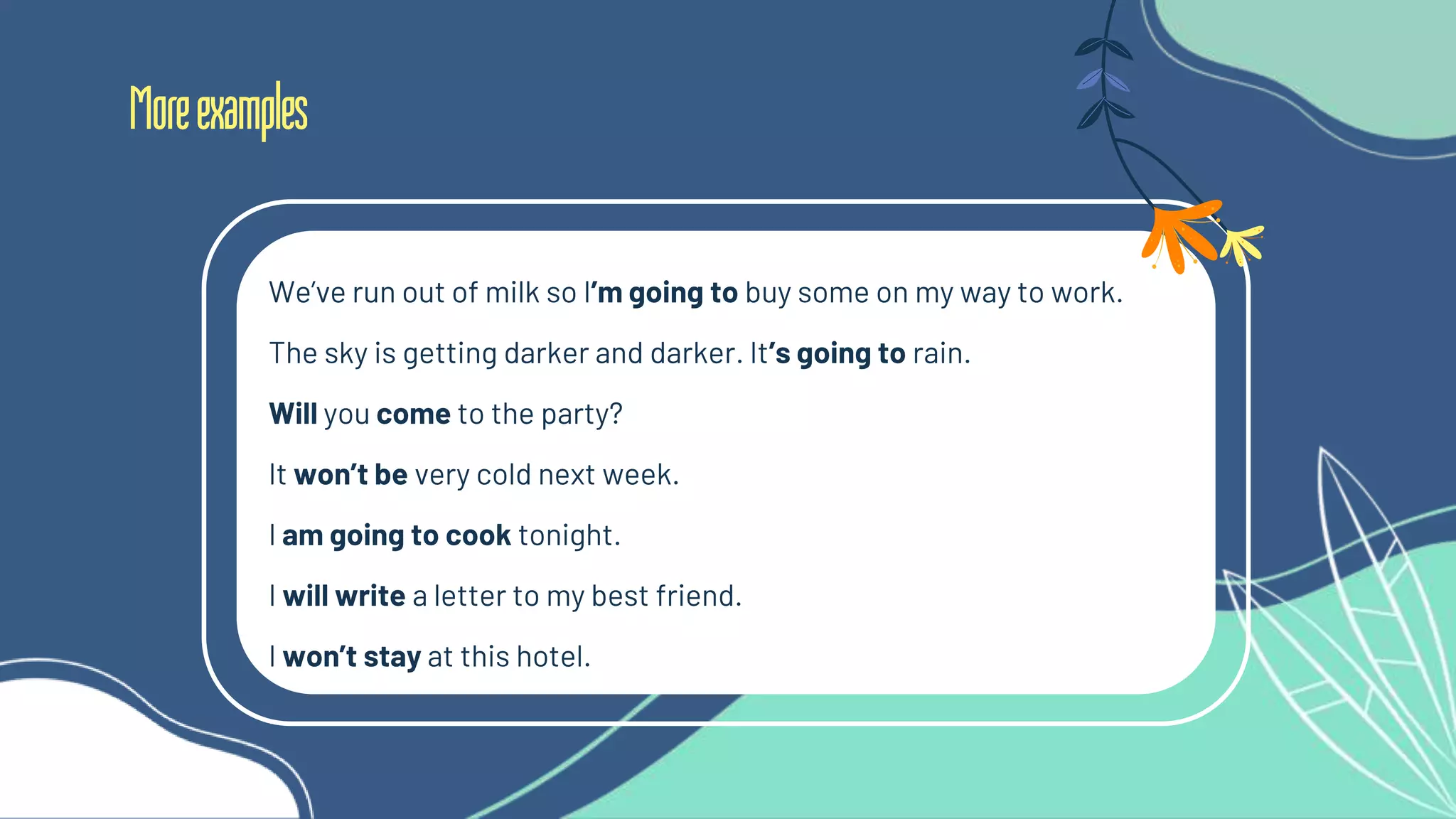
We’ve run out of milk so I’m going to buy some on my way to work.
The sky is getting darker and darker. It’s going to rain.
Will you come to the party?
It won’t be very cold next week.
I am going to cook tonight.
I will write a letter to my best friend.
I won’t stay at this hotel.
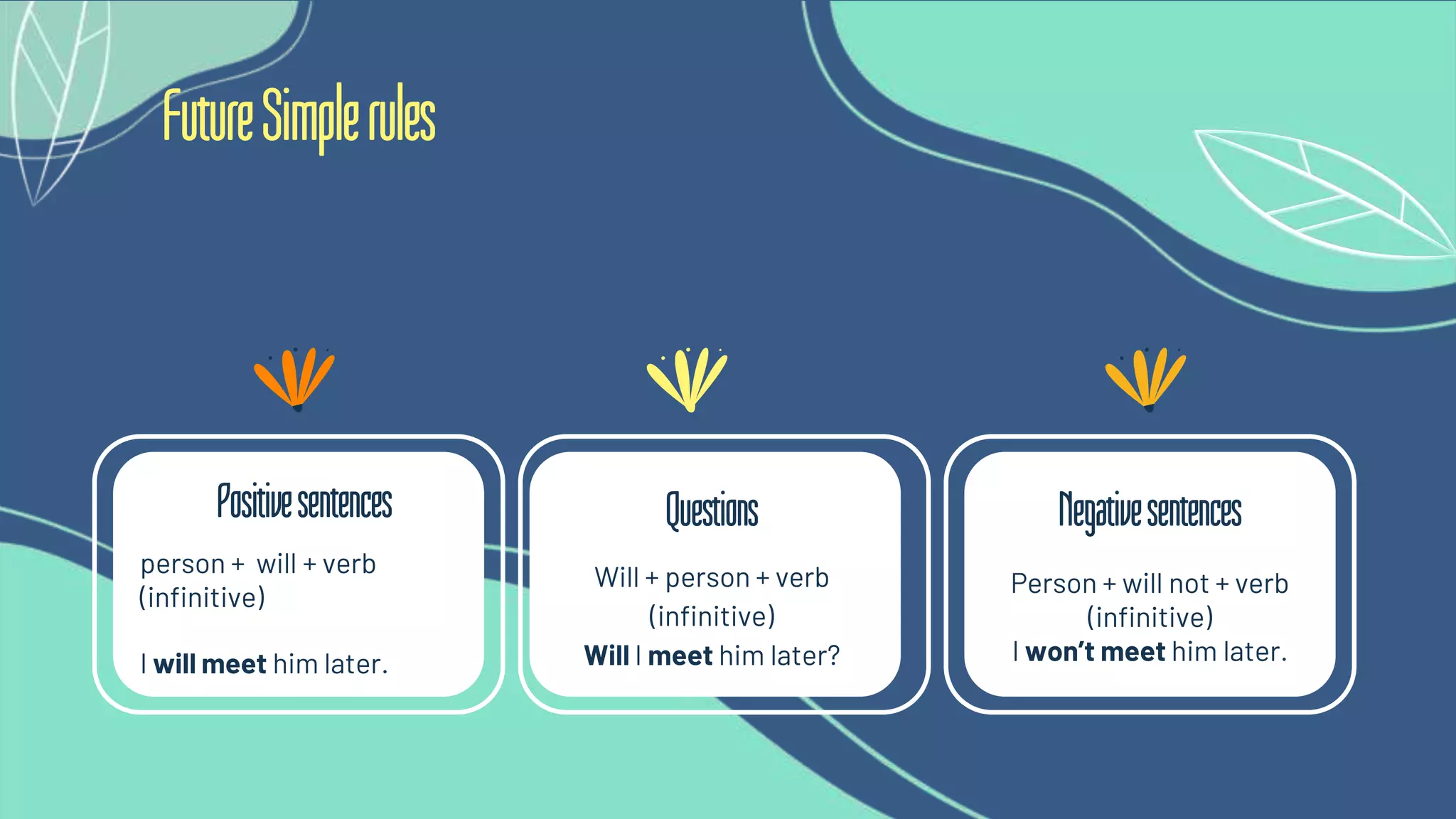
Negativesentences
Positivesentences
Person + will not + verb
(infinitive)
I won’t meet him later.
person + will + verb
(infinitive)
I will meet him later.
FutureSimplerules
Will + person + verb
(infinitive)
Will I meet him later?
Questions
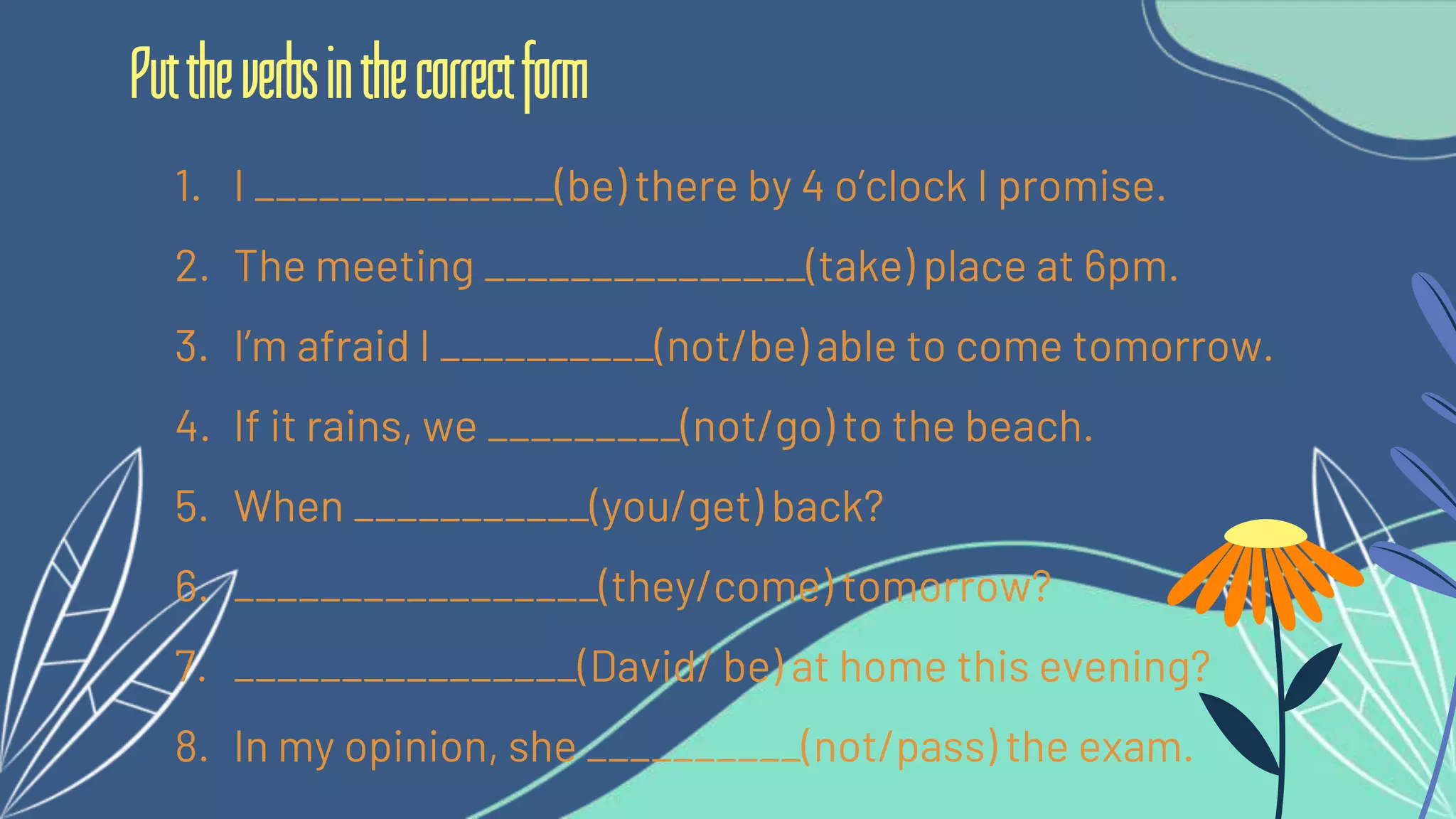
1. I ______________(be) there by 4 o’clock I promise.
2. The meeting _______________(take) place at 6pm.
3. I’m afraid I __________(not/be) able to come tomorrow.
4. If it rains, we _________(not/go) to the beach.
5. When ___________(you/get) back?
6. _________________(they/come) tomorrow?
7. ________________(David/ be) at home this evening?
8. In my opinion, she __________(not/pass) the exam.
Puttheverbsinthecorrectform
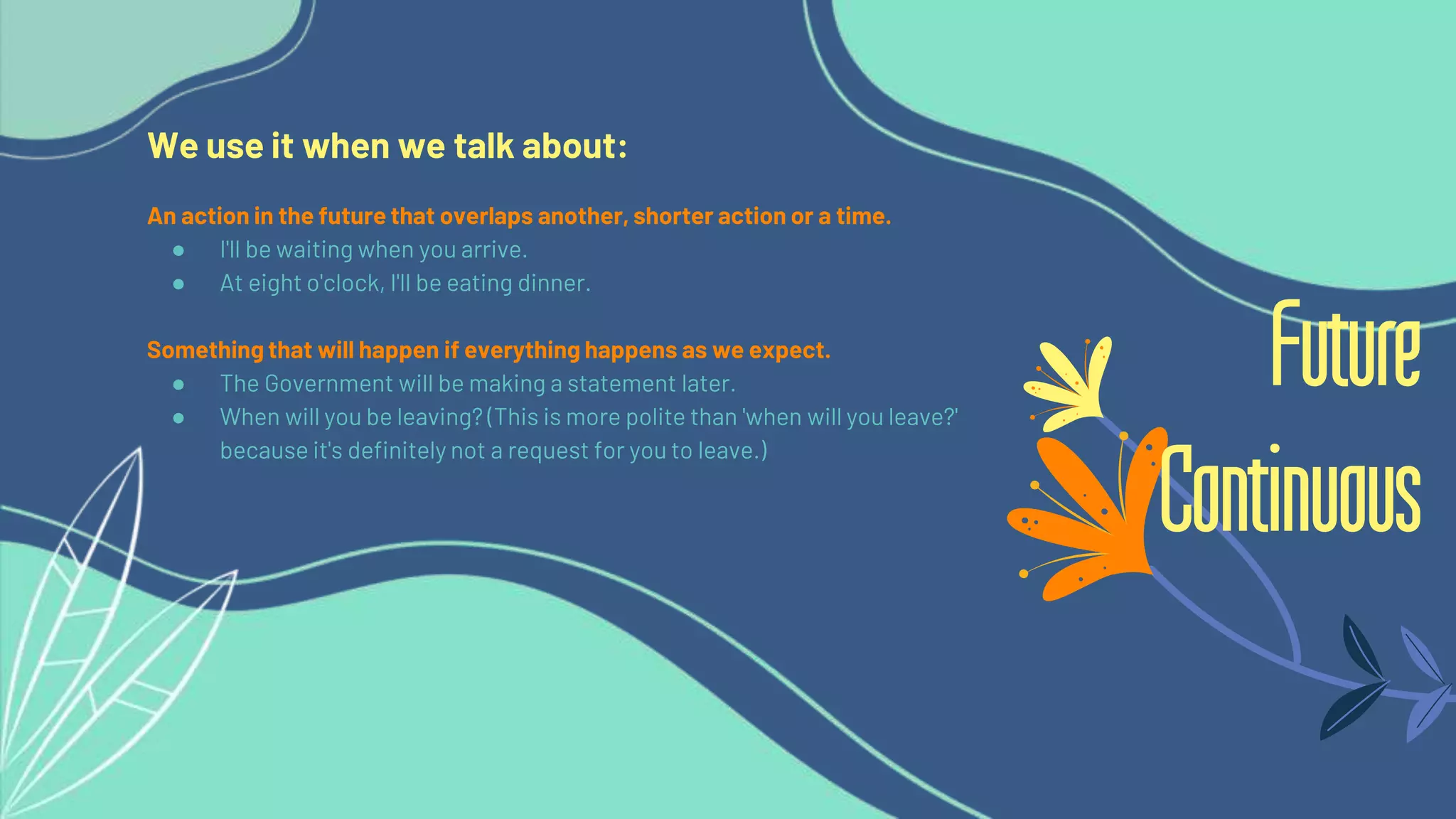
We use it when we talk about:
An action in the future that overlaps another, shorter action or a time.
● I'll be waiting when you arrive.
● At eight o'clock, I'll be eating dinner.
Something that will happen if everything happens as we expect.
● The Government will be making a statement later.
● When will you be leaving? (This is more polite than 'when will you leave?'
because it's definitely not a request for you to leave.)
Future
Continuous
Moreexamples
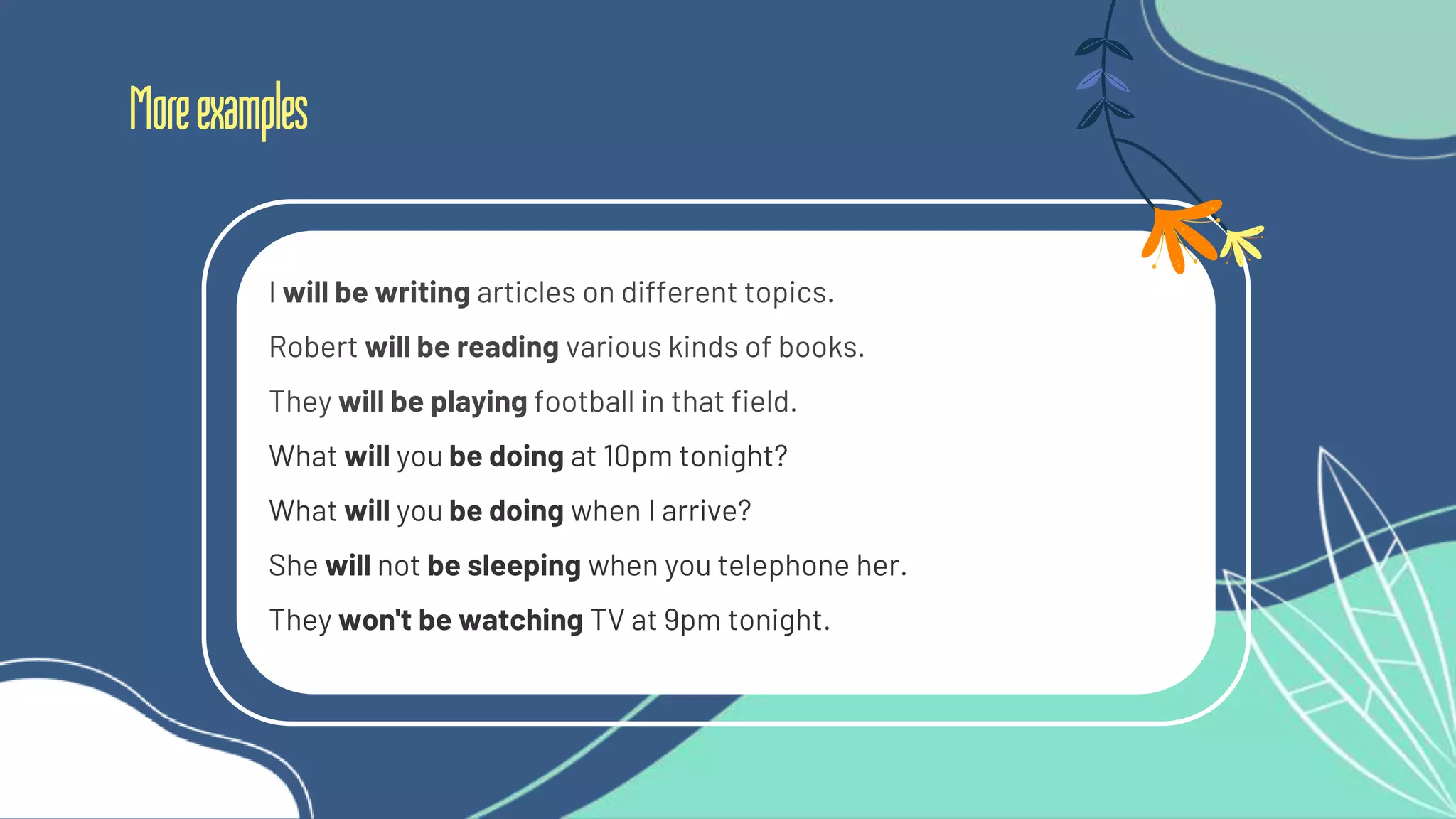
I will be writing articles on different topics.
Robert will be reading various kinds of books.
They will be playing football in that field.
What will you be doing at 10pm tonight?
What will you be doing when I arrive?
She will not be sleeping when you telephone her.
They won't be watching TV at 9pm tonight.
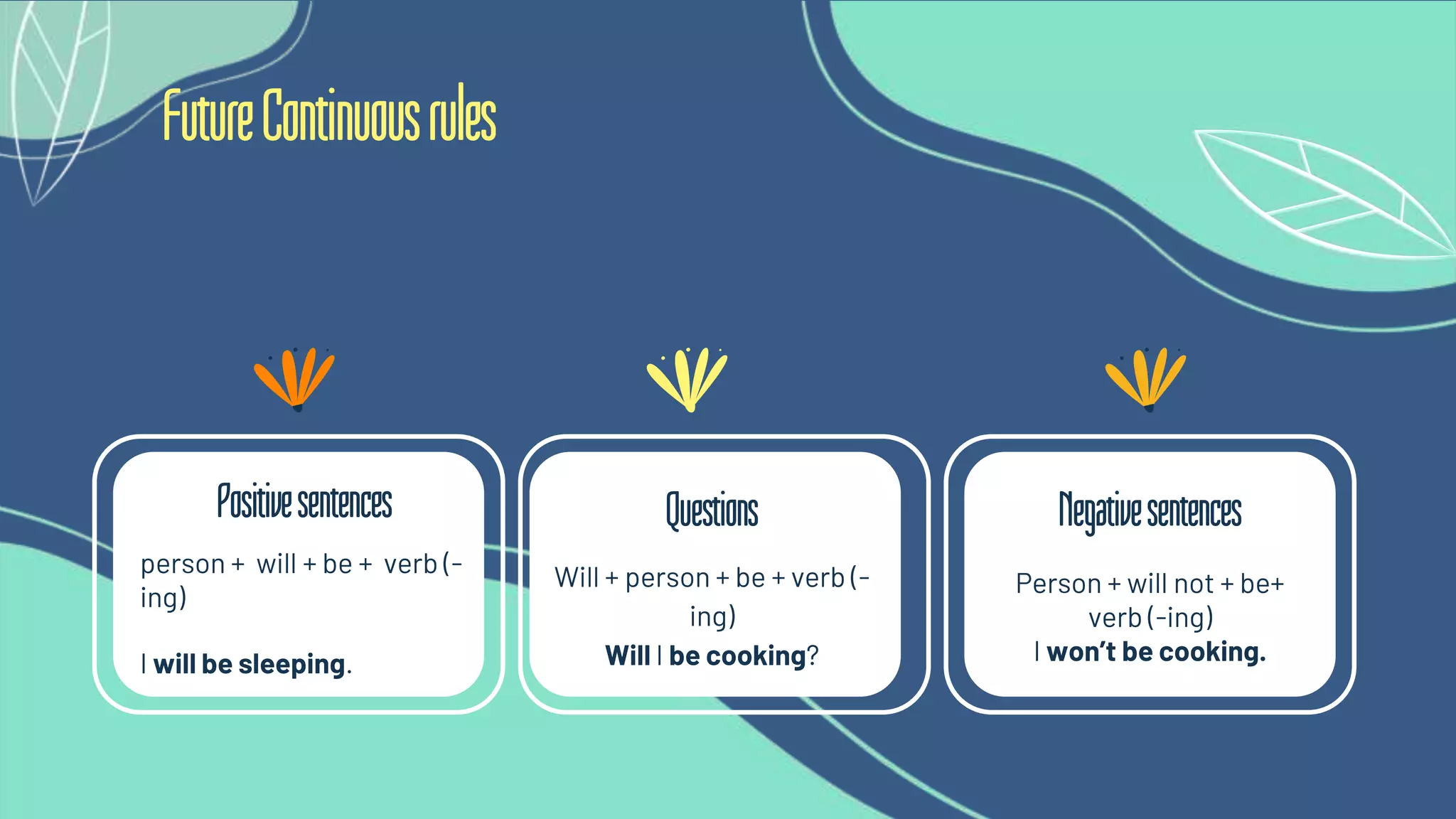
Negativesentences
Positivesentences
Person + will not + be+
verb (-ing)
I won’t be cooking.
person + will + be + verb (-
ing)
I will be sleeping.
FutureContinuousrules
Will + person + be + verb (-
ing)
Will I be cooking?
Questions
1. At 3 o’clock tomorrow, you ______________(lie) on the beach.
2. At 10 o’clock tomorrow she __________________(sleep).
3. When she arrives, I ______________________(not/wait).
4. When they arrive, David __________________(not/cook).
5. When the boss comes, ____________(John/use) the computer?
6. When she comes in, _____________(you/talk) on the phone?
7. At 8pm, where ___________________(I/wait)?
Puttheverbsinthecorrectform
1. I ____________(help) you as soon as I finish this project.
2. You should recognise her easily. She _____________(wear) a red skirt.
3. At 11pm I ________________(sleep).
4. I suppose the weather ______________(be) good.
5. She ______________(send) Bruno the letter when she has time.
6. Tomorrow at this time, I _____________________(attend) the conference.
7. They work hard. They ________________(get) good marks at the end of the school.
Testyourself!
We use it to:
Say 'how long' for an action that starts before and continues up to another
action or time in the future.
● When we get married, I'll have known Robert for four years.
● At 4 o'clock, I'll have been in this office for 24 hours.
Talk about an action that will finish before a certain time in the future, but
we don't know exactly when.
● By 10 o'clock, I will have finished my homework. (= I will finish my
homework some time before 10, but we don't know exactly when.)
● By the time I'm sixty, I will have retired. (= I will retire sometime before
I'm sixty. Maybe when I'm fifty-nine, maybe when I'm fifty-two.)
Future
Perfect
Simple
Moreexamples
Margaret will have married Jerome by then.
The storm will have raged by the time we arrive.
Will you have married Jerome by then?
Will Mom have cooked our favorite meal?
Will the plant have grown by then?
I will not have eaten by then.
Henry will not have ran by ten o'clock.
Jenny will not have saved enough money yet.
Negativesentences
Positivesentences
Person + will not + have+
verb in 3rd form
I won’t have finished this
book.
person + will + have + verb
in3rd form
I will have finished this
book.
FuturePerfectSimplerules
Will + person + have + verb in
3rd form
Will I have finished this
book?
Questions
1. I ___________(leave) by six.
2. ________________________(you/finish) the report by Monday?
3. She _________________(not/finish) work by seven.
4. When __________________(you/complete) the work?
5. They _______________(arrive) by dinner time.
6. ______________________(she/get) home by lunch?
7. He _________________(not/complete) the project by July.
8. ______________(you/do) everything by seven?
Puttheverbsinthecorrectform
We use it to:
Say 'how long' for an action that continues up to another point in the
future.
● In April, she will have been teaching for twelve years.
● By the time you arrive, I'll have been cooking for hours!
To talk about something that finishes just before another time or action (in
this case, in the future).
● When I see you, I'll have been studying, so I'll be tired.
Future
Perfect
Continuous
Moreexamples
In November, I will have been working at my company for three years.
At five o'clock, I will have been waiting for thirty minutes.
When I turn thirty, I will have been playing piano for twenty-one years.
By our 40th anniversary, this plant will have been growing for 35 years.
Will he have been sleeping for four hours by midnight?
Negativesentences
Positivesentences
Person + will not + have+
been + verb (-ing)
I won’t have been
working.
person + will + have + been +
verb (-ing)
I will have been working.
FuturePerfectContinuousrules
Will + person + have + been +
verb (-ing)
Will I have been working?
Questions
1. I ____________________(work) all weekend so I won't be energetic
on Sunday night.
2. How long ___________________(you / wait) when you finally get
your exam results?
3. Julie _________________________(not / eat) much, so we'll need to
make sure she has a good meal when she arrives.
4. __________________(she / wait) long by the time we get there?
1. ______________________(he / play) computer games for ten hours
when he finally stops?
Puttheverbsinthecorrectform
Futuretenses
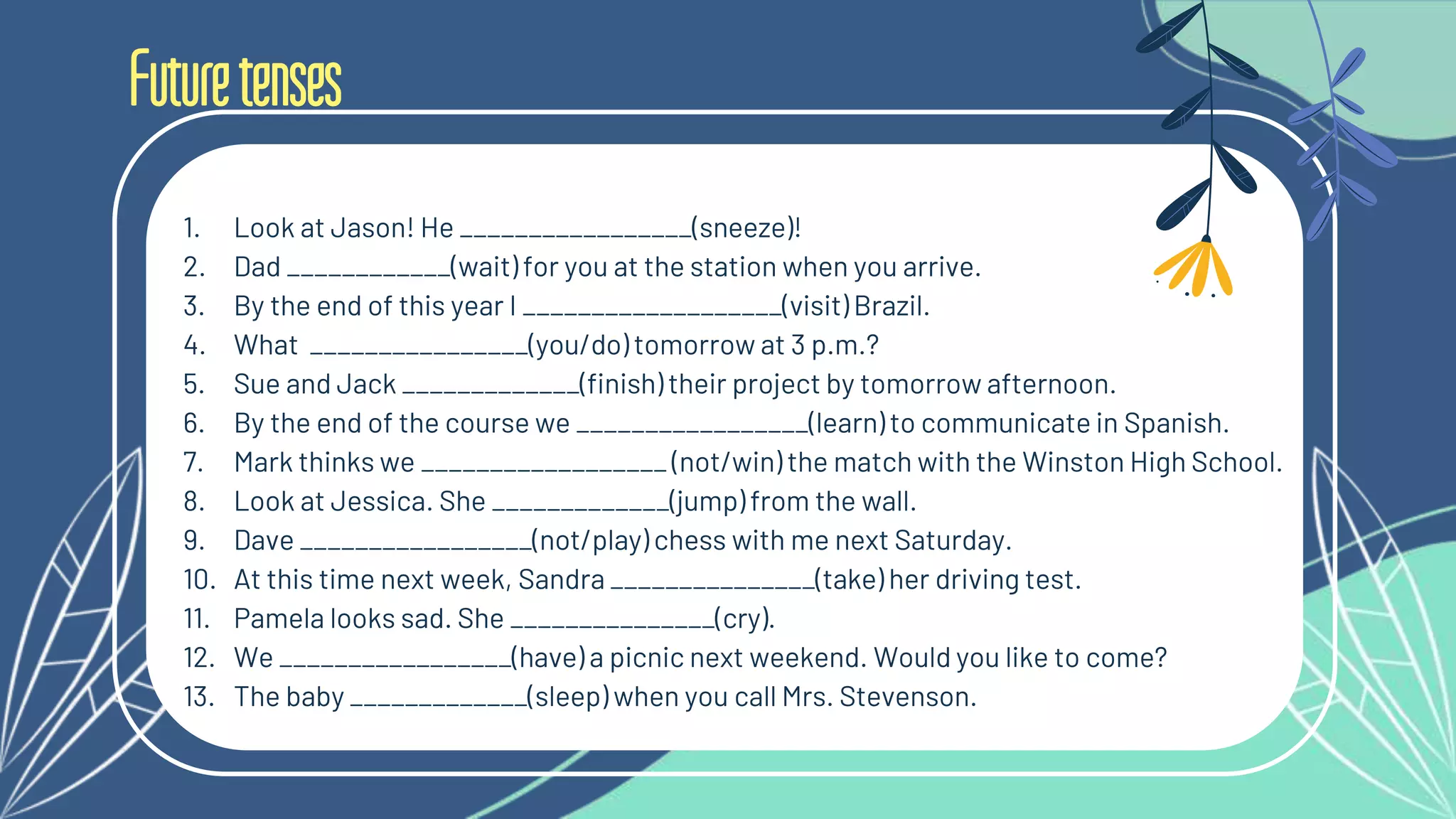
1. Look at Jason! He _________________(sneeze)!
2. Dad ____________(wait) for you at the station when you arrive.
3. By the end of this year I ___________________(visit) Brazil.
4. What ________________(you/do) tomorrow at 3 p.m.?
5. Sue and Jack _____________(finish) their project by tomorrow afternoon.
6. By the end of the course we _________________(learn) to communicate in Spanish.
7. Mark thinks we __________________ (not/win) the match with the Winston High School.
8. Look at Jessica. She _____________(jump) from the wall.
9. Dave _________________(not/play) chess with me next Saturday.
10. At this time next week, Sandra _______________(take) her driving test.
11. Pamela looks sad. She _______________(cry).
12. We _________________(have) a picnic next weekend. Would you like to come?
13. The baby _____________(sleep) when you call Mrs. Stevenson.
CREDITS: This presentation template was created by Slidesgo, including icons
by Flaticon, and infographics & images by Freepik
THANKS!
Do you have any questions?
Grammar rules taken from: https://www.perfect-english-grammar.com/

English tenses explained.pptx

  • 1.
  • 2.
  • 3.
    We use itwhen we talk about: Things which are always true: *Water boils at 100 degrees. Permanent situations (or nearly permanent; true for a few years at least): *Julie lives in London. Habits or things we do regularly: I drink coffee every morning. Future events which are part of a timetable: *My plane leaves at eight tonight. To talk about the future after certain words ('when' 'until' 'after' 'before' 'as soon as'): *I'll call you when I get home. To talk about what happens in books, plays and films: *At the end of the book, the detective catches the killer. Present Simple
  • 4.
    Negativesentences Positivesentences Here we use“don’t” in every person BUT in 3rd person singular we use “doesn’t”. In positive sentences we add “-s”, “-es”” or “-ies” to the 3rd person singular - he, she, it. PresentSimplerules To create questions we use “do” and in 3rd person singular we use “does”. Have - has Do - does Go - goes Questions Irregularverbs
  • 5.
    1. _______________(he/eat) riceevery day? 2. _______________(he/come) to London often? 3. They ________(go) to a restaurant every Sunday. 4. You usually _________(arrive) late. 5. He normally ________(eat) dinner at home. 6. ____________ (they/work) late usually? 7. I __________ (not/drink) coffee very often. Puttheverbsinthecorrectform
  • 6.
    We use itwhen we talk about: Things which are happening at the moment of speaking: *The water is boiling now, so you can put in the pasta. Temporary situations: *Julie is living in Paris for a few months (usually she lives in London). Situations which are slowly changing: *I'm getting better and better at speaking English. Temporary or new habits: *I'm drinking too much coffee these days because I'm so busy at work. Annoying habits (usually with 'always'): *My flatmate is always leaving the kitchen in a mess! Definite future plans: *I'm meeting John after class today. To talk about people in pictures and photos: *In this photo, my mother is walking beside a lake. Present Continuous
  • 7.
    Negativesentences Positivesentences Here we useto be + not. He is not playing golf. I am not playing golf. They are not playing golf. In positive sentences we use construction to be + verb (-ing). PresentContinuousrules To create questions we put to be first, then the person and then the verb. Questions
  • 8.
    1. _______________(you/come) tonight? 2.I _________________ (work) at the moment. 3. He ________________ (play) tennis now. 4. ______________ (you/come) to the cinema tonight? 5. He ________________(not/play) golf now. 6. Julie ______________(sleep) now. 7. What ________________ (you/do) right now? Puttheverbsinthecorrectform
  • 9.
    SIMPLEORCONTINUOUS? WHY? She goes toschool every day. They are playing footbal. Are you going out tonight? Is he making dinner? He wears tie to work. They are singing a song. Does she like fish? She is not doing the dishes. I don’t like doing the ironing. We don’t work on Fridays.
  • 10.
    1. Andy sometimes_____________ comics. ( to read) 2. We never _________________TV in the morning. ( to watch) 3. Listen! Sandy___________________ in the bathroom. ( to sing) 4. My sister usually _________________in the kitchen. ( to help) 5. My mother ____________________breakfast now. ( to make) 6. They often_____________________ the bathroom. ( to clean) 7. Look! The boys ___________________home. (to come) 8. Every day his grandfather ___________________for a walk. ( to go) 9. Cats __________mice. (to eat) 10. I ________________ with my friends at the moment. (to chat) 11. Every Monday she _______________ her kids to football practice. (to drive) Testyourself!
  • 11.
    Unfinished Actions We usethis tense when we want to talk about unfinished actions or states or habits that started in the past and continue to the present. Usually we use it to say 'how long' and we need 'since' or 'for'. *I have known Karen since 1994. *She has lived in London for three years. *I have worked here for six months. *I've liked chocolate since I was a child. *I've been hungry for hours. Finished Actions A finished action in someone's life (when the person is still alive: life experience): *My brother has been to Mexico three times. A finished action with a result in the present: *I've lost my keys! (The result is that I can't get into my house now). With an unfinished time word (this week, this month, today): *I've seen John this week. Present Perfect Simple
  • 12.
    Negativesentences Positivesentences Person + haven’t/hasn’t+ verb in 3rd form She hasn’t done her homework. person + have/has + verb in 3rd form She has done her homework PresentPerfectSimplerules Have/has + person + verb in 3rd form Has she done her homework? Questions
  • 13.
    1. You ___________(keep) a pet for three years. 2. _______________(you, eat) Thai food before? 3. _____________ (it, rain) all day? 4. He ___________ (not, forget) his books. 5. She ____________(steal) all the chocolate. 6. Who __________(he, meet) recently? 7. I __________ (know) him for three months. Puttheverbsinthecorrectform
  • 14.
    Unfinished actions To sayhow long for unfinished actions which started in the past and continue to the present. *I've been living in London for two years. *She's been working here since 2004. *We've been waiting for the bus for hours. For temporary habits or situations. *I've been going to the gym a lot recently. *They've been living with his mother while they look for a house. *I've been reading a lot recently. Finished actions Actions which have recently stopped (though the whole action can be unfinished) and have a result, which we can often see, hear, or feel, in the present. *I'm so tired, I've been studying. *I've been running, so I'm really hot. *It's been raining so the pavement is wet. Present Perfect Continuous
  • 15.
    Negativesentences Positivesentences Person + haven’t/hasn’t+ been + V (-ing) She hasn’t been working all day. person + have/has + been + V (-ing) She has been working all day. PresentPerfectContinuousrules Have/has + person + been + V (-ing) Has she been working all day? Questions
  • 16.
    1. She __________________(work)here for 5 years. 2. You __________________(not, eat) well recently. 3. _____________________(it, rain)? 4. You _______________(sleep) for 12 hours. 5. _______________(they, live) here for a long time? 6. I _________________ (swim) for two hours today. 7. How long _________________(you, study) Italian? Puttheverbsinthecorrectform
  • 17.
    Presenttenses 1. How long______________(you/wait) for the bus? You _________(look) really annoyed. 2. He never ___________(wear) a tie to work. 3. In winter, what ___________(you/wear)? 4. The coat ___________(not/fit) me. I need a bigger size. 5. The dog ____________(dig) all the morning, but it ______________(not/find) any bones. 6. How many books ____________________(she/edit) so far? 7. You are a great cook! The cake __________(taste) wonderfully. 8. See you later. I ____________(leave) in a minute. 9. Henry still _________________ (not/find) a job. 10. I _______________(drive)! You can sit in the back with Martin. 11. Why _______________(you/look) at me like that? Have I done something wrong? 12. This is an exam. Why ________________(you/talk)? 13. We _________________(walk) the whole day. Let’s have a rest.
  • 18.
  • 19.
    We use itwhen we talk about: Finished actions, states or habits in the past. ● I went to the cinema yesterday. ● We spent a lot of time in Japan in 2007. Adding details ● I've hurt my leg. I fell off a ladder when I was painting my bedroom. ● I've been on holiday. I went to Spain and Portugal. General knowledge ● Leonardo painted the Mona Lisa. ● The Vikings invaded Britain. Unreal or imaginary things in the present or future. ● If I won the lottery, I would buy a house. ● I wish I had more time! Past Simple
  • 20.
    Negativesentences Positivesentences Person + didn’t/wasn’t/weren’t + verb(infinitive) She didn’t eat two burgers today. person + past verb She ate two burgers today. PastSimplerules Did/was/were + person + verb (infinitive) Did she eat two burgers today? Questions
  • 21.
    1. I __________(be)at the cinema last night. 2. _________________(children/be) naughty? 3. What _____________(he/give) his mother for Christmas? 4. I _________________(not/drink) any beer last night. 5. She _____________ (get on) the bus in the city. 6. What time ______________(he/get up) yesterday? 7. We ________________(wake up) very late. Puttheverbsinthecorrectform
  • 22.
    We use itwhen we talk about: An action in the past which overlaps another action or a time. ● I was walking to the station when I met John. (I started walking before I met John, and maybe I continued afterwards.) ● At three o'clock, I was working. (I started before three o'clock and finished after three o'clock.) For the background of a story. ● The birds were singing, the sun was shining and in the cafés people were laughing and chatting. Amy sat down and took out her phone. Temporary habits or habits that happen more often than we expect in the past. ● He was always leaving the tap running. ● She was constantly singing. To emphasise that something lasted for a while. ● I was working in the garden all day. ● He was reading all evening. Past Continuous
  • 23.
    Negativesentences Positivesentences Person + wasn’t/weren’t+ verb (-ing) She wasn’t sleeping when I came. person + was/were + verb (- ing) She was sleeping when I came. PastContinuousrules Was/were + person + verb (- ing) Were they sleeping when I came? Questions
  • 24.
    1. He ___________________(cook). 2._______________________(she/play) cards? 3. I ___________________(cry). 4. ____________________(you/ sleep) when I got home? 5. It __________________(rain) at lunchtime. 6. What __________________(you/ do)? 7. Why ___________________(she/not/run)? Puttheverbsinthecorrectform
  • 25.
    1. I _______________(sit)in a cafe when you ______________(call). 2. When you ____________(arrive) at the party, who ___________ (be) there? 3. Susie _______________(watch) a film when she ___________(hear) the noise. 4. Yesterday I ______________(go) to the library, next I ___________(have) a swim , later I _____________(meet) Julie for coffee. 5. We ____________(play) tennis when John __________(hurt) his ankle. 6. What _______________(they/do) at 10pm last night - it was really noisy? 7. He ______________(take) a shower when the telephone ___________(ring). 8. When I ____________(walk) into the room, everyone __________(work). 9. It ___________(be) a day last September. The sun ____________(shine) and the birds _____________(sing). I ______________(walk) along the street when I _____________(meet) an old friend. Testyourself!
  • 26.
    1. He __________(live)in Russia when the Revolution ___________(start). 2. When her train __________(get) to the station, we _____________(wait) on the platform. 3. He ____________(be) so annoying! He ____________(always leave) his things everywhere. 4. On holiday we ____________(visit) Rome, ___________(see) the Vatican, and ____________ (spend) a few days at the beach. 5. Why ___________(you/ stand) on a chair when I __________(come) into the room? 6. They _____________(live)in Germany when they ______________(be) young. 7. When I __________(leave) the house, it _____________(snow). 8. He _________work) in a bank when he ___________(meet) his wife. 9. What __________(you/do) when I _____________(call) you last night? Needsomemore?
  • 27.
    We use itwhen we talk about: A finished action before a second point in the past. ● When we arrived, the film had started (= first the film started, then we arrived). ● I'd eaten dinner so I wasn't hungry. ● It had snowed in the night, so the bus didn't arrive. Something that started in the past and continued up to another action or time in the past. ● When he graduated, he had been in London for six years. (= He arrived in London six years before he graduated and lived there until he graduated, or even longer.) ● On the 20th of July, I'd worked here for three months. To talk about unreal or imaginary things in the past. ● If I had known you were ill, I would have visited you. ● She would have passed the exam if she had studied harder. ● I wish I hadn't gone to bed so late! Past Perfect Simple
  • 28.
    Negativesentences Positivesentences Person + hadn’t+ verb in 3rd form It hadn’t rained. person + had + verb in 3rd form She had been to Rome. PastPerfectSimplerules had + person + verb in 3rd form Had it rained? Questions
  • 29.
    1. When Iarrived at the cinema, the film ______________(start). 2. After they _____________(eat) the shellfish, they began to feel sick. 3. If you ____________(listen) to me, you would have got the job. 4. Julie didn’t arrive until after I __________(leave). 5. _____________(I/read) the book before the class? 6. ______________(it/be) cold all week? Puttheverbsinthecorrectform
  • 30.
    Negativesentences Positivesentences Person + hadn’t+ been + verb (-ing) She hadn’t been sleeping. person + had + been + verb (-ing) She had been sleeping. PastPerfectContinuousrules had + person + been + verb (- ing) Had she been sleeping? Questions
  • 31.
    1. I ____________________(work)all day, so I didn’t want to go out. 2. She _________________(not/work) but she was tired anyway. 3. _____________________(it/rain) when you left the restaurant? 4. We __________________(eat) all day, so we felt a bit ill. 5. He was in trouble with the teacher becase he ________________ (not/go) to classes. 6. There was water everywhere. What ________________________(the children/do) Puttheverbsinthecorrectform
  • 32.
    1. We hadalready eaten when John _________________(come) home. 2. I opened my handbag to find that I ________________(forget) my wallet. 3. When we ____________(arrive) at the station, the train had already left. 4. We got home to find that someone _____________(break) into our the house. 5. They ______________(study) all day so when we ___________(meet) them they were exhausted. 6. The bos ______________(talk) to clients on Skype for hours so she ___________(want) to take a break. 7. I _______________(drink) coffee all morning. By lunchtime, I _____________(feel) really strange! 8. I opened the fridge to find that someone _____________(eat) all my chocolate. Testyourself!
  • 33.
    Pasttenses 1. By thetime we ________(get) to the theatre, the play ________________(already, start). 2. Last night I ___________(dream) about going to the Moon. 3. When Ginny __________(see) me yesterday, I _____________(cross) the street. 4. My dad _____________(paint) the room before my brother __________(come) to help him. 5. As Claire _____________ (dust) the furniture, she ____________(break) her mum’s vase. 6. My sister ____________________(never, be) to the circus before. 7. Pam and I _______________________(study) for the history exam when the lights _____________(go) off. 8. You _____________(not/sleep) when I ______________(return) last night. 9. When ___________________(they/visit) you last time? 10. Yesterday at this time, Karen ______________________(write) a letter to her mum. 11. When we ______________________(go) out for a walk last Sunday, the sun ________________(shine) and it __________(be) quite warm.
  • 34.
  • 35.
    We use itwhen we talk about: Future facts and things that are less certain. ● The sun will rise at 7am. ● I think the Conservatives will win the next election. Promises / requests / refusals / offers. ● I'll help you with your homework. ● Will you give me a hand? ● I won't go! We use the simple future with 'will' in the first conditional, and in other sentences that have a conditional feeling. ● If it doesn't rain, we'll go to the park. ● Let's arrive early. That will give us time to relax. Future Simple
  • 36.
    Moreexamples We’ve run outof milk so I’m going to buy some on my way to work. The sky is getting darker and darker. It’s going to rain. Will you come to the party? It won’t be very cold next week. I am going to cook tonight. I will write a letter to my best friend. I won’t stay at this hotel.
  • 37.
    Negativesentences Positivesentences Person + willnot + verb (infinitive) I won’t meet him later. person + will + verb (infinitive) I will meet him later. FutureSimplerules Will + person + verb (infinitive) Will I meet him later? Questions
  • 38.
    1. I ______________(be)there by 4 o’clock I promise. 2. The meeting _______________(take) place at 6pm. 3. I’m afraid I __________(not/be) able to come tomorrow. 4. If it rains, we _________(not/go) to the beach. 5. When ___________(you/get) back? 6. _________________(they/come) tomorrow? 7. ________________(David/ be) at home this evening? 8. In my opinion, she __________(not/pass) the exam. Puttheverbsinthecorrectform
  • 39.
    We use itwhen we talk about: An action in the future that overlaps another, shorter action or a time. ● I'll be waiting when you arrive. ● At eight o'clock, I'll be eating dinner. Something that will happen if everything happens as we expect. ● The Government will be making a statement later. ● When will you be leaving? (This is more polite than 'when will you leave?' because it's definitely not a request for you to leave.) Future Continuous
  • 40.
    Moreexamples I will bewriting articles on different topics. Robert will be reading various kinds of books. They will be playing football in that field. What will you be doing at 10pm tonight? What will you be doing when I arrive? She will not be sleeping when you telephone her. They won't be watching TV at 9pm tonight.
  • 41.
    Negativesentences Positivesentences Person + willnot + be+ verb (-ing) I won’t be cooking. person + will + be + verb (- ing) I will be sleeping. FutureContinuousrules Will + person + be + verb (- ing) Will I be cooking? Questions
  • 42.
    1. At 3o’clock tomorrow, you ______________(lie) on the beach. 2. At 10 o’clock tomorrow she __________________(sleep). 3. When she arrives, I ______________________(not/wait). 4. When they arrive, David __________________(not/cook). 5. When the boss comes, ____________(John/use) the computer? 6. When she comes in, _____________(you/talk) on the phone? 7. At 8pm, where ___________________(I/wait)? Puttheverbsinthecorrectform
  • 43.
    1. I ____________(help)you as soon as I finish this project. 2. You should recognise her easily. She _____________(wear) a red skirt. 3. At 11pm I ________________(sleep). 4. I suppose the weather ______________(be) good. 5. She ______________(send) Bruno the letter when she has time. 6. Tomorrow at this time, I _____________________(attend) the conference. 7. They work hard. They ________________(get) good marks at the end of the school. Testyourself!
  • 44.
    We use itto: Say 'how long' for an action that starts before and continues up to another action or time in the future. ● When we get married, I'll have known Robert for four years. ● At 4 o'clock, I'll have been in this office for 24 hours. Talk about an action that will finish before a certain time in the future, but we don't know exactly when. ● By 10 o'clock, I will have finished my homework. (= I will finish my homework some time before 10, but we don't know exactly when.) ● By the time I'm sixty, I will have retired. (= I will retire sometime before I'm sixty. Maybe when I'm fifty-nine, maybe when I'm fifty-two.) Future Perfect Simple
  • 45.
    Moreexamples Margaret will havemarried Jerome by then. The storm will have raged by the time we arrive. Will you have married Jerome by then? Will Mom have cooked our favorite meal? Will the plant have grown by then? I will not have eaten by then. Henry will not have ran by ten o'clock. Jenny will not have saved enough money yet.
  • 46.
    Negativesentences Positivesentences Person + willnot + have+ verb in 3rd form I won’t have finished this book. person + will + have + verb in3rd form I will have finished this book. FuturePerfectSimplerules Will + person + have + verb in 3rd form Will I have finished this book? Questions
  • 47.
    1. I ___________(leave)by six. 2. ________________________(you/finish) the report by Monday? 3. She _________________(not/finish) work by seven. 4. When __________________(you/complete) the work? 5. They _______________(arrive) by dinner time. 6. ______________________(she/get) home by lunch? 7. He _________________(not/complete) the project by July. 8. ______________(you/do) everything by seven? Puttheverbsinthecorrectform
  • 48.
    We use itto: Say 'how long' for an action that continues up to another point in the future. ● In April, she will have been teaching for twelve years. ● By the time you arrive, I'll have been cooking for hours! To talk about something that finishes just before another time or action (in this case, in the future). ● When I see you, I'll have been studying, so I'll be tired. Future Perfect Continuous
  • 49.
    Moreexamples In November, Iwill have been working at my company for three years. At five o'clock, I will have been waiting for thirty minutes. When I turn thirty, I will have been playing piano for twenty-one years. By our 40th anniversary, this plant will have been growing for 35 years. Will he have been sleeping for four hours by midnight?
  • 50.
    Negativesentences Positivesentences Person + willnot + have+ been + verb (-ing) I won’t have been working. person + will + have + been + verb (-ing) I will have been working. FuturePerfectContinuousrules Will + person + have + been + verb (-ing) Will I have been working? Questions
  • 51.
    1. I ____________________(work)all weekend so I won't be energetic on Sunday night. 2. How long ___________________(you / wait) when you finally get your exam results? 3. Julie _________________________(not / eat) much, so we'll need to make sure she has a good meal when she arrives. 4. __________________(she / wait) long by the time we get there? 1. ______________________(he / play) computer games for ten hours when he finally stops? Puttheverbsinthecorrectform
  • 52.
    Futuretenses 1. Look atJason! He _________________(sneeze)! 2. Dad ____________(wait) for you at the station when you arrive. 3. By the end of this year I ___________________(visit) Brazil. 4. What ________________(you/do) tomorrow at 3 p.m.? 5. Sue and Jack _____________(finish) their project by tomorrow afternoon. 6. By the end of the course we _________________(learn) to communicate in Spanish. 7. Mark thinks we __________________ (not/win) the match with the Winston High School. 8. Look at Jessica. She _____________(jump) from the wall. 9. Dave _________________(not/play) chess with me next Saturday. 10. At this time next week, Sandra _______________(take) her driving test. 11. Pamela looks sad. She _______________(cry). 12. We _________________(have) a picnic next weekend. Would you like to come? 13. The baby _____________(sleep) when you call Mrs. Stevenson.
  • 53.
    CREDITS: This presentationtemplate was created by Slidesgo, including icons by Flaticon, and infographics & images by Freepik THANKS! Do you have any questions? Grammar rules taken from: https://www.perfect-english-grammar.com/

Editor's Notes

  • #6 Does he eat Does he come Go Arrive Eats Do they work Don’t drink
  • #9 Are you coming Am working Is playing Are you coming Is not playing Is sleeping Are you doing
  • #11 Reads Watch Is singing Helps Is making Clean Are coming Goes Eat Am chatting drives
  • #14 You have kept Have you eaten Has it rained He hasn’t forgotten She has stolen Who has he met I have known him
  • #17 Has been working Have not been eating Has it been raining Have been sleeping Have they been living I have been swimming Have you been studying
  • #18 Have you been waiting, look Wears Do you wear Doesn’t fit Has been digging, hasn’t found Has she edited Tastes Am leaving Hasn’t found Am driving Are you looking Are you talking Have been walking
  • #22 Was Were the children Did he give Wasn’t drinking Got on Did he get up Woke up
  • #25 Was cooking Was she playing Was crying Were you sleeping Was raining Were you doing Wasn’t she running
  • #26 Was sitting, called Arrived, was Was watching, heard Went, had, met Were playing, hurt Were they doing Was taking, rang Walked, was working Was, was shining, were singing. Was walking, met
  • #27 Was living, started Got, were waiting Was, is always leaving Visited, saw, spent Were you standing, came 6. They lived, were young 7. Left, was snowing 8. Was working, met 9. Were you doing, called
  • #30 Had started Had eaten Had listened Had left Had I read Had it been
  • #32 Had been working Hadn’t been working Had it been raining Had been eating Hadn’t been going Had the children been doing
  • #33 Came Had forgotten Arrived Had broken Had been studing, met Had been talking, wanted Had been drinking, felt Had eaten
  • #34 Got, had already started Dreamed Saw, was crossing Had been painting, came Was dusting, broke Had never been Were studying, went Werwn’t sleeping, returned Did they visit Had been writing Went, was shining, was
  • #39 Will be Will take Won’t be Won’t go Will you get Will they come/are they going to come Will David be Won’t pass
  • #43 Will be lying Will be sleeping Won’t be waiting Will not be cooking Will John be using Will you be talking Will I be waiting
  • #44 Will help Will be wearing Will be sleeping Will be Will send Will be attending Will get
  • #48 Will have left Will you have finished Will not have finished Will you have completed Will have arrived Will she have gotten Will not have completed Will you have done
  • #52 Will have been working Will have you been waiting Will have not been eating Will she have been waiting Will he have been playing
  • #53 Is going to sneeze Will be waiting Will have visited Will you be doing Will have finished Will have learned Won’t win Is going to jump Won’t be playing Will be taking Is going to cry Are going to have Will be sleeping