CHAPTER 3
Separation and Purification
© 2013 Marshall Cavendish International (Singapore) Private Limited
3.1 Obtaining Pure Substances from Mixtures
3.2 Separating a Solid from a Liquid
3.3 Separating Solids
3.4 Separating a Liquid (Solvent) from An Aqueous
Solution
3.5 Separating Liquids
3.6 Chromatography
3.7 Determining Purity
Separation and PurificationChapter 3
2
Learning Outcome
• describe a method to separate and purify a
solvent from a solution.
At the end of this section, you should be able to:
3.4 Separating a Liquid (Solvent)
from a Solution
3
Recall from Chap 4:
Aqeuous Solutions are Mixtures.
4
3.4 Separating a Liquid (Solvent)
from a Solution
SOLUTE
Simple Distillation
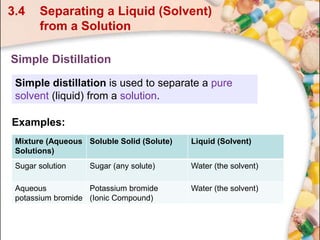
Simple distillation is used to separate a pure
solvent (liquid) from a solution.
Examples:
5
3.4 Separating a Liquid (Solvent)
from a Solution
Mixture (Aqueous
Solutions)
Soluble Solid (Solute) Liquid (Solvent)
Sugar solution Sugar (any solute) Water (the solvent)
Aqueous
potassium bromide
Potassium bromide
(Ionic Compound)
Water (the solvent)
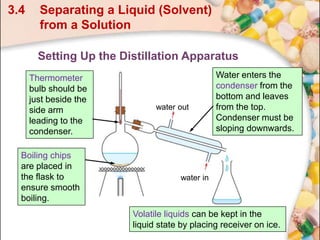
Setting Up the Distillation Apparatus
Thermometer
bulb should be
just beside the
side arm
leading to the
condenser.
Water enters the
condenser from the
bottom and leaves
from the top.
Condenser must be
sloping downwards.
Boiling chips
are placed in
the flask to
ensure smooth
boiling.
Volatile liquids can be kept in the
liquid state by placing receiver on ice.
water in
water out
6
3.4 Separating a Liquid (Solvent)
from a Solution
Simple distillation of salt solution
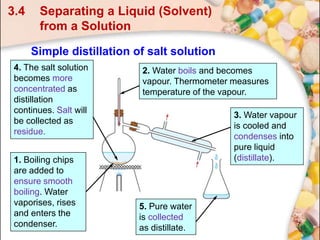
2. Water boils and becomes
vapour. Thermometer measures
temperature of the vapour.
3. Water vapour
is cooled and
condenses into
pure liquid
(distillate).
5. Pure water
is collected
as distillate.
4. The salt solution
becomes more
concentrated as
distillation
continues. Salt will
be collected as
residue.
1. Boiling chips
are added to
ensure smooth
boiling. Water
vaporises, rises
and enters the
condenser. 7
3.4 Separating a Liquid (Solvent)
from a Solution

Simple Distillation

  • 1.
    CHAPTER 3 Separation andPurification © 2013 Marshall Cavendish International (Singapore) Private Limited
  • 2.
    3.1 Obtaining PureSubstances from Mixtures 3.2 Separating a Solid from a Liquid 3.3 Separating Solids 3.4 Separating a Liquid (Solvent) from An Aqueous Solution 3.5 Separating Liquids 3.6 Chromatography 3.7 Determining Purity Separation and PurificationChapter 3 2
  • 3.
    Learning Outcome • describea method to separate and purify a solvent from a solution. At the end of this section, you should be able to: 3.4 Separating a Liquid (Solvent) from a Solution 3
  • 4.
    Recall from Chap4: Aqeuous Solutions are Mixtures. 4 3.4 Separating a Liquid (Solvent) from a Solution SOLUTE
  • 5.
    Simple Distillation Simple distillationis used to separate a pure solvent (liquid) from a solution. Examples: 5 3.4 Separating a Liquid (Solvent) from a Solution Mixture (Aqueous Solutions) Soluble Solid (Solute) Liquid (Solvent) Sugar solution Sugar (any solute) Water (the solvent) Aqueous potassium bromide Potassium bromide (Ionic Compound) Water (the solvent)
  • 6.
    Setting Up theDistillation Apparatus Thermometer bulb should be just beside the side arm leading to the condenser. Water enters the condenser from the bottom and leaves from the top. Condenser must be sloping downwards. Boiling chips are placed in the flask to ensure smooth boiling. Volatile liquids can be kept in the liquid state by placing receiver on ice. water in water out 6 3.4 Separating a Liquid (Solvent) from a Solution
  • 7.
    Simple distillation ofsalt solution 2. Water boils and becomes vapour. Thermometer measures temperature of the vapour. 3. Water vapour is cooled and condenses into pure liquid (distillate). 5. Pure water is collected as distillate. 4. The salt solution becomes more concentrated as distillation continues. Salt will be collected as residue. 1. Boiling chips are added to ensure smooth boiling. Water vaporises, rises and enters the condenser. 7 3.4 Separating a Liquid (Solvent) from a Solution

Editor's Notes

  • #5 It is an introduction to simple distillation. While we have discussed the methods used to extract the solute from a solvent, how do we recover the other part of the mixture, that is the solvent?
  • #7 Discuss with students why the above steps are taken. Why do we take that precaution with the thermometer? Answer: It registers the boiling point of the liquid we want to collect. That way, we will know when it is distilling over. 2. What would the reading be if the liquid is water? Answer: 100°C 3.Why do we take that precaution with the condenser? Answer: This ensures that the condenser is completely filled with water to cool and condense the vapour more effectively. It is sloping downwards to ensure that the distillate flows downwards into the receiver.
  • #8 This can be carried out in the laboratory as a demonstration using salt (sodium chloride) or coloured water. Students usually will be quite excited to see the distillate coming through as a colourless liquid. Some will volunteer to drink it!