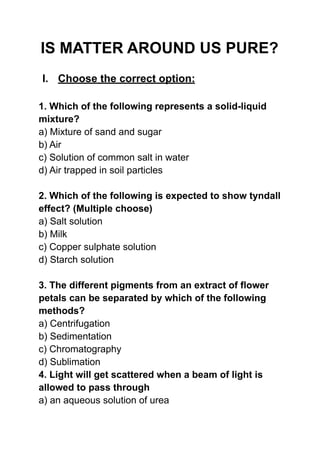
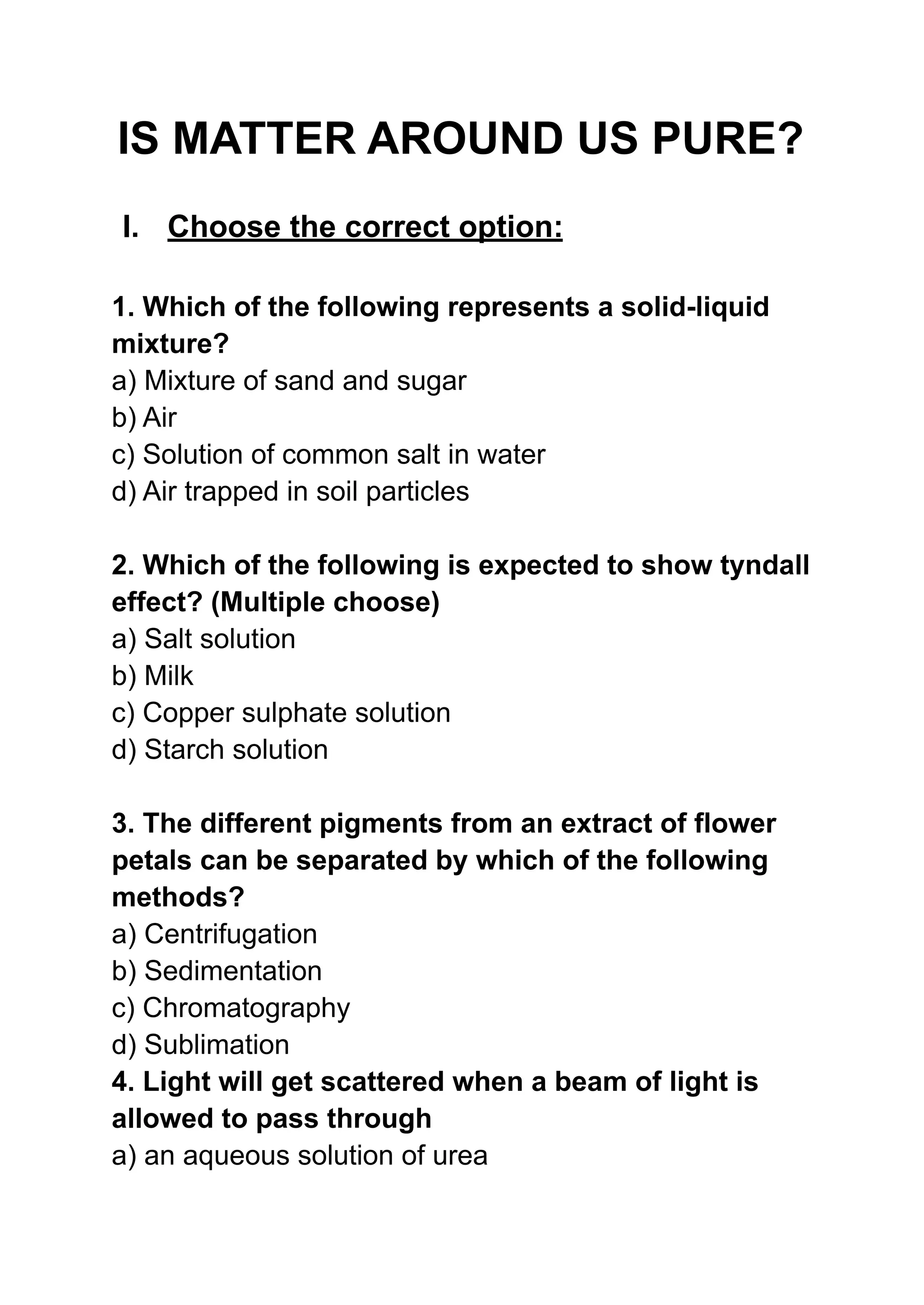
IS MATTER AROUND US PURE?
I. Choose the correct option:
1. Which of the following represents a solid-liquid
mixture?
a) Mixture of sand and sugar
b) Air
c) Solution of common salt in water
d) Air trapped in soil particles
2. Which of the following is expected to show tyndall
effect? (Multiple choose)
a) Salt solution
b) Milk
c) Copper sulphate solution
d) Starch solution
3. The different pigments from an extract of flower
petals can be separated by which of the following
methods?
a) Centrifugation
b) Sedimentation
c) Chromatography
d) Sublimation
4. Light will get scattered when a beam of light is
allowed to pass through
a) an aqueous solution of urea
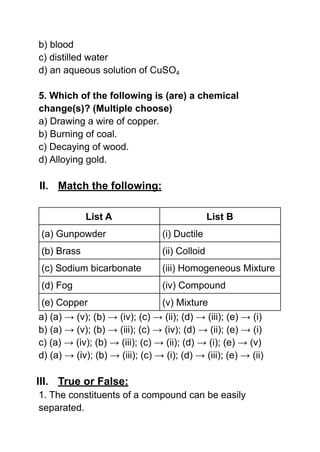
b) blood
c) distilled water
d) an aqueous solution of CuSO4
5. Which of the following is (are) a chemical
change(s)? (Multiple choose)
a) Drawing a wire of copper.
b) Burning of coal.
c) Decaying of wood.
d) Alloying gold.
II. Match the following:
List A List B
(a) Gunpowder (i) Ductile
(b) Brass (ii) Colloid
(c) Sodium bicarbonate (iii) Homogeneous Mixture
(d) Fog (iv) Compound
(e) Copper (v) Mixture
a) (a) → (v); (b) → (iv); (c) → (ii); (d) → (iii); (e) → (i)
b) (a) → (v); (b) → (iii); (c) → (iv); (d) → (ii); (e) → (i)
c) (a) → (iv); (b) → (iii); (c) → (ii); (d) → (i); (e) → (v)
d) (a) → (iv); (b) → (iii); (c) → (i); (d) → (iii); (e) → (ii)
III. True or False:
1. The constituents of a compound can be easily
separated.
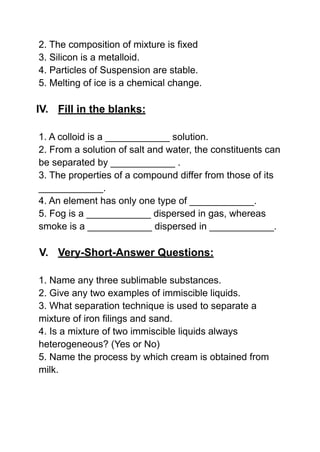
2. The composition of mixture is fixed
3. Silicon is a metalloid.
4. Particles of Suspension are stable.
5. Melting of ice is a chemical change.
IV. Fill in the blanks:
1. A colloid is a ____________ solution.
2. From a solution of salt and water, the constituents can
be separated by ____________ .
3. The properties of a compound differ from those of its
____________.
4. An element has only one type of ____________.
5. Fog is a ____________ dispersed in gas, whereas
smoke is a ____________ dispersed in ____________.
V. Very-Short-Answer Questions:
1. Name any three sublimable substances.
2. Give any two examples of immiscible liquids.
3. What separation technique is used to separate a
mixture of iron filings and sand.
4. Is a mixture of two immiscible liquids always
heterogeneous? (Yes or No)
5. Name the process by which cream is obtained from
milk.
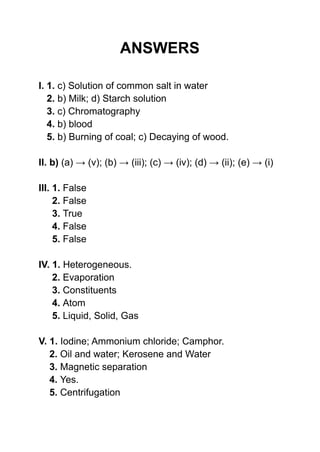
ANSWERS
I. 1. c) Solution of common salt in water
2. b) Milk; d) Starch solution
3. c) Chromatography
4. b) blood
5. b) Burning of coal; c) Decaying of wood.
II. b) (a) → (v); (b) → (iii); (c) → (iv); (d) → (ii); (e) → (i)
III. 1. False
2. False
3. True
4. False
5. False
IV. 1. Heterogeneous.
2. Evaporation
3. Constituents
4. Atom
5. Liquid, Solid, Gas
V. 1. Iodine; Ammonium chloride; Camphor.
2. Oil and water; Kerosene and Water
3. Magnetic separation
4. Yes.
5. Centrifugation

Is Matter Around Us Pure - exercises

  • 1.
    IS MATTER AROUNDUS PURE? I. Choose the correct option: 1. Which of the following represents a solid-liquid mixture? a) Mixture of sand and sugar b) Air c) Solution of common salt in water d) Air trapped in soil particles 2. Which of the following is expected to show tyndall effect? (Multiple choose) a) Salt solution b) Milk c) Copper sulphate solution d) Starch solution 3. The different pigments from an extract of flower petals can be separated by which of the following methods? a) Centrifugation b) Sedimentation c) Chromatography d) Sublimation 4. Light will get scattered when a beam of light is allowed to pass through a) an aqueous solution of urea
  • 2.
    b) blood c) distilledwater d) an aqueous solution of CuSO4 5. Which of the following is (are) a chemical change(s)? (Multiple choose) a) Drawing a wire of copper. b) Burning of coal. c) Decaying of wood. d) Alloying gold. II. Match the following: List A List B (a) Gunpowder (i) Ductile (b) Brass (ii) Colloid (c) Sodium bicarbonate (iii) Homogeneous Mixture (d) Fog (iv) Compound (e) Copper (v) Mixture a) (a) → (v); (b) → (iv); (c) → (ii); (d) → (iii); (e) → (i) b) (a) → (v); (b) → (iii); (c) → (iv); (d) → (ii); (e) → (i) c) (a) → (iv); (b) → (iii); (c) → (ii); (d) → (i); (e) → (v) d) (a) → (iv); (b) → (iii); (c) → (i); (d) → (iii); (e) → (ii) III. True or False: 1. The constituents of a compound can be easily separated.
  • 3.
    2. The compositionof mixture is fixed 3. Silicon is a metalloid. 4. Particles of Suspension are stable. 5. Melting of ice is a chemical change. IV. Fill in the blanks: 1. A colloid is a ____________ solution. 2. From a solution of salt and water, the constituents can be separated by ____________ . 3. The properties of a compound differ from those of its ____________. 4. An element has only one type of ____________. 5. Fog is a ____________ dispersed in gas, whereas smoke is a ____________ dispersed in ____________. V. Very-Short-Answer Questions: 1. Name any three sublimable substances. 2. Give any two examples of immiscible liquids. 3. What separation technique is used to separate a mixture of iron filings and sand. 4. Is a mixture of two immiscible liquids always heterogeneous? (Yes or No) 5. Name the process by which cream is obtained from milk.
  • 4.
    ANSWERS I. 1. c)Solution of common salt in water 2. b) Milk; d) Starch solution 3. c) Chromatography 4. b) blood 5. b) Burning of coal; c) Decaying of wood. II. b) (a) → (v); (b) → (iii); (c) → (iv); (d) → (ii); (e) → (i) III. 1. False 2. False 3. True 4. False 5. False IV. 1. Heterogeneous. 2. Evaporation 3. Constituents 4. Atom 5. Liquid, Solid, Gas V. 1. Iodine; Ammonium chloride; Camphor. 2. Oil and water; Kerosene and Water 3. Magnetic separation 4. Yes. 5. Centrifugation