Sentences Forms
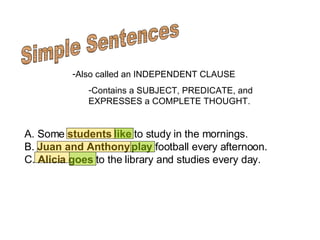
Simple Sentences Also called an INDEPENDENT CLAUSE Contains a SUBJECT, PREDICATE, and EXPRESSES a COMPLETE THOUGHT.     A. Some  students   like  to study in the mornings. B.  Juan and Anthony   play  football every afternoon. C.  Alicia   goes  to the library and studies every day.
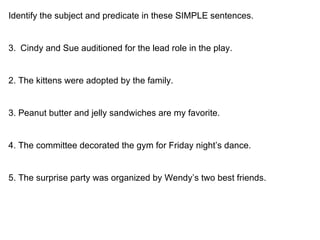
Identify the subject and predicate in these SIMPLE sentences. Cindy and Sue auditioned for the lead role in the play. 2. The kittens were adopted by the family. 3. Peanut butter and jelly sandwiches are my favorite. 4. The committee decorated the gym for Friday night’s dance. 5. The surprise party was organized by Wendy’s two best friends.
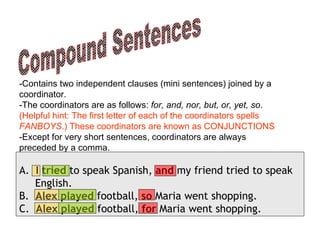
Compound Sentences -Contains two independent clauses (mini sentences) joined by a coordinator.  -The coordinators are as follows:  for, and, nor, but, or, yet, so .  (Helpful hint: The first letter of each of the coordinators spells  FANBOYS .) These coordinators are known as CONJUNCTIONS -Except for very short sentences, coordinators are always preceded by a comma.  A.   I tried  to speak Spanish,  and  my friend tried to speak  English.   B.   Alex played  football,  so  Maria went shopping.   C.   Alex played  football,  for  Maria went shopping.
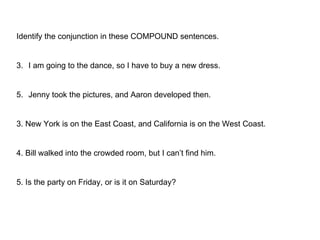
Identify the conjunction in these COMPOUND sentences. I am going to the dance, so I have to buy a new dress. Jenny took the pictures, and Aaron developed then. 3. New York is on the East Coast, and California is on the West Coast.  4. Bill walked into the crowded room, but I can’t find him. 5. Is the party on Friday, or is it on Saturday?
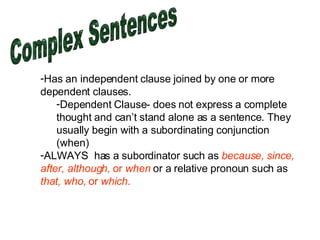
Complex Sentences Has an independent clause joined by one or more dependent clauses.  Dependent Clause- does not express a complete thought and can’t stand alone as a sentence. They usually begin with a subordinating conjunction (when) ALWAYS  has a subordinator such as  because, since, after, although,  or  when  or a relative pronoun such as  that, who,  or  which .
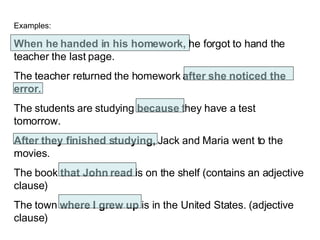
Examples: When he handed in his homework,  he forgot to hand the teacher the last page. The teacher returned the homework  after   she noticed the error. The students are studying  because  they have a test tomorrow. After they finished studying,  Jack and Maria went to the movies. The book  that John read  is on the shelf (contains an adjective clause) The town  where I grew up  is in the United States. (adjective clause)
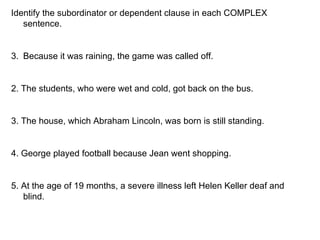
Identify the subordinator or dependent clause in each COMPLEX sentence. Because it was raining, the game was called off. 2. The students, who were wet and cold, got back on the bus. 3. The house, which Abraham Lincoln, was born is still standing. 4. George played football because Jean went shopping. 5. At the age of 19 months, a severe illness left Helen Keller deaf and blind.
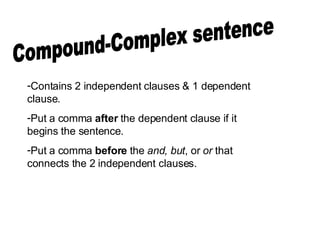
Compound-Complex sentence Contains 2 independent clauses & 1 dependent clause. Put a comma  after  the dependent clause if it begins the sentence. Put a comma  before  the  and, but , or  or  that connects the 2 independent clauses.
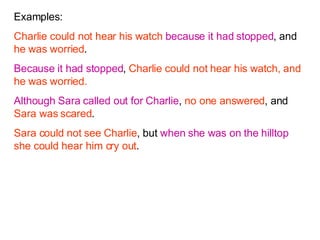
Examples: Charlie could not hear his watch   because it had stopped , and  he was worried . Because it had stopped ,  Charlie could not hear his watch, and he was worried. Although   Sara called out for Charlie ,  no one answered , and  Sara was scared . Sara could not see Charlie , but  when she was on the hilltop   she could hear him cry out .

Simple, Comp, Complex Sentences

  • 1.
  • 2.
    Simple Sentences Alsocalled an INDEPENDENT CLAUSE Contains a SUBJECT, PREDICATE, and EXPRESSES a COMPLETE THOUGHT.    A. Some students like to study in the mornings. B. Juan and Anthony play football every afternoon. C. Alicia goes to the library and studies every day.
  • 3.
    Identify the subjectand predicate in these SIMPLE sentences. Cindy and Sue auditioned for the lead role in the play. 2. The kittens were adopted by the family. 3. Peanut butter and jelly sandwiches are my favorite. 4. The committee decorated the gym for Friday night’s dance. 5. The surprise party was organized by Wendy’s two best friends.
  • 4.
    Compound Sentences -Containstwo independent clauses (mini sentences) joined by a coordinator. -The coordinators are as follows: for, and, nor, but, or, yet, so . (Helpful hint: The first letter of each of the coordinators spells FANBOYS .) These coordinators are known as CONJUNCTIONS -Except for very short sentences, coordinators are always preceded by a comma. A.  I tried to speak Spanish, and my friend tried to speak English.  B.  Alex played football, so Maria went shopping.  C.  Alex played football, for Maria went shopping.
  • 5.
    Identify the conjunctionin these COMPOUND sentences. I am going to the dance, so I have to buy a new dress. Jenny took the pictures, and Aaron developed then. 3. New York is on the East Coast, and California is on the West Coast. 4. Bill walked into the crowded room, but I can’t find him. 5. Is the party on Friday, or is it on Saturday?
  • 6.
    Complex Sentences Hasan independent clause joined by one or more dependent clauses. Dependent Clause- does not express a complete thought and can’t stand alone as a sentence. They usually begin with a subordinating conjunction (when) ALWAYS has a subordinator such as because, since, after, although, or when or a relative pronoun such as that, who, or which .
  • 7.
    Examples: When hehanded in his homework, he forgot to hand the teacher the last page. The teacher returned the homework after she noticed the error. The students are studying because they have a test tomorrow. After they finished studying, Jack and Maria went to the movies. The book that John read is on the shelf (contains an adjective clause) The town where I grew up is in the United States. (adjective clause)
  • 8.
    Identify the subordinatoror dependent clause in each COMPLEX sentence. Because it was raining, the game was called off. 2. The students, who were wet and cold, got back on the bus. 3. The house, which Abraham Lincoln, was born is still standing. 4. George played football because Jean went shopping. 5. At the age of 19 months, a severe illness left Helen Keller deaf and blind.
  • 9.
    Compound-Complex sentence Contains2 independent clauses & 1 dependent clause. Put a comma after the dependent clause if it begins the sentence. Put a comma before the and, but , or or that connects the 2 independent clauses.
  • 10.
    Examples: Charlie couldnot hear his watch because it had stopped , and he was worried . Because it had stopped , Charlie could not hear his watch, and he was worried. Although Sara called out for Charlie , no one answered , and Sara was scared . Sara could not see Charlie , but when she was on the hilltop she could hear him cry out .