•Finding The Periodic Payment
Interpolation to Find Unknown Rate or Time
Annuities Due
Finding The
Periodic Payment
• Formula:
A = R a n i
S = R s n i – I
R = A
a n i
R = S
s n i
 WHERE:
 R = the periodic payment of
the annuity
 N = number of payment of
the annuity or length of term
expressed in interest period
 i = interest rate per
conversion period
Sample Problem
 Mr. Santos borrowed 30,000 and
promised to cancel his debt 6 years by
paying equal sums at the end of each
month with interest at 5 % compounded
monthly . How much is Mr. Santos
monthly payment?
GIVEN
R = ?
A = 30,000
t = 6 years compounded monthly
n = 72
r = 5%
i = 5 %
12
SOLUTION
R = A
a n i
R = 30,000
a 72 5/12%
R = 30,000
62.0928
R = 483.15 ( the monthly payment )
Exercise Problem
 If money is worth 7% compounded
semiannually , how much shall be
invested at the end of every6 months to
accumulate a fund of 120,00 pesos at the
end of the years? ( the full amount is
given)
GIVEN
 R = the unknown semiannual deposit
 S = 120,000
 r = 7%
 i = 3.5%
 t = 10 years
 n = 20
SOLUTION
R = S
s n i
R = 120,000
S 20 3.5%
R = 120,000
28.2797
R = 4243.33
INTERPOLATION TO FIND
UNKNOWN RATE OR TIME
 Interpolation = is finding the value
of the conversion period i and n to get
the exact rate and time respectively.
= is also necessary when the nearest
value of i and n is desired.
SAMPLE PROBLEM
• What nominal rate compounded
semiannually is 8,000 the present value of
400 annuity payable semiannually for 15
years?
GIVEN
 i = the unknown rate per interest period
 R = 400
 r = ?
 n = 30 ( 15 years semiannually )
SOLUTION
 Substitute in the formula : R = A Substitute in the formula : R = A
a n i
 400 = 8,000 = 800 = 20
a n i 400
SOLUTION
 Referring to table V . Under column
n=30 , look for a value of n which is nearly
less, and little bit more than 20 .
TABLE V n=30
2-3/4 % 20.249
i 20.000
3% 19.600
SOLUTION
 20.249 – 20.000 = 0.249
 20.249 – 19.600 = 0.649
 Applying the principle of Ratio and
Proportions we obtain:
d = 0.249
¼% 0.649
d = ¼ x (0.249) d= 0.096
4(0.649)
SOLUTION
 From Table V we have :
 i = 2 ¾ % + d which is ; i = 2.75 + 0.096
 i – 2.846%
The nominal rate semiannually is 2 (i) ;
substitute the value if i ; 2(2.846) = 5.69
Therefore: the Nominal rate is = 5.69%
ANNUITIES DUE
 Annuity Due = is an annuity whose first payment
occurs immediately on a day to be called present.
 Term of an Annuity = is also defined a the time
from the beginning of the first payment interval to the
ends of the last one.
 First Payment = is made at the beginning of the term
and ends one payment interval after the last payment.
 Present Value of an Annuity due = is the sum
of the present values of the payments.
 Amount of an Annuity due = is the sum of the
accumulated values of the payments at the end of the
term.
SAMPLE PROBLEM
 Find the present value and the amount of
an annuity due paying 2,000 pesos
semiannually for a term of 9 ½ years if
money is worth 6%.
GIVEN
• R = 2000 every 6 months
• n = 19 ( for 9 ½ years)
• i = 3% from 6% / 2 semiannually
SOLUTION
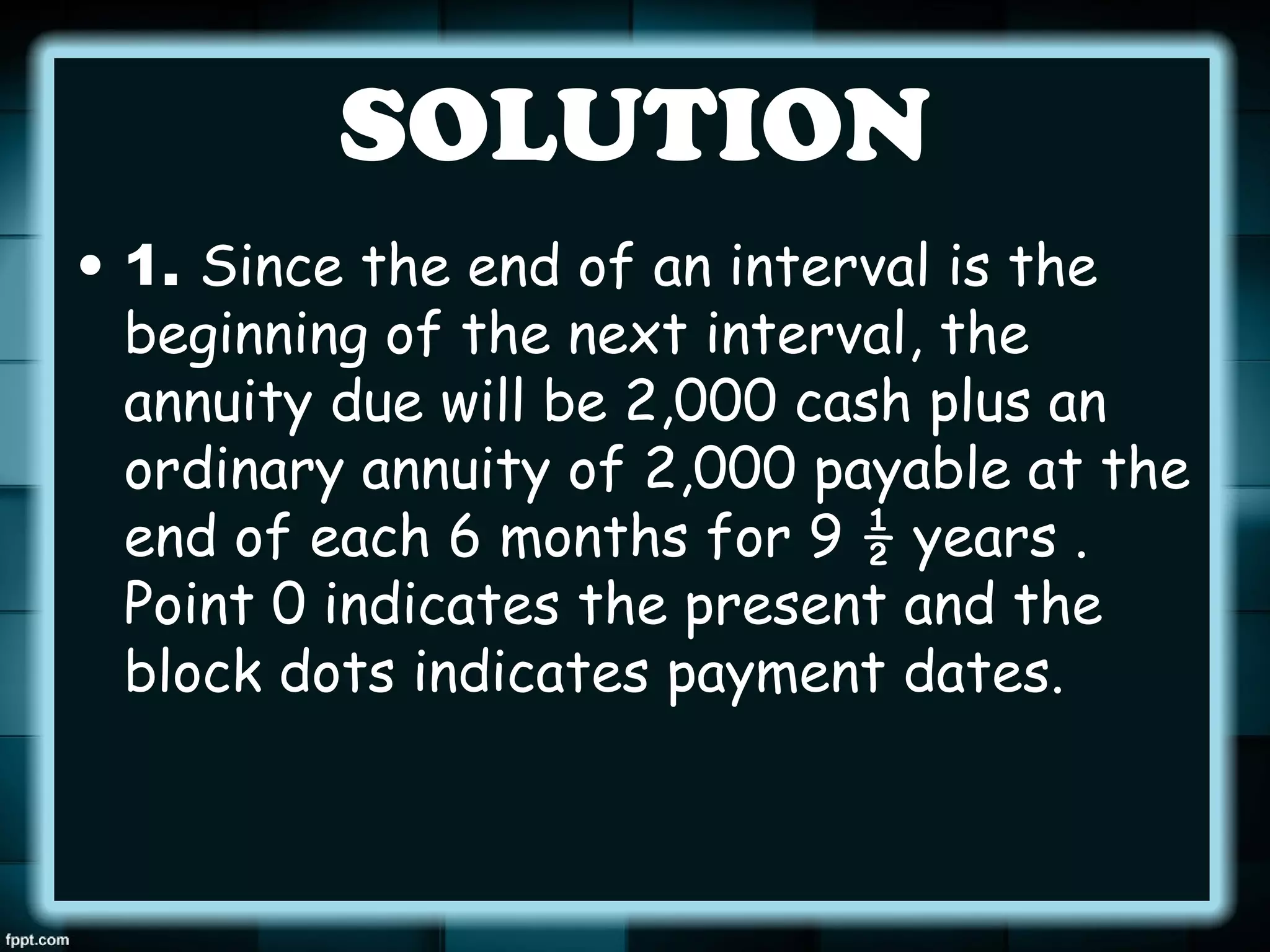
• 1. Since the end of an interval is the
beginning of the next interval, the
annuity due will be 2,000 cash plus an
ordinary annuity of 2,000 payable at the
end of each 6 months for 9 ½ years .
Point 0 indicates the present and the
block dots indicates payment dates.
SOLUTION
• 2. The present value A is found by adding
the first payment at point 0 to the present
value of the last 18 payments which form
an ordinary annuity whose term at point 0.
Hence:
• A = Down payment + 2,000 a n i
• A = 2,000 + 2,000 ( a 18 3% )
SOLUTION
• 3. Refer to Table V , under column n=18
and i = 3% the value is 13.753513
• A= 2,000 + 2,000 ( 13.753513 )
• A = 2,000 + 27.507
• A = 29,507
SOLUTION
• S = ( Accumulated 20 payments ) –
(Fictitious Payment )
• S = R s n i – ( one fictitious payment)
• S = 2,000 ( s 20 3 %) – 2,000
• 4. Refer to Table IV . Under column n= 20
and i = 3%, the value is 26.870374 .
Substitute:
• S = 2,000 ( 26.870374 ) – 2000 =
51,740.75
SUMMARY OF ANNUITIES
DUE FORMULA
 a n i = used to represent the Present
Value
 s n i = used to represent the Amount of
the Annuity Due
 A = R + R a n – 1 I
 S = R s n + 1 i - R
SAMPLE ROBLEM
 To discharge a debt amounting to 80,000
pesos , Mr. D. Cruz agreed to make equal
monthly deposit at the beginning of each
month for 5 years . How much should he
deposit monthly if money is worth 4%
compounded monthly?
GIVEN
 R = the periodic deposit
 A = 80,000
 n = 60 ( monthly for 5 years )
 i = 1/3 ( from 4% compounded monthly)
SOLUTION
 A = R = R a n-1 1/3 %
 80,000 = R + R a 60-1 1/3%
 Table V , under column n = 59 and I = 1/3% the
entry is : 53.480065
 SUBSTITUTE:
 80,000 = R + R ( 53.480065)
 80,000 = R ( 1 + 53.480 )
 R = 80,000 = 1.468.43 (PERIODIC PAYMENT)
 54.480

Simple annuities

  • 1.
    •Finding The PeriodicPayment Interpolation to Find Unknown Rate or Time Annuities Due
  • 2.
    Finding The Periodic Payment •Formula: A = R a n i S = R s n i – I R = A a n i R = S s n i  WHERE:  R = the periodic payment of the annuity  N = number of payment of the annuity or length of term expressed in interest period  i = interest rate per conversion period
  • 3.
    Sample Problem  Mr.Santos borrowed 30,000 and promised to cancel his debt 6 years by paying equal sums at the end of each month with interest at 5 % compounded monthly . How much is Mr. Santos monthly payment?
  • 4.
    GIVEN R = ? A= 30,000 t = 6 years compounded monthly n = 72 r = 5% i = 5 % 12
  • 5.
    SOLUTION R = A an i R = 30,000 a 72 5/12% R = 30,000 62.0928 R = 483.15 ( the monthly payment )
  • 6.
    Exercise Problem  Ifmoney is worth 7% compounded semiannually , how much shall be invested at the end of every6 months to accumulate a fund of 120,00 pesos at the end of the years? ( the full amount is given)
  • 7.
    GIVEN  R =the unknown semiannual deposit  S = 120,000  r = 7%  i = 3.5%  t = 10 years  n = 20
  • 8.
    SOLUTION R = S sn i R = 120,000 S 20 3.5% R = 120,000 28.2797 R = 4243.33
  • 9.
    INTERPOLATION TO FIND UNKNOWNRATE OR TIME  Interpolation = is finding the value of the conversion period i and n to get the exact rate and time respectively. = is also necessary when the nearest value of i and n is desired.
  • 10.
    SAMPLE PROBLEM • Whatnominal rate compounded semiannually is 8,000 the present value of 400 annuity payable semiannually for 15 years?
  • 11.
    GIVEN  i =the unknown rate per interest period  R = 400  r = ?  n = 30 ( 15 years semiannually )
  • 12.
    SOLUTION  Substitute inthe formula : R = A Substitute in the formula : R = A a n i  400 = 8,000 = 800 = 20 a n i 400
  • 13.
    SOLUTION  Referring totable V . Under column n=30 , look for a value of n which is nearly less, and little bit more than 20 . TABLE V n=30 2-3/4 % 20.249 i 20.000 3% 19.600
  • 14.
    SOLUTION  20.249 –20.000 = 0.249  20.249 – 19.600 = 0.649  Applying the principle of Ratio and Proportions we obtain: d = 0.249 ¼% 0.649 d = ¼ x (0.249) d= 0.096 4(0.649)
  • 15.
    SOLUTION  From TableV we have :  i = 2 ¾ % + d which is ; i = 2.75 + 0.096  i – 2.846% The nominal rate semiannually is 2 (i) ; substitute the value if i ; 2(2.846) = 5.69 Therefore: the Nominal rate is = 5.69%
  • 16.
    ANNUITIES DUE  AnnuityDue = is an annuity whose first payment occurs immediately on a day to be called present.  Term of an Annuity = is also defined a the time from the beginning of the first payment interval to the ends of the last one.  First Payment = is made at the beginning of the term and ends one payment interval after the last payment.  Present Value of an Annuity due = is the sum of the present values of the payments.  Amount of an Annuity due = is the sum of the accumulated values of the payments at the end of the term.
  • 17.
    SAMPLE PROBLEM  Findthe present value and the amount of an annuity due paying 2,000 pesos semiannually for a term of 9 ½ years if money is worth 6%.
  • 18.
    GIVEN • R =2000 every 6 months • n = 19 ( for 9 ½ years) • i = 3% from 6% / 2 semiannually
  • 19.
    SOLUTION • 1. Sincethe end of an interval is the beginning of the next interval, the annuity due will be 2,000 cash plus an ordinary annuity of 2,000 payable at the end of each 6 months for 9 ½ years . Point 0 indicates the present and the block dots indicates payment dates.
  • 20.
    SOLUTION • 2. Thepresent value A is found by adding the first payment at point 0 to the present value of the last 18 payments which form an ordinary annuity whose term at point 0. Hence: • A = Down payment + 2,000 a n i • A = 2,000 + 2,000 ( a 18 3% )
  • 21.
    SOLUTION • 3. Referto Table V , under column n=18 and i = 3% the value is 13.753513 • A= 2,000 + 2,000 ( 13.753513 ) • A = 2,000 + 27.507 • A = 29,507
  • 22.
    SOLUTION • S =( Accumulated 20 payments ) – (Fictitious Payment ) • S = R s n i – ( one fictitious payment) • S = 2,000 ( s 20 3 %) – 2,000 • 4. Refer to Table IV . Under column n= 20 and i = 3%, the value is 26.870374 . Substitute: • S = 2,000 ( 26.870374 ) – 2000 = 51,740.75
  • 23.
    SUMMARY OF ANNUITIES DUEFORMULA  a n i = used to represent the Present Value  s n i = used to represent the Amount of the Annuity Due  A = R + R a n – 1 I  S = R s n + 1 i - R
  • 24.
    SAMPLE ROBLEM  Todischarge a debt amounting to 80,000 pesos , Mr. D. Cruz agreed to make equal monthly deposit at the beginning of each month for 5 years . How much should he deposit monthly if money is worth 4% compounded monthly?
  • 25.
    GIVEN  R =the periodic deposit  A = 80,000  n = 60 ( monthly for 5 years )  i = 1/3 ( from 4% compounded monthly)
  • 26.
    SOLUTION  A =R = R a n-1 1/3 %  80,000 = R + R a 60-1 1/3%  Table V , under column n = 59 and I = 1/3% the entry is : 53.480065  SUBSTITUTE:  80,000 = R + R ( 53.480065)  80,000 = R ( 1 + 53.480 )  R = 80,000 = 1.468.43 (PERIODIC PAYMENT)  54.480