FUNDAMENTALS
OF ABM 2
Learning
Module 1
Statement of Financial
Position
LEARNING OBJECTIVES
Upon successful completion of this module, you will be able to:
 identify the elements of the SFP and describe each of them (DepEd-
MELC, DICES); and
 prepare an SFP using the report form and the account form with proper
classification of items as current and non-current. (DepEd-MELC,
DICES)
Lesson 1:
Elements of SFP (Asset, Liability,
and Owner’s Equity)
Statement of Financial Position (SFP),
previously referred to as Balance Sheet,
reports the resources available for the
company to use, obligations that the
company is required to settle, and the equity
that belongs to the owners of the company.
Explanation
A set of financial statements is
presented annually to the investors to
provide them with information about the
company’s financial results and financial
position.
Purpose of Statement of Financial
Position
The purpose of the statement of
financial position is to present true
information about the company’s assets,
liabilities, and equity. It helps to reveal the
financial position of the company as at a
particular date.
Advantages
• It provides information about the financial position of the company.
• It helps in ratio analysis.
• The statement of a current period can be compared with the last year’s
statement to track the company’s performance.
• Investors get information about the company’s financial health, and based on
this statement, they can make their investment decisions.
• It also helps determine the company’s liquidity by
providing data about the current assets available with the
company for settling its current liabilities.
Components of Statement of Financial Position
Assets
These are the resources that are owned by the company and are acquired or
generated with equity fund or outside borrowings.
Liabilities
Liabilities refer to the amounts owed by the company towards outside parties (i.e.
amounts owned to parties other than shareholders in their capacity as a shareholder).
Equity
Equity represents the amount belonging to the shareholders of
the company.
Lesson 2:
Preparation of SFP (Report Form
and Account Form)
The SFP reports the total assets, total
liabilities, and total owner’s equity of the
business. It follows the accounting
equation, A = L + OE; that is, total assets
should be equal with total liabilities and
owner’s equity.
There are two acceptable
formats of SFP:
Account form
and
Report form
Account Form follows the general ledger T-Account format. Assets
on the left and Liabilities and Equity on the right.
The second format of SFP is report form which is like a simple listing – assets are listed
first, followed by liabilities, and finally the equity.
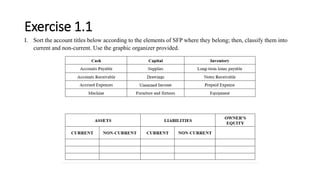
Exercise 1.1
I. Sort the account titles below according to the elements of SFP where they belong; then, classify them into
current and non-current. Use the graphic organizer provided.
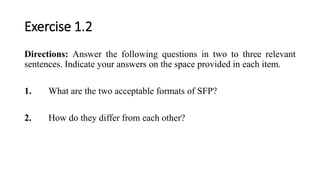
Exercise 1.2
Directions: Answer the following questions in two to three relevant
sentences. Indicate your answers on the space provided in each item.
1. What are the two acceptable formats of SFP?
2. How do they differ from each other?
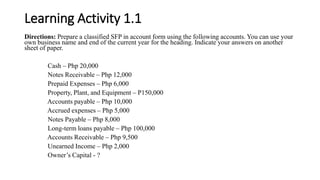
Learning Activity 1.1
Directions: Prepare a classified SFP in account form using the following accounts. You can use your
own business name and end of the current year for the heading. Indicate your answers on another
sheet of paper.
Cash – Php 20,000
Notes Receivable – Php 12,000
Prepaid Expenses – Php 6,000
Property, Plant, and Equipment – P150,000
Accounts payable – Php 10,000
Accrued expenses – Php 5,000
Notes Payable – Php 8,000
Long-term loans payable – Php 100,000
Accounts Receivable – Php 9,500
Unearned Income – Php 2,000
Owner’s Capital - ?
SEND YOUR ANSWERS TO ME (through chat) IN MS TEAMS
ON OR BEFORE SEPTEMBER 08 (WEDNESDAY) @5:00 P.M.

FABM2- Module 1.pptx

  • 1.
    FUNDAMENTALS OF ABM 2 Learning Module1 Statement of Financial Position
  • 2.
    LEARNING OBJECTIVES Upon successfulcompletion of this module, you will be able to:  identify the elements of the SFP and describe each of them (DepEd- MELC, DICES); and  prepare an SFP using the report form and the account form with proper classification of items as current and non-current. (DepEd-MELC, DICES)
  • 3.
    Lesson 1: Elements ofSFP (Asset, Liability, and Owner’s Equity)
  • 4.
    Statement of FinancialPosition (SFP), previously referred to as Balance Sheet, reports the resources available for the company to use, obligations that the company is required to settle, and the equity that belongs to the owners of the company.
  • 5.
    Explanation A set offinancial statements is presented annually to the investors to provide them with information about the company’s financial results and financial position.
  • 6.
    Purpose of Statementof Financial Position The purpose of the statement of financial position is to present true information about the company’s assets, liabilities, and equity. It helps to reveal the financial position of the company as at a particular date.
  • 8.
    Advantages • It providesinformation about the financial position of the company. • It helps in ratio analysis. • The statement of a current period can be compared with the last year’s statement to track the company’s performance. • Investors get information about the company’s financial health, and based on this statement, they can make their investment decisions. • It also helps determine the company’s liquidity by providing data about the current assets available with the company for settling its current liabilities.
  • 9.
    Components of Statementof Financial Position Assets These are the resources that are owned by the company and are acquired or generated with equity fund or outside borrowings. Liabilities Liabilities refer to the amounts owed by the company towards outside parties (i.e. amounts owned to parties other than shareholders in their capacity as a shareholder). Equity Equity represents the amount belonging to the shareholders of the company.
  • 10.
    Lesson 2: Preparation ofSFP (Report Form and Account Form)
  • 11.
    The SFP reportsthe total assets, total liabilities, and total owner’s equity of the business. It follows the accounting equation, A = L + OE; that is, total assets should be equal with total liabilities and owner’s equity.
  • 12.
    There are twoacceptable formats of SFP: Account form and Report form
  • 13.
    Account Form followsthe general ledger T-Account format. Assets on the left and Liabilities and Equity on the right.
  • 14.
    The second formatof SFP is report form which is like a simple listing – assets are listed first, followed by liabilities, and finally the equity.
  • 15.
    Exercise 1.1 I. Sortthe account titles below according to the elements of SFP where they belong; then, classify them into current and non-current. Use the graphic organizer provided.
  • 16.
    Exercise 1.2 Directions: Answerthe following questions in two to three relevant sentences. Indicate your answers on the space provided in each item. 1. What are the two acceptable formats of SFP? 2. How do they differ from each other?
  • 17.
    Learning Activity 1.1 Directions:Prepare a classified SFP in account form using the following accounts. You can use your own business name and end of the current year for the heading. Indicate your answers on another sheet of paper. Cash – Php 20,000 Notes Receivable – Php 12,000 Prepaid Expenses – Php 6,000 Property, Plant, and Equipment – P150,000 Accounts payable – Php 10,000 Accrued expenses – Php 5,000 Notes Payable – Php 8,000 Long-term loans payable – Php 100,000 Accounts Receivable – Php 9,500 Unearned Income – Php 2,000 Owner’s Capital - ?
  • 18.
    SEND YOUR ANSWERSTO ME (through chat) IN MS TEAMS ON OR BEFORE SEPTEMBER 08 (WEDNESDAY) @5:00 P.M.