
University of Baghdad
AL-Kwarizmi collage of engineering
Automated Manufacturing Engineering Dept.
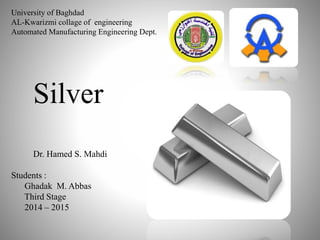
Silver
Dr. Hamed S. Mahdi
Students :
Ghadak M. Abbas
Third Stage
2014 – 2015
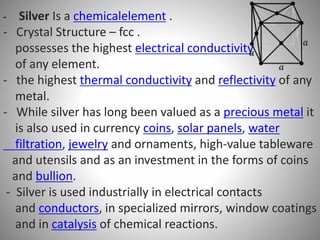
- Silver was discovered 3000 BC . Found in nature in several forms,
including pure metal in Norway and Canada and in the form of silver
chloride as in Mexico and Canada, there is usually mixed with other
metals such as gold, copper and lead.
- And are extraction and purification of silver from ores in several ways process
where crushed first, and then smelted productive mixture containing the basic
metal, a copper, lead and small amounts of silver in the process of copper
purification separate silver from copper to be a mixture called sludge then lifted
sludge treated with nitric acid to dissolve silver and then relive the way silver
electrode deposition
• Chemical Name – Silver
• Chemical Symbol - Ag
• Atomic Number - 47
• Chemical Series – Transition Metal
• Group 11, Period 5, Block D
• Appearance – lustrous white metal
• Silver is a little harder than gold and is very
ductile (can be pulled out into wires) and
malleable (can be beaten into sheets), being
exceeded only by gold and perhaps
palladium
General Properties
SilverColor
SolidPhase
10.49  g·cm−3
Density
9.320  g·cm−3
Liquid Density
961.78 °CMelting Point
2162 °CBoiling Point
11.28 kJ·mol-1
Heat of fusion
250.58 kJ·mol-1
Heat of vaporization
(25 °C) 25.350  J·mol−1·K−1
Heat capacity
Physical Properties
- Silver Is a chemicalelement .
- Crystal Structure – fcc .
possesses the highest electrical conductivity
of any element.
- the highest thermal conductivity and reflectivity of any
metal.
- While silver has long been valued as a precious metal it
is also used in currency coins, solar panels, water
filtration, jewelry and ornaments, high-value tableware
and utensils and as an investment in the forms of coins
and bullion.
- Silver is used industrially in electrical contacts
and conductors, in specialized mirrors, window coatings
and in catalysis of chemical reactions.
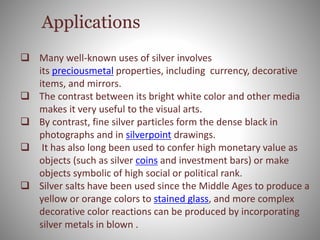
Applications
 Many well-known uses of silver involves
its preciousmetal properties, including currency, decorative
items, and mirrors.
 The contrast between its bright white color and other media
makes it very useful to the visual arts.
 By contrast, fine silver particles form the dense black in
photographs and in silverpoint drawings.
 It has also long been used to confer high monetary value as
objects (such as silver coins and investment bars) or make
objects symbolic of high social or political rank.
 Silver salts have been used since the Middle Ages to produce a
yellow or orange colors to stained glass, and more complex
decorative color reactions can be produced by incorporating
silver metals in blown .
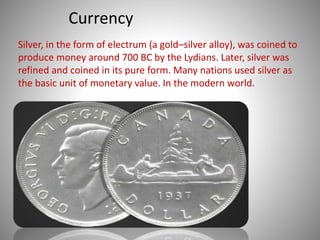
Currency
Silver, in the form of electrum (a gold–silver alloy), was coined to
produce money around 700 BC by the Lydians. Later, silver was
refined and coined in its pure form. Many nations used silver as
the basic unit of monetary value. In the modern world.
Solar energy
Solar modules mounted on solar trackers About 20g of
silver is used in every crystalline solar photovoltaic
panel made Silver is also used in plasmonic solar
cells.100 million ounces of silver are projected for use
by solar energy in 2015.
Silver is the reflective coating of choice for
concentrated solar power reflectors. In 2009, scientists
at the National Renewable Energy Laboratory (NREL)
and Sky Fuelteamed to develop large curved sheets of
metal that have the potential to be 30% less expensive
than today's best collectors of concentrated solar
power by replacing glass-based models with a silver
polymer sheet that has the same performance as the
heavy glass mirrors, but at much lower cost and
weight. It also is much easier to deploy and install. The
glossy film uses several layers of polymers, with an
inner layer of pure silver.
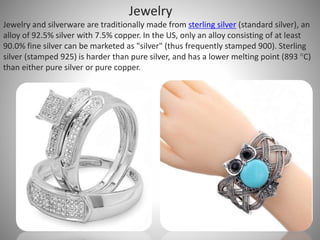
Jewelry
Jewelry and silverware are traditionally made from sterling silver (standard silver), an
alloy of 92.5% silver with 7.5% copper. In the US, only an alloy consisting of at least
90.0% fine silver can be marketed as "silver" (thus frequently stamped 900). Sterling
silver (stamped 925) is harder than pure silver, and has a lower melting point (893 °C)
than either pure silver or pure copper.
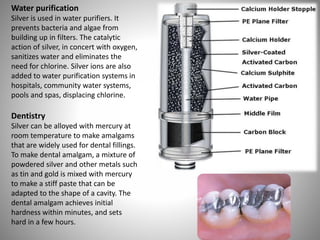
Water purification
Silver is used in water purifiers. It
prevents bacteria and algae from
building up in filters. The catalytic
action of silver, in concert with oxygen,
sanitizes water and eliminates the
need for chlorine. Silver ions are also
added to water purification systems in
hospitals, community water systems,
pools and spas, displacing chlorine.
Dentistry
Silver can be alloyed with mercury at
room temperature to make amalgams
that are widely used for dental fillings.
To make dental amalgam, a mixture of
powdered silver and other metals such
as tin and gold is mixed with mercury
to make a stiff paste that can be
adapted to the shape of a cavity. The
dental amalgam achieves initial
hardness within minutes, and sets
hard in a few hours.
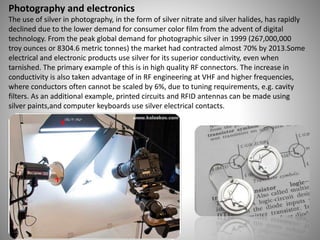
Photography and electronics
The use of silver in photography, in the form of silver nitrate and silver halides, has rapidly
declined due to the lower demand for consumer color film from the advent of digital
technology. From the peak global demand for photographic silver in 1999 (267,000,000
troy ounces or 8304.6 metric tonnes) the market had contracted almost 70% by 2013.Some
electrical and electronic products use silver for its superior conductivity, even when
tarnished. The primary example of this is in high quality RF connectors. The increase in
conductivity is also taken advantage of in RF engineering at VHF and higher frequencies,
where conductors often cannot be scaled by 6%, due to tuning requirements, e.g. cavity
filters. As an additional example, printed circuits and RFID antennas can be made using
silver paints,and computer keyboards use silver electrical contacts.
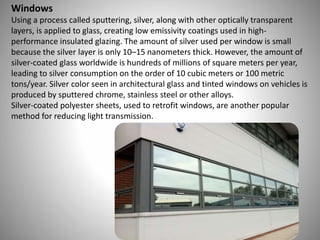
Windows
Using a process called sputtering, silver, along with other optically transparent
layers, is applied to glass, creating low emissivity coatings used in high-
performance insulated glazing. The amount of silver used per window is small
because the silver layer is only 10–15 nanometers thick. However, the amount of
silver-coated glass worldwide is hundreds of millions of square meters per year,
leading to silver consumption on the order of 10 cubic meters or 100 metric
tons/year. Silver color seen in architectural glass and tinted windows on vehicles is
produced by sputtered chrome, stainless steel or other alloys.
Silver-coated polyester sheets, used to retrofit windows, are another popular
method for reducing light transmission.
And it can be use also in :
- Air conditioning
- producing chemical elements : (Ethylene, Formaldehyde)
- in engines or in machines ( reduce friction because of it`s capability to take O2
- in rewards : ( silver medal )
- in other sttuff
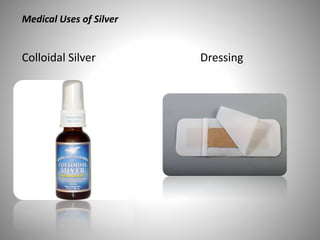
Colloidal Silver Dressing
Medical Uses of Silver
X – ray
Urinary catheters
Endotracheal tubes
Silver Alloys
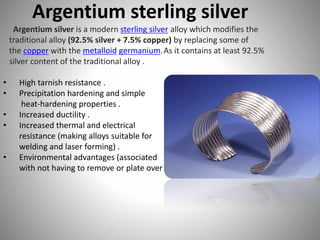
Argentium sterling silver
Argentium silver is a modern sterling silver alloy which modifies the
traditional alloy (92.5% silver + 7.5% copper) by replacing some of
the copper with the metalloid germanium.As it contains at least 92.5%
silver content of the traditional alloy .
• High tarnish resistance .
• Precipitation hardening and simple
heat-hardening properties .
• Increased ductility .
• Increased thermal and electrical
resistance (making alloys suitable for
welding and laser forming) .
• Environmental advantages (associated
with not having to remove or plate over firescale) .
Billon (alloy)
Billon is an alloy of a precious metal (most commonly silver, but also mercury)
with a majority base metal content (such as copper). It is used chiefly for
making coins, medals, and token coins.
The use of billon coins dates from ancient Greece and continued
through the Middle Ages.
Billon coins are perhaps best known
from the Roman Empire, where
progressive debasements of the
Roman denarius .
Britannia silver
Britannia silver is an alloy of silver containing 95.83% by weight silver, the
balance being usually copper.
This standard was introduced in England by Act of Parliament in 1697 to
replace sterling silver (92.5% silver) .
Britannia standard silver was introduced as part of the great recoinage
scheme of William III from 1696 .
Britannia silver is considerably softer than sterling .
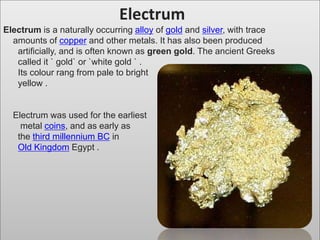
Electrum
Electrum is a naturally occurring alloy of gold and silver, with trace
amounts of copper and other metals. It has also been produced
artificially, and is often known as green gold. The ancient Greeks
called it ` gold` or `white gold ` .
Its colour rang from pale to bright
yellow .
Electrum was used for the earliest
metal coins, and as early as
the third millennium BC in
Old Kingdom Egypt .
Goloid
Goloid is an alloy of silver, gold and copper patented by Dr. William Wheeler
Hubbell on May 22, 1877 . The patent specifies 1 part gold (about 3.6%) , 24 parts silve
(about 87.3%) , and 2.5 parts copper (about 9.1%, all by weight) .. The alloy was used
the United States Mint to strike
pattern dollars, sometimes called
“ metric dollars“ .
In the end, goloid was rejected as
a coinage metal because it could not
be distinguished from the normal U.S.
90% silver coin alloy without chemical
analysis, thus inviting counterfeiters
to use silver-copper alloys alone to
make lower-value copies.
Shibuichi
Shibuichi (四分一) is an alloy which can be patinated into a range of
subtle
muted shades of blue or green, through the use of rokushō treatments. Its
name means "one-fourth" in Japanese and indicates the standard
formulation of one part silver ( 5% silver) to three parts copper (95%
copper ) .
Sterling silver
Sterling silver is an alloy of silver containing 92.5% by mass of silver
and 7.5% by mass of other metals, usually copper .
Fine silver, for example 99.9% pure silver, is generally too soft for
producing functional objects ;
therefore, the silver is usually alloyed
with copper to give it strength while
preserving the ductility and
appearance of the precious metal.
These replacement metals
include germanium, zinc and
platinum, as well as a variety of
other additives, including silicon
and boron .
Tibetan silver
Tibetan silver is used primarily in jewelry components, an
alloy of copper, and sometimes tin or nickel, with a small
percentage of pure silver. Its overall appearance is of aged
silver, but it can be polished to provide highlights on complex
castings.
http://en.wikipedia.org/wiki/Silver
http://en.wikipedia.org/wiki/List_of_alloys#Alloys_of_silver
Resources
Thanks for
listining

Silver & Alloys

  • 1.
    University of Baghdad AL-Kwarizmicollage of engineering Automated Manufacturing Engineering Dept. Silver Dr. Hamed S. Mahdi Students : Ghadak M. Abbas Third Stage 2014 – 2015
  • 2.
    - Silver wasdiscovered 3000 BC . Found in nature in several forms, including pure metal in Norway and Canada and in the form of silver chloride as in Mexico and Canada, there is usually mixed with other metals such as gold, copper and lead. - And are extraction and purification of silver from ores in several ways process where crushed first, and then smelted productive mixture containing the basic metal, a copper, lead and small amounts of silver in the process of copper purification separate silver from copper to be a mixture called sludge then lifted sludge treated with nitric acid to dissolve silver and then relive the way silver electrode deposition
  • 3.
    • Chemical Name– Silver • Chemical Symbol - Ag • Atomic Number - 47 • Chemical Series – Transition Metal • Group 11, Period 5, Block D • Appearance – lustrous white metal • Silver is a little harder than gold and is very ductile (can be pulled out into wires) and malleable (can be beaten into sheets), being exceeded only by gold and perhaps palladium General Properties
  • 4.
    SilverColor SolidPhase 10.49  g·cm−3 Density 9.320  g·cm−3 LiquidDensity 961.78 °CMelting Point 2162 °CBoiling Point 11.28 kJ·mol-1 Heat of fusion 250.58 kJ·mol-1 Heat of vaporization (25 °C) 25.350  J·mol−1·K−1 Heat capacity Physical Properties
  • 5.
    - Silver Isa chemicalelement . - Crystal Structure – fcc . possesses the highest electrical conductivity of any element. - the highest thermal conductivity and reflectivity of any metal. - While silver has long been valued as a precious metal it is also used in currency coins, solar panels, water filtration, jewelry and ornaments, high-value tableware and utensils and as an investment in the forms of coins and bullion. - Silver is used industrially in electrical contacts and conductors, in specialized mirrors, window coatings and in catalysis of chemical reactions.
  • 6.
    Applications  Many well-knownuses of silver involves its preciousmetal properties, including currency, decorative items, and mirrors.  The contrast between its bright white color and other media makes it very useful to the visual arts.  By contrast, fine silver particles form the dense black in photographs and in silverpoint drawings.  It has also long been used to confer high monetary value as objects (such as silver coins and investment bars) or make objects symbolic of high social or political rank.  Silver salts have been used since the Middle Ages to produce a yellow or orange colors to stained glass, and more complex decorative color reactions can be produced by incorporating silver metals in blown .
  • 7.
    Currency Silver, in theform of electrum (a gold–silver alloy), was coined to produce money around 700 BC by the Lydians. Later, silver was refined and coined in its pure form. Many nations used silver as the basic unit of monetary value. In the modern world.
  • 8.
    Solar energy Solar modulesmounted on solar trackers About 20g of silver is used in every crystalline solar photovoltaic panel made Silver is also used in plasmonic solar cells.100 million ounces of silver are projected for use by solar energy in 2015. Silver is the reflective coating of choice for concentrated solar power reflectors. In 2009, scientists at the National Renewable Energy Laboratory (NREL) and Sky Fuelteamed to develop large curved sheets of metal that have the potential to be 30% less expensive than today's best collectors of concentrated solar power by replacing glass-based models with a silver polymer sheet that has the same performance as the heavy glass mirrors, but at much lower cost and weight. It also is much easier to deploy and install. The glossy film uses several layers of polymers, with an inner layer of pure silver.
  • 9.
    Jewelry Jewelry and silverwareare traditionally made from sterling silver (standard silver), an alloy of 92.5% silver with 7.5% copper. In the US, only an alloy consisting of at least 90.0% fine silver can be marketed as "silver" (thus frequently stamped 900). Sterling silver (stamped 925) is harder than pure silver, and has a lower melting point (893 °C) than either pure silver or pure copper.
  • 10.
    Water purification Silver isused in water purifiers. It prevents bacteria and algae from building up in filters. The catalytic action of silver, in concert with oxygen, sanitizes water and eliminates the need for chlorine. Silver ions are also added to water purification systems in hospitals, community water systems, pools and spas, displacing chlorine. Dentistry Silver can be alloyed with mercury at room temperature to make amalgams that are widely used for dental fillings. To make dental amalgam, a mixture of powdered silver and other metals such as tin and gold is mixed with mercury to make a stiff paste that can be adapted to the shape of a cavity. The dental amalgam achieves initial hardness within minutes, and sets hard in a few hours.
  • 11.
    Photography and electronics Theuse of silver in photography, in the form of silver nitrate and silver halides, has rapidly declined due to the lower demand for consumer color film from the advent of digital technology. From the peak global demand for photographic silver in 1999 (267,000,000 troy ounces or 8304.6 metric tonnes) the market had contracted almost 70% by 2013.Some electrical and electronic products use silver for its superior conductivity, even when tarnished. The primary example of this is in high quality RF connectors. The increase in conductivity is also taken advantage of in RF engineering at VHF and higher frequencies, where conductors often cannot be scaled by 6%, due to tuning requirements, e.g. cavity filters. As an additional example, printed circuits and RFID antennas can be made using silver paints,and computer keyboards use silver electrical contacts.
  • 12.
    Windows Using a processcalled sputtering, silver, along with other optically transparent layers, is applied to glass, creating low emissivity coatings used in high- performance insulated glazing. The amount of silver used per window is small because the silver layer is only 10–15 nanometers thick. However, the amount of silver-coated glass worldwide is hundreds of millions of square meters per year, leading to silver consumption on the order of 10 cubic meters or 100 metric tons/year. Silver color seen in architectural glass and tinted windows on vehicles is produced by sputtered chrome, stainless steel or other alloys. Silver-coated polyester sheets, used to retrofit windows, are another popular method for reducing light transmission.
  • 13.
    And it canbe use also in : - Air conditioning - producing chemical elements : (Ethylene, Formaldehyde) - in engines or in machines ( reduce friction because of it`s capability to take O2 - in rewards : ( silver medal ) - in other sttuff
  • 15.
  • 16.
    X – ray Urinarycatheters Endotracheal tubes
  • 17.
  • 18.
    Argentium sterling silver Argentiumsilver is a modern sterling silver alloy which modifies the traditional alloy (92.5% silver + 7.5% copper) by replacing some of the copper with the metalloid germanium.As it contains at least 92.5% silver content of the traditional alloy . • High tarnish resistance . • Precipitation hardening and simple heat-hardening properties . • Increased ductility . • Increased thermal and electrical resistance (making alloys suitable for welding and laser forming) . • Environmental advantages (associated with not having to remove or plate over firescale) .
  • 19.
    Billon (alloy) Billon isan alloy of a precious metal (most commonly silver, but also mercury) with a majority base metal content (such as copper). It is used chiefly for making coins, medals, and token coins. The use of billon coins dates from ancient Greece and continued through the Middle Ages. Billon coins are perhaps best known from the Roman Empire, where progressive debasements of the Roman denarius .
  • 20.
    Britannia silver Britannia silveris an alloy of silver containing 95.83% by weight silver, the balance being usually copper. This standard was introduced in England by Act of Parliament in 1697 to replace sterling silver (92.5% silver) . Britannia standard silver was introduced as part of the great recoinage scheme of William III from 1696 . Britannia silver is considerably softer than sterling .
  • 21.
    Electrum Electrum is anaturally occurring alloy of gold and silver, with trace amounts of copper and other metals. It has also been produced artificially, and is often known as green gold. The ancient Greeks called it ` gold` or `white gold ` . Its colour rang from pale to bright yellow . Electrum was used for the earliest metal coins, and as early as the third millennium BC in Old Kingdom Egypt .
  • 22.
    Goloid Goloid is analloy of silver, gold and copper patented by Dr. William Wheeler Hubbell on May 22, 1877 . The patent specifies 1 part gold (about 3.6%) , 24 parts silve (about 87.3%) , and 2.5 parts copper (about 9.1%, all by weight) .. The alloy was used the United States Mint to strike pattern dollars, sometimes called “ metric dollars“ . In the end, goloid was rejected as a coinage metal because it could not be distinguished from the normal U.S. 90% silver coin alloy without chemical analysis, thus inviting counterfeiters to use silver-copper alloys alone to make lower-value copies.
  • 23.
    Shibuichi Shibuichi (四分一) isan alloy which can be patinated into a range of subtle muted shades of blue or green, through the use of rokushō treatments. Its name means "one-fourth" in Japanese and indicates the standard formulation of one part silver ( 5% silver) to three parts copper (95% copper ) .
  • 24.
    Sterling silver Sterling silveris an alloy of silver containing 92.5% by mass of silver and 7.5% by mass of other metals, usually copper . Fine silver, for example 99.9% pure silver, is generally too soft for producing functional objects ; therefore, the silver is usually alloyed with copper to give it strength while preserving the ductility and appearance of the precious metal. These replacement metals include germanium, zinc and platinum, as well as a variety of other additives, including silicon and boron .
  • 25.
    Tibetan silver Tibetan silveris used primarily in jewelry components, an alloy of copper, and sometimes tin or nickel, with a small percentage of pure silver. Its overall appearance is of aged silver, but it can be polished to provide highlights on complex castings.
  • 26.
  • 27.