SILVER METAL
Know your product
WHAT IS SILVER?
Like gold, silver is one of the world's oldest metals for jewelry
design . The metal is found in the Earth's crust in the pure, free
elemental form ("native silver"), Silver has long been valued as
a precious metal.
Silver is used in numerous applications other than currency, such
as solar panels, water filtration, jewelry, ornaments, high value
tableware and utensils.
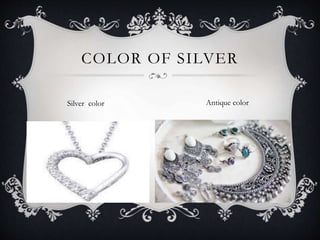
COLOR OF SILVER
Silver color Antique color
MILLESIMAL FINENESS
 Millesimal fineness is a system of denoting the purity of silver alloys by
parts per thousand of pure metal by mass in the alloy. For example, an alloy
containing 75% gold is denoted as "750". Many European countries use
decimal hallmark stamps (i.e. '585', '750', etc.) rather than '14K', '18K', etc.,
which is used in the United Kingdom and United States.
 It is an extension of the older karat system of denoting the purity of gold by
fractions of 24, such as "18 karat" for an alloy with 75% (18 parts per 24) pure
gold by mass.
MILLESIMAL FINENESS
 The millesimal fineness is usually rounded to a three figure number,
particularly where used as a hallmark, and the fineness may vary slightly from
the traditional versions of purity.
 Here are the most common millesimal fineness's used for precious
metals and the most common terms associated with them.
PURITY
Fine silver : 99%
Britannia silver : 95%
Sterling Silver : 92%
Coin Silver : 90%
Scandinavian : 83%
German Silver : 80 % or 83 %
FINE SILVER
 Fine silver has a fineness of 999. Also called pure silver,
or three nines fine, fine silver contains 99.9% silver, with the
balance being trace amounts of impurities. This grade of
silver is used to make bullion bars for international
commodities trading and investment in silver. In the modern
world, fine silver is understood to be too soft for general use.
BRITANNIA SILVER
Britannia silver has a fineness of at least 958.
The alloy is 95.84% pure silver and 4.16 per cent
copper or other metals. The Britannia standard
was developed in Britain in 1697 to help prevent
British sterling silver coins from being melted to
make silver plate.
STERLING SILVER
Sterling silver has a fineness of 925. The
sterling silver alloy is 92.5% pure silver and 7.5
per cent copper or other metals.
COIN SILVER
 Coin silver has a fineness of 900. The term "coin silver"
was derived from the fact that much of it was made
from melting down silver coins. It is important here to
note that there are differences between the coin silver
standard and the coin silver alloy, as actually used in
making silver objects.
SCANDINAVIAN SILVER
Scandinavian silver has a fineness of 830. The
Scandinavian silver alloy contains 83% pure silver
and 17% copper or other metals.
GERMAN SILVER
German silver will be marked with a millesimal
fineness of 800 or 835 (80% or 83.5% pure silver).
Any items simply marked "German silver",
JEWELLERY COLLECTION
 Bristles Finger Ring  Toe rings
JEWELLERY COLLECTION
 Neckless Ear Rings  Silver Chain
HALLMARKED YOUR
SILVER
BIS introduced hallmarking for silver jewellery in December
2005 under IS 2112, the standard specification for
'Hallmarking of Silver Jewellery.
TEST YOUR SILVER
 Bleach Test :
1. Simply put a drop of bleach on your item. Silver
tarnishes extremely quickly when exposed to a
powerful oxidizing agent such as common bleach.
2. Watch for tarnishing or no reaction. If it rapidly
tarnishes and turns black then the item is silver.
Thank you
HR Rahul Saxena

Silver

  • 1.
  • 2.
    WHAT IS SILVER? Likegold, silver is one of the world's oldest metals for jewelry design . The metal is found in the Earth's crust in the pure, free elemental form ("native silver"), Silver has long been valued as a precious metal. Silver is used in numerous applications other than currency, such as solar panels, water filtration, jewelry, ornaments, high value tableware and utensils.
  • 3.
    COLOR OF SILVER Silvercolor Antique color
  • 4.
    MILLESIMAL FINENESS  Millesimalfineness is a system of denoting the purity of silver alloys by parts per thousand of pure metal by mass in the alloy. For example, an alloy containing 75% gold is denoted as "750". Many European countries use decimal hallmark stamps (i.e. '585', '750', etc.) rather than '14K', '18K', etc., which is used in the United Kingdom and United States.  It is an extension of the older karat system of denoting the purity of gold by fractions of 24, such as "18 karat" for an alloy with 75% (18 parts per 24) pure gold by mass.
  • 5.
    MILLESIMAL FINENESS  Themillesimal fineness is usually rounded to a three figure number, particularly where used as a hallmark, and the fineness may vary slightly from the traditional versions of purity.  Here are the most common millesimal fineness's used for precious metals and the most common terms associated with them.
  • 6.
    PURITY Fine silver :99% Britannia silver : 95% Sterling Silver : 92% Coin Silver : 90% Scandinavian : 83% German Silver : 80 % or 83 %
  • 7.
    FINE SILVER  Finesilver has a fineness of 999. Also called pure silver, or three nines fine, fine silver contains 99.9% silver, with the balance being trace amounts of impurities. This grade of silver is used to make bullion bars for international commodities trading and investment in silver. In the modern world, fine silver is understood to be too soft for general use.
  • 8.
    BRITANNIA SILVER Britannia silverhas a fineness of at least 958. The alloy is 95.84% pure silver and 4.16 per cent copper or other metals. The Britannia standard was developed in Britain in 1697 to help prevent British sterling silver coins from being melted to make silver plate.
  • 9.
    STERLING SILVER Sterling silverhas a fineness of 925. The sterling silver alloy is 92.5% pure silver and 7.5 per cent copper or other metals.
  • 10.
    COIN SILVER  Coinsilver has a fineness of 900. The term "coin silver" was derived from the fact that much of it was made from melting down silver coins. It is important here to note that there are differences between the coin silver standard and the coin silver alloy, as actually used in making silver objects.
  • 11.
    SCANDINAVIAN SILVER Scandinavian silverhas a fineness of 830. The Scandinavian silver alloy contains 83% pure silver and 17% copper or other metals.
  • 12.
    GERMAN SILVER German silverwill be marked with a millesimal fineness of 800 or 835 (80% or 83.5% pure silver). Any items simply marked "German silver",
  • 13.
    JEWELLERY COLLECTION  BristlesFinger Ring  Toe rings
  • 14.
    JEWELLERY COLLECTION  NecklessEar Rings  Silver Chain
  • 15.
    HALLMARKED YOUR SILVER BIS introducedhallmarking for silver jewellery in December 2005 under IS 2112, the standard specification for 'Hallmarking of Silver Jewellery.
  • 16.
    TEST YOUR SILVER Bleach Test : 1. Simply put a drop of bleach on your item. Silver tarnishes extremely quickly when exposed to a powerful oxidizing agent such as common bleach. 2. Watch for tarnishing or no reaction. If it rapidly tarnishes and turns black then the item is silver.
  • 17.