”
Prof. C. P. Dorlikar
• Iron ores are rocks and minerals from which
metallic iron can be economically extracted.
The ores are usually rich in iron oxides and
vary in color from dark grey, bright yellow,
deep purple, to rusty red.
• The iron itself is usually found in the form of
magnetite (Fe3O4), hematite (Fe2O3),
goethite (FeO (OH)), limonite (FeO (OH).n
(H2O)) or siderite (FeCO3).
• If gold is king of metals, then iron is certainly
the chieftain or commander. It has retained
this position in almost all civilizations through
the recorded history.
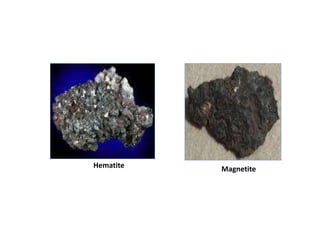
• The two main ore of iron ore are: 1) Hematite
(Fe2O3), 2) Magnetite (Fe3O4).
Hematite Magnetite
–
• Iron ore plays important role in development
of country. Iron ore is the basic raw material of
iron and steel industry. India is endowed with
large reserves of good quality ore,.
• The economic ion ore minerals are
• Magnetite Fe3O4 (72.4%Fe)
• Hematite Fe2O3 (70.0 % Fe)
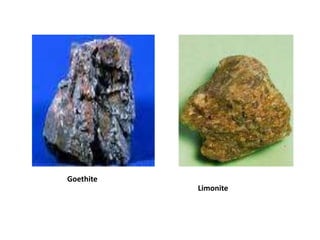
• Goethite (Foe (OH)), Limonite (Foe (OH).n
(H2O) (59.63 %Fe)
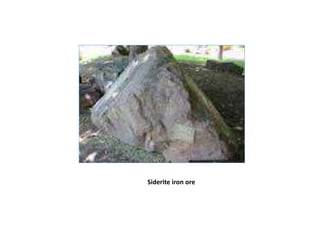
• Siderite FeCO3
Goethite
Limonite
Siderite iron ore
• 1. Deposits associated with banded iron
formation (BIF) of Precambrian Age. These are
both hematite and magnetite deposits.
• 2. Sedimentary iron ore deposits comprising
siderite, limonite.
• 3. Lateritic iron ore of residual type derived from
iron bearing gneisses, schists, basic lavas etc.
• 4. Magnetite – apatite bearing iron ore deposits
of Singbhum copper belt Precambrian age. The
deposite are associated with diorites.
• The major deposits of hematite are in Jharkhand,
Orissa, Chhattisgarh, Karnataka, Goa, and
Maharashtra. In Orissa, Bonai range of hills have
important iron ore deposits of Banspani, Barsua,
Kiriburu, Malangtoli etc. in Keonjhar and
Sundergarh districts..
• In Maharashtra, Surjagarh deposits are in
Gadchiroli distict. In Goa little inside the coastal
areas, important iron ore deposits are Bicholim,
Velguem, Surla, Pale, Codly and Costi; mostly in
north and central Goa.
• India produced about 83.36 million tonnes of iron
ore in 2001-2002, from 215 mines.
• Production is coming from large open cast mines,
most of which either captive to steel plant or have
export commitments.
• 5 mines in Chhattisgarh, 3 mines in Jharkhand, 2
each in Orissa
• Some of major iron ore producing mines are Kiriburu,
Basua, Gua, Nuamundly and Daitari in Jharkhand
Orrissa sector, Bailadila and Dalhi Rajhara in
Chhattisgarh, Dominalai and Kudremukh in Karnataka
:
• Iron ore is consumed mostly in iron and steel
industry and it is exported. It is use in making
pig iron, sponge iron and steel.
• It is also used in coal washeries, ferro-alloys,
foundry, cement and chemical industries,
glass, refractory, vanaspati, etc.
:
• K.M.Bangar
• Perbin Singh
• Ruttle
• Umathe

Iron Ore Deposites

  • 1.
  • 2.
    • Iron oresare rocks and minerals from which metallic iron can be economically extracted. The ores are usually rich in iron oxides and vary in color from dark grey, bright yellow, deep purple, to rusty red. • The iron itself is usually found in the form of magnetite (Fe3O4), hematite (Fe2O3), goethite (FeO (OH)), limonite (FeO (OH).n (H2O)) or siderite (FeCO3).
  • 3.
    • If goldis king of metals, then iron is certainly the chieftain or commander. It has retained this position in almost all civilizations through the recorded history. • The two main ore of iron ore are: 1) Hematite (Fe2O3), 2) Magnetite (Fe3O4).
  • 4.
  • 5.
    – • Iron oreplays important role in development of country. Iron ore is the basic raw material of iron and steel industry. India is endowed with large reserves of good quality ore,. • The economic ion ore minerals are • Magnetite Fe3O4 (72.4%Fe) • Hematite Fe2O3 (70.0 % Fe) • Goethite (Foe (OH)), Limonite (Foe (OH).n (H2O) (59.63 %Fe) • Siderite FeCO3
  • 6.
  • 7.
  • 8.
    • 1. Depositsassociated with banded iron formation (BIF) of Precambrian Age. These are both hematite and magnetite deposits. • 2. Sedimentary iron ore deposits comprising siderite, limonite. • 3. Lateritic iron ore of residual type derived from iron bearing gneisses, schists, basic lavas etc. • 4. Magnetite – apatite bearing iron ore deposits of Singbhum copper belt Precambrian age. The deposite are associated with diorites.
  • 9.
    • The majordeposits of hematite are in Jharkhand, Orissa, Chhattisgarh, Karnataka, Goa, and Maharashtra. In Orissa, Bonai range of hills have important iron ore deposits of Banspani, Barsua, Kiriburu, Malangtoli etc. in Keonjhar and Sundergarh districts.. • In Maharashtra, Surjagarh deposits are in Gadchiroli distict. In Goa little inside the coastal areas, important iron ore deposits are Bicholim, Velguem, Surla, Pale, Codly and Costi; mostly in north and central Goa.
  • 10.
    • India producedabout 83.36 million tonnes of iron ore in 2001-2002, from 215 mines. • Production is coming from large open cast mines, most of which either captive to steel plant or have export commitments. • 5 mines in Chhattisgarh, 3 mines in Jharkhand, 2 each in Orissa • Some of major iron ore producing mines are Kiriburu, Basua, Gua, Nuamundly and Daitari in Jharkhand Orrissa sector, Bailadila and Dalhi Rajhara in Chhattisgarh, Dominalai and Kudremukh in Karnataka
  • 11.
    : • Iron oreis consumed mostly in iron and steel industry and it is exported. It is use in making pig iron, sponge iron and steel. • It is also used in coal washeries, ferro-alloys, foundry, cement and chemical industries, glass, refractory, vanaspati, etc.
  • 12.
    : • K.M.Bangar • PerbinSingh • Ruttle • Umathe