Welcome
PRESENTED BY : SEEMA PRAJAPAT
Rock forming minerals:
 Minerals are solid substance and composed of atoms having
an orderly and regular arrangement.
 A Minerals is a naturally- occuring ,homogeneous element or
inirganic compound.
 Most minerals are composed of two or more elements that
combine to form a compound such as gypsum :
CaSO4.2H2O, Olivier, feldspar etc.
Formation of minerals:
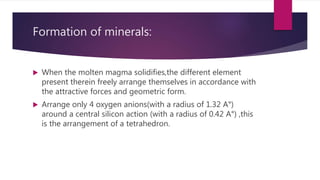
 When the molten magma solidifies,the different element
present therein freely arrange themselves in accordance with
the attractive forces and geometric form.
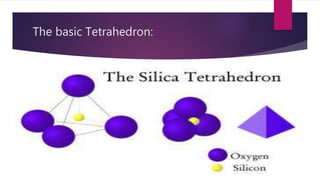
 Arrange only 4 oxygen anions(with a radius of 1.32 A°)
around a central silicon action (with a radius of 0.42 A°) ,this
is the arrangement of a tetrahedron.
The basic Tetrahedron:
Important rock–forming minerals:
 Primary minerals●
- Ferromagnesians
•Olivines Fe, mg
•pyroxenes Ca,Na,Fe,Mg
•Amphiboles,etc. Ca,Na,Fe,My,Al,OH
- Phyllosilicates
•Biotite K,Fe,Mg,So,OH
•Muscovite K,Al, OH.
Primary mineral:
 Non – ferromagnesians
•Tectosilicates
~Feldspar,such as:
Anorthite Ca,Al
Albite Na,Al
Orthoclase K,Al
~Quartz _
Secondary clay minerals:
 Na,K,Ca,Mg,Fe,Al,OH other then Si and O.
 In the Absence of a crystalline form, the material is
termed as non- crystalline e.g., allophone,chalcedony.
Primary minerals:
 The primary minerals are those which are formed owing to the
crystallization of molten magma.
 Orthosilicates
Phyllosilicates
Inosilicates
Tectosilicates _Quartz
_Feldspar.
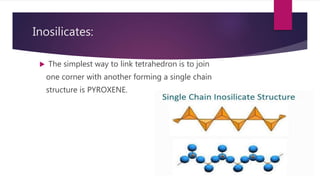
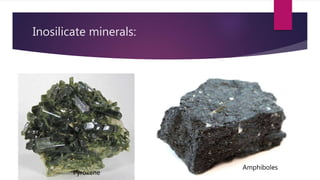
Inosilicates:
 The simplest way to link tetrahedron is to join
one corner with another forming a single chain
structure is PYROXENE.
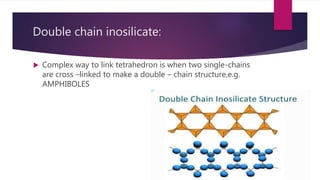
Double chain inosilicate:
 Complex way to link tetrahedron is when two single-chains
are cross –linked to make a double – chain structure,e.g.
AMPHIBOLES
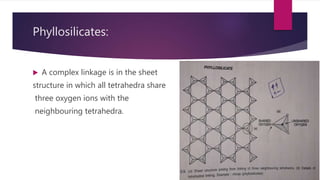
Phyllosilicates:
 A complex linkage is in the sheet
structure in which all tetrahedra share
three oxygen ions with the
neighbouring tetrahedra.
Inosilicate minerals:
Pyroxene
Amphiboles
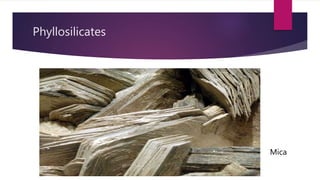
Phyllosilicates
Mica
Phyllosilicates:
 They have sheet structure of tetrahedra where each silicon
ion shares three oxygen ions with adjacent silicon ion to
form a pattern ,like honey –comb.
Orthosilicates:
 The orthosilicates are represented by olivine(Fe,Mg)2 SiO4.
 The structure consists of individual silicon –tetrahedra
alternating with positively – charged metal ions which
balance the negative charge of the tetrahedra units.
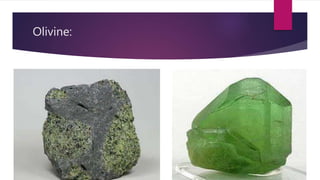
Olivine:
Tectosilicates:
 All four oxygen of the silica tetrahedron are shared by the
neighbouring silicon tetrahedra.this means that there are two
ions of oxygen for every ion of silicon thus forming a 3-
dimensional framework.it is represented by the formula SiO2.
 Quartz,feldspar.
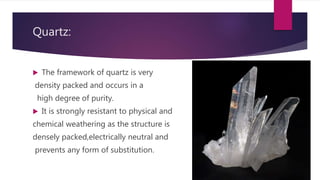
Quartz:
 The framework of quartz is very
density packed and occurs in a
high degree of purity.
 It is strongly resistant to physical and
chemical weathering as the structure is
densely packed,electrically neutral and
prevents any form of substitution.
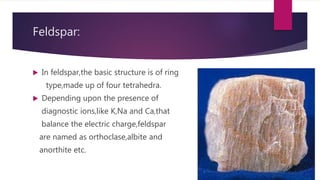
Feldspar:
 In feldspar,the basic structure is of ring
type,made up of four tetrahedra.
 Depending upon the presence of
diagnostic ions,like K,Na and Ca,that
balance the electric charge,feldspar
are named as orthoclase,albite and
anorthite etc.
Some important primary rock forming
minerals:
 FERROMAGNESIAN:
•Olivine Olive – green
•Pyroxene Dark-green
•Amphibole Green- black
•Biotite Black to dark green
 NON- FERROMAGNESIAN:
•Muscovite White,colourless
•Orthoclase Pink (flesh)
•Anorthite White to dark-grey
•Quartz Cloudless to grey.
Secondary minerals
Secondary minerals:
 The secondary minerals are formed at the earth’s surface by
weathering of the pre-existing primary minerals under
variable conditions of temperature and pressure.
 During weathering water accompanied by CO2 from the
Atmosphere plays an important role in processes, such as
hydrolysis, hydration and solution.
Some important secondary minerals:
 Silicates:
●clay minerals - ittlite ,kaolinite,montmorilonite etc.
 Non- silicates:
●oxide,hydroxides of Si,Al and Fe ; Haematite,Geothite;
L Limonite,gibbsite.
●Carbonated: Calcite,dolomite.
●Sulphates : Gypsum
●Phosphate : Apatite,Rock phosphate.
Clay minerals:
 The secondary minerals dominantly occurred in the clay
fractions of almost all soils in sedimentary rocks,especially
shales.
 Of the naturally –occurring inorganic crystalline minerals
found in the clay fraction of soils,the most commonly
observed are layer silicates(illite,
montmorilonite,chloride,vermiculite,kaolinite).
Classification of minerals:
 Quantity as:
 Essential minerals: Occur in quantities varying from
95-98% e.g.- calcium,silicate minerals.
 Accessory minerals: Occur in subsidiary amount
(2-5%) e.g. Apatite,purity,magnetite.
Mode of origin as:
 Primary minerals : formed from crystallization of
magma(molten mass) e.g. Miss,hornblade,quartz.
 Secondary minerals : formed due to decomposition
and/or alternation of primary minerals e.g.
Serpentine,clay minerals.
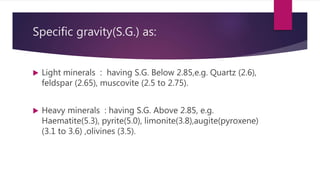
Specific gravity(S.G.) as:
 Light minerals : having S.G. Below 2.85,e.g. Quartz (2.6),
feldspar (2.65), muscovite (2.5 to 2.75).
 Heavy minerals : having S.G. Above 2.85, e.g.
Haematite(5.3), pyrite(5.0), limonite(3.8),augite(pyroxene)
(3.1 to 3.6) ,olivines (3.5).
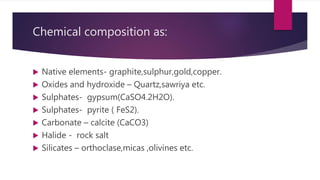
Chemical composition as:
 Native elements- graphite,sulphur,gold,copper.
 Oxides and hydroxide – Quartz,sawriya etc.
 Sulphates- gypsum(CaSO4.2H2O).
 Sulphates- pyrite ( FeS2).
 Carbonate – calcite (CaCO3)
 Halide - rock salt
 Silicates – orthoclase,micas ,olivines etc.
Thank you

ROCK FORMING MINERAL

  • 1.
    Welcome PRESENTED BY :SEEMA PRAJAPAT
  • 2.
    Rock forming minerals: Minerals are solid substance and composed of atoms having an orderly and regular arrangement.  A Minerals is a naturally- occuring ,homogeneous element or inirganic compound.  Most minerals are composed of two or more elements that combine to form a compound such as gypsum : CaSO4.2H2O, Olivier, feldspar etc.
  • 3.
    Formation of minerals: When the molten magma solidifies,the different element present therein freely arrange themselves in accordance with the attractive forces and geometric form.  Arrange only 4 oxygen anions(with a radius of 1.32 A°) around a central silicon action (with a radius of 0.42 A°) ,this is the arrangement of a tetrahedron.
  • 4.
  • 5.
    Important rock–forming minerals: Primary minerals● - Ferromagnesians •Olivines Fe, mg •pyroxenes Ca,Na,Fe,Mg •Amphiboles,etc. Ca,Na,Fe,My,Al,OH - Phyllosilicates •Biotite K,Fe,Mg,So,OH •Muscovite K,Al, OH.
  • 6.
    Primary mineral:  Non– ferromagnesians •Tectosilicates ~Feldspar,such as: Anorthite Ca,Al Albite Na,Al Orthoclase K,Al ~Quartz _
  • 7.
    Secondary clay minerals: Na,K,Ca,Mg,Fe,Al,OH other then Si and O.  In the Absence of a crystalline form, the material is termed as non- crystalline e.g., allophone,chalcedony.
  • 8.
    Primary minerals:  Theprimary minerals are those which are formed owing to the crystallization of molten magma.  Orthosilicates Phyllosilicates Inosilicates Tectosilicates _Quartz _Feldspar.
  • 9.
    Inosilicates:  The simplestway to link tetrahedron is to join one corner with another forming a single chain structure is PYROXENE.
  • 10.
    Double chain inosilicate: Complex way to link tetrahedron is when two single-chains are cross –linked to make a double – chain structure,e.g. AMPHIBOLES
  • 11.
    Phyllosilicates:  A complexlinkage is in the sheet structure in which all tetrahedra share three oxygen ions with the neighbouring tetrahedra.
  • 12.
  • 13.
  • 14.
    Phyllosilicates:  They havesheet structure of tetrahedra where each silicon ion shares three oxygen ions with adjacent silicon ion to form a pattern ,like honey –comb.
  • 15.
    Orthosilicates:  The orthosilicatesare represented by olivine(Fe,Mg)2 SiO4.  The structure consists of individual silicon –tetrahedra alternating with positively – charged metal ions which balance the negative charge of the tetrahedra units.
  • 16.
  • 17.
    Tectosilicates:  All fouroxygen of the silica tetrahedron are shared by the neighbouring silicon tetrahedra.this means that there are two ions of oxygen for every ion of silicon thus forming a 3- dimensional framework.it is represented by the formula SiO2.  Quartz,feldspar.
  • 18.
    Quartz:  The frameworkof quartz is very density packed and occurs in a high degree of purity.  It is strongly resistant to physical and chemical weathering as the structure is densely packed,electrically neutral and prevents any form of substitution.
  • 19.
    Feldspar:  In feldspar,thebasic structure is of ring type,made up of four tetrahedra.  Depending upon the presence of diagnostic ions,like K,Na and Ca,that balance the electric charge,feldspar are named as orthoclase,albite and anorthite etc.
  • 20.
    Some important primaryrock forming minerals:  FERROMAGNESIAN: •Olivine Olive – green •Pyroxene Dark-green •Amphibole Green- black •Biotite Black to dark green  NON- FERROMAGNESIAN: •Muscovite White,colourless •Orthoclase Pink (flesh) •Anorthite White to dark-grey •Quartz Cloudless to grey.
  • 21.
  • 22.
    Secondary minerals:  Thesecondary minerals are formed at the earth’s surface by weathering of the pre-existing primary minerals under variable conditions of temperature and pressure.  During weathering water accompanied by CO2 from the Atmosphere plays an important role in processes, such as hydrolysis, hydration and solution.
  • 23.
    Some important secondaryminerals:  Silicates: ●clay minerals - ittlite ,kaolinite,montmorilonite etc.  Non- silicates: ●oxide,hydroxides of Si,Al and Fe ; Haematite,Geothite; L Limonite,gibbsite. ●Carbonated: Calcite,dolomite. ●Sulphates : Gypsum ●Phosphate : Apatite,Rock phosphate.
  • 24.
    Clay minerals:  Thesecondary minerals dominantly occurred in the clay fractions of almost all soils in sedimentary rocks,especially shales.  Of the naturally –occurring inorganic crystalline minerals found in the clay fraction of soils,the most commonly observed are layer silicates(illite, montmorilonite,chloride,vermiculite,kaolinite).
  • 25.
    Classification of minerals: Quantity as:  Essential minerals: Occur in quantities varying from 95-98% e.g.- calcium,silicate minerals.  Accessory minerals: Occur in subsidiary amount (2-5%) e.g. Apatite,purity,magnetite.
  • 26.
    Mode of originas:  Primary minerals : formed from crystallization of magma(molten mass) e.g. Miss,hornblade,quartz.  Secondary minerals : formed due to decomposition and/or alternation of primary minerals e.g. Serpentine,clay minerals.
  • 27.
    Specific gravity(S.G.) as: Light minerals : having S.G. Below 2.85,e.g. Quartz (2.6), feldspar (2.65), muscovite (2.5 to 2.75).  Heavy minerals : having S.G. Above 2.85, e.g. Haematite(5.3), pyrite(5.0), limonite(3.8),augite(pyroxene) (3.1 to 3.6) ,olivines (3.5).
  • 28.
    Chemical composition as: Native elements- graphite,sulphur,gold,copper.  Oxides and hydroxide – Quartz,sawriya etc.  Sulphates- gypsum(CaSO4.2H2O).  Sulphates- pyrite ( FeS2).  Carbonate – calcite (CaCO3)  Halide - rock salt  Silicates – orthoclase,micas ,olivines etc.
  • 29.