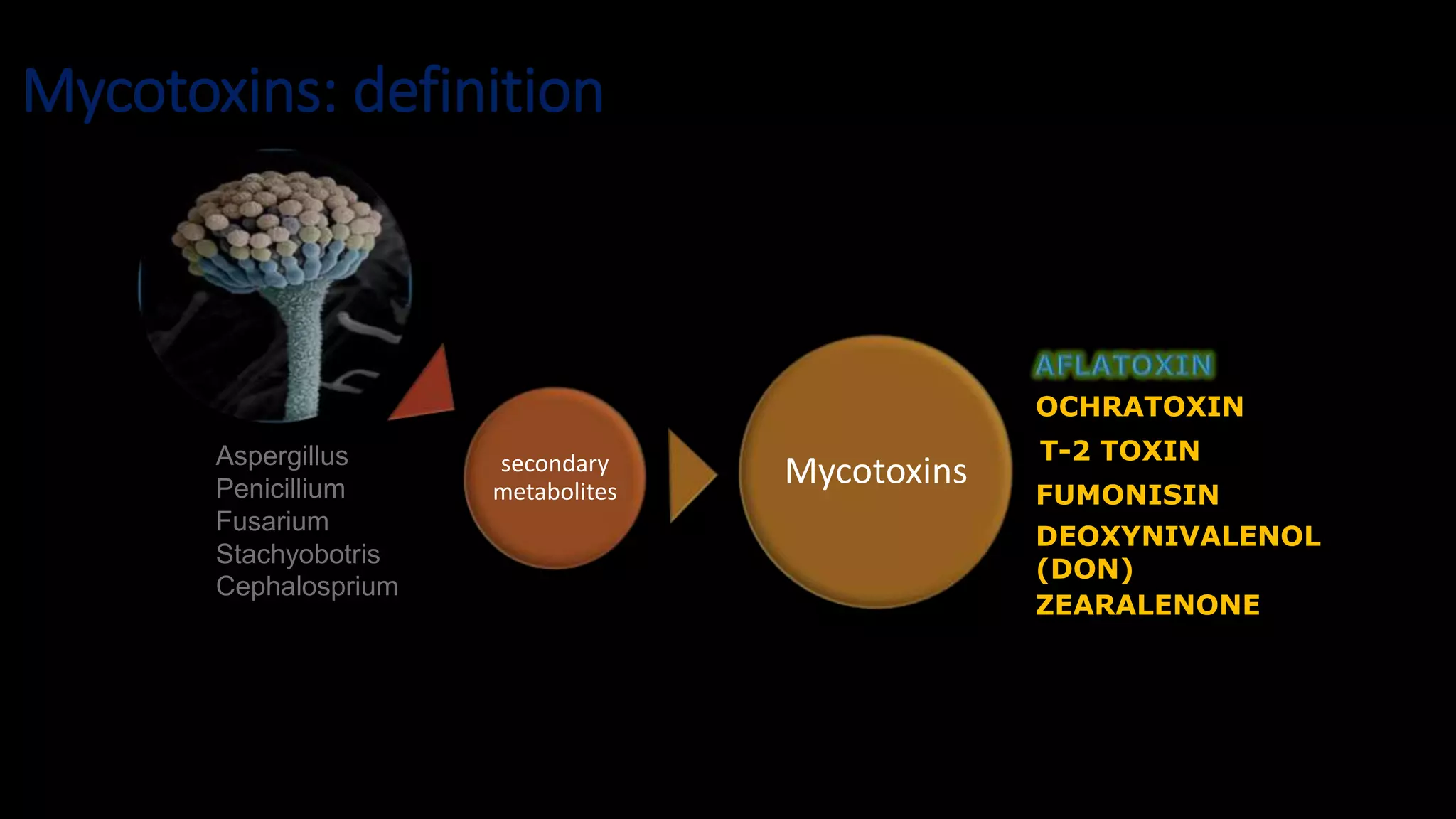

Mycotoxins: definition
secondary
metabolites
Mycotoxins
OCHRATOXIN
T-2 TOXIN
FUMONISIN
DEOXYNIVALENOL
(DON)
ZEARALENONE
Aspergillus
Penicillium
Fusarium
Stachyobotris
Cephalosprium
Mycotoxins: definition
secondary
metabolites
Mycotoxins
OCHRATOXIN
T-2 TOXIN
FUMONISIN
DEOXYNIVALENOL
(DON)
ZEARALENONE
Aspergillus
Penicillium
Fusarium
Stachyobotris
Cephalosprium
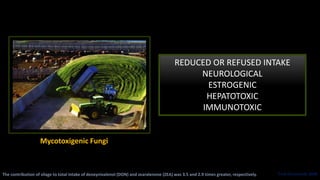
Mycotoxigenic Fungi
REDUCED OR REFUSED INTAKE
NEUROLOGICAL
ESTROGENIC
HEPATOTOXIC
IMMUNOTOXIC
Fink-Gremmels 2008The contribution of silage to total intake of deoxynivalenol (DON) and zearalenone (ZEA) was 3.5 and 2.9 times greater, respectively.
Fink-Gremmels 2008
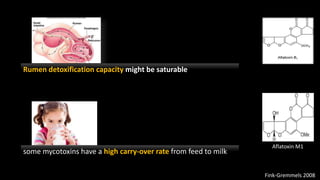
Rumen detoxification capacity might be saturable
some mycotoxins have a high carry-over rate from feed to milk
Aflatoxin M1
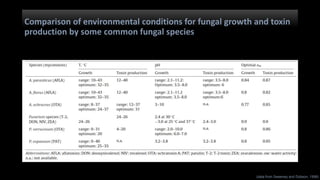
Comparison of environmental conditions for fungal growth and toxin production by some common fungal species
Comparison of environmental conditions for fungal growth and toxin
production by some common fungal species
(data from Sweeney and Dobson, 1998)
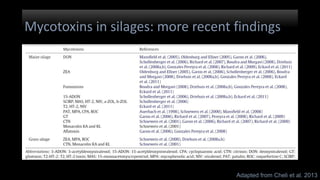
Mycotoxins in silages: more recent findings
Adapted from Cheli et al. 2013
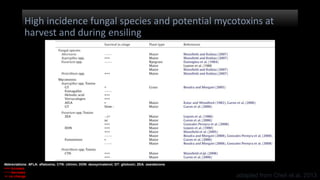
High incidence fungal species and potential mycotoxins at
harvest and during ensiling
Abbreviations: AFLA: aflatoxins; CTN: citrinin; DON: deoxynivalenol; GT: gliotoxin; ZEA: zearalenone
+++ increase
−−− decrease
=: no change adapted from Cheli et al. 2013
FDA Regulation
In the United States, FDA has set an action level of 0.5 ppb for AFM1 in
milk (Code of Federal Regulations Part 109)
• Milk containing AFM1 concentrations above the action level must be
discarded, causing significant economic loss for the dairy producer. Similar
regulations exist in most developed countries.
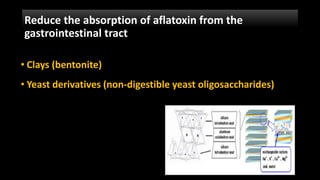
Reduce the absorption of aflatoxin from the
gastrointestinal tract
• Clays (bentonite)
• Yeast derivatives (non-digestible yeast oligosaccharides)
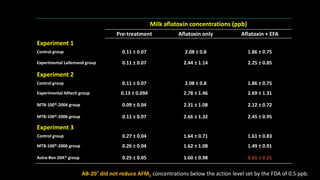
Milk aflatoxin concentrations (ppb)
Pre-treatment Aflatoxin only Aflatoxin + EFA
Experiment 1
Control group 0.11 ± 0.07 2.08 ± 0.8 1.86 ± 0.75
Experimental Lallemand group 0.11 ± 0.07 2.44 ± 1.14 2.25 ± 0.85
Experiment 2
Control group 0.11 ± 0.07 2.08 ± 0.8 1.86 ± 0.75
Experimental Alltech group 0.13 ± 0.094 2.78 ± 1.46 2.69 ± 1.31
MTB-100®-2004 group 0.09 ± 0.04 2.31 ± 1.08 2.12 ± 0.72
MTB-100®-2006 group 0.11 ± 0.07 2.66 ± 1.32 2.45 ± 0.95
Experiment 3
Control group 0.27 ± 0.04 1.64 ± 0.71 1.61 ± 0.83
MTB-100®-2006 group 0.26 ± 0.04 1.62 ± 1.08 1.49 ± 0.91
Astra-Ben 20A® group 0.25 ± 0.05 1.60 ± 0.98 0.61 ± 0.21
AB-20® did not reduce AFM1 concentrations below the action level set by the FDA of 0.5 ppb.
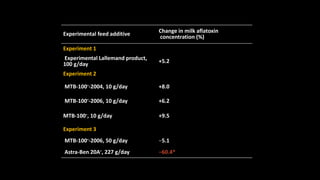
Experimental feed additive
Change in milk aflatoxin
concentration (%)
Experiment 1
Experimental Lallemand product,
100 g/day
+5.2
Experiment 2
MTB-100®-2004, 10 g/day +8.0
MTB-100®-2006, 10 g/day +6.2
MTB-100®, 10 g/day +9.5
Experiment 3
MTB-100®-2006, 50 g/day −5.1
Astra-Ben 20A®, 227 g/day −60.4*
silage mycotoxins

silage mycotoxins

Editor's Notes

  • #2 The secondary metabolites, called mycotoxins, are produced to give fungi a competitive edge against other microorganisms, including other fungi.
  • #3 The secondary metabolites, called mycotoxins, are produced to give fungi a competitive edge against other microorganisms, including other fungi.
  • #4  Mycotoxins contribute to economic losses due to negative effects on livestock productivity, crop losses
  • #5 in a review on the role of mycotoxins in the health and performance of dairy cows noted that and can vary with changes in diet or the presence of metabolic diseases. Another point of concern is that (Fink-Gremmels, 2008a).
  • #9 The transfer of aflatoxin from feed to milk is of critical importance because it is regulated in most countries.
  • #10 Certain feed additives are considered isolating agents that are capable of attaching other substances to their surface without any chemical action and have been used to reduce the absorption of aflatoxin from the gastrointestinal tract. Cation excahage capacity