7 Ways Procurement Innovation
  is Fundamentally Changing
      Spend Management
Innovation

  in·no·va·tion
  noun
   the act of innovating; introduction of
    new things or methods
Why is innovation so important?

   Innovation is what moves us forward to be able to:
    Be more efficient
    Be more effective
    Save (time, money, lives, etc.)
    Improve quality
    Make new discoveries
    Stay on the cutting edge
    Be thought leaders
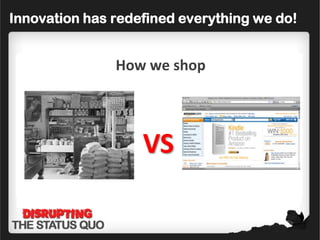
Innovation has redefined everything we do!


          How wewe travel
            we we shop
            How we buy
        HowHowcommunicate
            How commute
       How we power our lives

                    VS
                    VS
                   VS
                   VS
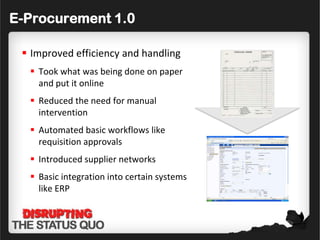
E-Procurement 1.0

  Improved efficiency and handling
   Took what was being done on paper
    and put it online
   Reduced the need for manual
    intervention
   Automated basic workflows like
    requisition approvals
   Introduced supplier networks
   Basic integration into certain systems
    like ERP
Stalled Innovation

   E-Procurement 1.0 required a robust technological
    backbone
    Quarters-to-years to implement
    Delayed time to value
    Limited ability to prove ROI
    Teams of resources to setup and maintain

   Technology and market conditions stalled innovation
    Dotcom bust
    Technology skepticism
Introducing the Cloud & Web 2.0

   More applications and innovation that have once again
    redefined the way we…
    Communicate (social networks, blogs)
    Get information (RSS, newsfeeds)
    Shop (online auctions, name your own price, supplier
     aggregators)
    Manage and maintain applications (less software, less
     hardware)

   And it is redefining the way that procurement, purchasing
    and sourcing organizations work
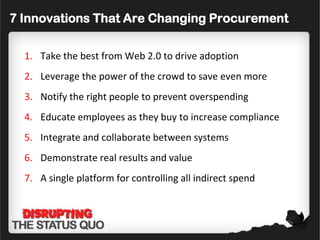
7 Innovations That Are Changing Procurement

  1. Take the best from Web 2.0 to drive adoption
  2. Leverage the power of the crowd to save even more
  3. Notify the right people to prevent overspending
  4. Educate employees as they buy to increase compliance
  5. Integrate and collaborate between systems
  6. Demonstrate real results and value
  7. A single platform for controlling all indirect spend
Innovation 1
Take the best from Web 2.0 to drive adoption
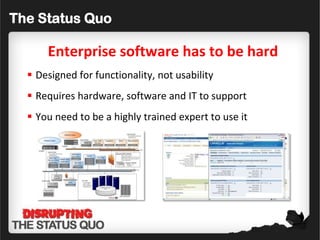
The Status Quo

      Enterprise software has to be hard
   Designed for functionality, not usability
   Requires hardware, software and IT to support
   You need to be a highly trained expert to use it
Disruptive Innovation

   Enterprise software can be as easy as
            consumer software
   Web 2.0 introduced a new generation of applications that
    Are more user friendly and user focused
    Puts power in the hands of the end user
    Makes it easier and faster to share information
    Provides a forum for anyone to say anything
Impact on Procurement

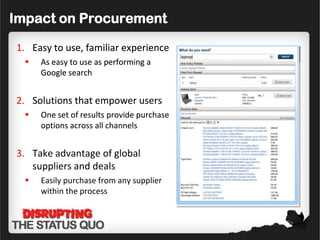
1. Easy to use, familiar experience
     As easy to use as performing a
      Google search


2. Solutions that empower users
     One set of results provide purchase
      options across all channels


3. Take advantage of global
   suppliers and deals
     Easily purchase from any supplier
      within the process
Innovation 2
Leverage the power of the crowd to drive adoption
The Status Quo

     Only professional buyers can source
                  good deals
   They are the most educated on suppliers in the space
   Have the skills to negotiate favorable terms and prices
   Are able to manage the process to choose the right
    supplier for the right purchase
Disruptive Innovation

          Anyone can find a good deal!
   Online world changed the way we buy – personally and
    professionally
    Buyers – not sellers – are in control
    No more global boundaries, you can buy from anyone at
     anytime
    Improved tools for comparison shopping, naming your
     price, etc.
Impact on Procurement
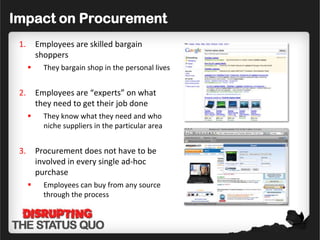
 1.       Employees are skilled bargain
          shoppers
           They bargain shop in the personal lives


 2.       Employees are “experts” on what
          they need to get their job done
           They know what they need and who
            niche suppliers in the particular area


 3.       Procurement does not have to be
          involved in every single ad-hoc
          purchase
           Employees can buy from any source
            through the process
Innovation 3
Notify the right people to prevent overspending
The Status Quo

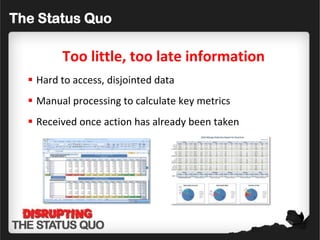
         Too little, too late information
   Hard to access, disjointed data
   Manual processing to calculate key metrics
   Received once action has already been taken
Disruptive Innovation

   Real-time data means real-time results
   Faster access to data necessary for smarter business
    decisions
    Instant access lets you know what is happening at that exact
     moment
    Proactive, customized alerts keeps you abreast of important
     things as they happen
Impact on Procurement

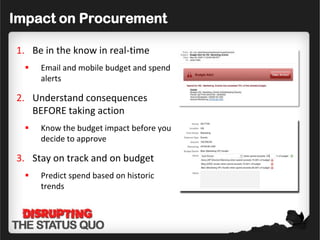
1. Be in the know in real-time
     Email and mobile budget and spend
      alerts

2. Understand consequences
   BEFORE taking action
     Know the budget impact before you
      decide to approve

3. Stay on track and on budget
     Predict spend based on historic
      trends
Innovation 4
Educate employees as they buy to increase
              compliance
The Status Quo

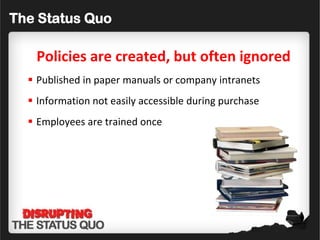
   Policies are created, but often ignored
   Published in paper manuals or company intranets
   Information not easily accessible during purchase
   Employees are trained once
Disruptive Innovation

    Empowerment, not only enablement
   E-Procurement empowers users beyond just filling out a
    form
    Use the process as a chance to educate employees on how to
     buy and from where to buy
    Get end-users involved in providing feedback on suppliers and
     product quality
Impact on Procurement
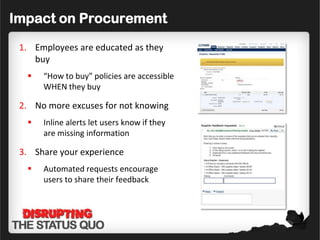
 1. Employees are educated as they
    buy
     “How to buy” policies are accessible
      WHEN they buy

 2. No more excuses for not knowing
     Inline alerts let users know if they
      are missing information

 3. Share your experience
     Automated requests encourage
      users to share their feedback
Innovation 5
Integrate and collaborate between systems
The Status Quo

   Procurement has e-procurement, accounting
     has ERP, employees have order forms, etc.
   Multiple, disparate systems
   Limited ability to work across departments
   Forces manual intervention
Disruptive Innovation

      Faster, easier, cheaper integration
   More common, compatible platforms and technology
      Out-of-the-box system connectors
      Open APIs for integration with key systems
      Automatic data flow between systems
      Users continue to use existing systems with little disruption
Impact on Procurement

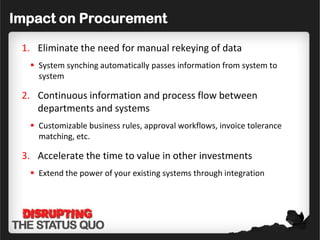
 1. Eliminate the need for manual rekeying of data
   System synching automatically passes information from system to
    system

 2. Continuous information and process flow between
    departments and systems
   Customizable business rules, approval workflows, invoice tolerance
    matching, etc.

 3. Accelerate the time to value in other investments
   Extend the power of your existing systems through integration
Innovation 6
Demonstrate real results and value
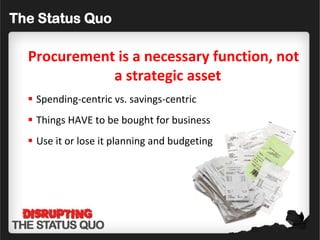
The Status Quo

  Procurement is a necessary function, not
             a strategic asset
   Spending-centric vs. savings-centric
   Things HAVE to be bought for business
   Use it or lose it planning and budgeting
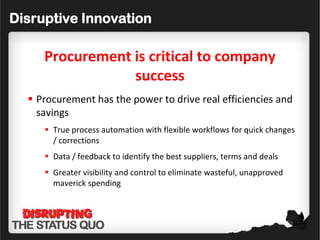
Disruptive Innovation

     Procurement is critical to company
                 success
   Procurement has the power to drive real efficiencies and
    savings
      True process automation with flexible workflows for quick changes
       / corrections
      Data / feedback to identify the best suppliers, terms and deals
      Greater visibility and control to eliminate wasteful, unapproved
       maverick spending
Impact on Procurement
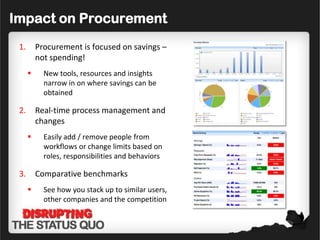
 1.       Procurement is focused on savings –
          not spending!
           New tools, resources and insights
            narrow in on where savings can be
            obtained

 2.       Real-time process management and
          changes
           Easily add / remove people from
            workflows or change limits based on
            roles, responsibilities and behaviors

 3.       Comparative benchmarks
           See how you stack up to similar users,
            other companies and the competition
Innovation 7
A single platform for controlling all indirect
                   spend
The Status Quo

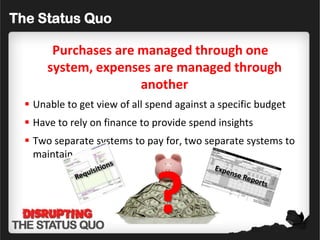
        Purchases are managed through one
       system, expenses are managed through
                      another
   Unable to get view of all spend against a specific budget
   Have to rely on finance to provide spend insights
   Two separate systems to pay for, two separate systems to
    maintain


                               ?
Disruptive Innovation

         Multi-tenant, cloud computing
                   platforms
   Support multiple roles, workflows and applications
    through a single platform
      One line of code means always the latest release and innovations
      One platform equals one database for comprehensive reporting
      One system for users to access, one process for approvers to
       manage
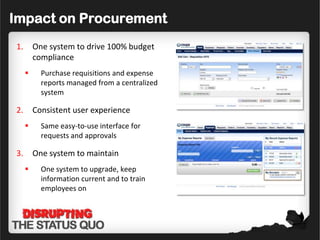
Impact on Procurement
1.       One system to drive 100% budget
         compliance
          Purchase requisitions and expense
           reports managed from a centralized
           system

2.       Consistent user experience
          Same easy-to-use interface for
           requests and approvals

3.       One system to maintain
          One system to upgrade, keep
           information current and to train
           employees on
Innovation in Action
       Demo
Summary
   Innovation is key to improving and moving forward

   7 recent innovations have radically changed procurement
    1.   Take the best from Web 2.0 to drive adoption
    2.   Leverage the power of the crowd to save even more
    3.   Notify the right people to prevent overspending
    4.   Educate employees as they buy to increase compliance
    5.   Integrate and collaborate between systems
    6.   Demonstrate real results and value
    7.   A single platform for controlling all indirect spend

   Move to the cloud to get the latest and greatest
     Cloud technologies make it possible to stay up-to-date without upgrade or IT
      headaches
Q
    &
        A
THANK YOU!
Rob Bernshteyn             Mark Carlton
Chief Executive Officer    Director, Solutions Consulting
rob.bernshetyn@coupa.com   mark.carlton@coupa.com

Signyc distrupting-status-quo - Coupa

  • 1.
    7 Ways ProcurementInnovation is Fundamentally Changing Spend Management
  • 2.
    Innovation in·no·va·tion noun  the act of innovating; introduction of new things or methods
  • 3.
    Why is innovationso important?  Innovation is what moves us forward to be able to:  Be more efficient  Be more effective  Save (time, money, lives, etc.)  Improve quality  Make new discoveries  Stay on the cutting edge  Be thought leaders
  • 4.
    Innovation has redefinedeverything we do! How wewe travel we we shop How we buy HowHowcommunicate How commute How we power our lives VS VS VS VS
  • 5.
    E-Procurement 1.0 Improved efficiency and handling  Took what was being done on paper and put it online  Reduced the need for manual intervention  Automated basic workflows like requisition approvals  Introduced supplier networks  Basic integration into certain systems like ERP
  • 6.
    Stalled Innovation  E-Procurement 1.0 required a robust technological backbone  Quarters-to-years to implement  Delayed time to value  Limited ability to prove ROI  Teams of resources to setup and maintain  Technology and market conditions stalled innovation  Dotcom bust  Technology skepticism
  • 7.
    Introducing the Cloud& Web 2.0  More applications and innovation that have once again redefined the way we…  Communicate (social networks, blogs)  Get information (RSS, newsfeeds)  Shop (online auctions, name your own price, supplier aggregators)  Manage and maintain applications (less software, less hardware)  And it is redefining the way that procurement, purchasing and sourcing organizations work
  • 8.
    7 Innovations ThatAre Changing Procurement 1. Take the best from Web 2.0 to drive adoption 2. Leverage the power of the crowd to save even more 3. Notify the right people to prevent overspending 4. Educate employees as they buy to increase compliance 5. Integrate and collaborate between systems 6. Demonstrate real results and value 7. A single platform for controlling all indirect spend
  • 9.
    Innovation 1 Take thebest from Web 2.0 to drive adoption
  • 10.
    The Status Quo Enterprise software has to be hard  Designed for functionality, not usability  Requires hardware, software and IT to support  You need to be a highly trained expert to use it
  • 11.
    Disruptive Innovation Enterprise software can be as easy as consumer software  Web 2.0 introduced a new generation of applications that  Are more user friendly and user focused  Puts power in the hands of the end user  Makes it easier and faster to share information  Provides a forum for anyone to say anything
  • 12.
    Impact on Procurement 1.Easy to use, familiar experience  As easy to use as performing a Google search 2. Solutions that empower users  One set of results provide purchase options across all channels 3. Take advantage of global suppliers and deals  Easily purchase from any supplier within the process
  • 13.
    Innovation 2 Leverage thepower of the crowd to drive adoption
  • 14.
    The Status Quo Only professional buyers can source good deals  They are the most educated on suppliers in the space  Have the skills to negotiate favorable terms and prices  Are able to manage the process to choose the right supplier for the right purchase
  • 15.
    Disruptive Innovation Anyone can find a good deal!  Online world changed the way we buy – personally and professionally  Buyers – not sellers – are in control  No more global boundaries, you can buy from anyone at anytime  Improved tools for comparison shopping, naming your price, etc.
  • 16.
    Impact on Procurement 1. Employees are skilled bargain shoppers  They bargain shop in the personal lives 2. Employees are “experts” on what they need to get their job done  They know what they need and who niche suppliers in the particular area 3. Procurement does not have to be involved in every single ad-hoc purchase  Employees can buy from any source through the process
  • 17.
    Innovation 3 Notify theright people to prevent overspending
  • 18.
    The Status Quo Too little, too late information  Hard to access, disjointed data  Manual processing to calculate key metrics  Received once action has already been taken
  • 19.
    Disruptive Innovation Real-time data means real-time results  Faster access to data necessary for smarter business decisions  Instant access lets you know what is happening at that exact moment  Proactive, customized alerts keeps you abreast of important things as they happen
  • 20.
    Impact on Procurement 1.Be in the know in real-time  Email and mobile budget and spend alerts 2. Understand consequences BEFORE taking action  Know the budget impact before you decide to approve 3. Stay on track and on budget  Predict spend based on historic trends
  • 21.
    Innovation 4 Educate employeesas they buy to increase compliance
  • 22.
    The Status Quo Policies are created, but often ignored  Published in paper manuals or company intranets  Information not easily accessible during purchase  Employees are trained once
  • 23.
    Disruptive Innovation Empowerment, not only enablement  E-Procurement empowers users beyond just filling out a form  Use the process as a chance to educate employees on how to buy and from where to buy  Get end-users involved in providing feedback on suppliers and product quality
  • 24.
    Impact on Procurement 1. Employees are educated as they buy  “How to buy” policies are accessible WHEN they buy 2. No more excuses for not knowing  Inline alerts let users know if they are missing information 3. Share your experience  Automated requests encourage users to share their feedback
  • 25.
    Innovation 5 Integrate andcollaborate between systems
  • 26.
    The Status Quo Procurement has e-procurement, accounting has ERP, employees have order forms, etc.  Multiple, disparate systems  Limited ability to work across departments  Forces manual intervention
  • 27.
    Disruptive Innovation Faster, easier, cheaper integration  More common, compatible platforms and technology  Out-of-the-box system connectors  Open APIs for integration with key systems  Automatic data flow between systems  Users continue to use existing systems with little disruption
  • 28.
    Impact on Procurement 1. Eliminate the need for manual rekeying of data  System synching automatically passes information from system to system 2. Continuous information and process flow between departments and systems  Customizable business rules, approval workflows, invoice tolerance matching, etc. 3. Accelerate the time to value in other investments  Extend the power of your existing systems through integration
  • 29.
  • 30.
    The Status Quo Procurement is a necessary function, not a strategic asset  Spending-centric vs. savings-centric  Things HAVE to be bought for business  Use it or lose it planning and budgeting
  • 31.
    Disruptive Innovation Procurement is critical to company success  Procurement has the power to drive real efficiencies and savings  True process automation with flexible workflows for quick changes / corrections  Data / feedback to identify the best suppliers, terms and deals  Greater visibility and control to eliminate wasteful, unapproved maverick spending
  • 32.
    Impact on Procurement 1. Procurement is focused on savings – not spending!  New tools, resources and insights narrow in on where savings can be obtained 2. Real-time process management and changes  Easily add / remove people from workflows or change limits based on roles, responsibilities and behaviors 3. Comparative benchmarks  See how you stack up to similar users, other companies and the competition
  • 33.
    Innovation 7 A singleplatform for controlling all indirect spend
  • 34.
    The Status Quo Purchases are managed through one system, expenses are managed through another  Unable to get view of all spend against a specific budget  Have to rely on finance to provide spend insights  Two separate systems to pay for, two separate systems to maintain ?
  • 35.
    Disruptive Innovation Multi-tenant, cloud computing platforms  Support multiple roles, workflows and applications through a single platform  One line of code means always the latest release and innovations  One platform equals one database for comprehensive reporting  One system for users to access, one process for approvers to manage
  • 36.
    Impact on Procurement 1. One system to drive 100% budget compliance  Purchase requisitions and expense reports managed from a centralized system 2. Consistent user experience  Same easy-to-use interface for requests and approvals 3. One system to maintain  One system to upgrade, keep information current and to train employees on
  • 37.
  • 38.
    Summary Innovation is key to improving and moving forward  7 recent innovations have radically changed procurement 1. Take the best from Web 2.0 to drive adoption 2. Leverage the power of the crowd to save even more 3. Notify the right people to prevent overspending 4. Educate employees as they buy to increase compliance 5. Integrate and collaborate between systems 6. Demonstrate real results and value 7. A single platform for controlling all indirect spend  Move to the cloud to get the latest and greatest  Cloud technologies make it possible to stay up-to-date without upgrade or IT headaches
  • 39.
    Q & A
  • 40.
    THANK YOU! Rob Bernshteyn Mark Carlton Chief Executive Officer Director, Solutions Consulting rob.bernshetyn@coupa.com mark.carlton@coupa.com

Editor's Notes

  • #14 Take a screen shot of search with results, animation to roll down with one and 2
  • #29 Strategic extension to existing system
  • #30 Accelerating time to value from your investments in other solutions
  • #40 Take the best from Web 2.0 to drive adoptionLeverage the power of the crowd to save even moreNotify the right people to prevent overspendingEducation, not excusesIntegrate and collaborate between systemsDemonstrate real results and valueA single platform for controlling all indirect spend