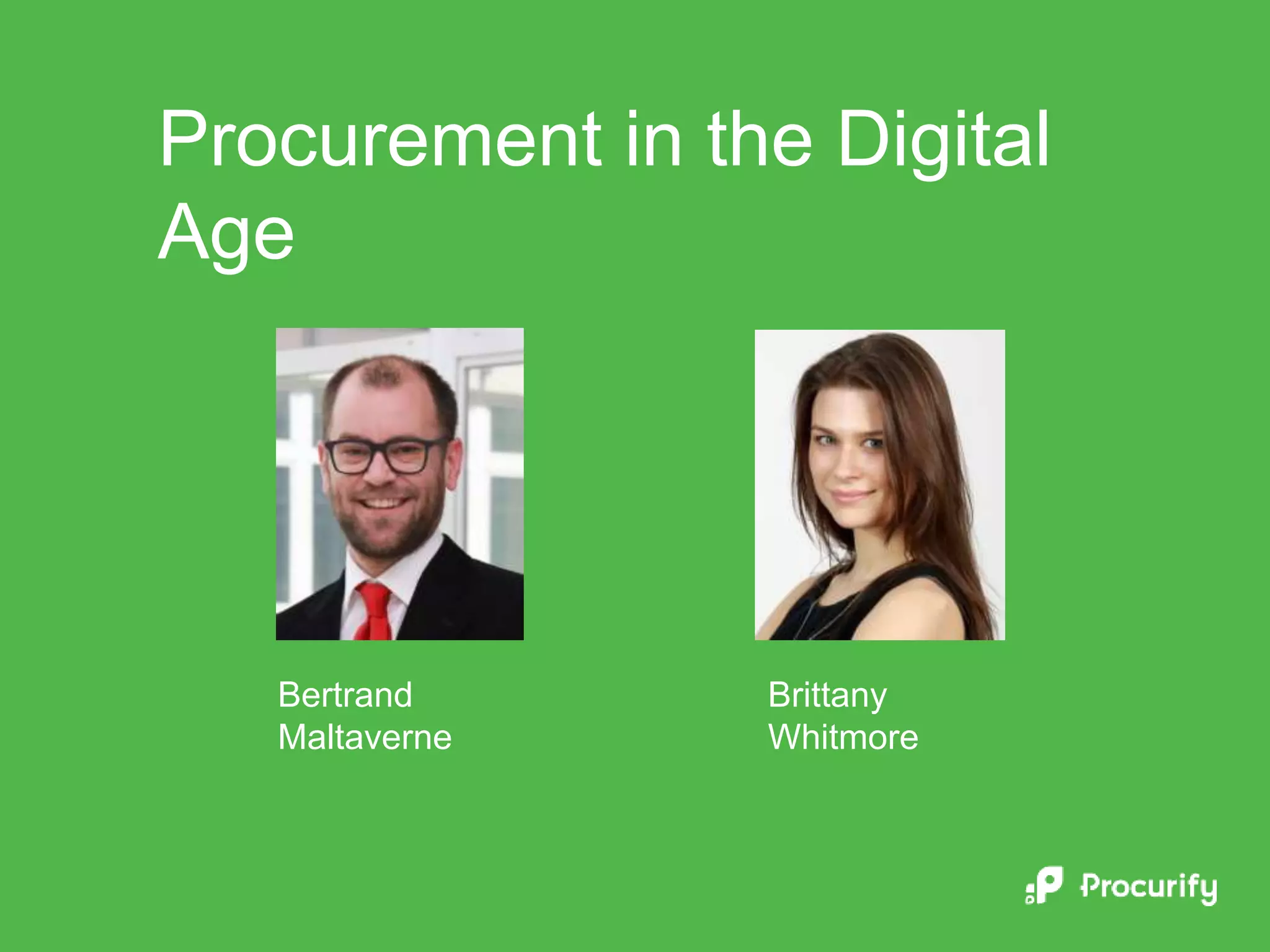
Procurement in the Digital
Age
Bertrand
Maltaverne
Brittany
Whitmore
Since 2014 POOL4TOOL Senior Business Consultant & Product Marketing
2013 - 2014 Schneider Electric, Global Indirect Procurement Tools Manager
2009 - 2012 Schneider Electric, EMEA Indirect Procurement Tools & Process
Manager
2004 - 2009 Schneider Electric, Global Purchasing Application Manager
2001 - 2004 Schneider Electric, Purchaser for Direct Materials
1998 - 2001 Schneider Electric, Technical Manager
About :
The only all-in-one platform for Direct Procurement:
• Strategic Procurement: Category Mgmt., SRM, …
• Operational Procurement: eSourcing, Supplier Perf., Quality and Issue Mgmt....
• Supply Chain execution: Supplier Network / Portal, PO, ASN, VMI, ...
Bertrand Maltaverne
https://at.linkedin.com/in/bmaltaverne
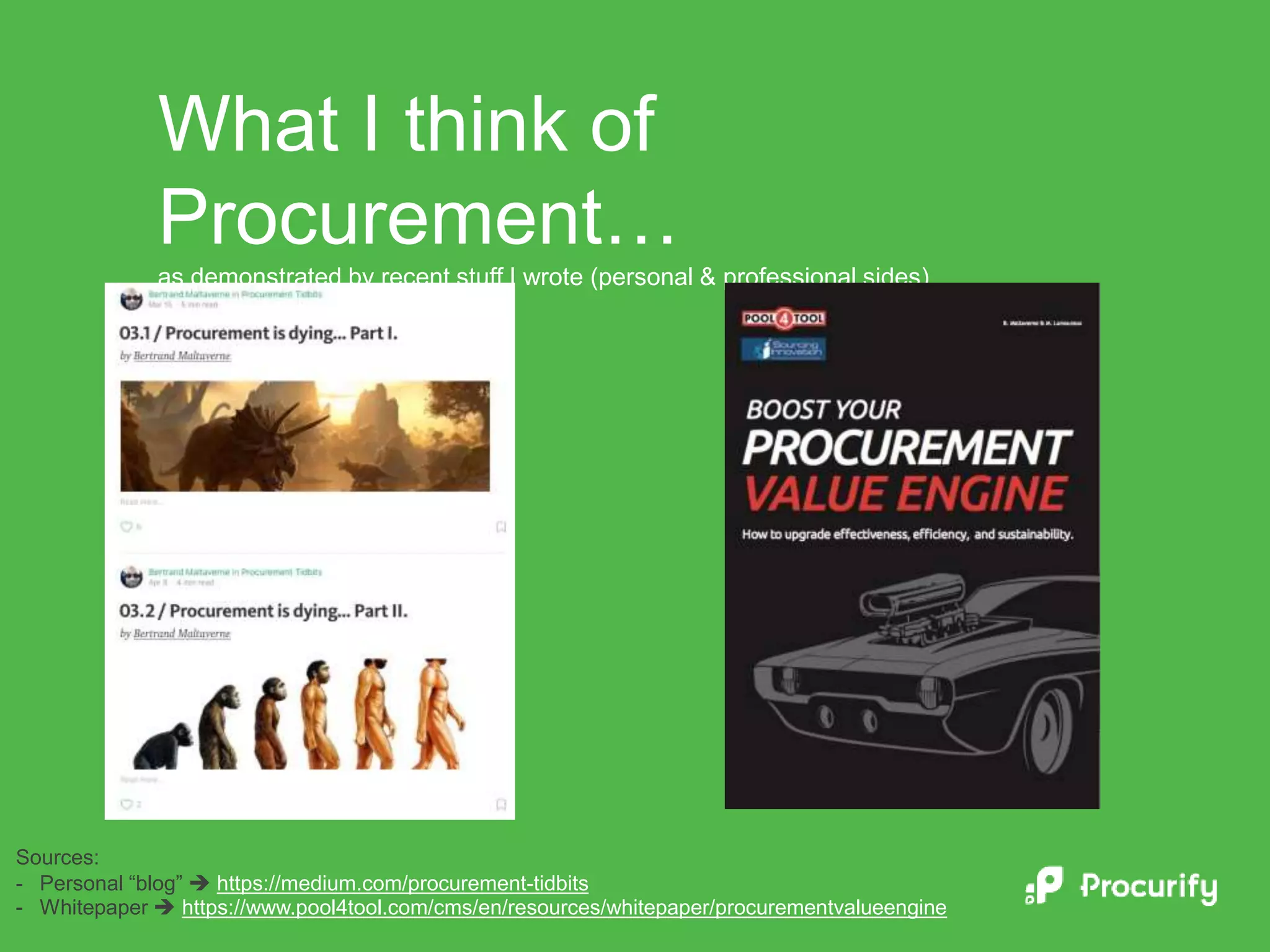
What I think of
Procurement…
as demonstrated by recent stuff I wrote (personal & professional sides)
Sources:
- Personal “blog”  https://medium.com/procurement-tidbits
- Whitepaper  https://www.pool4tool.com/cms/en/resources/whitepaper/procurementvalueengine
Why is it now or
never that
Procurement has to
re-invent itself?
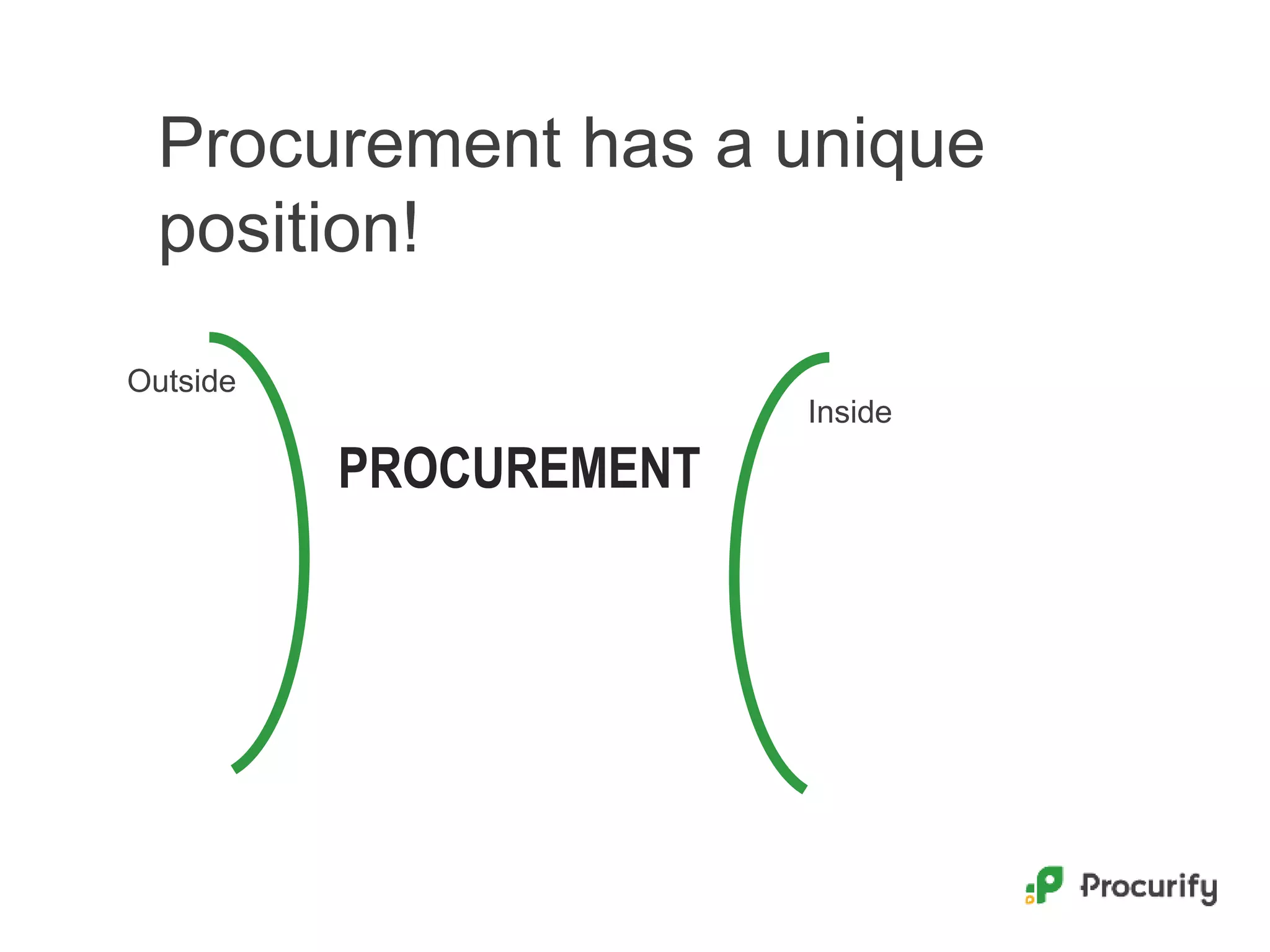
Procurement has a unique
position!
PROCUREMENT
Outside
Inside
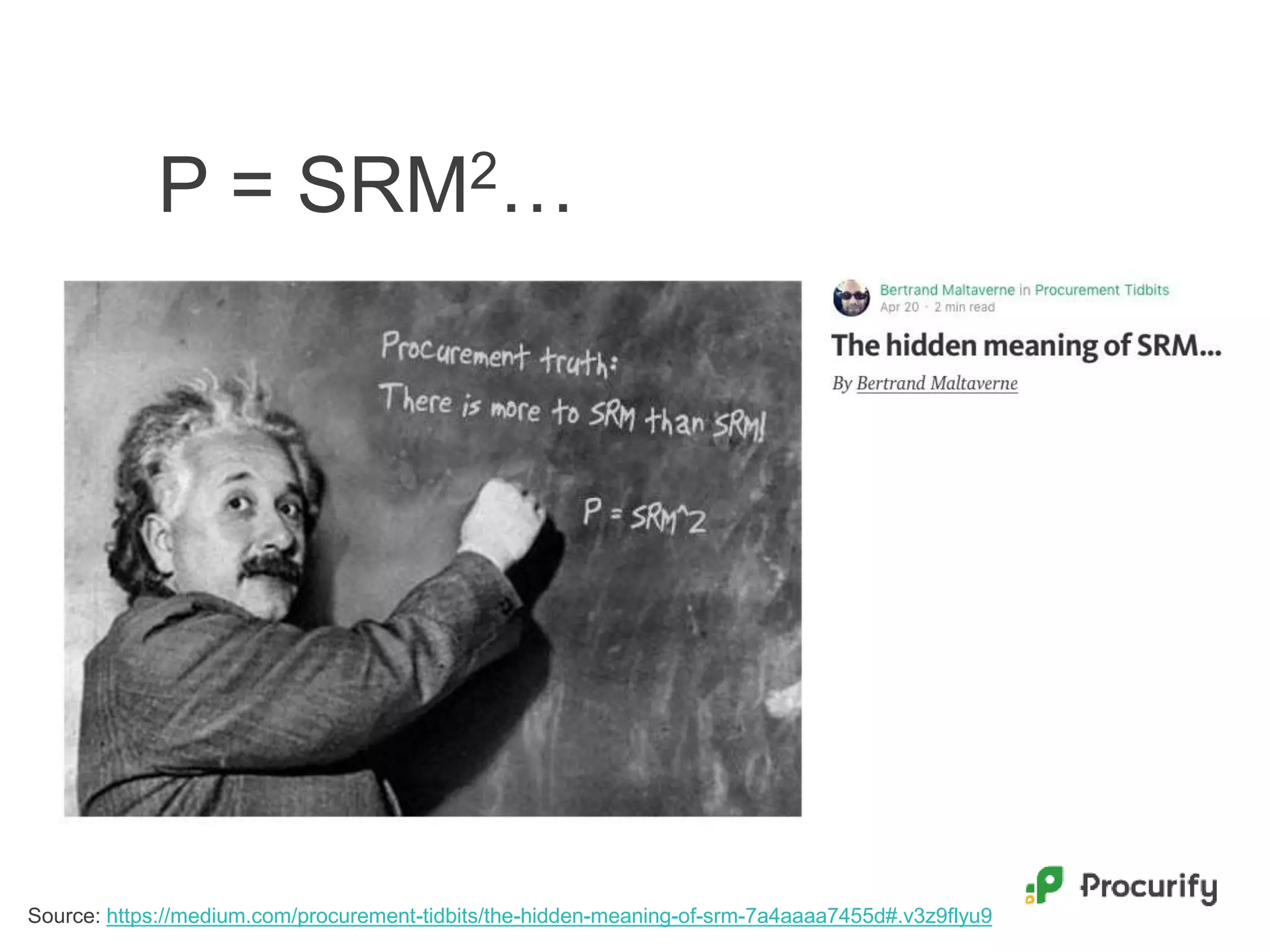
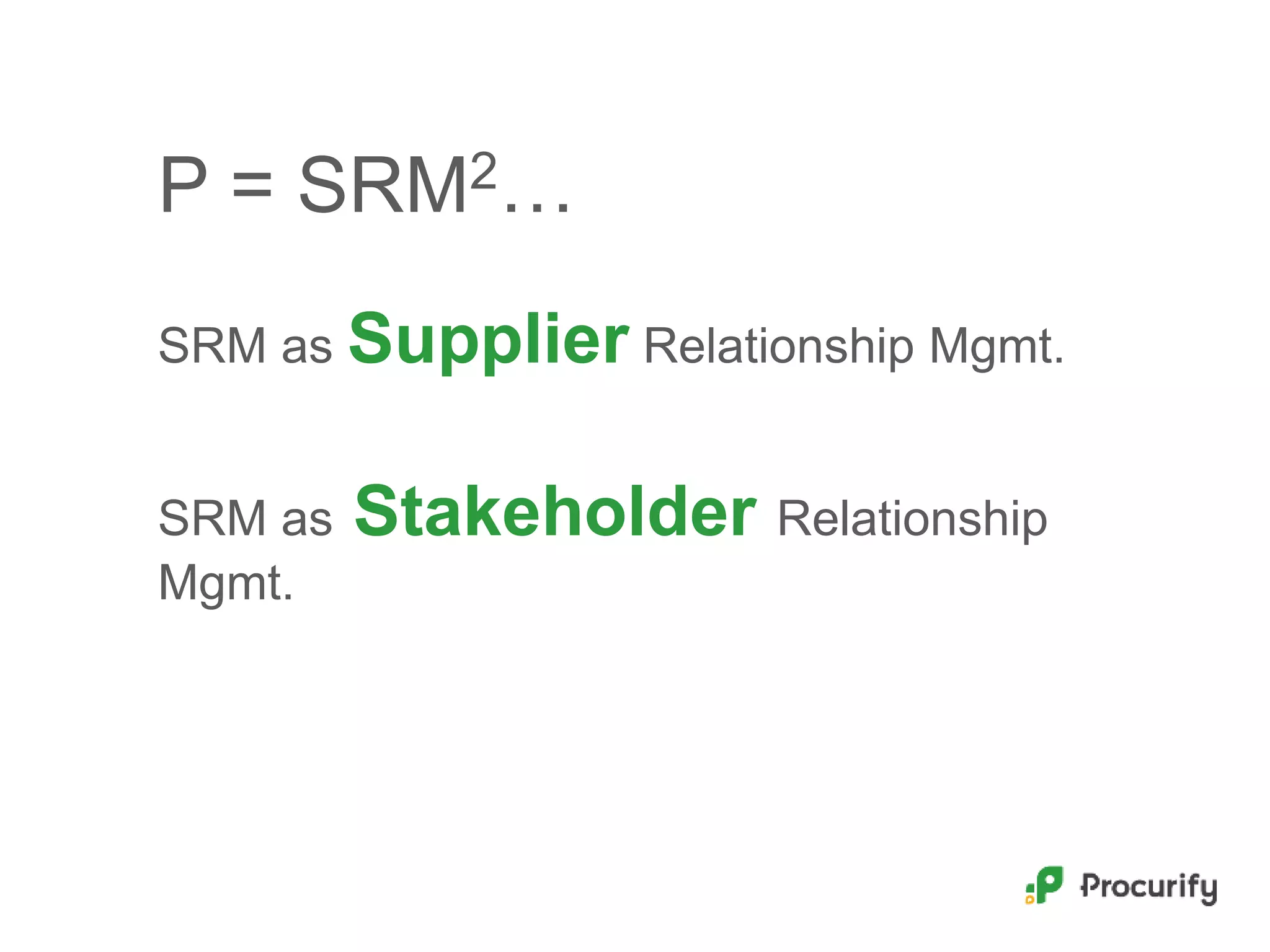
P = SRM2…
Source: https://medium.com/procurement-tidbits/the-hidden-meaning-of-srm-7a4aaaa7455d#.v3z9flyu9
P = SRM2…
SRM as Supplier Relationship Mgmt.
SRM as Stakeholder Relationship
Mgmt.
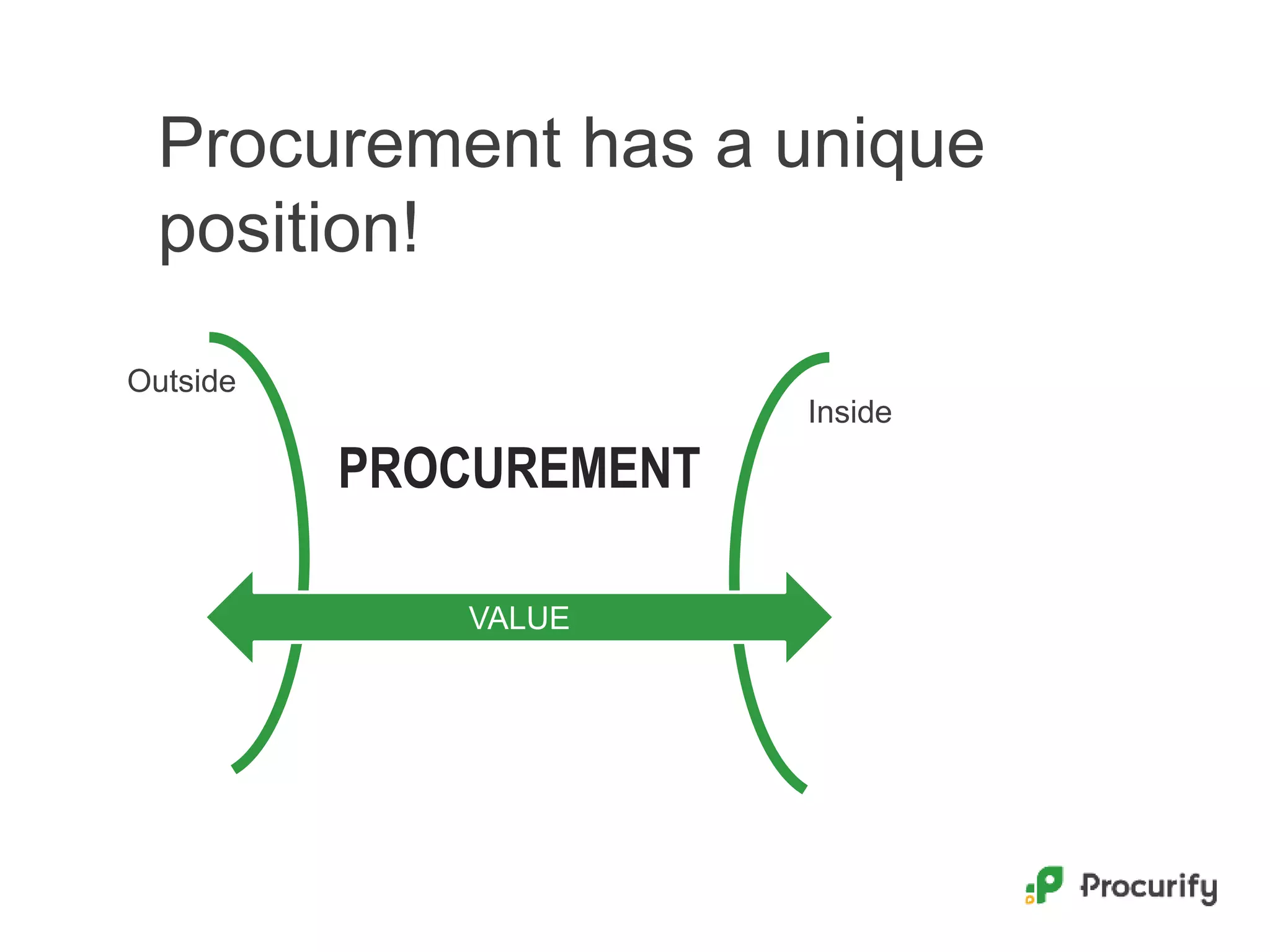
Procurement has a unique
position!
PROCUREMENT
Outside
Inside
VALUE
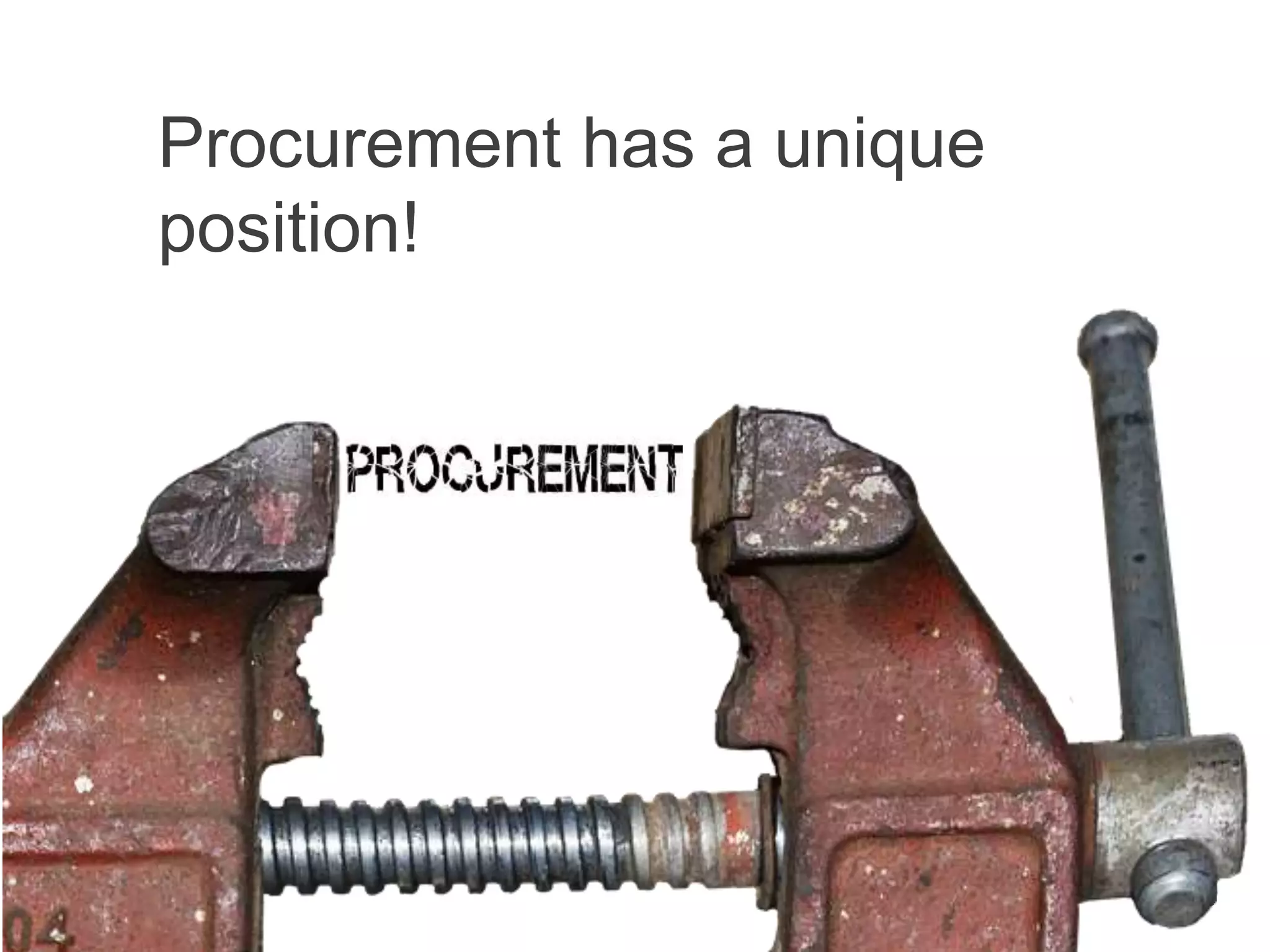
Procurement has a unique
position!
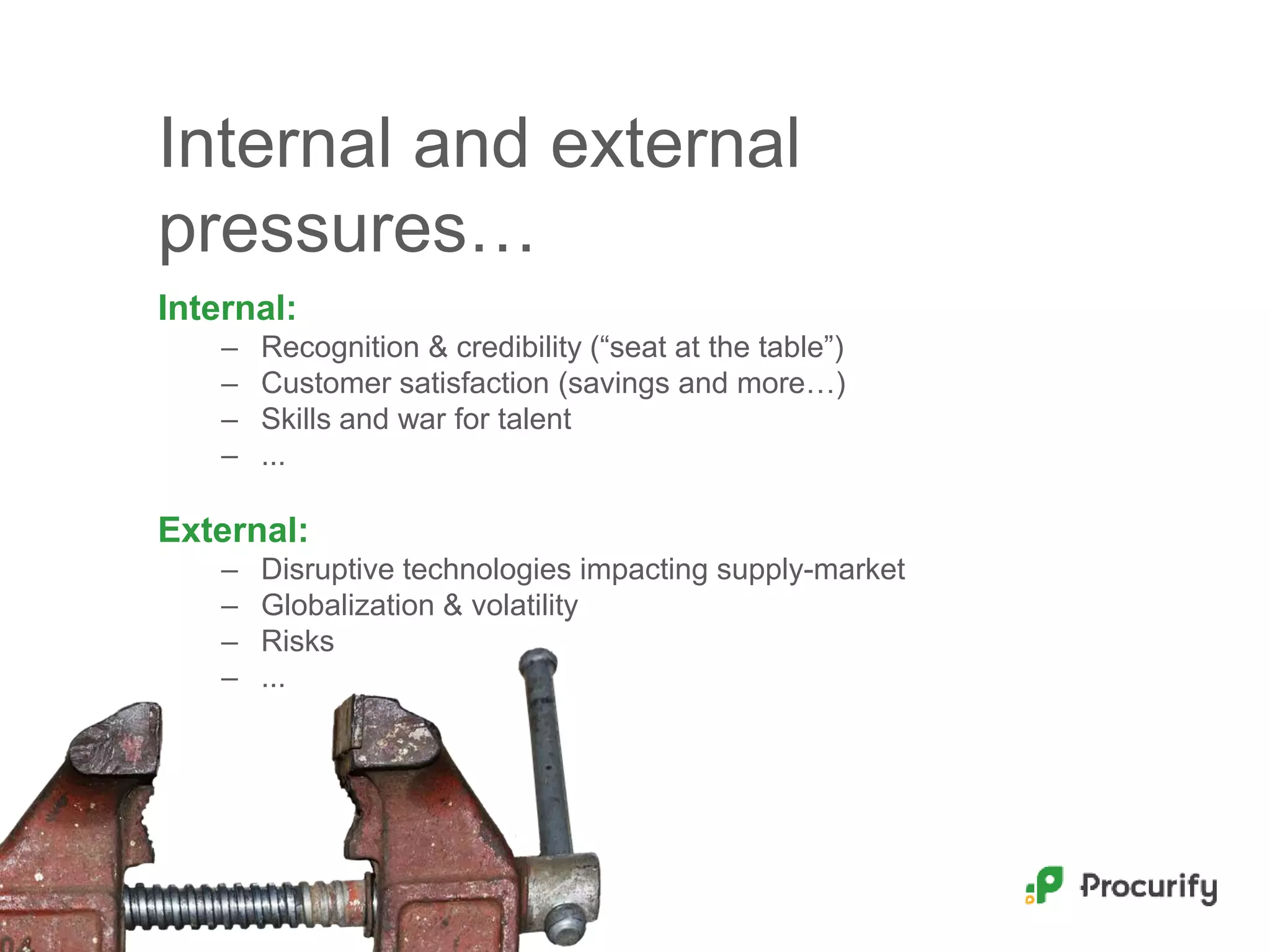
Internal and external
pressures…
Internal:
– Recognition & credibility (“seat at the table”)
– Customer satisfaction (savings and more…)
– Skills and war for talent
– ...
External:
– Disruptive technologies impacting supply-market
– Globalization & volatility
– Risks
– ...
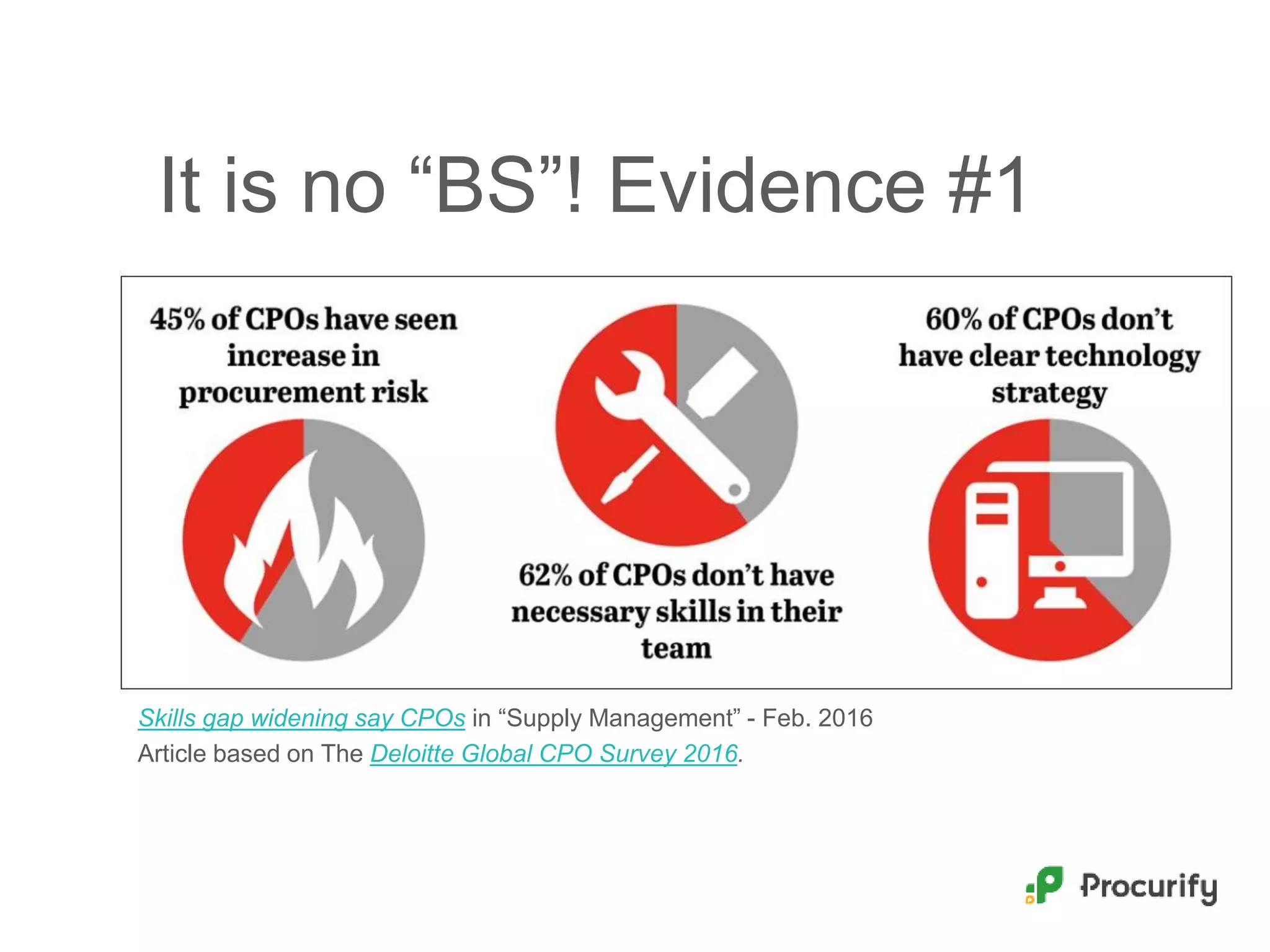
It is no “BS”! Evidence #1
Skills gap widening say CPOs in “Supply Management” - Feb. 2016
Article based on The Deloitte Global CPO Survey 2016.
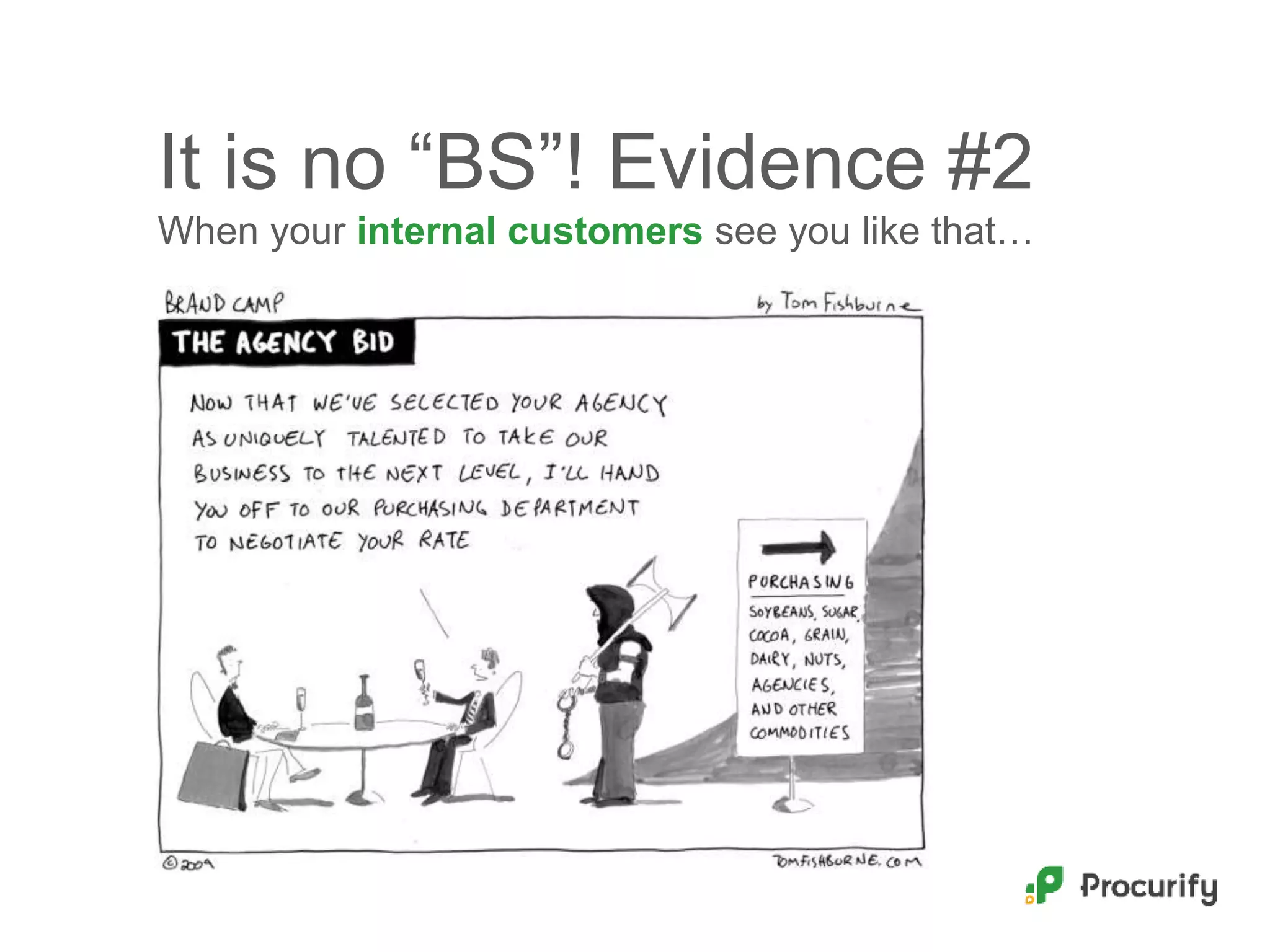
It is no “BS”! Evidence #2
When your internal customers see you like that…
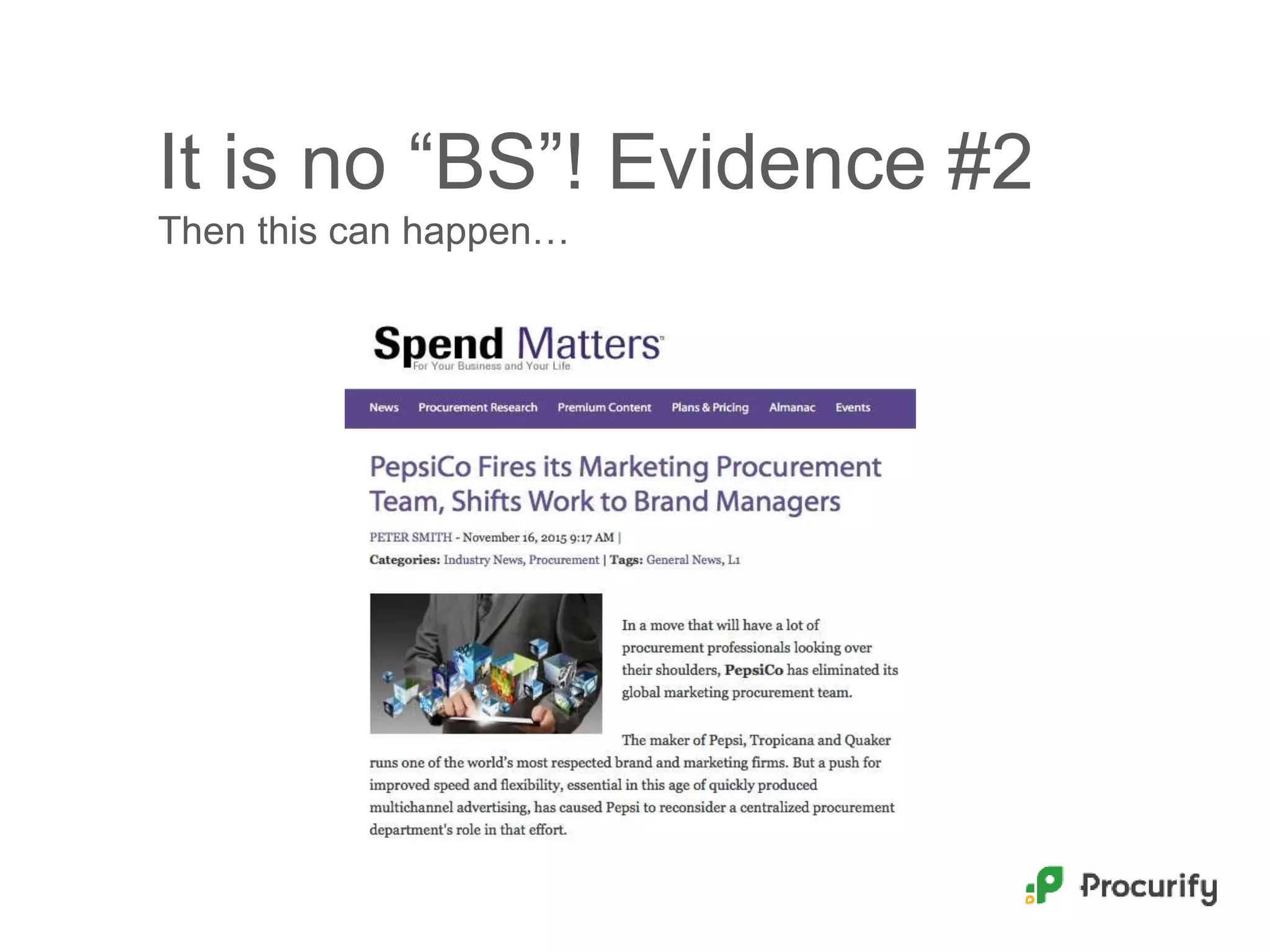
It is no “BS”! Evidence #2
Then this can happen…
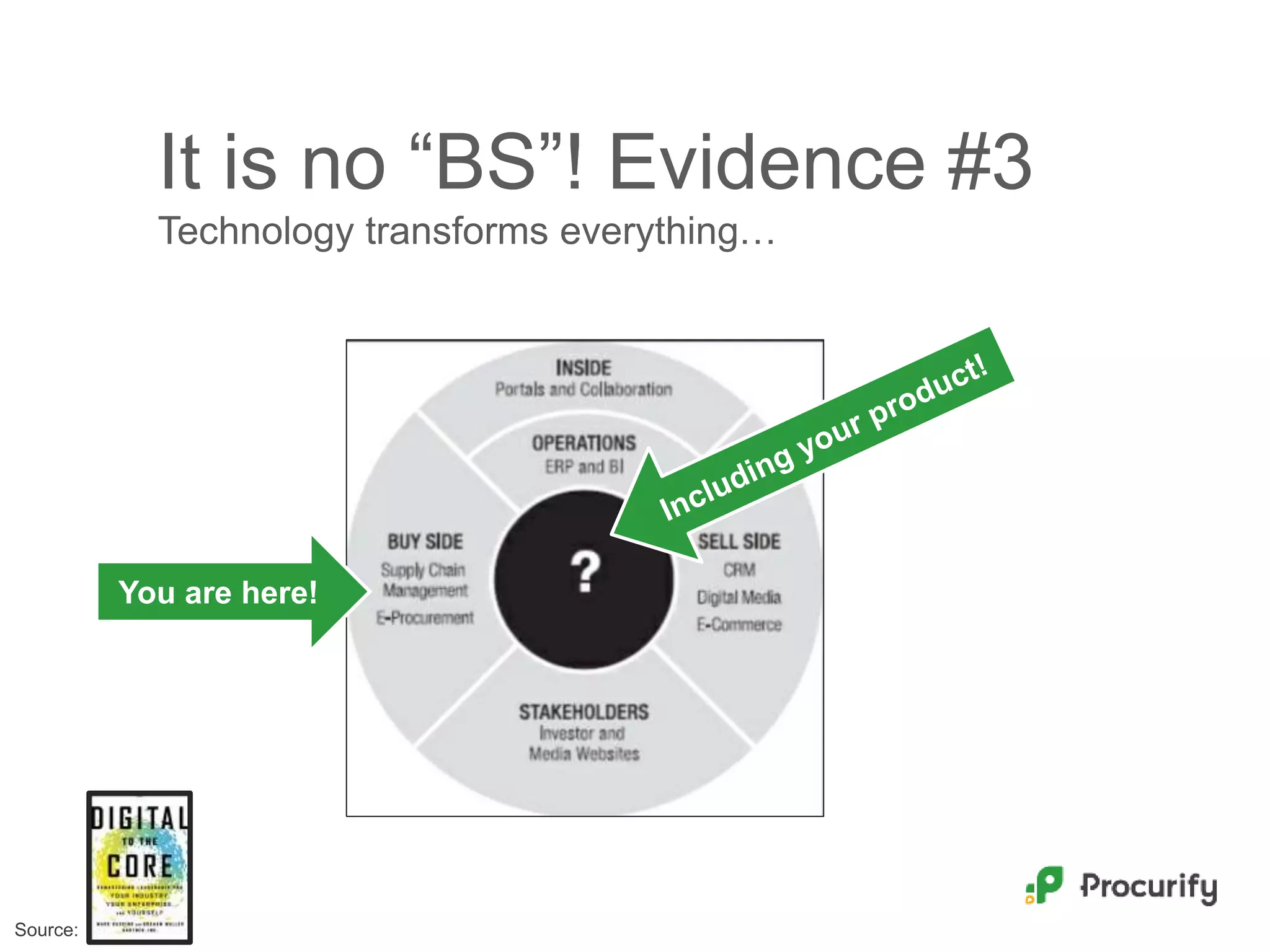
It is no “BS”! Evidence #3
Technology transforms everything…
Source:
You are here!
It is no “BS”! Evidence #3
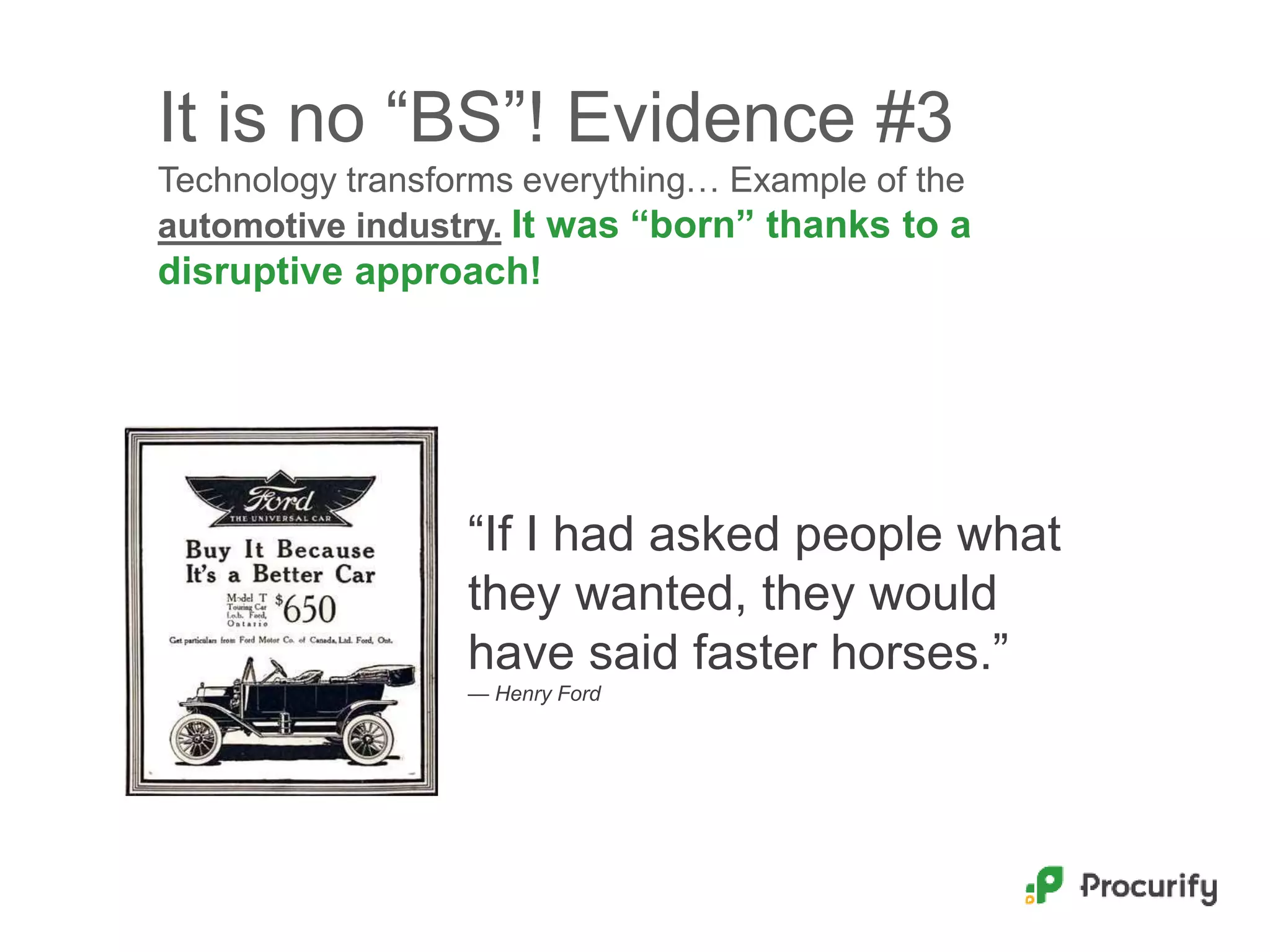
Technology transforms everything… Example of the
automotive industry. It was “born” thanks to a
disruptive approach!
“If I had asked people what
they wanted, they would
have said faster horses.”
— Henry Ford
It is no “BS”! Evidence #3
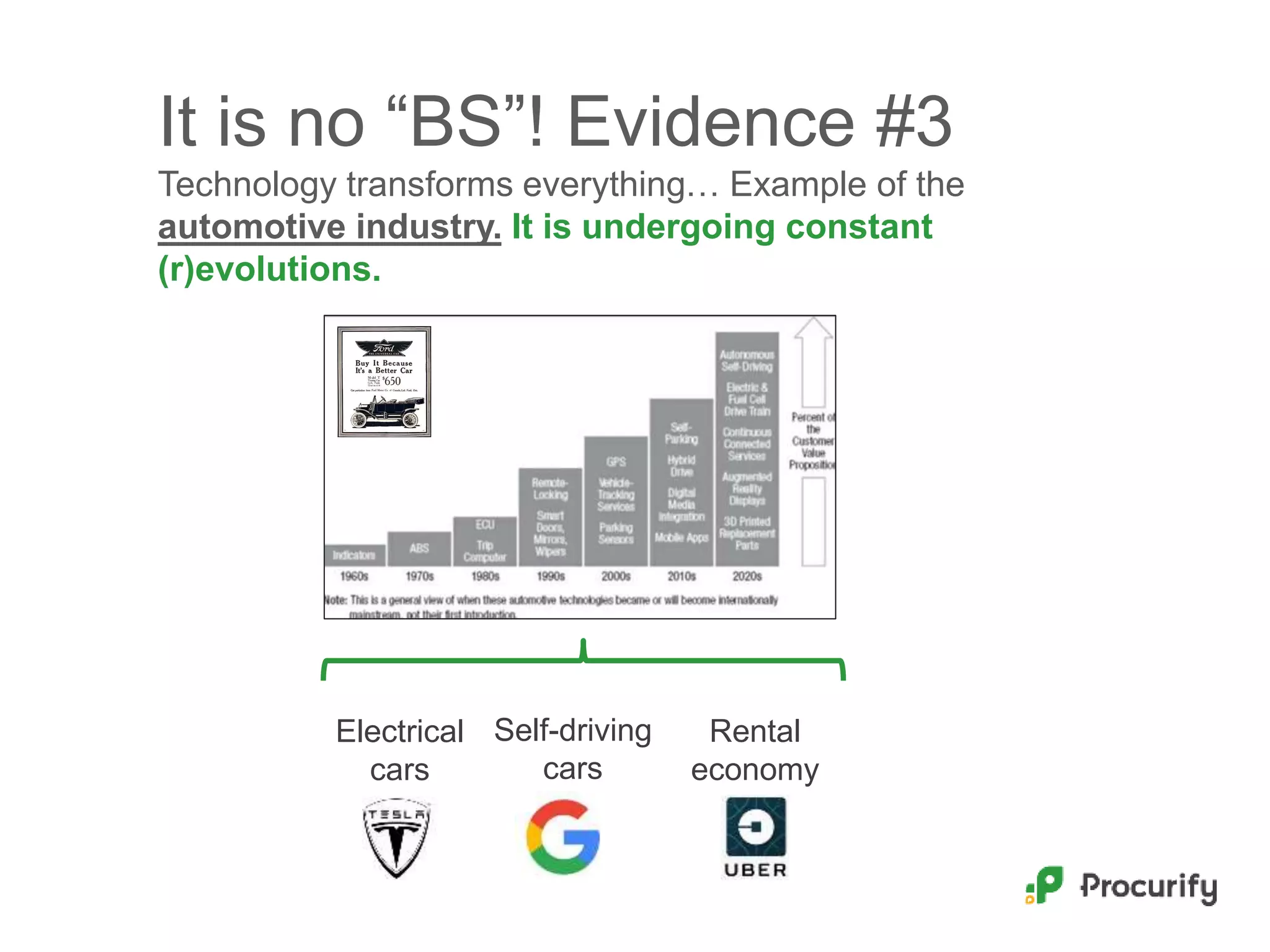
Technology transforms everything… Example of the
automotive industry. It is undergoing constant
(r)evolutions.
Electrical
cars
Self-driving
cars
Rental
economy
It is no “BS”! Evidence #3
Technology transforms everything…
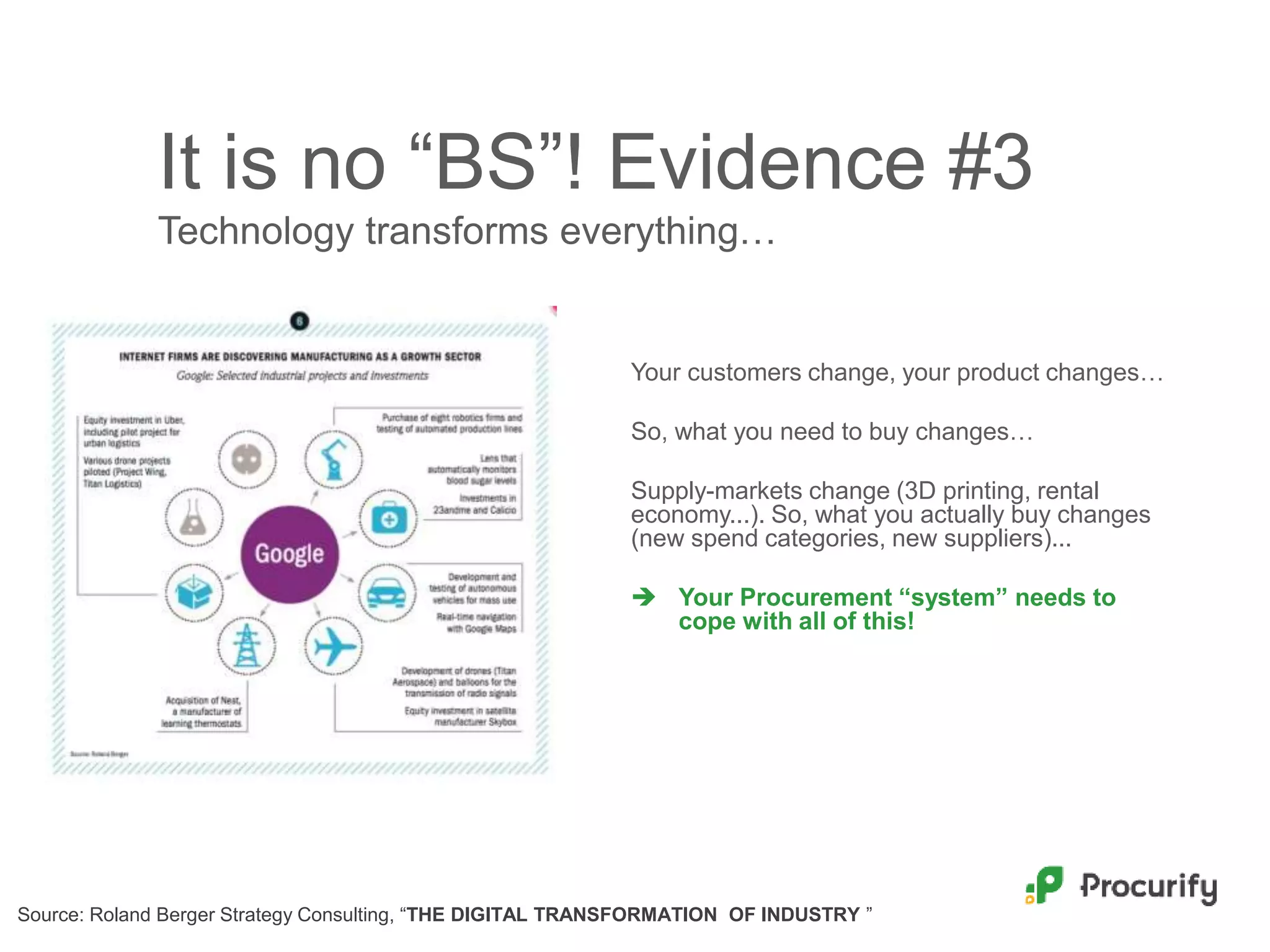
Your customers change, your product changes…
So, what you need to buy changes…
Supply-markets change (3D printing, rental
economy...). So, what you actually buy changes
(new spend categories, new suppliers)...
 Your Procurement “system” needs to
cope with all of this!
Source: Roland Berger Strategy Consulting, “THE DIGITAL TRANSFORMATION OF INDUSTRY ”
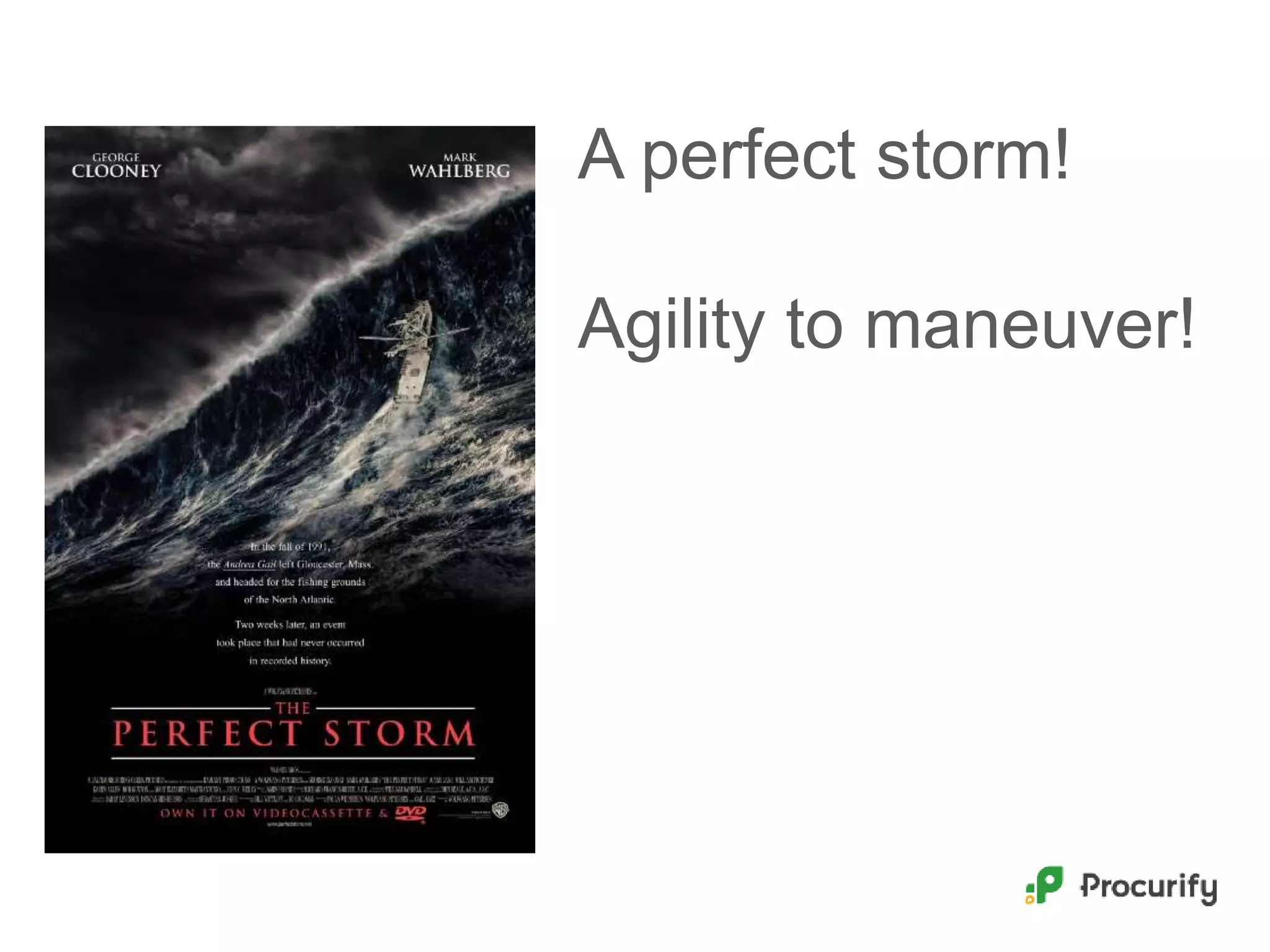
A perfect storm!
Agility to maneuver!
Source:
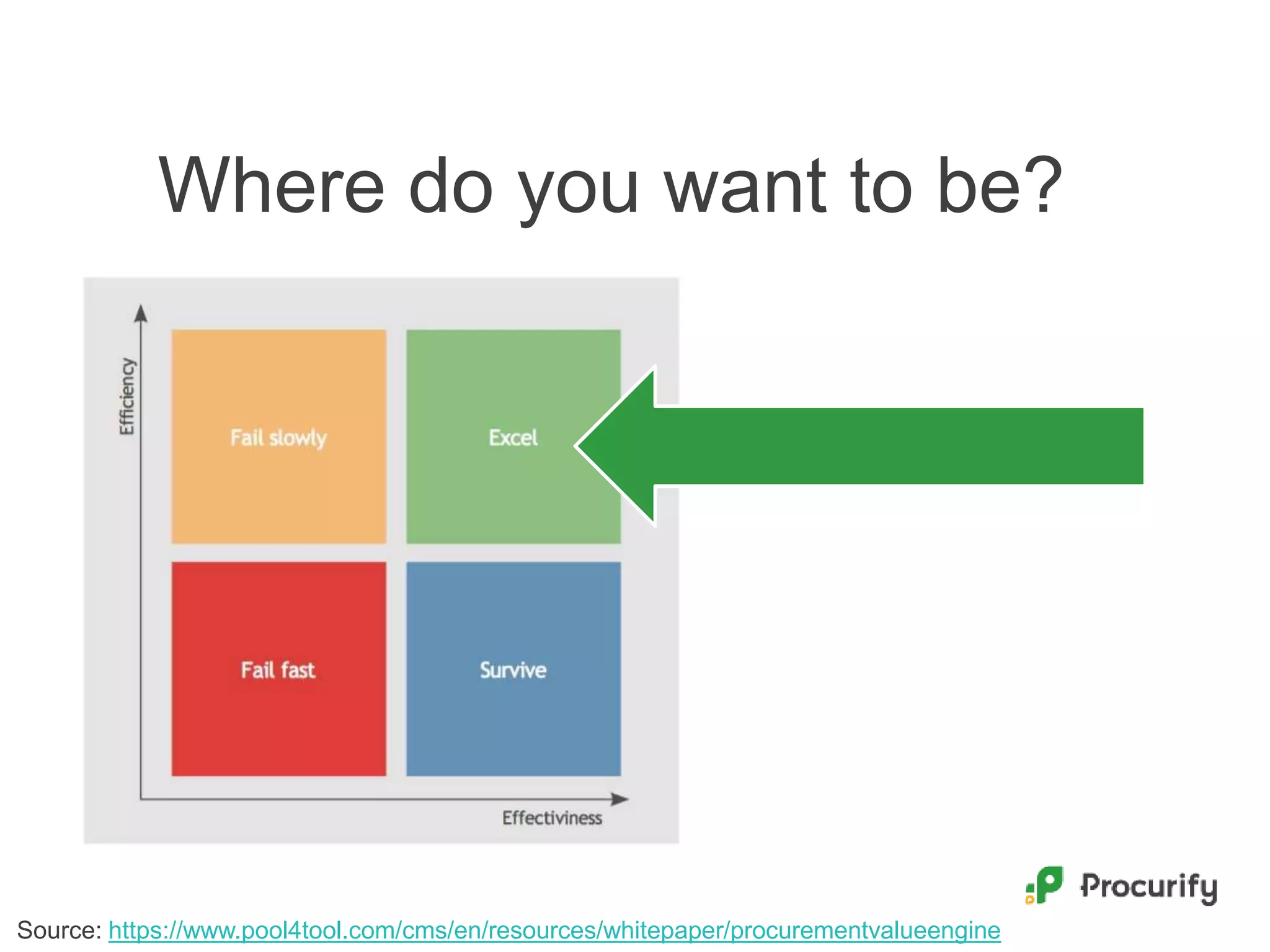
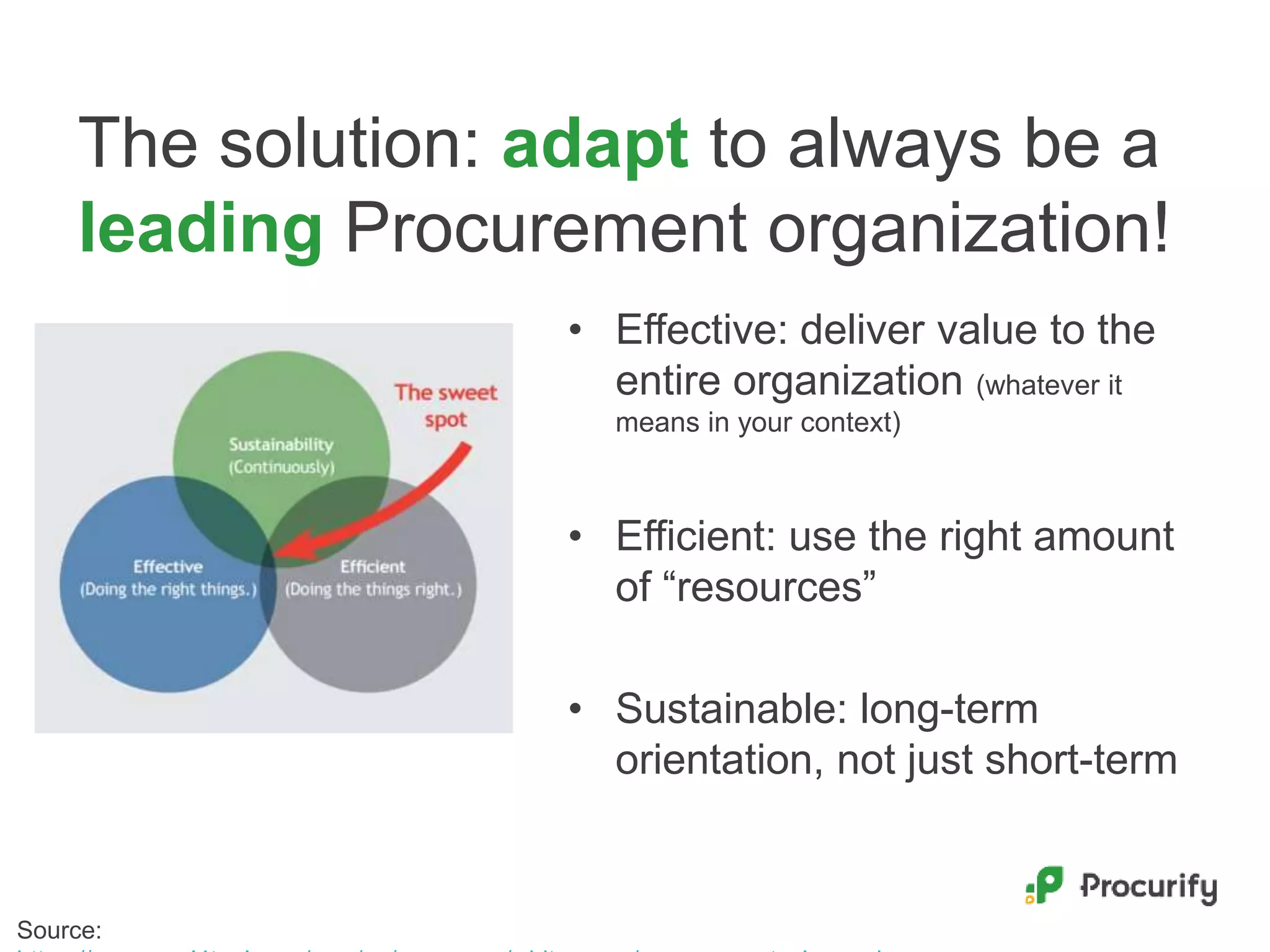
The solution: adapt to always be a
leading Procurement organization!
• Effective: deliver value to the
entire organization (whatever it
means in your context)
• Efficient: use the right amount
of “resources”
• Sustainable: long-term
orientation, not just short-term
Source: https://www.pool4tool.com/cms/en/resources/whitepaper/procurementvalueengine
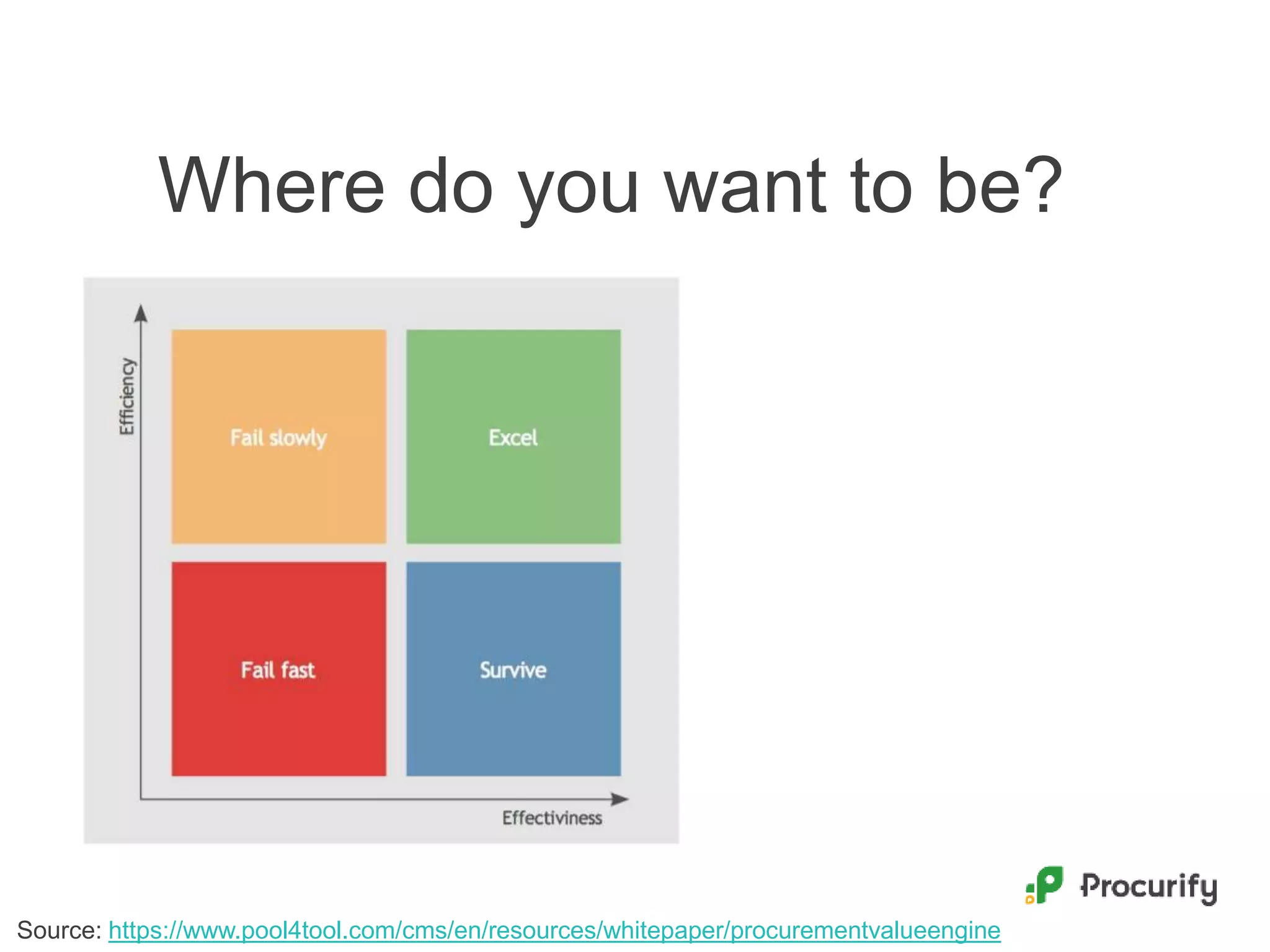
Where do you want to be?
Source: https://www.pool4tool.com/cms/en/resources/whitepaper/procurementvalueengine
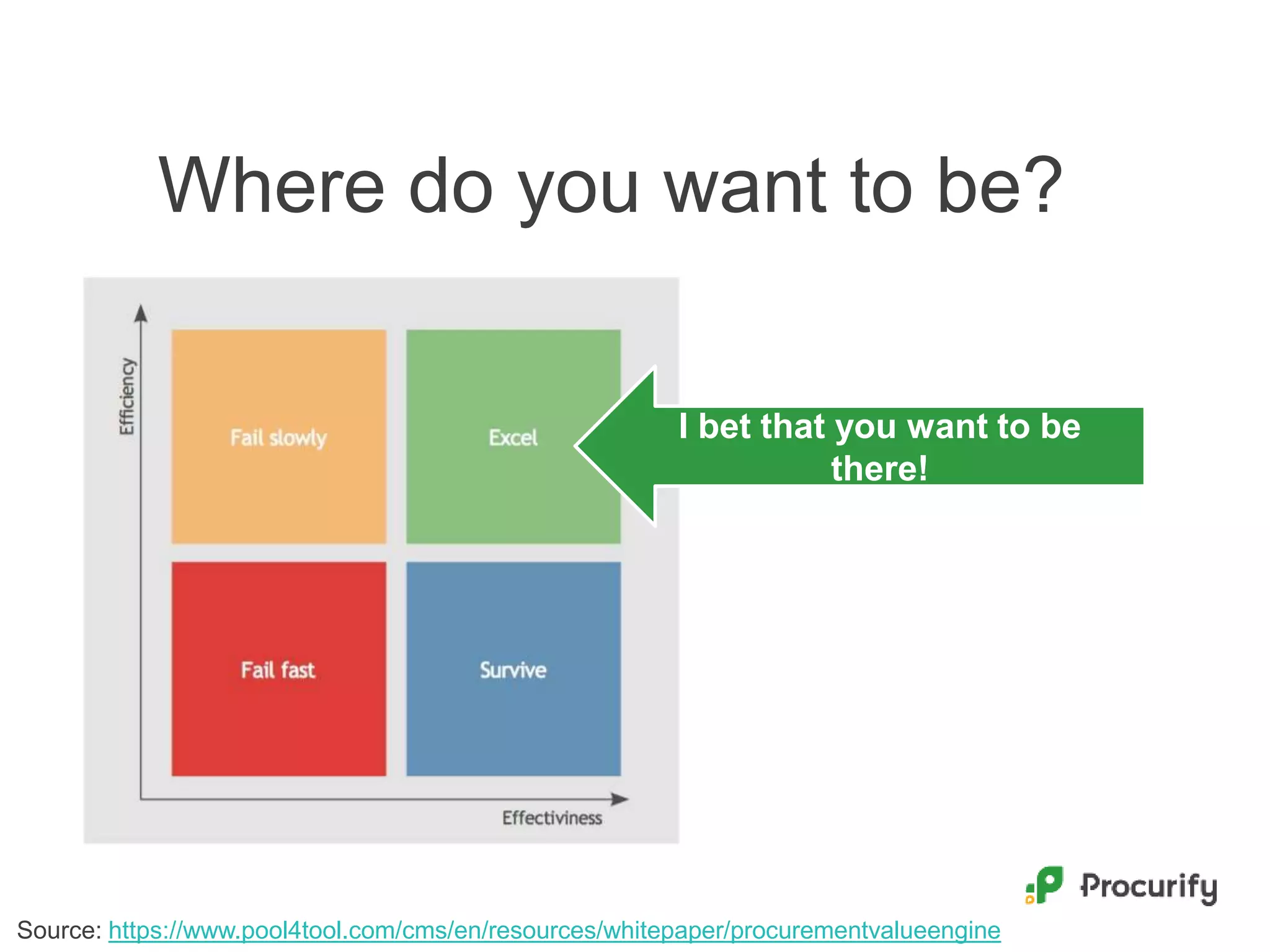
Where do you want to be?
I bet that you want to be
there!
What is the
“eTransformation”
about?
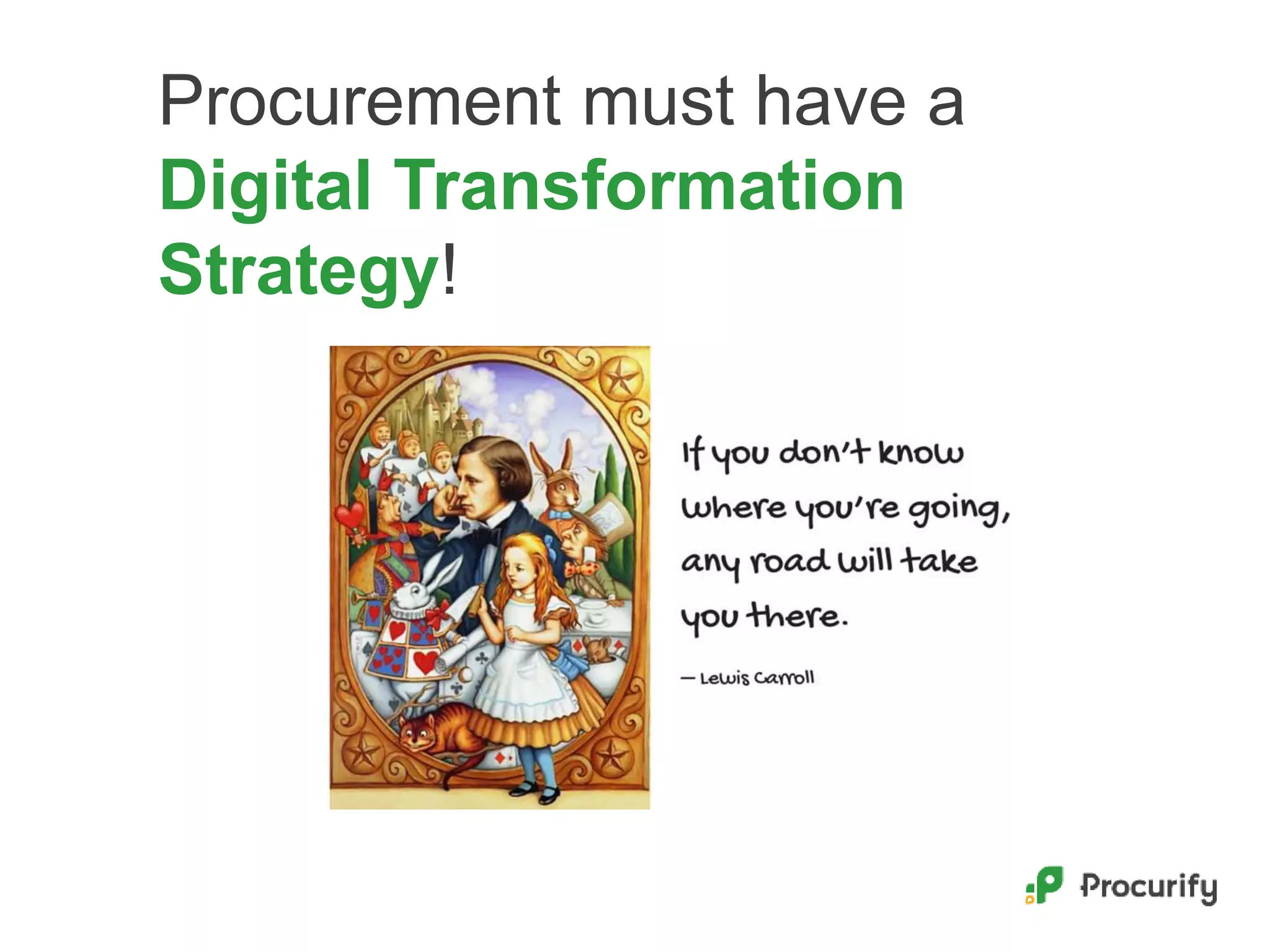
Procurement must have a
Digital Transformation
Strategy!
You have to tailor the strategy
to your context…
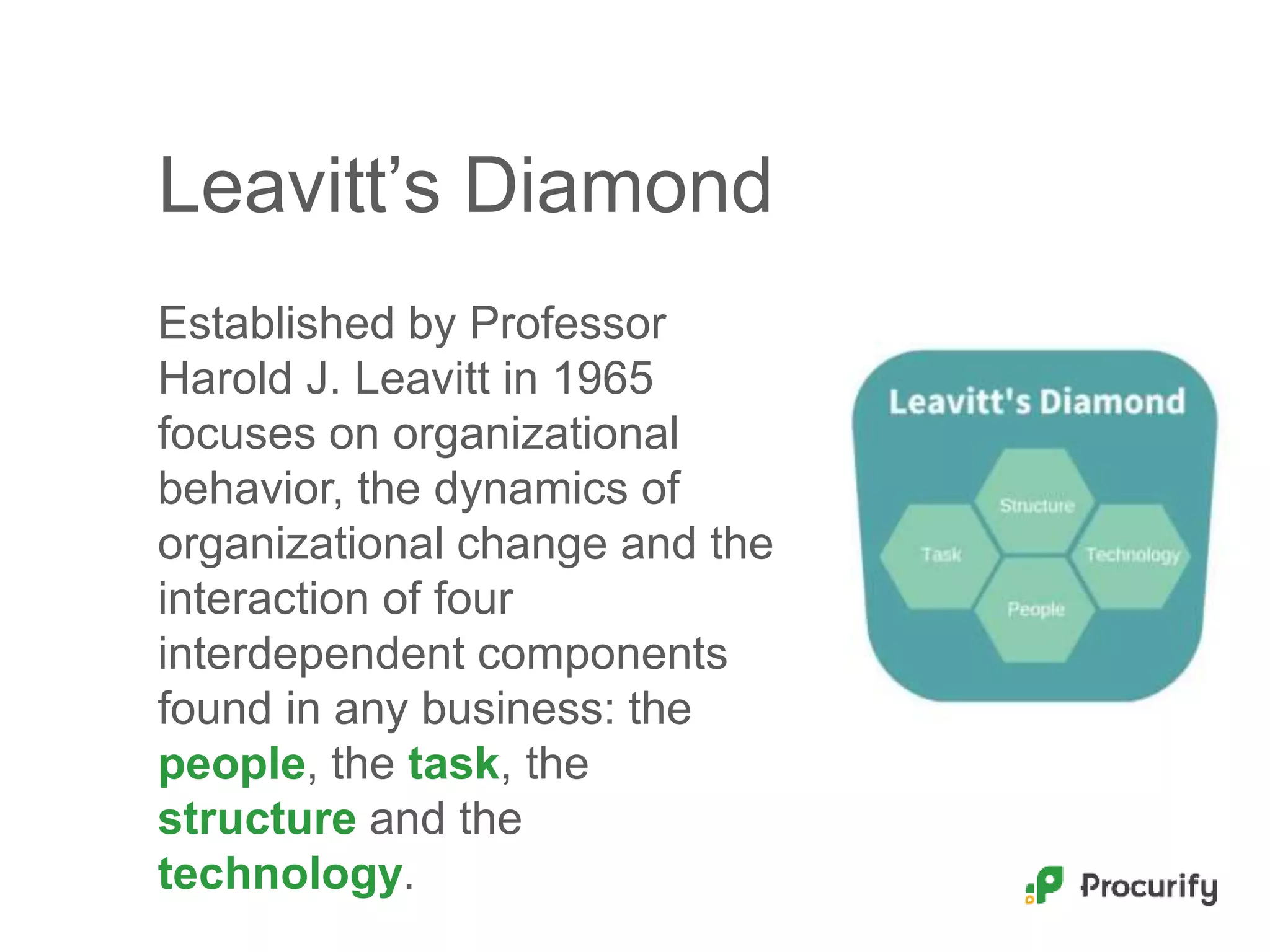
Leavitt’s Diamond
Established by Professor
Harold J. Leavitt in 1965
focuses on organizational
behavior, the dynamics of
organizational change and the
interaction of four
interdependent components
found in any business: the
people, the task, the
structure and the
technology.
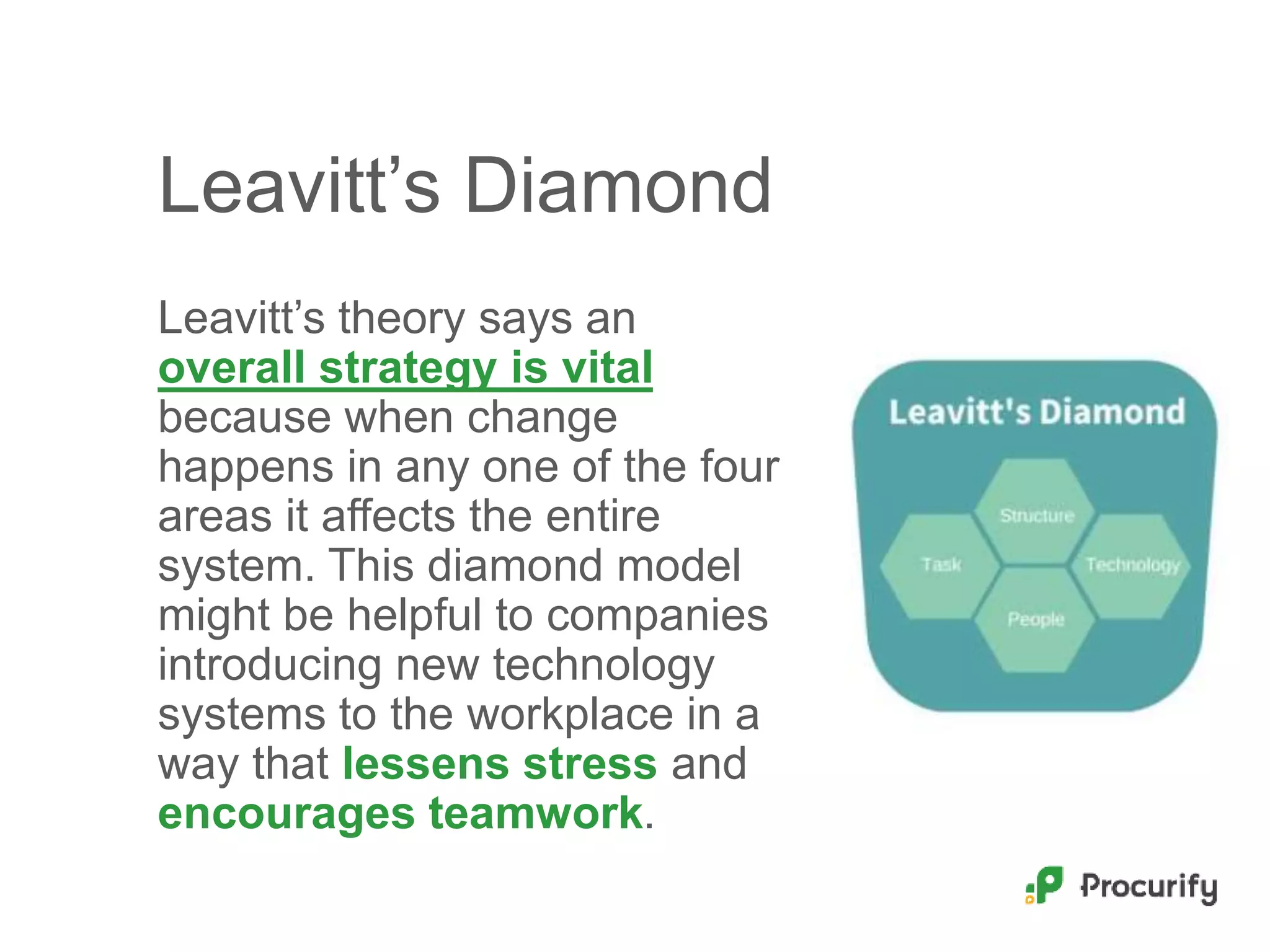
Leavitt’s Diamond
Leavitt’s theory says an
overall strategy is vital
because when change
happens in any one of the four
areas it affects the entire
system. This diamond model
might be helpful to companies
introducing new technology
systems to the workplace in a
way that lessens stress and
encourages teamwork.
A simplified version: “P.P.T.”
1. People
2. Process
3. Technology
(In that order!)
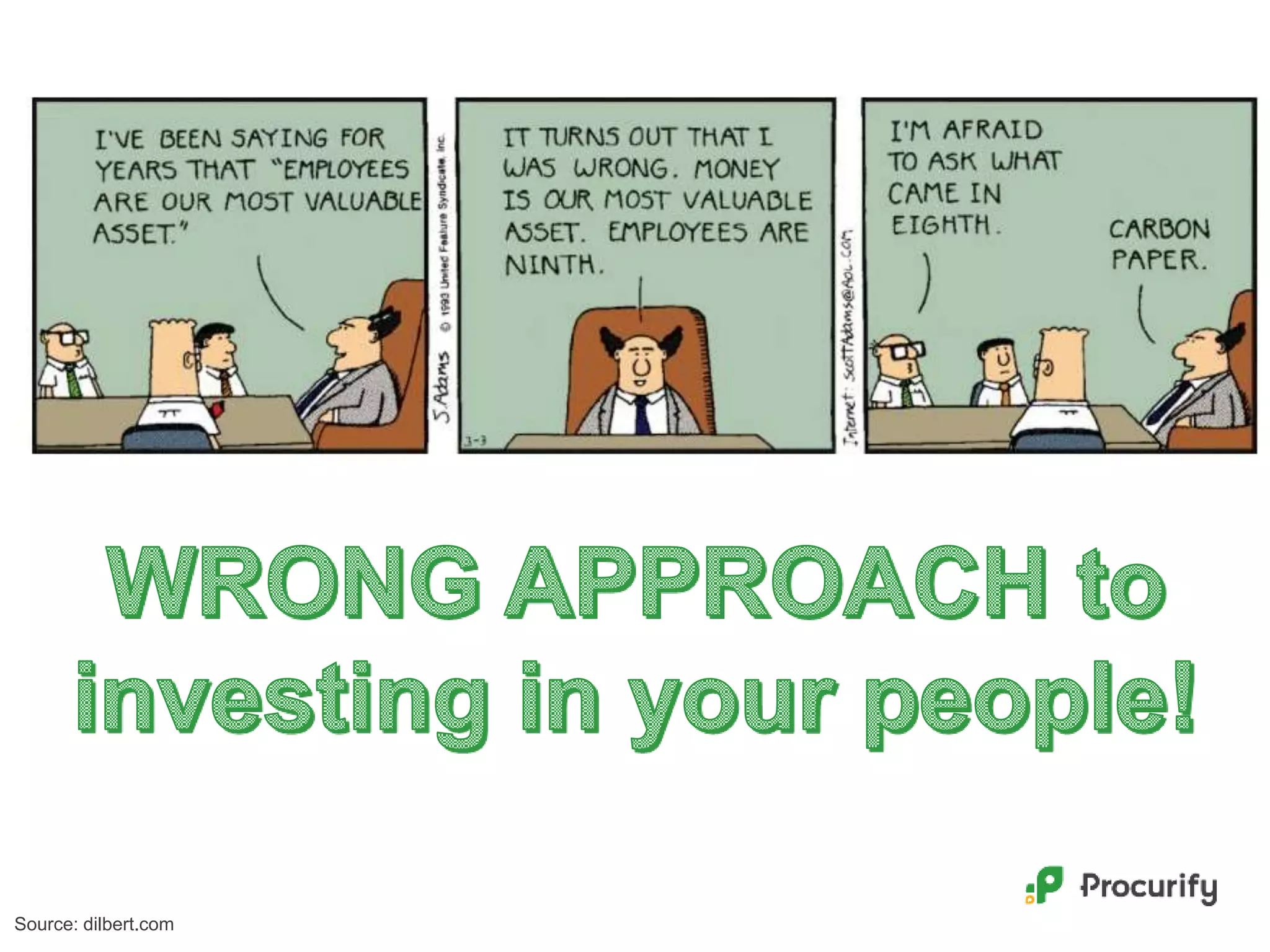
People: the key to
making a change
happen!
Source: dilbert.com
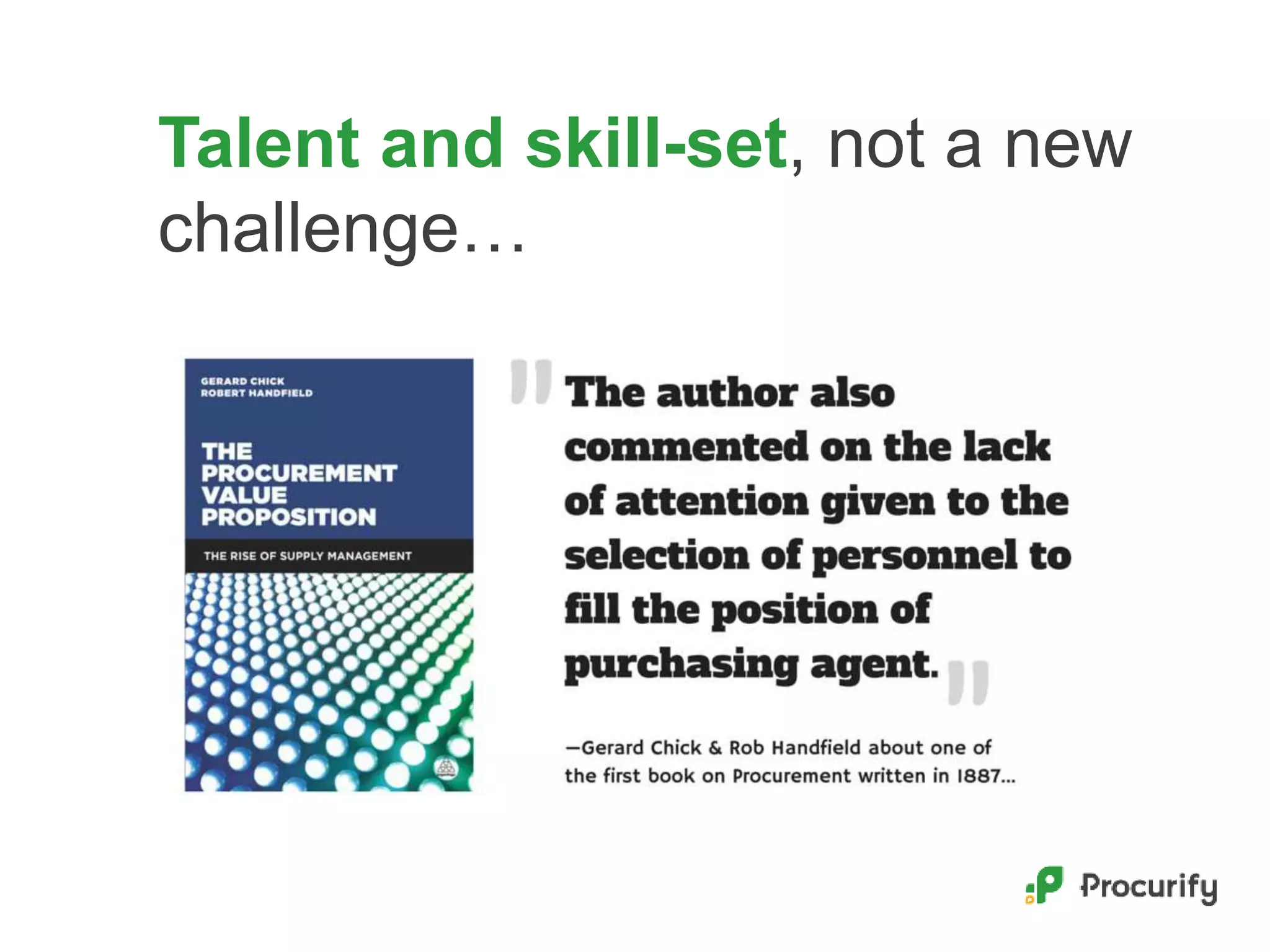
Talent and skill-set, not a new
challenge…
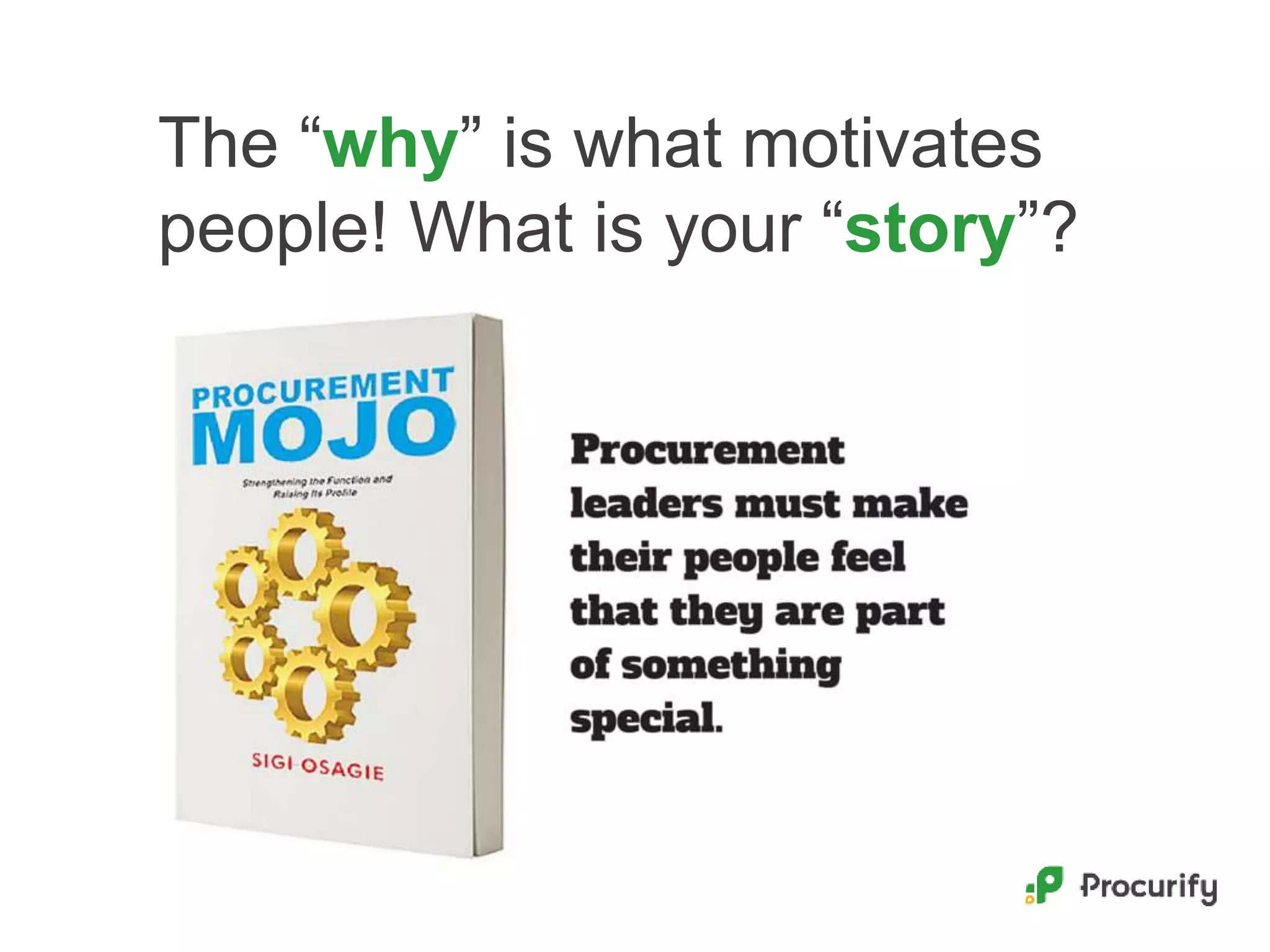
The “why” is what motivates
people! What is your “story”?
Source: dilbert.com
B2B or B2C, it is H2H!
Credit goes to Bryan Kramer for coining the expression…
Suppliers, internal customers, fellow practitioners…
are all people so business relationships are basically
human relations!
Put yourself in their shoes!  What are their
needs? Their goals/objectives/KPIs? What do
they value? “Customer” knowledge is key in the
process to ensure the right “delivery” out of the
sourcing process.
Include them!  Cross-functional teams are
key and a best practice to ensure adoption and
compliance.
Influence them!  Need standardization (when
possible), TCO/TVO…
Listen to them  Measure their satisfaction
regarding your service, feedback is always a
good thing!
For more: http://start.procurify.com/procurement-
sense-magazine/
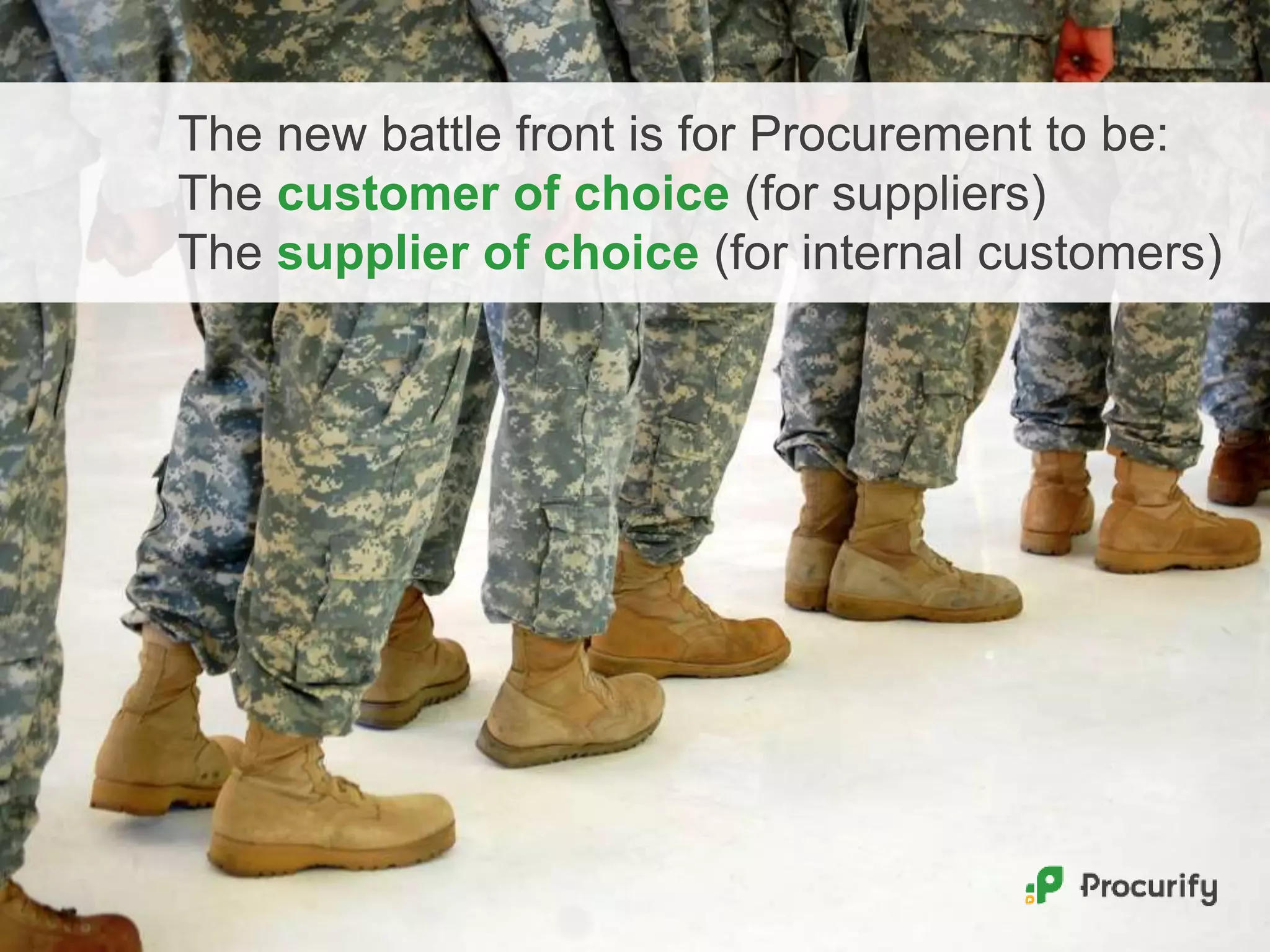
The new battle front is for Procurement to be:
The customer of choice (for suppliers)
The supplier of choice (for internal customers)
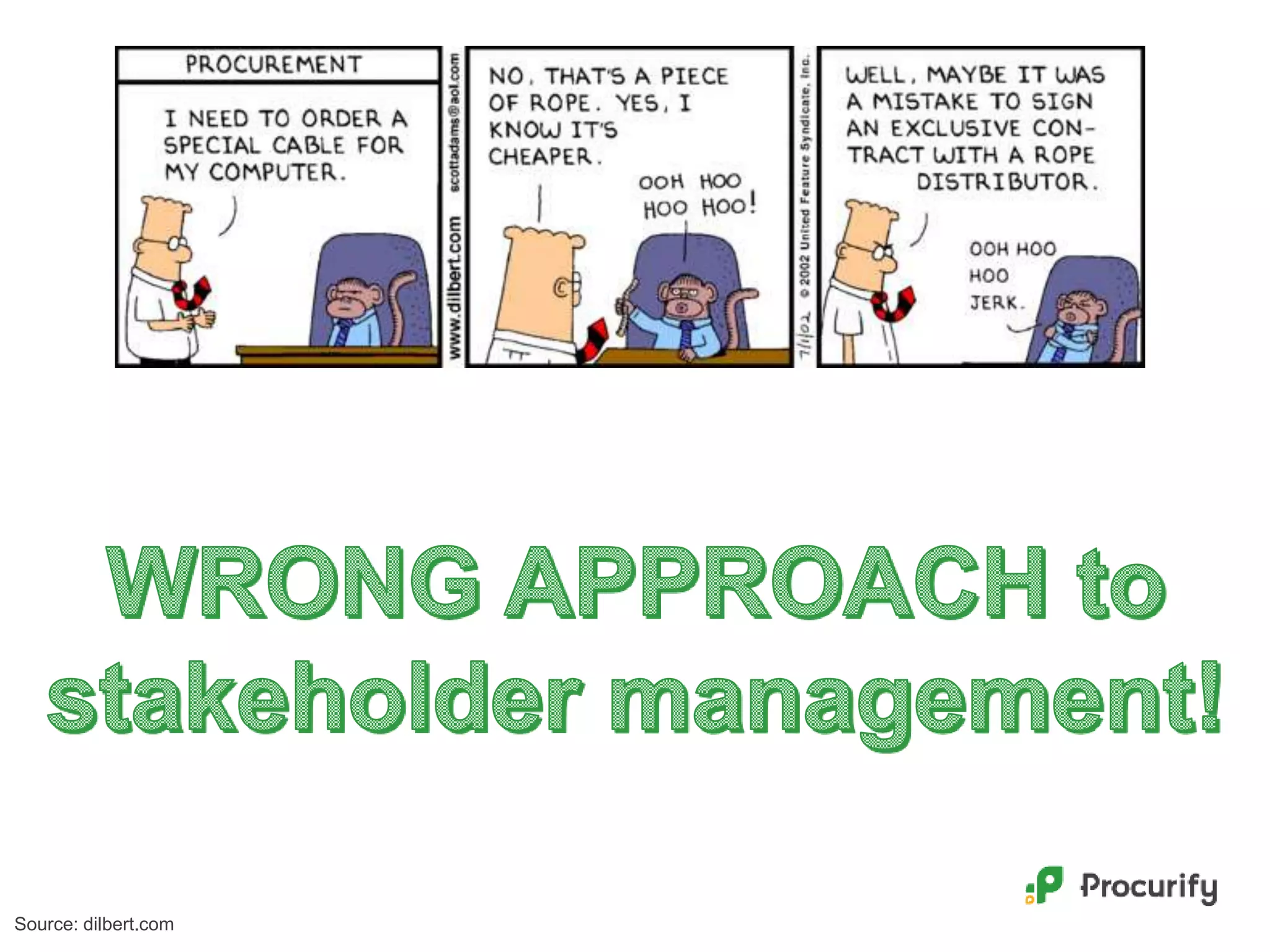
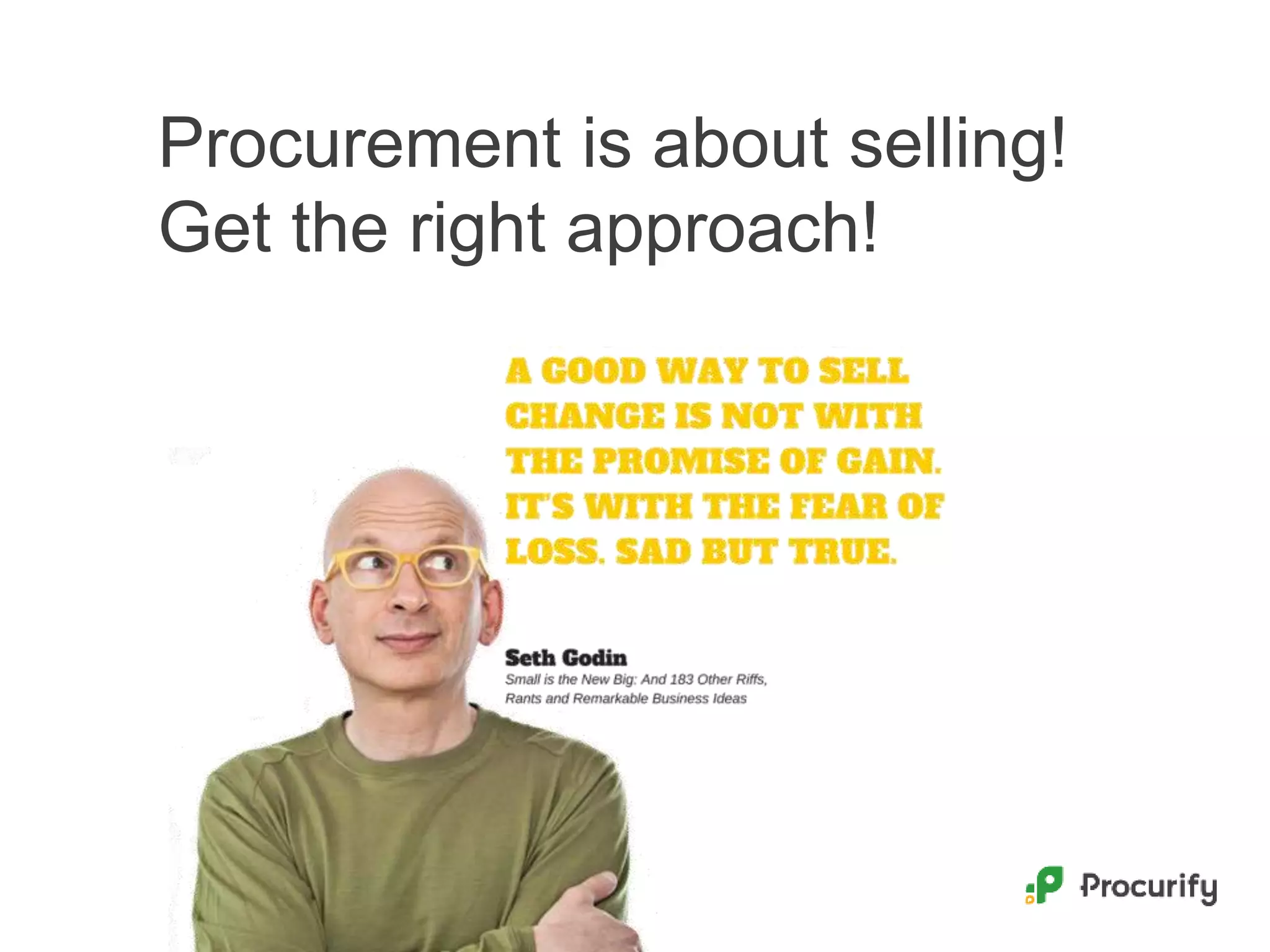
Procurement is about selling!
Get the right approach!
The usual approach:
Thanks to project XXX that will last XXX
months, you will be able to save XXX amount
of time.
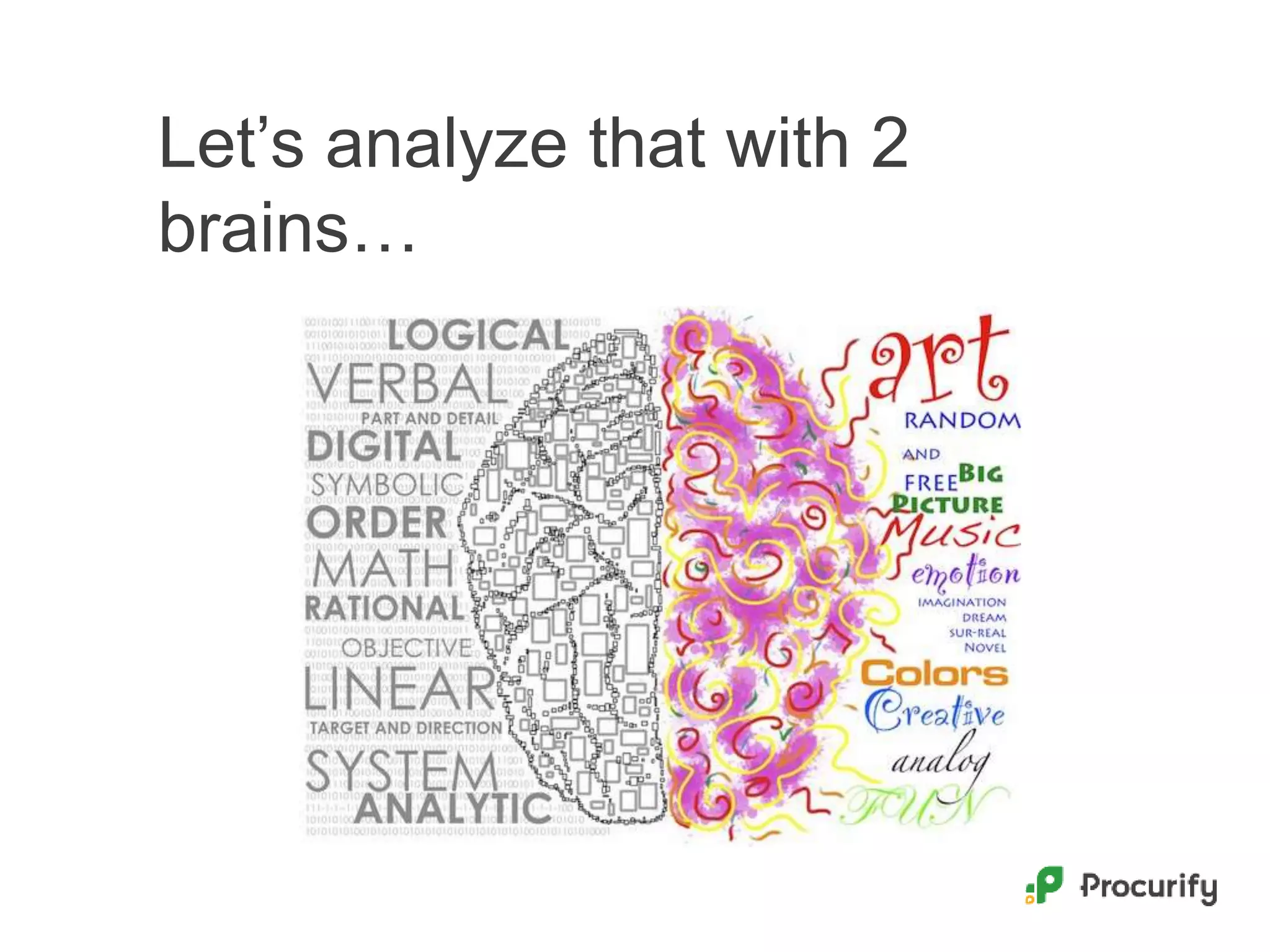
Let’s analyze that with 2
brains…
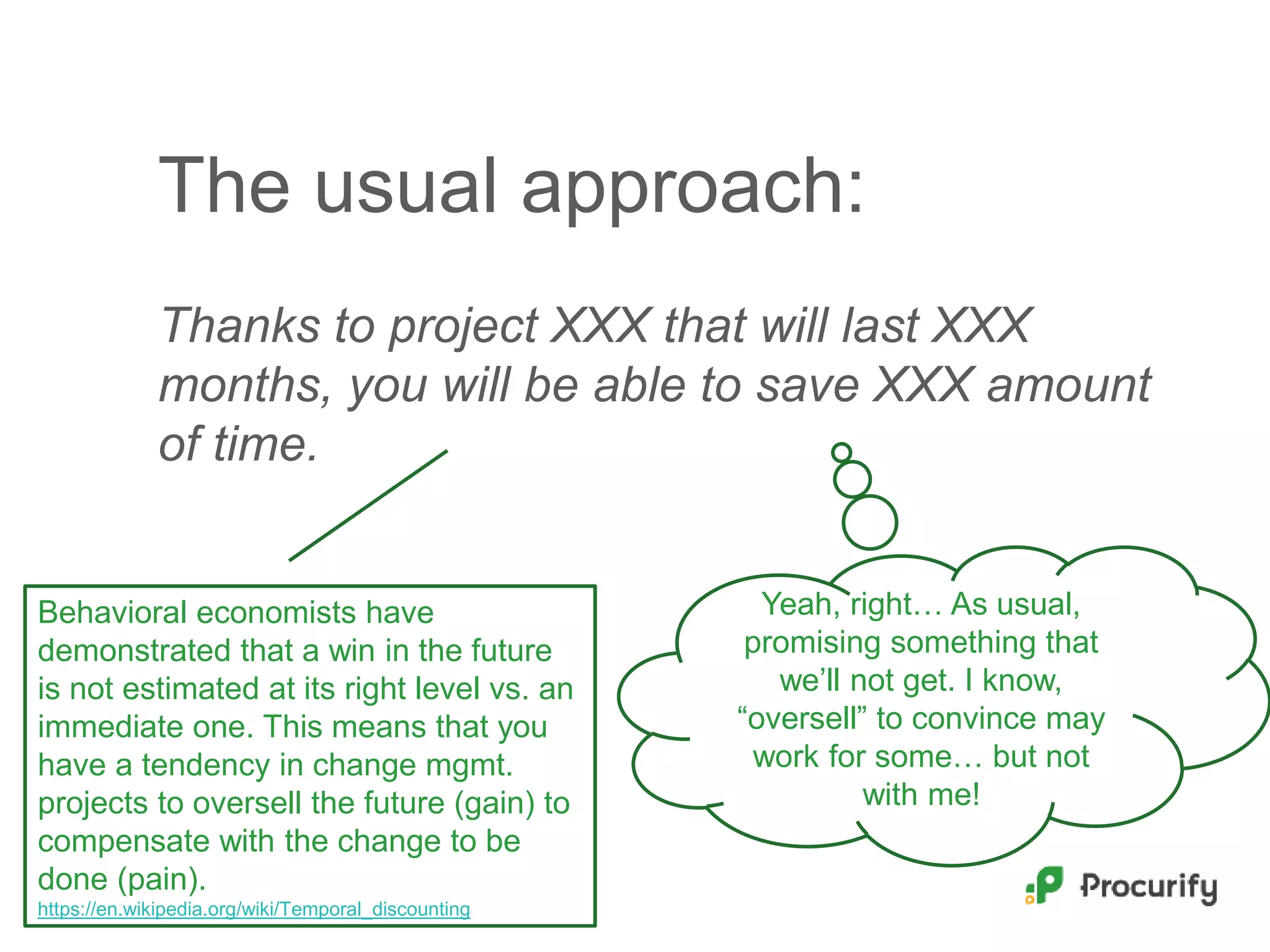
The usual approach:
Thanks to project XXX that will last XXX
months, you will be able to save XXX amount
of time.
Yeah, right… As usual,
promising something that
we’ll not get. I know,
“oversell” to convince may
work for some… but not
with me!
Behavioral economists have
demonstrated that a win in the future
is not estimated at its right level vs. an
immediate one. This means that you
have a tendency in change mgmt.
projects to oversell the future (gain) to
compensate with the change to be
done (pain).
https://en.wikipedia.org/wiki/Temporal_discounting
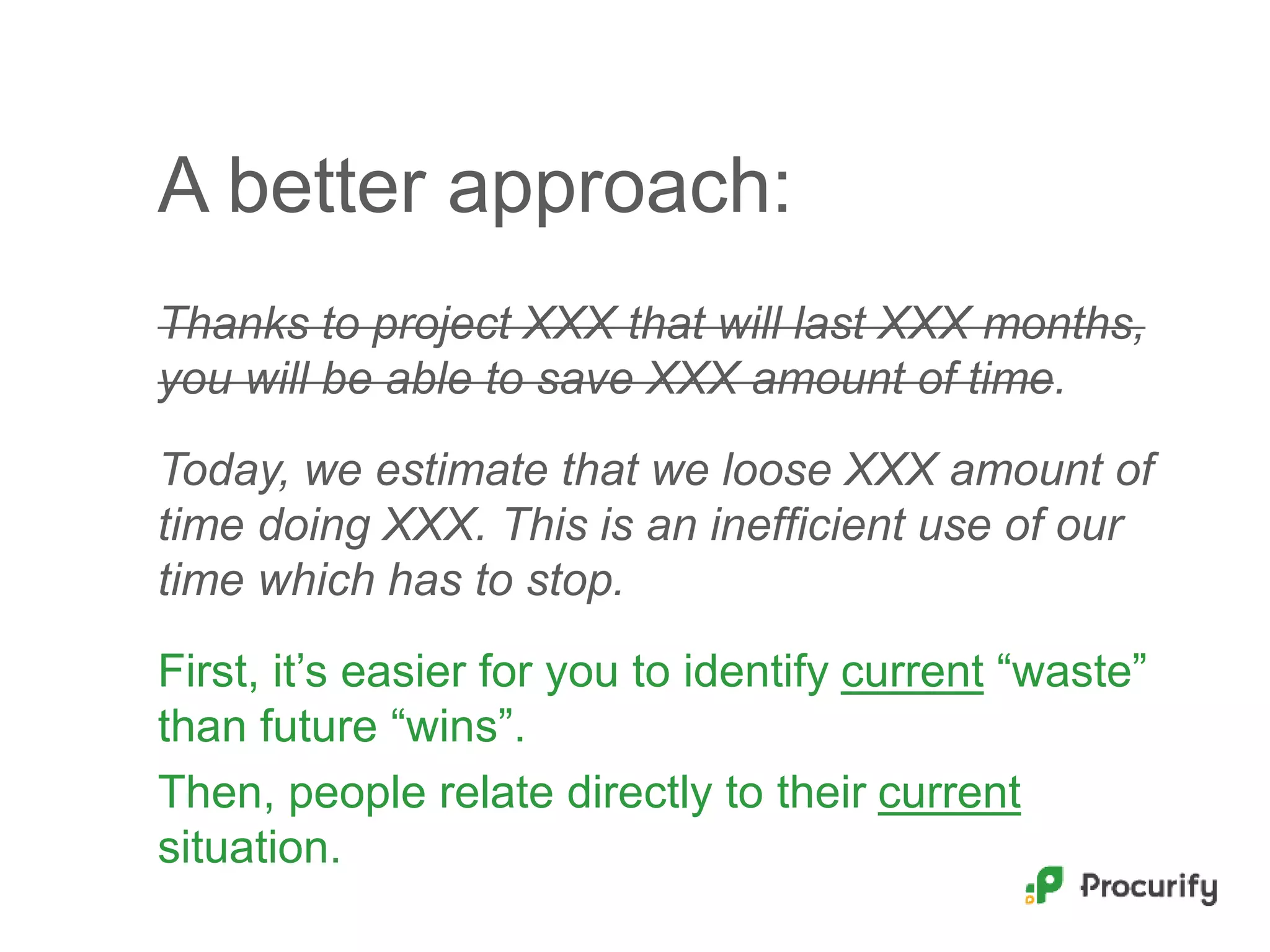
A better approach:
Thanks to project XXX that will last XXX months,
you will be able to save XXX amount of time.
Today, we estimate that we loose XXX amount of
time doing XXX. This is an inefficient use of our
time which has to stop.
First, it’s easier for you to identify current “waste”
than future “wins”.
Then, people relate directly to their current
situation.
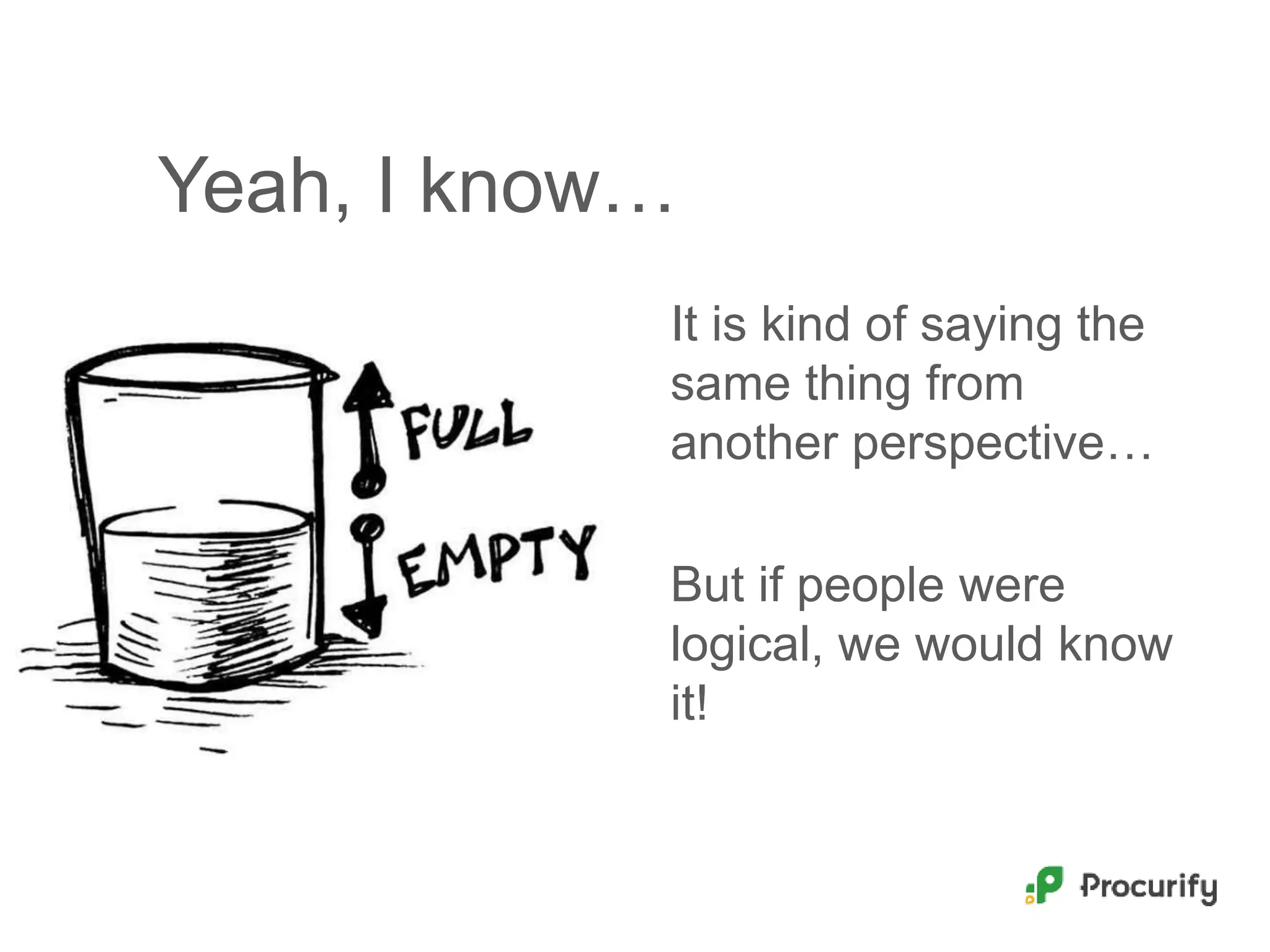
Yeah, I know…
It is kind of saying the
same thing from
another perspective…
But if people were
logical, we would know
it!
Process: the key to
making a change
sticky!
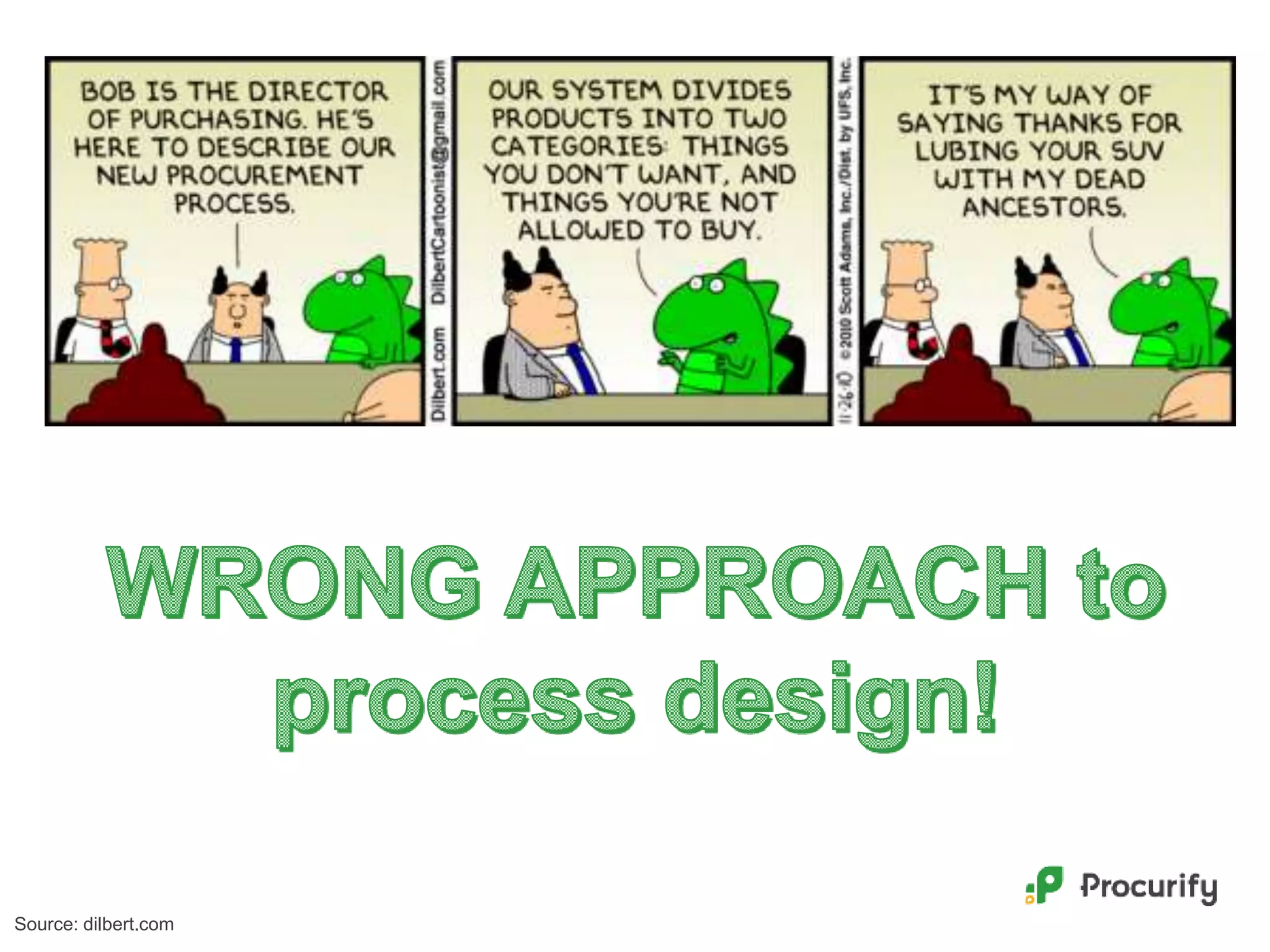
Source: dilbert.com
Think outside of the box!
“The usual methods for boosting performance—
process rationalization and automation—haven’t
yielded the dramatic improvements companies need.
In particular, heavy investments in information
technology have delivered disappointing results—
largely because companies tend to use technology to
mechanize old ways of doing business. They
leave the existing processes intact and use
computers simply to speed them up.”
Harvard Business Review, Reengineering Work:
Don’t Automate, Obliterate.
Think outside of the box!
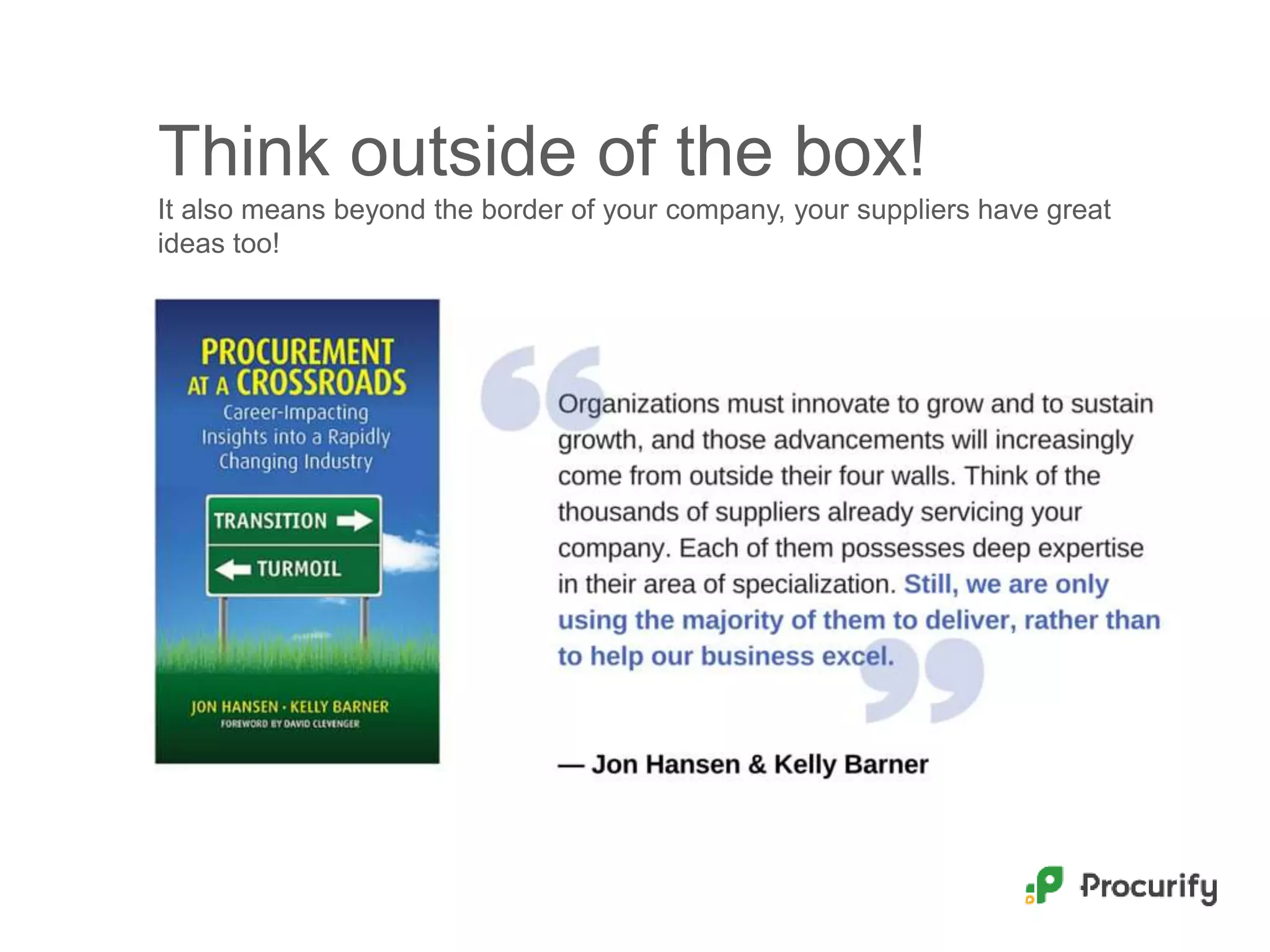
It also means beyond the border of your company, your suppliers have great
ideas too!
Clearly defined and
standardized processes,
please!
Reassessing your current way of doing things has the following benefits:
• You determine, and eventually confirm, that what you do is what you should
be doing
• You identify new ways of doing things to deliver even more value
Focusing on value-adding steps has several positive consequences:
• By defining the value that a process step adds, you define the business
case and R.O.I. which are key components to drive compliance and change
management
• Be removing steps that bring no value, you simplify your process
Streamlined process = case for change (people) + easier implementation
in a tool (technology)
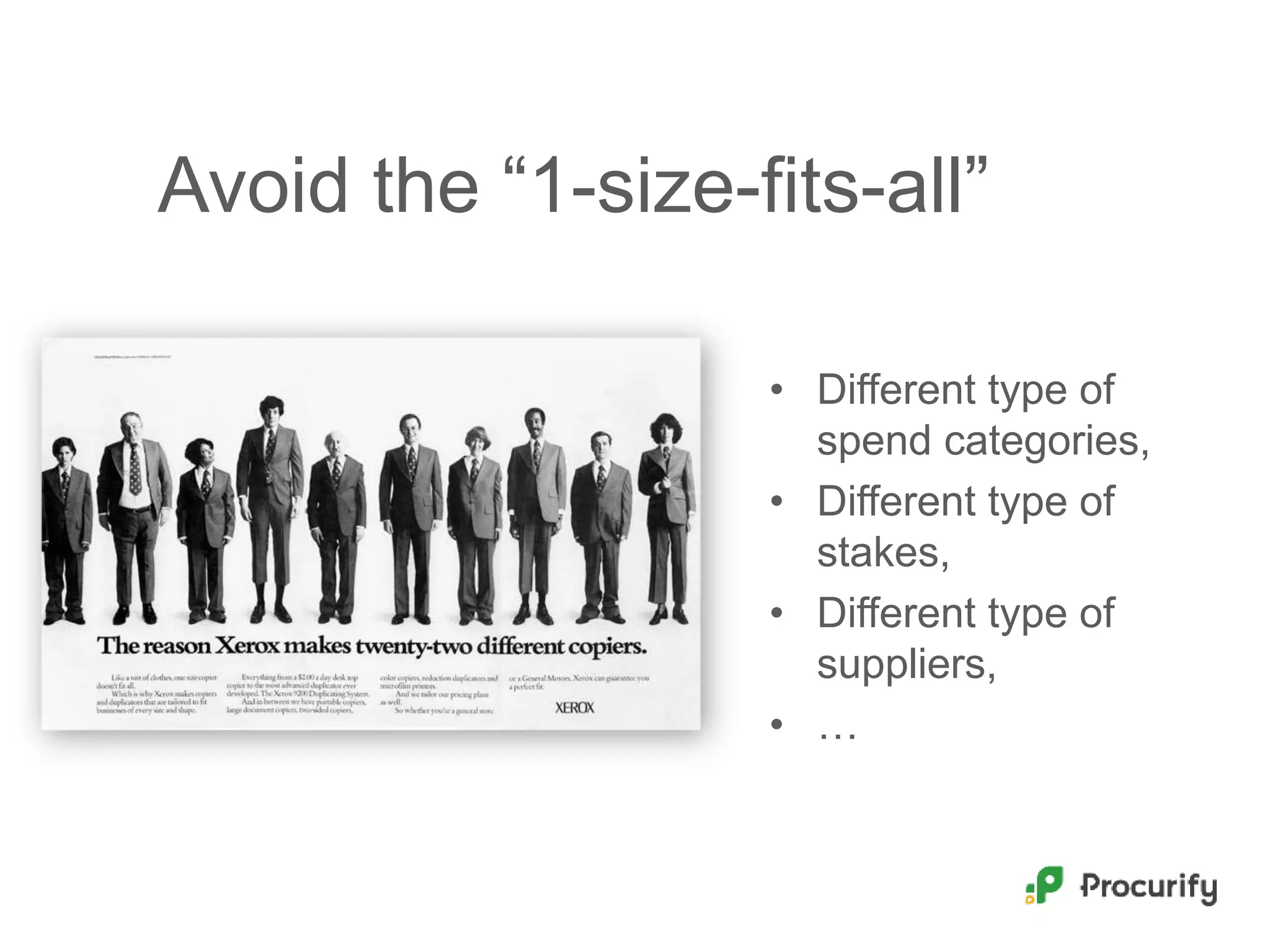
Avoid the “1-size-fits-all”
• Different type of
spend categories,
• Different type of
stakes,
• Different type of
suppliers,
• …
Technology: the key
to making a change
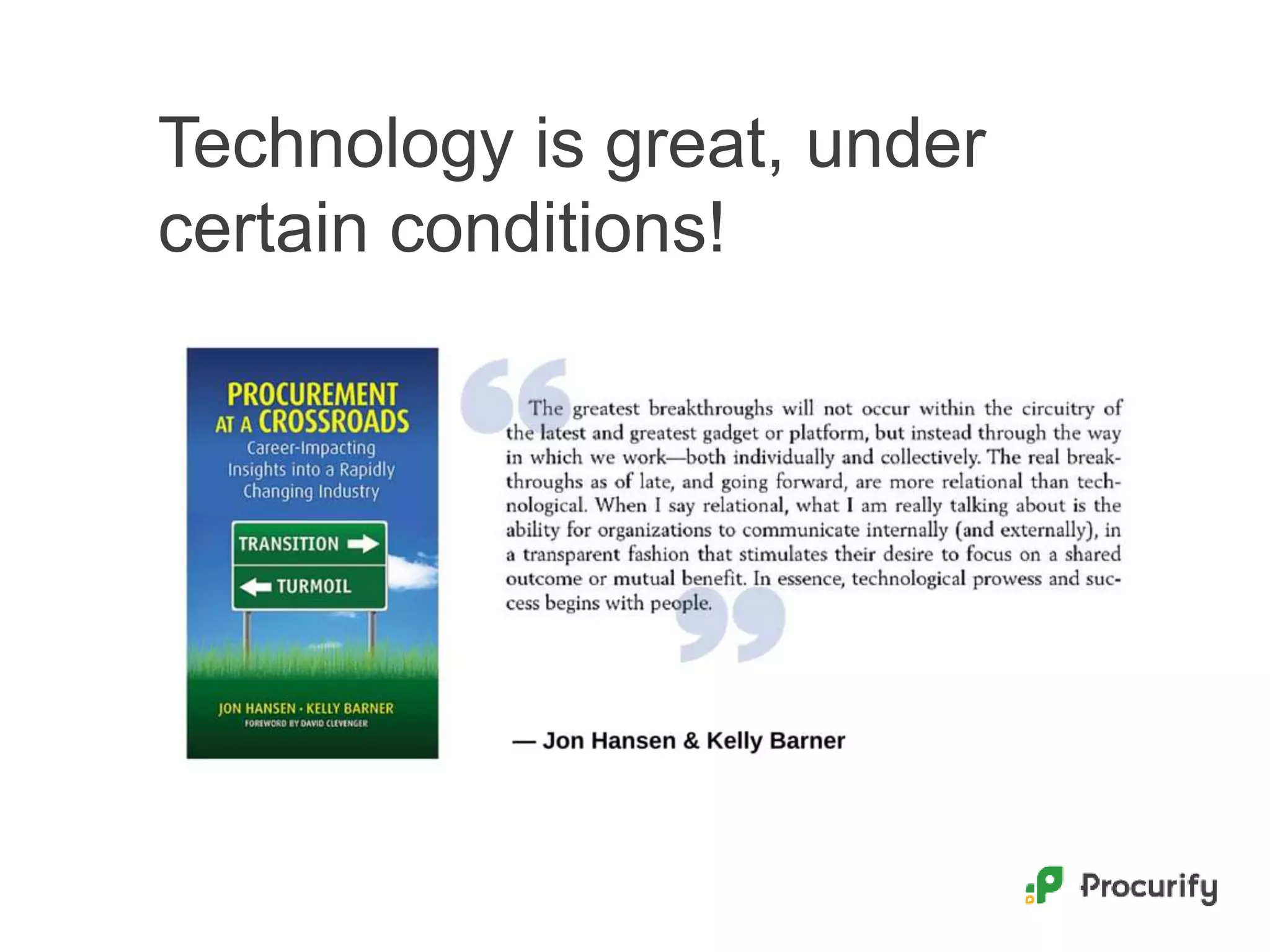
Technology is great, under
certain conditions!
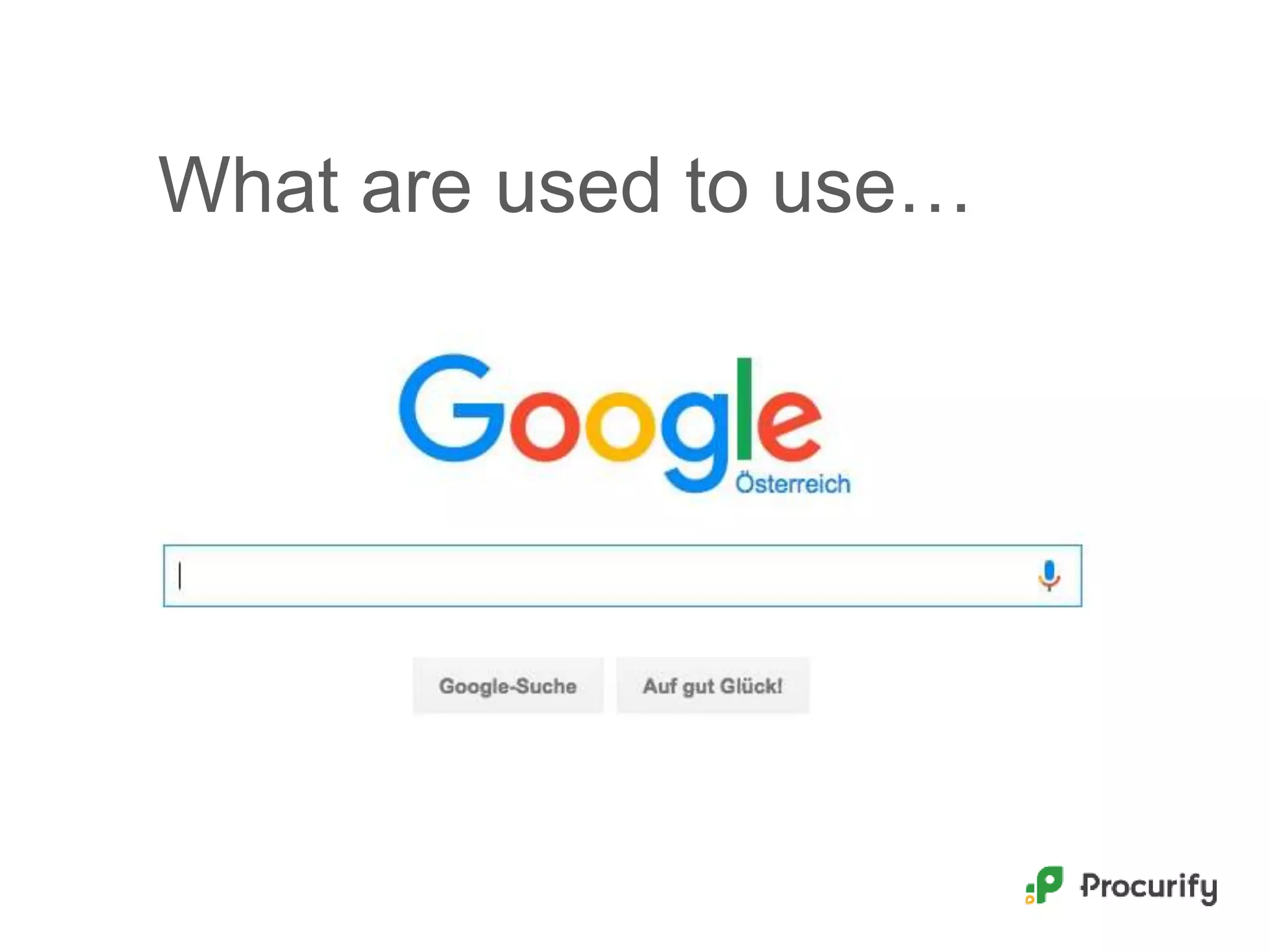
What are used to use…
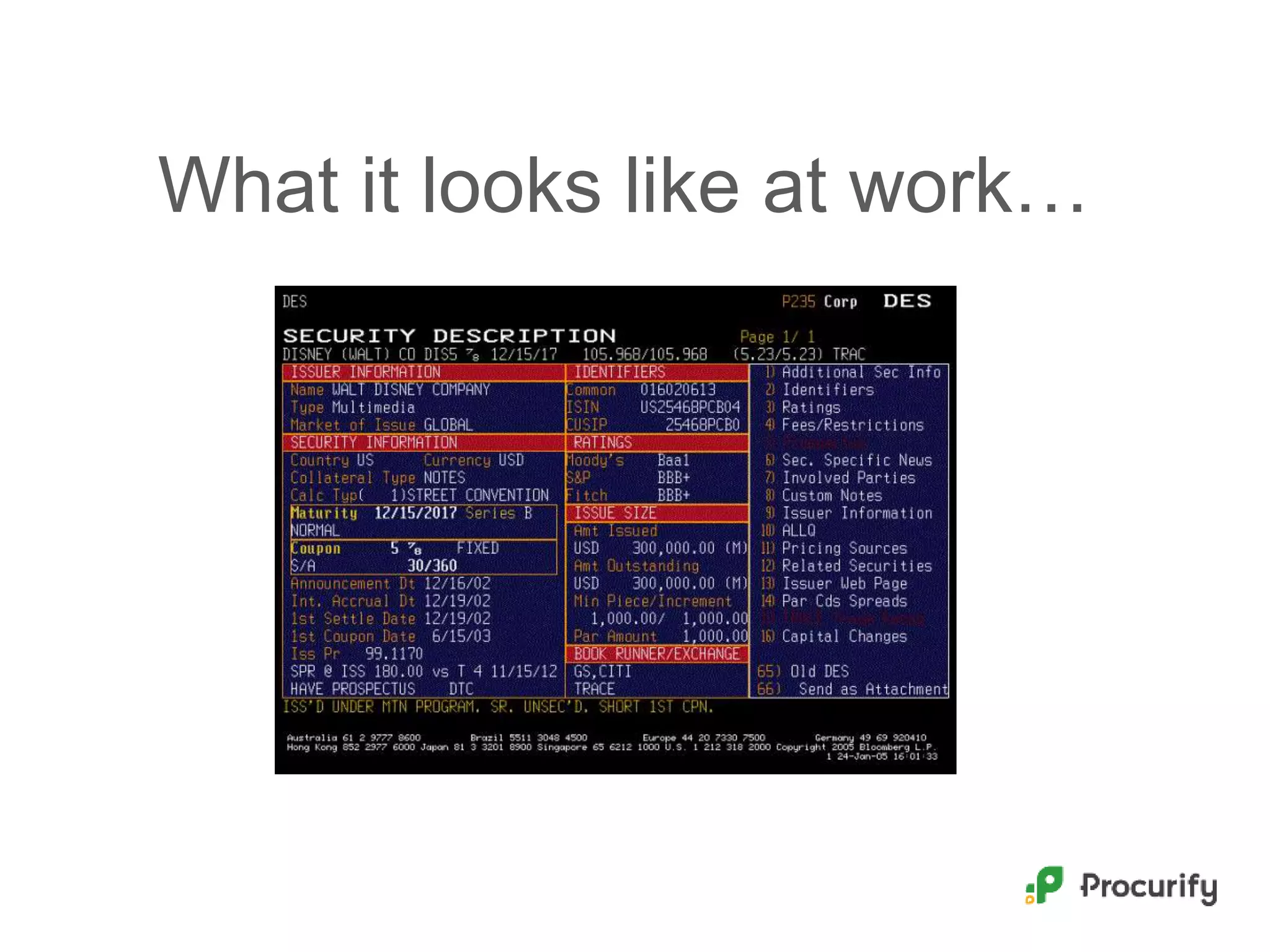
What it looks like at work…
Digital Masters —
 companies that use digital
technologies to drive
significantly higher levels
of profit, productivity, and
performance — do exist,
but they’re rare. […] Most
firms fall short of digital
mastery.
Conclusion…
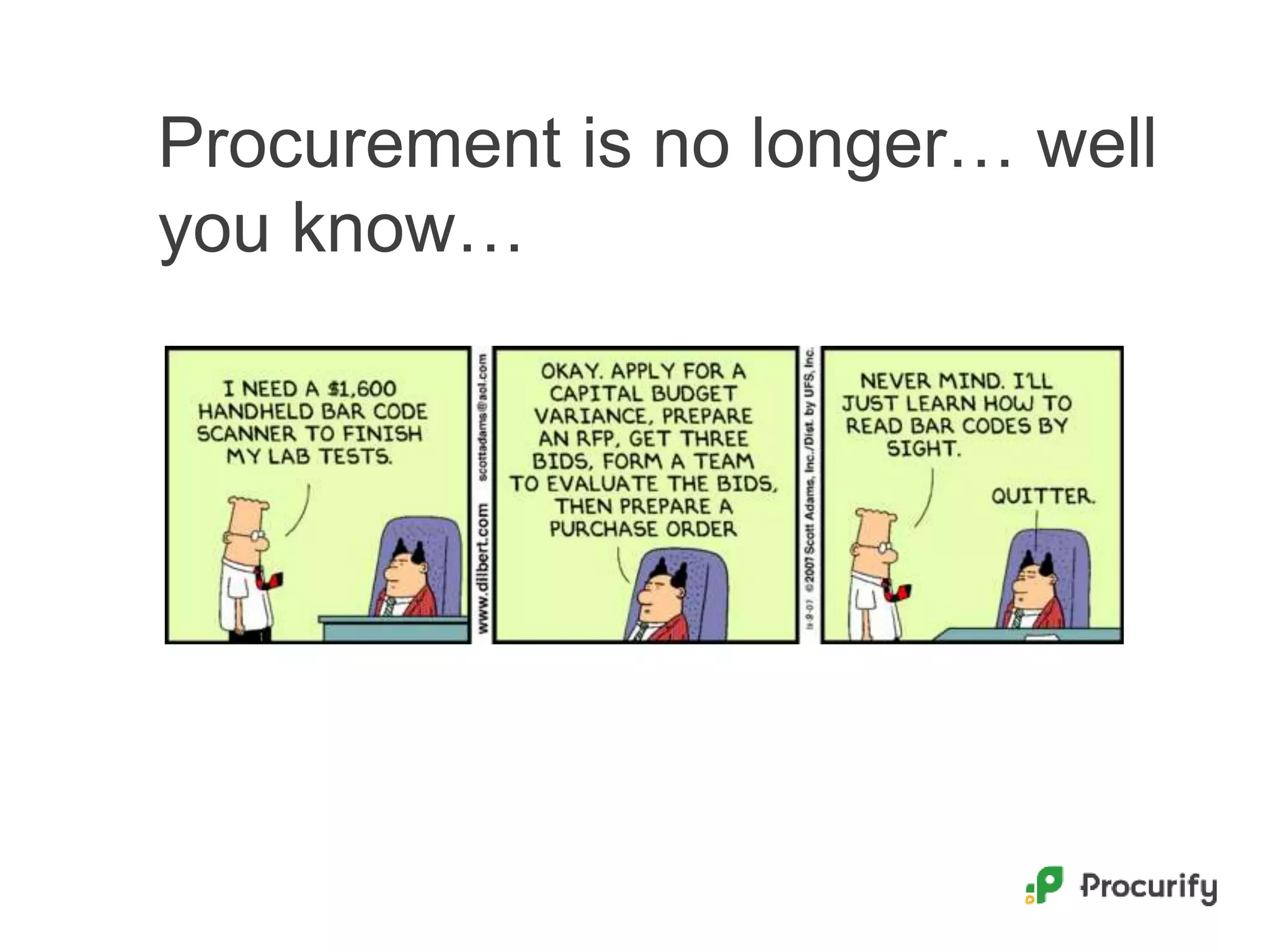
Procurement is no longer… well
you know…
Source: https://www.pool4tool.com/cms/en/resources/whitepaper/procurementvalueengine
Where do you want to be?
The best value for money!
Thank you!
LinkedIn https://at.linkedin.com/in/bmaltaverne
Twitter (news) https://twitter.com/@bmaltaverne
Medium(blog) https://medium.com/@bmaltaverne
Summary
The expression “digital transformation” is not just a buzz-word.
Because we live in a disrupted world, Procurement has to transform
itself and become a “digital master”.
This “eTransformation” of Procurement is a MUST if Procurement
wants to increase further the value it deliver to the organization and,
therefore, survive.
The Procurement organization of the future must be effective, efficient,
and sustainable.
This requires a “global” approach to defining and executing the
“eTransformation” focusing on the three pillars that are: people,
process, and technology.

Procurement In The Digital Age: Transform Your Process

  • 3.
    Procurement in theDigital Age Bertrand Maltaverne Brittany Whitmore
  • 4.
    Since 2014 POOL4TOOLSenior Business Consultant & Product Marketing 2013 - 2014 Schneider Electric, Global Indirect Procurement Tools Manager 2009 - 2012 Schneider Electric, EMEA Indirect Procurement Tools & Process Manager 2004 - 2009 Schneider Electric, Global Purchasing Application Manager 2001 - 2004 Schneider Electric, Purchaser for Direct Materials 1998 - 2001 Schneider Electric, Technical Manager About : The only all-in-one platform for Direct Procurement: • Strategic Procurement: Category Mgmt., SRM, … • Operational Procurement: eSourcing, Supplier Perf., Quality and Issue Mgmt.... • Supply Chain execution: Supplier Network / Portal, PO, ASN, VMI, ... Bertrand Maltaverne https://at.linkedin.com/in/bmaltaverne
  • 5.
    What I thinkof Procurement… as demonstrated by recent stuff I wrote (personal & professional sides) Sources: - Personal “blog”  https://medium.com/procurement-tidbits - Whitepaper  https://www.pool4tool.com/cms/en/resources/whitepaper/procurementvalueengine
  • 6.
    Why is itnow or never that Procurement has to re-invent itself?
  • 7.
    Procurement has aunique position! PROCUREMENT Outside Inside
  • 8.
    P = SRM2… Source:https://medium.com/procurement-tidbits/the-hidden-meaning-of-srm-7a4aaaa7455d#.v3z9flyu9
  • 9.
    P = SRM2… SRMas Supplier Relationship Mgmt. SRM as Stakeholder Relationship Mgmt.
  • 10.
    Procurement has aunique position! PROCUREMENT Outside Inside VALUE
  • 11.
    Procurement has aunique position!
  • 12.
    Internal and external pressures… Internal: –Recognition & credibility (“seat at the table”) – Customer satisfaction (savings and more…) – Skills and war for talent – ... External: – Disruptive technologies impacting supply-market – Globalization & volatility – Risks – ...
  • 13.
    It is no“BS”! Evidence #1 Skills gap widening say CPOs in “Supply Management” - Feb. 2016 Article based on The Deloitte Global CPO Survey 2016.
  • 14.
    It is no“BS”! Evidence #2 When your internal customers see you like that…
  • 15.
    It is no“BS”! Evidence #2 Then this can happen…
  • 16.
    It is no“BS”! Evidence #3 Technology transforms everything… Source: You are here!
  • 17.
    It is no“BS”! Evidence #3 Technology transforms everything… Example of the automotive industry. It was “born” thanks to a disruptive approach! “If I had asked people what they wanted, they would have said faster horses.” — Henry Ford
  • 18.
    It is no“BS”! Evidence #3 Technology transforms everything… Example of the automotive industry. It is undergoing constant (r)evolutions. Electrical cars Self-driving cars Rental economy
  • 19.
    It is no“BS”! Evidence #3 Technology transforms everything… Your customers change, your product changes… So, what you need to buy changes… Supply-markets change (3D printing, rental economy...). So, what you actually buy changes (new spend categories, new suppliers)...  Your Procurement “system” needs to cope with all of this! Source: Roland Berger Strategy Consulting, “THE DIGITAL TRANSFORMATION OF INDUSTRY ”
  • 20.
  • 21.
    Source: The solution: adaptto always be a leading Procurement organization! • Effective: deliver value to the entire organization (whatever it means in your context) • Efficient: use the right amount of “resources” • Sustainable: long-term orientation, not just short-term
  • 22.
  • 23.
  • 24.
  • 25.
    Procurement must havea Digital Transformation Strategy!
  • 26.
    You have totailor the strategy to your context…
  • 27.
    Leavitt’s Diamond Established byProfessor Harold J. Leavitt in 1965 focuses on organizational behavior, the dynamics of organizational change and the interaction of four interdependent components found in any business: the people, the task, the structure and the technology.
  • 28.
    Leavitt’s Diamond Leavitt’s theorysays an overall strategy is vital because when change happens in any one of the four areas it affects the entire system. This diamond model might be helpful to companies introducing new technology systems to the workplace in a way that lessens stress and encourages teamwork.
  • 29.
    A simplified version:“P.P.T.” 1. People 2. Process 3. Technology (In that order!)
  • 30.
    People: the keyto making a change happen!
  • 31.
  • 32.
    Talent and skill-set,not a new challenge…
  • 33.
    The “why” iswhat motivates people! What is your “story”?
  • 34.
  • 35.
    B2B or B2C,it is H2H! Credit goes to Bryan Kramer for coining the expression… Suppliers, internal customers, fellow practitioners… are all people so business relationships are basically human relations! Put yourself in their shoes!  What are their needs? Their goals/objectives/KPIs? What do they value? “Customer” knowledge is key in the process to ensure the right “delivery” out of the sourcing process. Include them!  Cross-functional teams are key and a best practice to ensure adoption and compliance. Influence them!  Need standardization (when possible), TCO/TVO… Listen to them  Measure their satisfaction regarding your service, feedback is always a good thing! For more: http://start.procurify.com/procurement- sense-magazine/
  • 36.
    The new battlefront is for Procurement to be: The customer of choice (for suppliers) The supplier of choice (for internal customers)
  • 37.
    Procurement is aboutselling! Get the right approach!
  • 38.
    The usual approach: Thanksto project XXX that will last XXX months, you will be able to save XXX amount of time.
  • 39.
    Let’s analyze thatwith 2 brains…
  • 40.
    The usual approach: Thanksto project XXX that will last XXX months, you will be able to save XXX amount of time. Yeah, right… As usual, promising something that we’ll not get. I know, “oversell” to convince may work for some… but not with me! Behavioral economists have demonstrated that a win in the future is not estimated at its right level vs. an immediate one. This means that you have a tendency in change mgmt. projects to oversell the future (gain) to compensate with the change to be done (pain). https://en.wikipedia.org/wiki/Temporal_discounting
  • 41.
    A better approach: Thanksto project XXX that will last XXX months, you will be able to save XXX amount of time. Today, we estimate that we loose XXX amount of time doing XXX. This is an inefficient use of our time which has to stop. First, it’s easier for you to identify current “waste” than future “wins”. Then, people relate directly to their current situation.
  • 42.
    Yeah, I know… Itis kind of saying the same thing from another perspective… But if people were logical, we would know it!
  • 43.
    Process: the keyto making a change sticky!
  • 44.
  • 45.
    Think outside ofthe box! “The usual methods for boosting performance— process rationalization and automation—haven’t yielded the dramatic improvements companies need. In particular, heavy investments in information technology have delivered disappointing results— largely because companies tend to use technology to mechanize old ways of doing business. They leave the existing processes intact and use computers simply to speed them up.” Harvard Business Review, Reengineering Work: Don’t Automate, Obliterate.
  • 46.
    Think outside ofthe box! It also means beyond the border of your company, your suppliers have great ideas too!
  • 47.
    Clearly defined and standardizedprocesses, please! Reassessing your current way of doing things has the following benefits: • You determine, and eventually confirm, that what you do is what you should be doing • You identify new ways of doing things to deliver even more value Focusing on value-adding steps has several positive consequences: • By defining the value that a process step adds, you define the business case and R.O.I. which are key components to drive compliance and change management • Be removing steps that bring no value, you simplify your process Streamlined process = case for change (people) + easier implementation in a tool (technology)
  • 48.
    Avoid the “1-size-fits-all” •Different type of spend categories, • Different type of stakes, • Different type of suppliers, • …
  • 49.
    Technology: the key tomaking a change
  • 50.
    Technology is great,under certain conditions!
  • 51.
    What are usedto use…
  • 52.
    What it lookslike at work…
  • 53.
    Digital Masters —  companies thatuse digital technologies to drive significantly higher levels of profit, productivity, and performance — do exist, but they’re rare. […] Most firms fall short of digital mastery.
  • 54.
  • 55.
    Procurement is nolonger… well you know…
  • 57.
  • 58.
    The best valuefor money!
  • 59.
    Thank you! LinkedIn https://at.linkedin.com/in/bmaltaverne Twitter(news) https://twitter.com/@bmaltaverne Medium(blog) https://medium.com/@bmaltaverne
  • 61.
    Summary The expression “digitaltransformation” is not just a buzz-word. Because we live in a disrupted world, Procurement has to transform itself and become a “digital master”. This “eTransformation” of Procurement is a MUST if Procurement wants to increase further the value it deliver to the organization and, therefore, survive. The Procurement organization of the future must be effective, efficient, and sustainable. This requires a “global” approach to defining and executing the “eTransformation” focusing on the three pillars that are: people, process, and technology.