Procurement 4.O – Journey
Towards Excellence
(Smart Procurement)
Krishan K. Batra
President & CEO, ISM-INDIA
1
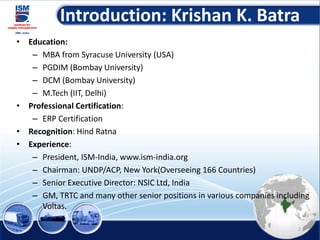
Introduction: Krishan K. Batra
• Education:
– MBA from Syracuse University (USA)
– PGDIM (Bombay University)
– DCM (Bombay University)
– M.Tech (IIT, Delhi)
• Professional Certification:
– ERP Certification
• Recognition: Hind Ratna
• Experience:
– President, ISM-India, www.ism-india.org
– Chairman: UNDP/ACP, New York(Overseeing 166 Countries)
– Senior Executive Director: NSIC Ltd, India
– GM, TRTC and many other senior positions in various companies including
Voltas.
2
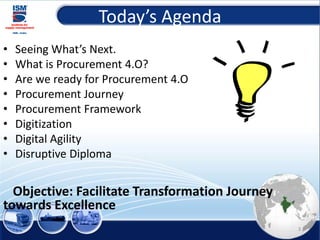
Today’s Agenda
• Seeing What’s Next.
• What is Procurement 4.O?
• Are we ready for Procurement 4.O
• Procurement Journey
• Procurement Framework
• Digitization
• Digital Agility
• Disruptive Diploma
Objective: Facilitate Transformation Journey
towards Excellence
3
Seeing What’s Next
• Historian in all of us cares about the
past
• The decision maker in all of us cares
about the future
• Good news is that the theory that
explains the past can-if used
properly-provide insight into the
future.
• The seeds of seeing what’s next were
sown a decade ago with the
publication of first article describing
the phenomenon of distruptive
innovation
• CHANGE IS DISRUPTIVE
4
• Disruption Expert
• Historian in all of us cares about
the past
• The decision maker in all of us
cares about the future
• Good news is that the theory that
explains the past can-if used
properly-provide insight into the
future.
• The seeds of seeing what’s next
were sown a decade ago with the
publication of publication of first
article describing the phenomenon
of distruptive innovation.
• Opportunties and threats created
by disruption.
• Flawed paradigm, Signals of
Change
• Disruptive Diplomas
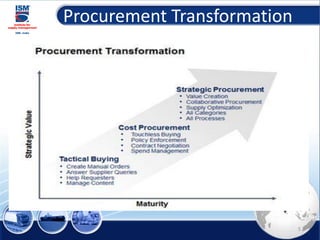
Procurement Transformation
5
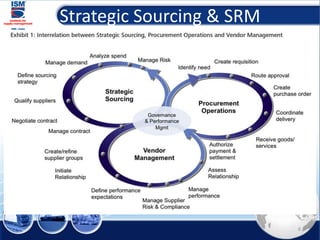
Strategic Sourcing & SRM
6
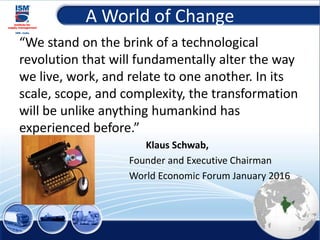
A World of Change
“We stand on the brink of a technological
revolution that will fundamentally alter the way
we live, work, and relate to one another. In its
scale, scope, and complexity, the transformation
will be unlike anything humankind has
experienced before.”
Klaus Schwab,
Founder and Executive Chairman
World Economic Forum January 2016
7
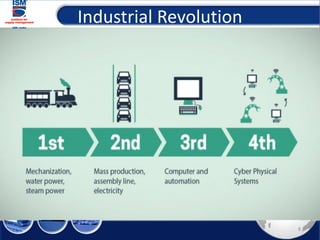
Industrial Revolution
8
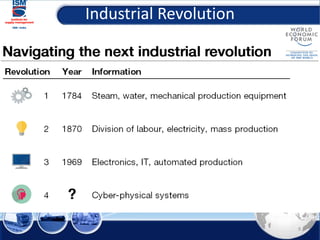
Industrial Revolution
9
INDUSTRY 4.0
• Some call it “digitalization,” some call it “Smart
Manufacturing,” and others call it “the next industrial
revolution” or “Industry 4.0.”
• Whatever term you use, a combination of new
technologies — from big data analytics to 3D printing
— is revolutionizing companies’ processes.
• The fourth industrial revolution does not only affect the
production (Smart Manufacturing / Factory) and
logistics (Logistics 4.0), but equally all other functional
areas of a company, in particular the procurement.
•
10
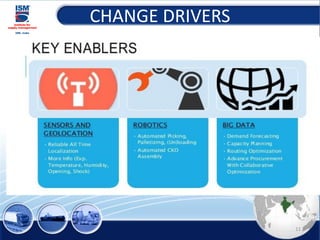
CHANGE DRIVERS
11
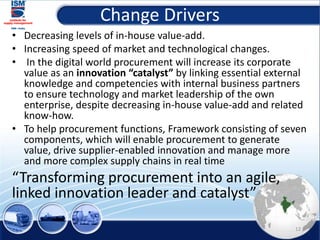
Change Drivers
• Decreasing levels of in-house value-add.
• Increasing speed of market and technological changes.
• In the digital world procurement will increase its corporate
value as an innovation “catalyst” by linking essential external
knowledge and competencies with internal business partners
to ensure technology and market leadership of the own
enterprise, despite decreasing in-house value-add and related
know-how.
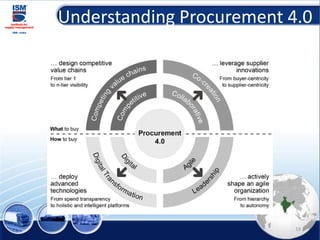
• To help procurement functions, Framework consisting of seven
components, which will enable procurement to generate
value, drive supplier-enabled innovation and manage more
and more complex supply chains in real time
“Transforming procurement into an agile,
linked innovation leader and catalyst”
12
13Procurement & Supply Management (CPP Level)
DISRUPTION
14
DISRUPTION
• The C-word i.e. Complacency is the dirtiest word in business
jargon.
• Disruptive Leadership is the front line defence against
complacency.
15
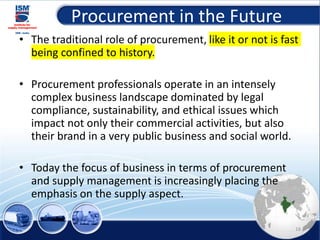
Procurement in the Future
• The traditional role of procurement, like it or not is fast
being confined to history.
• Procurement professionals operate in an intensely
complex business landscape dominated by legal
compliance, sustainability, and ethical issues which
impact not only their commercial activities, but also
their brand in a very public business and social world.
• Today the focus of business in terms of procurement
and supply management is increasingly placing the
emphasis on the supply aspect.
16
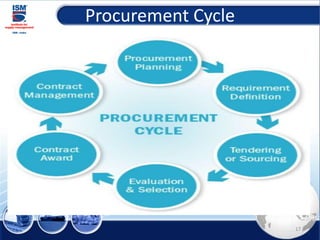
Procurement Cycle
17
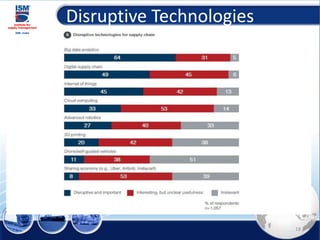
Disruptive Technologies
18
Understanding Procurement 4.0
19
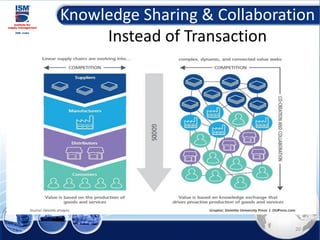
Knowledge Sharing & Collaboration
Instead of Transaction
20
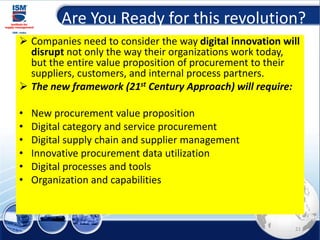
Are You Ready for this revolution?
➢ Companies need to consider the way digital innovation will
disrupt not only the way their organizations work today,
but the entire value proposition of procurement to their
suppliers, customers, and internal process partners.
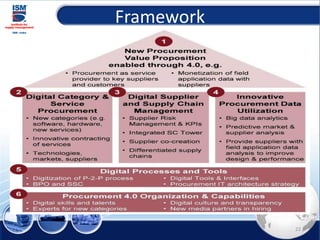
➢ The new framework (21st Century Approach) will require:
• New procurement value proposition
• Digital category and service procurement
• Digital supply chain and supplier management
• Innovative procurement data utilization
• Digital processes and tools
• Organization and capabilities
21
Framework
22
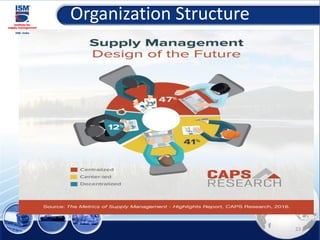
Organization Structure
23
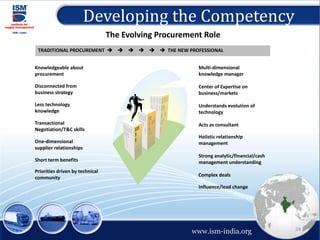
Developing the Competency
Knowledgeable about
procurement
Disconnected from
business strategy
Less technology
knowledge
Transactional
Negotiation/T&C skills
One-dimensional
supplier relationships
Short term benefits
Priorities driven by technical
community
Multi-dimensional
knowledge manager
Center of Expertise on
business/markets
Understands evolution of
technology
Acts as consultant
Holistic relationship
management
Strong analytic/financial/cash
management understanding
Complex deals
Influence/lead change
TRADITIONAL PROCUREMENT       THE NEW PROFESSIONAL
24
www.ism-india.org
The Evolving Procurement Role
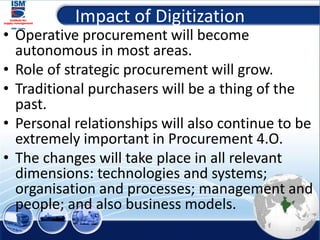
Impact of Digitization
• Operative procurement will become
autonomous in most areas.
• Role of strategic procurement will grow.
• Traditional purchasers will be a thing of the
past.
• Personal relationships will also continue to be
extremely important in Procurement 4.O.
• The changes will take place in all relevant
dimensions: technologies and systems;
organisation and processes; management and
people; and also business models.
25
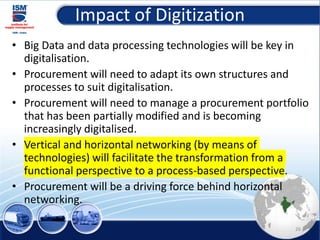
Impact of Digitization
• Big Data and data processing technologies will be key in
digitalisation.
• Procurement will need to adapt its own structures and
processes to suit digitalisation.
• Procurement will need to manage a procurement portfolio
that has been partially modified and is becoming
increasingly digitalised.
• Vertical and horizontal networking (by means of
technologies) will facilitate the transformation from a
functional perspective to a process-based perspective.
• Procurement will be a driving force behind horizontal
networking.
26
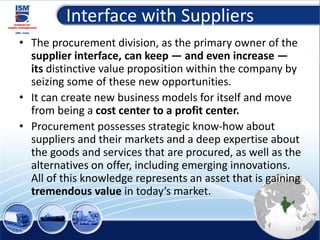
Interface with Suppliers
• The procurement division, as the primary owner of the
supplier interface, can keep — and even increase —
its distinctive value proposition within the company by
seizing some of these new opportunities.
• It can create new business models for itself and move
from being a cost center to a profit center.
• Procurement possesses strategic know-how about
suppliers and their markets and a deep expertise about
the goods and services that are procured, as well as the
alternatives on offer, including emerging innovations.
All of this knowledge represents an asset that is gaining
tremendous value in today’s market.
27
IMPACT OF PROCUREMENT 4.O
• The introduction of Procurement 4.0 will mean
developing new value propositions, meeting new
business needs, and integrating data across
functions and value chains.
• It will call for using this data proactively and
intelligently, while introducing digital processes
and tools.
• Perhaps most important, it will require
fundamentally reshaping the procurement
organization and its capabilities to take on the
challenges and opportunities of the expanding
global digital revolution.
28
Roadmap for Change
Knowledge and insight exist inside your infrastructure; it’s just
waiting to be found. By securely breaking down information
barriers you can understand and learn how everyone in the
company uses their time and help maximize the impact of our
workforce. Take these steps: :
▪ Upskill the Team: Establish expectations of sourcing,
procurement and vendor management.
• Bridge the Transition/Digitization: Anything that is
repeatable or can be defined by rules can ultimately be
automated, and it will increasingly become cost prohibitive
to focus expensive talent on these tasks.
• Stakeholder Relationship Management:
• Focus on digitization, innovation and the ability to respond
rapidly to changing market conditions
• Change KPIs (Operational Measurement to Organizational
Transformation)
29
Conclusion
• In short, the digital revolution is creating a whole
new paradigm for what used to be the
Procurement & Supply Chain.
• It was once about delivering the right quality at
the lowest cost, with the agreed service level;
now it is about increasing sales, creating more
value and capturing it.
• In today’s "smart everything" era, successful
procurement and sourcing solutions must offer
seamless usability, end-to-end collaboration, and
cost-saving efficiencies
30
Krishan K. Batra
President & CEO
ISM-India
Phone: (91) 124-4221353
Mobile: (91)9650745582
Email: krishan.batra@ism-india.org
www.ism-india.org
Thank You!
31

Procurement 4.o

  • 1.
    Procurement 4.O –Journey Towards Excellence (Smart Procurement) Krishan K. Batra President & CEO, ISM-INDIA 1
  • 2.
    Introduction: Krishan K.Batra • Education: – MBA from Syracuse University (USA) – PGDIM (Bombay University) – DCM (Bombay University) – M.Tech (IIT, Delhi) • Professional Certification: – ERP Certification • Recognition: Hind Ratna • Experience: – President, ISM-India, www.ism-india.org – Chairman: UNDP/ACP, New York(Overseeing 166 Countries) – Senior Executive Director: NSIC Ltd, India – GM, TRTC and many other senior positions in various companies including Voltas. 2
  • 3.
    Today’s Agenda • SeeingWhat’s Next. • What is Procurement 4.O? • Are we ready for Procurement 4.O • Procurement Journey • Procurement Framework • Digitization • Digital Agility • Disruptive Diploma Objective: Facilitate Transformation Journey towards Excellence 3
  • 4.
    Seeing What’s Next •Historian in all of us cares about the past • The decision maker in all of us cares about the future • Good news is that the theory that explains the past can-if used properly-provide insight into the future. • The seeds of seeing what’s next were sown a decade ago with the publication of first article describing the phenomenon of distruptive innovation • CHANGE IS DISRUPTIVE 4 • Disruption Expert • Historian in all of us cares about the past • The decision maker in all of us cares about the future • Good news is that the theory that explains the past can-if used properly-provide insight into the future. • The seeds of seeing what’s next were sown a decade ago with the publication of publication of first article describing the phenomenon of distruptive innovation. • Opportunties and threats created by disruption. • Flawed paradigm, Signals of Change • Disruptive Diplomas
  • 5.
  • 6.
  • 7.
    A World ofChange “We stand on the brink of a technological revolution that will fundamentally alter the way we live, work, and relate to one another. In its scale, scope, and complexity, the transformation will be unlike anything humankind has experienced before.” Klaus Schwab, Founder and Executive Chairman World Economic Forum January 2016 7
  • 8.
  • 9.
  • 10.
    INDUSTRY 4.0 • Somecall it “digitalization,” some call it “Smart Manufacturing,” and others call it “the next industrial revolution” or “Industry 4.0.” • Whatever term you use, a combination of new technologies — from big data analytics to 3D printing — is revolutionizing companies’ processes. • The fourth industrial revolution does not only affect the production (Smart Manufacturing / Factory) and logistics (Logistics 4.0), but equally all other functional areas of a company, in particular the procurement. • 10
  • 11.
  • 12.
    Change Drivers • Decreasinglevels of in-house value-add. • Increasing speed of market and technological changes. • In the digital world procurement will increase its corporate value as an innovation “catalyst” by linking essential external knowledge and competencies with internal business partners to ensure technology and market leadership of the own enterprise, despite decreasing in-house value-add and related know-how. • To help procurement functions, Framework consisting of seven components, which will enable procurement to generate value, drive supplier-enabled innovation and manage more and more complex supply chains in real time “Transforming procurement into an agile, linked innovation leader and catalyst” 12
  • 13.
    13Procurement & SupplyManagement (CPP Level)
  • 14.
  • 15.
    DISRUPTION • The C-wordi.e. Complacency is the dirtiest word in business jargon. • Disruptive Leadership is the front line defence against complacency. 15
  • 16.
    Procurement in theFuture • The traditional role of procurement, like it or not is fast being confined to history. • Procurement professionals operate in an intensely complex business landscape dominated by legal compliance, sustainability, and ethical issues which impact not only their commercial activities, but also their brand in a very public business and social world. • Today the focus of business in terms of procurement and supply management is increasingly placing the emphasis on the supply aspect. 16
  • 17.
  • 18.
  • 19.
  • 20.
    Knowledge Sharing &Collaboration Instead of Transaction 20
  • 21.
    Are You Readyfor this revolution? ➢ Companies need to consider the way digital innovation will disrupt not only the way their organizations work today, but the entire value proposition of procurement to their suppliers, customers, and internal process partners. ➢ The new framework (21st Century Approach) will require: • New procurement value proposition • Digital category and service procurement • Digital supply chain and supplier management • Innovative procurement data utilization • Digital processes and tools • Organization and capabilities 21
  • 22.
  • 23.
  • 24.
    Developing the Competency Knowledgeableabout procurement Disconnected from business strategy Less technology knowledge Transactional Negotiation/T&C skills One-dimensional supplier relationships Short term benefits Priorities driven by technical community Multi-dimensional knowledge manager Center of Expertise on business/markets Understands evolution of technology Acts as consultant Holistic relationship management Strong analytic/financial/cash management understanding Complex deals Influence/lead change TRADITIONAL PROCUREMENT       THE NEW PROFESSIONAL 24 www.ism-india.org The Evolving Procurement Role
  • 25.
    Impact of Digitization •Operative procurement will become autonomous in most areas. • Role of strategic procurement will grow. • Traditional purchasers will be a thing of the past. • Personal relationships will also continue to be extremely important in Procurement 4.O. • The changes will take place in all relevant dimensions: technologies and systems; organisation and processes; management and people; and also business models. 25
  • 26.
    Impact of Digitization •Big Data and data processing technologies will be key in digitalisation. • Procurement will need to adapt its own structures and processes to suit digitalisation. • Procurement will need to manage a procurement portfolio that has been partially modified and is becoming increasingly digitalised. • Vertical and horizontal networking (by means of technologies) will facilitate the transformation from a functional perspective to a process-based perspective. • Procurement will be a driving force behind horizontal networking. 26
  • 27.
    Interface with Suppliers •The procurement division, as the primary owner of the supplier interface, can keep — and even increase — its distinctive value proposition within the company by seizing some of these new opportunities. • It can create new business models for itself and move from being a cost center to a profit center. • Procurement possesses strategic know-how about suppliers and their markets and a deep expertise about the goods and services that are procured, as well as the alternatives on offer, including emerging innovations. All of this knowledge represents an asset that is gaining tremendous value in today’s market. 27
  • 28.
    IMPACT OF PROCUREMENT4.O • The introduction of Procurement 4.0 will mean developing new value propositions, meeting new business needs, and integrating data across functions and value chains. • It will call for using this data proactively and intelligently, while introducing digital processes and tools. • Perhaps most important, it will require fundamentally reshaping the procurement organization and its capabilities to take on the challenges and opportunities of the expanding global digital revolution. 28
  • 29.
    Roadmap for Change Knowledgeand insight exist inside your infrastructure; it’s just waiting to be found. By securely breaking down information barriers you can understand and learn how everyone in the company uses their time and help maximize the impact of our workforce. Take these steps: : ▪ Upskill the Team: Establish expectations of sourcing, procurement and vendor management. • Bridge the Transition/Digitization: Anything that is repeatable or can be defined by rules can ultimately be automated, and it will increasingly become cost prohibitive to focus expensive talent on these tasks. • Stakeholder Relationship Management: • Focus on digitization, innovation and the ability to respond rapidly to changing market conditions • Change KPIs (Operational Measurement to Organizational Transformation) 29
  • 30.
    Conclusion • In short,the digital revolution is creating a whole new paradigm for what used to be the Procurement & Supply Chain. • It was once about delivering the right quality at the lowest cost, with the agreed service level; now it is about increasing sales, creating more value and capturing it. • In today’s "smart everything" era, successful procurement and sourcing solutions must offer seamless usability, end-to-end collaboration, and cost-saving efficiencies 30
  • 31.
    Krishan K. Batra President& CEO ISM-India Phone: (91) 124-4221353 Mobile: (91)9650745582 Email: krishan.batra@ism-india.org www.ism-india.org Thank You! 31