E-procurement
Presented by Group 4
Sabuj Roy
21 MGT 023
2
What is
E-Procurement
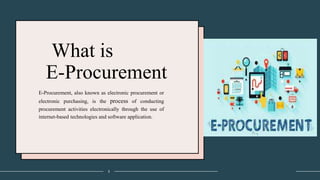
E-Procurement, also known as electronic procurement or
electronic purchasing, is the process of conducting
procurement activities electronically through the use of
internet-based technologies and software application.
3
The
procurement
process
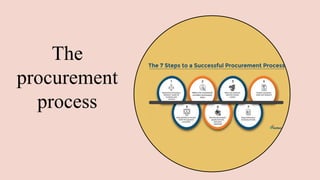
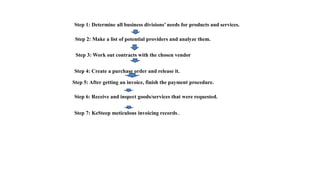
Step 1: Determine all business divisions’ needs for products and services.
Step 3: Work out contracts with the chosen vendor
Step 4: Create a purchase order and release it.
Step 6: Receive and inspect goods/services that were requested.
Step 7: KeSteep meticulous invoicing records..
Step 2: Make a list of potential providers and analyze them.
Step 5: After getting an invoice, finish the payment procedure.
Name: Marufa Akter Sumi.
Class Roll: 21 MGT 024.
Presentation Topic: Types of E-Procurement, Advantages,
Disadvantages.
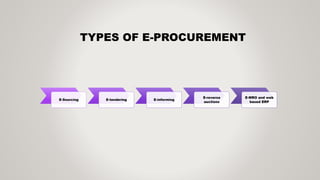
TYPES OF E-PROCUREMENT
E-Sourcing E-tendering E-informing
E-reverse
auctions
E-MRO and web
based ERP
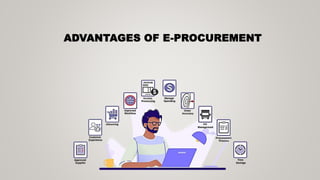
ADVANTAGES OF E-PROCUREMENT
DISADVANTAGES OF E-PROCUREMENT
Testing and Evaluation
Cost
Team Compliance
Research and planning.
Education and Training
Zihad Laskar
21 MGT 25
Presentation Topic : The Existing Purchasing Process,The E-
procurement Process, Estimating of E-procurement costs
10 20XX
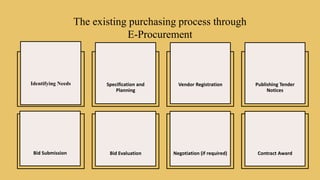
The existing purchasing process through
E-Procurement
Identifying Needs
Bid Submission
Specification and
Planning
Bid Evaluation
Vendor Registration
Negotiation (if required)
Publishing Tender
Notices
Contract Award
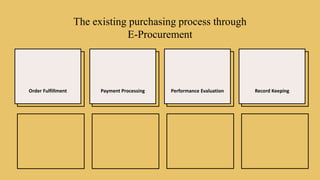
The existing purchasing process through
E-Procurement
Order Fulfillment Payment Processing Performance Evaluation Record Keeping
13 Presentation title 20XX
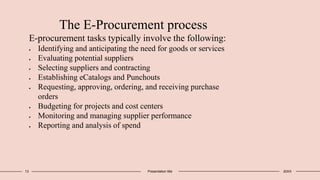
The E-Procurement process
E-procurement tasks typically involve the following:
 Identifying and anticipating the need for goods or services
 Evaluating potential suppliers
 Selecting suppliers and contracting
 Establishing eCatalogs and Punchouts
 Requesting, approving, ordering, and receiving purchase
orders
 Budgeting for projects and cost centers
 Monitoring and managing supplier performance
 Reporting and analysis of spend
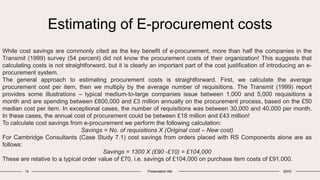
Estimating of E-procurement costs
14 Presentation title 20XX
While cost savings are commonly cited as the key benefit of e-procurement, more than half the companies in the
Transmit (1999) survey (54 percent) did not know the procurement costs of their organization! This suggests that
calculating costs is not straightforward, but it is clearly an important part of the cost justification of introducing an e-
procurement system.
The general approach to estimating procurement costs is straightforward. First, we calculate the average
procurement cost per item, then we multiply by the average number of requisitions. The Transmit (1999) report
provides some illustrations – typical medium-to-large companies issue between 1,000 and 5,000 requisitions a
month and are spending between £600,000 and £3 million annually on the procurement process, based on the £50
median cost per item. In exceptional cases, the number of requisitions was between 30,000 and 40,000 per month.
In these cases, the annual cost of procurement could be between £18 million and £43 million!
To calculate cost savings from e-procurement we perform the following calculation:
Savings = No. of requisitions X (Original cost – New cost)
For Cambridge Consultants (Case Study 7.1) cost savings from orders placed with RS Components alone are as
follows:
Savings = 1300 X (£90 -£10) = £104,000
These are relative to a typical order value of £70, i.e. savings of £104,000 on purchase item costs of £91,000.
Lamia Akter Moni
• 21 MGT 026
The impact of cost saving on
profitability
Cost saving can have a significant impact on profitability for businesses. Here are two
key points highlighting this impact:
Increased Margins:
Cost-saving measures directly contribute to an increase in profit margins. When
a company reduces its operating expenses or finds more efficient ways to produce goods and services, the cost of delivering
those products decreases. As a result, the company can sell its products at the same price or even reduce prices to gain a
competitive advantage.
Enhanced Competitiveness:
Cost-saving measures can also strengthen a company's
competitiveness in the market. In industries with tight profit margins, businesses that can maintain or
improve their profitability through cost-saving strategies are better positioned to weather market
downturns or economic challenges.
Barriers and risk of the e procurement adoption
Cybersecurity Threats:
Moving procurement processes to digital platforms exposes the
organization to potential cybersecurity risks. Cybercriminals may target e-procurement systems to gain
unauthorized access to sensitive data, such as financial information, supplier details, or confidential contracts.
Supplier Dependence and Reliability:
Relying heavily on e-procurement can create a significant dependency
on technology and external suppliers. If the e-procurement platform experiences downtime or technical
issues, it could disrupt the procurement process, delaying orders and affecting the organization's operations.
Rehan Hossen
21 MGT 028
18 Presentation title 20XX
Integrating company systems with supplier systems
It is about connecting two or more processes in an effective way. Therefore,
supplier integration is the degree to which firms collaborate with their suppliers.
This collaboration includes idea generation, new product development, product
concept development, large-scale production, and market testing.
19 Presentation title 20XX
B2B Marketplace
20 Presentation title 20XX
A B2B marketplace is a type of eCommerce platform
that brings together B2B sellers and buyers and enables
them to do business in one place online. Just like its
B2C counterpart, businesses sell their products (usually
in bulk with B2B) and other value-added services, but
on a B2B marketplace, the sellers are brands,
manufacturers, suppliers, and wholesalers, and the
customers are other businesses. These transactions are
processed online by the marketplace operator.
Reason for adoption of e-procurement
Seven reasons your buying organization should utilize a comprehensive e-procurement system.
1. Save a lot of time
2. Easily qualify your vendor pool
3. Track vendor performance
4. Easily publish and distribute bid documents
5. Evaluate multiple bids, quickly
6. Reduce risk and improve collaboration
7. Create and manage custom contracts
21 Presentation title 20XX
Preya Biswas
21MGT 029
Topic : Types of marketplace and The future of e- procurement
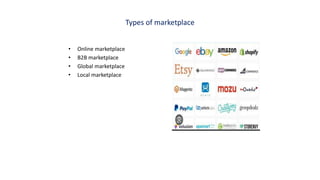
Types of marketplace
• Online marketplace
• B2B marketplace
• Global marketplace
• Local marketplace
The future of e-procurement
• Procurement teams have the potential to solve more complex problems in a quicker ,
more effective manner when using AI and machine learning .
Business can embed AI into applications to manage spend analysis ,strategic sourcing
and contract management.
Thank you

Group-4.pptx

  • 1.
  • 2.
  • 3.
    What is E-Procurement E-Procurement, alsoknown as electronic procurement or electronic purchasing, is the process of conducting procurement activities electronically through the use of internet-based technologies and software application. 3
  • 4.
  • 5.
    Step 1: Determineall business divisions’ needs for products and services. Step 3: Work out contracts with the chosen vendor Step 4: Create a purchase order and release it. Step 6: Receive and inspect goods/services that were requested. Step 7: KeSteep meticulous invoicing records.. Step 2: Make a list of potential providers and analyze them. Step 5: After getting an invoice, finish the payment procedure.
  • 6.
    Name: Marufa AkterSumi. Class Roll: 21 MGT 024. Presentation Topic: Types of E-Procurement, Advantages, Disadvantages.
  • 7.
    TYPES OF E-PROCUREMENT E-SourcingE-tendering E-informing E-reverse auctions E-MRO and web based ERP
  • 8.
  • 9.
    DISADVANTAGES OF E-PROCUREMENT Testingand Evaluation Cost Team Compliance Research and planning. Education and Training
  • 10.
    Zihad Laskar 21 MGT25 Presentation Topic : The Existing Purchasing Process,The E- procurement Process, Estimating of E-procurement costs 10 20XX
  • 11.
    The existing purchasingprocess through E-Procurement Identifying Needs Bid Submission Specification and Planning Bid Evaluation Vendor Registration Negotiation (if required) Publishing Tender Notices Contract Award
  • 12.
    The existing purchasingprocess through E-Procurement Order Fulfillment Payment Processing Performance Evaluation Record Keeping
  • 13.
    13 Presentation title20XX The E-Procurement process E-procurement tasks typically involve the following:  Identifying and anticipating the need for goods or services  Evaluating potential suppliers  Selecting suppliers and contracting  Establishing eCatalogs and Punchouts  Requesting, approving, ordering, and receiving purchase orders  Budgeting for projects and cost centers  Monitoring and managing supplier performance  Reporting and analysis of spend
  • 14.
    Estimating of E-procurementcosts 14 Presentation title 20XX While cost savings are commonly cited as the key benefit of e-procurement, more than half the companies in the Transmit (1999) survey (54 percent) did not know the procurement costs of their organization! This suggests that calculating costs is not straightforward, but it is clearly an important part of the cost justification of introducing an e- procurement system. The general approach to estimating procurement costs is straightforward. First, we calculate the average procurement cost per item, then we multiply by the average number of requisitions. The Transmit (1999) report provides some illustrations – typical medium-to-large companies issue between 1,000 and 5,000 requisitions a month and are spending between £600,000 and £3 million annually on the procurement process, based on the £50 median cost per item. In exceptional cases, the number of requisitions was between 30,000 and 40,000 per month. In these cases, the annual cost of procurement could be between £18 million and £43 million! To calculate cost savings from e-procurement we perform the following calculation: Savings = No. of requisitions X (Original cost – New cost) For Cambridge Consultants (Case Study 7.1) cost savings from orders placed with RS Components alone are as follows: Savings = 1300 X (£90 -£10) = £104,000 These are relative to a typical order value of £70, i.e. savings of £104,000 on purchase item costs of £91,000.
  • 15.
  • 16.
    The impact ofcost saving on profitability Cost saving can have a significant impact on profitability for businesses. Here are two key points highlighting this impact: Increased Margins: Cost-saving measures directly contribute to an increase in profit margins. When a company reduces its operating expenses or finds more efficient ways to produce goods and services, the cost of delivering those products decreases. As a result, the company can sell its products at the same price or even reduce prices to gain a competitive advantage. Enhanced Competitiveness: Cost-saving measures can also strengthen a company's competitiveness in the market. In industries with tight profit margins, businesses that can maintain or improve their profitability through cost-saving strategies are better positioned to weather market downturns or economic challenges.
  • 17.
    Barriers and riskof the e procurement adoption Cybersecurity Threats: Moving procurement processes to digital platforms exposes the organization to potential cybersecurity risks. Cybercriminals may target e-procurement systems to gain unauthorized access to sensitive data, such as financial information, supplier details, or confidential contracts. Supplier Dependence and Reliability: Relying heavily on e-procurement can create a significant dependency on technology and external suppliers. If the e-procurement platform experiences downtime or technical issues, it could disrupt the procurement process, delaying orders and affecting the organization's operations.
  • 18.
    Rehan Hossen 21 MGT028 18 Presentation title 20XX
  • 19.
    Integrating company systemswith supplier systems It is about connecting two or more processes in an effective way. Therefore, supplier integration is the degree to which firms collaborate with their suppliers. This collaboration includes idea generation, new product development, product concept development, large-scale production, and market testing. 19 Presentation title 20XX
  • 20.
    B2B Marketplace 20 Presentationtitle 20XX A B2B marketplace is a type of eCommerce platform that brings together B2B sellers and buyers and enables them to do business in one place online. Just like its B2C counterpart, businesses sell their products (usually in bulk with B2B) and other value-added services, but on a B2B marketplace, the sellers are brands, manufacturers, suppliers, and wholesalers, and the customers are other businesses. These transactions are processed online by the marketplace operator.
  • 21.
    Reason for adoptionof e-procurement Seven reasons your buying organization should utilize a comprehensive e-procurement system. 1. Save a lot of time 2. Easily qualify your vendor pool 3. Track vendor performance 4. Easily publish and distribute bid documents 5. Evaluate multiple bids, quickly 6. Reduce risk and improve collaboration 7. Create and manage custom contracts 21 Presentation title 20XX
  • 22.
    Preya Biswas 21MGT 029 Topic: Types of marketplace and The future of e- procurement
  • 23.
    Types of marketplace •Online marketplace • B2B marketplace • Global marketplace • Local marketplace
  • 24.
    The future ofe-procurement • Procurement teams have the potential to solve more complex problems in a quicker , more effective manner when using AI and machine learning . Business can embed AI into applications to manage spend analysis ,strategic sourcing and contract management.
  • 25.