The scientific method
• At some level, everything is based on a
model of behavior.
• Even scientific saws change because
there are no absolutes.
Measurements
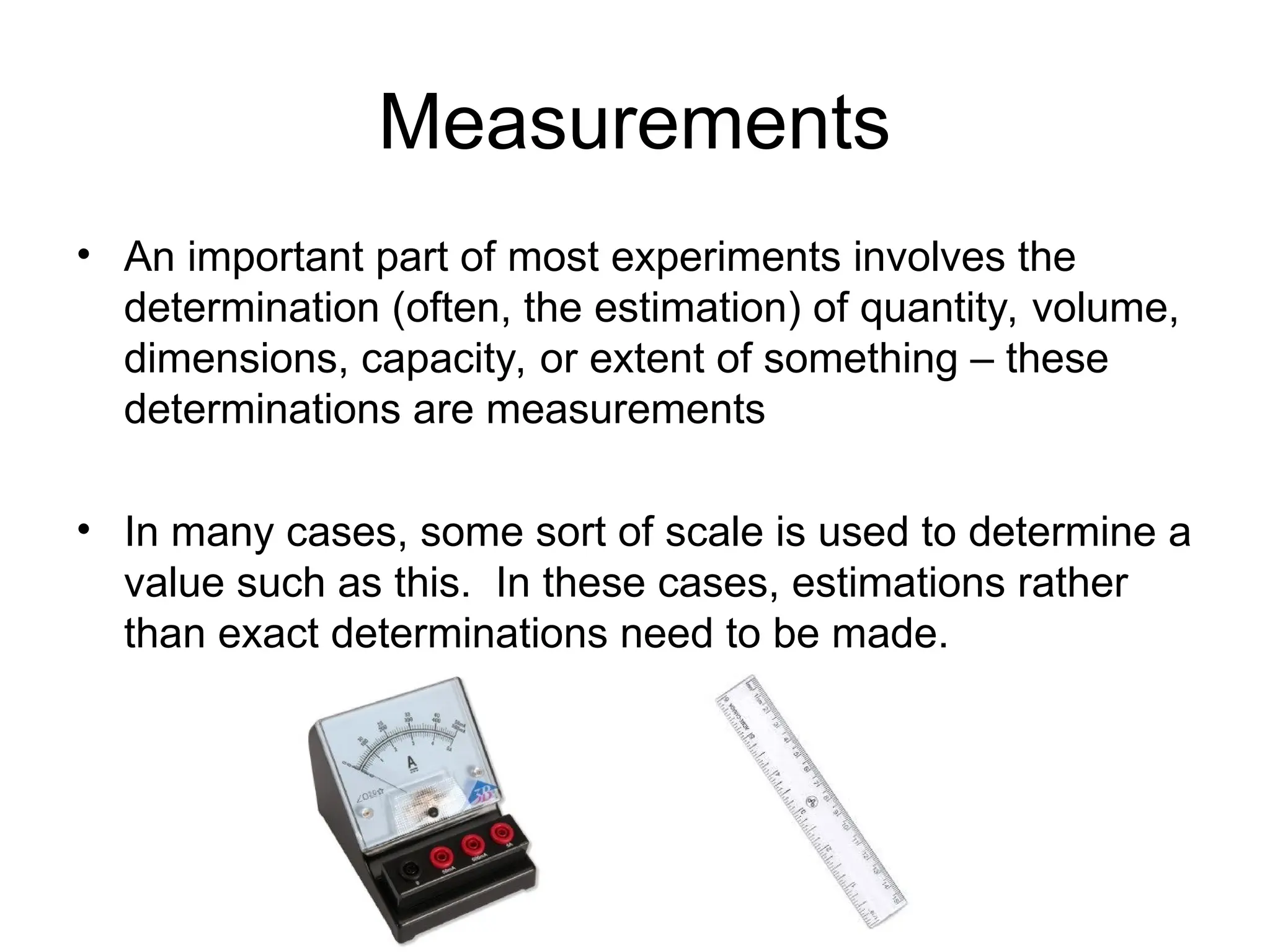
• An important part of most experiments involves the
determination (often, the estimation) of quantity, volume,
dimensions, capacity, or extent of something – these
determinations are measurements
• In many cases, some sort of scale is used to determine a
value such as this. In these cases, estimations rather
than exact determinations need to be made.
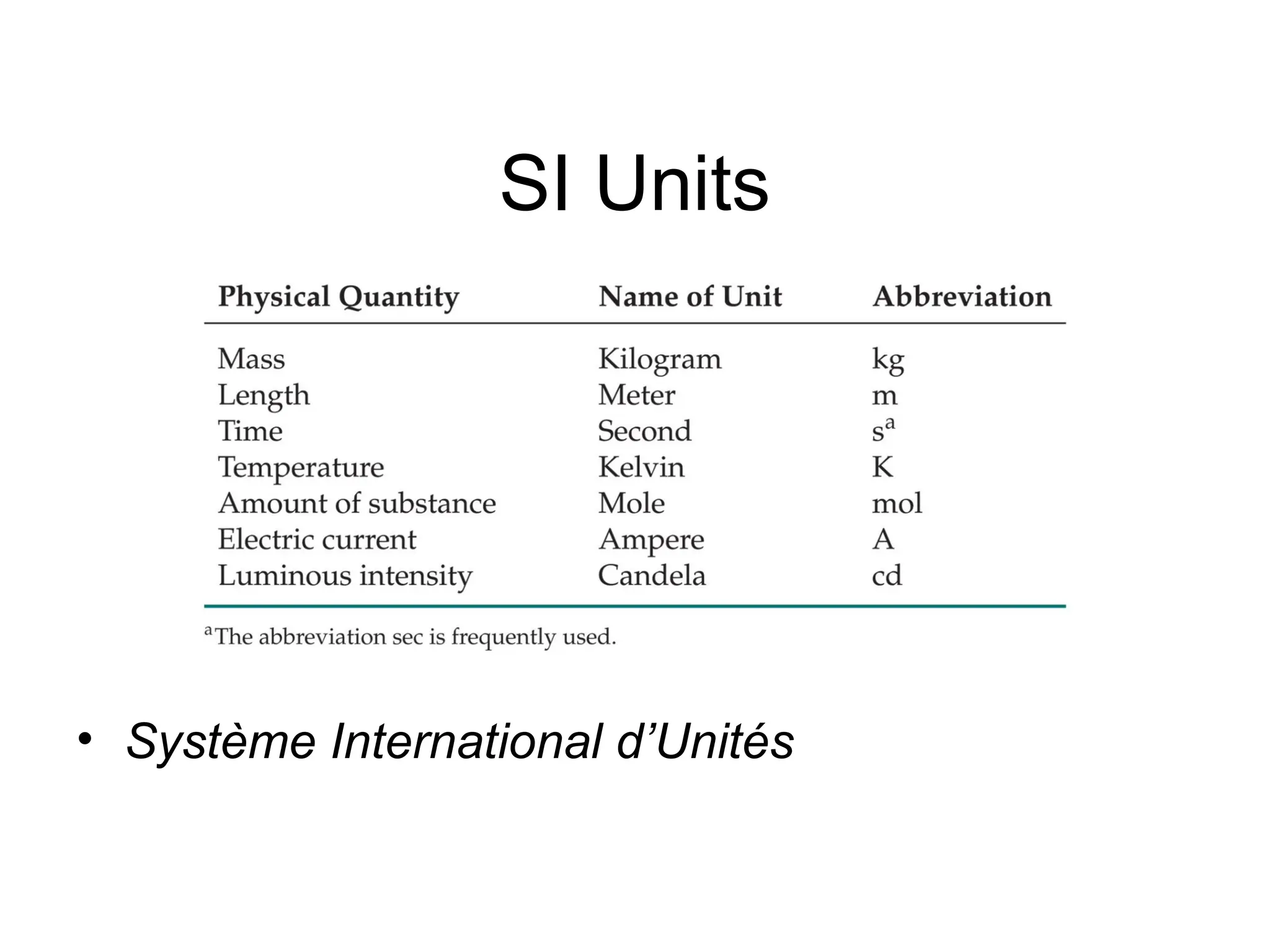
SI Units
• Système International d’Unités
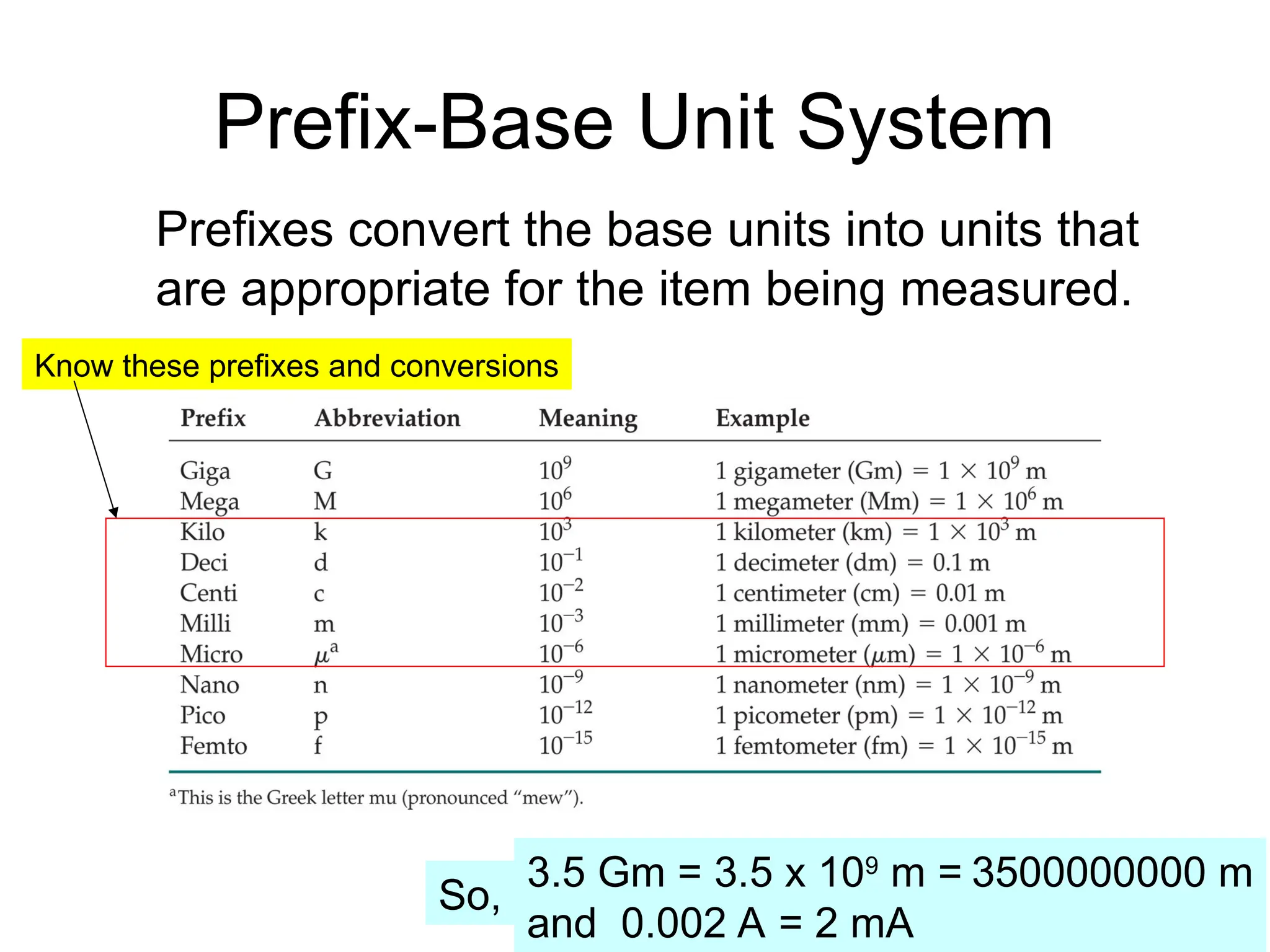
Prefix-Base Unit System
Prefixes convert the base units into units that
are appropriate for the item being measured.
Know these prefixes and conversions
3.5 Gm = 3.5 x 10⁹
m = 3500000000 m
and 0.002 A = 2 mA
So,
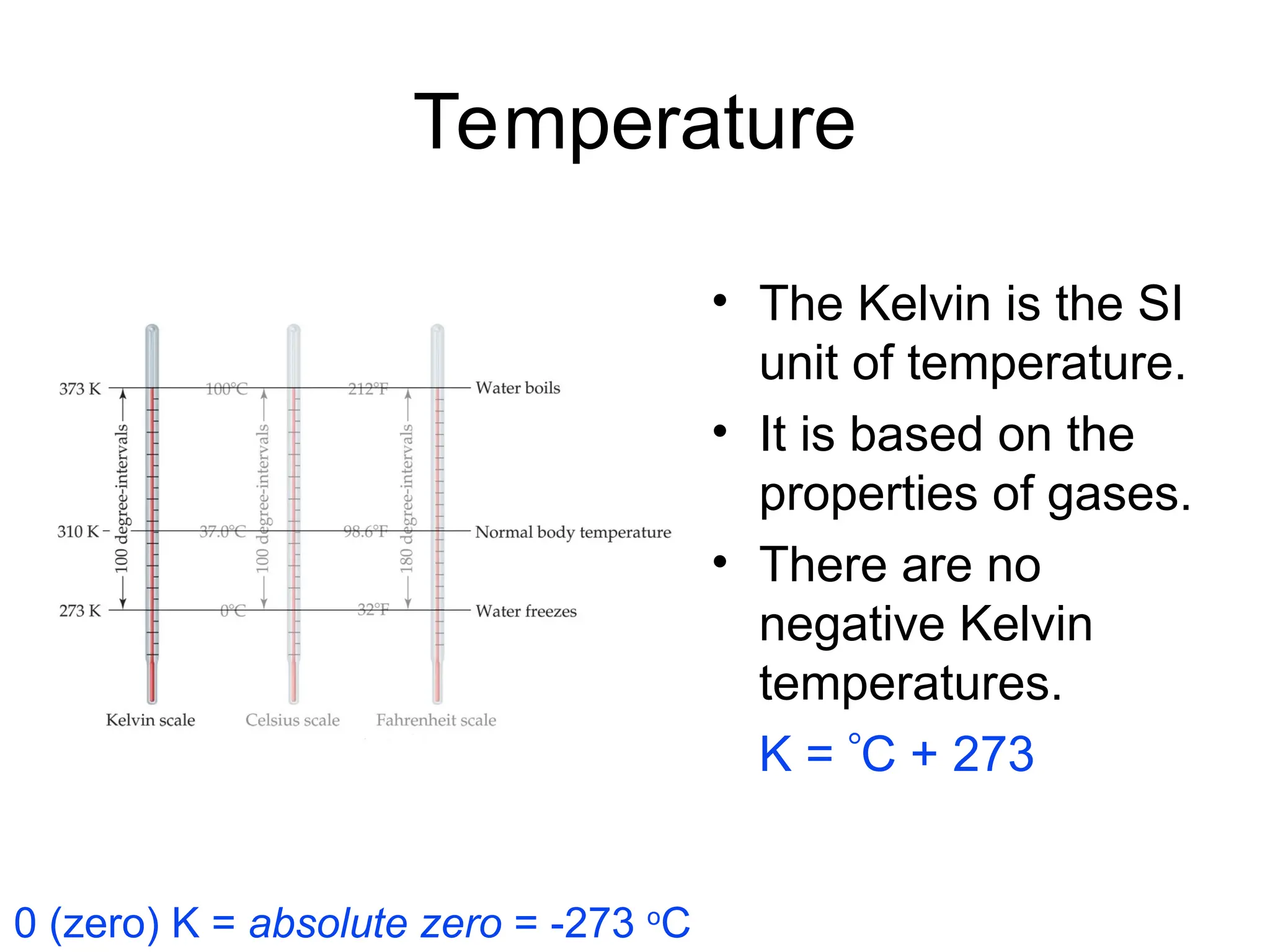
Temperature
• The Kelvin is the SI
unit of temperature.
• It is based on the
properties of gases.
• There are no
negative Kelvin
temperatures.
K = C + 273
0 (zero) K = absolute zero = -273 o
C
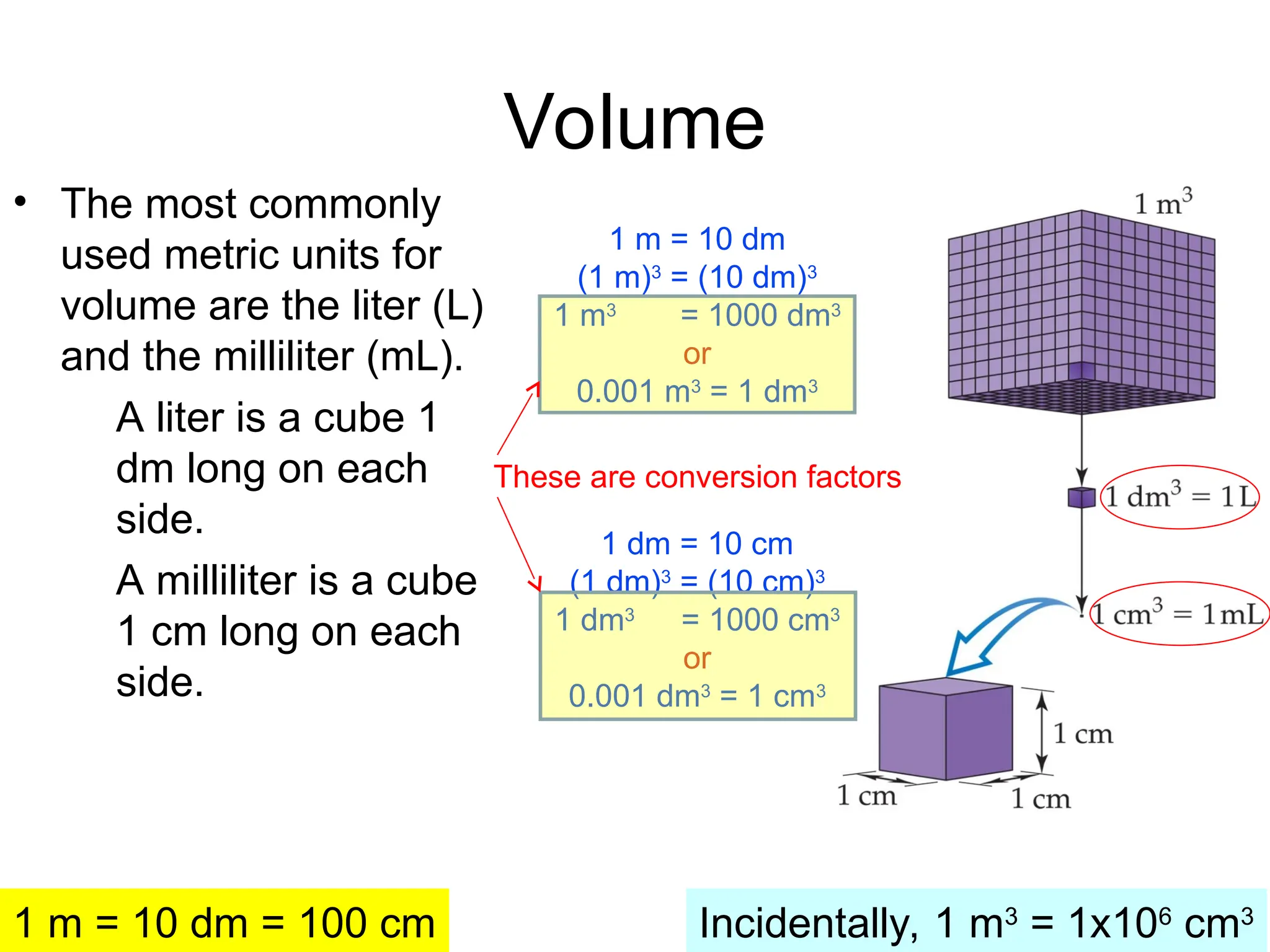
Volume
• The most commonly
used metric units for
volume are the liter (L)
and the milliliter (mL).
A liter is a cube 1
dm long on each
side.
A milliliter is a cube
1 cm long on each
side.
1 m = 10 dm = 100 cm
1 m = 10 dm
(1 m)3
= (10 dm)3
1 m3
= 1000 dm3
or
0.001 m3
= 1 dm3
1 dm = 10 cm
(1 dm)3
= (10 cm)3
1 dm3
= 1000 cm3
or
0.001 dm3
= 1 cm3
Incidentally, 1 m3
= 1x10⁶
cm3
These are conversion factors
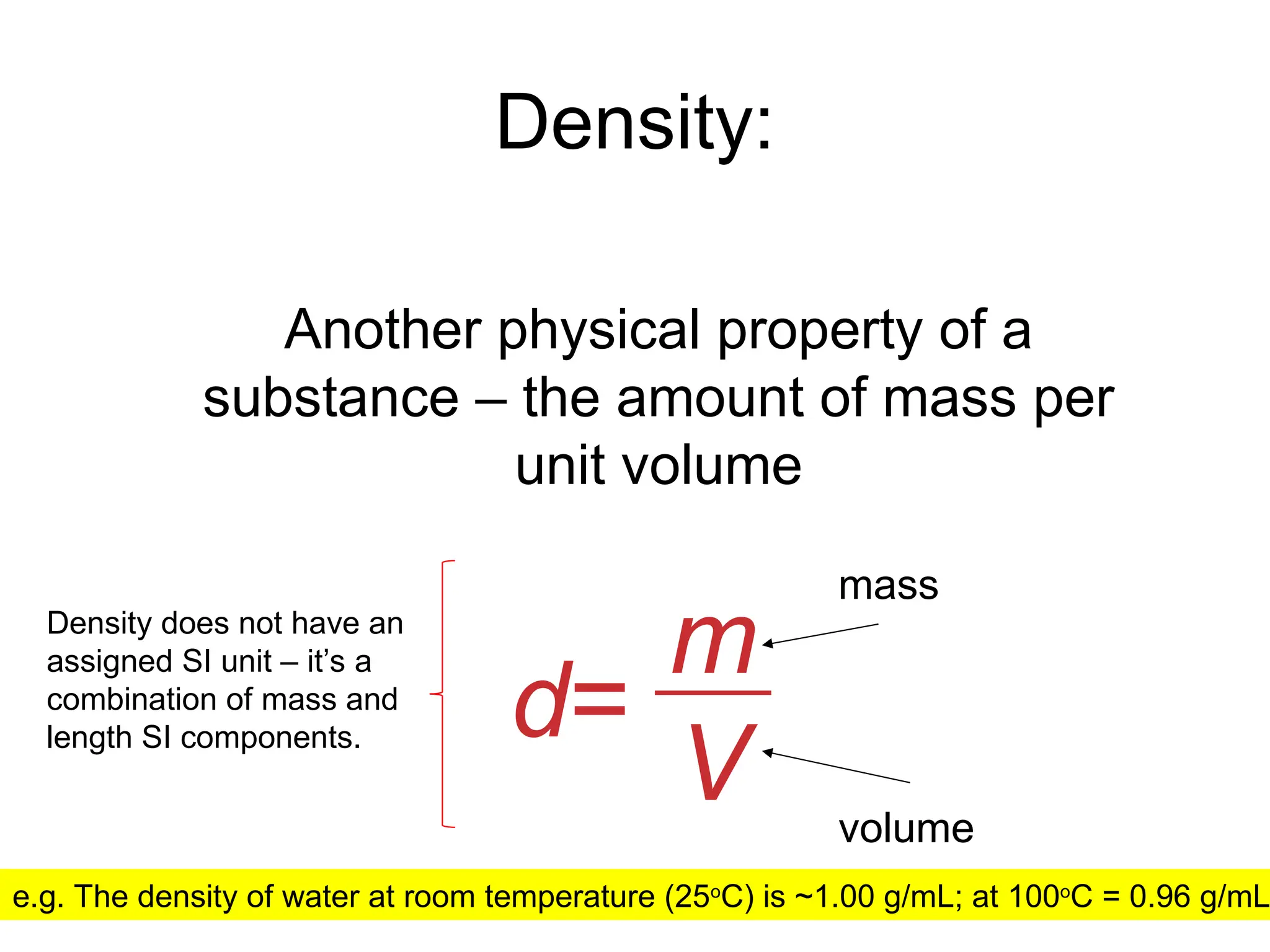
Density:
Another physical property of a
substance – the amount of mass per
unit volume
d=
m
V
mass
volume
e.g. The density of water at room temperature (25o
C) is ~1.00 g/mL; at 100o
C = 0.96 g/mL
Density does not have an
assigned SI unit – it’s a
combination of mass and
length SI components.
Density:
• Density is temperature-sensitive,
because the volume that a sample
occupies can change with temperature.
• Densities are often given with the
temperature at which they were
measured. If not, assume a
temperature of about 25o
C.
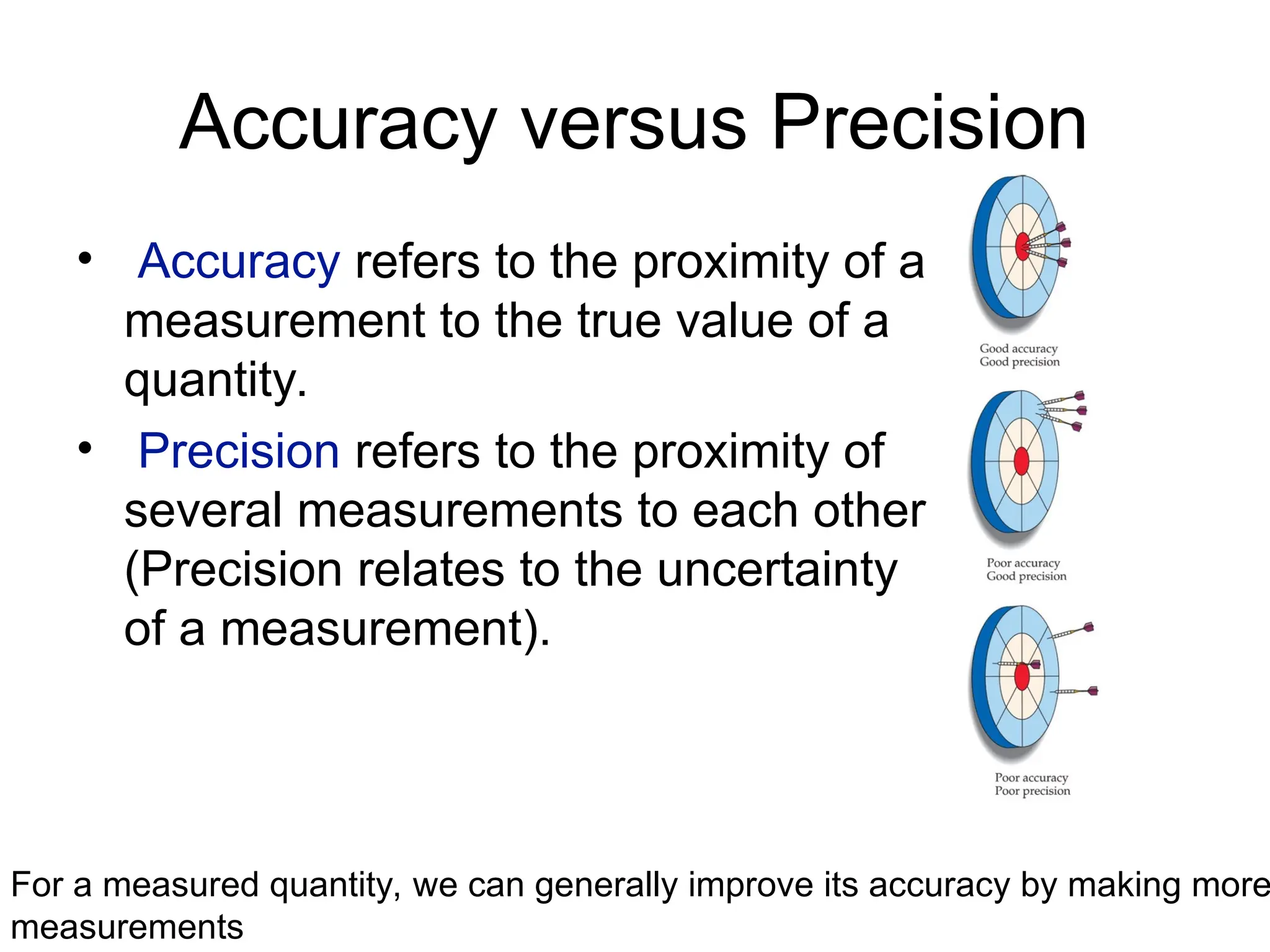
Accuracy versus Precision
• Accuracy refers to the proximity of a
measurement to the true value of a
quantity.
• Precision refers to the proximity of
several measurements to each other
(Precision relates to the uncertainty
of a measurement).
For a measured quantity, we can generally improve its accuracy by making more
measurements
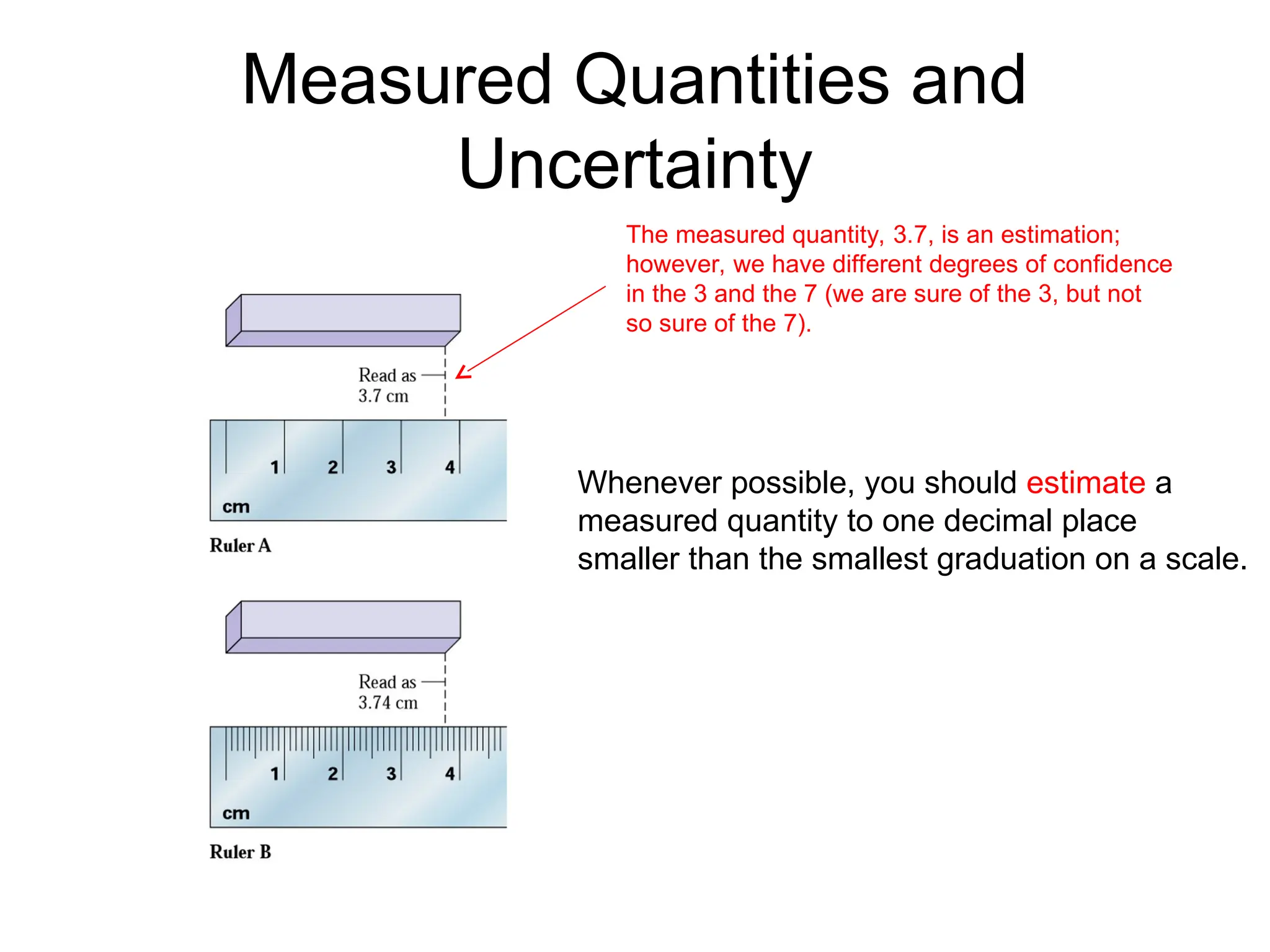
Measured Quantities and
Uncertainty
Whenever possible, you should estimate a
measured quantity to one decimal place
smaller than the smallest graduation on a scale.
The measured quantity, 3.7, is an estimation;
however, we have different degrees of confidence
in the 3 and the 7 (we are sure of the 3, but not
so sure of the 7).
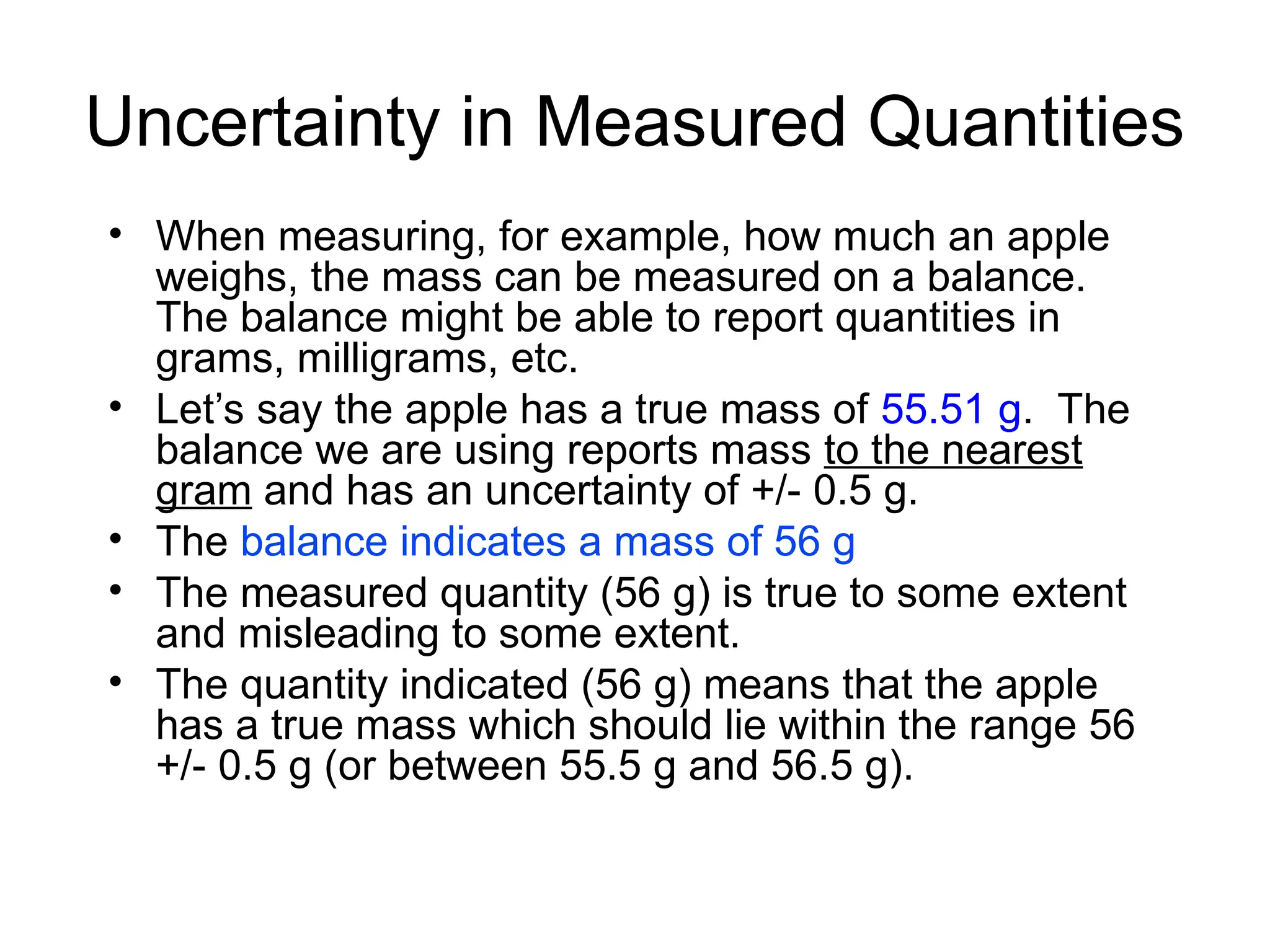
Uncertainty in Measured Quantities
• When measuring, for example, how much an apple
weighs, the mass can be measured on a balance.
The balance might be able to report quantities in
grams, milligrams, etc.
• Let’s say the apple has a true mass of 55.51 g. The
balance we are using reports mass to the nearest
gram and has an uncertainty of +/- 0.5 g.
• The balance indicates a mass of 56 g
• The measured quantity (56 g) is true to some extent
and misleading to some extent.
• The quantity indicated (56 g) means that the apple
has a true mass which should lie within the range 56
+/- 0.5 g (or between 55.5 g and 56.5 g).
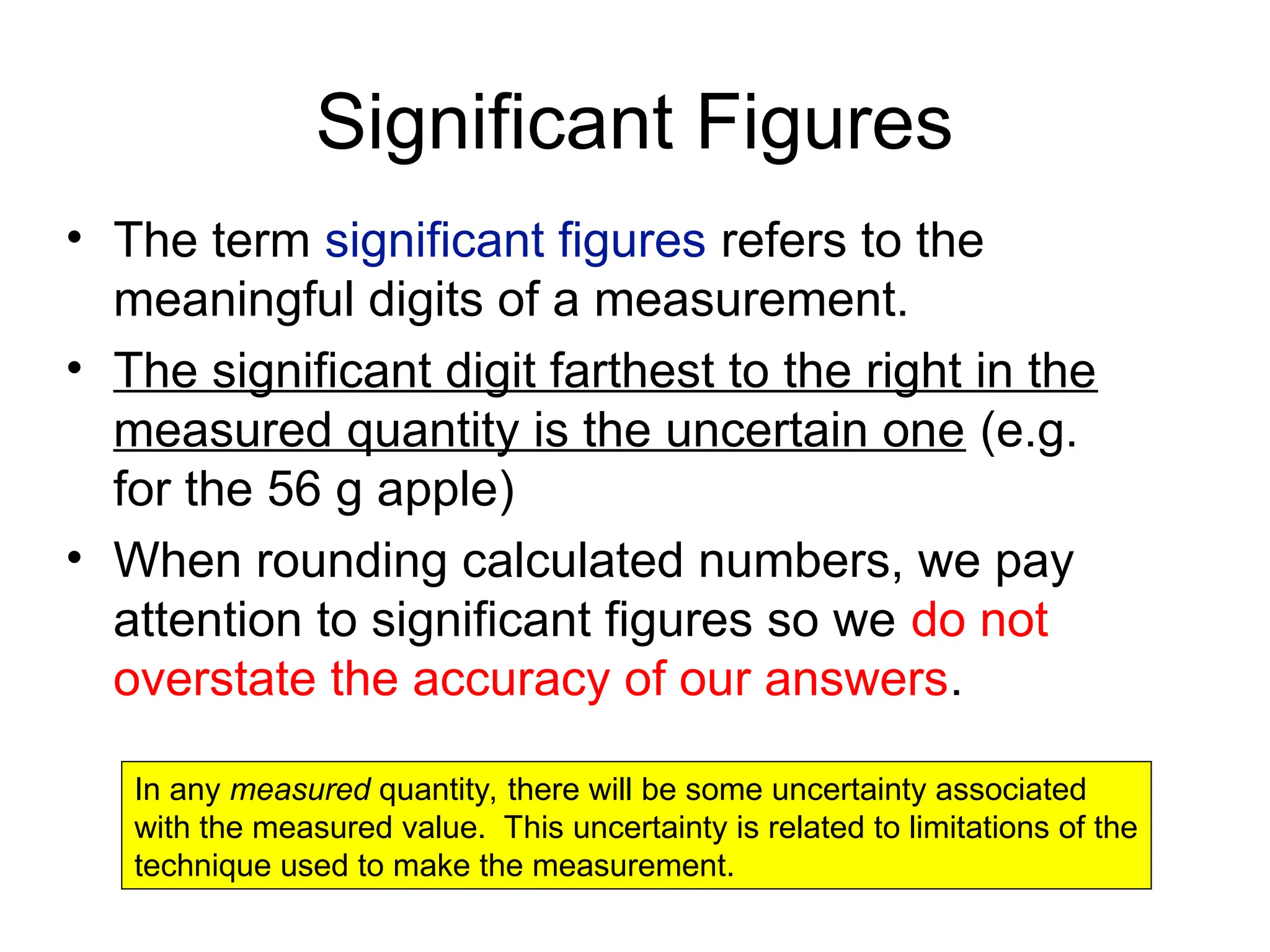
Significant Figures
• The term significant figures refers to the
meaningful digits of a measurement.
• The significant digit farthest to the right in the
measured quantity is the uncertain one (e.g.
for the 56 g apple)
• When rounding calculated numbers, we pay
attention to significant figures so we do not
overstate the accuracy of our answers.
In any measured quantity, there will be some uncertainty associated
with the measured value. This uncertainty is related to limitations of the
technique used to make the measurement.
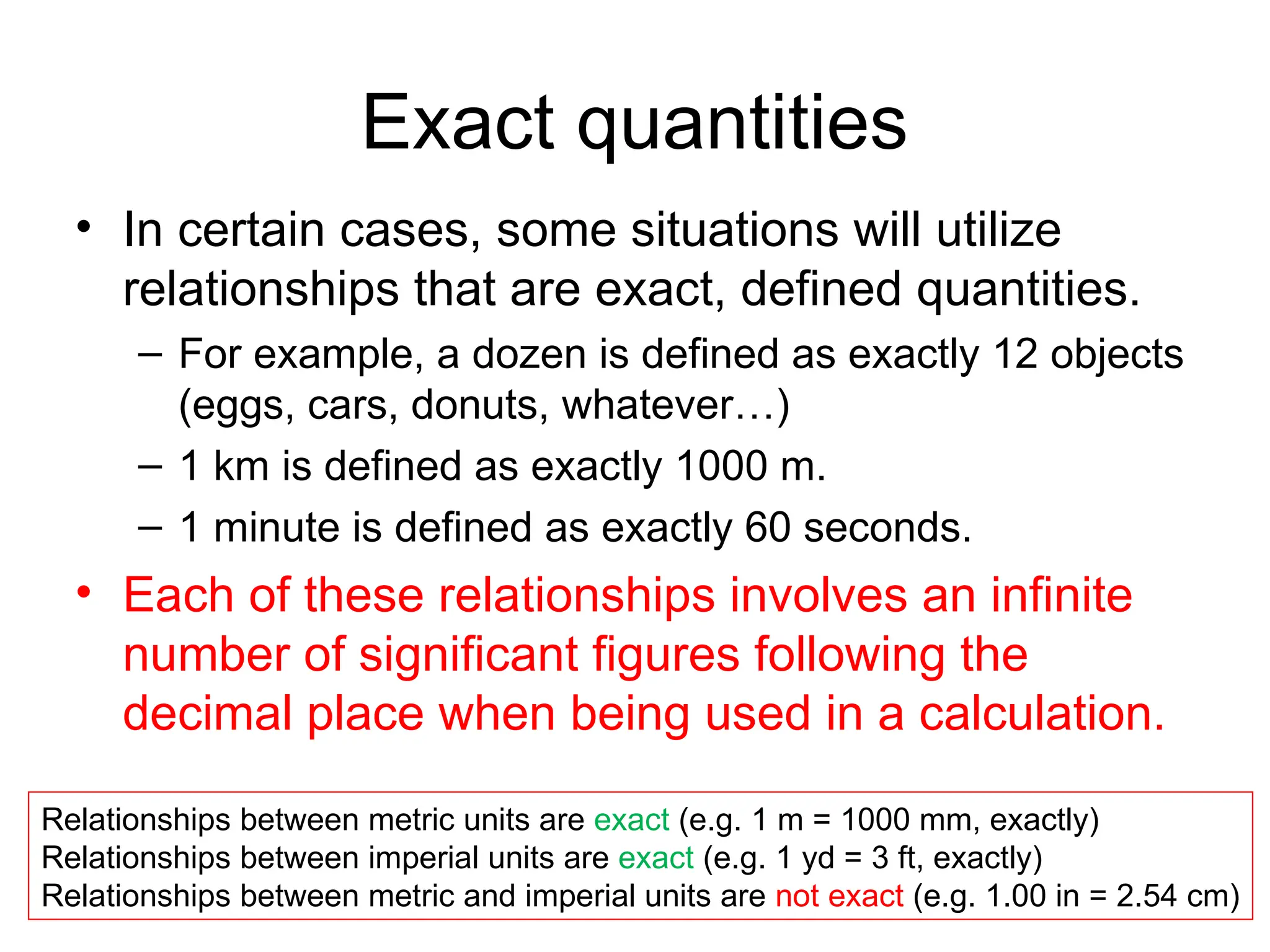
Exact quantities
• In certain cases, some situations will utilize
relationships that are exact, defined quantities.
– For example, a dozen is defined as exactly 12 objects
(eggs, cars, donuts, whatever…)
– 1 km is defined as exactly 1000 m.
– 1 minute is defined as exactly 60 seconds.
• Each of these relationships involves an infinite
number of significant figures following the
decimal place when being used in a calculation.
Relationships between metric units are exact (e.g. 1 m = 1000 mm, exactly)
Relationships between imperial units are exact (e.g. 1 yd = 3 ft, exactly)
Relationships between metric and imperial units are not exact (e.g. 1.00 in = 2.54 cm)
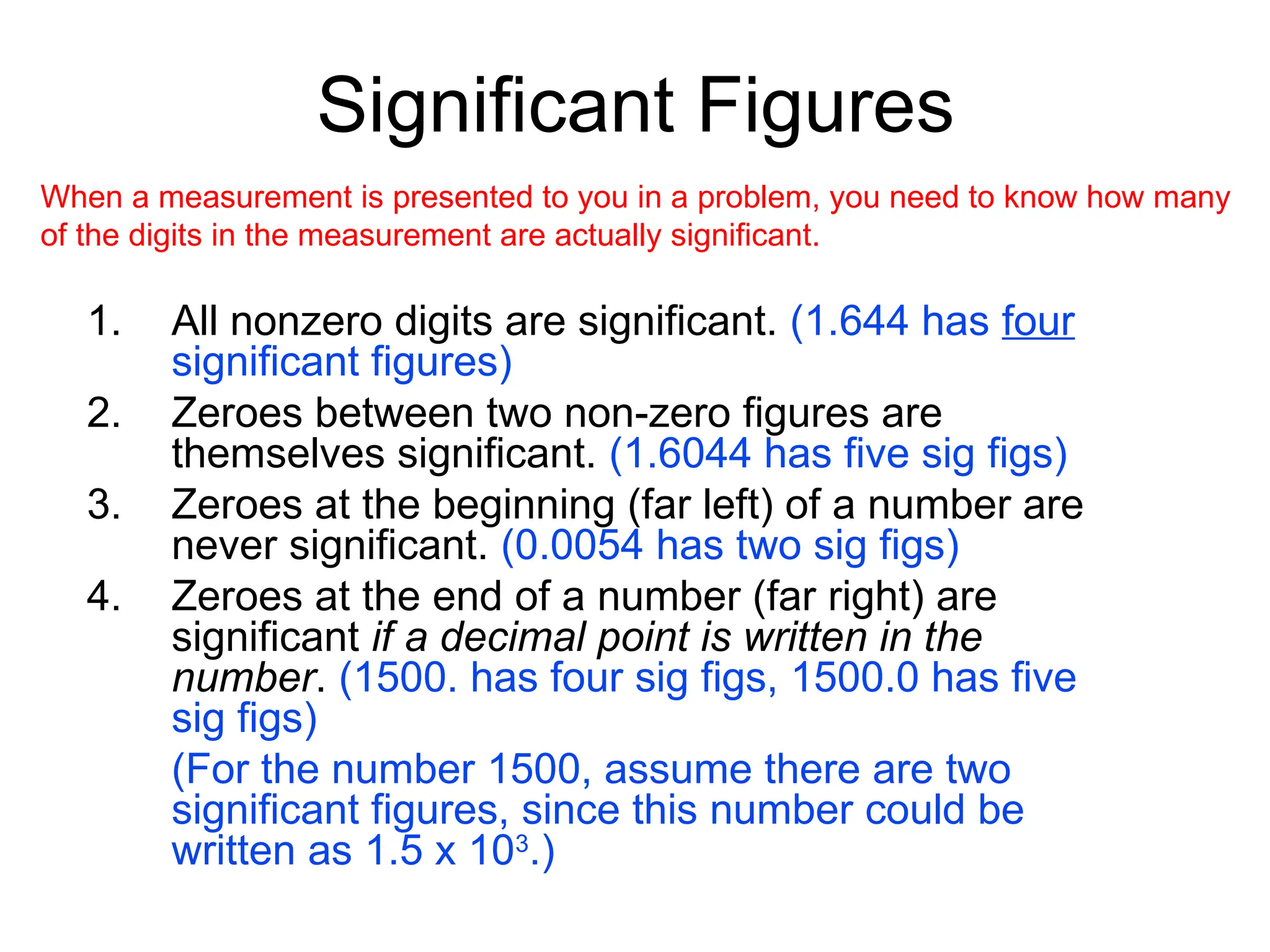
Significant Figures
1. All nonzero digits are significant. (1.644 has four
significant figures)
2. Zeroes between two non-zero figures are
themselves significant. (1.6044 has five sig figs)
3. Zeroes at the beginning (far left) of a number are
never significant. (0.0054 has two sig figs)
4. Zeroes at the end of a number (far right) are
significant if a decimal point is written in the
number. (1500. has four sig figs, 1500.0 has five
sig figs)
(For the number 1500, assume there are two
significant figures, since this number could be
written as 1.5 x 10³
.)
When a measurement is presented to you in a problem, you need to know how many
of the digits in the measurement are actually significant.
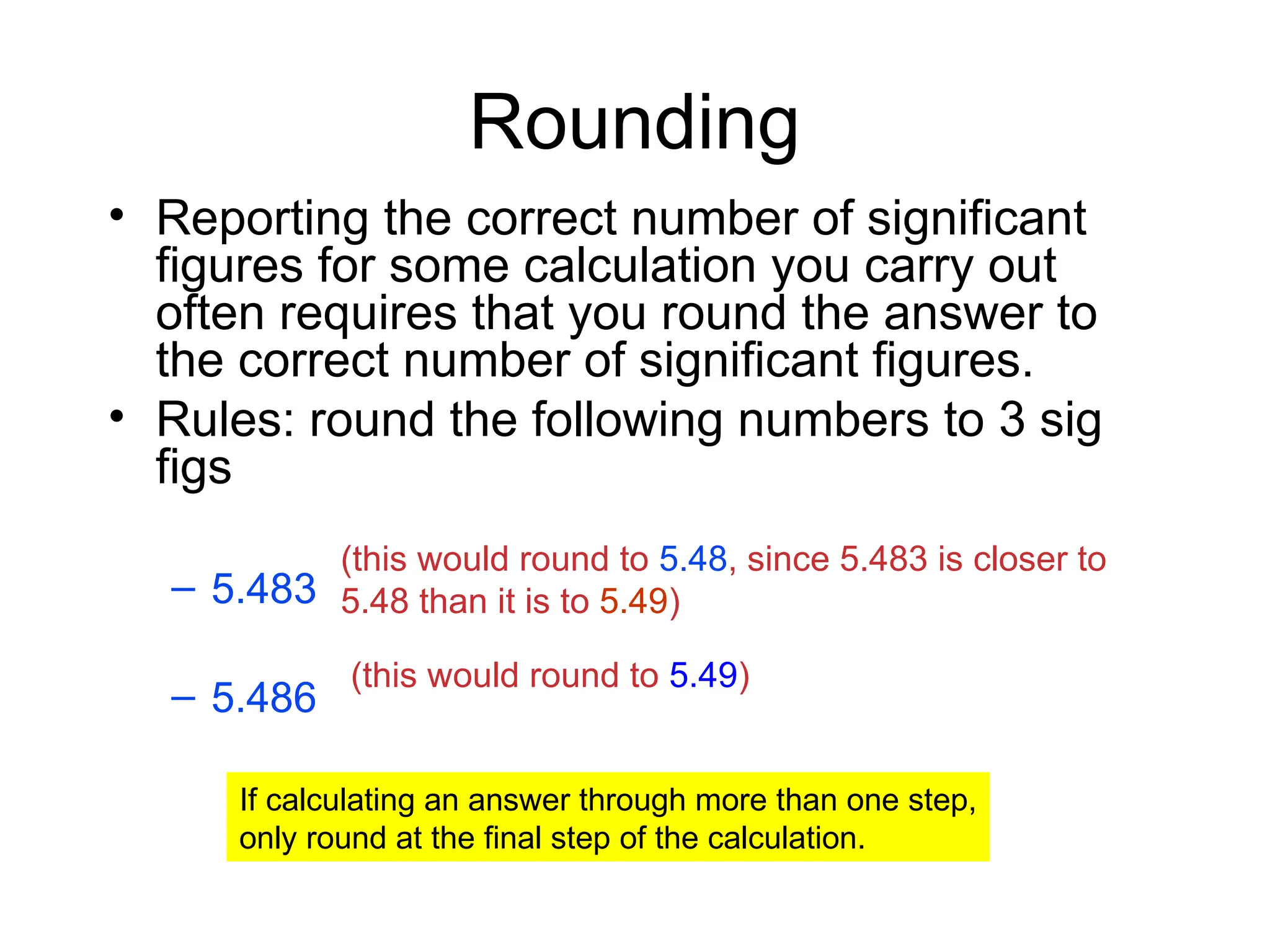
Rounding
• Reporting the correct number of significant
figures for some calculation you carry out
often requires that you round the answer to
the correct number of significant figures.
• Rules: round the following numbers to 3 sig
figs
– 5.483
– 5.486
(this would round to 5.48, since 5.483 is closer to
5.48 than it is to 5.49)
(this would round to 5.49)
If calculating an answer through more than one step,
only round at the final step of the calculation.
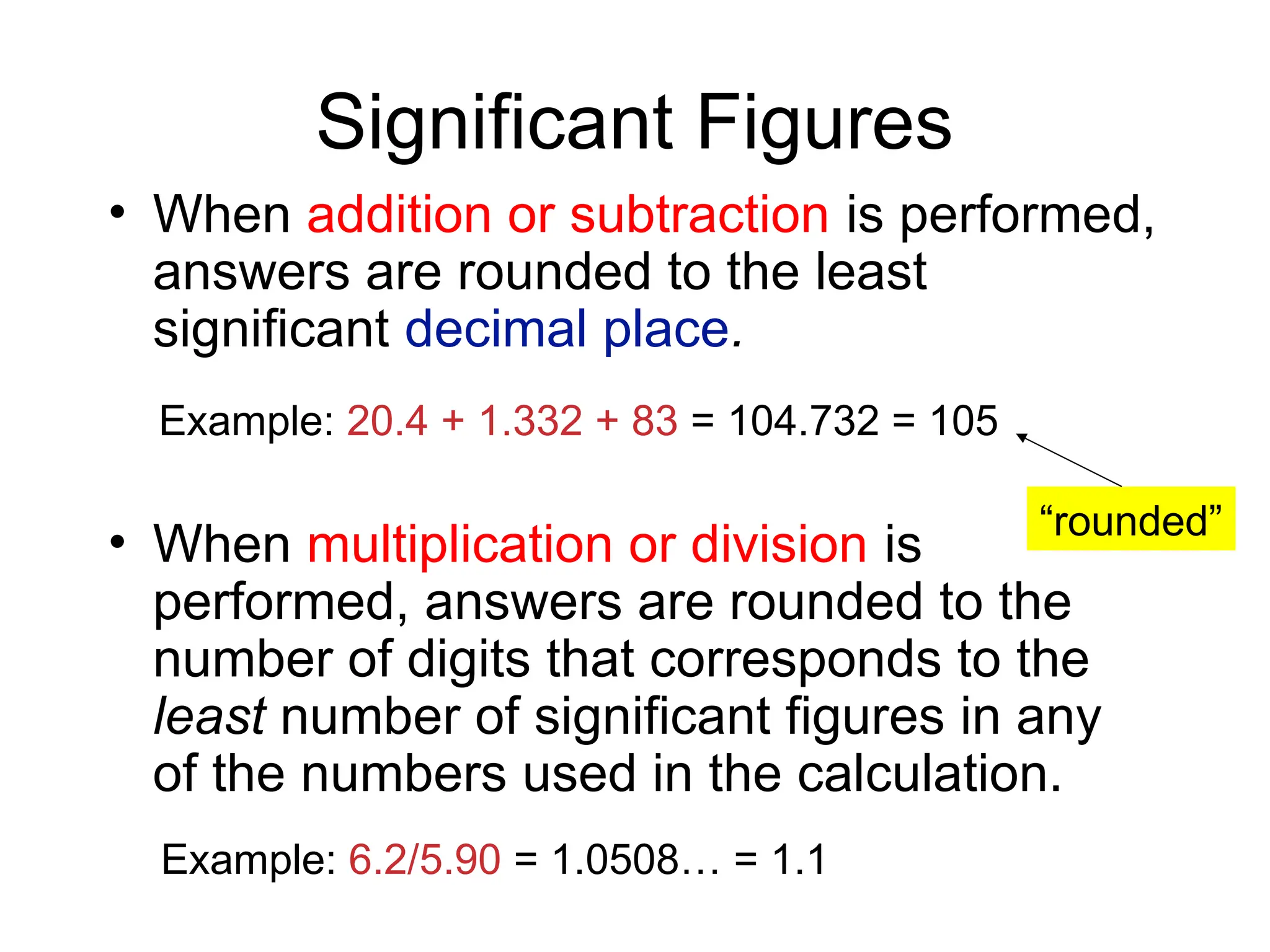
Significant Figures
• When addition or subtraction is performed,
answers are rounded to the least
significant decimal place.
• When multiplication or division is
performed, answers are rounded to the
number of digits that corresponds to the
least number of significant figures in any
of the numbers used in the calculation.
Example: 6.2/5.90 = 1.0508… = 1.1
Example: 20.4 + 1.332 + 83 = 104.732 = 105
“rounded”
Significant Figures
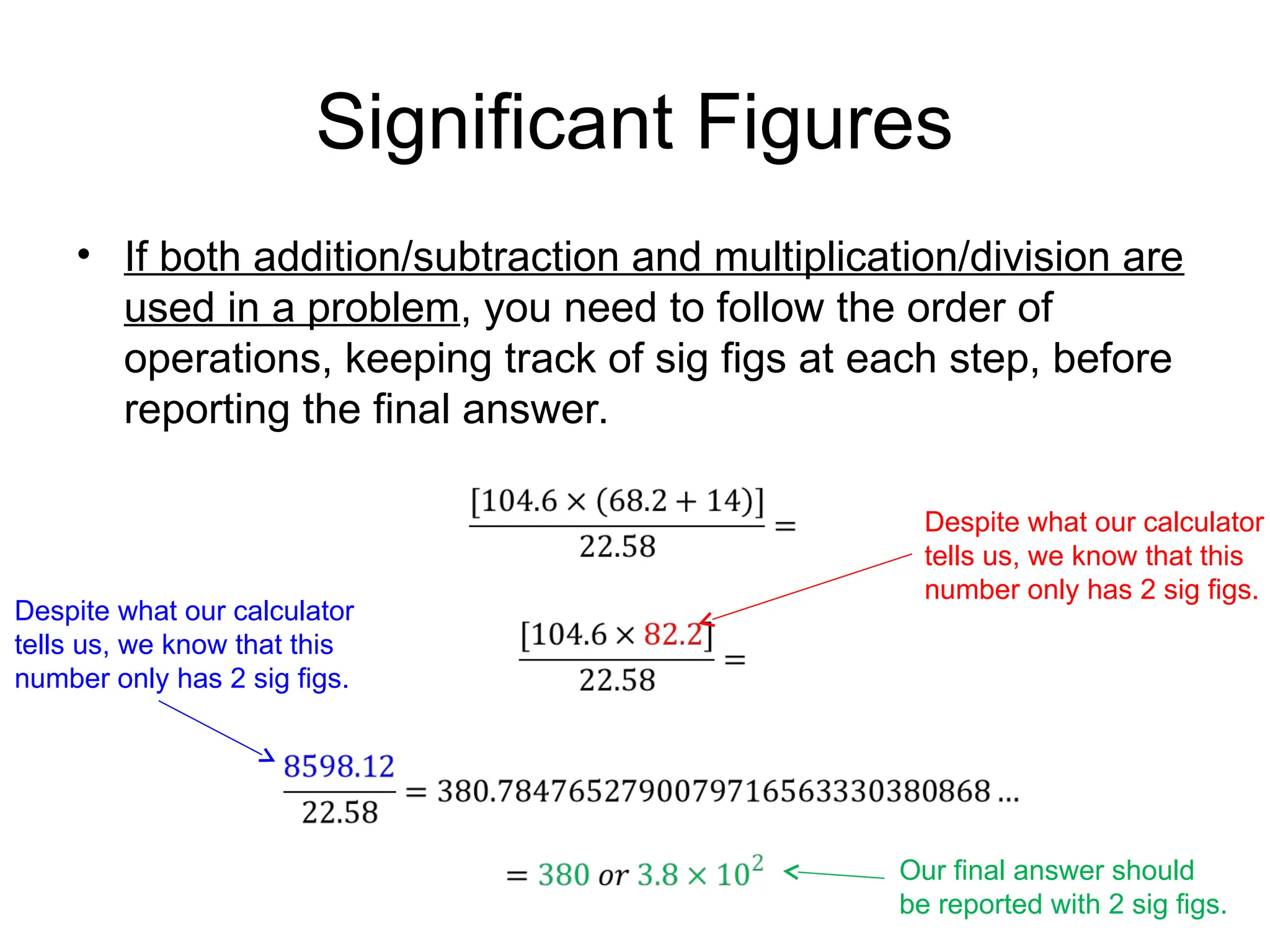
• If both addition/subtraction and multiplication/division are
used in a problem, you need to follow the order of
operations, keeping track of sig figs at each step, before
reporting the final answer.
1) Calculate (68.2 + 14). Do not round the answer, but keep in mind how many sig figs
the answer possesses.
2) Calculate [104.6 x (answer from 1st
step)]. Again, do not round the answer yet, but
keep in mind how many sig figs are involved in the calculation at this point.
3) , and then round the answer to the correct sig figs.
Significant Figures
• If both addition/subtraction and multiplication/division are
used in a problem, you need to follow the order of
operations, keeping track of sig figs at each step, before
reporting the final answer.
Despite what our calculator
tells us, we know that this
number only has 2 sig figs.
Despite what our calculator
tells us, we know that this
number only has 2 sig figs.
Our final answer should
be reported with 2 sig figs.
An example using sig figs
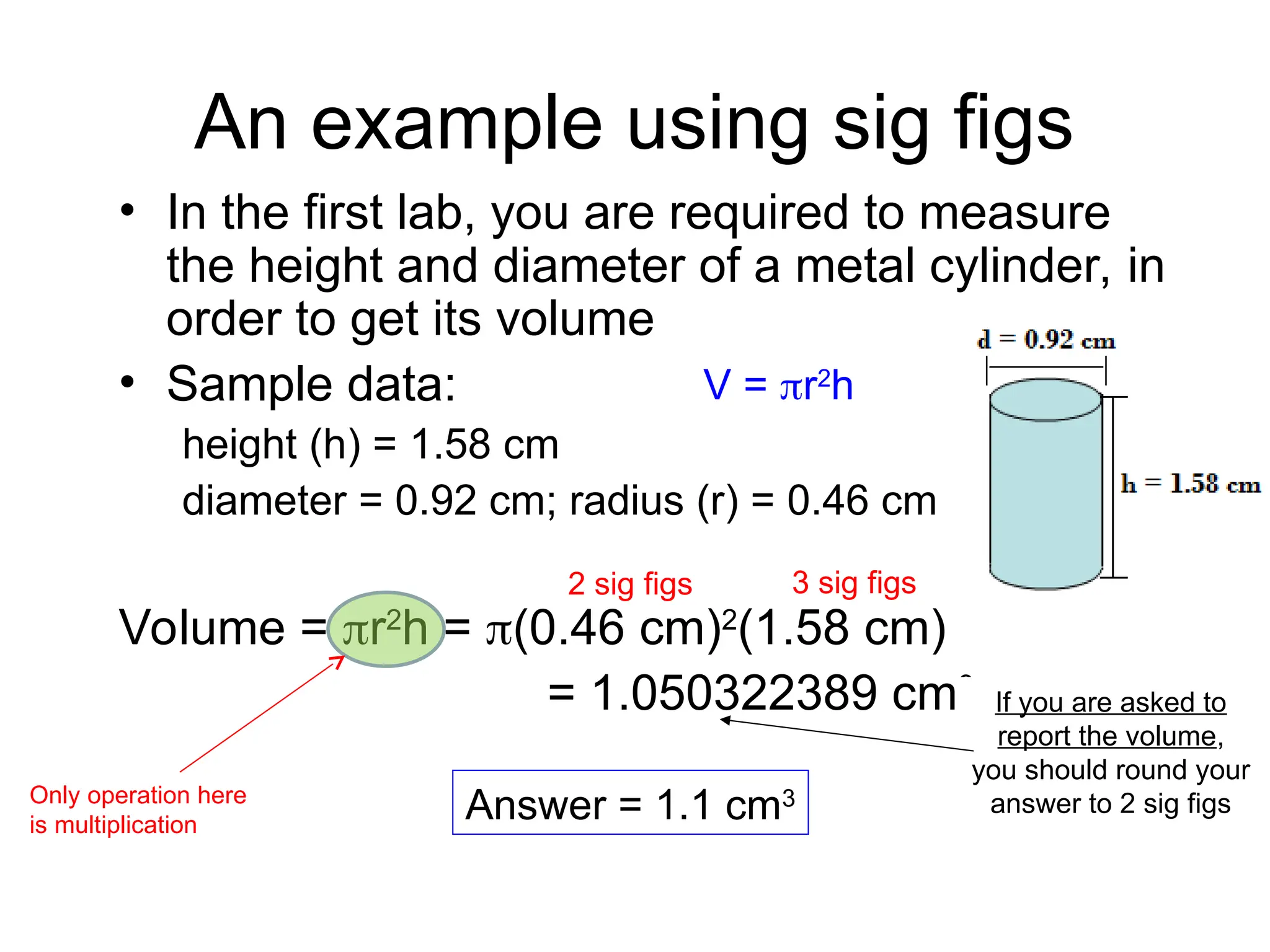
• In the first lab, you are required to measure
the height and diameter of a metal cylinder, in
order to get its volume
• Sample data:
height (h) = 1.58 cm
diameter = 0.92 cm; radius (r) = 0.46 cm
Volume = r2
h = (0.46 cm)2
(1.58 cm)
= 1.050322389 cm3
3 sig figs
2 sig figs
If you are asked to
report the volume,
you should round your
answer to 2 sig figs
Answer = 1.1 cm3
Only operation here
is multiplication
V = r2
h
Calculation of Density
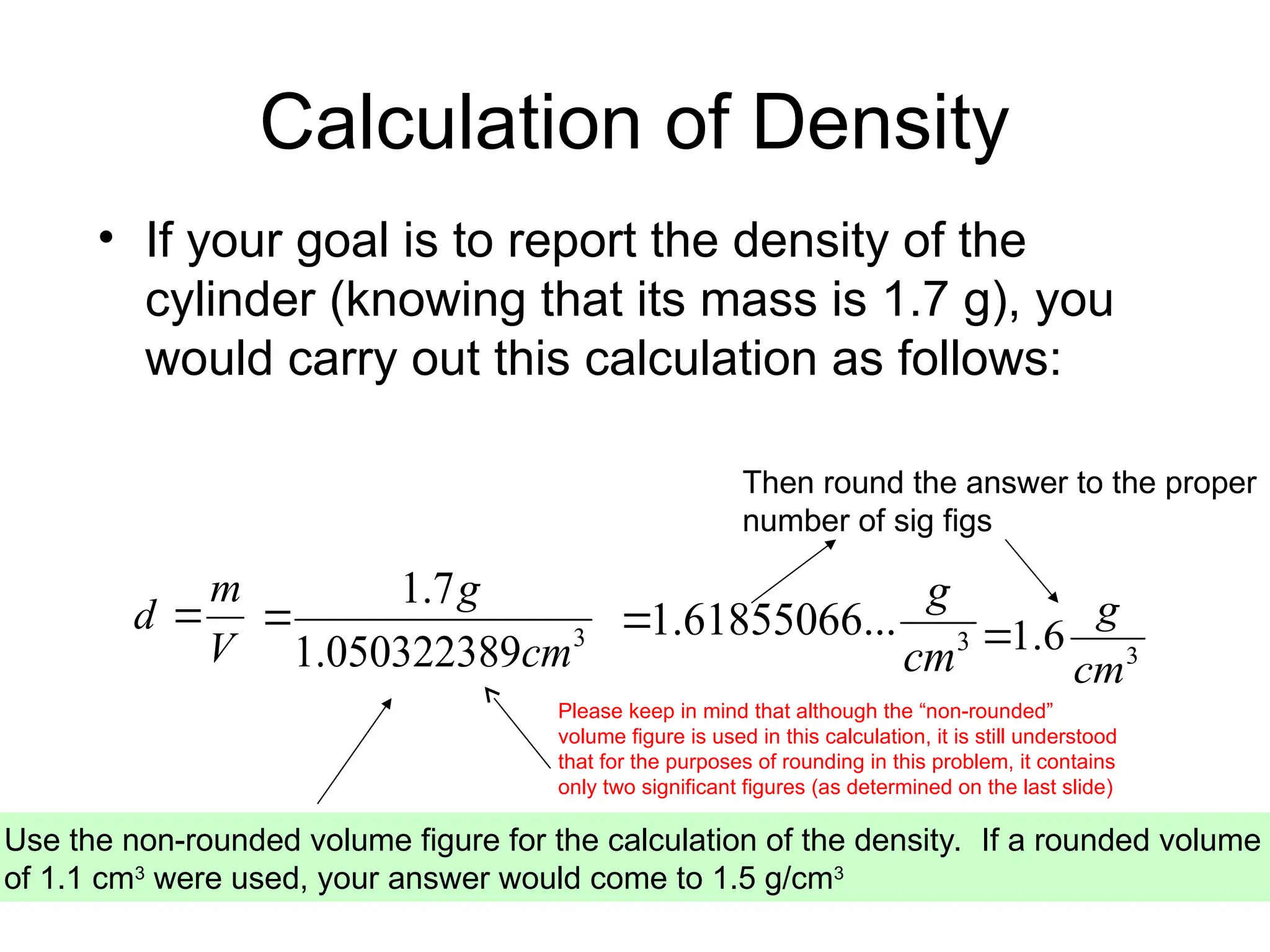
• If your goal is to report the density of the
cylinder (knowing that its mass is 1.7 g), you
would carry out this calculation as follows:
3
050322389
.
1
7
.
1
cm
g

Use the non-rounded volume figure for the calculation of the density. If a rounded volume
of 1.1 cm3
were used, your answer would come to 1.5 g/cm3
Then round the answer to the proper
number of sig figs
V
m
d 
3
...
61855066
.
1
cm
g

3
6
.
1
cm
g

Please keep in mind that although the “non-rounded”
volume figure is used in this calculation, it is still understood
that for the purposes of rounding in this problem, it contains
only two significant figures (as determined on the last slide)
Dimensional Analysis
(conversion factors)
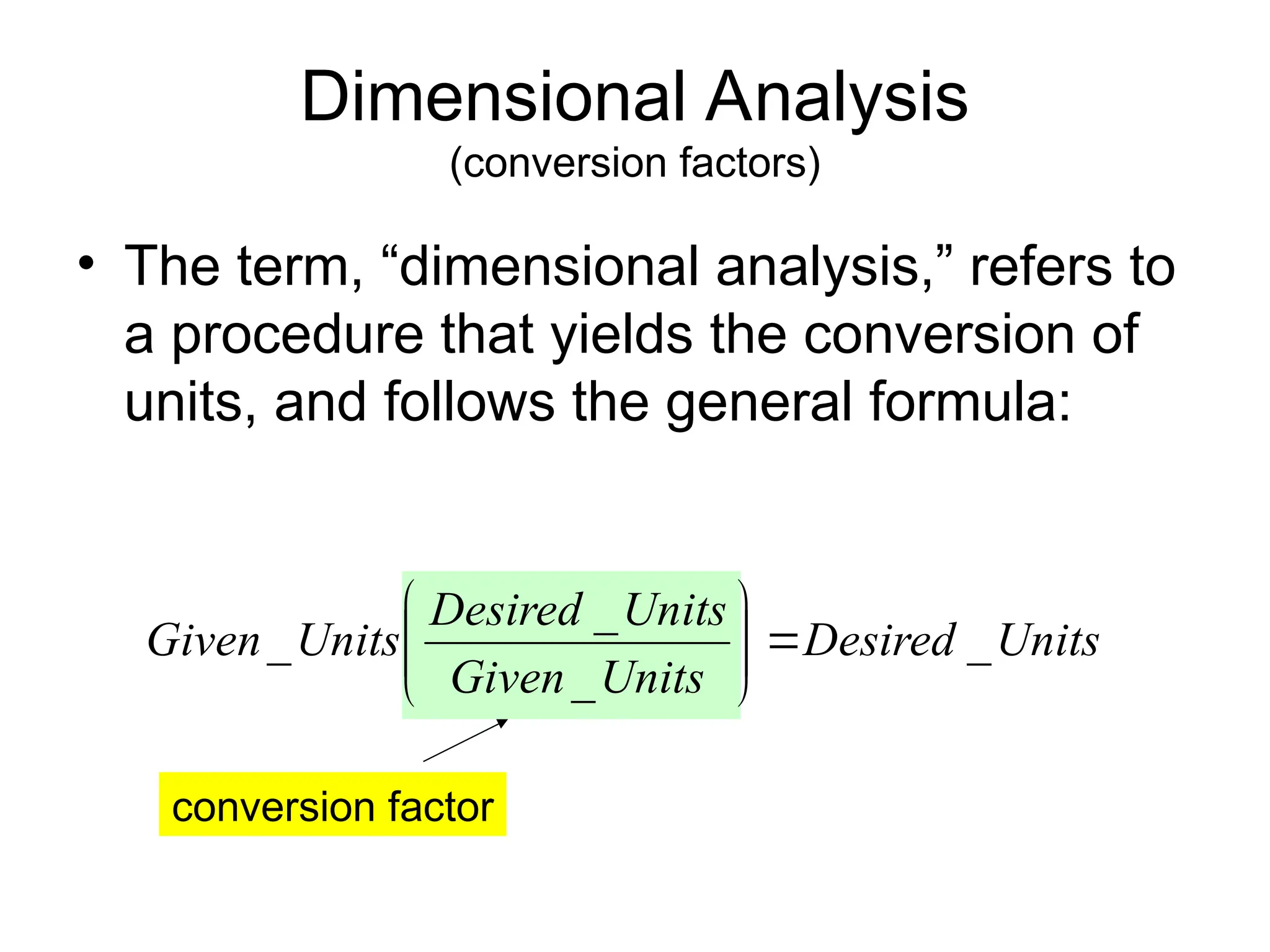
• The term, “dimensional analysis,” refers to
a procedure that yields the conversion of
units, and follows the general formula:
Units
Desired
Units
Given
Units
Desired
Units
Given _
_
_
_ 








conversion factor
Some useful conversions
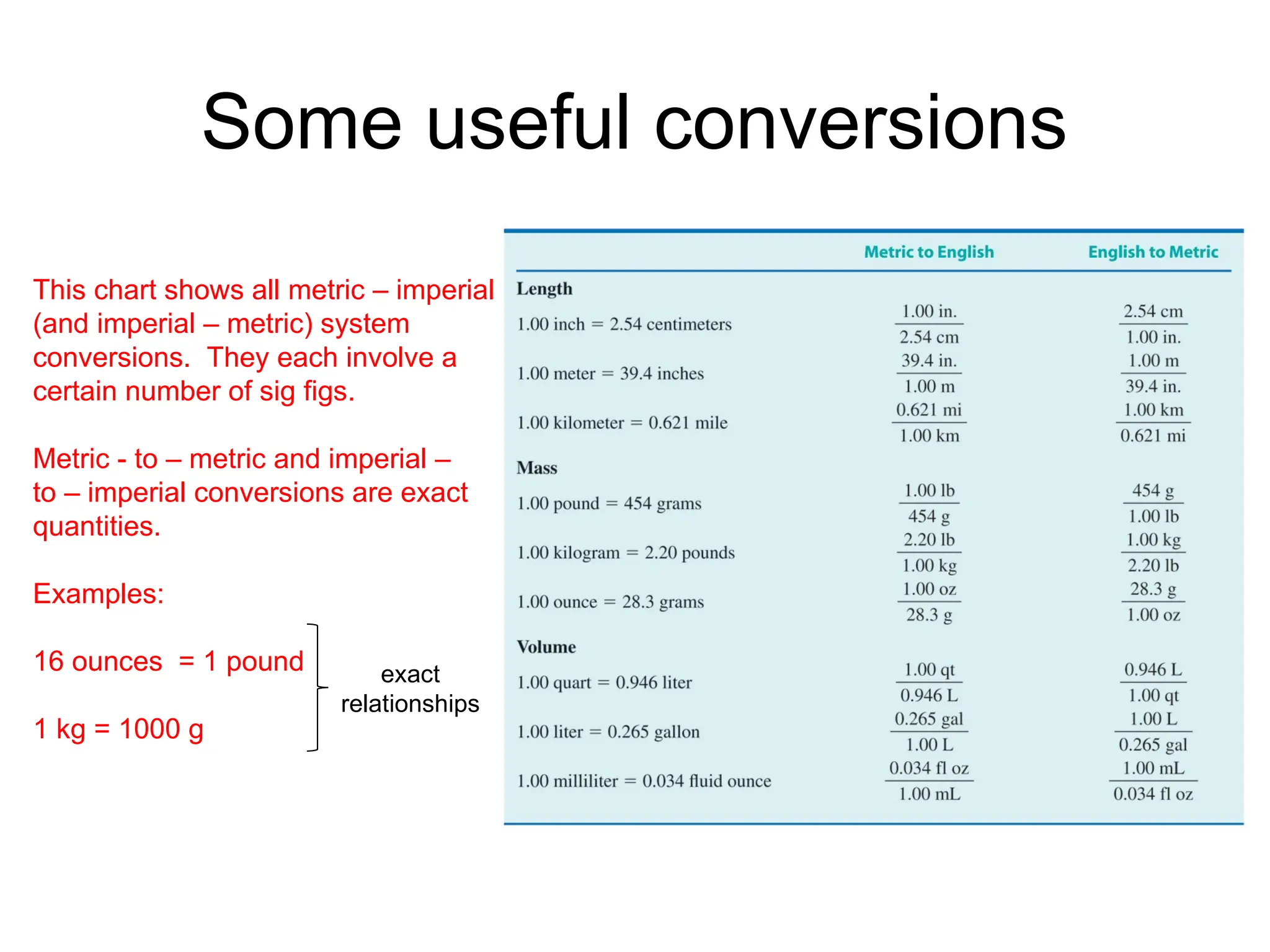
This chart shows all metric – imperial
(and imperial – metric) system
conversions. They each involve a
certain number of sig figs.
Metric - to – metric and imperial –
to – imperial conversions are exact
quantities.
Examples:
16 ounces = 1 pound
1 kg = 1000 g
exact
relationships
Sample Problem
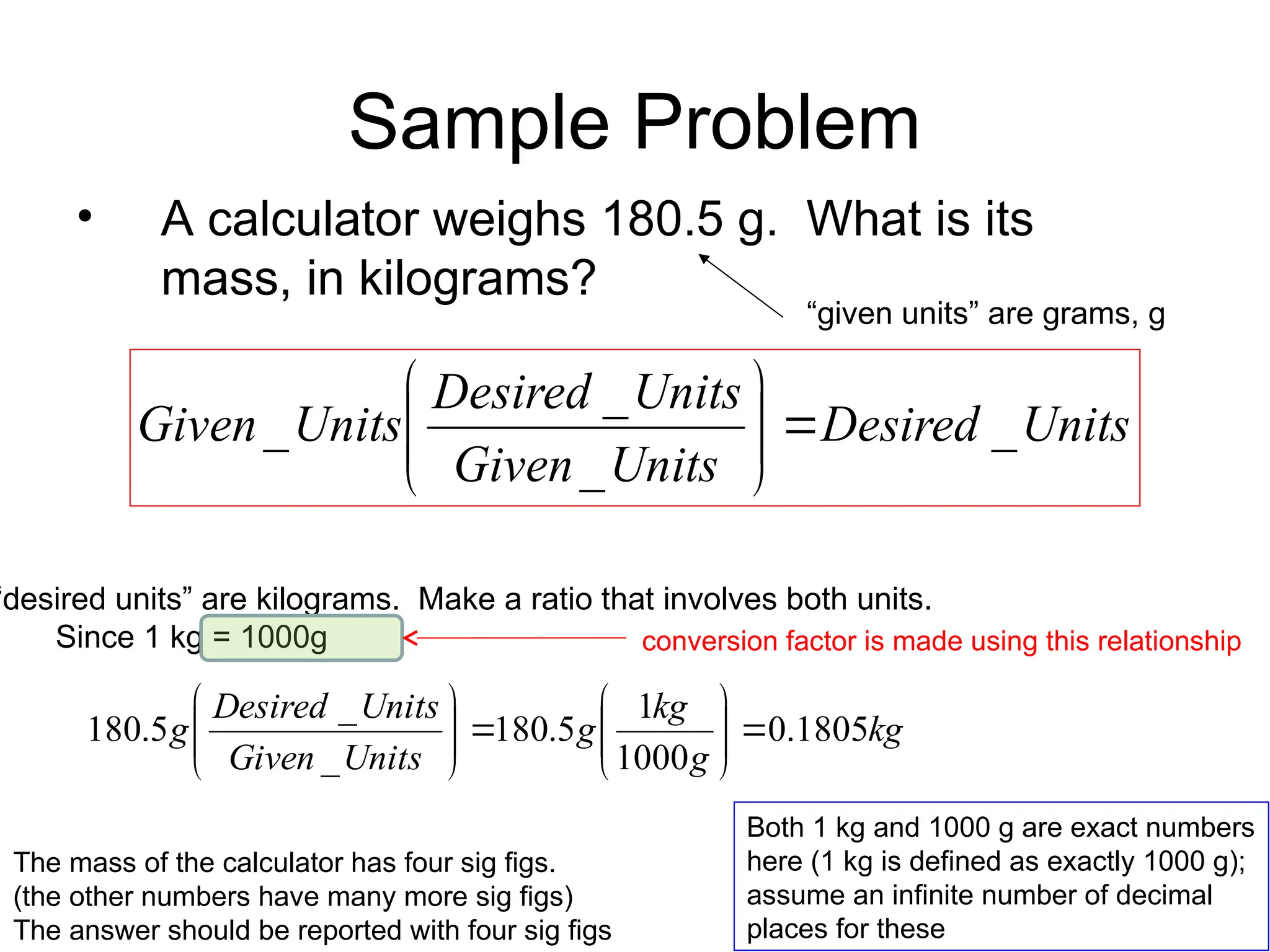
• A calculator weighs 180.5 g. What is its
mass, in kilograms?
Units
Desired
Units
Given
Units
Desired
Units
Given _
_
_
_ 








“given units” are grams, g
“desired units” are kilograms. Make a ratio that involves both units.
Since 1 kg = 1000g
kg
g
kg
g
Units
Given
Units
Desired
g 1805
.
0
1000
1
5
.
180
_
_
5
.
180 

















Both 1 kg and 1000 g are exact numbers
here (1 kg is defined as exactly 1000 g);
assume an infinite number of decimal
places for these
The mass of the calculator has four sig figs.
(the other numbers have many more sig figs)
The answer should be reported with four sig figs
conversion factor is made using this relationship
Dimensional Analysis
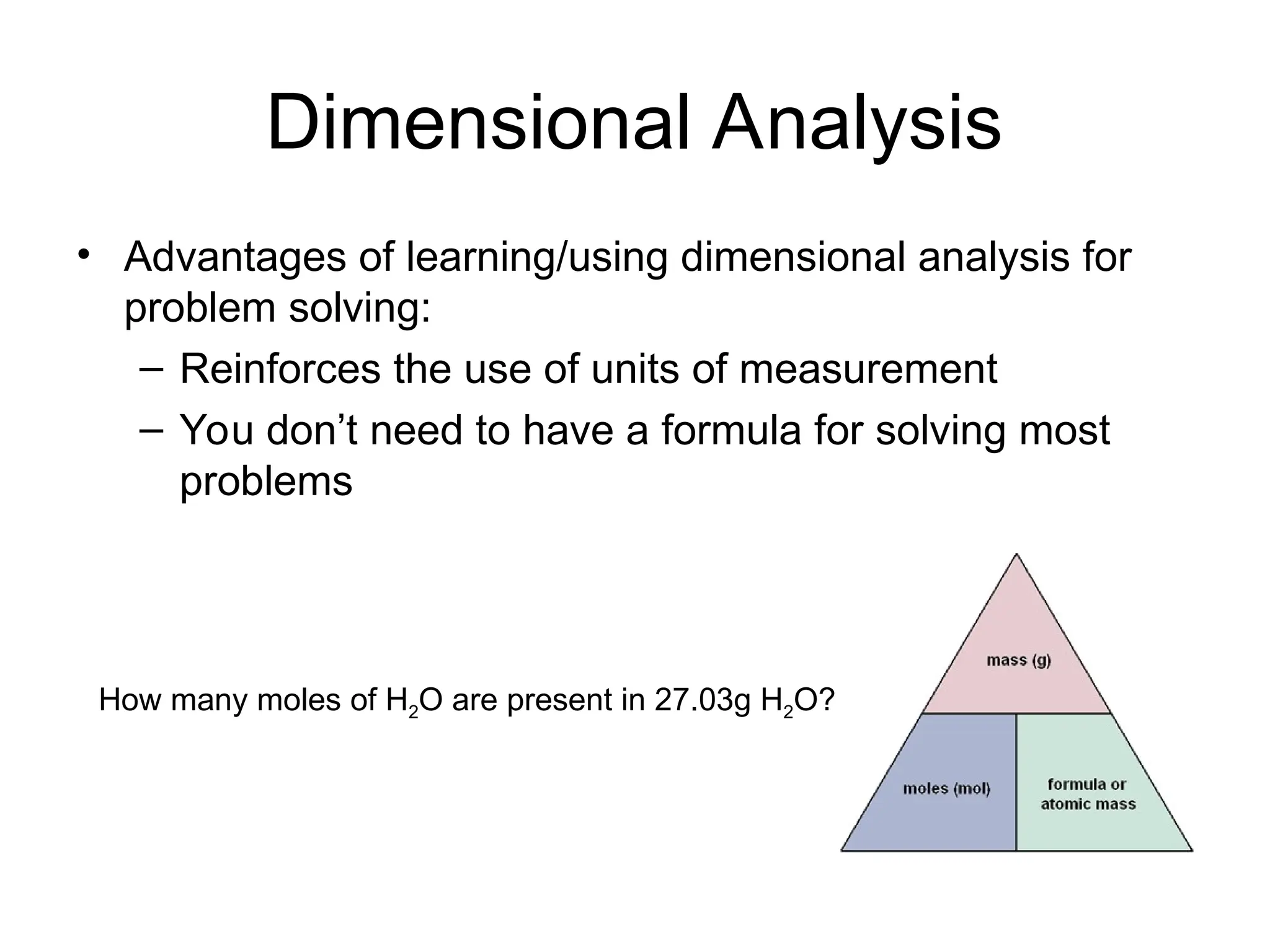
• Advantages of learning/using dimensional analysis for
problem solving:
– Reinforces the use of units of measurement
– You don’t need to have a formula for solving most
problems
How many moles of H2O are present in 27.03g H2O?
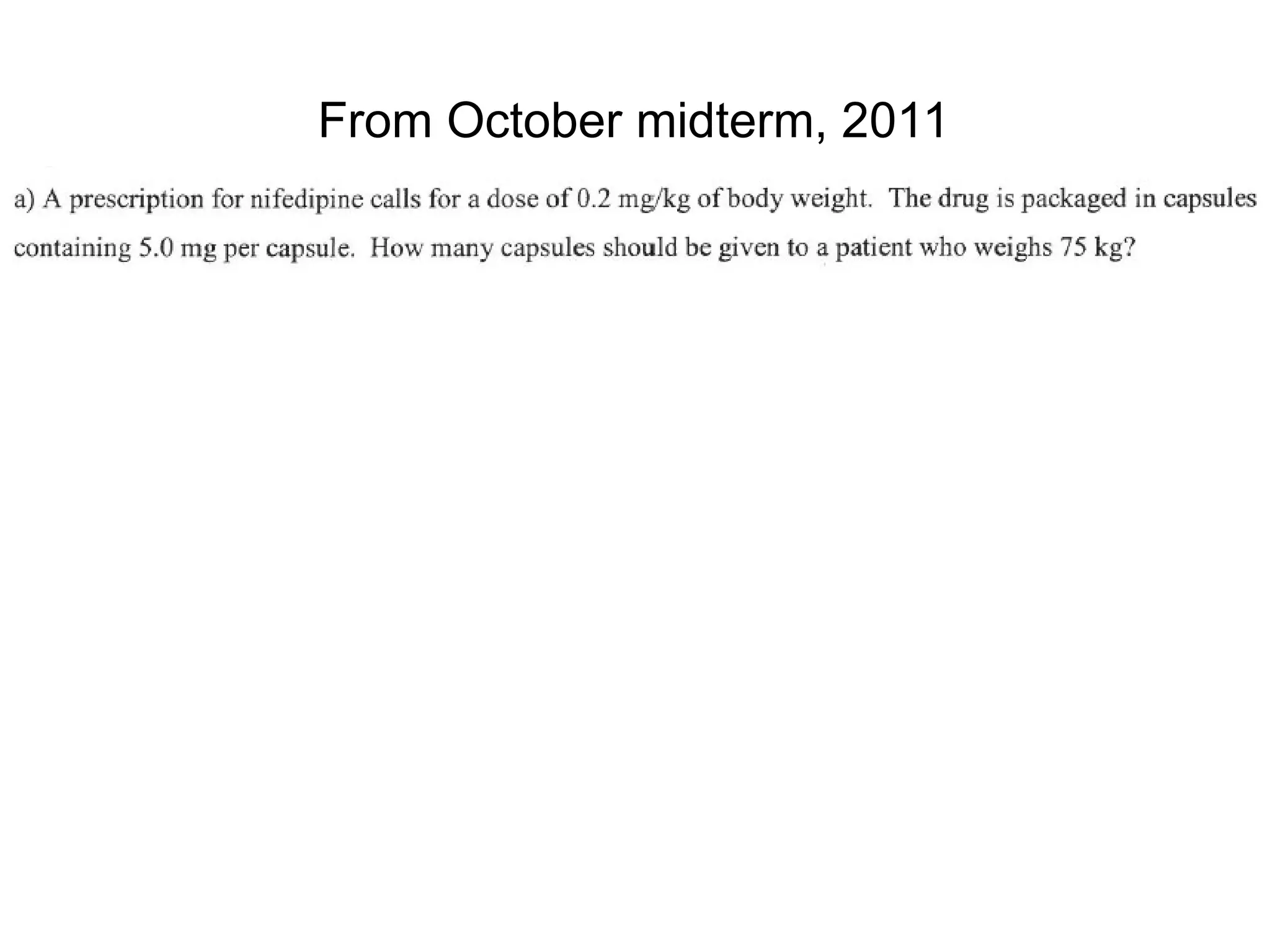
From October midterm, 2011
Sample Problem
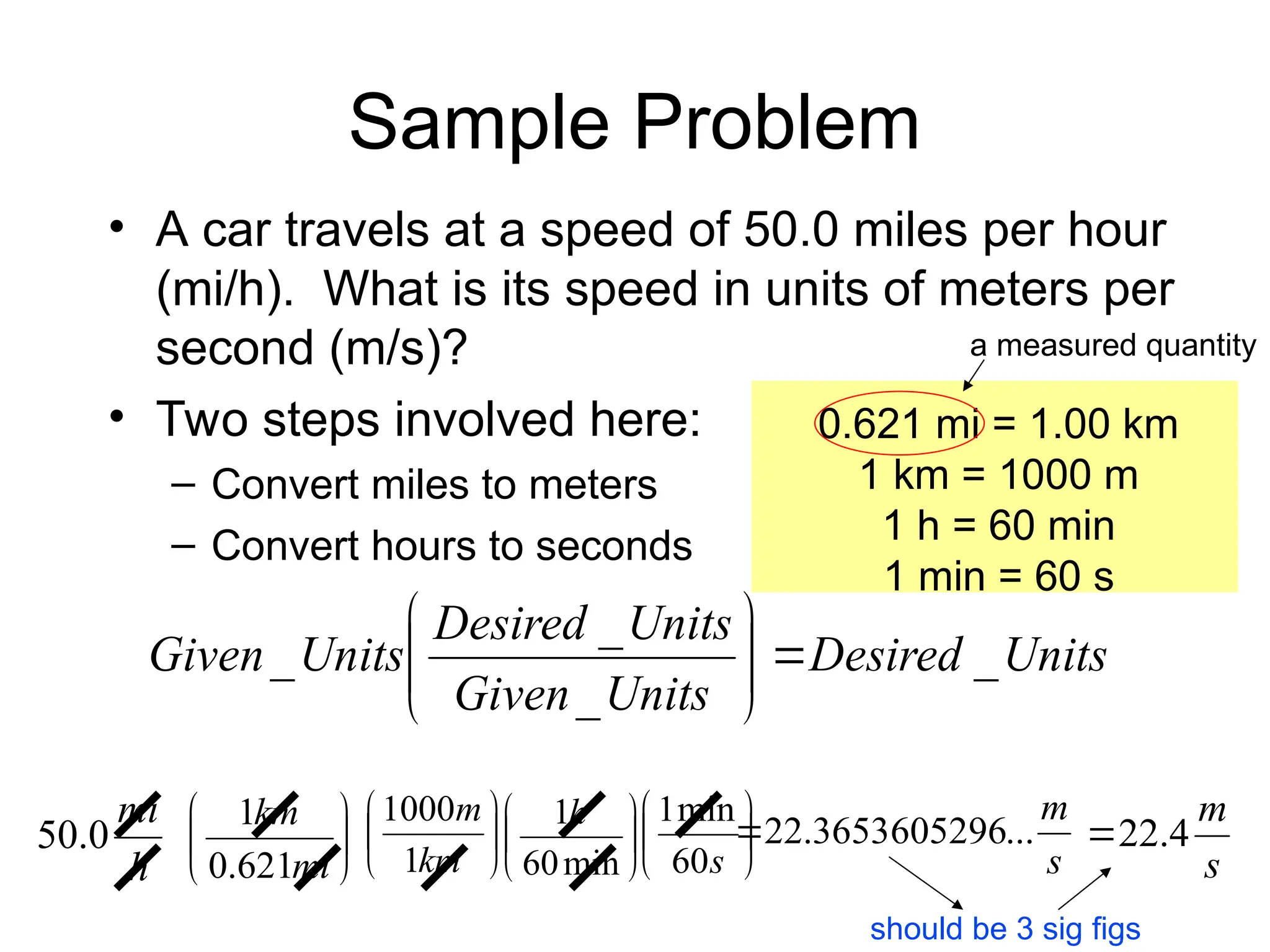
• A car travels at a speed of 50.0 miles per hour
(mi/h). What is its speed in units of meters per
second (m/s)?
• Two steps involved here:
– Convert miles to meters
– Convert hours to seconds
Units
Desired
Units
Given
Units
Desired
Units
Given _
_
_
_ 








0.621 mi = 1.00 km
1 km = 1000 m
1 h = 60 min
1 min = 60 s
h
mi
0
.
50 





mi
km
621
.
0
1






km
m
1
1000






min
60
1h






s
60
min
1
s
m
...
3653605296
.
22

s
m
4
.
22

should be 3 sig figs
a measured quantity

Chapter 2-1 significant figures and units

  • 1.
    The scientific method •At some level, everything is based on a model of behavior. • Even scientific saws change because there are no absolutes.
  • 2.
    Measurements • An importantpart of most experiments involves the determination (often, the estimation) of quantity, volume, dimensions, capacity, or extent of something – these determinations are measurements • In many cases, some sort of scale is used to determine a value such as this. In these cases, estimations rather than exact determinations need to be made.
  • 3.
    SI Units • SystèmeInternational d’Unités
  • 4.
    Prefix-Base Unit System Prefixesconvert the base units into units that are appropriate for the item being measured. Know these prefixes and conversions 3.5 Gm = 3.5 x 10⁹ m = 3500000000 m and 0.002 A = 2 mA So,
  • 5.
    Temperature • The Kelvinis the SI unit of temperature. • It is based on the properties of gases. • There are no negative Kelvin temperatures. K = C + 273 0 (zero) K = absolute zero = -273 o C
  • 6.
    Volume • The mostcommonly used metric units for volume are the liter (L) and the milliliter (mL). A liter is a cube 1 dm long on each side. A milliliter is a cube 1 cm long on each side. 1 m = 10 dm = 100 cm 1 m = 10 dm (1 m)3 = (10 dm)3 1 m3 = 1000 dm3 or 0.001 m3 = 1 dm3 1 dm = 10 cm (1 dm)3 = (10 cm)3 1 dm3 = 1000 cm3 or 0.001 dm3 = 1 cm3 Incidentally, 1 m3 = 1x106 cm3 These are conversion factors
  • 7.
    Density: Another physical propertyof a substance – the amount of mass per unit volume d= m V mass volume e.g. The density of water at room temperature (25o C) is ~1.00 g/mL; at 100o C = 0.96 g/mL Density does not have an assigned SI unit – it’s a combination of mass and length SI components.
  • 8.
    Density: • Density istemperature-sensitive, because the volume that a sample occupies can change with temperature. • Densities are often given with the temperature at which they were measured. If not, assume a temperature of about 25o C.
  • 9.
    Accuracy versus Precision •Accuracy refers to the proximity of a measurement to the true value of a quantity. • Precision refers to the proximity of several measurements to each other (Precision relates to the uncertainty of a measurement). For a measured quantity, we can generally improve its accuracy by making more measurements
  • 10.
    Measured Quantities and Uncertainty Wheneverpossible, you should estimate a measured quantity to one decimal place smaller than the smallest graduation on a scale. The measured quantity, 3.7, is an estimation; however, we have different degrees of confidence in the 3 and the 7 (we are sure of the 3, but not so sure of the 7).
  • 11.
    Uncertainty in MeasuredQuantities • When measuring, for example, how much an apple weighs, the mass can be measured on a balance. The balance might be able to report quantities in grams, milligrams, etc. • Let’s say the apple has a true mass of 55.51 g. The balance we are using reports mass to the nearest gram and has an uncertainty of +/- 0.5 g. • The balance indicates a mass of 56 g • The measured quantity (56 g) is true to some extent and misleading to some extent. • The quantity indicated (56 g) means that the apple has a true mass which should lie within the range 56 +/- 0.5 g (or between 55.5 g and 56.5 g).
  • 12.
    Significant Figures • Theterm significant figures refers to the meaningful digits of a measurement. • The significant digit farthest to the right in the measured quantity is the uncertain one (e.g. for the 56 g apple) • When rounding calculated numbers, we pay attention to significant figures so we do not overstate the accuracy of our answers. In any measured quantity, there will be some uncertainty associated with the measured value. This uncertainty is related to limitations of the technique used to make the measurement.
  • 13.
    Exact quantities • Incertain cases, some situations will utilize relationships that are exact, defined quantities. – For example, a dozen is defined as exactly 12 objects (eggs, cars, donuts, whatever…) – 1 km is defined as exactly 1000 m. – 1 minute is defined as exactly 60 seconds. • Each of these relationships involves an infinite number of significant figures following the decimal place when being used in a calculation. Relationships between metric units are exact (e.g. 1 m = 1000 mm, exactly) Relationships between imperial units are exact (e.g. 1 yd = 3 ft, exactly) Relationships between metric and imperial units are not exact (e.g. 1.00 in = 2.54 cm)
  • 14.
    Significant Figures 1. Allnonzero digits are significant. (1.644 has four significant figures) 2. Zeroes between two non-zero figures are themselves significant. (1.6044 has five sig figs) 3. Zeroes at the beginning (far left) of a number are never significant. (0.0054 has two sig figs) 4. Zeroes at the end of a number (far right) are significant if a decimal point is written in the number. (1500. has four sig figs, 1500.0 has five sig figs) (For the number 1500, assume there are two significant figures, since this number could be written as 1.5 x 10³ .) When a measurement is presented to you in a problem, you need to know how many of the digits in the measurement are actually significant.
  • 15.
    Rounding • Reporting thecorrect number of significant figures for some calculation you carry out often requires that you round the answer to the correct number of significant figures. • Rules: round the following numbers to 3 sig figs – 5.483 – 5.486 (this would round to 5.48, since 5.483 is closer to 5.48 than it is to 5.49) (this would round to 5.49) If calculating an answer through more than one step, only round at the final step of the calculation.
  • 16.
    Significant Figures • Whenaddition or subtraction is performed, answers are rounded to the least significant decimal place. • When multiplication or division is performed, answers are rounded to the number of digits that corresponds to the least number of significant figures in any of the numbers used in the calculation. Example: 6.2/5.90 = 1.0508… = 1.1 Example: 20.4 + 1.332 + 83 = 104.732 = 105 “rounded”
  • 17.
    Significant Figures • Ifboth addition/subtraction and multiplication/division are used in a problem, you need to follow the order of operations, keeping track of sig figs at each step, before reporting the final answer. 1) Calculate (68.2 + 14). Do not round the answer, but keep in mind how many sig figs the answer possesses. 2) Calculate [104.6 x (answer from 1st step)]. Again, do not round the answer yet, but keep in mind how many sig figs are involved in the calculation at this point. 3) , and then round the answer to the correct sig figs.
  • 18.
    Significant Figures • Ifboth addition/subtraction and multiplication/division are used in a problem, you need to follow the order of operations, keeping track of sig figs at each step, before reporting the final answer. Despite what our calculator tells us, we know that this number only has 2 sig figs. Despite what our calculator tells us, we know that this number only has 2 sig figs. Our final answer should be reported with 2 sig figs.
  • 19.
    An example usingsig figs • In the first lab, you are required to measure the height and diameter of a metal cylinder, in order to get its volume • Sample data: height (h) = 1.58 cm diameter = 0.92 cm; radius (r) = 0.46 cm Volume = r2 h = (0.46 cm)2 (1.58 cm) = 1.050322389 cm3 3 sig figs 2 sig figs If you are asked to report the volume, you should round your answer to 2 sig figs Answer = 1.1 cm3 Only operation here is multiplication V = r2 h
  • 20.
    Calculation of Density •If your goal is to report the density of the cylinder (knowing that its mass is 1.7 g), you would carry out this calculation as follows: 3 050322389 . 1 7 . 1 cm g  Use the non-rounded volume figure for the calculation of the density. If a rounded volume of 1.1 cm3 were used, your answer would come to 1.5 g/cm3 Then round the answer to the proper number of sig figs V m d  3 ... 61855066 . 1 cm g  3 6 . 1 cm g  Please keep in mind that although the “non-rounded” volume figure is used in this calculation, it is still understood that for the purposes of rounding in this problem, it contains only two significant figures (as determined on the last slide)
  • 21.
    Dimensional Analysis (conversion factors) •The term, “dimensional analysis,” refers to a procedure that yields the conversion of units, and follows the general formula: Units Desired Units Given Units Desired Units Given _ _ _ _          conversion factor
  • 22.
    Some useful conversions Thischart shows all metric – imperial (and imperial – metric) system conversions. They each involve a certain number of sig figs. Metric - to – metric and imperial – to – imperial conversions are exact quantities. Examples: 16 ounces = 1 pound 1 kg = 1000 g exact relationships
  • 23.
    Sample Problem • Acalculator weighs 180.5 g. What is its mass, in kilograms? Units Desired Units Given Units Desired Units Given _ _ _ _          “given units” are grams, g “desired units” are kilograms. Make a ratio that involves both units. Since 1 kg = 1000g kg g kg g Units Given Units Desired g 1805 . 0 1000 1 5 . 180 _ _ 5 . 180                   Both 1 kg and 1000 g are exact numbers here (1 kg is defined as exactly 1000 g); assume an infinite number of decimal places for these The mass of the calculator has four sig figs. (the other numbers have many more sig figs) The answer should be reported with four sig figs conversion factor is made using this relationship
  • 24.
    Dimensional Analysis • Advantagesof learning/using dimensional analysis for problem solving: – Reinforces the use of units of measurement – You don’t need to have a formula for solving most problems How many moles of H2O are present in 27.03g H2O?
  • 25.
  • 26.
    Sample Problem • Acar travels at a speed of 50.0 miles per hour (mi/h). What is its speed in units of meters per second (m/s)? • Two steps involved here: – Convert miles to meters – Convert hours to seconds Units Desired Units Given Units Desired Units Given _ _ _ _          0.621 mi = 1.00 km 1 km = 1000 m 1 h = 60 min 1 min = 60 s h mi 0 . 50       mi km 621 . 0 1       km m 1 1000       min 60 1h       s 60 min 1 s m ... 3653605296 . 22  s m 4 . 22  should be 3 sig figs a measured quantity