Significant Digits or“Figures”
• How to recognize significant figures when:
– Taking a measurement
– Reading a measurement
– Performing a calculation
3.
Uncertainty in Measurement
Adigit that must be estimated is called uncertain. A
measurement always has some degree of uncertainty.
4.
Why Is thereUncertainty?
Measurements are performed with instruments.
No instrument can read to an infinite number of
decimal places
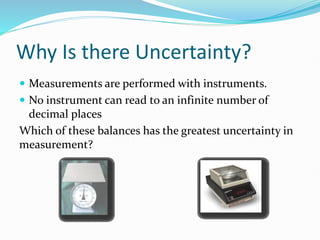
Which of these balances has the greatest uncertainty in
measurement?
5.
Accuracy and Precisionin Measurements
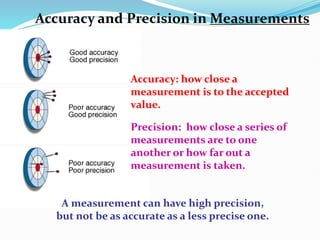
Accuracy: how close a
measurement is to the accepted
value.
Precision: how close a series of
measurements are to one
another or how far out a
measurement is taken.
A measurement can have high precision,
but not be as accurate as a less precise one.
6.
Precision and Accuracy
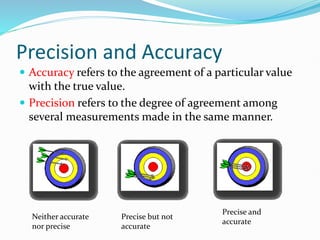
Accuracy refers to the agreement of a particular value
with the true value.
Precision refers to the degree of agreement among
several measurements made in the same manner.
Neither accurate
nor precise
Precise but not
accurate
Precise and
accurate
7.
Types of error
Random Error (indeterminate Error) – measurement
has an equal probability of being high or low.
Systematic Error ( Determinate Error) – Occurs in the
same direction each time (high or low), often resulting
from poor technique or incorrect calibration.
8.
Random Errors –Many experiments, when repeated, will
yield slightly different results each time. Random errors are
produced by unknown and unpredictable variations in the
experimental situation.
➢Ex – when shooting bullets, it is unlikely that they have the same exit
speed due to variations in the cartridge, fluctuations in gunpowder
explosion etc…
➢Ex – when bouncing a ball, it is unlikely to rebound to the same height
each time bounce is repeated. This may be due to orientation of ball in
air, orientation of ball as it hits surface, uneven surface etc…
➢Small random errors means experiment has high precision.
9.
3.Systematic Errors– areerrors associated with a particular
instrument or experimental technique. Systematic errors are not
reduced by repeating measurements.
➢ -is measuring device perfectly accurate ( calibration)?
➢ - is device zeroed ?
➢ -is the experiment being performed in a wind or presence of air
currents?
➢ -is there a bias on behalf of the experimenter? ( right handed/left
handed)
➢ -is odometer on car accurate if tires have been changed ?
➢ most electrical equipment is assumed to have a 5% systematic
error
➢ Small systematic errors means experiment has high accuracy
10.
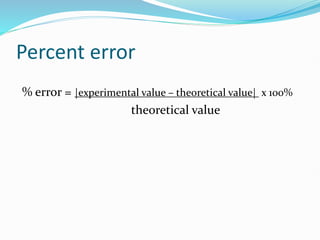
Percent error
% error= |experimental value – theoretical value| x 100%
theoretical value
11.
Significant Figures
Scientistuse significant figures to determine how
precise a measurement is
Significant digits in a measurement include all of the
known digits plus one estimated digit
12.
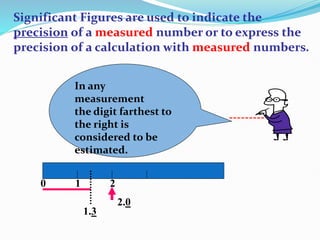
Significant Figures areused to indicate the
precision of a measured number or to express the
precision of a calculation with measured numbers.
In any
measurement
the digit farthest to
the right is
considered to be
estimated.
0 1 2
1.3
2.0
13.
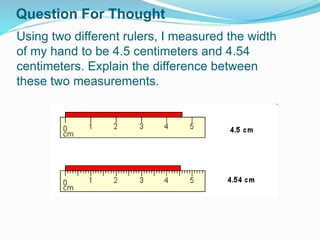
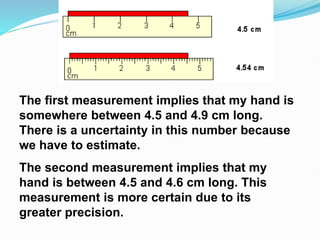
Using two differentrulers, I measured the width
of my hand to be 4.5 centimeters and 4.54
centimeters. Explain the difference between
these two measurements.
Question For Thought
14.
The first measurementimplies that my hand is
somewhere between 4.5 and 4.9 cm long.
There is a uncertainty in this number because
we have to estimate.
The second measurement implies that my
hand is between 4.5 and 4.6 cm long. This
measurement is more certain due to its
greater precision.
15.
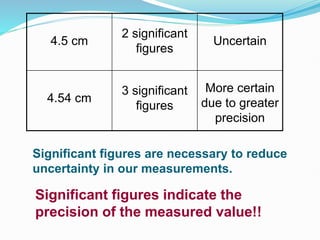
Significant figures arenecessary to reduce
uncertainty in our measurements.
Significant figures indicate the
precision of the measured value!!
4.5 cm
2 significant
figures
Uncertain
4.54 cm
3 significant
figures
More certain
due to greater
precision
16.
Significant Figures
Scientistuse significant figures to determine how
precise a measurement is
Significant digits in a measurement include all of the
known digits plus one estimated digit
So when reading an instrument…
Read instrument to the last digit that you know
Estimate or “eyeball” the final digit
17.
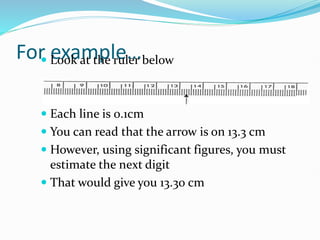
For example…
Lookat the ruler below
Each line is 0.1cm
You can read that the arrow is on 13.3 cm
However, using significant figures, you must
estimate the next digit
That would give you 13.30 cm
18.
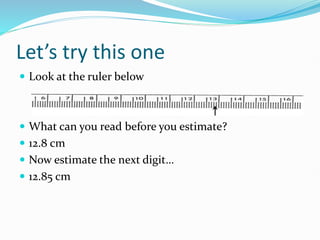
Let’s try thisone
Look at the ruler below
What can you read before you estimate?
12.8 cm
Now estimate the next digit…
12.85 cm
19.
The same rulesapply with all
instruments
The same rules apply
Read to the last digit that you know
Estimate the final digit
20.
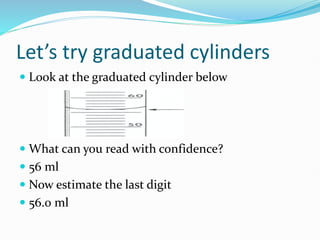
Let’s try graduatedcylinders
Look at the graduated cylinder below
What can you read with confidence?
56 ml
Now estimate the last digit
56.0 ml
21.
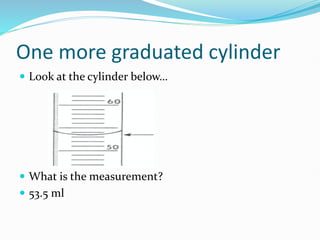
One more graduatedcylinder
Look at the cylinder below…
What is the measurement?
53.5 ml
22.
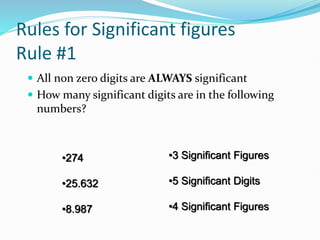
Rules for Significantfigures
Rule #1
All non zero digits are ALWAYS significant
How many significant digits are in the following
numbers?
•274
•25.632
•8.987
•3 Significant Figures
•5 Significant Digits
•4 Significant Figures
23.
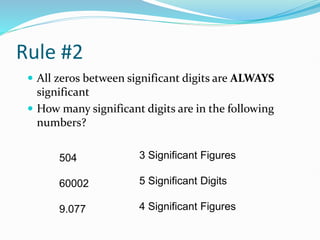
Rule #2
Allzeros between significant digits are ALWAYS
significant
How many significant digits are in the following
numbers?
504
60002
9.077
3 Significant Figures
5 Significant Digits
4 Significant Figures
24.
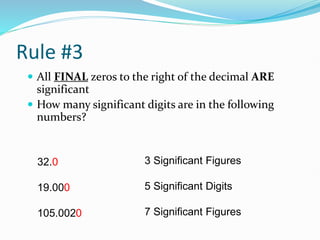
Rule #3
AllFINAL zeros to the right of the decimal ARE
significant
How many significant digits are in the following
numbers?
32.0
19.000
105.0020
3 Significant Figures
5 Significant Digits
7 Significant Figures
25.
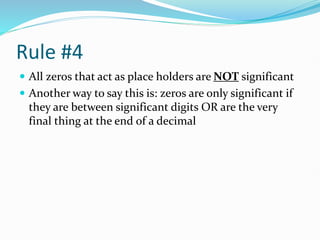
Rule #4
Allzeros that act as place holders are NOT significant
Another way to say this is: zeros are only significant if
they are between significant digits OR are the very
final thing at the end of a decimal
26.
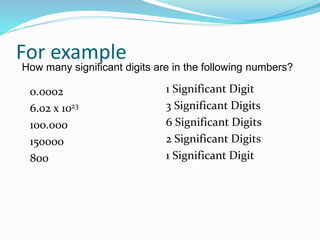
For example
0.0002
6.02 x10²³
100.000
150000
800
1 Significant Digit
3 Significant Digits
6 Significant Digits
2 Significant Digits
1 Significant Digit
How many significant digits are in the following numbers?
27.
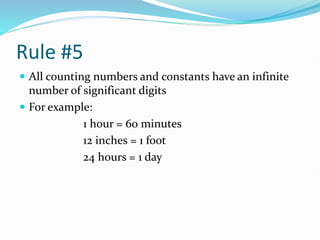
Rule #5
Allcounting numbers and constants have an infinite
number of significant digits
For example:
1 hour = 60 minutes
12 inches = 1 foot
24 hours = 1 day
28.
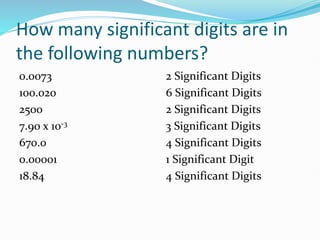
How many significantdigits are in
the following numbers?
0.0073
100.020
2500
7.90 x 10⁻³
670.0
0.00001
18.84
2 Significant Digits
6 Significant Digits
2 Significant Digits
3 Significant Digits
4 Significant Digits
1 Significant Digit
4 Significant Digits
29.
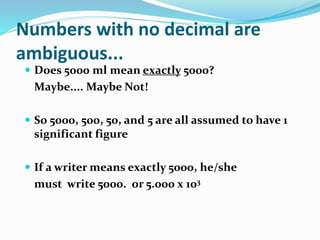
Numbers with nodecimal are
ambiguous...
Does 5000 ml mean exactly 5000?
Maybe.... Maybe Not!
So 5000, 500, 50, and 5 are all assumed to have 1
significant figure
If a writer means exactly 5000, he/she
must write 5000. or 5.000 x 10³
30.
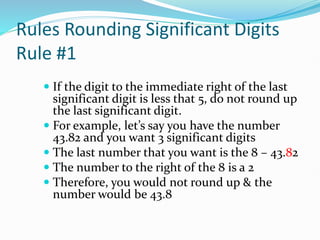
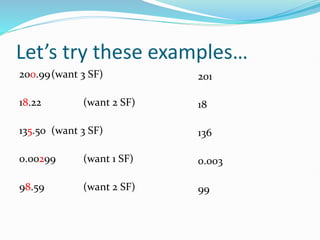
Rules Rounding SignificantDigits
Rule #1
If the digit to the immediate right of the last
significant digit is less that 5, do not round up
the last significant digit.
For example, let’s say you have the number
43.82 and you want 3 significant digits
The last number that you want is the 8 – 43.82
The number to the right of the 8 is a 2
Therefore, you would not round up & the
number would be 43.8
31.
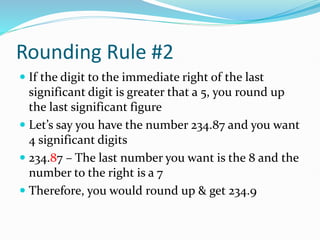
Rounding Rule #2
If the digit to the immediate right of the last
significant digit is greater that a 5, you round up
the last significant figure
Let’s say you have the number 234.87 and you want
4 significant digits
234.87 – The last number you want is the 8 and the
number to the right is a 7
Therefore, you would round up & get 234.9
32.
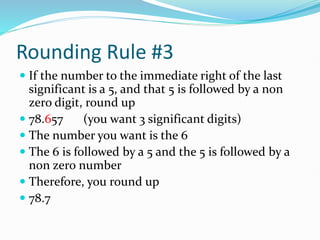
Rounding Rule #3
If the number to the immediate right of the last
significant is a 5, and that 5 is followed by a non
zero digit, round up
78.657 (you want 3 significant digits)
The number you want is the 6
The 6 is followed by a 5 and the 5 is followed by a
non zero number
Therefore, you round up
78.7
33.
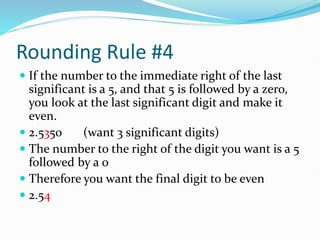
Rounding Rule #4
If the number to the immediate right of the last
significant is a 5, and that 5 is followed by a zero,
you look at the last significant digit and make it
even.
2.5350 (want 3 significant digits)
The number to the right of the digit you want is a 5
followed by a 0
Therefore you want the final digit to be even
2.54
34.
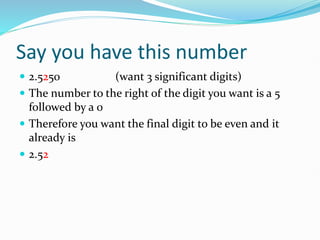
Say you havethis number
2.5250 (want 3 significant digits)
The number to the right of the digit you want is a 5
followed by a 0
Therefore you want the final digit to be even and it
already is
2.52
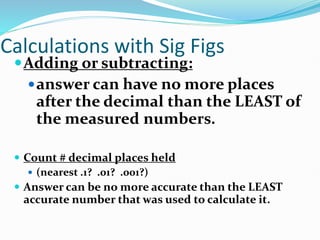
Calculations with SigFigs
Adding or subtracting:
answer can have no more places
after the decimal than the LEAST of
the measured numbers.
Count # decimal places held
(nearest .1? .01? .001?)
Answer can be no more accurate than the LEAST
accurate number that was used to calculate it.
37.
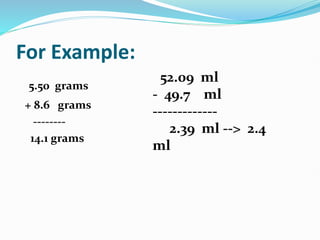
For Example:
5.50 grams
+8.6 grams
--------
14.1 grams
52.09 ml
- 49.7 ml
-------------
2.39 ml --> 2.4
ml
38.
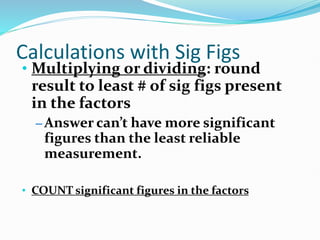
Calculations with SigFigs
• Multiplying or dividing: round
result to least # of sig figs present
in the factors
– Answer can’t have more significant
figures than the least reliable
measurement.
• COUNT significant figures in the factors
39.
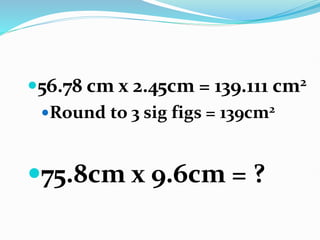
56.78 cm x2.45cm = 139.111 cm2
Round to 3 sig figs = 139cm2
75.8cm x 9.6cm = ?
40.
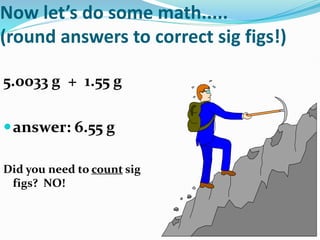
Now let’s dosome math.....
(round answers to correct sig figs!)
5.0033 g + 1.55 g
answer: 6.55 g
Did you need to count sig
figs? NO!
41.
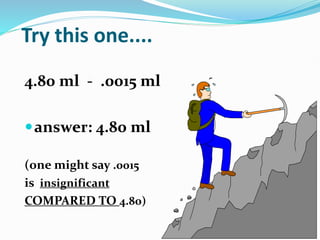
Try this one....
4.80ml - .0015 ml
answer: 4.80 ml
(one might say .0015
is insignificant
COMPARED TO 4.80)
Rules for significantfigures in
mathematical operations
Multiplication and Division – number of significant
figures you need to round the answer to the same
number of significant figures as the measurement with
the least number of significant figures. The position of
the decimal point has nothing to do with the rounding
process when multiplying and dividing measurements.
Ex. 6.38 x 2.0 =
12.76 -→ 13 (2 significant figures)
44.
Rules for significantfigures in
mathematical operations
Addition and Subtraction: The answer to an addition or
subtraction calculation should be rounded to the same
number of decimal places (not digits) as the
measurement with the least number of decimal places.
6.8 + 11.934=
18.734 → 18.7 ( 3 sig figs)
45.
Here’s a tougherone.....
3.0 C/s x 60 s/min x 60 min/hr =
answer: 10800 C/hr rounds to 11000 C/hr
Note:
Standard conversion factors never limit sig. figures-
instruments and equipment do.
46.
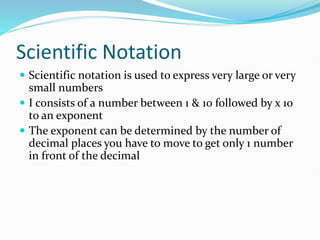
Scientific Notation
Scientificnotation is used to express very large or very
small numbers
I consists of a number between 1 & 10 followed by x 10
to an exponent
The exponent can be determined by the number of
decimal places you have to move to get only 1 number
in front of the decimal
47.
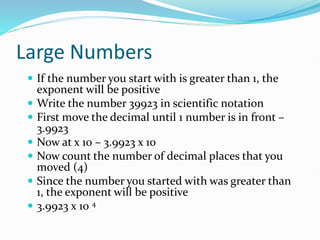
Large Numbers
Ifthe number you start with is greater than 1, the
exponent will be positive
Write the number 39923 in scientific notation
First move the decimal until 1 number is in front –
3.9923
Now at x 10 – 3.9923 x 10
Now count the number of decimal places that you
moved (4)
Since the number you started with was greater than
1, the exponent will be positive
3.9923 x 10 4
48.
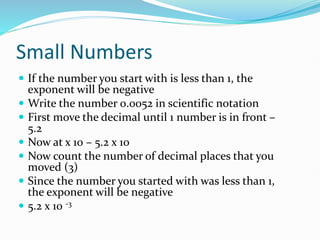
Small Numbers
Ifthe number you start with is less than 1, the
exponent will be negative
Write the number 0.0052 in scientific notation
First move the decimal until 1 number is in front –
5.2
Now at x 10 – 5.2 x 10
Now count the number of decimal places that you
moved (3)
Since the number you started with was less than 1,
the exponent will be negative
5.2 x 10 -3
Going from ScientificNotation to
Ordinary Notation
You start with the number and move the decimal the
same number of spaces as the exponent.
If the exponent is positive, the number will be greater
than 1
If the exponent is negative, the number will be less
than 1
51.
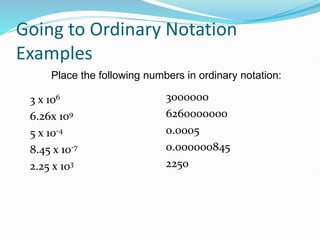
Going to OrdinaryNotation
Examples
3 x 10⁶
6.26x 10⁹
5 x 10⁻⁴
8.45 x 10⁻⁷
2.25 x 10³
3000000
6260000000
0.0005
0.000000845
2250
Place the following numbers in ordinary notation: