Copyright © 2014, Oracle and/or its affiliates. All rights reserved.1
Quantitative Signal Detection for Mid-
sized Biopharmaceutical Companies
Robert Weber, Senior Product Strategy Manager
Oracle Health Sciences
Dr. Marc A. Zittartz, Chief Quality Officer
PharmaSOL
Copyright © 2014, Oracle and/or its affiliates. All rights reserved.2
The following is intended to outline our general product direction. It is
intended for information purposes only, and may not be incorporated into
any contract. It is not a commitment to deliver any material, code, or
functionality, and should not be relied upon in making purchasing decisions.
The development, release, and timing of any features or functionality
described for Oracle’s products remains at the sole discretion of Oracle.
Copyright © 2014, Oracle and/or its affiliates. All rights reserved.3
Signal Detection Overview
 Signal Detection and Management has moved into the focus of
Pharmacovigilance activities
 Signals can be detected multiple ways
– Single Case Review
– During PSUR or DSUR creation
– Literature Review
– Authority inquiries
– (Automated) Signal Detection
 Signal can be found from multiple sources
– Spontaneous Reporting Databases
– Clinical Trials
– Electronic Health Records
Copyright © 2014, Oracle and/or its affiliates. All rights reserved.4
Signal Detection Approaches
 Identification of new risks: New Signals
– Quantitative Signal Detection – Disproportionality Statistics
– Tracking of Designated Medical Events (DMEs)
– Case Scoring
– Temporal Pattern (Aberration) Detection
 Monitoring of known risks: “Re-Signaling”
– “Keep under Review” – Targeted Medical Events (TMEs)
– Increased Frequency
– Increased Severity (Seriousness, Fatalities…)
Copyright © 2014, Oracle and/or its affiliates. All rights reserved.5
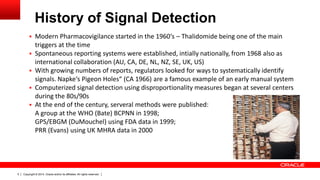
History of Signal Detection
 Modern Pharmacovigilance started in the 1960‘s – Thalidomide being one of the main
triggers at the time
 Spontaneous reporting systems were established, intially nationally, from 1968 also as
international collaboration (AU, CA, DE, NL, NZ, SE, UK, US)
 With growing numbers of reports, regulators looked for ways to systematically identify
signals. Napke‘s Pigeon Holes“ (CA 1966) are a famous example of an early manual system
 Computerized signal detection using disproportionality measures began at several centers
during the 80s/90s
 At the end of the century, serveral methods were published:
A group at the WHO (Bate) BCPNN in 1998;
GPS/EBGM (DuMouchel) using FDA data in 1999;
PRR (Evans) using UK MHRA data in 2000
Copyright © 2014, Oracle and/or its affiliates. All rights reserved.6
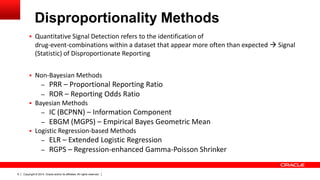
Disproportionality Methods
 Quantitative Signal Detection refers to the identification of
drug-event-combinations within a dataset that appear more often than expected  Signal
(Statistic) of Disproportionate Reporting
 Non-Bayesian Methods
– PRR – Proportional Reporting Ratio
– ROR – Reporting Odds Ratio
 Bayesian Methods
– IC (BCPNN) – Information Component
– EBGM (MGPS) – Empirical Bayes Geometric Mean
 Logistic Regression-based Methods
– ELR – Extended Logistic Regression
– RGPS – Regression-enhanced Gamma-Poisson Shrinker
Copyright © 2014, Oracle and/or its affiliates. All rights reserved.7
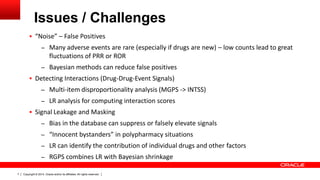
Issues / Challenges
 “Noise” – False Positives
– Many adverse events are rare (especially if drugs are new) – low counts lead to great
fluctuations of PRR or ROR
– Bayesian methods can reduce false positives
 Detecting Interactions (Drug-Drug-Event Signals)
– Multi-item disproportionality analysis (MGPS -> INTSS)
– LR analysis for computing interaction scores
 Signal Leakage and Masking
– Bias in the database can suppress or falsely elevate signals
– “Innocent bystanders” in polypharmacy situations
– LR can identify the contribution of individual drugs and other factors
– RGPS combines LR with Bayesian shrinkage
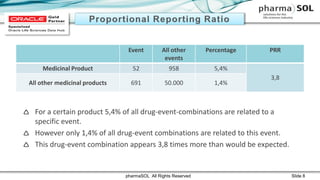
 For a certain product 5,4% of all drug-event-combinations are related to a
specific event.
 However only 1,4% of all drug-event combinations are related to this event.
 This drug-event combination appears 3,8 times more than would be expected.
pharmaSOL All Rights Reserved Slide 8
Event All other
events
Percentage PRR
Medicinal Product 52 958 5,4%
3,8
All other medicinal products 691 50.000 1,4%
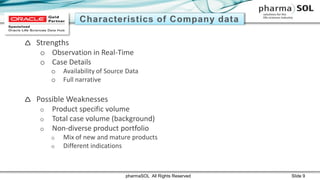
 Strengths
o Observation in Real-Time
o Case Details
o Availability of Source Data
o Full narrative
 Possible Weaknesses
o Product specific volume
o Total case volume (background)
o Non-diverse product portfolio
o Mix of new and mature products
o Different indications
pharmaSOL All Rights Reserved Slide 9
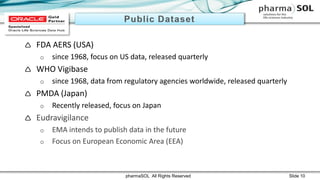
 FDA AERS (USA)
o since 1968, focus on US data, released quarterly
 WHO Vigibase
o since 1968, data from regulatory agencies worldwide, released quarterly
 PMDA (Japan)
o Recently released, focus on Japan
 Eudravigilance
o EMA intends to publish data in the future
o Focus on European Economic Area (EEA)
pharmaSOL All Rights Reserved Slide 10
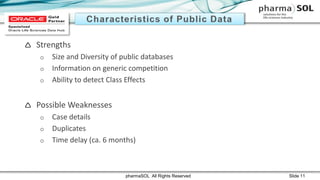
 Strengths
o Size and Diversity of public databases
o Information on generic competition
o Ability to detect Class Effects
 Possible Weaknesses
o Case details
o Duplicates
o Time delay (ca. 6 months)
pharmaSOL All Rights Reserved Slide 11
pharmaSOL All Rights Reserved Slide 12
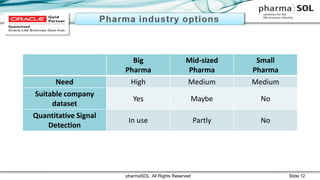
Big
Pharma
Mid-sized
Pharma
Small
Pharma
Need High Medium Medium
Suitable company
dataset
Yes Maybe No
Quantitative Signal
Detection
In use Partly No
pharmaSOL All Rights Reserved Slide 13
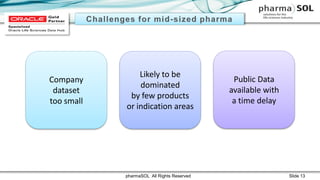
Company
dataset
too small
Likely to be
dominated
by few products
or indication areas
Public Data
available with
a time delay
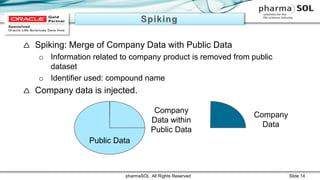
 Spiking: Merge of Company Data with Public Data
o Information related to company product is removed from public
dataset
o Identifier used: compound name
 Company data is injected.
pharmaSOL All Rights Reserved Slide 14
Public Data
Company
Data
Company
Data within
Public Data
pharmaSOL All Rights Reserved Slide 15
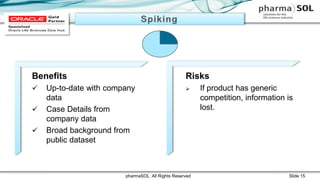
Risks
 If product has generic
competition, information is
lost.
Benefits
 Up-to-date with company
data
 Case Details from
company data
 Broad background from
public dataset
Copyright © 2014, Oracle and/or its affiliates. All rights reserved.16
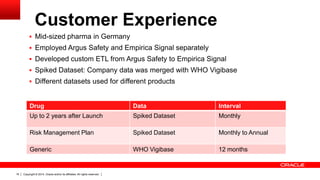
Customer Experience
 Mid-sized pharma in Germany
 Employed Argus Safety and Empirica Signal separately
 Developed custom ETL from Argus Safety to Empirica Signal
 Spiked Dataset: Company data was merged with WHO Vigibase
 Different datasets used for different products
Drug Data Interval
Up to 2 years after Launch Spiked Dataset Monthly
Risk Management Plan Spiked Dataset Monthly to Annual
Generic WHO Vigibase 12 months
Discussion
pharmasol All Rights Reserved Slide 17
pharmasol All Rights Reserved Slide 18
For more details contact
robert.weber@oracle.com
marc.zittartz@pharmasol.de

Quantitative signal detection for the mid sized pharma - webcast

  • 1.
    Copyright © 2014,Oracle and/or its affiliates. All rights reserved.1 Quantitative Signal Detection for Mid- sized Biopharmaceutical Companies Robert Weber, Senior Product Strategy Manager Oracle Health Sciences Dr. Marc A. Zittartz, Chief Quality Officer PharmaSOL
  • 2.
    Copyright © 2014,Oracle and/or its affiliates. All rights reserved.2 The following is intended to outline our general product direction. It is intended for information purposes only, and may not be incorporated into any contract. It is not a commitment to deliver any material, code, or functionality, and should not be relied upon in making purchasing decisions. The development, release, and timing of any features or functionality described for Oracle’s products remains at the sole discretion of Oracle.
  • 3.
    Copyright © 2014,Oracle and/or its affiliates. All rights reserved.3 Signal Detection Overview  Signal Detection and Management has moved into the focus of Pharmacovigilance activities  Signals can be detected multiple ways – Single Case Review – During PSUR or DSUR creation – Literature Review – Authority inquiries – (Automated) Signal Detection  Signal can be found from multiple sources – Spontaneous Reporting Databases – Clinical Trials – Electronic Health Records
  • 4.
    Copyright © 2014,Oracle and/or its affiliates. All rights reserved.4 Signal Detection Approaches  Identification of new risks: New Signals – Quantitative Signal Detection – Disproportionality Statistics – Tracking of Designated Medical Events (DMEs) – Case Scoring – Temporal Pattern (Aberration) Detection  Monitoring of known risks: “Re-Signaling” – “Keep under Review” – Targeted Medical Events (TMEs) – Increased Frequency – Increased Severity (Seriousness, Fatalities…)
  • 5.
    Copyright © 2014,Oracle and/or its affiliates. All rights reserved.5 History of Signal Detection  Modern Pharmacovigilance started in the 1960‘s – Thalidomide being one of the main triggers at the time  Spontaneous reporting systems were established, intially nationally, from 1968 also as international collaboration (AU, CA, DE, NL, NZ, SE, UK, US)  With growing numbers of reports, regulators looked for ways to systematically identify signals. Napke‘s Pigeon Holes“ (CA 1966) are a famous example of an early manual system  Computerized signal detection using disproportionality measures began at several centers during the 80s/90s  At the end of the century, serveral methods were published: A group at the WHO (Bate) BCPNN in 1998; GPS/EBGM (DuMouchel) using FDA data in 1999; PRR (Evans) using UK MHRA data in 2000
  • 6.
    Copyright © 2014,Oracle and/or its affiliates. All rights reserved.6 Disproportionality Methods  Quantitative Signal Detection refers to the identification of drug-event-combinations within a dataset that appear more often than expected  Signal (Statistic) of Disproportionate Reporting  Non-Bayesian Methods – PRR – Proportional Reporting Ratio – ROR – Reporting Odds Ratio  Bayesian Methods – IC (BCPNN) – Information Component – EBGM (MGPS) – Empirical Bayes Geometric Mean  Logistic Regression-based Methods – ELR – Extended Logistic Regression – RGPS – Regression-enhanced Gamma-Poisson Shrinker
  • 7.
    Copyright © 2014,Oracle and/or its affiliates. All rights reserved.7 Issues / Challenges  “Noise” – False Positives – Many adverse events are rare (especially if drugs are new) – low counts lead to great fluctuations of PRR or ROR – Bayesian methods can reduce false positives  Detecting Interactions (Drug-Drug-Event Signals) – Multi-item disproportionality analysis (MGPS -> INTSS) – LR analysis for computing interaction scores  Signal Leakage and Masking – Bias in the database can suppress or falsely elevate signals – “Innocent bystanders” in polypharmacy situations – LR can identify the contribution of individual drugs and other factors – RGPS combines LR with Bayesian shrinkage
  • 8.
     For acertain product 5,4% of all drug-event-combinations are related to a specific event.  However only 1,4% of all drug-event combinations are related to this event.  This drug-event combination appears 3,8 times more than would be expected. pharmaSOL All Rights Reserved Slide 8 Event All other events Percentage PRR Medicinal Product 52 958 5,4% 3,8 All other medicinal products 691 50.000 1,4%
  • 9.
     Strengths o Observationin Real-Time o Case Details o Availability of Source Data o Full narrative  Possible Weaknesses o Product specific volume o Total case volume (background) o Non-diverse product portfolio o Mix of new and mature products o Different indications pharmaSOL All Rights Reserved Slide 9
  • 10.
     FDA AERS(USA) o since 1968, focus on US data, released quarterly  WHO Vigibase o since 1968, data from regulatory agencies worldwide, released quarterly  PMDA (Japan) o Recently released, focus on Japan  Eudravigilance o EMA intends to publish data in the future o Focus on European Economic Area (EEA) pharmaSOL All Rights Reserved Slide 10
  • 11.
     Strengths o Sizeand Diversity of public databases o Information on generic competition o Ability to detect Class Effects  Possible Weaknesses o Case details o Duplicates o Time delay (ca. 6 months) pharmaSOL All Rights Reserved Slide 11
  • 12.
    pharmaSOL All RightsReserved Slide 12 Big Pharma Mid-sized Pharma Small Pharma Need High Medium Medium Suitable company dataset Yes Maybe No Quantitative Signal Detection In use Partly No
  • 13.
    pharmaSOL All RightsReserved Slide 13 Company dataset too small Likely to be dominated by few products or indication areas Public Data available with a time delay
  • 14.
     Spiking: Mergeof Company Data with Public Data o Information related to company product is removed from public dataset o Identifier used: compound name  Company data is injected. pharmaSOL All Rights Reserved Slide 14 Public Data Company Data Company Data within Public Data
  • 15.
    pharmaSOL All RightsReserved Slide 15 Risks  If product has generic competition, information is lost. Benefits  Up-to-date with company data  Case Details from company data  Broad background from public dataset
  • 16.
    Copyright © 2014,Oracle and/or its affiliates. All rights reserved.16 Customer Experience  Mid-sized pharma in Germany  Employed Argus Safety and Empirica Signal separately  Developed custom ETL from Argus Safety to Empirica Signal  Spiked Dataset: Company data was merged with WHO Vigibase  Different datasets used for different products Drug Data Interval Up to 2 years after Launch Spiked Dataset Monthly Risk Management Plan Spiked Dataset Monthly to Annual Generic WHO Vigibase 12 months
  • 17.
  • 18.
    pharmasol All RightsReserved Slide 18 For more details contact robert.weber@oracle.com marc.zittartz@pharmasol.de