Unit 1 A & C- Psychoanalytic & Analytical Psych.docx
1.
1
Psychoanalytic Psychology
Sigmund Freud
•During his early 40s, Freud had numerous psychosomatic disorders, as well as exaggerated fears of
dying and other phobias, and was involved in the difficult task of self-analysis. By exploring the
meaning of his own dreams, he gained insights into the dynamics of personality development
• He came to realize the intense hostility he had felt for his father. He also recalled his childhood
sexual feelings for his mother, who was attractive, loving, and protective.
• He attempted to keep control over the movement by expelling those who dared to disagree. Carl Jung
and Alfred Adler, for example, worked closely with Freud, but each founded his own therapeutic
school after repeated disagreements with Freud on theoretical and clinical issues.
• He pioneered new techniques for understanding human behavior, and his efforts resulted in the
most comprehensive theory of person
• Freud’s psychoanalytic system is a model of personality development and an approach to
psychotherapy. He gave psychotherapy a new look and new horizons, calling attention to
psychodynamic factors that motivate behavior, focusing on the role of the unconscious, and
developing the first therapeutic procedures for understanding and modifying the structure of one’s
basic character. Freud’s theory is a benchmark against which many other theories are measured.
• We are in an era of theoretical pluralism in psychoanalytic theory today and can no longer
speak of the psychoanalytic theory of treatment
• Although deviating significantly from traditional Freudian psychoanalysis, these approaches (Erik
Erikson’s Thoery of prosocial development, object-relations theory, self psychology, and the
relational model of psychoanalysis) retain the emphasis on unconscious processes, the role of
transference and countertransference, the existence of ego defenses and internal conflicts, and the
importance of early life experiences
View of Human Nature
• According to Freud: human nature is basically deterministic, our behavior is determined by irrational
forces, unconscious motivations, and biological and instinctual drives as these evolve through key
psychosexual stages in the first 5-6 years of life. =
• Libido— to refer to sexual energy, he later broadened it to include the energy of all the life instincts.
These instincts serve the purpose of the survival of the individual and the human race; they are
oriented toward growth, development, and creativity. Libido, then, should be understood as a source
of motivation that encompasses sexual energy but goes beyond it. Freud includes all pleasurable acts in
hisconcept of the life instincts; he sees the goal of much of life as gaining pleasure and avoiding pain.
• Death Instincts— account for the aggressive drive. At times, people manifest through their behavior
an unconscious wish to die or to hurt themselves or others. Managing this aggressive drive is a major
challenge to the human race. In Freud’s view, both sexual and aggressive drives are powerful
determinants of why people act as they do.
• In the Psychoanyaltic view, personality systems are names for psychological structures and should
not be thought of as manikins that separately operate the personality; one’s personality functions as
a wholerather than as three discrete segments.
ID—roughly all the untamed drives or impulses that might be likened to the biological
component. Original system of personality; at birth a person is all id. The id is the primary
source of psychic energy and the seat of the instincts.
- It lacks organization and is blind, demanding, and insistent. A cauldron of
seething excitement, the id cannot tolerate tension, and it functions to discharge
tension immediately.
- Ruled by Pleasure Principle—aimed at reducing tension, avoiding pain, and gaining
pleasure, the id is illogical, amoral, and driven to satisfy instinctual needs. The id never
matures, remaining the spoiled brat of personality. It does not think but only wishes or
acts. The id is largely unconscious, or out of awareness.
Ego—attempts to organize and mediate between the id and the reality of dangers posed by the
id’s impulses
2.
2
- has contactwith the external world of reality. It is the “executive” that governs, controls,
and regulates the personality. As a “traffic cop,” it mediates between the instincts and
the surrounding environment. The ego controls consciousness and exercises censorship.
- Ruled by Reality Principle—does realistic and logical thinking and formulates plans of
action for satisfying needs. The ego, as the seat of intelligence and rationality, checks
and controls the blind impulses of the id. Whereas the id knows only subjective reality,
the ego distinguishes between mental images and things in the external world.
Superego—internalized social component, largely rooted in what the person imagines to be
the expectations of parental figures. It is one way to protect ourselves from the dangers of
our own drives is to establish a superego.
- Judicial branch of personality. It includes a person’s moral code, the main concern
being whether an action is good or bad, right or wrong. It represents the ideal rather
than the real and strives not for pleasure but for perfection
- Represents the traditional values and ideals of society as they are handed down from
parents to children. It functions to inhibit the id impulses, to persuade the ego to
substitute moralistic goals for realistic ones, and to strive for perfection. As the
internalization of
the standards of parents and society, the superego is related to psychological rewards and
punishments. The rewards are feelings of pride and self-love;the punishments are
feelings of guilt and inferiority.
• Taking in these imagined expectations is to protect ourselves from our own impulses, the superego
may be more punitive and demanding than the person’s parents really were. Actions of the ego may or
may not be conscious.
• Ego and consciousness are not the same, the slogan for psychoanalysis has shifted from “making the
unconscious conscious” to “where there was id, let there be ego.”
• Orthodox Freudian perspective, humans are viewed as energy systems. The dynamics of
personality consist of the ways in which psychic energy is distributed to the id, ego, and superego.
Because the amount of energy is limited, one system gains control over the available energy at the
expense of the other two systems. Behavior is determined by this psychic energy.
Unconscious & the Unconsciousness
• The unconscious cannot be studied directly but is inferred from behavior. Clinical evidence
for postulating the unconscious includes the following:
1. dreams, which are symbolic representations of unconscious needs, wishes, and conflicts;
2. slips of the tongue and forgetting, for example, a familiar name
3. posthypnotic suggestions;
4. material derived from free-association techniques;
5. material derived from projective techniques; and
6. the symbolic content of psychotic symptoms.
Unconscious—stores all experiences, memories, and repressed material. Needs and motivations that are
inaccessible—that is, out of awareness—are also outside the sphere of conscious control. Most
psychological functioning exists in the out-of-awareness realm. The aim of psychoanalytic therapy is to
make the unconscious motives conscious, for only then can an individual exercise choice.
Unconscious processes are at the root of all forms of neurotic symptoms and behaviors. From
this perspective, a “cure” is based on uncovering the meaning of symptoms, the causes of
behavior, andthe repressed materials that interfere with healthy functioning. It is to be noted,
however, that intellectual insight alone does not resolve the symptom. The client’s need to cling
to old patterns (repetition) must be confronted by working through transference distortions.
Anxiety—feeling of dread that results from repressed feelings, memories, desires, and experiences
that emerge to the surface of awareness. It can be considered as a state of tension that motivates us to
do something. It develops out of a conflict among the id, ego, and superego over control of the
available psychic energy. The function of anxiety is to warn of impending danger.
• Reality Anxiety—fear of danger from the external world, and the level of such anxiety is
proportionate to the degree of real threat. Neurotic and moral anxieties are evoked by threats to
the“balance of power” within the person. They signal to the ego that unless appropriate measures are
taken the danger may increase until the ego is overthrown
3.
3
• Neurotic Anxiety—fearthat the instincts will get out of hand and cause the person to do something for
4.
4
which she orhe will be punished
• Moral Anxiety—fear of one’s own conscience. People with a well-developed conscience tend to
feel guilty when they do something contrary to their moral code.
• When the ego cannot control anxiety by rational and direct methods, it relies on indirect ones—
namely, ego-defense behavior. Help the individual cope with anxiety and prevent the ego from being
overwhelmed.
• Ego defenses are normal behaviors that can have adaptive value provided they do not become a style of
life that enables the individual to avoid facing reality. The defenses employed depend on the
individual’s level of development and degree of anxiety. Defense mechanisms have two
characteristicsin common:
(1) they either deny or distort reality, and (2) they operate on an unconscious level.
Development of Personality
Freud’s Psychosexual Stages: (See section 4.2f for full details)
• Oral Stage—inability to trust oneself and others, resulting in the fear of loving and forming close
relationships and low self-esteem
• Anal Stage—inability to recognize and express anger, leading to the denial of one’s own power as
a person and the lack of a sense of autonomy.
• Phallic Stage—inability to fully accept one’s sexuality and sexual feelings, and also to difficulty
in accepting oneself as a man or woman.
• According to the Freudian psychoanalytic view, these three areas of personal and social development
— love and trust, dealing with negative feelings, and developing a positive acceptance of sexuality—
are all grounded in the first six years of life. When a child’s needs are not adequately met during these
stages of development, an individual may become fixated at that stage and behave in psychologically
immature ways later on in life
6
Erikson’s Psychosocial Perspective:
•Erikson built on Freud’s ideas and extended his theory by stressing the psychosocial aspects
of development beyond early childhood.
• Psychosocial Stages—Erikson’s basic psychological and social tasks, which individuals need to
master at intervals from infancy through old age. This stage perspective provides the counselor with
the conceptual tools for understanding key developmental tasks characteristic of the various stages of
life.
• Erikson’s theory of development holds that psychosexual growth and psychosocial growth take
place together, and that at each stage of life we face the task of establishing equilibrium between
ourselves and our social world. He describes development in terms of the entire life span, divided by
specific crises to be resolved.
• According to Erikson, a crisis is equivalent to a turning point in life when we have the potential to
move forward or to regress. At these turning points, we can either resolve our conflicts or fail to
masterthe developmental task. To a large extent, our life is the result of the choices we make at each of
these stages.
7.
7
• Classical Psychoanalysis—groundedon id psychology, holds that instincts and intrapsychic
conflicts are the basic factors shaping personality development (both normal and abnormal)
• Contemporary Psychoanalysis— grounded on ego psychology, which does not deny the role of
intrapsychic conflicts but emphasizes the striving of the ego for mastery and competence throughout
the human life span. Ego psychology therapists assist clients in gaining awareness of their defenses and
help them develop better ways of coping with these defenses
deals with both the early and the later developmental stages, for the assumption is that current
problems cannot simply be reduced to repetitions of unconscious conflicts from early childhood.
The stages of adolescence, mid-adulthood, and later adulthood all involve particular crises that
must be addressed. As one’s past has meaning in terms of the future, there is continuity in
development, reflected by stages of growth; each stage is related to the other stages
Questions such as these can give direction to the therapeutic process
• What are some major developmental tasks at each stage in life, and how are these tasks related
tocounseling?
• What themes give continuity to this individual’s life?
• What are some universal concerns of people at various points in life? How can people be challenged
to make life-affirming choices at these points?
• What is the relationship between an individual’s current problems and significant events from
earlier years?
• What choices were made at critical periods, and how did the person deal with these various crises?
• What are the sociocultural factors influencing development that need to be understood if therapy is
tobe comprehensive?
THE THERAPEUTIC PROCESS
Therapeutic Goals
• Ultimate goal of psychoanalytic treatment is to increase adaptive functioning, which involves the
reduction of symptoms and the resolution of conflicts
• Two goals of Freudian psychoanalytic therapy are to make the unconscious conscious and to
strengthen the ego so that behavior is based more on reality and less on instinctual cravings or
irrational guilt
• Therapeutic methods are used to bring out unconscious material. Then childhood experiences
are reconstructed, discussed, interpreted, and analyzed.
• Psychoanalytic therapy is oriented toward achieving insight, but not just an intellectual
understanding;it is essential that the feelings and memories associated with this self-understanding be
experienced.
Therapist’s Function and Role
“Blank Screen” Approach— Therapist assume an anonymous nonjudgmental stance avoid self-disclosure
and maintain a sense of neutrality to foster a transference relationship, in which their clients will
make projections onto them.
• If therapists say little about themselves and rarely share their personal reactions, the assumption
is that whatever the client feels toward them will largely be the product of feelings associated with
other significant figures from the past. These projections, which have their origins in unfinished and
repressed situations, are considered “grist for the mill,” and their analysis is the very essence
oftherapeutic work.
• Establishing a therapeutic alliance is a primary treatment goal, and repairing any damaged alliance
is essential if therapy is to progress
8.
8
• One ofthe central functions of analysis is to help clients acquire the freedom to love, work, and
play. Other functions include assisting clients in achieving self-awareness, honesty, and more
effective personal relationships; in dealing with anxiety in a realistic way; and in gaining control over
impulsive and irrational behavior
• A major function of interpretation is to accelerate the process of uncovering unconscious material.
• The psychoanalytic therapist pays attention to both what is spoken and what is unspoken, listens
for gaps and inconsistencies in the client’s story, infers the meaning of reported dreams and free
associations, and remains sensitive to clues concerning the client’s feelings toward the therapist
• Whether clients change depends considerably more on their readiness to change than on the accuracy of
the therapist’s interpretations. If the therapist pushes the client too rapidly or offers ill-timed
interpretations, therapy will not be effective. Change occurs through the process of reworking old
patterns so that clients might become freer to act in new ways
Client’s Experience in Therapy
• Clients interested in classical psychoanalysis must be willing to commit themselves to an intensive,
long-term therapy process. After some face-to-face sessions with the analyst, clients lie on a couch
and engage in Free Association— no censorship, just saying whatever comes to mind, known as the
“fundamental rule”
• The client is free to express any idea or feeling, no matter how irresponsible, scandalous, politically
incorrect, selfish, or infantile. The analyst remains nonjudgmental, listening carefully and asking
questions and making interpretations as the analysis progresses.
• It is a responsibility of the analyst to keep the analytic situation safe for the client, so the
analyst is not free to engage in spontaneous self-expression
• In classical analysis, therapeutic neutrality and anonymity are valued by the analyst, and holding a
consistent setting or “frame” plays a large part in this analytic technique. Therapeutic change requires
an extended period of “working through” old patterns in the safety of the therapeutic relationship.
• Psychodynamic Psychotherapy emerged as a way of shortening and simplifying the lengthy process
of classical psychoanalysis
• Psychodynamic therapists do remain alert to transference manifestations, explore the meaning of
clients’ dreams, explore both the past and the present, offer interpretations for defenses and
resistance,and are concerned with unconscious material. Traditional analytic therapists make more
frequent interpretations of transferences and engage in fewer supportive interventions than do
psychodynamic therapists
• Clients make a commitment to stick it out through therapeutic process. They are typically asked not to
make any radical changes in their lifestyle during the period of analysis, such as getting a divorce or
quitting their job. The reason for avoiding making such changes pertains to the therapeutic process that
oftentimes is unsettling and also associated with loosening of defenses
• Psychoanalytic psychotherapy typically involves fewer sessions per week, the sessions are usually face
to face, and the therapist is supportive; hence, there is less therapeutic “regression.”
• Psychoanalytic clients are ready to terminate their sessions when they and their analyst mutually
agree that they have resolved those symptoms and core conflicts that were amenable to resolution, have
clarified and accepted their remaining emotional problems, have understood the historical roots of their
difficulties, have mastery of core themes, have insight into how their environment affects them and
how they affect the environment, have achieved reduced defensiveness, and can integrate their
awareness of past problems with their present relationships
• In contemporary relational psychoanalysis, the therapist does not strive for an objective stance.
Contemporary psychodynamic therapists focus as much on here-and-now transference as on
9.
9
earlierreenactment. By bringingthe past into the present relationship, a new understanding of the past
canunfold
• Contemporary psychodynamic therapists view their emotional communication with clients as a
useful way to gain information and create connection. Analytic therapy focuses on feelings,
perceptions, and action that are happening in the moment in the therapy sessions
• Transference and countertransference are central to understanding psychodynamic therapy
• Transference involves the unconscious repetition of the past in the present. “It reflects the
deep patterning of old experiences in relationships as they emerge in current life”
• Transference takes place when clients resurrect these early intense conflicts relating to love,
sexuality, hostility, anxiety, and resentment; bring them into the present; reexperience them; and
attach them to the therapist.
• Angry feelings are the product of negative transference, but clients also may develop a positive
transference and, for example, fall in love with the therapist, wish to be adopted, or in many other
ways seek the love, acceptance, and approval of an all-powerful therapist. In short, the therapist
becomes a current substitute for significant others.
• Transference Relationship must be ‘worked through’—consists of repetitive and elaborate
explorations of unconscious material and defenses, most of which originated in early childhood.
• Effective therapy requires that the client develop a relationship with the therapist in the present that is a
corrective (excessive usage of defense mechanisms, faulty behavioural patterns, and
unconscious/repressed conflicts) and integrative experience.
• If this demanding phase of the therapeutic relationship is not properly worked through, clients
simply transfer their infantile wishes for universal love and acceptance to other figures. It is precisely
in the client–therapist relationship that the manifestation of these childhood motivations becomes
apparent.
• We experience transference with many people, and our past is always a vital part of the person we
are presently becoming. The notion of never becoming completely free of past experiences has
significant implications for therapists who become intimately involved in the unresolved conflicts of
their clients.
• Therapists’ countertransference reactions are inevitable because all therapists have unresolved conflicts
and personal vulnerabilities that are activated through their professional work
• Countertransference— phenomenon that occurs when there is inappropriate affect, when
therapists respond in irrational ways, or when they lose their objectivity in a relationship because
their own conflicts are triggered. Consists of a therapist’s unconscious emotional responses to a client
based on the therapist’s own past, resulting in a distorted perception of the client’s behavior. Include all
of the therapist’s reactions to all aspect’s of client’s personality & behaviour; may include withdrawal,
anger, love, annoyance, powerlessness, avoidance, overidentification, control, or sadness.
• It is of paramount importance that therapists develop some level of objectivity and not react defensively
and subjectively in the face of anger, love, adulation, criticism, and other intense feelings expressed by
their clients.
10.
10
TECHNIQUES & PROCEDURES
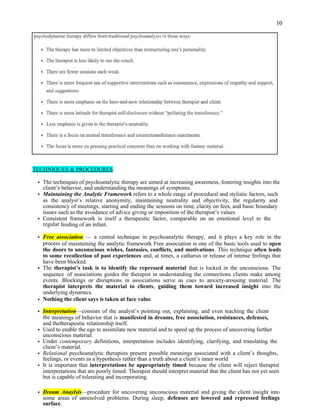
•The techniques of psychoanalytic therapy are aimed at increasing awareness, fostering insights into the
client’s behavior, and understanding the meanings of symptoms.
• Maintaining the Analytic Framework refers to a whole range of procedural and stylistic factors, such
as the analyst’s relative anonymity, maintaining neutrality and objectivity, the regularity and
consistency of meetings, starting and ending the sessions on time, clarity on fees, and basic boundary
issues such as the avoidance of advice giving or imposition of the therapist’s values
• Consistent framework is itself a therapeutic factor, comparable on an emotional level to the
regular feeding of an infant.
• Free association — a central technique in psychoanalytic therapy, and it plays a key role in the
process of maintaining the analytic framework Free association is one of the basic tools used to open
the doors to unconscious wishes, fantasies, conflicts, and motivations. This technique often leads
to some recollection of past experiences and, at times, a catharsis or release of intense feelings that
have been blocked.
• The therapist’s task is to identify the repressed material that is locked in the unconscious. The
sequence of associations guides the therapist in understanding the connections clients make among
events. Blockings or disruptions in associations serve as cues to anxiety-arousing material. The
therapist interprets the material to clients, guiding them toward increased insight into the
underlying dynamics.
• Nothing the client says is taken at face value.
• Interpretation—consists of the analyst’s pointing out, explaining, and even teaching the client
the meanings of behavior that is manifested in dreams, free association, resistances, defenses,
and thetherapeutic relationship itself.
• Used to enable the ego to assimilate new material and to speed up the process of uncovering further
unconscious material.
• Under contemporary definitions, interpretation includes identifying, clarifying, and translating the
client’s material.
• Relational psychoanalytic therapists present possible meanings associated with a client’s thoughts,
feelings, or events as a hypothesis rather than a truth about a client’s inner world
• It is important that interpretations be appropriately timed because the client will reject therapist
interpretations that are poorly timed. Therapist should interpret material that the client has not yet seen
but is capable of tolerating and incorporating.
• Dream Anaylsis—procedure for uncovering unconscious material and giving the client insight into
some areas of unresolved problems. During sleep, defenses are lowered and repressed feelings
surface.
11.
11
• Freud seesdreams as the “royal road to the unconscious,” for in them one’s unconscious wishes,
needs, and fears are expressed. Some motivations are so unacceptable to the person that they are
expressed in disguised or symbolic form rather than being revealed directly.
• Manifest Content— The literal dream itself and how it appears to the dreamer. The therapist’s taskis
to uncover disguised meanings by studying the symbols in the manifest content of the dream
• Latent Content—consists of hidden, symbolic, and unconscious motives, wishes, and fears. Because
they are so painful and threatening, the unconscious sexual and aggressive impulses thatmake up
latent content are transformed into the more acceptable
• Dreamwork— the process by which the latent content of a dream is transformed into the less
threatening manifest content
Analysis & Interpretation of Resistance
• Resistance—fundamental to the practice of psychoanalysis, is anything that works against the
progress of therapy and prevents the client from producing previously unconscious material. Refers to
any idea, attitude, feeling, or action (conscious or unconscious) that fosters the status quo and gets in
the way of change.
As a defense against anxiety, resistance operates specifically in psychoanalytic therapy to
prevent clients and therapists from succeeding in their joint effort to gain insights into the
dynamics of theunconscious.
Therapists’ interpretations help clients become aware of the reasons for the resistance so they can
deal with them. As a general rule, therapists point out and interpret the most obvious
resistances to lessen the possibility of clients’ rejecting the interpretation and to increase the
chance that they willbegin to look at their resistive behavior.
• The transference situation is considered valuable because its manifestations provide clients with the
opportunity to reexperience a variety of feelings that would otherwise be inaccessible. Through the
relationship with the therapist, clients express feelings, beliefs, and desires that they have buried in their
unconscious. Interpreting transference is a route to elucidating the client’s intrapsychic life
• Analytically oriented therapists consider the process of exploring and interpreting transference feelings
as the core of the therapeutic process because it is aimed at achieving increased awareness and
personality change.
• The analysis of transference is a central technique in both classical psychoanalysis and
psychoanalytically oriented therapy, for it allows clients to achieve here-and-now insight into the
influence of the past on their present functioning. Interpretation of the transference relationship enables
clients to work through old conflicts that are keeping them fixated and retarding their emotional growth
Group Counseling
• Regardless of their theoretical orientation, it is well for group therapists to understand such
psychoanalytic phenomena as transference, countertransference, resistance, and the use of ego-defense
mechanisms as reactions to anxiety.
• In most groups, individuals elicit a range of feelings such as attraction, anger, competition,
and avoidance. These transference feelings may resemble those that members experienced
toward significant people in their past.
• Group participants frequently compete for the attention of the leader—a situation reminiscent of earlier
times when they had to vie for their parents’ attention with their brothers and sisters. This rivalry can
be explored in a group as a way of gaining increased awareness of how the participants dealt with
competition as children and how their past success or lack of it affects their present interactions with
others.
• Groups can provide a dynamic understanding of how people function in out-of-group situations.
Projections onto the leader and onto other members are valuable clues to unresolved conflicts within
the person that can be identified, explored, and worked through in the group.
• Countertransference can be a useful tool for the group therapist to understand the dynamics that might
be operating in a group. However, group leaders need to be alert to signs of unresolved internal
conflicts that could interfere with effective group functioning and create a situation in which
membersare used to satisfy the leaders’ own unfulfilled needs