ACTIVATING DEFENCE IN
RESPONSE
Ankur Vats
EMPLOYEE-PERSONAL
BUZZ WORDS
Incident – Something Happened
Breach – Someone came inside and accessed data
Response – What are we doing once something happened?
Visibility – Do we have the right set of tools to view what is
happening in out premises?
Alerts – Do we get notified when something happens?
Threats – Are there any incidents that can cause disturbance
to business continuity?
EMPLOYEE-PERSONAL
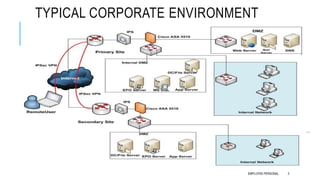
TYPICAL CORPORATE ENVIRONMENT
3EMPLOYEE-PERSONAL
LOG MANAGEMENT
Log management (LM) comprises an approach to
dealing with large volumes of computer-generated log
messages (also known as audit records, audit trails,
event-logs, etc.).
LM covers
Log collection,
Centralized aggregation,
Long-term retention,
Log analysis (in real-time and in bulk after storage) as well as
Log search and
Reporting.
4EMPLOYEE-PERSONAL
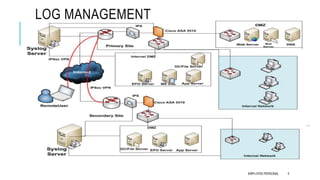
LOG MANAGEMENT
5EMPLOYEE-PERSONAL
LOG MANAGEMENT CHALLENGES
Analyzing Logs for Relevant Security Intelligence
Centralizing Log Collection
Meeting IT Compliance Requirements
Conducting Effective Root Cause Analysis
Making Log Data More Meaningful
Tracking Suspicious User Behavior
6EMPLOYEE-PERSONAL
INTRODUCTION TO SIEM
The term Security Information Event Management
(SIEM), coined by Mark Nicolett and Amrit Williams of
Gartner in 2005.
Security Information and Event Management (SIEM) is a term
for software and products services combining security
information management (SIM) and security event manager
(SEM).
The segment of security management that deals with real-
time monitoring, correlation of events, notifications and
console views is commonly known as Security Event
Management (SEM).
The second area provides long-term storage, analysis and7EMPLOYEE-PERSONAL
KEY OBJECTIVES
 Identify threats and possible breaches
 Collect audit logs for security and compliance
 Conduct investigations and provide evidence
8EMPLOYEE-PERSONAL
WHY IS SIEM NECESSARY?
Rise in data breaches due to internal and
external threats
Attackers are smart and traditional security
tools just don’t suffice
Mitigate sophisticated cyber-attacks
Manage increasing volumes of logs from
multiple sources
Meet stringent compliance requirements
9EMPLOYEE-PERSONAL
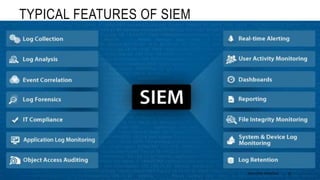
TYPICAL FEATURES OF SIEM
10EMPLOYEE-PERSONAL
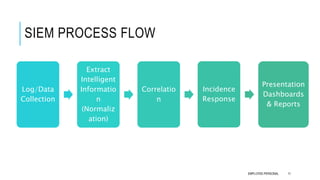
SIEM PROCESS FLOW
Log/Data
Collection
Extract
Intelligent
Informatio
n
(Normaliz
ation)
Correlatio
n
Incidence
Response
Presentation
Dashboards
& Reports
11EMPLOYEE-PERSONAL
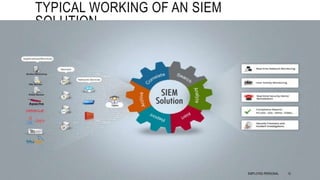
TYPICAL WORKING OF AN SIEM
SOLUTION
12EMPLOYEE-PERSONAL
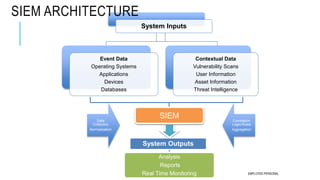
System Inputs
Event Data
Operating Systems
Applications
Devices
Databases
Contextual Data
Vulnerability Scans
User Information
Asset Information
Threat Intelligence
Data
Collection
Normalization
Correlation
Logic/Rules
Aggregation
SIEM
System Outputs
Analysis
Reports
Real Time Monitoring
SIEM ARCHITECTURE
EMPLOYEE-PERSONAL
CONTEXT
14
“User Broberts Successfully Authenticated to 10.100.52.105 from
client 10.10.8.22 “
“10.100.52.105 New Client Connection 10.10.8.22 on account:
Broberts: Success”
Long story short: what needs to be done is to break down every
known log message out there, and put it into a normalized format,
like this:
“User [USERNAME] [STATUS] Authenticated to [DESTIP] from client
[SOURCEIP]”
“10.100.52.105 New Client Connection 10.10.8.22 on account:
Broberts: Success”
EMPLOYEE-PERSONAL
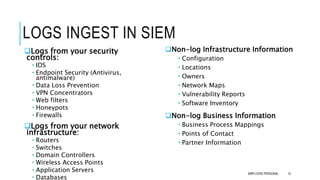
LOGS INGEST IN SIEM
Logs from your security
controls:
 IDS
 Endpoint Security (Antivirus,
antimalware)
 Data Loss Prevention
 VPN Concentrators
 Web filters
 Honeypots
 Firewalls
Logs from your network
infrastructure:
 Routers
 Switches
 Domain Controllers
 Wireless Access Points
 Application Servers
 Databases
15
Non-log Infrastructure Information
 Configuration
 Locations
 Owners
 Network Maps
 Vulnerability Reports
 Software Inventory
Non-log Business Information
 Business Process Mappings
 Points of Contact
 Partner Information
EMPLOYEE-PERSONAL
8 CRITICAL FEATURES OF
SIEM
16EMPLOYEE-PERSONAL
#1. LOG COLLECTION
Universal Log Collection
 To collect logs from heterogeneous sources
(Windows systems, Unix/Linux systems,
applications, databases, routers, switches, and
other devices).
Log collection method - agent-
based or agentless
 Both Recommended
Centralized log collection
Events Per Second (EPS) – Rate at
which your IT infrastructure sends
events
 If not calculated properly the SIEM solution will
start dropping events before they are stored in
the database leading to incorrect reports, search
results, alerts, and correlation. 17EMPLOYEE-PERSONAL
#2. USER ACTIVITY MONITORING
SIEM solutions should have Out-
of-the-box user activity
monitoring, Privileged user
monitoring and audit (PUMA)
reporting feature.
Ensure that the SIEM solution
gives the ‘Complete audit trail’
 Know which user performed the action, what
was the result of the action, on what server it
happened, and user workstation/device from
where the action was triggered.
18EMPLOYEE-PERSONAL
#3. REAL TIME EVENT CORRELATION
A
B
C
D
Real-time event correlation is all
about proactively dealing with
threats.
Correlation boosts network
security by processing millions of
events simultaneously to detect
anomalous events on the network.
Correlation can be based on log
search, rules and alerts
 Predefined rules and alerts are not sufficient.
Custom rule and alert builder is a must for
every SIEM solution.
 Ensure that the process of correlating events
is easy.
19EMPLOYEE-PERSONAL
#4. LOG RETENTION
SIEM solutions should
automatically archive all log data
from systems, devices &
applications to a ‘centralized’
repository.
Ensure that the SIEM solution has
‘Tamper Proof’ feature which
‘encrypts’ and ‘time stamps’ them
for compliance and forensics
purposes.
Ease of retrieving and analyzing
archived log data.
20EMPLOYEE-PERSONAL
#5. IT COMPLIANCE REPORTS
IT compliance is the core of every
SIEM solution.
Ensure that the SIEM solution has
out-of-the-box regulatory
compliance reports such as PCI DSS,
FISMA, GLBA, SOX, HIPAA, etc.
SIEM solutions should also have
the capability to customize and
build new compliance reports to
comply with future regulatory acts.
21EMPLOYEE-PERSONAL
#6. FILE INTEGRITY MONITORING
File integrity monitoring helps
security professionals in monitoring
business critical files and folders.
Ensure that the SIEM solution tracks
and reports on all changes
happening such as when files and
folders are created, accessed,
viewed, deleted, modified, renamed
and much more.
The SIEM solution should also send
real-time alerts when unauthorized
users access critical files and folders.
22EMPLOYEE-PERSONAL
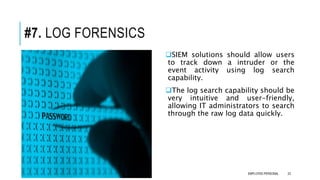
#7. LOG FORENSICS
SIEM solutions should allow users
to track down a intruder or the
event activity using log search
capability.
The log search capability should be
very intuitive and user-friendly,
allowing IT administrators to search
through the raw log data quickly.
23EMPLOYEE-PERSONAL
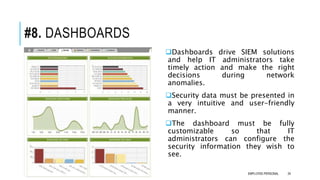
#8. DASHBOARDS
Dashboards drive SIEM solutions
and help IT administrators take
timely action and make the right
decisions during network
anomalies.
Security data must be presented in
a very intuitive and user-friendly
manner.
The dashboard must be fully
customizable so that IT
administrators can configure the
security information they wish to
see.
24EMPLOYEE-PERSONAL
SIEM PRODUCTS IN MARKET
Licensed
versions:
•IBM X-Force
•HP ArcSight
•LogRhythm
•Splunk
•Alien Vault
•And others
25
Open Source:
• Elastic Search +
Kibana
• MozDef
• And many more
EMPLOYEE-PERSONAL
PCI DSS
The Payment Card Industry Data Security Standard (PCI DSS) is a
proprietary information security standard for organizations that handle
branded credit cards from the major card schemes
including Visa, MasterCard, American Express, Discover, and JCB. Private label
cards – those which aren't part of a major card scheme – are not included in the
scope of the PCI DSS.
The PCI Standard is mandated by the card brands and administered by
the Payment Card Industry Security Standards Council. The standard was created to
increase controls around cardholder data to reduce credit card fraud. Validation of
compliance is performed annually, either by an external Qualified Security
Assessor (QSA) that creates a Report on Compliance (ROC) for organizations
handling large volumes of transactions, or by Self-Assessment Questionnaire (SAQ)
for companies handling smaller volumes.
26EMPLOYEE-PERSONAL
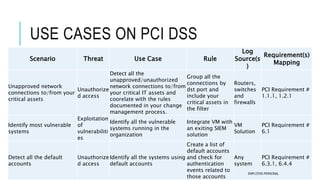
USE CASES ON PCI DSS
27
Scenario Threat Use Case Rule
Log
Source(s
)
Requirement(s)
Mapping
Unapproved network
connections to/from your
critical assets
Unauthorize
d access
Detect all the
unapproved/unauthorized
network connections to/from
your critical IT assets and
coorelate with the rules
documented in your change
management process.
Group all the
connections by
dst port and
include your
critical assets in
the filter
Routers,
switches
and
firewalls
PCI Requirement #
1.1.1, 1.2.1
Identify most vulnerable
systems
Exploitation
of
vulnerabiliti
es
Identify all the vulnerable
systems running in the
organization
Integrate VM with
an exiting SIEM
solution
VM
Solution
PCI Requirement #
6.1
Detect all the default
accounts
Unauthorize
d access
Identify all the systems using
default accounts
Create a list of
default accounts
and check for
authentication
events related to
those accounts
Any
system
PCI Requirement #
6.3.1, 6.4.4
EMPLOYEE-PERSONAL
WHY SIEM IMPLEMENTATION FAILS?
Lack of Planning
 No defined scope
Faulty Deployment Strategies
 Incoherent log management data collection
 High volume of irrelevant data can overload the system
Operational
 Lack of management oversight
 Assume plug and play
“Security is a process, not a product”
28EMPLOYEE-PERSONAL
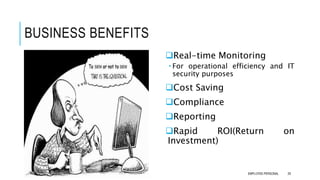
BUSINESS BENEFITS
Real-time Monitoring
 For operational efficiency and IT
security purposes
Cost Saving
Compliance
Reporting
Rapid ROI(Return on
Investment)
29EMPLOYEE-PERSONAL
TOP CHALLENGES OF IMPLEMENTING
SIEM
SIEM is to Complex.
SIEM takes too long to deploy.
SIEM is too expensive.
SIEM’s are too noisy.
SIEM’s aren’t typically “cloud friendly”.
30EMPLOYEE-PERSONAL
SUCCESSFUL IMPLEMENTATION
CRITERIA
Malware Control.
Boundary Defenses.
Access Control.
Acceptable Use Monitoring(AUP).
Application Defenses.
Compliance and Audit Data
Requirements.
Monitoring and Reporting
Requirements.
Deployment and Infrastructure
Activation.
Network and Host Defenses.
Network and System Resource
Integrity.
31EMPLOYEE-PERSONAL
Q & A
EMPLOYEE-PERSONAL 32
EMPLOYEE-PERSONAL 33

SIEM - Activating Defense through Response by Ankur Vats

  • 1.
  • 2.
    BUZZ WORDS Incident –Something Happened Breach – Someone came inside and accessed data Response – What are we doing once something happened? Visibility – Do we have the right set of tools to view what is happening in out premises? Alerts – Do we get notified when something happens? Threats – Are there any incidents that can cause disturbance to business continuity? EMPLOYEE-PERSONAL
  • 3.
  • 4.
    LOG MANAGEMENT Log management(LM) comprises an approach to dealing with large volumes of computer-generated log messages (also known as audit records, audit trails, event-logs, etc.). LM covers Log collection, Centralized aggregation, Long-term retention, Log analysis (in real-time and in bulk after storage) as well as Log search and Reporting. 4EMPLOYEE-PERSONAL
  • 5.
  • 6.
    LOG MANAGEMENT CHALLENGES AnalyzingLogs for Relevant Security Intelligence Centralizing Log Collection Meeting IT Compliance Requirements Conducting Effective Root Cause Analysis Making Log Data More Meaningful Tracking Suspicious User Behavior 6EMPLOYEE-PERSONAL
  • 7.
    INTRODUCTION TO SIEM Theterm Security Information Event Management (SIEM), coined by Mark Nicolett and Amrit Williams of Gartner in 2005. Security Information and Event Management (SIEM) is a term for software and products services combining security information management (SIM) and security event manager (SEM). The segment of security management that deals with real- time monitoring, correlation of events, notifications and console views is commonly known as Security Event Management (SEM). The second area provides long-term storage, analysis and7EMPLOYEE-PERSONAL
  • 8.
    KEY OBJECTIVES  Identifythreats and possible breaches  Collect audit logs for security and compliance  Conduct investigations and provide evidence 8EMPLOYEE-PERSONAL
  • 9.
    WHY IS SIEMNECESSARY? Rise in data breaches due to internal and external threats Attackers are smart and traditional security tools just don’t suffice Mitigate sophisticated cyber-attacks Manage increasing volumes of logs from multiple sources Meet stringent compliance requirements 9EMPLOYEE-PERSONAL
  • 10.
    TYPICAL FEATURES OFSIEM 10EMPLOYEE-PERSONAL
  • 11.
  • 12.
    TYPICAL WORKING OFAN SIEM SOLUTION 12EMPLOYEE-PERSONAL
  • 13.
    System Inputs Event Data OperatingSystems Applications Devices Databases Contextual Data Vulnerability Scans User Information Asset Information Threat Intelligence Data Collection Normalization Correlation Logic/Rules Aggregation SIEM System Outputs Analysis Reports Real Time Monitoring SIEM ARCHITECTURE EMPLOYEE-PERSONAL
  • 14.
    CONTEXT 14 “User Broberts SuccessfullyAuthenticated to 10.100.52.105 from client 10.10.8.22 “ “10.100.52.105 New Client Connection 10.10.8.22 on account: Broberts: Success” Long story short: what needs to be done is to break down every known log message out there, and put it into a normalized format, like this: “User [USERNAME] [STATUS] Authenticated to [DESTIP] from client [SOURCEIP]” “10.100.52.105 New Client Connection 10.10.8.22 on account: Broberts: Success” EMPLOYEE-PERSONAL
  • 15.
    LOGS INGEST INSIEM Logs from your security controls:  IDS  Endpoint Security (Antivirus, antimalware)  Data Loss Prevention  VPN Concentrators  Web filters  Honeypots  Firewalls Logs from your network infrastructure:  Routers  Switches  Domain Controllers  Wireless Access Points  Application Servers  Databases 15 Non-log Infrastructure Information  Configuration  Locations  Owners  Network Maps  Vulnerability Reports  Software Inventory Non-log Business Information  Business Process Mappings  Points of Contact  Partner Information EMPLOYEE-PERSONAL
  • 16.
    8 CRITICAL FEATURESOF SIEM 16EMPLOYEE-PERSONAL
  • 17.
    #1. LOG COLLECTION UniversalLog Collection  To collect logs from heterogeneous sources (Windows systems, Unix/Linux systems, applications, databases, routers, switches, and other devices). Log collection method - agent- based or agentless  Both Recommended Centralized log collection Events Per Second (EPS) – Rate at which your IT infrastructure sends events  If not calculated properly the SIEM solution will start dropping events before they are stored in the database leading to incorrect reports, search results, alerts, and correlation. 17EMPLOYEE-PERSONAL
  • 18.
    #2. USER ACTIVITYMONITORING SIEM solutions should have Out- of-the-box user activity monitoring, Privileged user monitoring and audit (PUMA) reporting feature. Ensure that the SIEM solution gives the ‘Complete audit trail’  Know which user performed the action, what was the result of the action, on what server it happened, and user workstation/device from where the action was triggered. 18EMPLOYEE-PERSONAL
  • 19.
    #3. REAL TIMEEVENT CORRELATION A B C D Real-time event correlation is all about proactively dealing with threats. Correlation boosts network security by processing millions of events simultaneously to detect anomalous events on the network. Correlation can be based on log search, rules and alerts  Predefined rules and alerts are not sufficient. Custom rule and alert builder is a must for every SIEM solution.  Ensure that the process of correlating events is easy. 19EMPLOYEE-PERSONAL
  • 20.
    #4. LOG RETENTION SIEMsolutions should automatically archive all log data from systems, devices & applications to a ‘centralized’ repository. Ensure that the SIEM solution has ‘Tamper Proof’ feature which ‘encrypts’ and ‘time stamps’ them for compliance and forensics purposes. Ease of retrieving and analyzing archived log data. 20EMPLOYEE-PERSONAL
  • 21.
    #5. IT COMPLIANCEREPORTS IT compliance is the core of every SIEM solution. Ensure that the SIEM solution has out-of-the-box regulatory compliance reports such as PCI DSS, FISMA, GLBA, SOX, HIPAA, etc. SIEM solutions should also have the capability to customize and build new compliance reports to comply with future regulatory acts. 21EMPLOYEE-PERSONAL
  • 22.
    #6. FILE INTEGRITYMONITORING File integrity monitoring helps security professionals in monitoring business critical files and folders. Ensure that the SIEM solution tracks and reports on all changes happening such as when files and folders are created, accessed, viewed, deleted, modified, renamed and much more. The SIEM solution should also send real-time alerts when unauthorized users access critical files and folders. 22EMPLOYEE-PERSONAL
  • 23.
    #7. LOG FORENSICS SIEMsolutions should allow users to track down a intruder or the event activity using log search capability. The log search capability should be very intuitive and user-friendly, allowing IT administrators to search through the raw log data quickly. 23EMPLOYEE-PERSONAL
  • 24.
    #8. DASHBOARDS Dashboards driveSIEM solutions and help IT administrators take timely action and make the right decisions during network anomalies. Security data must be presented in a very intuitive and user-friendly manner. The dashboard must be fully customizable so that IT administrators can configure the security information they wish to see. 24EMPLOYEE-PERSONAL
  • 25.
    SIEM PRODUCTS INMARKET Licensed versions: •IBM X-Force •HP ArcSight •LogRhythm •Splunk •Alien Vault •And others 25 Open Source: • Elastic Search + Kibana • MozDef • And many more EMPLOYEE-PERSONAL
  • 26.
    PCI DSS The PaymentCard Industry Data Security Standard (PCI DSS) is a proprietary information security standard for organizations that handle branded credit cards from the major card schemes including Visa, MasterCard, American Express, Discover, and JCB. Private label cards – those which aren't part of a major card scheme – are not included in the scope of the PCI DSS. The PCI Standard is mandated by the card brands and administered by the Payment Card Industry Security Standards Council. The standard was created to increase controls around cardholder data to reduce credit card fraud. Validation of compliance is performed annually, either by an external Qualified Security Assessor (QSA) that creates a Report on Compliance (ROC) for organizations handling large volumes of transactions, or by Self-Assessment Questionnaire (SAQ) for companies handling smaller volumes. 26EMPLOYEE-PERSONAL
  • 27.
    USE CASES ONPCI DSS 27 Scenario Threat Use Case Rule Log Source(s ) Requirement(s) Mapping Unapproved network connections to/from your critical assets Unauthorize d access Detect all the unapproved/unauthorized network connections to/from your critical IT assets and coorelate with the rules documented in your change management process. Group all the connections by dst port and include your critical assets in the filter Routers, switches and firewalls PCI Requirement # 1.1.1, 1.2.1 Identify most vulnerable systems Exploitation of vulnerabiliti es Identify all the vulnerable systems running in the organization Integrate VM with an exiting SIEM solution VM Solution PCI Requirement # 6.1 Detect all the default accounts Unauthorize d access Identify all the systems using default accounts Create a list of default accounts and check for authentication events related to those accounts Any system PCI Requirement # 6.3.1, 6.4.4 EMPLOYEE-PERSONAL
  • 28.
    WHY SIEM IMPLEMENTATIONFAILS? Lack of Planning  No defined scope Faulty Deployment Strategies  Incoherent log management data collection  High volume of irrelevant data can overload the system Operational  Lack of management oversight  Assume plug and play “Security is a process, not a product” 28EMPLOYEE-PERSONAL
  • 29.
    BUSINESS BENEFITS Real-time Monitoring For operational efficiency and IT security purposes Cost Saving Compliance Reporting Rapid ROI(Return on Investment) 29EMPLOYEE-PERSONAL
  • 30.
    TOP CHALLENGES OFIMPLEMENTING SIEM SIEM is to Complex. SIEM takes too long to deploy. SIEM is too expensive. SIEM’s are too noisy. SIEM’s aren’t typically “cloud friendly”. 30EMPLOYEE-PERSONAL
  • 31.
    SUCCESSFUL IMPLEMENTATION CRITERIA Malware Control. BoundaryDefenses. Access Control. Acceptable Use Monitoring(AUP). Application Defenses. Compliance and Audit Data Requirements. Monitoring and Reporting Requirements. Deployment and Infrastructure Activation. Network and Host Defenses. Network and System Resource Integrity. 31EMPLOYEE-PERSONAL
  • 32.
  • 33.