THREE TYPES OF LOW SPEED SHREDDER DESIGN
RODGERS M. HILL
Dallas, Texas
ABSTRACT
This paper describes three basic designs of low-speed
(sometimes called shear) shredders which have evolved
to meet varying application requirements in shredding
different types of bulky, waste materials. What has
emerged are three distinct configurations of shredder '
rotors and cutters, used in units with basically similar
mechanical characteristics. The basic shredder can be
either electromechanically or electrohydraulically
driven, with the preference for either of the two being
entirely dependent on the nature and volume of the
material to be reduced in size. Thus, the evolution of
different types of low-speed shredders is the direct
result of the need to shred various specialized sub­
classes of material separately from, or in addition to,
the general waste stream.
INTRODUCI'ION
With very few exceptions, low-speed shredders are
used for the size reduction of waste materials such as
. (but not limited to): municipal solid waste, discarded
tires, old appliances-commonly referred to as white
goods, industrial and construction debris, and scrap
electrical wire and cable.
There are two basic reasons for shredding any of
these materials: densification to reduce volume, or
265
preparation for downstream processing operations.
Densification, or simple size reduction, by itself im­
poses few restrictions on shredder design. The brute
force of the drive applied to the cutters can result in
more or less acceptable results being obtained with
different cutter designs.
In contrast, preparation for downstream processing
operations may subject the shredder to stringent per­
formance requirements for the particle size and form
produced. Thus, a primary criteria in the design will
be the use, if any, of the shredder output. It there are
downstream processing operations, the characteristics
of the material being shredded then will impose sec­
ondary selection criteria on the shredder design. Hom­
ogeniety of the material or whether it contains a wide
variety of materials, whether it needs to be cleanly
sheared or can be torn apart, and the material com­
position all impose greater restrictions (than in den­
sification applications) on the design required for
desired shredder performance.
TYPE I SHEAR SHREDDER
Figure 1 shows one of the first types of shear shred­
ders whi�h e�olved over the past 10 years for a specific­
use applicatIOn: the preshearing of scrap nonferrous
ROTATION
--------
ROTATION
----
,---- STATIONARY
KNIVES
ROTOR KNIFE (TYP)
FIG. 1 TYPE I WIRE SHREDDER
[Input Torque Specifications: 38,200 ft-Ib/Shaft @ 19 rpm (51,800 N Shaft)]
insulated wire and cable to prepare it for feeding into
a mechanical reclamation system. In this instance, the
raw material is relatively homogeneous (when com­
pared to solid waste) in composition but varies in form.
It may be, in a typical scrap processing operation, in
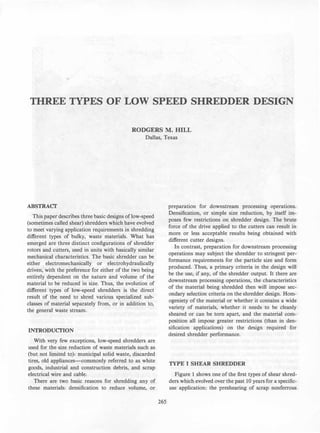
the form of dense bales weighing up to 2000 lb (900
kg) (as shown in Photograph 1), coils, bundles, or loose
wire. This mass of material then needs to be converted
into relatively loose, free-flowing pieces 6-24 in. (15-
60 cm) long, that can be fed into the first processing
operation, a close-tolerance radial knife granulator.
Three factors had to be taken into consideration in
the design of this type of shear shredder:
(a) The limitations of alternate processing methods:
small, manually-fed shears were quite labor-intensive
(as well as unsafe) while hydraulic guillotine shears
tended to compress the wire into dense blocks. Neither
of these methods could economically precut dense bales
(a process factor).
(b) The sensitivity of the downstream granulators
to surge or shock loads: either of the above methods
could result in overfeeding the downstream system and
the compressed material from hydraulic shears caused
more rapid wear in the granulator (again, a process
factor).
(c) The nature of the feed: the dense bales needed
to be tom apart yet the individual wires needed to be
cut, not stretched and tom.
266
The resultant design, shown in Fig. 1, incorporates
two counter-rotating shafts that do not intermesh with
each other. Instead, they cut against a stationary anvil
bar equipped with replaceable and adjustable knives.
At the same time, the knives have sufficient projection
to pull apart the dense mass of wire and cable. As the
knives on the two rotors pass between the stationary
knives they pull through, and cut into short lengths,
the tangled mass of raw material.
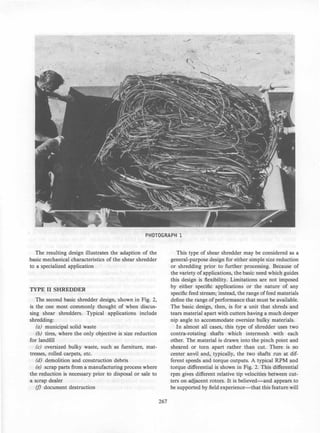
In Photograph 2 the rotor configuration is shown;
in the center can be seen a portion of the stationary
anvil which supports the stationary knives. The two
shafts are independently driven and can independently
reverse should an obstruction, or thick mass of ma­
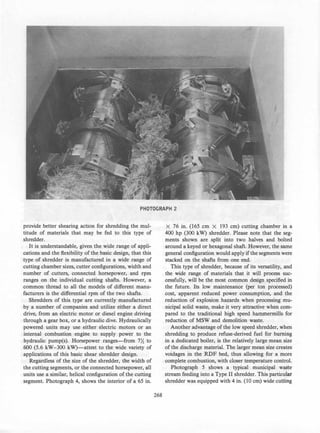
terial, be present. The result is a uniform flow of wire
and cable cut into short lengths (see Photograph 3)
which can be fed to the downstream processing system.
The unique feature of this type of shear shredder
makes it ideal for this one purpose. That same feature,
rotor knives cutting against stationary knives on a
center anvil, make it impractical for such materials as
municipal solid waste, tires, "white goods", and other
bulky waste. For those, the center anvil will result in
a drastic reduction in capacity due to bridging of ma­
terial on the anvil. Additionally, the nip angle, or line
of attack of the cutters onto the material being shred­
ded, is not sufficient to pull bulky items into the in­
terface of the cutters.
...
PHOTOGRAPH 1
The resulting design illustrates the adaption of the
basic mechanical characteristics of the shear shredder
to a specialized application
TYPE IT SHREDDER
The second basic shredder design, shown in Fig. 2,
is the one most commonly thought of when discus­
sing shear shredders. Typical applications include
shredding:
(a) municipal solid waste
(b) tires, where the only objective is size reduction
for landfill
(c) oversized bulky waste, such as furniture, mat­
tresses, rolled carpets, etc.
(d) demolition and construction debris
(e) scrap parts from a manufacturing process where
the reduction is necessary prior to disposal or sale to
a scrap dealer
(f) document destruction
267
This type of shear shredder may be considered as a
general-purpose design for either simple size reduction
or shredding prior to further processing. Because of
the variety of applications, the basic need which guides
this design is flexibility. Limitations are not imposed
by either specific applications or the nature of any
specific feed stream; instead, the range of feed materials
define the range of performance that must be available.
The basic design, then, is for a unit that shreds and
tears material apart with cutters having a much deeper
nip angle to accommodate oversize bulky materials.
In almost all cases, this type of shredder uses two
contra-rotating shafts which intermesh with each
other. The material is drawn into the pinch point and
sheared or torn apart rather than cut. There is no
center anvil and, typically, the two shafts run at dif­
ferent speeds and torque outputs. A typical RPM and
torque differential is shown in Fig. 2. This differential
rpm gives different relative tip velocities between cut­
ters on adjacent rotors. It is believed-and appears to
be supported by field experience-that this feature will
PHOTOGRAPH 2
provide better shearing action for shredding the mul­
titude of materials that may be fed to this type of
shredder.
It is understandable, given the wide range of appli­
cations and the flexibility of the basic design, that this
type of shredder is manufactured in a wide range of
cutting chamber sizes, cutter configurations, width and
number of cutters, connected horsepower, and rpm
ranges on the individual cutting shafts. However, a
common thread to all the models of different manu­
facturers is the differential rpm of the two shafts.
Shredders of this type are currently manufactured
by a number of companies and utilize either a direct
drive, from an electric motor or diesel engine driving
through a gear box, or a hydraulic dive. Hydraulically
powered units may use either electric motors or an
internal combustion engine to supply power to the
hydraulic pump(s). Horsepower ranges-from 7X. to
600 (5.6 kW-300 kW)-attest to the wide variety of
applications of this basic shear shredder design.
Regardless of the size of the shredder, the width of
the cutting segments, or the connected horsepower, all
units use a similar, helical configuration of the cutting
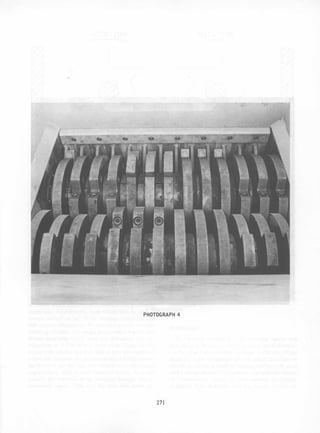
segment. Photograph 4, shows the interior of a 65 in.
268
X 76 in. (165 cm X 193 cm) cutting chamber in a
400 hp (300 kW) shredder. Please note that the seg­
ments shown are split into two halves and bolted
around a keyed or hexagonal shaft. However, the same
general configuration would apply ifthe segments were
stacked on the shafts from one end.
This type of shredder, because of its versatility, and
the wide range of materials that it will process suc­
cessfully, will be the most common design specified in
the future. Its low maintenance (per ton processed)
cost, apparent reduced power consumption, and the
reduction of explosion hazards when processing mu­
nicipal solid waste, make it very attractive when com­
pared to the traditional high speed hammermills for
reduction of MSW and demolition waste.
Another advantage of the low speed shredder, when
shredding to produce refuse-derived fuel for burning
in a dedicated boiler, is the relatively large mean size
of the discharge material. The larger mean size creates
voidages in the RDF bed, thus allowing for a more
complete combustion, with closer temperature control.
Photograph 5 shows a typical municipal waste
stream feeding into a Type II shredder. This particular
shredder was equipped with 4 in. (10 cm) wide cutfing
•
7
PHOTOGRAPH 3
segments having a 4 in. cutter projection. The resultant
size distribution of the shredded material is shown in
Fig. 3. What is significant is that an average of only
8.3% of the discharge passed a X in. (6.35 mm) sizing
screen. The minimum was 5.1% and the maximum
was 10.3%. The mean size of the discharge was 2 in.
(50.8 mm) which would result, in the case of firing
in a dedicated boiler, in a very uniform combustion
air flow with resulting close control on combustion
temperature.
This size distribution points out a further advantage
of the shear shredder, compared to a high-speed impact
mill, for the primary reduction of solid waste. That is
the coarser mean size of glass and ceramic particles.
If it is desirable to have a low ash content in the RDF
then this rather coarse glass fraction is not only easier
to separate, it is not imbedded in the organic materials
by high velocity impacts in the shredder. Thus, sep­
aration of glass and ceramics from RDF prior to com­
bustion becomes more efficient.
269
While the Type II shredder represents what we be­
lieve to be the state of the art in MSW shredders,
specific components of the general waste stream may
require a different approach if they are to be processed
as a separate material stream. Tires, when included in
MSW, present no problem for a Type II shredder.
However, the increased interest in use of shredded tires
as a fuel, increased rubber reclamation, and legislation
prohibiting the landfilling of tires in any form have
created a new, ever-increasing waste stream composed
only of tires. The result, then, is the third type of
shredder I shall discuss today.
TYPE III SHREDDER
Like a Type I shredder, this third type is designed
with a specific waste stream in mind, and with a specific
end use objective for the product generated. The design
must take into account both downstream process re-
ROTATION
-----
ROTATION
----
HARDFACED
CUTTING
SURFACE
FIG. 2 TYPE II MSW SHREDDER
[Input Torque Specifications: 1 @ 32,000 ft-Ib/Shaft @ 32 rpm (43,400 N. m Shaft @ 32 rpm);
1 @ 57,000 ft-Ib/Shaft @ 16 rpm (77,306 N. m Shaft @ 16 rpm)]
SCREEN PERCENT RETAINED
SIZE. IN.
AVG. MIN. MAX.
+4 19.3 9.7 32.9
+2 30.7 23.0 35.0
+1 19.2 14.9 23.9
+1/2 13.2 8.9 17.4
+1/4 9.3 6.2 12.0
PAN 8.3 5.1 10.3
FIG. 3 02-03 DECEMBER 1980 SIZE DISTRIBUTION OF
SHREDDER OUTPUT: ELEVEN SAMPLINGS FROM 11.2
TO 28.4 Ib; AVERAGE SIZE 18.8 Ib; AVERAGE BULK
DENSITY 5.4 pcf
270
quirements and the specific nature of the feed material.
Specifically:
(a) The shredder output must be reasonably uni­
form in shape, of a size that can be readily burned,
and free of long strips of rubber.
(b) The raw material is bulky, flexible, elastic, and
not easy to engage in the interface between the cutters.
As a result, this Type III shredder design incorpo­
rates features from the first two types, and, like Type
I, adds some very unique features to meet the require­
ments of its specific feed material. Figure 4 illustrates
a typical cross-section through the cutting chamber of
this design.
First, because of the elasticity of the feed material,
and to give better control over the particle size pro­
duced, it borrows the idea of replaceable cutting edges
from the Type I shredder. Next, froIJ1 a Type II shred­
der, it borrows the idea of the intermeshing rotors and
eliminates the center anvil, to ease the entrance of the
bulky feed material into the cutting interface and re­
duce the possibility of material bridging.
PHOTOGRAPH 4
271
PHOTOGRAPH 5
272
ROTATION ROTATION
�-------- -------..-
- - - -
ROTATION ROTATION
FIG. 4 TYPE III TIRE SHREDDER
[Input Torque Specifications: 26,500 ft-Ib/Shaft @ 19 rpm (35,900 N Shaft)]
These two features, by themselves, however, will not
eliminate the possibility of producing the long strips
of rubber which interfere with downstream processing
operations. Additionally, tires would still be free to
bounce around on top of the rotating cutters, greatly
reducing net throughput. To solve this specific material
handling problem, the design incorporates a set of star
shaped feed rolls which push the individual tire car­
casses one at a time into cutting zone. These feeders
engage the tire carcass and feed it into the cutters at
a feed rate less than the peripheral speed of the cutters.
As the tires are fed into the cutting zone the cutters
engage them with a true shearing action. It is not
possible for the tires to be extruded through the in­
termeshed cutters. This cuts the tires into more uni-
273
form pieces and eliminates the production of long strips
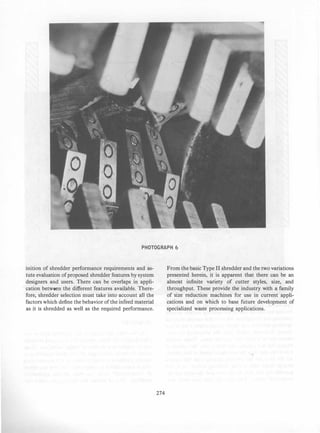
of rubber. A typical Type III Shredder is shown in
Photograph 6.
SUMMARY
As has been illustrated in the previous figures and
photographs, the basic concept of a low-speed shredder
can be subject to a number of design variations. These
adapt the basic advantages of low-speed shredding to
specific problems in waste processing and provide users
with a wider choice in equipment-or even the option
of "customized" units-to meet specific application
problems. This, of course, will also require closer def-
PHOTOGRAPH 6
inition of shredder performance requirements and as­
tute evaluation of proposed shredder features by system
designers and users. There can be overlaps in appli­
cation between the different features available. There­
fore, shredder selection must take into account all the
factors which define the behavior of the infeed material
as it is shredded as well as the required performance.
274
From the basic Type II shredder and the two variations
presented herein, it is apparent that there can be an
almost infinite variety of cutter styles, size, and
throughput. These provide the industry with a family
of size reduction machines for use in current appli­
cations and on which to base future development of
specialized waste processing applications.

shredder design

  • 1.
    THREE TYPES OFLOW SPEED SHREDDER DESIGN RODGERS M. HILL Dallas, Texas ABSTRACT This paper describes three basic designs of low-speed (sometimes called shear) shredders which have evolved to meet varying application requirements in shredding different types of bulky, waste materials. What has emerged are three distinct configurations of shredder ' rotors and cutters, used in units with basically similar mechanical characteristics. The basic shredder can be either electromechanically or electrohydraulically driven, with the preference for either of the two being entirely dependent on the nature and volume of the material to be reduced in size. Thus, the evolution of different types of low-speed shredders is the direct result of the need to shred various specialized sub­ classes of material separately from, or in addition to, the general waste stream. INTRODUCI'ION With very few exceptions, low-speed shredders are used for the size reduction of waste materials such as . (but not limited to): municipal solid waste, discarded tires, old appliances-commonly referred to as white goods, industrial and construction debris, and scrap electrical wire and cable. There are two basic reasons for shredding any of these materials: densification to reduce volume, or 265 preparation for downstream processing operations. Densification, or simple size reduction, by itself im­ poses few restrictions on shredder design. The brute force of the drive applied to the cutters can result in more or less acceptable results being obtained with different cutter designs. In contrast, preparation for downstream processing operations may subject the shredder to stringent per­ formance requirements for the particle size and form produced. Thus, a primary criteria in the design will be the use, if any, of the shredder output. It there are downstream processing operations, the characteristics of the material being shredded then will impose sec­ ondary selection criteria on the shredder design. Hom­ ogeniety of the material or whether it contains a wide variety of materials, whether it needs to be cleanly sheared or can be torn apart, and the material com­ position all impose greater restrictions (than in den­ sification applications) on the design required for desired shredder performance. TYPE I SHEAR SHREDDER Figure 1 shows one of the first types of shear shred­ ders whi�h e�olved over the past 10 years for a specific­ use applicatIOn: the preshearing of scrap nonferrous
  • 2.
    ROTATION -------- ROTATION ---- ,---- STATIONARY KNIVES ROTOR KNIFE(TYP) FIG. 1 TYPE I WIRE SHREDDER [Input Torque Specifications: 38,200 ft-Ib/Shaft @ 19 rpm (51,800 N Shaft)] insulated wire and cable to prepare it for feeding into a mechanical reclamation system. In this instance, the raw material is relatively homogeneous (when com­ pared to solid waste) in composition but varies in form. It may be, in a typical scrap processing operation, in the form of dense bales weighing up to 2000 lb (900 kg) (as shown in Photograph 1), coils, bundles, or loose wire. This mass of material then needs to be converted into relatively loose, free-flowing pieces 6-24 in. (15- 60 cm) long, that can be fed into the first processing operation, a close-tolerance radial knife granulator. Three factors had to be taken into consideration in the design of this type of shear shredder: (a) The limitations of alternate processing methods: small, manually-fed shears were quite labor-intensive (as well as unsafe) while hydraulic guillotine shears tended to compress the wire into dense blocks. Neither of these methods could economically precut dense bales (a process factor). (b) The sensitivity of the downstream granulators to surge or shock loads: either of the above methods could result in overfeeding the downstream system and the compressed material from hydraulic shears caused more rapid wear in the granulator (again, a process factor). (c) The nature of the feed: the dense bales needed to be tom apart yet the individual wires needed to be cut, not stretched and tom. 266 The resultant design, shown in Fig. 1, incorporates two counter-rotating shafts that do not intermesh with each other. Instead, they cut against a stationary anvil bar equipped with replaceable and adjustable knives. At the same time, the knives have sufficient projection to pull apart the dense mass of wire and cable. As the knives on the two rotors pass between the stationary knives they pull through, and cut into short lengths, the tangled mass of raw material. In Photograph 2 the rotor configuration is shown; in the center can be seen a portion of the stationary anvil which supports the stationary knives. The two shafts are independently driven and can independently reverse should an obstruction, or thick mass of ma­ terial, be present. The result is a uniform flow of wire and cable cut into short lengths (see Photograph 3) which can be fed to the downstream processing system. The unique feature of this type of shear shredder makes it ideal for this one purpose. That same feature, rotor knives cutting against stationary knives on a center anvil, make it impractical for such materials as municipal solid waste, tires, "white goods", and other bulky waste. For those, the center anvil will result in a drastic reduction in capacity due to bridging of ma­ terial on the anvil. Additionally, the nip angle, or line of attack of the cutters onto the material being shred­ ded, is not sufficient to pull bulky items into the in­ terface of the cutters.
  • 3.
    ... PHOTOGRAPH 1 The resultingdesign illustrates the adaption of the basic mechanical characteristics of the shear shredder to a specialized application TYPE IT SHREDDER The second basic shredder design, shown in Fig. 2, is the one most commonly thought of when discus­ sing shear shredders. Typical applications include shredding: (a) municipal solid waste (b) tires, where the only objective is size reduction for landfill (c) oversized bulky waste, such as furniture, mat­ tresses, rolled carpets, etc. (d) demolition and construction debris (e) scrap parts from a manufacturing process where the reduction is necessary prior to disposal or sale to a scrap dealer (f) document destruction 267 This type of shear shredder may be considered as a general-purpose design for either simple size reduction or shredding prior to further processing. Because of the variety of applications, the basic need which guides this design is flexibility. Limitations are not imposed by either specific applications or the nature of any specific feed stream; instead, the range of feed materials define the range of performance that must be available. The basic design, then, is for a unit that shreds and tears material apart with cutters having a much deeper nip angle to accommodate oversize bulky materials. In almost all cases, this type of shredder uses two contra-rotating shafts which intermesh with each other. The material is drawn into the pinch point and sheared or torn apart rather than cut. There is no center anvil and, typically, the two shafts run at dif­ ferent speeds and torque outputs. A typical RPM and torque differential is shown in Fig. 2. This differential rpm gives different relative tip velocities between cut­ ters on adjacent rotors. It is believed-and appears to be supported by field experience-that this feature will
  • 4.
    PHOTOGRAPH 2 provide bettershearing action for shredding the mul­ titude of materials that may be fed to this type of shredder. It is understandable, given the wide range of appli­ cations and the flexibility of the basic design, that this type of shredder is manufactured in a wide range of cutting chamber sizes, cutter configurations, width and number of cutters, connected horsepower, and rpm ranges on the individual cutting shafts. However, a common thread to all the models of different manu­ facturers is the differential rpm of the two shafts. Shredders of this type are currently manufactured by a number of companies and utilize either a direct drive, from an electric motor or diesel engine driving through a gear box, or a hydraulic dive. Hydraulically powered units may use either electric motors or an internal combustion engine to supply power to the hydraulic pump(s). Horsepower ranges-from 7X. to 600 (5.6 kW-300 kW)-attest to the wide variety of applications of this basic shear shredder design. Regardless of the size of the shredder, the width of the cutting segments, or the connected horsepower, all units use a similar, helical configuration of the cutting segment. Photograph 4, shows the interior of a 65 in. 268 X 76 in. (165 cm X 193 cm) cutting chamber in a 400 hp (300 kW) shredder. Please note that the seg­ ments shown are split into two halves and bolted around a keyed or hexagonal shaft. However, the same general configuration would apply ifthe segments were stacked on the shafts from one end. This type of shredder, because of its versatility, and the wide range of materials that it will process suc­ cessfully, will be the most common design specified in the future. Its low maintenance (per ton processed) cost, apparent reduced power consumption, and the reduction of explosion hazards when processing mu­ nicipal solid waste, make it very attractive when com­ pared to the traditional high speed hammermills for reduction of MSW and demolition waste. Another advantage of the low speed shredder, when shredding to produce refuse-derived fuel for burning in a dedicated boiler, is the relatively large mean size of the discharge material. The larger mean size creates voidages in the RDF bed, thus allowing for a more complete combustion, with closer temperature control. Photograph 5 shows a typical municipal waste stream feeding into a Type II shredder. This particular shredder was equipped with 4 in. (10 cm) wide cutfing
  • 5.
    • 7 PHOTOGRAPH 3 segments havinga 4 in. cutter projection. The resultant size distribution of the shredded material is shown in Fig. 3. What is significant is that an average of only 8.3% of the discharge passed a X in. (6.35 mm) sizing screen. The minimum was 5.1% and the maximum was 10.3%. The mean size of the discharge was 2 in. (50.8 mm) which would result, in the case of firing in a dedicated boiler, in a very uniform combustion air flow with resulting close control on combustion temperature. This size distribution points out a further advantage of the shear shredder, compared to a high-speed impact mill, for the primary reduction of solid waste. That is the coarser mean size of glass and ceramic particles. If it is desirable to have a low ash content in the RDF then this rather coarse glass fraction is not only easier to separate, it is not imbedded in the organic materials by high velocity impacts in the shredder. Thus, sep­ aration of glass and ceramics from RDF prior to com­ bustion becomes more efficient. 269 While the Type II shredder represents what we be­ lieve to be the state of the art in MSW shredders, specific components of the general waste stream may require a different approach if they are to be processed as a separate material stream. Tires, when included in MSW, present no problem for a Type II shredder. However, the increased interest in use of shredded tires as a fuel, increased rubber reclamation, and legislation prohibiting the landfilling of tires in any form have created a new, ever-increasing waste stream composed only of tires. The result, then, is the third type of shredder I shall discuss today. TYPE III SHREDDER Like a Type I shredder, this third type is designed with a specific waste stream in mind, and with a specific end use objective for the product generated. The design must take into account both downstream process re-
  • 6.
    ROTATION ----- ROTATION ---- HARDFACED CUTTING SURFACE FIG. 2 TYPEII MSW SHREDDER [Input Torque Specifications: 1 @ 32,000 ft-Ib/Shaft @ 32 rpm (43,400 N. m Shaft @ 32 rpm); 1 @ 57,000 ft-Ib/Shaft @ 16 rpm (77,306 N. m Shaft @ 16 rpm)] SCREEN PERCENT RETAINED SIZE. IN. AVG. MIN. MAX. +4 19.3 9.7 32.9 +2 30.7 23.0 35.0 +1 19.2 14.9 23.9 +1/2 13.2 8.9 17.4 +1/4 9.3 6.2 12.0 PAN 8.3 5.1 10.3 FIG. 3 02-03 DECEMBER 1980 SIZE DISTRIBUTION OF SHREDDER OUTPUT: ELEVEN SAMPLINGS FROM 11.2 TO 28.4 Ib; AVERAGE SIZE 18.8 Ib; AVERAGE BULK DENSITY 5.4 pcf 270 quirements and the specific nature of the feed material. Specifically: (a) The shredder output must be reasonably uni­ form in shape, of a size that can be readily burned, and free of long strips of rubber. (b) The raw material is bulky, flexible, elastic, and not easy to engage in the interface between the cutters. As a result, this Type III shredder design incorpo­ rates features from the first two types, and, like Type I, adds some very unique features to meet the require­ ments of its specific feed material. Figure 4 illustrates a typical cross-section through the cutting chamber of this design. First, because of the elasticity of the feed material, and to give better control over the particle size pro­ duced, it borrows the idea of replaceable cutting edges from the Type I shredder. Next, froIJ1 a Type II shred­ der, it borrows the idea of the intermeshing rotors and eliminates the center anvil, to ease the entrance of the bulky feed material into the cutting interface and re­ duce the possibility of material bridging.
  • 7.
  • 8.
  • 9.
    ROTATION ROTATION �-------- -------..- -- - - ROTATION ROTATION FIG. 4 TYPE III TIRE SHREDDER [Input Torque Specifications: 26,500 ft-Ib/Shaft @ 19 rpm (35,900 N Shaft)] These two features, by themselves, however, will not eliminate the possibility of producing the long strips of rubber which interfere with downstream processing operations. Additionally, tires would still be free to bounce around on top of the rotating cutters, greatly reducing net throughput. To solve this specific material handling problem, the design incorporates a set of star shaped feed rolls which push the individual tire car­ casses one at a time into cutting zone. These feeders engage the tire carcass and feed it into the cutters at a feed rate less than the peripheral speed of the cutters. As the tires are fed into the cutting zone the cutters engage them with a true shearing action. It is not possible for the tires to be extruded through the in­ termeshed cutters. This cuts the tires into more uni- 273 form pieces and eliminates the production of long strips of rubber. A typical Type III Shredder is shown in Photograph 6. SUMMARY As has been illustrated in the previous figures and photographs, the basic concept of a low-speed shredder can be subject to a number of design variations. These adapt the basic advantages of low-speed shredding to specific problems in waste processing and provide users with a wider choice in equipment-or even the option of "customized" units-to meet specific application problems. This, of course, will also require closer def-
  • 10.
    PHOTOGRAPH 6 inition ofshredder performance requirements and as­ tute evaluation of proposed shredder features by system designers and users. There can be overlaps in appli­ cation between the different features available. There­ fore, shredder selection must take into account all the factors which define the behavior of the infeed material as it is shredded as well as the required performance. 274 From the basic Type II shredder and the two variations presented herein, it is apparent that there can be an almost infinite variety of cutter styles, size, and throughput. These provide the industry with a family of size reduction machines for use in current appli­ cations and on which to base future development of specialized waste processing applications.