DEEPSHIKHA KALA SANSTHAN GROUP OF
INSTITUTIONS JAIPUR
A PRESENTATION ON
CONCEPTS OF SHOTCRETE TECHNOLOGY
UNDER THE GUIDANCE
OF
• MD AMANULLAH
• B TECH (C.E)
• SEM-7TH
• ROLL NO-11EDGCE027
SUBMITTED BY-
MR. RAJEEV KUMAR
MR. JAMBU JAIN
Assistant professor
DKSGI JAIPUR
CONTENT
 INTRODUCTION
 DEFINITION OF SHOTCRETE
 SHOTCRETE MATERIALS
 EQUIPMENTS USED IN SHOTCRETE
 SHOTCRETE VERSUS CONVENTIONAL CONCRETE
 DRY PROCESSES
 WET PROCESS
 APPLICATIONS OF SHOTCRETE
 ADVANTAGES
 DISADVANTAGES
 CONCLUSION
 REFRENCES
INTRODUCTION
Shortcreting has proved to be the best method for construction of curved surfaces
Domes are now much easier to construct with the advent of with this shotcrete technology.
Tunnel linings are also becoming easy technology.
This technical paper includes the concept of shotcrete and how it differs from conventional
concrete.
It also enumerates the different types of process involved in shotcreting.
DEFINITION OF SHOTCRETE
Shotcrete is a mortar or high performance concrete conveyed through a hose and
pneumatically projected at high velocity onto a backing surface.
applied mixture of cement, aggregate, and water conveyed through a hose and projected at
high velocity onto the application surface.
It is the force of this spraying action that leads to compaction of the concrete or mortar
which then forms layers of concrete to the required thickness.
Shotcreting has been an acceptable way of placing cementitious material in a variety of
applications.
This mechanism reduces the rebound waste that occurs through the shotcreting process and
these fibers also resist plastic shrinkage and cracking through their ability to enhance the
early stage tensile strength of concrete.
HISTORY
Shotcrete, then known as gunite (/ˈgənīt/), was invented in 1907 by
American taxidermi Akeley to repair the crumbling facade of the Field
Columbian Museum in Chicago (the old Palace of Fine Arts from the World's
Columbian Exposition. He used the method of blowing dry material out of a
hose with compressed air, injecting water at the nozzle as it was released.
In 1911, he was granted a patent for his inventions, the "cement gun", the
equipment used, and "gunite", the material that was produced.
There is no evidence that Akeley ever used sprayable concrete in his
taxidermy work, as is sometimes suggested. F. Trubee Davison covered this
and other Akeley inventions in a special issue of Natural History magazine[
Until the 1950s when the wet-mix process was devised, only the dry-mix
process was used. In the 1960s,
The alternative method for gunning by the dry method was devised with the
development of the rotary gun, with an open hopper that could be fed
continuously. Shotcrete is also a viable means and method for placing
structural concrete.
SHOTCRETE MATERIALS
(SAME AS CONCRETE)
• Portland Cement
• Water
• Sand
• Admixtures / Fibers
Difference : ???
• Applied via Compressed Air
NOVEL SHOTCRETE MATERIALS
 POLYMER MODIFICATION
 POZZOLANIC ADMIXTURES
 FIBER REINFORCEMENT
 LOW VELOCITY SHOTCRETE
 STEEL FIBRE REINFORCED MICRO SILICA SHOTCRETE
EQUIPMENTS USED IN SHOTCRETE
 Batching and mixing equipment
 Admixture dispensers
 Air COMPRESSOR
 Nozzles
 Shotcrete accelerator
Fig-1.1
Fig-1.2
Cskeda.en.alibaba.c
SHOTCRETE VERSUS CONVENTIONAL CONCRETE
 Unlike conventional concrete, which is first placed and then compacted in second operati
 shotcrete undergoes placement and compaction at the same time due to the force with
which it is projected from the nozzle.
 Shotcrete is more dense, homogeneous, strong, and waterproof than is possible to obtain
by any other process.
 Shotcrete is not placed or contained by forms. It can be impacted onto any type or shape o
surface, including vertical or overhead areas.
WORKING OF DRY PROCESS PROCEEDS AS PER
THE FOLLOWING STEPS:
 Step1: Pre blended, dry or semi-dampened materials are placed into
shotcrete equipment and metered into a hose.
 Step2: Compressed air conveys materials at high velocity to the nozzle
where the water is added.
 Step3: Then the material is consolidated on receiving surface by high
impact velocity
.
 The dry process can be used for any shotcreting applications from the
smallest patching and sealing works to largest projects.
 The maximum production achievable with dry process equipment ranges
from 10-12 yards per hour of dry mix depending on the conditions.
 Most applications have production rates of 2-6 cubic yards per hour of
mix.
DEFINITIONOFWETMIXSHOTCRETE
 Shotcrete in which all of the ingredients, except accelerator, are mixed before
introduction into the delivery hose.
http://www.zzkaishan.en.alibaba.com
Fig-1.4
SHOTCRETE (WET MIX)
 Accelerator, if used, is added to the shotcrete mixture at the nozzle in
such a way that the quantity can be properly regulated and monitored.
http://www.concreteconstruction.net/images/Shotcrete%20Pu
mps%20and%20Related%20Equipment_tcm45-342547.
Fig-1.5
WORKING OF WET PROCESS PROCEEDS AS
PER THE FOLLOWING STEPS:
 Step 1: Wet material is pumped to the nozzle where compressed air is
introduced to
 Step2: All ingredients, including water, are thoroughly mixed and introduced
into the shotcrete equipment.
 provide high velocity for placement and consolidation of the material onto the
receiving surface.
 Step 3: Mostly wet-process shotcreting is done with premixed mortar or small
aggregate concrete.
 The mix design and consistency of supply are very important in order to provide
a mix with the workability or plasticity to be pumped through a small-diameter
hose.
 Sand gradation is same as for the dry process and for coarse aggregate mixes;
20-30 percent of 20mm aggregate is added. Cement content will vary according
to agg.
 However, most mixes contain approximately 700 pounds or more of
cement.
APPLICATION OF SHOTCRETE
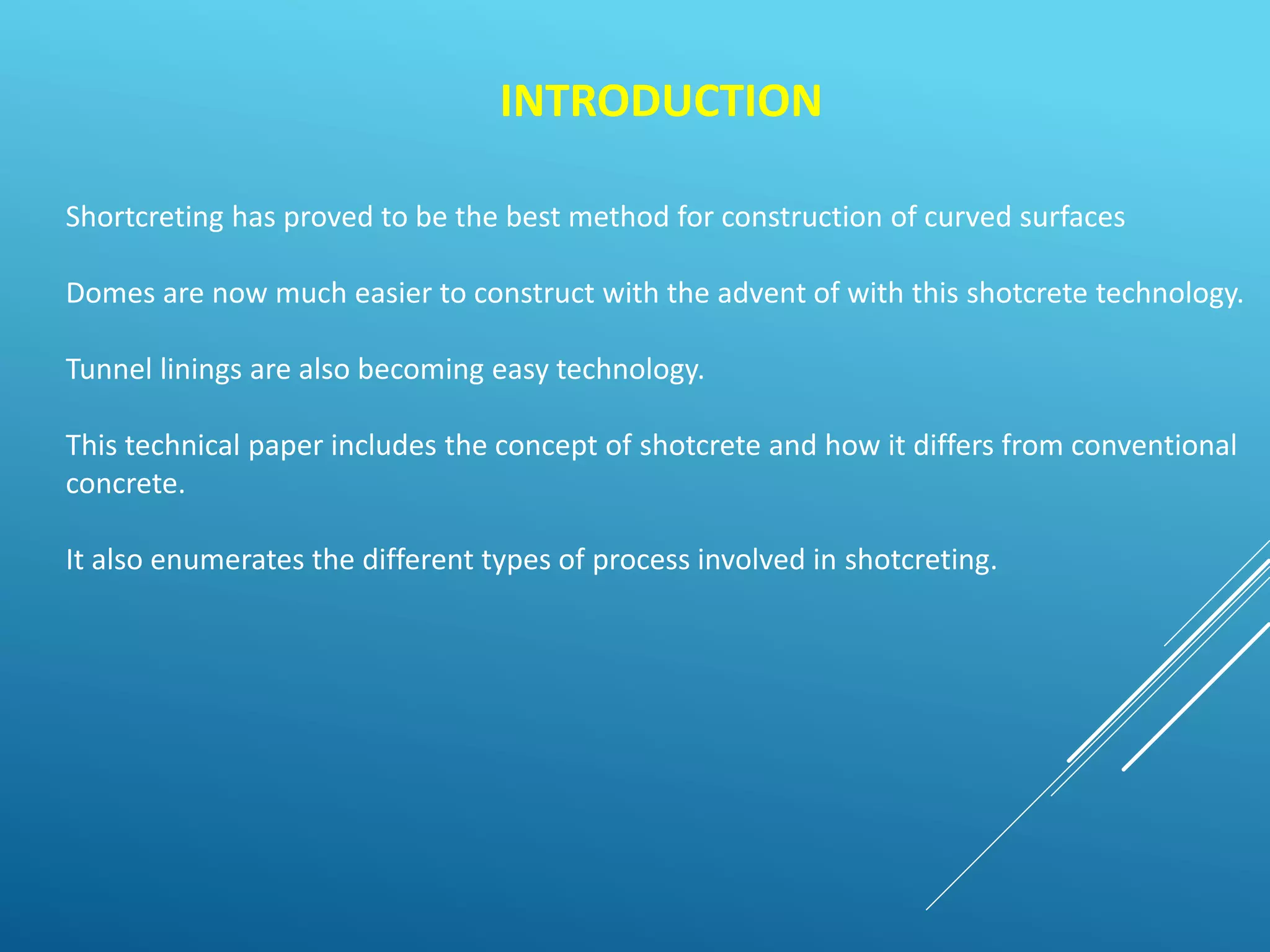
 Support of underground openings in tunnel, mines, drainage adits and
exploratory audits.
 Rock slope stabilization and support for excavated foundations, often in
conjuction with rock and soil anchor systems.
 Channel linings, protection of bridge abutments and stabilization of debris-flow
prone creeks.
 Rehabilitation of reinforced concrete structures such as bridges ,chemical
processing and handling plants.
 Rehabilitation of deteriorated marine structures such as bulkheads, piers, sea
Fig-1.6 Fig-1.7
APPLICATION OF SHOTCRETE
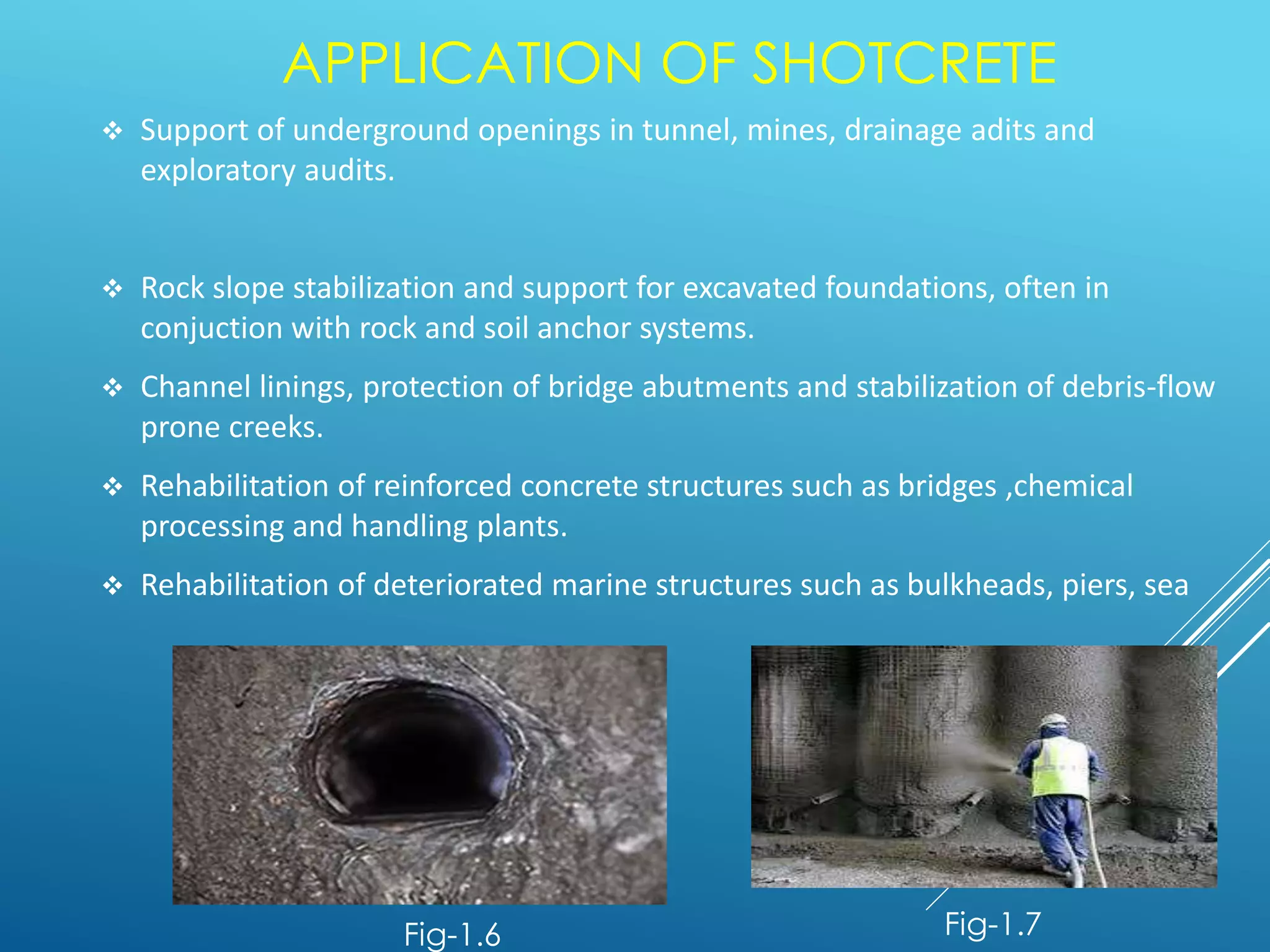
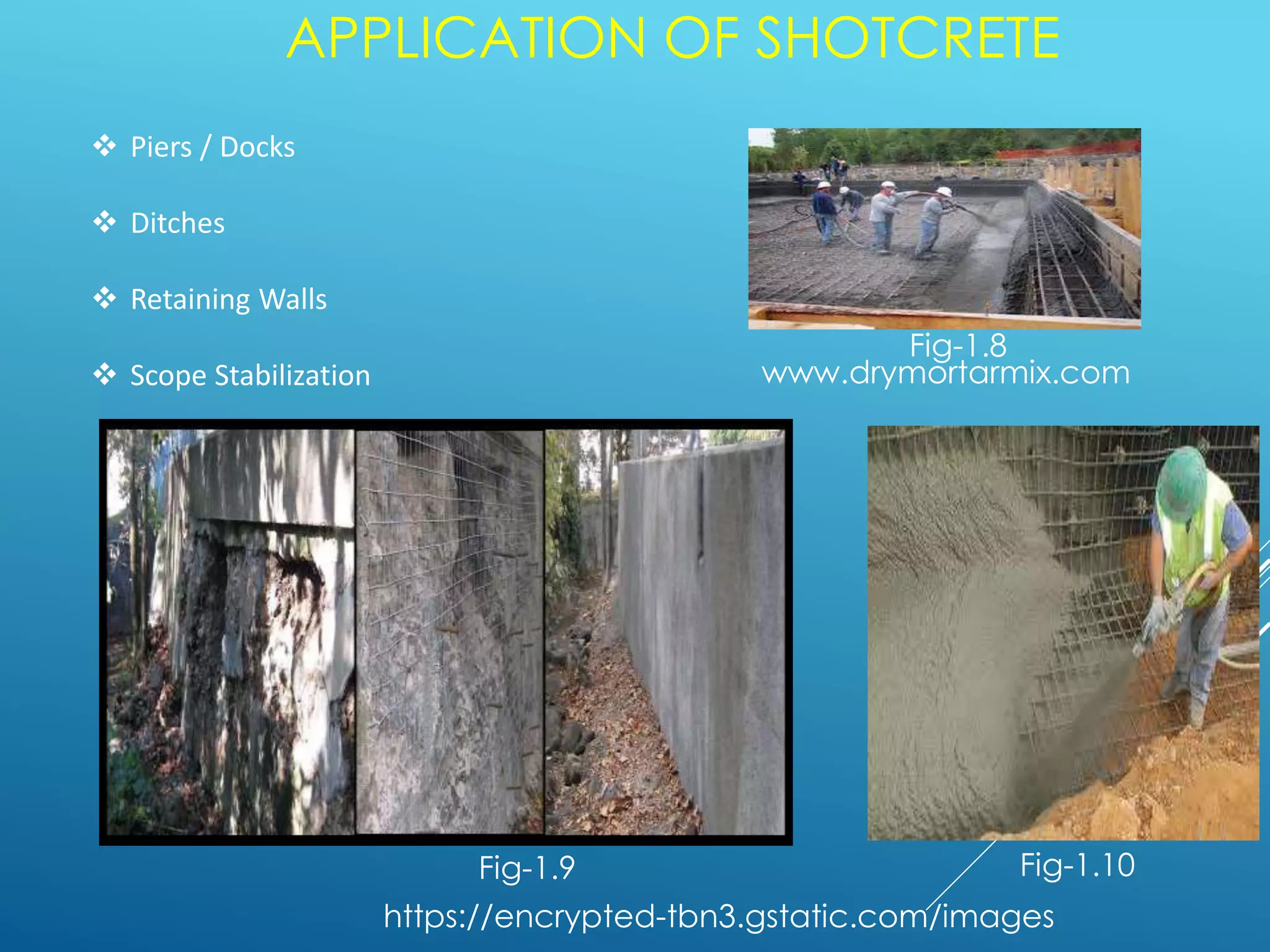
 Piers / Docks
 Ditches
 Retaining Walls
 Scope Stabilization
https://encrypted-tbn3.gstatic.com/images
Fig-1.8
Fig-1.9 Fig-1.10
www.drymortarmix.com
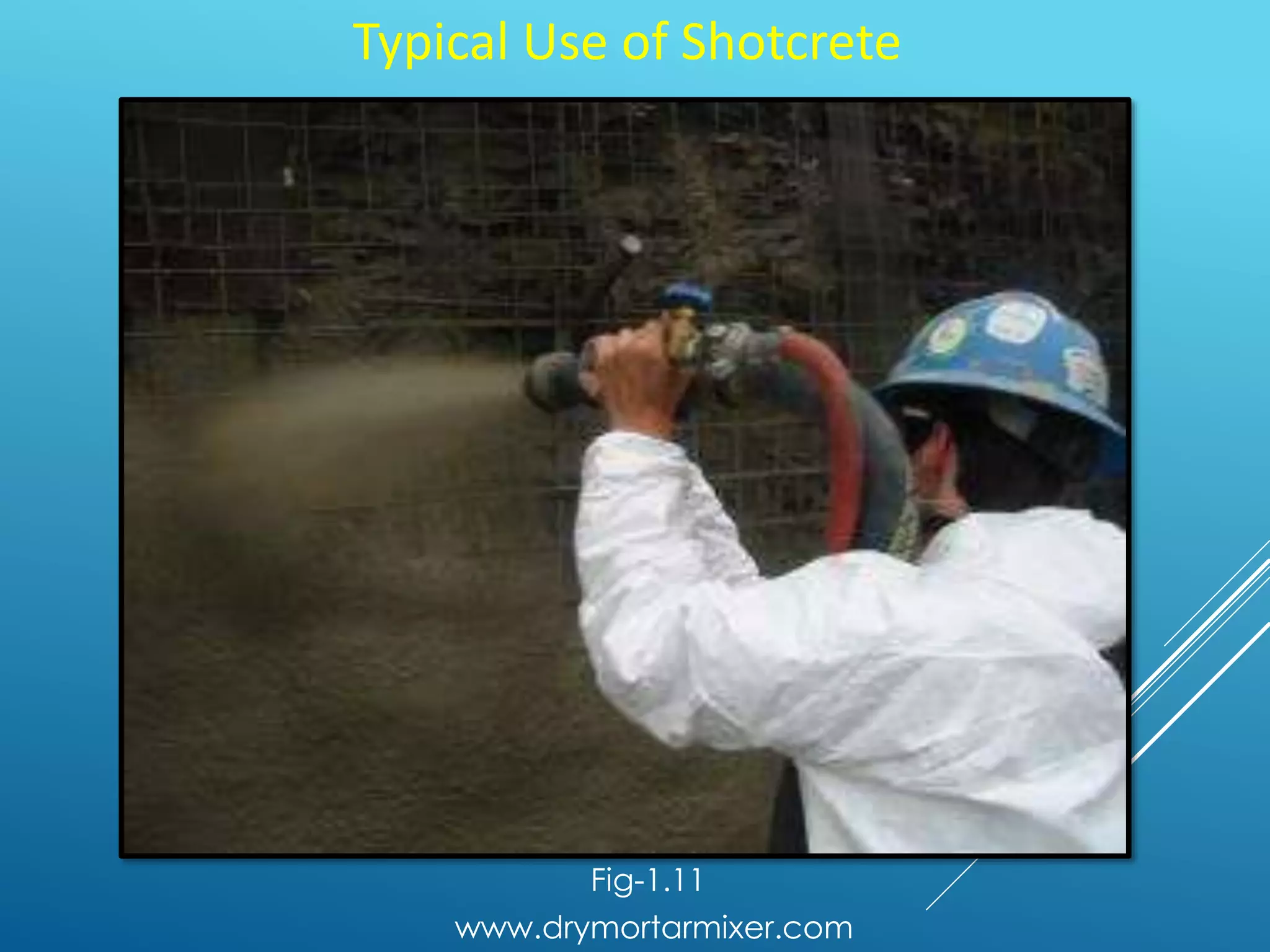
Typical Use of Shotcrete
www.drymortarmixer.com
Fig-1.11
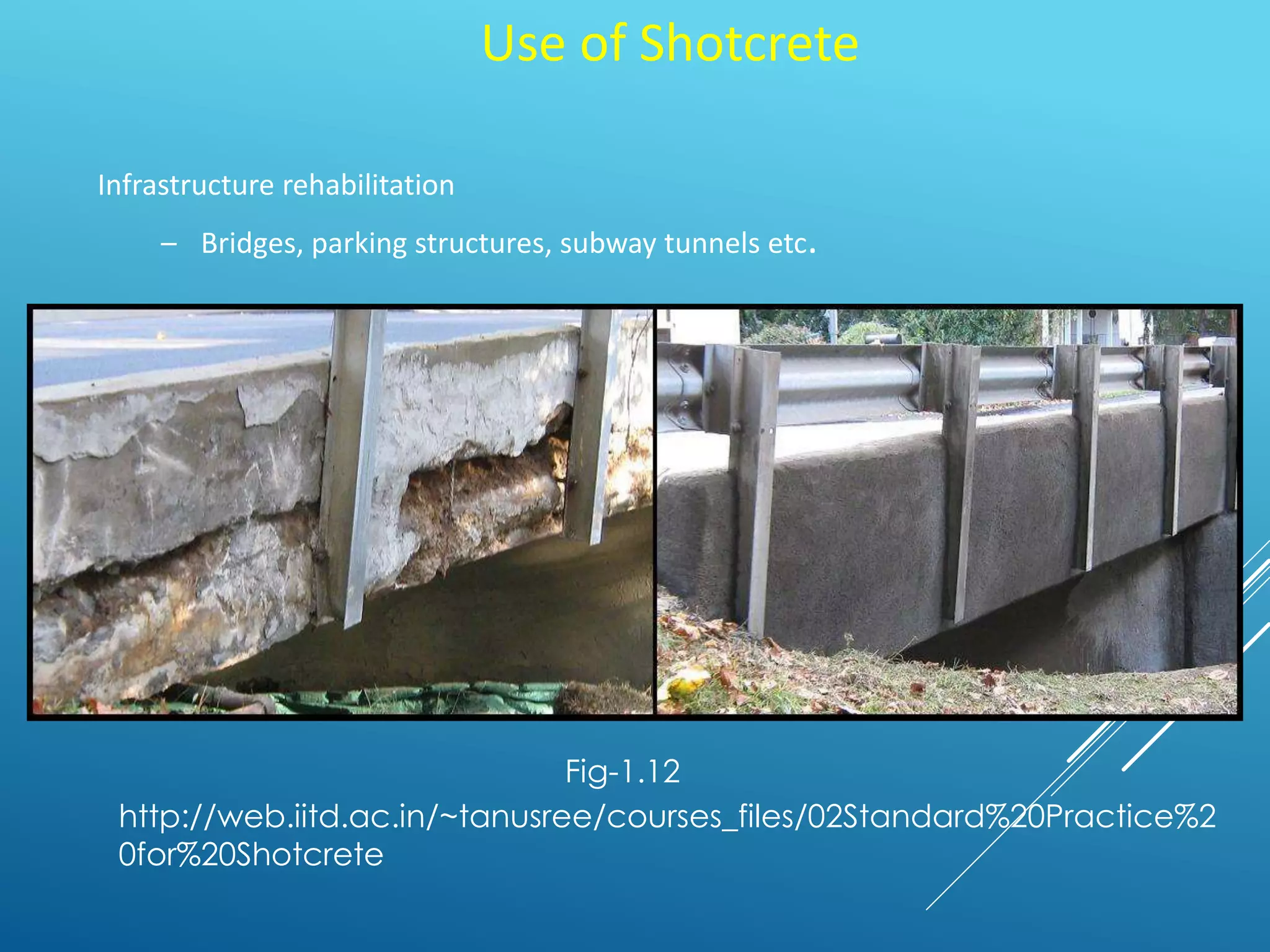
Use of Shotcrete
Infrastructure rehabilitation
– Bridges, parking structures, subway tunnels etc.
Fig-1.12
http://web.iitd.ac.in/~tanusree/courses_files/02Standard%20Practice%2
0for%20Shotcrete
Uses of Shotcrete
Fig-1.13
http://www.marylanddriveway.com/files/Concrete2010/StructuresAlbert
Pugliese.ppt
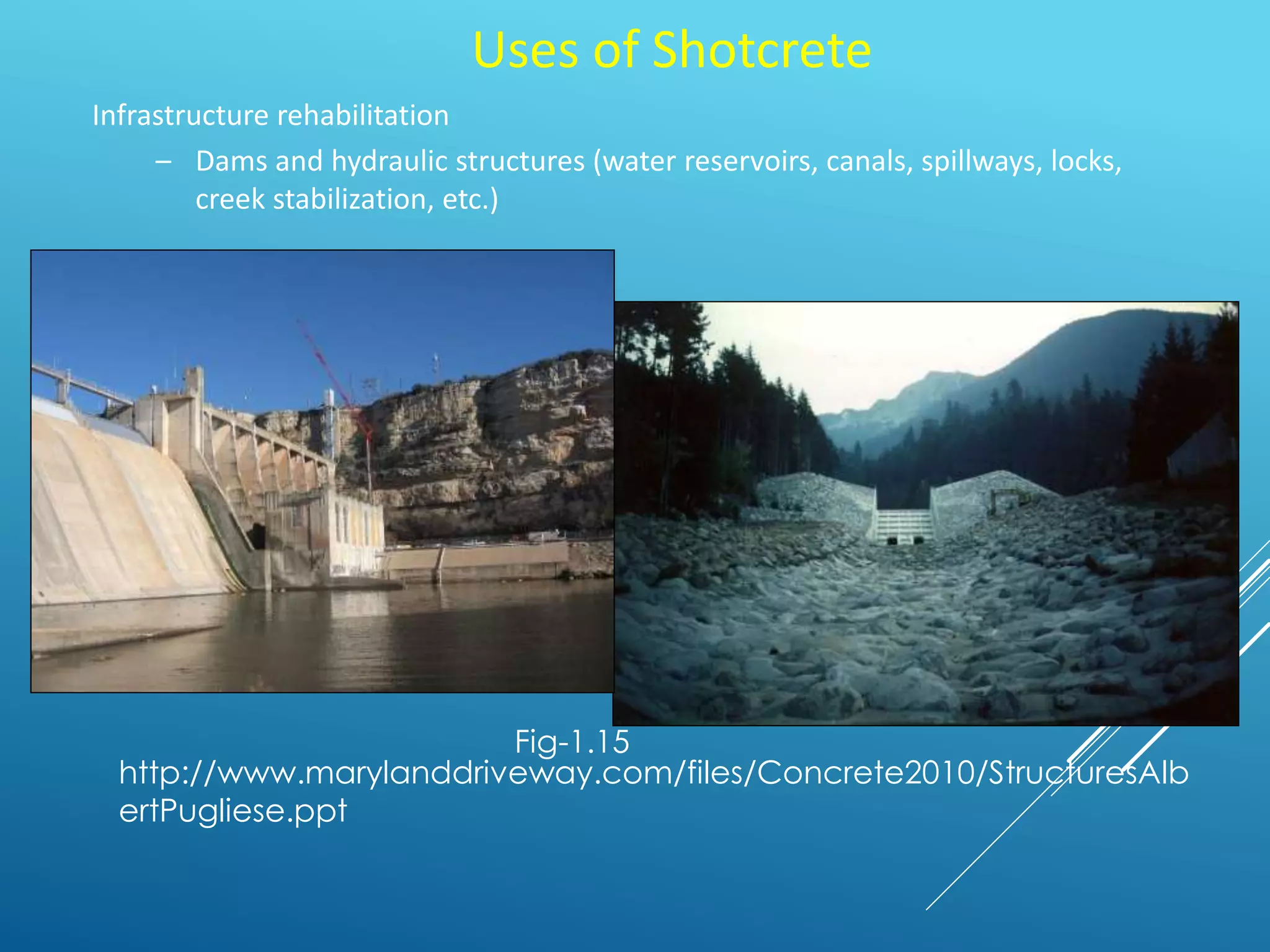
Uses of Shotcrete
Infrastructure rehabilitation
– Dams and hydraulic structures (water reservoirs, canals, spillways, locks,
creek stabilization, etc.)
Fig-1.15
http://www.marylanddriveway.com/files/Concrete2010/StructuresAlb
ertPugliese.ppt
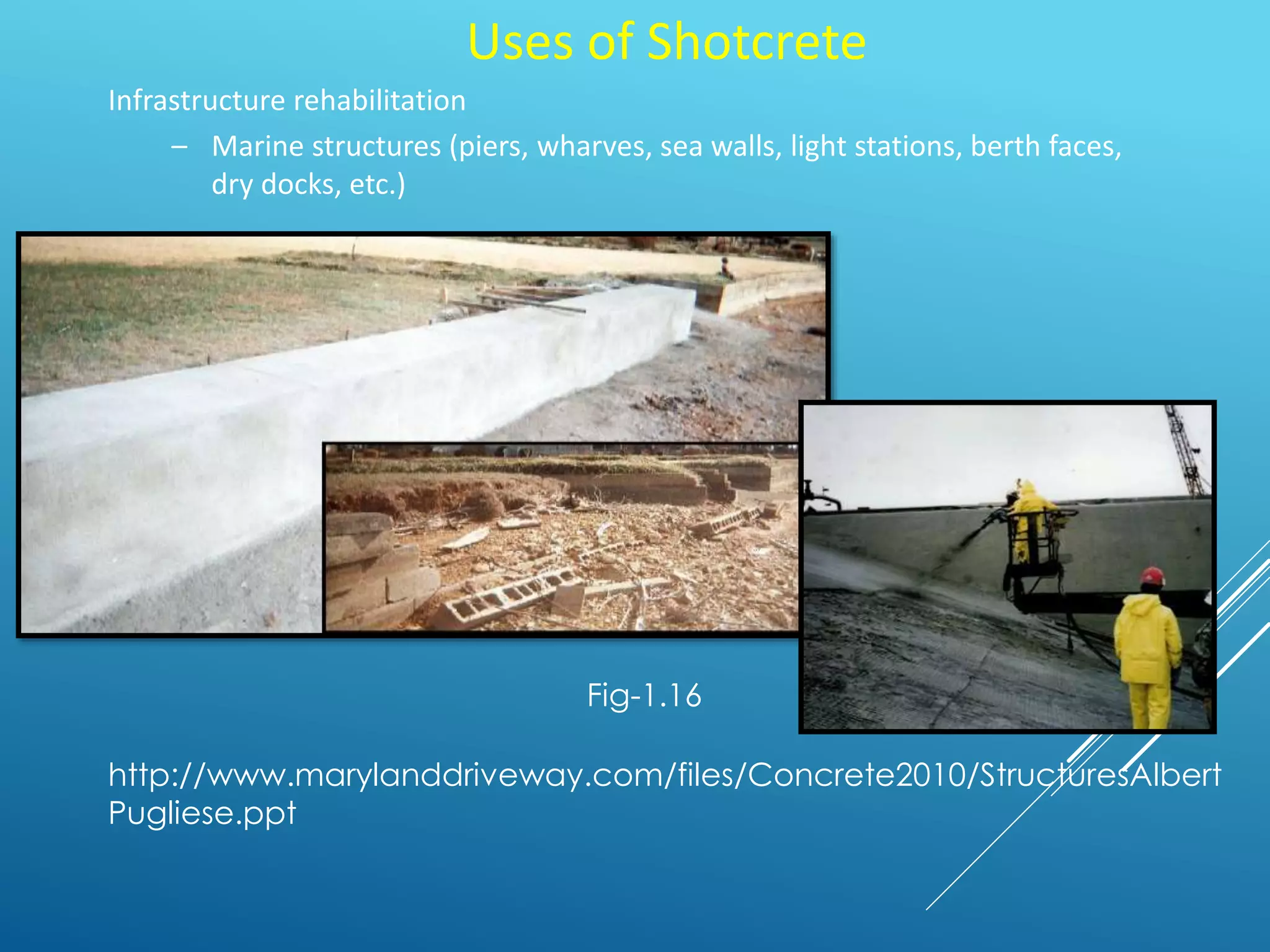
Uses of Shotcrete
Infrastructure rehabilitation
– Marine structures (piers, wharves, sea walls, light stations, berth faces,
dry docks, etc.)
Fig-1.16
http://www.marylanddriveway.com/files/Concrete2010/StructuresAlbert
Pugliese.ppt
ADVANTAGES
 Little or no framework is required.
 Cost effective method for placing concrete.
 Ideal for irregular surfaces application.
 Allows for easier material handling in areas with difficult access.
 Easy start up, shutdown and clean up.
 An increase in load bearing capacity due to redistribution of
stresses.
 Excellent corrosion resistance
2.ADVANTAGES
 Highway and railroad tunnels
 Mining operations
 Slope stabilization
 Building foundations
 Concrete repair & restoration
 Parking garages
 Housing
DISADVANTAGES
 Rain may wash out the cement leaving a sandy surface, or it may
saturate the shotcrete and cause sloughing or sagging
 Strong wind will separate the material between the nozzle and
the point of deposit, reducing the strength
 It requires skilled and experienced labours.
 A greater degree of geotechnical knowledge is required
 Improperly applied shotcrete may create conditions much worse
than the untreated condition
CONCLUSION
 The use of Shotcrete to build new concrete structures as well as
to restore and repair existing structures is well known and
documented and it is perhaps the most diverse method available
for concrete construction.
 The use of this innovative technology is increasing day by day and
procedures for its proper performance are well developed and
high quality work is regularly obtained.
 Shotcrete is a viable option for doing superstructure repair
(unformed) and substructure repair (unformed) if done strictly
according to specifications and best practices.
 It is a good substitute for the manual lay-up method for vertical
and overhead applications using rapid set mortar.
REFRENCES
 www.powershow.com/.../Scaling_and_Bolting_or_Shotcrete_powerpoint
 www.slideshare.net/MTarunkumarreddy/shotcrete-23966466
 https://www.google.co.in/#q=whwt+is+the+concepts+of+shotcrete+technology
 https://www.google.co.in/#q=shotcrete+technology+by+journOL
 www.scribd.com/doc/88509426/Concepts-of-Shot-Crete-Technology.
 http://www.sika.com/dms/getdocument.get/54526415-2059-3fb7-bfd6-
8ba8b55c664d/Fact%204_shotcrete_competence.
PPT ON SHOTCRETE TECHNOLGY BY MD AMANULLAH

PPT ON SHOTCRETE TECHNOLGY BY MD AMANULLAH

  • 1.
    DEEPSHIKHA KALA SANSTHANGROUP OF INSTITUTIONS JAIPUR A PRESENTATION ON CONCEPTS OF SHOTCRETE TECHNOLOGY UNDER THE GUIDANCE OF • MD AMANULLAH • B TECH (C.E) • SEM-7TH • ROLL NO-11EDGCE027 SUBMITTED BY- MR. RAJEEV KUMAR MR. JAMBU JAIN Assistant professor DKSGI JAIPUR
  • 2.
    CONTENT  INTRODUCTION  DEFINITIONOF SHOTCRETE  SHOTCRETE MATERIALS  EQUIPMENTS USED IN SHOTCRETE  SHOTCRETE VERSUS CONVENTIONAL CONCRETE  DRY PROCESSES  WET PROCESS  APPLICATIONS OF SHOTCRETE  ADVANTAGES  DISADVANTAGES  CONCLUSION  REFRENCES
  • 3.
    INTRODUCTION Shortcreting has provedto be the best method for construction of curved surfaces Domes are now much easier to construct with the advent of with this shotcrete technology. Tunnel linings are also becoming easy technology. This technical paper includes the concept of shotcrete and how it differs from conventional concrete. It also enumerates the different types of process involved in shotcreting.
  • 4.
    DEFINITION OF SHOTCRETE Shotcreteis a mortar or high performance concrete conveyed through a hose and pneumatically projected at high velocity onto a backing surface. applied mixture of cement, aggregate, and water conveyed through a hose and projected at high velocity onto the application surface. It is the force of this spraying action that leads to compaction of the concrete or mortar which then forms layers of concrete to the required thickness. Shotcreting has been an acceptable way of placing cementitious material in a variety of applications. This mechanism reduces the rebound waste that occurs through the shotcreting process and these fibers also resist plastic shrinkage and cracking through their ability to enhance the early stage tensile strength of concrete.
  • 5.
    HISTORY Shotcrete, then knownas gunite (/ˈgənīt/), was invented in 1907 by American taxidermi Akeley to repair the crumbling facade of the Field Columbian Museum in Chicago (the old Palace of Fine Arts from the World's Columbian Exposition. He used the method of blowing dry material out of a hose with compressed air, injecting water at the nozzle as it was released. In 1911, he was granted a patent for his inventions, the "cement gun", the equipment used, and "gunite", the material that was produced. There is no evidence that Akeley ever used sprayable concrete in his taxidermy work, as is sometimes suggested. F. Trubee Davison covered this and other Akeley inventions in a special issue of Natural History magazine[ Until the 1950s when the wet-mix process was devised, only the dry-mix process was used. In the 1960s, The alternative method for gunning by the dry method was devised with the development of the rotary gun, with an open hopper that could be fed continuously. Shotcrete is also a viable means and method for placing structural concrete.
  • 6.
    SHOTCRETE MATERIALS (SAME ASCONCRETE) • Portland Cement • Water • Sand • Admixtures / Fibers Difference : ??? • Applied via Compressed Air
  • 7.
    NOVEL SHOTCRETE MATERIALS POLYMER MODIFICATION  POZZOLANIC ADMIXTURES  FIBER REINFORCEMENT  LOW VELOCITY SHOTCRETE  STEEL FIBRE REINFORCED MICRO SILICA SHOTCRETE
  • 8.
    EQUIPMENTS USED INSHOTCRETE  Batching and mixing equipment  Admixture dispensers  Air COMPRESSOR  Nozzles  Shotcrete accelerator Fig-1.1 Fig-1.2 Cskeda.en.alibaba.c
  • 9.
    SHOTCRETE VERSUS CONVENTIONALCONCRETE  Unlike conventional concrete, which is first placed and then compacted in second operati  shotcrete undergoes placement and compaction at the same time due to the force with which it is projected from the nozzle.  Shotcrete is more dense, homogeneous, strong, and waterproof than is possible to obtain by any other process.  Shotcrete is not placed or contained by forms. It can be impacted onto any type or shape o surface, including vertical or overhead areas.
  • 10.
    WORKING OF DRYPROCESS PROCEEDS AS PER THE FOLLOWING STEPS:  Step1: Pre blended, dry or semi-dampened materials are placed into shotcrete equipment and metered into a hose.  Step2: Compressed air conveys materials at high velocity to the nozzle where the water is added.  Step3: Then the material is consolidated on receiving surface by high impact velocity .  The dry process can be used for any shotcreting applications from the smallest patching and sealing works to largest projects.  The maximum production achievable with dry process equipment ranges from 10-12 yards per hour of dry mix depending on the conditions.  Most applications have production rates of 2-6 cubic yards per hour of mix.
  • 11.
    DEFINITIONOFWETMIXSHOTCRETE  Shotcrete inwhich all of the ingredients, except accelerator, are mixed before introduction into the delivery hose. http://www.zzkaishan.en.alibaba.com Fig-1.4
  • 12.
    SHOTCRETE (WET MIX) Accelerator, if used, is added to the shotcrete mixture at the nozzle in such a way that the quantity can be properly regulated and monitored. http://www.concreteconstruction.net/images/Shotcrete%20Pu mps%20and%20Related%20Equipment_tcm45-342547. Fig-1.5
  • 13.
    WORKING OF WETPROCESS PROCEEDS AS PER THE FOLLOWING STEPS:  Step 1: Wet material is pumped to the nozzle where compressed air is introduced to  Step2: All ingredients, including water, are thoroughly mixed and introduced into the shotcrete equipment.  provide high velocity for placement and consolidation of the material onto the receiving surface.  Step 3: Mostly wet-process shotcreting is done with premixed mortar or small aggregate concrete.  The mix design and consistency of supply are very important in order to provide a mix with the workability or plasticity to be pumped through a small-diameter hose.  Sand gradation is same as for the dry process and for coarse aggregate mixes; 20-30 percent of 20mm aggregate is added. Cement content will vary according to agg.  However, most mixes contain approximately 700 pounds or more of cement.
  • 14.
    APPLICATION OF SHOTCRETE Support of underground openings in tunnel, mines, drainage adits and exploratory audits.  Rock slope stabilization and support for excavated foundations, often in conjuction with rock and soil anchor systems.  Channel linings, protection of bridge abutments and stabilization of debris-flow prone creeks.  Rehabilitation of reinforced concrete structures such as bridges ,chemical processing and handling plants.  Rehabilitation of deteriorated marine structures such as bulkheads, piers, sea Fig-1.6 Fig-1.7
  • 15.
    APPLICATION OF SHOTCRETE Piers / Docks  Ditches  Retaining Walls  Scope Stabilization https://encrypted-tbn3.gstatic.com/images Fig-1.8 Fig-1.9 Fig-1.10 www.drymortarmix.com
  • 16.
    Typical Use ofShotcrete www.drymortarmixer.com Fig-1.11
  • 17.
    Use of Shotcrete Infrastructurerehabilitation – Bridges, parking structures, subway tunnels etc. Fig-1.12 http://web.iitd.ac.in/~tanusree/courses_files/02Standard%20Practice%2 0for%20Shotcrete
  • 18.
  • 19.
    Uses of Shotcrete Infrastructurerehabilitation – Dams and hydraulic structures (water reservoirs, canals, spillways, locks, creek stabilization, etc.) Fig-1.15 http://www.marylanddriveway.com/files/Concrete2010/StructuresAlb ertPugliese.ppt
  • 20.
    Uses of Shotcrete Infrastructurerehabilitation – Marine structures (piers, wharves, sea walls, light stations, berth faces, dry docks, etc.) Fig-1.16 http://www.marylanddriveway.com/files/Concrete2010/StructuresAlbert Pugliese.ppt
  • 21.
    ADVANTAGES  Little orno framework is required.  Cost effective method for placing concrete.  Ideal for irregular surfaces application.  Allows for easier material handling in areas with difficult access.  Easy start up, shutdown and clean up.  An increase in load bearing capacity due to redistribution of stresses.  Excellent corrosion resistance
  • 22.
    2.ADVANTAGES  Highway andrailroad tunnels  Mining operations  Slope stabilization  Building foundations  Concrete repair & restoration  Parking garages  Housing
  • 23.
    DISADVANTAGES  Rain maywash out the cement leaving a sandy surface, or it may saturate the shotcrete and cause sloughing or sagging  Strong wind will separate the material between the nozzle and the point of deposit, reducing the strength  It requires skilled and experienced labours.  A greater degree of geotechnical knowledge is required  Improperly applied shotcrete may create conditions much worse than the untreated condition
  • 24.
    CONCLUSION  The useof Shotcrete to build new concrete structures as well as to restore and repair existing structures is well known and documented and it is perhaps the most diverse method available for concrete construction.  The use of this innovative technology is increasing day by day and procedures for its proper performance are well developed and high quality work is regularly obtained.  Shotcrete is a viable option for doing superstructure repair (unformed) and substructure repair (unformed) if done strictly according to specifications and best practices.  It is a good substitute for the manual lay-up method for vertical and overhead applications using rapid set mortar.
  • 25.
    REFRENCES  www.powershow.com/.../Scaling_and_Bolting_or_Shotcrete_powerpoint  www.slideshare.net/MTarunkumarreddy/shotcrete-23966466 https://www.google.co.in/#q=whwt+is+the+concepts+of+shotcrete+technology  https://www.google.co.in/#q=shotcrete+technology+by+journOL  www.scribd.com/doc/88509426/Concepts-of-Shot-Crete-Technology.  http://www.sika.com/dms/getdocument.get/54526415-2059-3fb7-bfd6- 8ba8b55c664d/Fact%204_shotcrete_competence.