Short Bowel Syndrome
Dr.Neelam Ahirwar
Objectives
 Definition
 Etiology
 Clinical manifestation
 Management
 prognosis
 Complication
Definition
 It is a malabsorpative state that may
follow massive resection of small intestine.
 There is no specific intestinal length at
which SBS well clinically present.
 The small intestine of the neonate is about
250 cm in length, 750 cm in adult.
 Infants have more favorable long term
prognosis.
 Factors that influence the length of time
until child independent of TPN
 Extent/ location of resection.
 Presence or absence of colon
 Presence /Absence of ICV.
 Degree of adaptation in remaining bowel.
 Extent of residual bowel disease or
complications e.g. adhesions, strictures
Etiology
 Congenital anomalies :
 Intestinal Atresia .
 Gastroschisis
 omphalocele
 Hirschsprung’s disease,
 Acquired :
Resection of bowel:
 NEC ,
 Crohn’s disease
 volulus,
 tumor ,
 radiation enteritis,
 ischemic injury
Manifestation
 Fluid & electlytes
imbalance.
 Steatorrhea
 Wt loss and malnutrition.
 Minerals def: Ca, Mg, Iron,
zinc, B12, fat soluble vit.
 Malabsorption of CHO and
protein.
 Metabolic acidosis.
 Gastric acid hypersecretion.
 Cholelithiasis.
 Liver disease, cholestasis.
 Bone disease.
 Complications related to
TPN.
Reduction of functioning bowel mass to below min
necessary to balance supply & demand of essential
body needs leading to intestinal failure manifested
as:
Manifestation related to site of
resection
 Duodenal resection
 Jejunal resection
 Ileal resection
 Loss of the ileocecal valve
 Colon
Duodenal resection
 Protein , CHO, fat maldigestion
 Ca, mg, iron, folate malabsorption
 Fat soluble vit deficiency
Jejunal resection
 CHO Malabsorption.
 Water soluble vit defiency .
 Malabsorption is transient (ileal
adaptation).
Ileal resection
 Steatorrhea as bile salts not absorbed.
 Cholesterol stones secondary to loss of bile
acids.
 Fat soluble vit def.
 B12 def
 Loss of ileal brake, decrease transit time
causing diarrhea.
Loss of the ileocecal valve
 Bacterial overgrowth: allows bacteria to
flux into ilium
 Rapid transit time that exacerbate
malabsorption.
Colon
 Role of The Colon:
 water absorption.
 It gives additional length, it slows transit time
and slows gasteric empting,
 But
 Deconjugation of bile acids by colonic bacteria &
secondary secretory diarrhea.
 lactic acidosis: conversion of CHO by
lactobacillus to D-lactic acid lead to high AG
metabolic acidosis,
Intestinal adaptation
 Starts 24-48 hrs post-op, (enteral feeds
as early as possible).
 Lasts up to 11-12 years .
 Change in morphorogy and functional
capacity.
Change in morphorogy
 Macroscopic
 Increase in length
 Microscopic
 Villus: increase height and diameter
 Crypt: elongation
 Epithelial cell life cycle: increase proliferation
 decrease apoptosis.
Change in functional capacity
 Increase absorption per unit length
 Upregulation of sodium glucose
transporter.
Lab investigation
 Blood
 U&E, bone profile, & mg, PRN then biweekly
 CBC, triglycerides, cholesterol Weekly
 Folate, vit B12, copper, zinc, Monthly
 Blood gas and AG for suspected lactic
acidosis.
Microbiology
 If sepsis suspected; blood & urine c/s
 Cultures from both the central and
peripheral sites.
 Consider opportunistic infections, so search
for fungal infection.
Imaging Studies
To assess for potential complications,
 Infection
 Abdominal ultrasonography to look for fungal balls in
the kidney
 Bowel obstruction
 Plain radiography.
 Barium imaging of the bowel
 Liver disease
 Abdominal US to study the liver, biliary tract, &
presence of ascites.
Management
 During early period after intestinal
resection, TPN to prevent fluid and
electrolytes imblance.
 Stomal & fecal losses replaced q 2 hrs with
solution separate from TPN.
 May develop gastric hypersecretion so give
H2 blocker
Management
 The goals of nutritional therapy
 1.Maintain adequate nutrition
 2.Promote intestinal adaptation
 3.Avoid complications
 TPN for the first 7-10 days
 TPN :30 kcal/kg/day
 Enteral feeding when hemodynamic
stable and fluid management stable.
 Continuous enteral feeds: to prevent
osmotic diarrhea.
 Bolus feeds less well tolerated.
 Formula osmolality should be < 310
mosm/kg.
Composition
 Protien hydrolysate or elemental diets
 Complex carbohydrate is better than
simple carbohydrate
 Oxalate restriction in patient with an
intact colon and fat malabsorption to avoid
stone formation.
 Lipid
 Medium-chain triglycerides
 Better absorbed in the presence of bile acid or
pancreatic insufficiency.
 Long-chain triglycerides : more effective
in stimulating intestinal adaptation
 Mix MCT + LCT
 Indications for continued parental
nutrition
 Poor weight gain or loss of maintenance weight.
 Extensive stomal fluid and electrolyte losses
which cannot be replaced orally.
Pharmacologic therapy
 Decrease stomal secretory losses
 H2 blockers, PPI & octreotide
 ??loperamide
 Ursodeoxycholic acid: Improves bile acid–dependent bile
flow.
 Antibiotics used to prevent small-bowel overgrowth.
 Insufficient data regarding -glutamine affects clinical
outcomes in infants.
 GH in children with SBS may have some benefit in those
with low or limited GH responsiveness.
Surgical Care
 Surgical care is related to venous access (ie,
central line placement to provide TPN).
 Gastrostomy tube placement to provide for
enteral access.
Nontransplantation procedures
 To improve the surface area or to slow transit
emptying time.
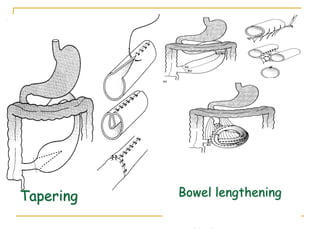
 Bianchi procedure (intestinal tapering or
lengthening)
 Indicated in small bowel with bacterial
overgrowth ,dilated bowel and continued
malabsorption
 Cutting bowel longitudinally, and create a segment
of bowel twice length, half diameter without loss
of mucosal surface area.
Tapering Bowel lengthening
 Indications
 Impending or overt liver failure
 IV access loss
 Frequent central line related sepsis
 Intestinal failure
Small bowel transplantation
Prognosis
 Ultimately patient with SBS may be
successfully wean from TPN although the
entire process may take several years.
 Intestinal transplantation should be
consider as a last resort.
Complications
 Early complications
 Catheter related
complication
 chronic complications
 liver & biliary disease
 Bacterial overgrowth
 D-lactic acidosis,
 Nutritional def,
Bacterial overgrowth
 Defined as increased bacterial content in the
small intestine
 Occurs if no Ileum , dilated bowel loops with
hypomotility segment & strictures.
 Clinically: N, V, distension, FTT, increase hepatic
injury from TPN , GI blood loss
 Also common cause of clinical deterioration in a
previously stable patient with SBS.
 Diagnosed duodenal fluid analysis, culture, stool
c/s, H2 breath test.
 This well leads to CHO malabsorption,
worsening of osmotic diarrhea, and
increased risk of metabolic acidosis and
dehydration.
 Treatment with antibiotic , including
administration of metronidazole
alternating with oral gentamicin.
 Should be cycled on a weekly or biweekly
basis.
Conclusion
 Early management of SBS replacement of fluid and
electrolytes.
 Enteral feeding should begin once the patient
stabilizes.
 Continuous enteral feeding or is preferred.
 For enteral feedings, hypoallergenic protein
hydrolysate formulas or breast milk are usually best
tolerated
 Several pharmacological approaches have been tested
to enhance intestinal adaptation and improve feeding
tolerance. None of these approaches are proven to be
helpful, but studies are ongoing.
Thanks

Short Bowel Syndrome.pptx

  • 1.
  • 2.
    Objectives  Definition  Etiology Clinical manifestation  Management  prognosis  Complication
  • 3.
    Definition  It isa malabsorpative state that may follow massive resection of small intestine.  There is no specific intestinal length at which SBS well clinically present.  The small intestine of the neonate is about 250 cm in length, 750 cm in adult.  Infants have more favorable long term prognosis.
  • 4.
     Factors thatinfluence the length of time until child independent of TPN  Extent/ location of resection.  Presence or absence of colon  Presence /Absence of ICV.  Degree of adaptation in remaining bowel.  Extent of residual bowel disease or complications e.g. adhesions, strictures
  • 5.
    Etiology  Congenital anomalies:  Intestinal Atresia .  Gastroschisis  omphalocele  Hirschsprung’s disease,  Acquired : Resection of bowel:  NEC ,  Crohn’s disease  volulus,  tumor ,  radiation enteritis,  ischemic injury
  • 6.
    Manifestation  Fluid &electlytes imbalance.  Steatorrhea  Wt loss and malnutrition.  Minerals def: Ca, Mg, Iron, zinc, B12, fat soluble vit.  Malabsorption of CHO and protein.  Metabolic acidosis.  Gastric acid hypersecretion.  Cholelithiasis.  Liver disease, cholestasis.  Bone disease.  Complications related to TPN. Reduction of functioning bowel mass to below min necessary to balance supply & demand of essential body needs leading to intestinal failure manifested as:
  • 7.
    Manifestation related tosite of resection  Duodenal resection  Jejunal resection  Ileal resection  Loss of the ileocecal valve  Colon
  • 8.
    Duodenal resection  Protein, CHO, fat maldigestion  Ca, mg, iron, folate malabsorption  Fat soluble vit deficiency
  • 9.
    Jejunal resection  CHOMalabsorption.  Water soluble vit defiency .  Malabsorption is transient (ileal adaptation).
  • 10.
    Ileal resection  Steatorrheaas bile salts not absorbed.  Cholesterol stones secondary to loss of bile acids.  Fat soluble vit def.  B12 def  Loss of ileal brake, decrease transit time causing diarrhea.
  • 11.
    Loss of theileocecal valve  Bacterial overgrowth: allows bacteria to flux into ilium  Rapid transit time that exacerbate malabsorption.
  • 12.
    Colon  Role ofThe Colon:  water absorption.  It gives additional length, it slows transit time and slows gasteric empting,  But  Deconjugation of bile acids by colonic bacteria & secondary secretory diarrhea.  lactic acidosis: conversion of CHO by lactobacillus to D-lactic acid lead to high AG metabolic acidosis,
  • 13.
    Intestinal adaptation  Starts24-48 hrs post-op, (enteral feeds as early as possible).  Lasts up to 11-12 years .  Change in morphorogy and functional capacity.
  • 14.
    Change in morphorogy Macroscopic  Increase in length  Microscopic  Villus: increase height and diameter  Crypt: elongation  Epithelial cell life cycle: increase proliferation  decrease apoptosis.
  • 15.
    Change in functionalcapacity  Increase absorption per unit length  Upregulation of sodium glucose transporter.
  • 16.
    Lab investigation  Blood U&E, bone profile, & mg, PRN then biweekly  CBC, triglycerides, cholesterol Weekly  Folate, vit B12, copper, zinc, Monthly  Blood gas and AG for suspected lactic acidosis.
  • 17.
    Microbiology  If sepsissuspected; blood & urine c/s  Cultures from both the central and peripheral sites.  Consider opportunistic infections, so search for fungal infection.
  • 18.
    Imaging Studies To assessfor potential complications,  Infection  Abdominal ultrasonography to look for fungal balls in the kidney  Bowel obstruction  Plain radiography.  Barium imaging of the bowel  Liver disease  Abdominal US to study the liver, biliary tract, & presence of ascites.
  • 19.
    Management  During earlyperiod after intestinal resection, TPN to prevent fluid and electrolytes imblance.  Stomal & fecal losses replaced q 2 hrs with solution separate from TPN.  May develop gastric hypersecretion so give H2 blocker
  • 20.
    Management  The goalsof nutritional therapy  1.Maintain adequate nutrition  2.Promote intestinal adaptation  3.Avoid complications
  • 21.
     TPN forthe first 7-10 days  TPN :30 kcal/kg/day  Enteral feeding when hemodynamic stable and fluid management stable.  Continuous enteral feeds: to prevent osmotic diarrhea.  Bolus feeds less well tolerated.  Formula osmolality should be < 310 mosm/kg.
  • 22.
    Composition  Protien hydrolysateor elemental diets  Complex carbohydrate is better than simple carbohydrate  Oxalate restriction in patient with an intact colon and fat malabsorption to avoid stone formation.
  • 23.
     Lipid  Medium-chaintriglycerides  Better absorbed in the presence of bile acid or pancreatic insufficiency.  Long-chain triglycerides : more effective in stimulating intestinal adaptation  Mix MCT + LCT
  • 24.
     Indications forcontinued parental nutrition  Poor weight gain or loss of maintenance weight.  Extensive stomal fluid and electrolyte losses which cannot be replaced orally.
  • 25.
    Pharmacologic therapy  Decreasestomal secretory losses  H2 blockers, PPI & octreotide  ??loperamide  Ursodeoxycholic acid: Improves bile acid–dependent bile flow.  Antibiotics used to prevent small-bowel overgrowth.  Insufficient data regarding -glutamine affects clinical outcomes in infants.  GH in children with SBS may have some benefit in those with low or limited GH responsiveness.
  • 26.
    Surgical Care  Surgicalcare is related to venous access (ie, central line placement to provide TPN).  Gastrostomy tube placement to provide for enteral access.
  • 27.
    Nontransplantation procedures  Toimprove the surface area or to slow transit emptying time.  Bianchi procedure (intestinal tapering or lengthening)  Indicated in small bowel with bacterial overgrowth ,dilated bowel and continued malabsorption  Cutting bowel longitudinally, and create a segment of bowel twice length, half diameter without loss of mucosal surface area.
  • 28.
  • 29.
     Indications  Impendingor overt liver failure  IV access loss  Frequent central line related sepsis  Intestinal failure Small bowel transplantation
  • 30.
    Prognosis  Ultimately patientwith SBS may be successfully wean from TPN although the entire process may take several years.  Intestinal transplantation should be consider as a last resort.
  • 31.
    Complications  Early complications Catheter related complication  chronic complications  liver & biliary disease  Bacterial overgrowth  D-lactic acidosis,  Nutritional def,
  • 32.
    Bacterial overgrowth  Definedas increased bacterial content in the small intestine  Occurs if no Ileum , dilated bowel loops with hypomotility segment & strictures.  Clinically: N, V, distension, FTT, increase hepatic injury from TPN , GI blood loss  Also common cause of clinical deterioration in a previously stable patient with SBS.  Diagnosed duodenal fluid analysis, culture, stool c/s, H2 breath test.
  • 33.
     This wellleads to CHO malabsorption, worsening of osmotic diarrhea, and increased risk of metabolic acidosis and dehydration.  Treatment with antibiotic , including administration of metronidazole alternating with oral gentamicin.  Should be cycled on a weekly or biweekly basis.
  • 34.
    Conclusion  Early managementof SBS replacement of fluid and electrolytes.  Enteral feeding should begin once the patient stabilizes.  Continuous enteral feeding or is preferred.  For enteral feedings, hypoallergenic protein hydrolysate formulas or breast milk are usually best tolerated  Several pharmacological approaches have been tested to enhance intestinal adaptation and improve feeding tolerance. None of these approaches are proven to be helpful, but studies are ongoing.
  • 35.