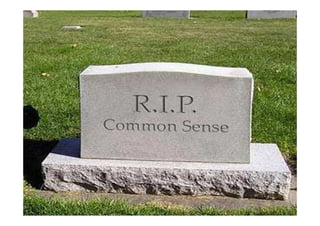
The Common Sense Approach
How a Value Investor Analyses a Business


              Don Fitzgerald, CFA - Shorex Geneva December 2011
Why Investment Process Matters?


                                  2
3
    3
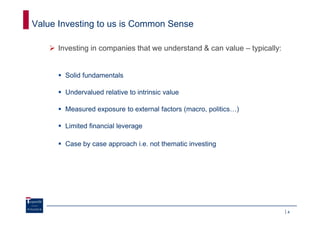
Value Investing to us is Common Sense

      Investing in companies that we understand & can value – typically:


        Solid fundamentals

        Undervalued relative to intrinsic value

        Measured exposure to external factors (macro, politics…)

        Limited financial leverage

        Case by case approach i.e. not thematic investing


                                                                           4
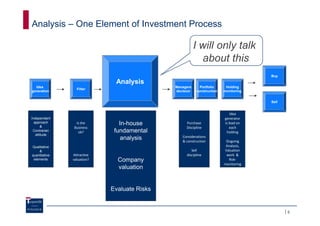
Analysis – One Element of Investment Process

                                                        I will only talk
                                                          about this
                                                                                    Buy
                             Analysis
  Idea                                       Managers     Portfolio     Holding
                 Filter
generation                                   decision   construction   monitoring


                                                                                    Sell


                                                                           Idea
Independant                                                            generator
  approach
       &
                Is the         In-house           Purchase             is lead on
               Business                           Discipline               each
 Contrarian      ok?         fundamental                                holding
   attitude
                                                Considerations
                                analysis        & construction          Ongoing
Qualitative                                                             Analysis,
    &                                                Sell              Valuation
quantitative   Attractive                         discipline            work &
 elements      valuation?     Company                                    Risk-
                                                                       monitoring
                              valuation


                            Evaluate Risks


                                                                                           5
Is this a good Business?


      What is business model?

      Understand sales process, customer relationships, production
      process

      Describe business to a ten year old

      Use past to get hints as to future

      Compare returns with competitors

      What kind of reinvestment of capital is needed to grow?


                                                                     6
Example: Baron de Ley – Spanish Wine-maker


     Medium Price Branded Rioja Wine

     15% self supply

     Competitive advantage – brand strength and reputation

     60% sales - domestic cash cow; 40% sales – International via
     wholesalers

     Exports drive growth

     Through cycle good returns: EBIT% : 26 to 33%; ROCE 9% to 15%


                                                                     7
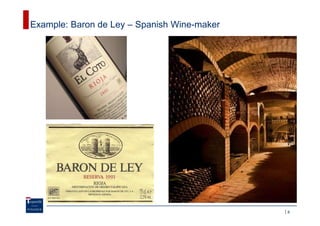
Example: Baron de Ley – Spanish Wine-maker


                                             8
Is this a Good Industry?

      Entry Barriers?
      Relative power :
            Customers
            Suppliers
            Competitors
            Regulators

      Pricing power?
      Key success factors
      Long-term demand drivers
      Industry changing?


                                 9
Example: Cement Industry – Capital Allocation Key

      Barriers to entry
            Ownership of quarries / environmental constraints
            Capital intensity
           Transport costs (High weight to value)
            Control over import terminals
            Vertical integration


                                       In Summary
                                              Extremely Capital Intensive
                                              Local Markets often local oligopolies
                                              Cyclical

                                       Therefore capital allocation is key
                                                                                      10
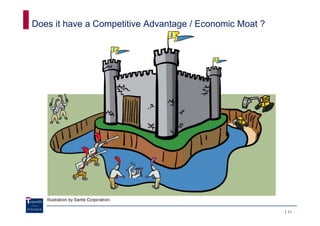
Does it have a Competitive Advantage / Economic Moat ?


                                                         11
What is a Moat?

     Intangible Assets
           Brands
           Patents
           Approvals & Licenses

     Customer Switching Costs

     Network Effect

     Distribution

     Cost Advantages
           Process
           Scale
           Low-Cost Resources


                                  12
Example: EKORNES


                   13
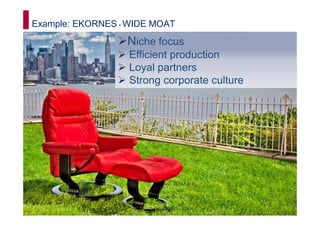
Example: EKORNES - WIDE MOAT
                  Niche focus
                   Efficient production
                   Loyal partners
                   Strong corporate culture


                                              14
The Numbers – Make Link with the Business


     10 year financial review
     Normalized earnings power
     Credibility of financial statements


                                            15
Profitability & Returns

      Visibility of earnings

      Gross Margins, EBIT Margins & ROCE

      Cost Structure

      Fixed or variable cost business? Operational leverage?

      What drives earnings - volume growth, price increases or margin
      improvement?


                                                                        16
Balance Sheet

     Capital structure

     Refinancing needs?

     Coverage ratios on interest payments?

     Trapped cash?

     Trends in inventory turns, days payable / receivables?

     Off Balance Sheet Liabilities


                                                              17
Cash Flow


     Does cash generation differ from reported earnings?

     Capital requirements & cash flow characteristics?

     Maintenance vs expansionary capex

     How does company invest its cash? CapEx? Dividends?
     Buybacks? Acquisitions?


                                                           18
Integrity of Financial Statements


      Accounting policies conservative? in line with their peers?

      Rapid inventory growth – stuffing the channel

      Growth of AR to sales and AP to sales

      Any accounting changes – smaller reserve for bad debt, revenue
      recognition, etc.


                                                                       19
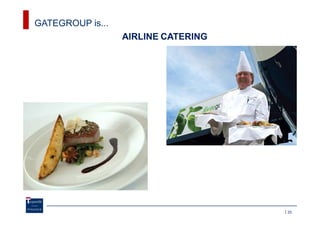
GATEGROUP is...
                  AIRLINE CATERING


                                     20
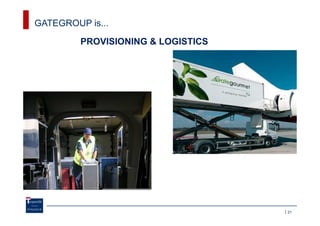
GATEGROUP is...

         PROVISIONING & LOGISTICS


                                    21
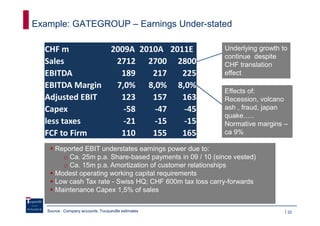
Example: GATEGROUP – Earnings Under-stated

  CHF m                             2009A 2010A 2011E       Underlying growth to
                                                            continue despite
  Sales                              2712 2700 2800         CHF translation
  EBITDA                              189    217   225      effect
  EBITDA Margin                      7,0% 8,0% 8,0%
                                                            Effects of:
  Adjusted EBIT                       123    157   163      Recession, volcano
  Capex                                -58   -47   -45      ash , fraud, japan
                                                            quake…..
  less taxes                           -21   -15   -15      Normative margins –
  FCF to Firm                         110    155   165      ca 9%

       Reported EBIT understates earnings power due to:
         o Ca. 25m p.a. Share-based payments in 09 / 10 (since vested)
         o Ca. 15m p.a. Amortization of customer relationships
       Modest operating working capital requirements
       Low cash Tax rate - Swiss HQ; CHF 600m tax loss carry-forwards
       Maintenance Capex 1,5% of sales

   Source : Company accounts, Tocqueville estimates                                22
Assess Management

     Background? Reputation? Track record?


     Interests aligned?


     Buying or selling stock?


     Good at allocating capital?


     Smart Operators?


                                             23
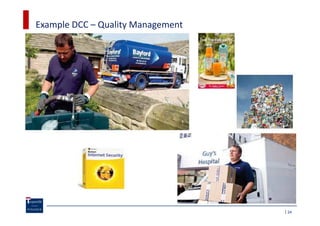
Example DCC – Quality Management


                                   24
Example: DCC – High Quality Management

     Building leading positions


      Contrarian perspective - Investing capital where others exit


      Smart Operators


     Incentives Aligned


      Financial discipline


                                                                     25
Identify Risks

       Business Risks : Threats to the business model? Over-earning ?


       Macro-economic Risks


      Financial Risks: Operational & financial leverage ? Off Balance
      Sheet? Funding?


       Market Risk: Where we diverge from consensus perception?


              Key Goal - Avoid permanent capital impairment


                                                                        26
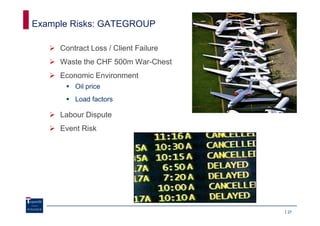
Example Risks: GATEGROUP

     Contract Loss / Client Failure
     Waste the CHF 500m War-Chest
     Economic Environment
         Oil price
         Load factors

     Labour Dispute
     Event Risk


                                      27
Other Factors


      What is the major misperception?

      Any catalysts?

      Significant pending newsflow

      Ownership structure

      Is there a better owner? Is it a target?


                                                 28
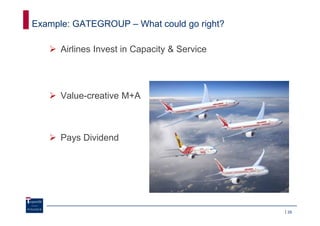
Example: GATEGROUP – What could go right?

      Airlines Invest in Capacity & Service


      Value-creative M+A


      Pays Dividend


                                              29
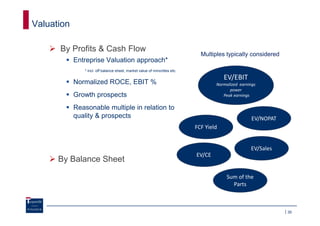
Valuation

      By Profits & Cash Flow
                                                                              Multiples typically considered
            Entreprise Valuation approach*
               * incl. off balance sheet, market value of minorities etc.
                                                                                        EV/EBIT
            Normalized ROCE, EBIT %                                                 Normalized earnings
                                                                                          power
            Growth prospects                                                           Peak earnings

            Reasonable multiple in relation to
            quality & prospects                                                                      EV/NOPAT
                                                                            FCF Yield


                                                                                                    EV/Sales
                                                                            EV/CE
      By Balance Sheet

                                                                                         Sum of the
                                                                                           Parts


                                                                                                                30
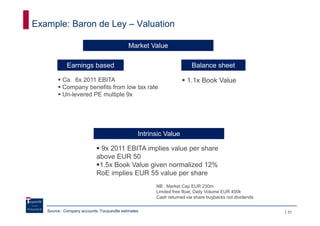
Example: Baron de Ley – Valuation

                                             Market Value

             Earnings based                                             Balance sheet

          Ca. 6x 2011 EBITA                                           1.1x Book Value
          Company benefits from low tax rate
          Un-levered PE multiple 9x


                                                  Intrinsic Value

                             9x 2011 EBITA implies value per share
                            above EUR 50
                             1.5x Book Value given normalized 12%
                            RoE implies EUR 55 value per share
                                                        NB : Market Cap EUR 230m
                                                        Limited free float, Daily Volume EUR 400k
                                                        Cash returned via share buybacks not dividends

   Source : Company accounts, Tocqueville estimates                                                      31
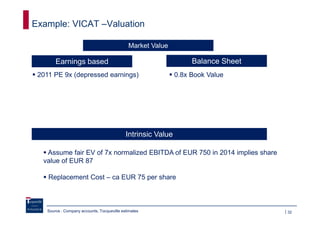
Example: VICAT –Valuation

                                              Market Value

        Earnings based                                              Balance Sheet
 2011 PE 9x (depressed earnings)                               0.8x Book Value


                                             Intrinsic Value

   Assume fair EV of 7x normalized EBITDA of EUR 750 in 2014 implies share
  value of EUR 87

    Replacement Cost – ca EUR 75 per share


    Source : Company accounts, Tocqueville estimates                                32
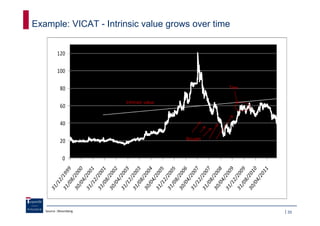
Example: VICAT - Intrinsic value grows over time


          120

          100

            80                                     Trim


                        Intrinsic value
            60

            40

                                          Bought
            20

              0


   Source : Bloomberg                                     33
Did the patient survive our process?


                                       34
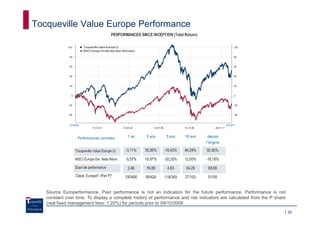
Tocqueville Value Europe Performance


   Source Europerformance. Past performance is not an indication for the future performance. Performance is not
   constant over time. To display a complete history of performance and risk indicators are calculated from the P share
   (real fixed management fees: 1.20%) for periods prior to 09/10/2008
                                                                                                                          35
Tocqueville Value Europe – Volatility and Awards

            Lower volatility over the long term

                                                          Tocqueville Value
                        Volatility                                                             MSCI Europe TR
                                                              Europe

       1 month                                                   21.69%                                29.78%
       1 year                                                    14.86%                                19.50%
       3 years                                                   14.21%                                17.77%
       5 years                                                   16.53%                                18.40%
       Since inception                                           14.63%                                16.88%


  Don Fitzgerald
  Sébastien Lemonnier
Citywire – Category European Equities


           Ranked 5th/109 in category since inception (from 31/03/00 to 31/10/2011)
     Source Europerformance. Past performance is not an indication for the future performance. Performance is not constant over time.
                                                                                                                                        36
Tocqueville Value Europe: Main Features


     Independent approach and contrarian attitude


     Limited Restrictions in terms of geography, sector or market capitalisation
         At least 75% invested in equities of EU-based companies


     Bottom-up approach for Fundamental Company Analysis
         Index-agnostic portfolio management


     Long-Term investment horizon

     Diversified Portfolio : 50-80 equity positions
         No position represents more than 5% of the total portfolio


                                                                                   37
Fund Managers of Tocqueville Value Europe


           Don Fitzgerald, CFA (36)

             Investment and finance professional in Europe for the past fifteen years and spent the
           last eight years identifying, analyzing and managing portfolios of undervalued securities
           in the European equity and distressed debt markets.

            Prior to that seven years in corporate and investment banking.

            Worked in Dublin, London, Frankfurt and Paris.

             Completed the CFA program in 2006 and graduated from Trinity College Dublin with a
           first class honours degree in Business Studies and German in 1996.

            Don co-manages the Tocqueville Value Europe fund. The fund’s multi-capitalization
           investment strategy is contrarian and value-oriented and stock selection is bottom-up,
           based upon intensive proprietary research and a disciplined investment process.
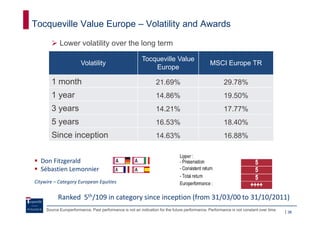
            Don is rated A by Citywire for risk-adjusted returns and the fund ranks among the top-
           performing European equity mutual funds over the past decade with five out of five
           ratings from Lipper in all categories


                                                                                                     38
Fund Managers of Tocqueville Value Europe


           Sébastien Lemonnier (32)

            Fund manager at Tocqueville Finance since January 2006

            Since 2003 dedicated financial analyst at Tocqueville Finance for Tocqueville Value
           Europe

             Master « Financial Management » from Université Paris I – Panthéon Sorbonne
           (2003)

            Sébastien co-manages the Tocqueville Value Europe fund. The fund’s multi-
           capitalization investment strategy is contrarian and value-oriented and stock selection
           is bottom-up, based upon intensive proprietary research and a disciplined investment
           process.
             Sébastien is rated A by Citywire for risk-adjusted returns and the fund ranks among
           the top-performing European equity mutual funds over the past decade with five out of
           five ratings from Lipper in all categories


                                                                                                     39
Disclaimer
   • This document is strictly confidential and for the use of intended recipients only. It may not be reproduced,
   communicated or published in its entirety or in part, without the prior written authorisation of Tocqueville Finance
   S.A.

   • This commercial document should not be interpreted as a contractual or pre-contractual commitment on the
   part of Tocqueville Finance S.A. It is produced purely for illustrative purposes and may be amended at any time
   without previous notice.

   • The information/analyses contained in this document, particularly figures, have come partly from external
   sources considered to be trustworthy. However, Tocqueville Finance SA cannot guarantee that the
   information/analyses are complete, accurate and up-to-date.

   • Tocqueville Finance S.A. draws investors’ attention to the fact that past performances are presented on the
   basis of figures relating to previous years and are not an indication of future performance.

   • Moreover, Tocqueville Finance S.A. in no way guarantees the current or future performances of funds cited in
   this document

   • Investors are reminded that any financial investment includes risks (market risks, capital risk, foreign exchange
   risk) that may result in financial losses. Therefore, Tocqueville Finance S.A. recommends that prior to any
   investment, the recipient of this document carefully reads the prospectuses of the cited funds which are available
   free of charge at its head office located 8 rue Lamennais, Paris 75008 or on its website
   www.tocquevillefinance.eu and ensures that they have the experience and knowledge needed to make an
   investment decision, particularly with regard to the legal and tax implications.


                                                                                                                          40

How to Value a Business

  • 1.
    The Common SenseApproach How a Value Investor Analyses a Business Don Fitzgerald, CFA - Shorex Geneva December 2011
  • 2.
  • 3.
    3 3
  • 4.
    Value Investing tous is Common Sense Investing in companies that we understand & can value – typically: Solid fundamentals Undervalued relative to intrinsic value Measured exposure to external factors (macro, politics…) Limited financial leverage Case by case approach i.e. not thematic investing 4
  • 5.
    Analysis – OneElement of Investment Process I will only talk about this Buy Analysis Idea Managers Portfolio Holding Filter generation decision construction monitoring Sell Idea Independant generator approach & Is the In-house Purchase is lead on Business Discipline each Contrarian ok? fundamental holding attitude Considerations analysis & construction Ongoing Qualitative Analysis, & Sell Valuation quantitative Attractive discipline work & elements valuation? Company Risk- monitoring valuation Evaluate Risks 5
  • 6.
    Is this agood Business? What is business model? Understand sales process, customer relationships, production process Describe business to a ten year old Use past to get hints as to future Compare returns with competitors What kind of reinvestment of capital is needed to grow? 6
  • 7.
    Example: Baron deLey – Spanish Wine-maker Medium Price Branded Rioja Wine 15% self supply Competitive advantage – brand strength and reputation 60% sales - domestic cash cow; 40% sales – International via wholesalers Exports drive growth Through cycle good returns: EBIT% : 26 to 33%; ROCE 9% to 15% 7
  • 8.
    Example: Baron deLey – Spanish Wine-maker 8
  • 9.
    Is this aGood Industry? Entry Barriers? Relative power : Customers Suppliers Competitors Regulators Pricing power? Key success factors Long-term demand drivers Industry changing? 9
  • 10.
    Example: Cement Industry– Capital Allocation Key Barriers to entry Ownership of quarries / environmental constraints Capital intensity Transport costs (High weight to value) Control over import terminals Vertical integration In Summary Extremely Capital Intensive Local Markets often local oligopolies Cyclical Therefore capital allocation is key 10
  • 11.
    Does it havea Competitive Advantage / Economic Moat ? 11
  • 12.
    What is aMoat? Intangible Assets Brands Patents Approvals & Licenses Customer Switching Costs Network Effect Distribution Cost Advantages Process Scale Low-Cost Resources 12
  • 13.
  • 14.
    Example: EKORNES -WIDE MOAT Niche focus Efficient production Loyal partners Strong corporate culture 14
  • 15.
    The Numbers –Make Link with the Business 10 year financial review Normalized earnings power Credibility of financial statements 15
  • 16.
    Profitability & Returns Visibility of earnings Gross Margins, EBIT Margins & ROCE Cost Structure Fixed or variable cost business? Operational leverage? What drives earnings - volume growth, price increases or margin improvement? 16
  • 17.
    Balance Sheet Capital structure Refinancing needs? Coverage ratios on interest payments? Trapped cash? Trends in inventory turns, days payable / receivables? Off Balance Sheet Liabilities 17
  • 18.
    Cash Flow Does cash generation differ from reported earnings? Capital requirements & cash flow characteristics? Maintenance vs expansionary capex How does company invest its cash? CapEx? Dividends? Buybacks? Acquisitions? 18
  • 19.
    Integrity of FinancialStatements Accounting policies conservative? in line with their peers? Rapid inventory growth – stuffing the channel Growth of AR to sales and AP to sales Any accounting changes – smaller reserve for bad debt, revenue recognition, etc. 19
  • 20.
    GATEGROUP is... AIRLINE CATERING 20
  • 21.
    GATEGROUP is... PROVISIONING & LOGISTICS 21
  • 22.
    Example: GATEGROUP –Earnings Under-stated CHF m 2009A 2010A 2011E Underlying growth to continue despite Sales 2712 2700 2800 CHF translation EBITDA 189 217 225 effect EBITDA Margin 7,0% 8,0% 8,0% Effects of: Adjusted EBIT 123 157 163 Recession, volcano Capex -58 -47 -45 ash , fraud, japan quake….. less taxes -21 -15 -15 Normative margins – FCF to Firm 110 155 165 ca 9% Reported EBIT understates earnings power due to: o Ca. 25m p.a. Share-based payments in 09 / 10 (since vested) o Ca. 15m p.a. Amortization of customer relationships Modest operating working capital requirements Low cash Tax rate - Swiss HQ; CHF 600m tax loss carry-forwards Maintenance Capex 1,5% of sales Source : Company accounts, Tocqueville estimates 22
  • 23.
    Assess Management Background? Reputation? Track record? Interests aligned? Buying or selling stock? Good at allocating capital? Smart Operators? 23
  • 24.
    Example DCC –Quality Management 24
  • 25.
    Example: DCC –High Quality Management Building leading positions Contrarian perspective - Investing capital where others exit Smart Operators Incentives Aligned Financial discipline 25
  • 26.
    Identify Risks Business Risks : Threats to the business model? Over-earning ? Macro-economic Risks Financial Risks: Operational & financial leverage ? Off Balance Sheet? Funding? Market Risk: Where we diverge from consensus perception? Key Goal - Avoid permanent capital impairment 26
  • 27.
    Example Risks: GATEGROUP Contract Loss / Client Failure Waste the CHF 500m War-Chest Economic Environment Oil price Load factors Labour Dispute Event Risk 27
  • 28.
    Other Factors What is the major misperception? Any catalysts? Significant pending newsflow Ownership structure Is there a better owner? Is it a target? 28
  • 29.
    Example: GATEGROUP –What could go right? Airlines Invest in Capacity & Service Value-creative M+A Pays Dividend 29
  • 30.
    Valuation By Profits & Cash Flow Multiples typically considered Entreprise Valuation approach* * incl. off balance sheet, market value of minorities etc. EV/EBIT Normalized ROCE, EBIT % Normalized earnings power Growth prospects Peak earnings Reasonable multiple in relation to quality & prospects EV/NOPAT FCF Yield EV/Sales EV/CE By Balance Sheet Sum of the Parts 30
  • 31.
    Example: Baron deLey – Valuation Market Value Earnings based Balance sheet Ca. 6x 2011 EBITA 1.1x Book Value Company benefits from low tax rate Un-levered PE multiple 9x Intrinsic Value 9x 2011 EBITA implies value per share above EUR 50 1.5x Book Value given normalized 12% RoE implies EUR 55 value per share NB : Market Cap EUR 230m Limited free float, Daily Volume EUR 400k Cash returned via share buybacks not dividends Source : Company accounts, Tocqueville estimates 31
  • 32.
    Example: VICAT –Valuation Market Value Earnings based Balance Sheet 2011 PE 9x (depressed earnings) 0.8x Book Value Intrinsic Value Assume fair EV of 7x normalized EBITDA of EUR 750 in 2014 implies share value of EUR 87 Replacement Cost – ca EUR 75 per share Source : Company accounts, Tocqueville estimates 32
  • 33.
    Example: VICAT -Intrinsic value grows over time 120 100 80 Trim Intrinsic value 60 40 Bought 20 0 Source : Bloomberg 33
  • 34.
    Did the patientsurvive our process? 34
  • 35.
    Tocqueville Value EuropePerformance Source Europerformance. Past performance is not an indication for the future performance. Performance is not constant over time. To display a complete history of performance and risk indicators are calculated from the P share (real fixed management fees: 1.20%) for periods prior to 09/10/2008 35
  • 36.
    Tocqueville Value Europe– Volatility and Awards Lower volatility over the long term Tocqueville Value Volatility MSCI Europe TR Europe 1 month 21.69% 29.78% 1 year 14.86% 19.50% 3 years 14.21% 17.77% 5 years 16.53% 18.40% Since inception 14.63% 16.88% Don Fitzgerald Sébastien Lemonnier Citywire – Category European Equities Ranked 5th/109 in category since inception (from 31/03/00 to 31/10/2011) Source Europerformance. Past performance is not an indication for the future performance. Performance is not constant over time. 36
  • 37.
    Tocqueville Value Europe:Main Features Independent approach and contrarian attitude Limited Restrictions in terms of geography, sector or market capitalisation At least 75% invested in equities of EU-based companies Bottom-up approach for Fundamental Company Analysis Index-agnostic portfolio management Long-Term investment horizon Diversified Portfolio : 50-80 equity positions No position represents more than 5% of the total portfolio 37
  • 38.
    Fund Managers ofTocqueville Value Europe Don Fitzgerald, CFA (36) Investment and finance professional in Europe for the past fifteen years and spent the last eight years identifying, analyzing and managing portfolios of undervalued securities in the European equity and distressed debt markets. Prior to that seven years in corporate and investment banking. Worked in Dublin, London, Frankfurt and Paris. Completed the CFA program in 2006 and graduated from Trinity College Dublin with a first class honours degree in Business Studies and German in 1996. Don co-manages the Tocqueville Value Europe fund. The fund’s multi-capitalization investment strategy is contrarian and value-oriented and stock selection is bottom-up, based upon intensive proprietary research and a disciplined investment process. Don is rated A by Citywire for risk-adjusted returns and the fund ranks among the top- performing European equity mutual funds over the past decade with five out of five ratings from Lipper in all categories 38
  • 39.
    Fund Managers ofTocqueville Value Europe Sébastien Lemonnier (32) Fund manager at Tocqueville Finance since January 2006 Since 2003 dedicated financial analyst at Tocqueville Finance for Tocqueville Value Europe Master « Financial Management » from Université Paris I – Panthéon Sorbonne (2003) Sébastien co-manages the Tocqueville Value Europe fund. The fund’s multi- capitalization investment strategy is contrarian and value-oriented and stock selection is bottom-up, based upon intensive proprietary research and a disciplined investment process. Sébastien is rated A by Citywire for risk-adjusted returns and the fund ranks among the top-performing European equity mutual funds over the past decade with five out of five ratings from Lipper in all categories 39
  • 40.
    Disclaimer • This document is strictly confidential and for the use of intended recipients only. It may not be reproduced, communicated or published in its entirety or in part, without the prior written authorisation of Tocqueville Finance S.A. • This commercial document should not be interpreted as a contractual or pre-contractual commitment on the part of Tocqueville Finance S.A. It is produced purely for illustrative purposes and may be amended at any time without previous notice. • The information/analyses contained in this document, particularly figures, have come partly from external sources considered to be trustworthy. However, Tocqueville Finance SA cannot guarantee that the information/analyses are complete, accurate and up-to-date. • Tocqueville Finance S.A. draws investors’ attention to the fact that past performances are presented on the basis of figures relating to previous years and are not an indication of future performance. • Moreover, Tocqueville Finance S.A. in no way guarantees the current or future performances of funds cited in this document • Investors are reminded that any financial investment includes risks (market risks, capital risk, foreign exchange risk) that may result in financial losses. Therefore, Tocqueville Finance S.A. recommends that prior to any investment, the recipient of this document carefully reads the prospectuses of the cited funds which are available free of charge at its head office located 8 rue Lamennais, Paris 75008 or on its website www.tocquevillefinance.eu and ensures that they have the experience and knowledge needed to make an investment decision, particularly with regard to the legal and tax implications. 40