Issues in Acquisition Valuation

            s      Acquisition valuations are complex, because the valuation often
                   involved issues like synergy and control, which go beyond just valuing
                   a target firm. It is important on the right sequence, including
                             Acquisition Valuation
                    • When should you consider synergy?
                    • Where does the method of payment enter the process.
            s      Can synergy be valued, and if so, how?
            s      What is the value ofAswath Damodaran estimate the value?
                                       control? How can you


Aswath Damodaran                                                                            2
                                                                                            1
Steps involved in an Acquisition Valuation

            s      Step 1 : Establish a motivefor the acquisition
            s      Step 2:Choose a target
            s      Step 3: Valuethe target with the acquisition motive built in.
            s      Step 4 : Decide on the mode of payment - cash or stock, and if cash,
                   arrange for financing - debt or equity.
            s      Step 5:Choose the accounting method for the merger/acquisition -
                   purchase or pooling.


Aswath Damodaran                                                                          3
Step 1: Motives behind acquisitions

            (1) Simplest rationale is undervaluation , i.e., that firms that are undervalued by
                financial markets, relative to true value, will be targeted for acquisition by
                those who recognize this anomaly.
            (2) A more controversial reason is diversification , with the intent of stabilizing
                earnings and reducing risk.
            (3) Synergy refers to the potential additional value from combining two firms,
                either from operational or financial sources.
                   • Operating Synergy can come from   higher growth or lower costs
                   • Financial Synergy can come from    tax savings, increased debt capacity or cash
                       slack.
            (4)Poorly managed firms are taken over and restructured by the new owners,
                who lay claim to the additional value.
            (5) Managerial self-interest and hubris are the primary, though unstated, reasons
                for many takeovers.


Aswath Damodaran                                                                                       4
Step 2: Choose a target firm for the acquisition

            If motive is Target firm
            Undervaluation trades at a price below the estimated value
            Diversification is in a business which is different from the acquiring firm’s
                                   business
            Operating Synergy have the characteristics that create the operating synergy
                                   Cost Savings : in same business to create economies of scale.
                                   Higher growth : should have potential for higher growth.
            Financial Synergy Tax Savings : provides a tax benefit to acquirer
                                   Debt Capacity : is unable to borrow money or pay high rates
                                   Cash slack : has great projects/ no funds
            Control badly managed firm whose stock has underperformed the
                                   market.
            Manager’s Interests has characteristics that best meet CEO’s ego and power
                                   needs.


Aswath Damodaran                                                                                   5
Step 3: Value Target Firm with motive built in

            If motive is Target firm
            Undervaluation Value target firm as stand-alone entity: No extra premium
            Diversification Value target firm as stand-alone entity: No extra premium
            Operating Synergy Value the firms independently.
                                   Value the combined firm with the operating synergy
                                   Synergy is the difference between the latter and former
                                   Target Firm Value = Independent Value + Synergy
            Financial Synergy Tax Benefits: Value of Target Firm + PV of Tax Benefits
                                   Debt Capacity: Value of Target Firm + Increase in Value
                                   from Debt
                                   Cash Slack: Value of Target Firm + NPV of Projects/ Target
            Control Value of Target Firm run optimally
            Manager’s Interest Value of Target Firm: No additional premium


Aswath Damodaran                                                                                6
The Valuation Process

                                                           VALUING AN ACQUISITION


                   Component Valuation Guidelines Should you pay?


                                     Value the combined firm with synergy built in             . This may include   Which firm is
                                     a. a higher growth rate in revenues:          growth synergy                   indispensable for the
                                     b. higher margins, because of          economies of scale                      synergy?
                                     c. lower taxes, because of tax benefits:          tax synergy                  If it is the target, you
                    Synergy          d. lower cost of debt:     financing synergy                                   should be willing to
                                     e. higher debt ratio because of lower risk:           debt capacity            pay up to the
                                     Subtract the value of the target firm (with control premium) +                 synergy.
                                     value of the bidding firm (pre-acquisition). This is the value of              If it is the bidder, you
                                     the synergy.                                                                   should not.


                                     Value the company as if optimally managed. This
                                                                                                                    If motive is control or
                                     will usually mean that investment, financing and
                                     dividend policy will be altered:                                               in a stand-alone
                                     Investment Policy: Higher returns on projects and                              valuation, this is the
                                                      divesting unproductive projects.                              maximium you should
                    Control                                                                                         pay.
                                     Financing Policy: Move to a better financing
                    Premium
                                                      structure; eg. optimal capital structure
                                     Dividend Policy: Return unused cash
                                     Practically,
                                     1. Look at industry averages for optimal (if lazy)
                                     2. Do a full-fledged corporate financial analysis


                                                                                                                    If motive is
                    Status Quo       Value the company as is, with existing inputs                                  undervaluation, this is
                    Valuation        for investment, financing and dividend policy.                                 the maximum you
                                                                                                                    should pay.


Aswath Damodaran                                                                                                                               7
Valuing NCR for AT & T

                                                           VALUING NCR for AT & T


                   Component Valuation Guidelines Value


                                     Value the combined firm with synergy built in             . This may include   $ 11,278 million
                                     a. a higher growth rate in revenues:          growth synergy                   - $ 6,723 million
                                     b. higher margins, because of          economies of scale                      = $ 4,552 million
                                     c. lower taxes, because of tax benefits:          tax synergy
                    Synergy          d. lower cost of debt:     financing synergy
                                     e. higher debt ratio because of lower risk:           debt capacity
                                     Subtract the value of the target firm (with control premium) +
                                     value of the bidding firm (pre-acquisition). This is the value of
                                     the synergy.


                                     Value the company as if optimally managed. This
                                                                                                                    $ 6,723 million -
                                     will usually mean that investment, financing and
                                     dividend policy will be altered:                                               $ 5,949 million
                                     Investment Policy: Higher returns on projects and                              = $ 774 million
                                                      divesting unproductive projects.
                    Control
                                     Financing Policy: Move to a better financing
                    Premium
                                                      structure; eg. optimal capital structure
                                     Dividend Policy: Return unused cash
                                     Practically,
                                     1. Look at industry averages for optimal (if lazy)
                                     2. Do a full-fledged corporate financial analysis


                                                                                                                    $ 5,949 million
                    Status Quo       Value the company as is, with existing inputs
                    Valuation        for investment, financing and dividend policy.


Aswath Damodaran                                                                                                                        8
Step 4: Decide on payment mechanism: Cash
                            versus Stock

            q      Generally speaking, firms which believe that their stock is under
                   valuedwill not use stock to do acquisitions.
            q      Conversely, firms which believe that their stock is over or correctly
                   valued will use stock to do acquisitions.
            q      Not surprisingly, the premium paid is larger when an acquisition is
                   financed with stock rather than cash.
            q      There might be an accounting rationale for using stockas opposed to
                   cash. You are allowed to use pooling instead of purchase.
            s      There might also be a tax rationale for using stock. Cash acquisitions
                   create tax liabilities to the selling firm’s stockholders.


Aswath Damodaran                                                                            9
The Exchange Ratio in a Stock for Stock
                                 Exchange

            q      Correct Exchange Ratio to use in a Valuation = Value per Share of
                   Target Firm (with control premium and target-controlled synergies) /
                   Value per Share of Bidding Firm
            q      If the exchange ratio is set too high , there will be a transfer of wealth
                   from the bidding firm’s stockholders to the target firm’s
                   stockholders.
            q      If the exchange ratio is set too low , there will be transfer of wealth
                   from the target firm to the bidding firm’s stockholders.


Aswath Damodaran                                                                                10
Step 5: Choose an accounting method for the
                               merger

            s      Purchase Method:
                    – The acquiring firm records the assets and liabilities of the acquired firm at market
                        value, with goodwill capturing the difference between market value and the value
                        of the assets acquired.
                    • This goodwill will then be amortized , though the amortization                  is not tax
                        deductible. If a firm pays cash on an acquisition, it has to use the purchase method
                        to record the transaction.
            s      Pooling of Interests :
                    – The book values of the assets and liabilities of the merging firms are added to
                        arrive at values for the combined firm. Since the market value of the transaction is
                        not recognized, no goodwill is created or amortized.
                    – This approach is allowed only if the acquiring firm exchanges its common stock
                        for common stock of the acquired firm.
                    – Since earnings are not affected by the amortization of goodwill, the reported
                        earnings per share under this approach will be greater than the reported earnings
                        per share in the purchase approach.


Aswath Damodaran                                                                                                   11
The Value of Control

            s      The value of control should be inversely proportional to the
                   perceived quality of that management and its capacity to maximize
                   firm value.
            s      Value of control will be much greater for a poorly managed firm
                   that operates at below optimum capacity than it is for a well managed
                   firm.
            s      Value of Control = Value of firm, with restructuring - Value of firm,
                   without restructuring
            s      Negligible or firms which are operating at or close to their optimal
                   value


Aswath Damodaran                                                                           12
Empirical Evidence on the Value of Control


                               Target Characteristics - Hostile vs. Friendly Takeovers

                                                    Target 5-yr stock
                           Target ROE -             returns - Market              % of Stock held
                           Industry ROE                  Returns                    by insiders
               20.00%
               15.00%
               10.00%
                   5.00%
                   0.00%
               -5.00%


                                       Hostile Takeovers Friendly Takeovers


Aswath Damodaran                                                                                    13
After the hostile takeover..

            s      Many of the hostile takeovers were followed by an           increase in
                   leverage, which resulted in a downgrading of the debt. The leverage
                   was quickly reduced, however, with proceeds from sale of assets.
            s      There was no significant change in the amount of capital
                   investment in these firms, but investment was more focused on core
                   business.
            s      Almost 60% of the takeovers were followed by                 significant
                   divestitures , where half or more of the firm was divested.          The
                   overwhelming majority of the divestitures were of units which were in
                   business areas unrelated to the company's core business , i.e., they
                   constituted reversal of earlier corporate diversification.
            s      There were significant management changes in 17 of the 19 hostile
                   takeovers, with the entire corporate management team replaced in 7 of
                   the takeovers.


Aswath Damodaran                                                                          14
Stand Alone Valuation: Digital - Status Quo

            s      Digital had earning before interest and taxes of $391.38 million in
                   1997, which translated into a
                    • A pre-tax operating margin of 3% on its revenues of $13,046 million
                    • An after-tax return on capital of 8.51%
            s      Based upon its beta of 1.15, an after-tax cost of borrowing of 5% and a
                   debt ratio of approximately 10%, the cost of capital for Digital in 1997
                   was
                    • Cost of Equity = 6% + 1.15 (5.5%) = 12.33%
                    • Cost of Capital = 12.33% (.9) + 5% (.1) = 11.59%
            s      Digital had capital expenditures of $475 million, depreciation of $ 461
                   million and working capital was 15% of revenues.
            s      Operating income, net cap ex and revenues are expected to grow 6% a
                   year for the next 5 years, and 5% thereafter.


Aswath Damodaran                                                                              15
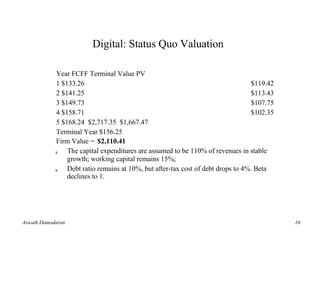
Digital: Status Quo Valuation

            Year FCFF Terminal Value PV
            1 $133.26                                                             $119.42
            2 $141.25                                                             $113.43
            3 $149.73                                                             $107.75
            4 $158.71                                                             $102.35
            5 $168.24 $2,717.35 $1,667.47
            Terminal Year $156.25
            Firm Value = $2,110.41
            s   The capital expenditures are assumed to be 110% of revenues in stable
                growth; working capital remains 15%;
            s   Debt ratio remains at 10%, but after-tax cost of debt drops to 4%. Beta
                declines to 1.


Aswath Damodaran                                                                            16
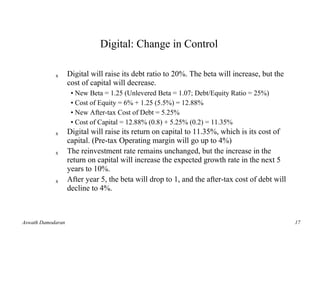
Digital: Change in Control

            s      Digital will raise its debt ratio to 20%. The beta will increase, but the
                   cost of capital will decrease.
                    • New Beta = 1.25 (Unlevered Beta = 1.07; Debt/Equity Ratio = 25%)
                    • Cost of Equity = 6% + 1.25 (5.5%) = 12.88%
                    • New After-tax Cost of Debt = 5.25%
                    • Cost of Capital = 12.88% (0.8) + 5.25% (0.2) = 11.35%
            s      Digital will raise its return on capital to 11.35%, which is its cost of
                   capital. (Pre-tax Operating margin will go up to 4%)
            s      The reinvestment rate remains unchanged, but the increase in the
                   return on capital will increase the expected growth rate in the next 5
                   years to 10%.
            s      After year 5, the beta will drop to 1, and the after-tax cost of debt will
                   decline to 4%.


Aswath Damodaran                                                                                17
Digital Valuation: Change in Control

            Year FCFF Terminal Value PV
               1 $156.29                               $140.36
               2 $171.91                               $138.65
               3 $189.11                               $136.97
               4 $208.02                               $135.31
               5 $228.82 $6,584.62 $3,980.29
            Terminal Year $329.23
            Value of the Firm: with Control Change =     $ 4,531 million
            Value of the Firm: Status Quo =             $ 2,110 million
            Value of Control                           = $2,421 million


Aswath Damodaran                                                           18
Valuing Synergy

            s      The key to the existence of synergy is that the target firm controls a
                   specialized resource that becomes more valuable if combined with
                   the bidding firm's resources. The specialized resource will vary
                   depending upon the merger:
                    • In horizontal mergers: economies of scale, which reduce costs, or from
                      increased market power, which increases profit margins and sales.
                      (Examples: Bank of America and Security Pacific, Chase and Chemical)
                    • In vertical integration: Primary source of synergy here comes from
                      controlling the chain of production much more completely.
                    • In functional integration : When a firm with strengths in one functional
                      area acquires another firm with strengths in a different functional area,
                      the potential synergy gains arise from exploiting the strengths in these
                      areas.


Aswath Damodaran                                                                              19
Valuing operating synergy

            (a) What formis the synergy expected to take? Will it        reduce costs as a
                percentage of sales and increase profit margins (as is the case when
                there are economies of scale)? Will it increase future growth (as is
                the case when there is increased market power)? )
            (b) When can the synergy be reasonably expected to start affecting
                cashflows? (Will the gains from synergy show up instantaneously after
                the takeover? If it will take time, when can the gains be expected to
                start showing up? )


Aswath Damodaran                                                                             20
A procedure for valuing synergy

            (1) the firms involved in the merger are         valued independently , by
                discounting expected cash flows to each firm at the weighted average
                cost of capital for that firm.
            (2) the value of the combined firm, with no synergy, is obtained by
                adding the values obtained for each firm in the first step.
            (3) The effects of synergy are built into expected growth rates and
                cashflows , and the combined firm is re-valued with synergy.
             Value of Synergy = Value of the combined firm, with synergy - Value of
                                    the combined firm, without synergy


Aswath Damodaran                                                                     21
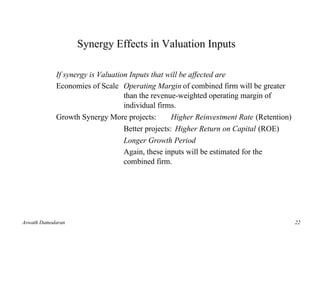
Synergy Effects in Valuation Inputs

            If synergy is Valuation Inputs that will be affected are
            Economies of Scale Operating Margin of combined firm will be greater
                                  than the revenue-weighted operating margin of
                                  individual firms.
            Growth Synergy More projects:         Higher Reinvestment Rate (Retention)
                                  Better projects: Higher Return on Capital (ROE)
                                  Longer Growth Period
                                  Again, these inputs will be estimated for the
                                  combined firm.


Aswath Damodaran                                                                         22
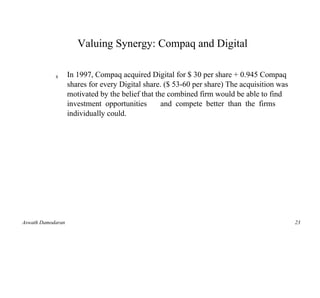
Valuing Synergy: Compaq and Digital

            s      In 1997, Compaq acquired Digital for $ 30 per share + 0.945 Compaq
                   shares for every Digital share. ($ 53-60 per share) The acquisition was
                   motivated by the belief that the combined firm would be able to find
                   investment opportunities       and compete better than the firms
                   individually could.


Aswath Damodaran                                                                             23
Background Data

                                                    Compaq Digital: Opt Mgd
            Current EBIT                            $ 2,987 million $ 522 million
            Current Revenues $25,484 mil $13,046 mil
            Capital Expenditures - Depreciation $ 184 million $ 14 (offset)
            Expected growth rate -next 5 years 10% 10%
            Expected growth rate after year 5 5% 5%
            Debt /(Debt + Equity) 10% 20%
            After-tax cost of debt 5% 5.25%
            Beta for equity - next 5 years 1.25 1.25
            Beta for equity - after year 5 1.00 1.0
            Working Capital/Revenues 15% 15%
            Tax rate is 36% for both companies


Aswath Damodaran                                                                    24
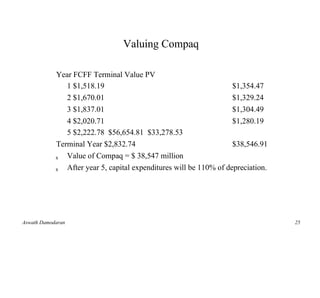
Valuing Compaq

            Year FCFF Terminal Value PV
               1 $1,518.19                                          $1,354.47
               2 $1,670.01                                          $1,329.24
               3 $1,837.01                                          $1,304.49
               4 $2,020.71                                          $1,280.19
               5 $2,222.78 $56,654.81 $33,278.53
            Terminal Year $2,832.74                                 $38,546.91
            s  Value of Compaq = $ 38,547 million
            s  After year 5, capital expenditures will be 110% of depreciation.


Aswath Damodaran                                                                  25
Combined Firm Valuation

            s      The Combined firm will have some economies of scale, allowing it to increase
                   its current after-tax operating margin slightly. The dollar savings will be
                   approximately $ 100 million.
                    • Current Operating Margin = (2987+522)/(25484+13046) = 9.11%
                    • New Operating Margin = (2987+522+100)/(25484+13046) = 9.36%
            s      The combined firm will also have a slightly higher growth rate of 10.50% over
                   the next 5 years, because of operating synergies.
            s      The beta of the combined firm is computed in two steps:
                    • Digital’s Unlevered Beta = 1.07; Compaq’s Unlevered Beta=1.17
                    • Digital’s Firm Value = 4.5; Compaq’s Firm Value = 38.6
                    • Unlevered Beta = 1.07 * (4.5/43.1) + 1.17 (38.6/43.1) = 1.16
                    • Combined Firm’s Debt/Equity Ratio = 13.64%
                    • New Levered Beta = 1.16 (1+(1-0.36)(.1364)) = 1.26
                    • Cost of Capital = 12.93% (.88) + 5% (.12) = 11.98%


Aswath Damodaran                                                                                   26
Combined Firm Valuation

            Year FCFF Terminal Value PV
               1 $1,726.65                         $1,541.95
               2 $1,907.95                         $1,521.59
               3 $2,108.28                         $1,501.50
               4 $2,329.65                         $1,481.68
               5 $2,574.26 $66,907.52 $39,463.87
            Terminal Year $3,345.38
            Value of Combined Firm                 = $ 45,511


Aswath Damodaran                                                27
The Value of Synergy

            s      Value of Combined Firm wit Synergy = $45,511 million
            s      Value of Compaq + Value of Digital
                                  = 38,547 + 4532 = $ 43,079 million
            s      Total Value of Synergy                            = $ 2,432 million


Aswath Damodaran                                                                         28
Digital: Valuation Blocks

            Value of Firm - Status Quo = $ 2,110 million
            + Value of Control                          = $ 2,521 million
            Value of Firm - Change of Control = $ 4,531 million
            + Value of Synergy                          = $ 2,432 million
            Total Value of Digital with Synergy = $ 6,963 million


Aswath Damodaran                                                            29
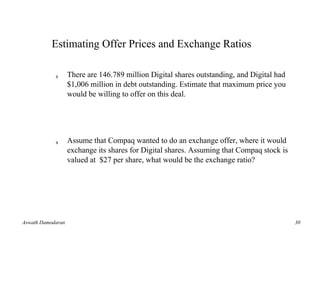
Estimating Offer Prices and Exchange Ratios

            s      There are 146.789 million Digital shares outstanding, and Digital had
                   $1,006 million in debt outstanding. Estimate that maximum price you
                   would be willing to offer on this deal.


            s      Assume that Compaq wanted to do an exchange offer, where it would
                   exchange its shares for Digital shares. Assuming that Compaq stock is
                   valued at $27 per share, what would be the exchange ratio?


Aswath Damodaran                                                                           30
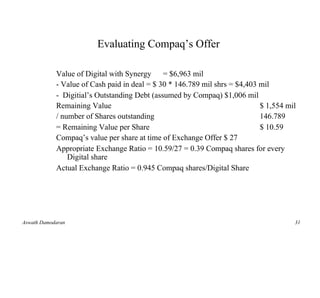
Evaluating Compaq’s Offer

            Value of Digital with Synergy = $6,963 mil
            - Value of Cash paid in deal = $ 30 * 146.789 mil shrs = $4,403 mil
            - Digitial’s Outstanding Debt (assumed by Compaq) $1,006 mil
            Remaining Value                                                 $ 1,554 mil
            / number of Shares outstanding                                  146.789
            = Remaining Value per Share                                     $ 10.59
            Compaq’s value per share at time of Exchange Offer $ 27
            Appropriate Exchange Ratio = 10.59/27 = 0.39 Compaq shares for every
                Digital share
            Actual Exchange Ratio = 0.945 Compaq shares/Digital Share


Aswath Damodaran                                                                      31
Citicorp + Travelers = ?

                                    Citicorp Travelers Citigroup
            Net Income $    3,591 $       3,104 $      6,695
            BV of Equity $ 20,722 $ 20,736 $ 41,458
            ROE 17.33% 14.97% 16.15%
            Dividends $      1,104 $      587 $ 1,691
            Payout Ratio 30.74% 18.91% 25.27%
            Retention Ratio 69.26% 81.09% 74.73%
            Expected growth 12.00% 12.14% 12.07%
            Growth Period 5 5 5
            Beta 1.25 1.40 1.33
            Risk Premium 4.00% 4.00% 4.00%
            MV of Equity (bil) 81 84 165.00
            Cost of Equity 11.00% 11.60% 11.31%
            Beta - stable 1.00 1.00 1.00
            Growth-stable 6.00% 6.00% 6.00%
            Payout-stable 65.38% 59.92% 62.85%
            DDM $ 70,743 $ 53,464 $ 124,009
            DDM/share 155.84      46.38

Aswath Damodaran                                                   32
The Right Exchange Ratio

            s      Based upon these numbers, what exchange ratio would you agree to as
                   a Citicorp stockholder?


            s      The actual exchange ratio was 2.5 shares of Travelers for every share
                   of Citicorp. As a Citicorp stockholder, do you think that this is a
                   reasonable exchange ratio?


Aswath Damodaran                                                                           33
The Value of Synergy


                               Increase in Value of Equity as ROE
                                                    Increase

                   30000

                   25000

                   20000

                   15000

                   10000

                    5000

                           0
                                    Increase by1% Increase by 2% Increase by 3%

                                                 Change in ROE of combined firm


Aswath Damodaran                                                                  34
Financial Synergy

            s      Sources of Financial Synergy
                    • Diversification : Acquiring another firm as a way of reducing risk cannot
                      create wealth for two publicly traded firms, with diversified stockholders,
                      but it could create wealth for private firms or closely held publicly traded
                      firms.
                    • Cash Slack: When a firm with significant excess cash acquires a firm,
                      with great projects but insufficient capital, the combination can create
                      value.
                    • Tax Benefits : The tax paid by two firms combined together may be lower
                      than the taxes paid by them as individual firms.
                    • Debt Capacity : By combining two firms, each of which has little or no
                      capacity to carry debt, it is possible to create a firm that may have the
                      capacity to borrow money and create value.


Aswath Damodaran                                                                                     35
I. Diversification: No Value Creation?

            s      A takeover, motivated only by diversification considerations, has no
                   effect on the combined value of the two firms involved in the takeover.
                   The value of the combined firms will always be the sum of the values
                   of the independent firms.
            s      In the case of private firms or closely held firms, where the owners
                   may not be diversified personally, there might be a potential value gain
                   from diversification.


Aswath Damodaran                                                                              36
II. Cash Slack

            s      Managers may reject profitable investment opportunities if they
                   have to raise new capital to finance them.
            s      It may therefore make sense for a company with      excess cash and no
                   investment opportunities to take over a cash-poor firm with good
                   investment opportunities, or vice versa.
            s      The additional value of combining these two firms lies in the present
                   value of the projects that would not have been taken if they had
                   stayed apart, but can now be taken because of the availability of cash.


Aswath Damodaran                                                                         37
Valuing Cash Slack

            q      Assume that Netscape has a severe capital rationing problem, that
                   results in approximately          $500 million of investments,          with a
                   cumulative net present value of $100 million, being rejected.
            q      IBM has far more cash than promising projects, and has accumulated
                   $4 billion in cash that it is trying to invest. It is under pressure to return
                   the cash to the owners.
            q      If IBM takes over Netscape Inc, it can be argued that the value of the
                   combined firm will increase by the synergy benefit of $100 million,
                   which is the net present value of the projects possessed by the latter
                   that can now be taken with the excess cash from the former.


Aswath Damodaran                                                                                    38
III. Tax Benefits

            (1) If one of the firms has tax deductions that it cannot use because it is
                losing money, while the other firm has income on which it pays
                significant taxes, the combining of the two firms can lead to tax
                benefits that can be shared by the two firms. The value of this synergy
                is the present value of the tax savings that accrue because of this
                merger.
            (2) The assets of the firm being taken over can be written up to reflect
                new market value, in some forms of mergers, leading to higher tax
                savings from depreciation in future years.


Aswath Damodaran                                                                          39
Valuing Tax Benefits: Tax Losses

            s      Assume that you are Best Buys, the electronics retailer, and that you
                   would like to enter the hardware component of the market. You have
                   been approached by investment bankers for Zenith, which while still a
                   recognized brand name, is on its last legs financially. The firm has net
                   operating losses of $ 2 billion. If your tax rate is 36%, estimate the tax
                   benefits from this acquisition.


            s      If Best Buys had only $500 million in taxable income, how would you
                   compute the tax benefits?


            s      If the market value of Zenith is $800 million, would you pay this tax
                   benefit as a premium on the market value?


Aswath Damodaran                                                                                40
Valuing Tax Benefits: Asset Write Up

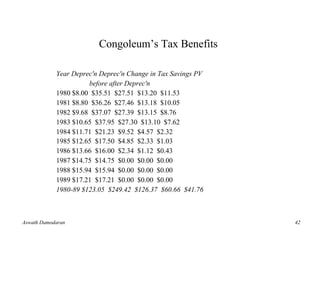
            s      One of the earliest leveraged buyouts was done on Congoleum Inc., a
                   diversified firm in ship building, flooring and automotive accessories,
                   in 1979 by the firm's own management.
                    • After the takeover, estimated to cost $400 million, the firm would be
                       allowed to write up its assets to reflect their new market values, and claim
                       depreciation on the new values.
                    • The estimated change in depreciation and the present value effect of this
                       depreciation, discounted at the firm's cost of capital of 14.5% is shown
                       below:


Aswath Damodaran                                                                                 41
Congoleum’s Tax Benefits

            Year Deprec'n Deprec'n Change in Tax Savings PV
                      before after Deprec'n
            1980 $8.00 $35.51 $27.51 $13.20 $11.53
            1981 $8.80 $36.26 $27.46 $13.18 $10.05
            1982 $9.68 $37.07 $27.39 $13.15 $8.76
            1983 $10.65 $37.95 $27.30 $13.10 $7.62
            1984 $11.71 $21.23 $9.52 $4.57 $2.32
            1985 $12.65 $17.50 $4.85 $2.33 $1.03
            1986 $13.66 $16.00 $2.34 $1.12 $0.43
            1987 $14.75 $14.75 $0.00 $0.00 $0.00
            1988 $15.94 $15.94 $0.00 $0.00 $0.00
            1989 $17.21 $17.21 $0.00 $0.00 $0.00
            1980-89 $123.05 $249.42 $126.37 $60.66 $41.76


Aswath Damodaran                                              42
IV. Debt Capacity

            s      Diversification will lead to an increase in debt capacity and an
                   increase in the value of the firm .
            s      Has to be weighed against the immediate transfer of wealth that occurs
                   to existing bondholders in both firms from the stockholders.


Aswath Damodaran                                                                            43
Valuing Debt Capacity

            s      When two firms in different businesses merge, the combined firm will
                   have less variable earnings, and may be able to borrow more (have a
                   higher debt ratio) than the individual firms.
            s      In the following example, we will combine two firms, with optimal
                   debt ratios of 30% each, and end up with a firm with an optimal debt
                   ratio of 40%.


Aswath Damodaran                                                                          44
Effect on Costs of Capital of Added debt

                                    Firm A Firm B AB -No AB - Added
                                                 New Debt Debt
            Debt (%) 30% 30% 30% 40%
            Cost of debt 6.00% 5.40% 5.65% 5.65%
            Equity(%) 70% 70% 70% 60%
            Cost of equity 13.60% 12.50% 12.95% 13.65%
            WACC - Year 1 11.32% 10.37% 10.76% 10.45%
            WACC- Year 2 11.32% 10.37% 10.76% 10.45%
            WACC- Year 3 11.32% 10.37% 10.77% 10.45%
            WACC-Year 4 11.32% 10.37% 10.77% 10.45%
            WACC-Year 5 11.32% 10.37% 10.77% 10.45%
            WACC-after year 5 10.55% 10.37% 10.45% 9.76%


Aswath Damodaran                                                      45
Effect on Value of Added Debt

                              Firm A Firm B AB -No new AB - Added
                                            Debt Debt
            FCFF in year 1 $120.00 $220.00 $340.00 $340.00
            FCFF in year 2 $144.00 $242.00 $386.00 $386.00
            FCFF in year 3 $172.80 $266.20 $439.00 $439.00
            FCFF in year 4 $207.36 $292.82 $500.18 $500.18
            FCFF in year 5 $248.83 $322.10 $570.93 $570.93
            Terminal Value $5,796.97 $7,813.00 $13,609.97 $16,101.22
            Present Value $4,020.91 $5,760.47 $9,781.38 $11,429.35
            s  The value of the firm, as a consequence of the added debt, will
               increase from $9,781.38 million to $11,429.35 million.


Aswath Damodaran                                                                 46
Empirical Evidence on Synergy

            s      If synergy is perceived to exist in a takeover,      the value of the
                   combined firm should be greater than the sum of the values of the
                   bidding and target firms, operating independently.
                   V(AB) > V(A) + V(B)
            s      Bradley, Desai and Kim (1988) use a sample of 236 inter-firm tender
                   offers between 1963 and 1984 and report that the combined value of
                   the target and bidder firms increases 7.48% ($117 million in 1984
                   dollars), on average, on the announcement of the merger.
            s      Operating synergy was the primary motive in one-third of hostile
                   takeovers . (Bhide)


Aswath Damodaran                                                                           47
Operational Evidence on Synergy

            •      A stronger test of synergy is to evaluate whether merged firms improve
                   their performance (profitability and growth), relative to their competitors,
                   after takeovers.
                    • McKinsey and Co. examined 58 acquisition programs between 1972 and 1983 for
                       evidence on two questions -
                         •   Did the return on the amount invested in the acquisitions exceed the cost of capital?
                         •   Did the acquisitions help the parent companies outperform the competition?
                    • They concluded that        28 of the 58 programs failed both tests , and 6 failed at least
                        one test.
            •      Large number of acquisitions that are reversed within fairly short time
                   periods. About 20.2% of the acquisitions made between 1982 and 1986 were
                   divested by 1988. In studies that have tracked acquisitions for longer time
                   periods (ten years or more) the divestiture rate of acquisitions rises to
                   almost 50%.


Aswath Damodaran                                                                                                     48
Who gets the benefits of synergy?

            s      The sharing of the benefits of synergy among the two players will
                   depend in large part on whether the bidding firm's contribution to the
                   creation of the synergy is unique or easily replaced . If it can be
                   easily replaced, the bulk of the synergy benefits will accrue to the
                   target firm. It is unique, the sharing of benefits will be much more
                   equitable.
            s      Bradley, Desai and Kim (1988) conclude that the benefits of synergy
                   accrue primarily to the target firms when there are        multiplebidders
                   involved in the takeover. They estimate that the market-adjusted stock
                   returns around the announcement of the takeover for the successful
                   bidder to be 2%, in single bidder takeovers, and -1.33%, in contested
                   takeovers.


Aswath Damodaran                                                                                49
Acq valn
Acq valn
Acq valn
Acq valn

Acq valn

  • 1.
    Issues in AcquisitionValuation s Acquisition valuations are complex, because the valuation often involved issues like synergy and control, which go beyond just valuing a target firm. It is important on the right sequence, including Acquisition Valuation • When should you consider synergy? • Where does the method of payment enter the process. s Can synergy be valued, and if so, how? s What is the value ofAswath Damodaran estimate the value? control? How can you Aswath Damodaran 2 1
  • 2.
    Steps involved inan Acquisition Valuation s Step 1 : Establish a motivefor the acquisition s Step 2:Choose a target s Step 3: Valuethe target with the acquisition motive built in. s Step 4 : Decide on the mode of payment - cash or stock, and if cash, arrange for financing - debt or equity. s Step 5:Choose the accounting method for the merger/acquisition - purchase or pooling. Aswath Damodaran 3
  • 3.
    Step 1: Motivesbehind acquisitions (1) Simplest rationale is undervaluation , i.e., that firms that are undervalued by financial markets, relative to true value, will be targeted for acquisition by those who recognize this anomaly. (2) A more controversial reason is diversification , with the intent of stabilizing earnings and reducing risk. (3) Synergy refers to the potential additional value from combining two firms, either from operational or financial sources. • Operating Synergy can come from higher growth or lower costs • Financial Synergy can come from tax savings, increased debt capacity or cash slack. (4)Poorly managed firms are taken over and restructured by the new owners, who lay claim to the additional value. (5) Managerial self-interest and hubris are the primary, though unstated, reasons for many takeovers. Aswath Damodaran 4
  • 4.
    Step 2: Choosea target firm for the acquisition If motive is Target firm Undervaluation trades at a price below the estimated value Diversification is in a business which is different from the acquiring firm’s business Operating Synergy have the characteristics that create the operating synergy Cost Savings : in same business to create economies of scale. Higher growth : should have potential for higher growth. Financial Synergy Tax Savings : provides a tax benefit to acquirer Debt Capacity : is unable to borrow money or pay high rates Cash slack : has great projects/ no funds Control badly managed firm whose stock has underperformed the market. Manager’s Interests has characteristics that best meet CEO’s ego and power needs. Aswath Damodaran 5
  • 5.
    Step 3: ValueTarget Firm with motive built in If motive is Target firm Undervaluation Value target firm as stand-alone entity: No extra premium Diversification Value target firm as stand-alone entity: No extra premium Operating Synergy Value the firms independently. Value the combined firm with the operating synergy Synergy is the difference between the latter and former Target Firm Value = Independent Value + Synergy Financial Synergy Tax Benefits: Value of Target Firm + PV of Tax Benefits Debt Capacity: Value of Target Firm + Increase in Value from Debt Cash Slack: Value of Target Firm + NPV of Projects/ Target Control Value of Target Firm run optimally Manager’s Interest Value of Target Firm: No additional premium Aswath Damodaran 6
  • 6.
    The Valuation Process VALUING AN ACQUISITION Component Valuation Guidelines Should you pay? Value the combined firm with synergy built in . This may include Which firm is a. a higher growth rate in revenues: growth synergy indispensable for the b. higher margins, because of economies of scale synergy? c. lower taxes, because of tax benefits: tax synergy If it is the target, you Synergy d. lower cost of debt: financing synergy should be willing to e. higher debt ratio because of lower risk: debt capacity pay up to the Subtract the value of the target firm (with control premium) + synergy. value of the bidding firm (pre-acquisition). This is the value of If it is the bidder, you the synergy. should not. Value the company as if optimally managed. This If motive is control or will usually mean that investment, financing and dividend policy will be altered: in a stand-alone Investment Policy: Higher returns on projects and valuation, this is the divesting unproductive projects. maximium you should Control pay. Financing Policy: Move to a better financing Premium structure; eg. optimal capital structure Dividend Policy: Return unused cash Practically, 1. Look at industry averages for optimal (if lazy) 2. Do a full-fledged corporate financial analysis If motive is Status Quo Value the company as is, with existing inputs undervaluation, this is Valuation for investment, financing and dividend policy. the maximum you should pay. Aswath Damodaran 7
  • 7.
    Valuing NCR forAT & T VALUING NCR for AT & T Component Valuation Guidelines Value Value the combined firm with synergy built in . This may include $ 11,278 million a. a higher growth rate in revenues: growth synergy - $ 6,723 million b. higher margins, because of economies of scale = $ 4,552 million c. lower taxes, because of tax benefits: tax synergy Synergy d. lower cost of debt: financing synergy e. higher debt ratio because of lower risk: debt capacity Subtract the value of the target firm (with control premium) + value of the bidding firm (pre-acquisition). This is the value of the synergy. Value the company as if optimally managed. This $ 6,723 million - will usually mean that investment, financing and dividend policy will be altered: $ 5,949 million Investment Policy: Higher returns on projects and = $ 774 million divesting unproductive projects. Control Financing Policy: Move to a better financing Premium structure; eg. optimal capital structure Dividend Policy: Return unused cash Practically, 1. Look at industry averages for optimal (if lazy) 2. Do a full-fledged corporate financial analysis $ 5,949 million Status Quo Value the company as is, with existing inputs Valuation for investment, financing and dividend policy. Aswath Damodaran 8
  • 8.
    Step 4: Decideon payment mechanism: Cash versus Stock q Generally speaking, firms which believe that their stock is under valuedwill not use stock to do acquisitions. q Conversely, firms which believe that their stock is over or correctly valued will use stock to do acquisitions. q Not surprisingly, the premium paid is larger when an acquisition is financed with stock rather than cash. q There might be an accounting rationale for using stockas opposed to cash. You are allowed to use pooling instead of purchase. s There might also be a tax rationale for using stock. Cash acquisitions create tax liabilities to the selling firm’s stockholders. Aswath Damodaran 9
  • 9.
    The Exchange Ratioin a Stock for Stock Exchange q Correct Exchange Ratio to use in a Valuation = Value per Share of Target Firm (with control premium and target-controlled synergies) / Value per Share of Bidding Firm q If the exchange ratio is set too high , there will be a transfer of wealth from the bidding firm’s stockholders to the target firm’s stockholders. q If the exchange ratio is set too low , there will be transfer of wealth from the target firm to the bidding firm’s stockholders. Aswath Damodaran 10
  • 10.
    Step 5: Choosean accounting method for the merger s Purchase Method: – The acquiring firm records the assets and liabilities of the acquired firm at market value, with goodwill capturing the difference between market value and the value of the assets acquired. • This goodwill will then be amortized , though the amortization is not tax deductible. If a firm pays cash on an acquisition, it has to use the purchase method to record the transaction. s Pooling of Interests : – The book values of the assets and liabilities of the merging firms are added to arrive at values for the combined firm. Since the market value of the transaction is not recognized, no goodwill is created or amortized. – This approach is allowed only if the acquiring firm exchanges its common stock for common stock of the acquired firm. – Since earnings are not affected by the amortization of goodwill, the reported earnings per share under this approach will be greater than the reported earnings per share in the purchase approach. Aswath Damodaran 11
  • 11.
    The Value ofControl s The value of control should be inversely proportional to the perceived quality of that management and its capacity to maximize firm value. s Value of control will be much greater for a poorly managed firm that operates at below optimum capacity than it is for a well managed firm. s Value of Control = Value of firm, with restructuring - Value of firm, without restructuring s Negligible or firms which are operating at or close to their optimal value Aswath Damodaran 12
  • 12.
    Empirical Evidence onthe Value of Control Target Characteristics - Hostile vs. Friendly Takeovers Target 5-yr stock Target ROE - returns - Market % of Stock held Industry ROE Returns by insiders 20.00% 15.00% 10.00% 5.00% 0.00% -5.00% Hostile Takeovers Friendly Takeovers Aswath Damodaran 13
  • 13.
    After the hostiletakeover.. s Many of the hostile takeovers were followed by an increase in leverage, which resulted in a downgrading of the debt. The leverage was quickly reduced, however, with proceeds from sale of assets. s There was no significant change in the amount of capital investment in these firms, but investment was more focused on core business. s Almost 60% of the takeovers were followed by significant divestitures , where half or more of the firm was divested. The overwhelming majority of the divestitures were of units which were in business areas unrelated to the company's core business , i.e., they constituted reversal of earlier corporate diversification. s There were significant management changes in 17 of the 19 hostile takeovers, with the entire corporate management team replaced in 7 of the takeovers. Aswath Damodaran 14
  • 14.
    Stand Alone Valuation:Digital - Status Quo s Digital had earning before interest and taxes of $391.38 million in 1997, which translated into a • A pre-tax operating margin of 3% on its revenues of $13,046 million • An after-tax return on capital of 8.51% s Based upon its beta of 1.15, an after-tax cost of borrowing of 5% and a debt ratio of approximately 10%, the cost of capital for Digital in 1997 was • Cost of Equity = 6% + 1.15 (5.5%) = 12.33% • Cost of Capital = 12.33% (.9) + 5% (.1) = 11.59% s Digital had capital expenditures of $475 million, depreciation of $ 461 million and working capital was 15% of revenues. s Operating income, net cap ex and revenues are expected to grow 6% a year for the next 5 years, and 5% thereafter. Aswath Damodaran 15
  • 15.
    Digital: Status QuoValuation Year FCFF Terminal Value PV 1 $133.26 $119.42 2 $141.25 $113.43 3 $149.73 $107.75 4 $158.71 $102.35 5 $168.24 $2,717.35 $1,667.47 Terminal Year $156.25 Firm Value = $2,110.41 s The capital expenditures are assumed to be 110% of revenues in stable growth; working capital remains 15%; s Debt ratio remains at 10%, but after-tax cost of debt drops to 4%. Beta declines to 1. Aswath Damodaran 16
  • 16.
    Digital: Change inControl s Digital will raise its debt ratio to 20%. The beta will increase, but the cost of capital will decrease. • New Beta = 1.25 (Unlevered Beta = 1.07; Debt/Equity Ratio = 25%) • Cost of Equity = 6% + 1.25 (5.5%) = 12.88% • New After-tax Cost of Debt = 5.25% • Cost of Capital = 12.88% (0.8) + 5.25% (0.2) = 11.35% s Digital will raise its return on capital to 11.35%, which is its cost of capital. (Pre-tax Operating margin will go up to 4%) s The reinvestment rate remains unchanged, but the increase in the return on capital will increase the expected growth rate in the next 5 years to 10%. s After year 5, the beta will drop to 1, and the after-tax cost of debt will decline to 4%. Aswath Damodaran 17
  • 17.
    Digital Valuation: Changein Control Year FCFF Terminal Value PV 1 $156.29 $140.36 2 $171.91 $138.65 3 $189.11 $136.97 4 $208.02 $135.31 5 $228.82 $6,584.62 $3,980.29 Terminal Year $329.23 Value of the Firm: with Control Change = $ 4,531 million Value of the Firm: Status Quo = $ 2,110 million Value of Control = $2,421 million Aswath Damodaran 18
  • 18.
    Valuing Synergy s The key to the existence of synergy is that the target firm controls a specialized resource that becomes more valuable if combined with the bidding firm's resources. The specialized resource will vary depending upon the merger: • In horizontal mergers: economies of scale, which reduce costs, or from increased market power, which increases profit margins and sales. (Examples: Bank of America and Security Pacific, Chase and Chemical) • In vertical integration: Primary source of synergy here comes from controlling the chain of production much more completely. • In functional integration : When a firm with strengths in one functional area acquires another firm with strengths in a different functional area, the potential synergy gains arise from exploiting the strengths in these areas. Aswath Damodaran 19
  • 19.
    Valuing operating synergy (a) What formis the synergy expected to take? Will it reduce costs as a percentage of sales and increase profit margins (as is the case when there are economies of scale)? Will it increase future growth (as is the case when there is increased market power)? ) (b) When can the synergy be reasonably expected to start affecting cashflows? (Will the gains from synergy show up instantaneously after the takeover? If it will take time, when can the gains be expected to start showing up? ) Aswath Damodaran 20
  • 20.
    A procedure forvaluing synergy (1) the firms involved in the merger are valued independently , by discounting expected cash flows to each firm at the weighted average cost of capital for that firm. (2) the value of the combined firm, with no synergy, is obtained by adding the values obtained for each firm in the first step. (3) The effects of synergy are built into expected growth rates and cashflows , and the combined firm is re-valued with synergy. Value of Synergy = Value of the combined firm, with synergy - Value of the combined firm, without synergy Aswath Damodaran 21
  • 21.
    Synergy Effects inValuation Inputs If synergy is Valuation Inputs that will be affected are Economies of Scale Operating Margin of combined firm will be greater than the revenue-weighted operating margin of individual firms. Growth Synergy More projects: Higher Reinvestment Rate (Retention) Better projects: Higher Return on Capital (ROE) Longer Growth Period Again, these inputs will be estimated for the combined firm. Aswath Damodaran 22
  • 22.
    Valuing Synergy: Compaqand Digital s In 1997, Compaq acquired Digital for $ 30 per share + 0.945 Compaq shares for every Digital share. ($ 53-60 per share) The acquisition was motivated by the belief that the combined firm would be able to find investment opportunities and compete better than the firms individually could. Aswath Damodaran 23
  • 23.
    Background Data Compaq Digital: Opt Mgd Current EBIT $ 2,987 million $ 522 million Current Revenues $25,484 mil $13,046 mil Capital Expenditures - Depreciation $ 184 million $ 14 (offset) Expected growth rate -next 5 years 10% 10% Expected growth rate after year 5 5% 5% Debt /(Debt + Equity) 10% 20% After-tax cost of debt 5% 5.25% Beta for equity - next 5 years 1.25 1.25 Beta for equity - after year 5 1.00 1.0 Working Capital/Revenues 15% 15% Tax rate is 36% for both companies Aswath Damodaran 24
  • 24.
    Valuing Compaq Year FCFF Terminal Value PV 1 $1,518.19 $1,354.47 2 $1,670.01 $1,329.24 3 $1,837.01 $1,304.49 4 $2,020.71 $1,280.19 5 $2,222.78 $56,654.81 $33,278.53 Terminal Year $2,832.74 $38,546.91 s Value of Compaq = $ 38,547 million s After year 5, capital expenditures will be 110% of depreciation. Aswath Damodaran 25
  • 25.
    Combined Firm Valuation s The Combined firm will have some economies of scale, allowing it to increase its current after-tax operating margin slightly. The dollar savings will be approximately $ 100 million. • Current Operating Margin = (2987+522)/(25484+13046) = 9.11% • New Operating Margin = (2987+522+100)/(25484+13046) = 9.36% s The combined firm will also have a slightly higher growth rate of 10.50% over the next 5 years, because of operating synergies. s The beta of the combined firm is computed in two steps: • Digital’s Unlevered Beta = 1.07; Compaq’s Unlevered Beta=1.17 • Digital’s Firm Value = 4.5; Compaq’s Firm Value = 38.6 • Unlevered Beta = 1.07 * (4.5/43.1) + 1.17 (38.6/43.1) = 1.16 • Combined Firm’s Debt/Equity Ratio = 13.64% • New Levered Beta = 1.16 (1+(1-0.36)(.1364)) = 1.26 • Cost of Capital = 12.93% (.88) + 5% (.12) = 11.98% Aswath Damodaran 26
  • 26.
    Combined Firm Valuation Year FCFF Terminal Value PV 1 $1,726.65 $1,541.95 2 $1,907.95 $1,521.59 3 $2,108.28 $1,501.50 4 $2,329.65 $1,481.68 5 $2,574.26 $66,907.52 $39,463.87 Terminal Year $3,345.38 Value of Combined Firm = $ 45,511 Aswath Damodaran 27
  • 27.
    The Value ofSynergy s Value of Combined Firm wit Synergy = $45,511 million s Value of Compaq + Value of Digital = 38,547 + 4532 = $ 43,079 million s Total Value of Synergy = $ 2,432 million Aswath Damodaran 28
  • 28.
    Digital: Valuation Blocks Value of Firm - Status Quo = $ 2,110 million + Value of Control = $ 2,521 million Value of Firm - Change of Control = $ 4,531 million + Value of Synergy = $ 2,432 million Total Value of Digital with Synergy = $ 6,963 million Aswath Damodaran 29
  • 29.
    Estimating Offer Pricesand Exchange Ratios s There are 146.789 million Digital shares outstanding, and Digital had $1,006 million in debt outstanding. Estimate that maximum price you would be willing to offer on this deal. s Assume that Compaq wanted to do an exchange offer, where it would exchange its shares for Digital shares. Assuming that Compaq stock is valued at $27 per share, what would be the exchange ratio? Aswath Damodaran 30
  • 30.
    Evaluating Compaq’s Offer Value of Digital with Synergy = $6,963 mil - Value of Cash paid in deal = $ 30 * 146.789 mil shrs = $4,403 mil - Digitial’s Outstanding Debt (assumed by Compaq) $1,006 mil Remaining Value $ 1,554 mil / number of Shares outstanding 146.789 = Remaining Value per Share $ 10.59 Compaq’s value per share at time of Exchange Offer $ 27 Appropriate Exchange Ratio = 10.59/27 = 0.39 Compaq shares for every Digital share Actual Exchange Ratio = 0.945 Compaq shares/Digital Share Aswath Damodaran 31
  • 31.
    Citicorp + Travelers= ? Citicorp Travelers Citigroup Net Income $ 3,591 $ 3,104 $ 6,695 BV of Equity $ 20,722 $ 20,736 $ 41,458 ROE 17.33% 14.97% 16.15% Dividends $ 1,104 $ 587 $ 1,691 Payout Ratio 30.74% 18.91% 25.27% Retention Ratio 69.26% 81.09% 74.73% Expected growth 12.00% 12.14% 12.07% Growth Period 5 5 5 Beta 1.25 1.40 1.33 Risk Premium 4.00% 4.00% 4.00% MV of Equity (bil) 81 84 165.00 Cost of Equity 11.00% 11.60% 11.31% Beta - stable 1.00 1.00 1.00 Growth-stable 6.00% 6.00% 6.00% Payout-stable 65.38% 59.92% 62.85% DDM $ 70,743 $ 53,464 $ 124,009 DDM/share 155.84 46.38 Aswath Damodaran 32
  • 32.
    The Right ExchangeRatio s Based upon these numbers, what exchange ratio would you agree to as a Citicorp stockholder? s The actual exchange ratio was 2.5 shares of Travelers for every share of Citicorp. As a Citicorp stockholder, do you think that this is a reasonable exchange ratio? Aswath Damodaran 33
  • 33.
    The Value ofSynergy Increase in Value of Equity as ROE Increase 30000 25000 20000 15000 10000 5000 0 Increase by1% Increase by 2% Increase by 3% Change in ROE of combined firm Aswath Damodaran 34
  • 34.
    Financial Synergy s Sources of Financial Synergy • Diversification : Acquiring another firm as a way of reducing risk cannot create wealth for two publicly traded firms, with diversified stockholders, but it could create wealth for private firms or closely held publicly traded firms. • Cash Slack: When a firm with significant excess cash acquires a firm, with great projects but insufficient capital, the combination can create value. • Tax Benefits : The tax paid by two firms combined together may be lower than the taxes paid by them as individual firms. • Debt Capacity : By combining two firms, each of which has little or no capacity to carry debt, it is possible to create a firm that may have the capacity to borrow money and create value. Aswath Damodaran 35
  • 35.
    I. Diversification: NoValue Creation? s A takeover, motivated only by diversification considerations, has no effect on the combined value of the two firms involved in the takeover. The value of the combined firms will always be the sum of the values of the independent firms. s In the case of private firms or closely held firms, where the owners may not be diversified personally, there might be a potential value gain from diversification. Aswath Damodaran 36
  • 36.
    II. Cash Slack s Managers may reject profitable investment opportunities if they have to raise new capital to finance them. s It may therefore make sense for a company with excess cash and no investment opportunities to take over a cash-poor firm with good investment opportunities, or vice versa. s The additional value of combining these two firms lies in the present value of the projects that would not have been taken if they had stayed apart, but can now be taken because of the availability of cash. Aswath Damodaran 37
  • 37.
    Valuing Cash Slack q Assume that Netscape has a severe capital rationing problem, that results in approximately $500 million of investments, with a cumulative net present value of $100 million, being rejected. q IBM has far more cash than promising projects, and has accumulated $4 billion in cash that it is trying to invest. It is under pressure to return the cash to the owners. q If IBM takes over Netscape Inc, it can be argued that the value of the combined firm will increase by the synergy benefit of $100 million, which is the net present value of the projects possessed by the latter that can now be taken with the excess cash from the former. Aswath Damodaran 38
  • 38.
    III. Tax Benefits (1) If one of the firms has tax deductions that it cannot use because it is losing money, while the other firm has income on which it pays significant taxes, the combining of the two firms can lead to tax benefits that can be shared by the two firms. The value of this synergy is the present value of the tax savings that accrue because of this merger. (2) The assets of the firm being taken over can be written up to reflect new market value, in some forms of mergers, leading to higher tax savings from depreciation in future years. Aswath Damodaran 39
  • 39.
    Valuing Tax Benefits:Tax Losses s Assume that you are Best Buys, the electronics retailer, and that you would like to enter the hardware component of the market. You have been approached by investment bankers for Zenith, which while still a recognized brand name, is on its last legs financially. The firm has net operating losses of $ 2 billion. If your tax rate is 36%, estimate the tax benefits from this acquisition. s If Best Buys had only $500 million in taxable income, how would you compute the tax benefits? s If the market value of Zenith is $800 million, would you pay this tax benefit as a premium on the market value? Aswath Damodaran 40
  • 40.
    Valuing Tax Benefits:Asset Write Up s One of the earliest leveraged buyouts was done on Congoleum Inc., a diversified firm in ship building, flooring and automotive accessories, in 1979 by the firm's own management. • After the takeover, estimated to cost $400 million, the firm would be allowed to write up its assets to reflect their new market values, and claim depreciation on the new values. • The estimated change in depreciation and the present value effect of this depreciation, discounted at the firm's cost of capital of 14.5% is shown below: Aswath Damodaran 41
  • 41.
    Congoleum’s Tax Benefits Year Deprec'n Deprec'n Change in Tax Savings PV before after Deprec'n 1980 $8.00 $35.51 $27.51 $13.20 $11.53 1981 $8.80 $36.26 $27.46 $13.18 $10.05 1982 $9.68 $37.07 $27.39 $13.15 $8.76 1983 $10.65 $37.95 $27.30 $13.10 $7.62 1984 $11.71 $21.23 $9.52 $4.57 $2.32 1985 $12.65 $17.50 $4.85 $2.33 $1.03 1986 $13.66 $16.00 $2.34 $1.12 $0.43 1987 $14.75 $14.75 $0.00 $0.00 $0.00 1988 $15.94 $15.94 $0.00 $0.00 $0.00 1989 $17.21 $17.21 $0.00 $0.00 $0.00 1980-89 $123.05 $249.42 $126.37 $60.66 $41.76 Aswath Damodaran 42
  • 42.
    IV. Debt Capacity s Diversification will lead to an increase in debt capacity and an increase in the value of the firm . s Has to be weighed against the immediate transfer of wealth that occurs to existing bondholders in both firms from the stockholders. Aswath Damodaran 43
  • 43.
    Valuing Debt Capacity s When two firms in different businesses merge, the combined firm will have less variable earnings, and may be able to borrow more (have a higher debt ratio) than the individual firms. s In the following example, we will combine two firms, with optimal debt ratios of 30% each, and end up with a firm with an optimal debt ratio of 40%. Aswath Damodaran 44
  • 44.
    Effect on Costsof Capital of Added debt Firm A Firm B AB -No AB - Added New Debt Debt Debt (%) 30% 30% 30% 40% Cost of debt 6.00% 5.40% 5.65% 5.65% Equity(%) 70% 70% 70% 60% Cost of equity 13.60% 12.50% 12.95% 13.65% WACC - Year 1 11.32% 10.37% 10.76% 10.45% WACC- Year 2 11.32% 10.37% 10.76% 10.45% WACC- Year 3 11.32% 10.37% 10.77% 10.45% WACC-Year 4 11.32% 10.37% 10.77% 10.45% WACC-Year 5 11.32% 10.37% 10.77% 10.45% WACC-after year 5 10.55% 10.37% 10.45% 9.76% Aswath Damodaran 45
  • 45.
    Effect on Valueof Added Debt Firm A Firm B AB -No new AB - Added Debt Debt FCFF in year 1 $120.00 $220.00 $340.00 $340.00 FCFF in year 2 $144.00 $242.00 $386.00 $386.00 FCFF in year 3 $172.80 $266.20 $439.00 $439.00 FCFF in year 4 $207.36 $292.82 $500.18 $500.18 FCFF in year 5 $248.83 $322.10 $570.93 $570.93 Terminal Value $5,796.97 $7,813.00 $13,609.97 $16,101.22 Present Value $4,020.91 $5,760.47 $9,781.38 $11,429.35 s The value of the firm, as a consequence of the added debt, will increase from $9,781.38 million to $11,429.35 million. Aswath Damodaran 46
  • 46.
    Empirical Evidence onSynergy s If synergy is perceived to exist in a takeover, the value of the combined firm should be greater than the sum of the values of the bidding and target firms, operating independently. V(AB) > V(A) + V(B) s Bradley, Desai and Kim (1988) use a sample of 236 inter-firm tender offers between 1963 and 1984 and report that the combined value of the target and bidder firms increases 7.48% ($117 million in 1984 dollars), on average, on the announcement of the merger. s Operating synergy was the primary motive in one-third of hostile takeovers . (Bhide) Aswath Damodaran 47
  • 47.
    Operational Evidence onSynergy • A stronger test of synergy is to evaluate whether merged firms improve their performance (profitability and growth), relative to their competitors, after takeovers. • McKinsey and Co. examined 58 acquisition programs between 1972 and 1983 for evidence on two questions - • Did the return on the amount invested in the acquisitions exceed the cost of capital? • Did the acquisitions help the parent companies outperform the competition? • They concluded that 28 of the 58 programs failed both tests , and 6 failed at least one test. • Large number of acquisitions that are reversed within fairly short time periods. About 20.2% of the acquisitions made between 1982 and 1986 were divested by 1988. In studies that have tracked acquisitions for longer time periods (ten years or more) the divestiture rate of acquisitions rises to almost 50%. Aswath Damodaran 48
  • 48.
    Who gets thebenefits of synergy? s The sharing of the benefits of synergy among the two players will depend in large part on whether the bidding firm's contribution to the creation of the synergy is unique or easily replaced . If it can be easily replaced, the bulk of the synergy benefits will accrue to the target firm. It is unique, the sharing of benefits will be much more equitable. s Bradley, Desai and Kim (1988) conclude that the benefits of synergy accrue primarily to the target firms when there are multiplebidders involved in the takeover. They estimate that the market-adjusted stock returns around the announcement of the takeover for the successful bidder to be 2%, in single bidder takeovers, and -1.33%, in contested takeovers. Aswath Damodaran 49