


Mergers and Acquisitions
 for Private Companies


     An introduction by:
What will be covered

    Why do sellers sell?    
                                Accounting due

    Should you buy?             diligence

    More questions to ask
                            
                                Legal due diligence
    before buying           
                                Types of deals

    The Mergers and         
                                Post-merger
    Acquisitions process        integration

    Basic negotiation       
                                Some important
    strategies                  reminders

    Resolving valuation
    differences
Why do sellers sell?

    Retirement                
                                  Sale of part of

    Need additional               company to fund
    expertise to take             growth
    company to the next       
                                  Accessing
    level                         accumulated wealth

    Divesting a division or   
                                  Buying out a partner
    product line              
                                  Paying off debts

    Industry changes

    Operational troubles
Why is it important to know why
            sellers sell?
 1. Knowing common reasons why sellers sell may
 indicate whether a particular company is a potential
                target for acquisition.

2. Seller's motivation to sell affects the potential sale
                           price.

  3. Knowing seller's motivation may also highlight
     potential issues post-merger and acquisition.

   Query: As you think about your suppliers and
 competitors, would any of them be motivated to sell
   based on any of the common reasons for sale?
Should you buy?

    Strengthen market    
                             Eliminate competition
    position             
                             Enhance offering

    Turnaround to make   
                             IPO
    money
                         
                             Access to customer

    Complementary for        base
    cross-selling
                         
                             New capabilities and

    Geographic               technologies
    expansion
                         
                             Business

    Economies of scale       transformation
Points to ponder:


Have you previously acquired a company? In
hindsight, was it for a good reason? Why or why
                        not?

If you were considering to acquire a company
presently, what would be your reason for doing
                      so?
More questions to ask before buying

The previous reasons relate to corporate/business
  unit strategies. In addition to those reasons, you
                   need to consider:

  a. Is the target company the best candidate?

   b. Can the deal be made at the right price?

   c. Is it the best way to structure? (in terms of
              shares, assets, contracts, etc)
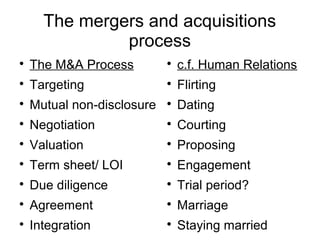
The mergers and acquisitions
               process

    The M&A Process         
                                c.f. Human Relations

    Targeting               
                                Flirting

    Mutual non-disclosure   
                                Dating

    Negotiation             
                                Courting

    Valuation               
                                Proposing

    Term sheet/ LOI         
                                Engagement

    Due diligence           
                                Trial period?

    Agreement               
                                Marriage

    Integration             
                                Staying married
Basic negotiation strategies

    Know your position relative to the      
                                                Always leave room for yourself and
    other                                       the other side to step down without
                                                losing face. Don't issue

    Assess your Best Alternative to a           unnecessary ultimatums unless
    Negotiated Agreement (“BATNA”)              you are ready to stand by it.
    and that of the other side
                                            
                                                Be aware of silent needs, interests

    Assess your Worst Alternative to a          and wants, of the decision-makers,
    Negotiated Agreement (“WATNA”)              as well as their influencers and
    and that of the other side                  professional advisers.

    Only deal with decision makers-         
                                                Be comfortable with long periods of
    check for their mandate                     silence.

    Use “if...then”
“If I concede to your request, then
    would you in turn...”

    Practice active listening. Listen for
    the unspoken messages.
Resolving valuation differences
       between seller and buyer

    Make payments over          
                                    Use share swaps instead
    time instead of                 of cash
    immediately.                
                                    Retain the seller as a

    Agree to earn-outs for          consultant
    seller (i.e. seller gets    
                                    Provide a bonus for the
    value he wants based on
                                    seller to remain in the
    future revenues, profits,
                                    company
    etc)

    Agree to value on a
    future year

    Undertake a partial buy-
    out
Be aware that there are at least 2
     types of due diligence


       Accounting due diligence

         Legal due diligence
Accounting due diligence

    Financial/accounting info             
                                              Material commitments to key
    (whether made on same                     staff, suppliers and
    basis/principles? Statutory filings       customers
    done? Bank signatories and
    safeguards?)                          
                                              Valuation of properties and

    Debts                                     equipment

    Statutory contributions and
                                          
                                              Insurances
    tax compliance (EPF, SOCSO,           
                                              Transfer pricing issues
    PCB, corporate taxes, customs
    and excise- laws may render
    directors liable for company
    liabilities, so important to make
    sure in order)
Legal due diligence

    NDAs                                   
                                               Compliance to laws and legal
                                               obligations (tax, environment,

    Corporate info (capitalisation,            employment, conditions of
    shareholding, directorship,                contracts and titles)
    authorisation, good standing,
    structure, subsidiaries, affiliates)   
                                               Intellectual property
                                               (ownership, registration)

    Contracts and MOUs
    (employees, suppliers, customers,      
                                               Pending litigation, claims and
    creditors, banks, share options,           contingent liabilities
    powers of attorney)
                                           
                                               Insurances (validity and

    Inventory (ownership, risks)               subsistence, inventory, real estate,

    Real estate, machinery and                 machine and equipment, all risks,
                                               others)
    equipment (ownership,
    encumbrances)                          
                                               Regulatory requirements for
                                               operations (licences and permits,
                                               subsisting breaches, renewals and
                                               conditions)
Common types of deals
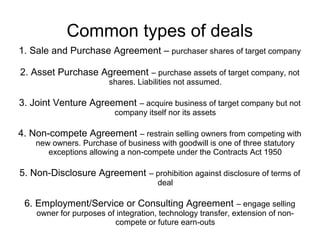
1. Sale and Purchase Agreement – purchaser shares of target company

2. Asset Purchase Agreement – purchase assets of target company, not
                        shares. Liabilities not assumed.

3. Joint Venture Agreement – acquire business of target company but not
                          company itself nor its assets

4. Non-compete Agreement – restrain selling owners from competing with
    new owners. Purchase of business with goodwill is one of three statutory
       exceptions allowing a non-compete under the Contracts Act 1950

5. Non-Disclosure Agreement – prohibition against disclosure of terms of
                                      deal

 6. Employment/Service or Consulting Agreement – engage selling
    owner for purposes of integration, technology transfer, extension of non-
                         compete or future earn-outs
Important clauses for shareholder
               agreements

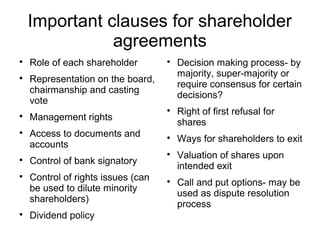
    Role of each shareholder        
                                        Decision making process- by
                                        majority, super-majority or

    Representation on the board,
                                        require consensus for certain
    chairmanship and casting
                                        decisions?
    vote
                                    
                                        Right of first refusal for

    Management rights
                                        shares

    Access to documents and         
                                        Ways for shareholders to exit
    accounts
                                    
                                        Valuation of shares upon

    Control of bank signatory
                                        intended exit

    Control of rights issues (can   
                                        Call and put options- may be
    be used to dilute minority
                                        used as dispute resolution
    shareholders)
                                        process

    Dividend policy
Post-merger integration

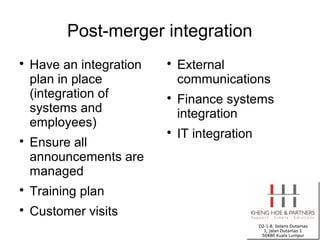
    Have an integration   
                              External
    plan in place             communications
    (integration of       
                              Finance systems
    systems and               integration
    employees)
                          
                              IT integration

    Ensure all
    announcements are
    managed

    Training plan

    Customer visits
Some important reminders

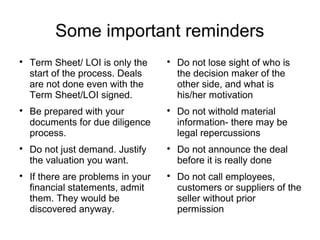
    Term Sheet/ LOI is only the     
                                        Do not lose sight of who is
    start of the process. Deals         the decision maker of the
    are not done even with the          other side, and what is
    Term Sheet/LOI signed.              his/her motivation

    Be prepared with your           
                                        Do not withold material
    documents for due diligence         information- there may be
    process.                            legal repercussions

    Do not just demand. Justify     
                                        Do not announce the deal
    the valuation you want.             before it is really done

    If there are problems in your   
                                        Do not call employees,
    financial statements, admit         customers or suppliers of the
    them. They would be                 seller without prior
    discovered anyway.                  permission
About Us

We are a niche law practice servicing businesses
       and business owners, focused on:

          1. Litigation and arbitration;

   2. Real estate transactions and financing;

           3. Construction disputes;

         4. Corporate/commercial work.
A final word

When in doubt, Ask@MyCounsel.com.my
        Like us on Facebook
   Follow us on twitter @mycounsel
         Find us on Linkedin
  URL: http://www.mycounsel.com.my
Questions?

Thank You.

20120925 m&a for private cos

  • 1.
    Mergers and Acquisitions for Private Companies An introduction by:
  • 2.
    What will becovered  Why do sellers sell?  Accounting due  Should you buy? diligence  More questions to ask  Legal due diligence before buying  Types of deals  The Mergers and  Post-merger Acquisitions process integration  Basic negotiation  Some important strategies reminders  Resolving valuation differences
  • 3.
    Why do sellerssell?  Retirement  Sale of part of  Need additional company to fund expertise to take growth company to the next  Accessing level accumulated wealth  Divesting a division or  Buying out a partner product line  Paying off debts  Industry changes  Operational troubles
  • 4.
    Why is itimportant to know why sellers sell? 1. Knowing common reasons why sellers sell may indicate whether a particular company is a potential target for acquisition. 2. Seller's motivation to sell affects the potential sale price. 3. Knowing seller's motivation may also highlight potential issues post-merger and acquisition. Query: As you think about your suppliers and competitors, would any of them be motivated to sell based on any of the common reasons for sale?
  • 5.
    Should you buy?  Strengthen market  Eliminate competition position  Enhance offering  Turnaround to make  IPO money  Access to customer  Complementary for base cross-selling  New capabilities and  Geographic technologies expansion  Business  Economies of scale transformation
  • 6.
    Points to ponder: Haveyou previously acquired a company? In hindsight, was it for a good reason? Why or why not? If you were considering to acquire a company presently, what would be your reason for doing so?
  • 7.
    More questions toask before buying The previous reasons relate to corporate/business unit strategies. In addition to those reasons, you need to consider: a. Is the target company the best candidate? b. Can the deal be made at the right price? c. Is it the best way to structure? (in terms of shares, assets, contracts, etc)
  • 8.
    The mergers andacquisitions process  The M&A Process  c.f. Human Relations  Targeting  Flirting  Mutual non-disclosure  Dating  Negotiation  Courting  Valuation  Proposing  Term sheet/ LOI  Engagement  Due diligence  Trial period?  Agreement  Marriage  Integration  Staying married
  • 9.
    Basic negotiation strategies  Know your position relative to the  Always leave room for yourself and other the other side to step down without losing face. Don't issue  Assess your Best Alternative to a unnecessary ultimatums unless Negotiated Agreement (“BATNA”) you are ready to stand by it. and that of the other side  Be aware of silent needs, interests  Assess your Worst Alternative to a and wants, of the decision-makers, Negotiated Agreement (“WATNA”) as well as their influencers and and that of the other side professional advisers.  Only deal with decision makers-  Be comfortable with long periods of check for their mandate silence.  Use “if...then” “If I concede to your request, then would you in turn...”  Practice active listening. Listen for the unspoken messages.
  • 10.
    Resolving valuation differences between seller and buyer  Make payments over  Use share swaps instead time instead of of cash immediately.  Retain the seller as a  Agree to earn-outs for consultant seller (i.e. seller gets  Provide a bonus for the value he wants based on seller to remain in the future revenues, profits, company etc)  Agree to value on a future year  Undertake a partial buy- out
  • 11.
    Be aware thatthere are at least 2 types of due diligence Accounting due diligence Legal due diligence
  • 12.
    Accounting due diligence  Financial/accounting info  Material commitments to key (whether made on same staff, suppliers and basis/principles? Statutory filings customers done? Bank signatories and safeguards?)  Valuation of properties and  Debts equipment  Statutory contributions and  Insurances tax compliance (EPF, SOCSO,  Transfer pricing issues PCB, corporate taxes, customs and excise- laws may render directors liable for company liabilities, so important to make sure in order)
  • 13.
    Legal due diligence  NDAs  Compliance to laws and legal obligations (tax, environment,  Corporate info (capitalisation, employment, conditions of shareholding, directorship, contracts and titles) authorisation, good standing, structure, subsidiaries, affiliates)  Intellectual property (ownership, registration)  Contracts and MOUs (employees, suppliers, customers,  Pending litigation, claims and creditors, banks, share options, contingent liabilities powers of attorney)  Insurances (validity and  Inventory (ownership, risks) subsistence, inventory, real estate,  Real estate, machinery and machine and equipment, all risks, others) equipment (ownership, encumbrances)  Regulatory requirements for operations (licences and permits, subsisting breaches, renewals and conditions)
  • 14.
    Common types ofdeals 1. Sale and Purchase Agreement – purchaser shares of target company 2. Asset Purchase Agreement – purchase assets of target company, not shares. Liabilities not assumed. 3. Joint Venture Agreement – acquire business of target company but not company itself nor its assets 4. Non-compete Agreement – restrain selling owners from competing with new owners. Purchase of business with goodwill is one of three statutory exceptions allowing a non-compete under the Contracts Act 1950 5. Non-Disclosure Agreement – prohibition against disclosure of terms of deal 6. Employment/Service or Consulting Agreement – engage selling owner for purposes of integration, technology transfer, extension of non- compete or future earn-outs
  • 15.
    Important clauses forshareholder agreements  Role of each shareholder  Decision making process- by majority, super-majority or  Representation on the board, require consensus for certain chairmanship and casting decisions? vote  Right of first refusal for  Management rights shares  Access to documents and  Ways for shareholders to exit accounts  Valuation of shares upon  Control of bank signatory intended exit  Control of rights issues (can  Call and put options- may be be used to dilute minority used as dispute resolution shareholders) process  Dividend policy
  • 16.
    Post-merger integration  Have an integration  External plan in place communications (integration of  Finance systems systems and integration employees)  IT integration  Ensure all announcements are managed  Training plan  Customer visits
  • 17.
    Some important reminders  Term Sheet/ LOI is only the  Do not lose sight of who is start of the process. Deals the decision maker of the are not done even with the other side, and what is Term Sheet/LOI signed. his/her motivation  Be prepared with your  Do not withold material documents for due diligence information- there may be process. legal repercussions  Do not just demand. Justify  Do not announce the deal the valuation you want. before it is really done  If there are problems in your  Do not call employees, financial statements, admit customers or suppliers of the them. They would be seller without prior discovered anyway. permission
  • 18.
    About Us We area niche law practice servicing businesses and business owners, focused on: 1. Litigation and arbitration; 2. Real estate transactions and financing; 3. Construction disputes; 4. Corporate/commercial work.
  • 19.
    A final word Whenin doubt, Ask@MyCounsel.com.my Like us on Facebook Follow us on twitter @mycounsel Find us on Linkedin URL: http://www.mycounsel.com.my
  • 20.