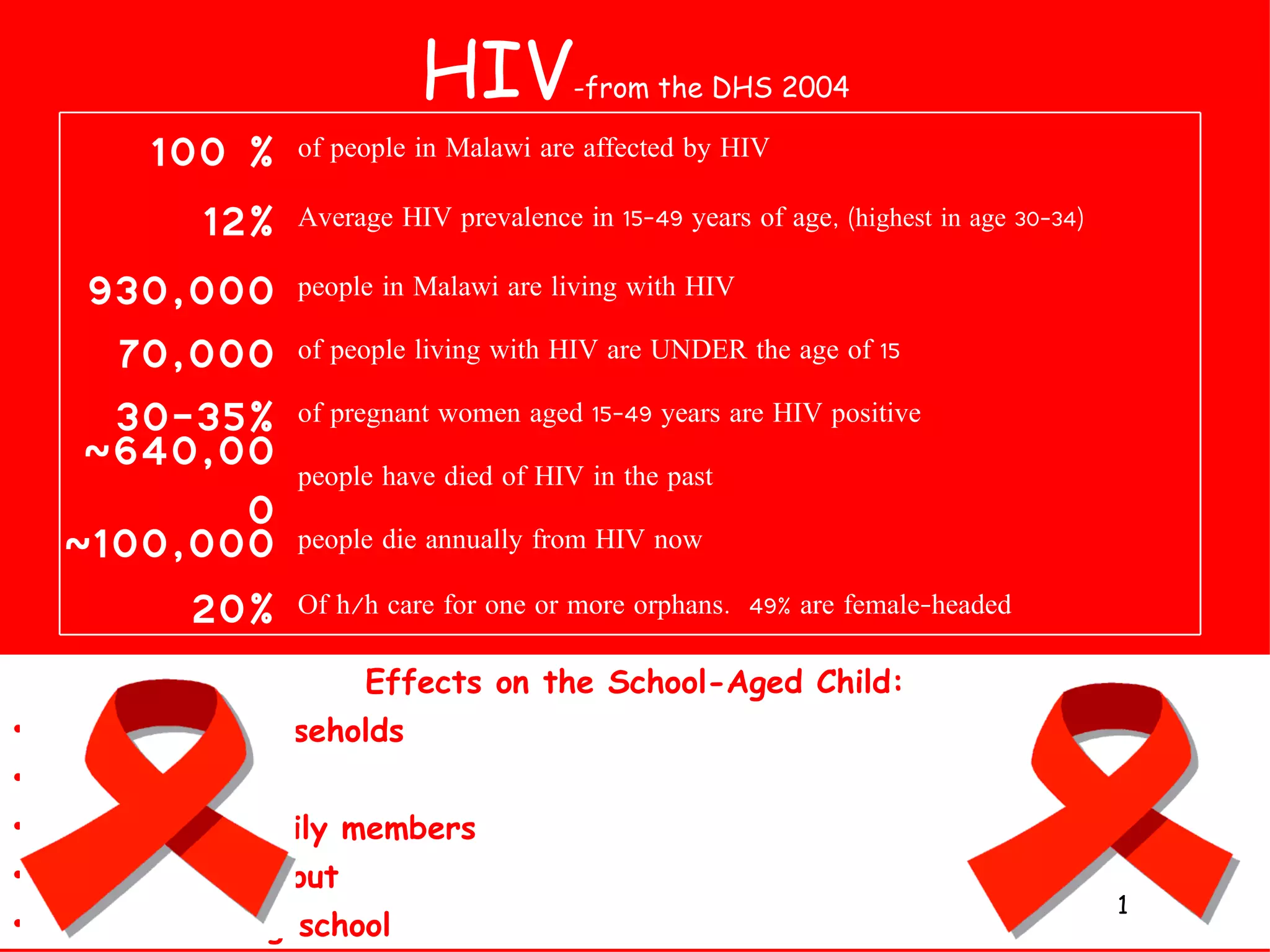
HIV -from the DHS 2004 Effects on the School-Aged Child: Single parent households Orphan hood Caring for ill family members Absence or drop out Teachers missing school 100 % of people in Malawi are affected by HIV 12% Average HIV prevalence in 15-49 years of age,  (highest in age 30-34) 930,000 people in Malawi are living with HIV 70,000 of people living with HIV are UNDER the age of 15 30-35% of pregnant women aged 15-49 years are HIV positive ~640,000 people have died of HIV in the past ~100,000 people die annually from HIV now 20% Of h/h care for one or more orphans.  49% are female-headed
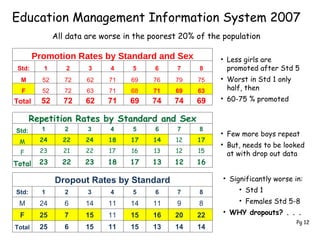
Education Management Information System 2007 All data are worse in the poorest 20% of the population Less girls are promoted after Std 5 Worst in Std 1 only half, then 60-75 % promoted Few more boys repeat But, needs to be looked at with drop out data Significantly worse in: Std 1 Females Std 5-8 WHY dropouts? . . . Pg 12 Promotion Rates by Standard and Sex Std: 1 2 3 4 5 6 7 8 M 52 72 62 71 69 76 79 75 F 52 72 63 71 68 71 69 63 Total  52 72 62 71 69 74 74 69 Repetition Rates by Standard and Sex Std: 1 2 3 4 5 6 7 8 M 24 22 24 18 17 14 12 17 F 23 21 22 17 16 13 12 15 Total  23 22 23 18 17 13 12 16 Dropout Rates by Standard Std: 1 2 3 4 5 6 7 8 M 24 6 14 11 14 11 9 8 F 25 7 15 11 15 16 20 22 Total  25 6 15 11 15 13 14 14
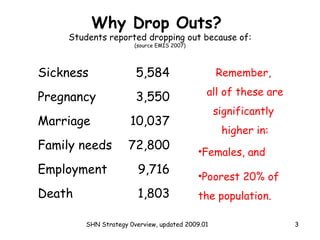
Why Drop Outs?  Students reported dropping out because of: (source EMIS 2007) Remember,  all of these are significantly  higher in: Females, and Poorest 20% of the population. SHN Strategy 0verview, updated 2009.01 Sickness  5,584 Pregnancy  3,550 Marriage  10,037 Family needs 72,800 Employment  9,716 Death  1,803
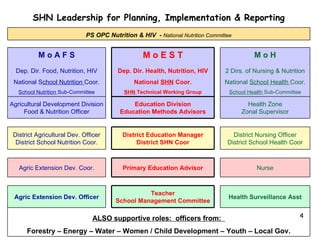
SHN Leadership for Planning, Implementation & Reporting PS OPC Nutrition & HIV  -  National Nutrition Committee M o A F S M o E S T M o H Dep. Dir. Food, Nutrition, HIV National S chool Nutrition  Coor. School Nutrition  Sub-Committee Dep. Dir. Health, Nutrition, HIV National  SHN  Coor. SHN  Technical Working Group 2 Dirs. of Nursing & Nutrition National  School Health  Coor. School Health  Sub-Committee Agricultural Development Division Food & Nutrition Officer Education Division Education Methods Advisors Health Zone Zonal Supervisor District Agricultural Dev. Officer District School Nutrition Coor. District Education Manager District SHN Coor District Nursing Officer District School Health Coor Agric Extension Dev. Coor. Primary Education Advisor Nurse Agric Extension Dev. Officer Teacher School Management Committee Health Surveillance Asst ALSO supportive roles:  officers from:  Forestry – Energy – Water – Women / Child Development – Youth – Local Gov.
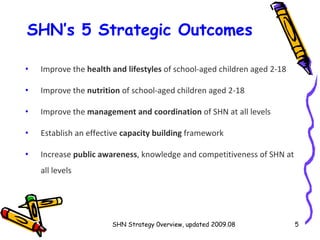
Improve the  health and lifestyles  of school-aged children aged 2-18 Improve the  nutrition  of school-aged children aged 2-18 Improve the  management and coordination  of SHN at all levels Establish an effective  capacity building  framework Increase  public awareness , knowledge and competitiveness of SHN at all levels SHN Strategy 0verview, updated 2009.08 SHN’s 5 Strategic Outcomes
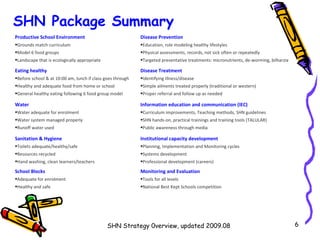
SHN Package Summary SHN Strategy 0verview, updated 2009.08 Productive School Environment Grounds match curriculum Model 6 food groups Landscape that is ecologically appropriate Disease Prevention Education, role modeling healthy lifestyles Physical assessments, records, not sick often or repeatedly Targeted preventative treatments: micronutrients, de-worming, bilharzia Eating healthy Before school & at 10:00 am, lunch if class goes through Healthy and adequate food from home or school General healthy eating following 6 food group model Disease Treatment Identifying illness/disease Simple ailments treated properly (traditional or western) Proper referral and follow up as needed Water Water adequate for enrolment Water system managed properly Runoff water used Information education and communication (IEC) Curriculum improvements, Teaching methods, SHN guidelines SHN hands-on, practical trainings and training tools (TALULAR) Public awareness through media Sanitation & Hygiene Toilets adequate/healthy/safe Resources recycled Hand washing, clean learners/teachers Institutional capacity development Planning, Implementation and Monitoring cycles Systems development Professional development (careers) School Blocks Adequate for enrolment Healthy and safe Monitoring and Evaluation Tools for all levels National Best Kept Schools competition
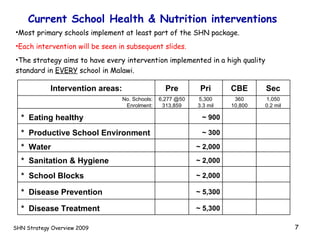
SHN Strategy Overview 2009 Current School Health & Nutrition interventions Most primary schools implement at least part of the SHN package. Each intervention will be seen in subsequent slides. The strategy aims to have every intervention implemented in a high quality standard in  EVERY  school in Malawi. Intervention areas: Pre Pri CBE Sec No. Schools: Enrolment: 6,277 @50 313,859 5,300 3.3 mil 360 10,800 1,050 0.2 mil *  Eating healthy ~ 900 *  Productive School Environment ~ 300 *  Water  ~ 2,000 *  Sanitation & Hygiene ~ 2,000 *  School Blocks  ~ 2,000 *  Disease Prevention ~ 5,300 *  Disease Treatment  ~ 5,300
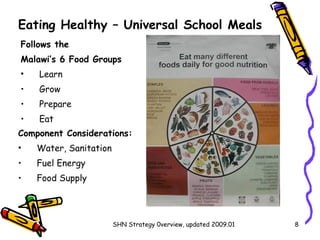
Eating Healthy – Universal School Meals Follows the  Malawi’s 6 Food Groups Learn Grow Prepare Eat SHN Strategy 0verview, updated 2009.01 Component Considerations: Water, Sanitation Fuel Energy Food Supply
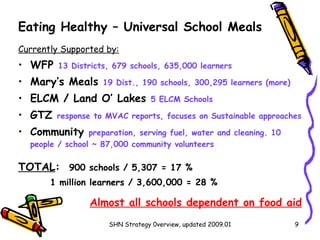
Eating Healthy – Universal School Meals Currently Supported by: WFP  13 Districts, 679 schools, 635,000 learners Mary’s Meals  19 Dist., 190 schools, 300,295 learners (more) ELCM / Land O’ Lakes  5 ELCM Schools GTZ  response to MVAC reports, focuses on Sustainable approaches Community  preparation, serving fuel, water and cleaning. 10 people / school ~ 87,000 community volunteers TOTAL :  900 schools / 5,307 = 17 % 1 million learners / 3,600,000 = 28 % Almost all schools dependent on food aid SHN Strategy 0verview, updated 2009.01
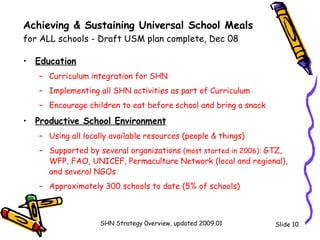
Achieving & Sustaining Universal School Meals  for ALL schools - Draft USM plan complete, Dec 08 Education   Curriculum integration for SHN  Implementing all SHN activities as part of Curriculum Encourage children to eat before school and bring a snack Productive School Environment Using all locally available resources (people & things) Supported by several organizations  (most started in 2006):  GTZ, WFP, FAO, UNICEF, Permaculture Network (local and regional), and several NGOs Approximately 300 schools to date (5% of schools) Slide  SHN Strategy 0verview, updated 2009.01

Shn Overview Updated 2009 06 P11 20

  • 1.
    HIV -from theDHS 2004 Effects on the School-Aged Child: Single parent households Orphan hood Caring for ill family members Absence or drop out Teachers missing school 100 % of people in Malawi are affected by HIV 12% Average HIV prevalence in 15-49 years of age, (highest in age 30-34) 930,000 people in Malawi are living with HIV 70,000 of people living with HIV are UNDER the age of 15 30-35% of pregnant women aged 15-49 years are HIV positive ~640,000 people have died of HIV in the past ~100,000 people die annually from HIV now 20% Of h/h care for one or more orphans. 49% are female-headed
  • 2.
    Education Management InformationSystem 2007 All data are worse in the poorest 20% of the population Less girls are promoted after Std 5 Worst in Std 1 only half, then 60-75 % promoted Few more boys repeat But, needs to be looked at with drop out data Significantly worse in: Std 1 Females Std 5-8 WHY dropouts? . . . Pg 12 Promotion Rates by Standard and Sex Std: 1 2 3 4 5 6 7 8 M 52 72 62 71 69 76 79 75 F 52 72 63 71 68 71 69 63 Total 52 72 62 71 69 74 74 69 Repetition Rates by Standard and Sex Std: 1 2 3 4 5 6 7 8 M 24 22 24 18 17 14 12 17 F 23 21 22 17 16 13 12 15 Total 23 22 23 18 17 13 12 16 Dropout Rates by Standard Std: 1 2 3 4 5 6 7 8 M 24 6 14 11 14 11 9 8 F 25 7 15 11 15 16 20 22 Total 25 6 15 11 15 13 14 14
  • 3.
    Why Drop Outs? Students reported dropping out because of: (source EMIS 2007) Remember, all of these are significantly higher in: Females, and Poorest 20% of the population. SHN Strategy 0verview, updated 2009.01 Sickness 5,584 Pregnancy 3,550 Marriage 10,037 Family needs 72,800 Employment 9,716 Death 1,803
  • 4.
    SHN Leadership forPlanning, Implementation & Reporting PS OPC Nutrition & HIV - National Nutrition Committee M o A F S M o E S T M o H Dep. Dir. Food, Nutrition, HIV National S chool Nutrition Coor. School Nutrition Sub-Committee Dep. Dir. Health, Nutrition, HIV National SHN Coor. SHN Technical Working Group 2 Dirs. of Nursing & Nutrition National School Health Coor. School Health Sub-Committee Agricultural Development Division Food & Nutrition Officer Education Division Education Methods Advisors Health Zone Zonal Supervisor District Agricultural Dev. Officer District School Nutrition Coor. District Education Manager District SHN Coor District Nursing Officer District School Health Coor Agric Extension Dev. Coor. Primary Education Advisor Nurse Agric Extension Dev. Officer Teacher School Management Committee Health Surveillance Asst ALSO supportive roles: officers from: Forestry – Energy – Water – Women / Child Development – Youth – Local Gov.
  • 5.
    Improve the health and lifestyles of school-aged children aged 2-18 Improve the nutrition of school-aged children aged 2-18 Improve the management and coordination of SHN at all levels Establish an effective capacity building framework Increase public awareness , knowledge and competitiveness of SHN at all levels SHN Strategy 0verview, updated 2009.08 SHN’s 5 Strategic Outcomes
  • 6.
    SHN Package SummarySHN Strategy 0verview, updated 2009.08 Productive School Environment Grounds match curriculum Model 6 food groups Landscape that is ecologically appropriate Disease Prevention Education, role modeling healthy lifestyles Physical assessments, records, not sick often or repeatedly Targeted preventative treatments: micronutrients, de-worming, bilharzia Eating healthy Before school & at 10:00 am, lunch if class goes through Healthy and adequate food from home or school General healthy eating following 6 food group model Disease Treatment Identifying illness/disease Simple ailments treated properly (traditional or western) Proper referral and follow up as needed Water Water adequate for enrolment Water system managed properly Runoff water used Information education and communication (IEC) Curriculum improvements, Teaching methods, SHN guidelines SHN hands-on, practical trainings and training tools (TALULAR) Public awareness through media Sanitation & Hygiene Toilets adequate/healthy/safe Resources recycled Hand washing, clean learners/teachers Institutional capacity development Planning, Implementation and Monitoring cycles Systems development Professional development (careers) School Blocks Adequate for enrolment Healthy and safe Monitoring and Evaluation Tools for all levels National Best Kept Schools competition
  • 7.
    SHN Strategy Overview2009 Current School Health & Nutrition interventions Most primary schools implement at least part of the SHN package. Each intervention will be seen in subsequent slides. The strategy aims to have every intervention implemented in a high quality standard in EVERY school in Malawi. Intervention areas: Pre Pri CBE Sec No. Schools: Enrolment: 6,277 @50 313,859 5,300 3.3 mil 360 10,800 1,050 0.2 mil * Eating healthy ~ 900 * Productive School Environment ~ 300 * Water ~ 2,000 * Sanitation & Hygiene ~ 2,000 * School Blocks ~ 2,000 * Disease Prevention ~ 5,300 * Disease Treatment ~ 5,300
  • 8.
    Eating Healthy –Universal School Meals Follows the Malawi’s 6 Food Groups Learn Grow Prepare Eat SHN Strategy 0verview, updated 2009.01 Component Considerations: Water, Sanitation Fuel Energy Food Supply
  • 9.
    Eating Healthy –Universal School Meals Currently Supported by: WFP 13 Districts, 679 schools, 635,000 learners Mary’s Meals 19 Dist., 190 schools, 300,295 learners (more) ELCM / Land O’ Lakes 5 ELCM Schools GTZ response to MVAC reports, focuses on Sustainable approaches Community preparation, serving fuel, water and cleaning. 10 people / school ~ 87,000 community volunteers TOTAL : 900 schools / 5,307 = 17 % 1 million learners / 3,600,000 = 28 % Almost all schools dependent on food aid SHN Strategy 0verview, updated 2009.01
  • 10.
    Achieving & SustainingUniversal School Meals for ALL schools - Draft USM plan complete, Dec 08 Education Curriculum integration for SHN Implementing all SHN activities as part of Curriculum Encourage children to eat before school and bring a snack Productive School Environment Using all locally available resources (people & things) Supported by several organizations (most started in 2006): GTZ, WFP, FAO, UNICEF, Permaculture Network (local and regional), and several NGOs Approximately 300 schools to date (5% of schools) Slide SHN Strategy 0verview, updated 2009.01