Project
“Guidelines for a Sustainable
Mobility Plan for Tbilisi”
Tbilisi, Georgia
IV Local Economic Development Forum
Sustainable Urban Transport
7-8 April, 2010
Introduction
Georgian – Italian
cooperation
Project supported by Italian
Ministry of Economics and
Finance (MEF)
Main objective
“preparation of preliminary
Guidelines for a Sustainable
Mobility Plan for Tbilisi”
aims at providing the local
administration a valid
technical support to its
Departments of Transport and
International Relations
dedicated to sustainable
development and international
cooperation
Italian Ministry of
Economics and Finance
NET Engineering S.p.A. profile and fields
of expertise
NET Engineering is a dynamic Company which produces and
supplies technical and management services in the field of
civil engineering for customers in Italy and abroad.
The roots of the company come from the early 70’s with the
professional activity of the majority shareholder. NET
Engineering today is a joint stock company which employs
about 160 people, with offices in Monselice (30 minutes from
Venezia), Roma, Mestre-Venezia, Napoli.
Our Company’s mission is to provide optimal integration of
competencies to respond to customers’ needs, studying,
planning, designing and implementing projects in the
following sectors :
 Transportation
 Land Use, Environment, City Planning
 Architecture and Real Estate Development
 Hydraulics and Water Cycle
 Consulting
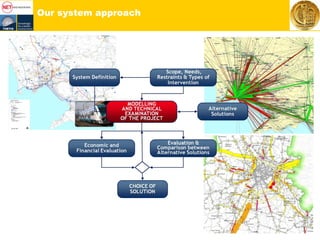
Our system approach
Thetis company
Thetis operates as a
Consultant, Solution Provider
and Systems Integrator in
advanced technology
applications, Expertise from
the Venice environment
• Environmental and Civil
Engineering: Requalification
of polluted areas and territory,
construction management,
rehabilitation of historical
building
• Intelligent Transport
Systems for Sustainable
Mobility: Public Transport
fleet management systems;
Integrated Traffic
Management Systems.
The Company personnel is 200 permanent staff,
growing.
Several international partners from Industry and
Academy cooperate with Thetis.
Thetis is member of Ertico, UITP, Aipnc… and
participates to International Research Projects
within the EU Framework Programmes
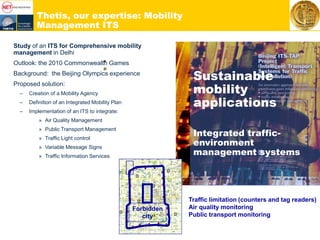
Thetis, our expertise: Mobility
Management ITS
Study of an ITS for Comprehensive mobility
management in Delhi
Outlook: the 2010 Commonwealth Games
Background: the Beijing Olympics experience
Proposed solution:
– Creation of a Mobility Agency
– Definition of an Integrated Mobility Plan
– Implementation of an ITS to integrate:
» Air Quality Management
» Public Transport Management
» Traffic Light control
» Variable Message Signs
» Traffic Information Services
Sustainable
mobility
applications
Integrated traffic-
environment
management systems
Traffic limitation (counters and tag readers)
Air quality monitoring
Public transport monitoring
Forbidden
city
What is
Sustainable Urban Mobility
 The ability to meet the needs to move people and goods,
without sacrificing the essential human and ecological values,
today and in the future.
 The focus is on moving people and not vehicles !
 Organising mobility such that the consumption of energy ,
environment and land does not endanger the opportunities of
future generations to reach at least the same welfare level as
those living now.
 Access to goods and services for all inhabitants of the urban
area
 Safety access to all
Unmanaged mobility ..
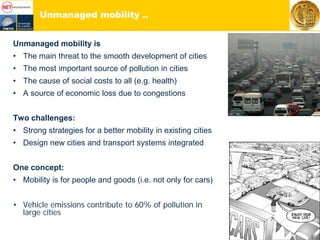
Unmanaged mobility is
• The main threat to the smooth development of cities
• The most important source of pollution in cities
• The cause of social costs to all (e.g. health)
• A source of economic loss due to congestions
Two challenges:
• Strong strategies for a better mobility in existing cities
• Design new cities and transport systems integrated
One concept:
• Mobility is for people and goods (i.e. not only for cars)
• Vehicle emissions contribute to 60% of pollution in
large cities
How to implement
Sustainable Urban Mobility
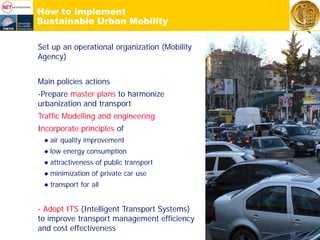
Set up an operational organization (Mobility
Agency)
Main policies actions
-Prepare master plans to harmonize
urbanization and transport
Traffic Modelling and engineering
Incorporate principles of
● air quality improvement
● low energy consumption
● attractiveness of public transport
● minimization of private car use
● transport for all
- Adopt ITS (Intelligent Transport Systems)
to improve transport management efficiency
and cost effectiveness
The role of the Mobility Agencies
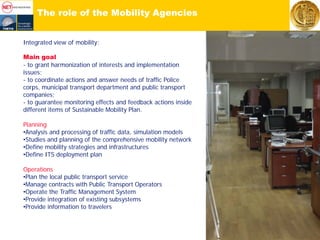
Integrated view of mobility:
Main goal
- to grant harmonization of interests and implementation
issues;
- to coordinate actions and answer needs of traffic Police
corps, municipal transport department and public transport
companies;
- to guarantee monitoring effects and feedback actions inside
different items of Sustainable Mobility Plan.
Planning
•Analysis and processing of traffic data, simulation models
•Studies and planning of the comprehensive mobility network
•Define mobility strategies and infrastructures
•Define ITS deployment plan
Operations
•Plan the local public transport service
•Manage contracts with Public Transport Operators
•Operate the Traffic Management System
•Provide integration of existing subsystems
•Provide information to travelers
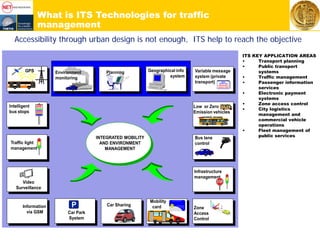
Low or Zero
Emission vehicles
Geographical info
system
Bus lane
control
Environment
monitoring
Planning
Atc
GPS
P
Car Park
System
Traffic light
management
Intelligent
bus stops
Variable message
system (private
transport)
Infrastructure
management
INTEGRATED MOBILITY
AND ENVIRONMENT
MANAGEMENT
dsf dfsf fevvfvd evvdvd
fevvfvd evvdvd
fvd evvdvd
SF FFD ERFREF BFGBGFB
Mobility
cardCar Sharing
Zone
Access
Control
entrataentrata uscita 13
Video
Surveillance
Information
via GSM
What is ITS Technologies for traffic
management
Accessibility through urban design is not enough, ITS help to reach the objective
ITS KEY APPLICATION AREAS
• Transport planning
• Public transport
systems
• Traffic management
• Passenger information
services
• Electronic payment
systems
• Zone access control
• City logistics
management and
commercial vehicle
operations
• Fleet management of
public services
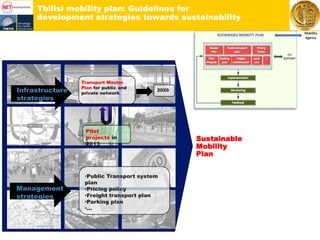
Tbilisi mobility plan: Guidelines for
development strategies towards sustainability
Management
strategies
Infrastructure
strategies
Transport Master
Plan for public and
private network
•Public Transport system
plan
•Pricing policy
•Freight transport plan
•Parking plan
•…
Pilot
projects in
2013
2020
Sustainable
Mobility
Plan
Mobility
Agency
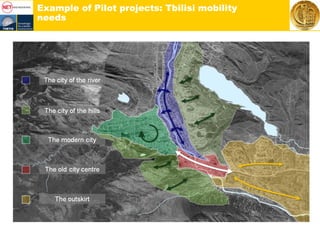
Example of Pilot projects: Tbilisi mobility
needs
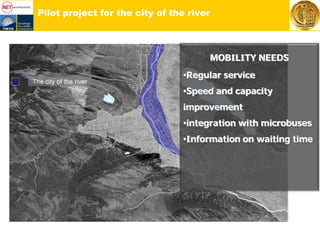
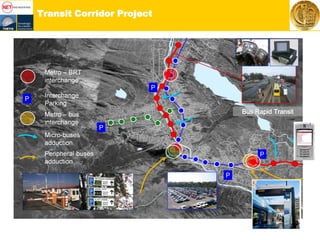
Pilot project for the city of the river
MOBILITY NEEDS
•Regular service
•Speed and capacity
improvement
•integration with microbuses
•Information on waiting time
Transit Corridor Project
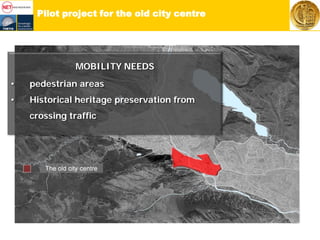
Pilot project for the old city centre
MOBILITY NEEDS
• pedestrian areas
• Historical heritage preservation from
crossing traffic
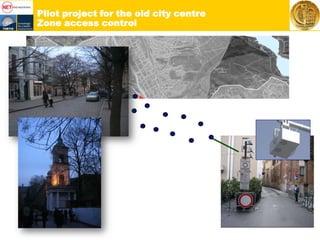
Pilot project for the old city centre
Zone access control
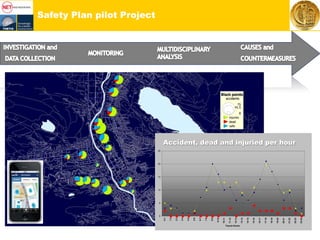
Safety Plan pilot Project
0
5
10
15
20
25
Fascia Oraria
Accident, dead and injuried per hour
Air Quality Management System pilot Project
integrated in the management centre
Stazione di Milano Juvara, Gennaio 2003:
Dati Previsti vs. Dati Misurati
0
25
50
75
100
125
150
Giorni di Previsione
(Gennaio 2003)
ConcentrazionediPM10[mg/m3]
Dati Misurati
Previsioni Reti Neurali
Soglia dei 50 mg/m3
Previsioni Lazy Learning
Previsioni Mod. Lineare
MILANO
GENOVA
TRENTO
VERONA
PIACENZA
MODENA
BRESCIA
VARESE
BERGAMO
SONDRIO
PARMA
NOVARA
ALESSANDRIA
4900
4950
5000
5050
5100
5150
(UTM-km)
400 450 500 550 600 650
(UTM - km)
[ug/m3]
0
5
10
15
20
25
30
35
40
45
50
55
60
65
70
75
80
Conclusion
 The implementation of a Sustainable Mobility Plan will
integrate the vision of the on going Master Plan project with
the action on mobility management and the implementation of
ITS tools;
 The creation of a Mobility Agency, according to international
practices, in charge of implementation of a Sustainable Mobility
Plan;
 The opportunity to realise Pilot project, inside the Sustainable
Mobility Plan and going forward the same objective of Master
Plan, in order to get two main goals:
• arising level of performances for public transport service
network in the next future with specific planning activities and
ITS tools implementation;
• providing Master Plan of a useful tool to tune and recalibrate,
if necessary, transport macro modelling features.
Eng Paolo Squillante (paolo.squillante@thetis.it)
Eng. Matteo Apollonio (matteo.apollonio@thetis.it)
Thetis SpA
Castello 2737/f
30122 Venice, Italy
Tel +39 041 2406111
Fax +39 041 5210292
www.thetis.it
info@thetis.it
Eng. Giovanni Acciaro (giovanni.acciaro@netspa.it)
Doct. Gabriele.Sau (gabriele.sau@netspa.it)
NET Engineering SpA
Centro Direzionale "Le Torri" Via Squero 12
35043 Monselice (PD)
Tel. +39 0429 787111
Fax +39 0429 787105
http://www.netspa.com/
info@nestpa.com
Thank you for
your
attention

Guidelines for a Sustainable Mobility Plan for Tbilisi

  • 1.
    Project “Guidelines for aSustainable Mobility Plan for Tbilisi” Tbilisi, Georgia IV Local Economic Development Forum Sustainable Urban Transport 7-8 April, 2010
  • 2.
    Introduction Georgian – Italian cooperation Projectsupported by Italian Ministry of Economics and Finance (MEF) Main objective “preparation of preliminary Guidelines for a Sustainable Mobility Plan for Tbilisi” aims at providing the local administration a valid technical support to its Departments of Transport and International Relations dedicated to sustainable development and international cooperation Italian Ministry of Economics and Finance
  • 3.
    NET Engineering S.p.A.profile and fields of expertise NET Engineering is a dynamic Company which produces and supplies technical and management services in the field of civil engineering for customers in Italy and abroad. The roots of the company come from the early 70’s with the professional activity of the majority shareholder. NET Engineering today is a joint stock company which employs about 160 people, with offices in Monselice (30 minutes from Venezia), Roma, Mestre-Venezia, Napoli. Our Company’s mission is to provide optimal integration of competencies to respond to customers’ needs, studying, planning, designing and implementing projects in the following sectors :  Transportation  Land Use, Environment, City Planning  Architecture and Real Estate Development  Hydraulics and Water Cycle  Consulting
  • 4.
  • 5.
    Thetis company Thetis operatesas a Consultant, Solution Provider and Systems Integrator in advanced technology applications, Expertise from the Venice environment • Environmental and Civil Engineering: Requalification of polluted areas and territory, construction management, rehabilitation of historical building • Intelligent Transport Systems for Sustainable Mobility: Public Transport fleet management systems; Integrated Traffic Management Systems. The Company personnel is 200 permanent staff, growing. Several international partners from Industry and Academy cooperate with Thetis. Thetis is member of Ertico, UITP, Aipnc… and participates to International Research Projects within the EU Framework Programmes
  • 6.
    Thetis, our expertise:Mobility Management ITS Study of an ITS for Comprehensive mobility management in Delhi Outlook: the 2010 Commonwealth Games Background: the Beijing Olympics experience Proposed solution: – Creation of a Mobility Agency – Definition of an Integrated Mobility Plan – Implementation of an ITS to integrate: » Air Quality Management » Public Transport Management » Traffic Light control » Variable Message Signs » Traffic Information Services Sustainable mobility applications Integrated traffic- environment management systems Traffic limitation (counters and tag readers) Air quality monitoring Public transport monitoring Forbidden city
  • 7.
    What is Sustainable UrbanMobility  The ability to meet the needs to move people and goods, without sacrificing the essential human and ecological values, today and in the future.  The focus is on moving people and not vehicles !  Organising mobility such that the consumption of energy , environment and land does not endanger the opportunities of future generations to reach at least the same welfare level as those living now.  Access to goods and services for all inhabitants of the urban area  Safety access to all
  • 8.
    Unmanaged mobility .. Unmanagedmobility is • The main threat to the smooth development of cities • The most important source of pollution in cities • The cause of social costs to all (e.g. health) • A source of economic loss due to congestions Two challenges: • Strong strategies for a better mobility in existing cities • Design new cities and transport systems integrated One concept: • Mobility is for people and goods (i.e. not only for cars) • Vehicle emissions contribute to 60% of pollution in large cities
  • 9.
    How to implement SustainableUrban Mobility Set up an operational organization (Mobility Agency) Main policies actions -Prepare master plans to harmonize urbanization and transport Traffic Modelling and engineering Incorporate principles of ● air quality improvement ● low energy consumption ● attractiveness of public transport ● minimization of private car use ● transport for all - Adopt ITS (Intelligent Transport Systems) to improve transport management efficiency and cost effectiveness
  • 10.
    The role ofthe Mobility Agencies Integrated view of mobility: Main goal - to grant harmonization of interests and implementation issues; - to coordinate actions and answer needs of traffic Police corps, municipal transport department and public transport companies; - to guarantee monitoring effects and feedback actions inside different items of Sustainable Mobility Plan. Planning •Analysis and processing of traffic data, simulation models •Studies and planning of the comprehensive mobility network •Define mobility strategies and infrastructures •Define ITS deployment plan Operations •Plan the local public transport service •Manage contracts with Public Transport Operators •Operate the Traffic Management System •Provide integration of existing subsystems •Provide information to travelers
  • 11.
    Low or Zero Emissionvehicles Geographical info system Bus lane control Environment monitoring Planning Atc GPS P Car Park System Traffic light management Intelligent bus stops Variable message system (private transport) Infrastructure management INTEGRATED MOBILITY AND ENVIRONMENT MANAGEMENT dsf dfsf fevvfvd evvdvd fevvfvd evvdvd fvd evvdvd SF FFD ERFREF BFGBGFB Mobility cardCar Sharing Zone Access Control entrataentrata uscita 13 Video Surveillance Information via GSM What is ITS Technologies for traffic management Accessibility through urban design is not enough, ITS help to reach the objective ITS KEY APPLICATION AREAS • Transport planning • Public transport systems • Traffic management • Passenger information services • Electronic payment systems • Zone access control • City logistics management and commercial vehicle operations • Fleet management of public services
  • 12.
    Tbilisi mobility plan:Guidelines for development strategies towards sustainability Management strategies Infrastructure strategies Transport Master Plan for public and private network •Public Transport system plan •Pricing policy •Freight transport plan •Parking plan •… Pilot projects in 2013 2020 Sustainable Mobility Plan Mobility Agency
  • 13.
    Example of Pilotprojects: Tbilisi mobility needs
  • 14.
    Pilot project forthe city of the river MOBILITY NEEDS •Regular service •Speed and capacity improvement •integration with microbuses •Information on waiting time
  • 15.
  • 16.
    Pilot project forthe old city centre MOBILITY NEEDS • pedestrian areas • Historical heritage preservation from crossing traffic
  • 17.
    Pilot project forthe old city centre Zone access control
  • 18.
    Safety Plan pilotProject 0 5 10 15 20 25 Fascia Oraria Accident, dead and injuried per hour
  • 19.
    Air Quality ManagementSystem pilot Project integrated in the management centre Stazione di Milano Juvara, Gennaio 2003: Dati Previsti vs. Dati Misurati 0 25 50 75 100 125 150 Giorni di Previsione (Gennaio 2003) ConcentrazionediPM10[mg/m3] Dati Misurati Previsioni Reti Neurali Soglia dei 50 mg/m3 Previsioni Lazy Learning Previsioni Mod. Lineare MILANO GENOVA TRENTO VERONA PIACENZA MODENA BRESCIA VARESE BERGAMO SONDRIO PARMA NOVARA ALESSANDRIA 4900 4950 5000 5050 5100 5150 (UTM-km) 400 450 500 550 600 650 (UTM - km) [ug/m3] 0 5 10 15 20 25 30 35 40 45 50 55 60 65 70 75 80
  • 20.
    Conclusion  The implementationof a Sustainable Mobility Plan will integrate the vision of the on going Master Plan project with the action on mobility management and the implementation of ITS tools;  The creation of a Mobility Agency, according to international practices, in charge of implementation of a Sustainable Mobility Plan;  The opportunity to realise Pilot project, inside the Sustainable Mobility Plan and going forward the same objective of Master Plan, in order to get two main goals: • arising level of performances for public transport service network in the next future with specific planning activities and ITS tools implementation; • providing Master Plan of a useful tool to tune and recalibrate, if necessary, transport macro modelling features.
  • 21.
    Eng Paolo Squillante(paolo.squillante@thetis.it) Eng. Matteo Apollonio (matteo.apollonio@thetis.it) Thetis SpA Castello 2737/f 30122 Venice, Italy Tel +39 041 2406111 Fax +39 041 5210292 www.thetis.it info@thetis.it Eng. Giovanni Acciaro (giovanni.acciaro@netspa.it) Doct. Gabriele.Sau (gabriele.sau@netspa.it) NET Engineering SpA Centro Direzionale "Le Torri" Via Squero 12 35043 Monselice (PD) Tel. +39 0429 787111 Fax +39 0429 787105 http://www.netspa.com/ info@nestpa.com Thank you for your attention