Suburban Facades 1
DISCLAIMER: This material is provided "as is" without warranty of any kind, either express or implied on the part of the authors/disseminators, including, but not limited to, the implied warranties of merchantability,
fitness for a particular purpose, or non-infringement. This publication could include technical inaccuracies or typographical errors and any reliance on the information contained herein is at the complete risk of the
user. It is recommended that the user consult original sources. Changes may be added from time to time to the information herein; these changes may be incorporated in new editions as information becomes
available and inaccuracies are detected. Links to websites are provided solely for your information and convenience. The authors/disseminators are not responsible for the content and the privacy practices of these
websites and encourage you to examine each site's privacy policy and disclaimers before providing any personal information.
Suburban Design Ideas: Facades
Facades with their walls, windows and doors introduce your building to potential investors and clients. A
building facade is – sometimes literally – your shop window. Attractive walls don’t have to be costly. A few
simple “rules-of-thumb” can make a big difference, both in the marketplace and in promoting your
proposal to neighbours. Here are some ideas – but don’t forget to check your building code and land use
by-law for any legal requirements! And consider retaining an architect to help you realize your objectives
and guide you through the design and construction process.
Get streetwise
First impressions of
your project will come
from the street.
Passersby shouldn’t
have to peer through
binoculars across a sea
of parking to find your
building. Try to get at least one wall along a
public sidewalk to attract more walk-in
customers who won’t use your land to park their
cars. Include some space for outdoor cafes and
sidewalk sales. Provide awnings and shop
windows to let people see what your tenants
have to offer. Make sure people can walk into
your building right off the sidewalk.
Build a base
Good streets are not
just strips of pavement.
They’re like outdoor
rooms furnished with
trees, benches and places to linger. Your
building can help shape this outdoor room if you
make a base that’s close to the sidewalk and in
proportion to the street. In general, the wider the
street, the taller should be the base for your
building. Narrow streets should have a base
around two storeys high. Wide streets should
have a base around four storeys high. The base
is close to pedestrians and motorists, so it’s
worth focusing the most design detail there.
Step back
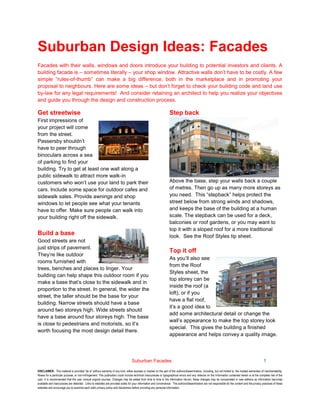
Above the base, step your walls back a couple
of metres. Then go up as many more storeys as
you need. This “stepback” helps protect the
street below from strong winds and shadows,
and keeps the base of the building at a human
scale. The stepback can be used for a deck,
balconies or roof gardens, or you may want to
top it with a sloped roof for a more traditional
look. See the Roof Styles tip sheet.
Top it off
As you’ll also see
from the Roof
Styles sheet, the
top storey can be
inside the roof (a
loft), or if you
have a flat roof,
it’s a good idea to
add some architectural detail or change the
wall’s appearance to make the top storey look
special. This gives the building a finished
appearance and helps convey a quality image.
Suburban Facades 2
DISCLAIMER: This material is provided "as is" without warranty of any kind, either express or implied on the part of the authors/disseminators, including, but not limited to, the implied warranties of merchantability,
fitness for a particular purpose, or non-infringement. This publication could include technical inaccuracies or typographical errors and any reliance on the information contained herein is at the complete risk of the
user. It is recommended that the user consult original sources. Changes may be added from time to time to the information herein; these changes may be incorporated in new editions as information becomes
available and inaccuracies are detected. Links to websites are provided solely for your information and convenience. The authors/disseminators are not responsible for the content and the privacy practices of these
websites and encourage you to examine each site's privacy policy and disclaimers before providing any personal information.
Break it up
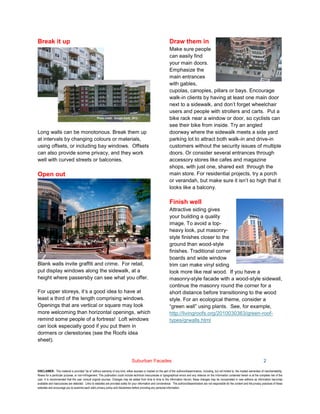
Long walls can be monotonous. Break them up
at intervals by changing colours or materials,
using offsets, or including bay windows. Offsets
can also provide some privacy, and they work
well with curved streets or balconies.
Open out
Blank walls invite graffiti and crime. For retail,
put display windows along the sidewalk, at a
height where passersby can see what you offer.
For upper storeys, it’s a good idea to have at
least a third of the length comprising windows.
Openings that are vertical or square may look
more welcoming than horizontal openings, which
remind some people of a fortress! Loft windows
can look especially good if you put them in
dormers or clerestories (see the Roofs idea
sheet).
Draw them in
Make sure people
can easily find
your main doors.
Emphasize the
main entrances
with gables,
cupolas, canopies, pillars or bays. Encourage
walk-in clients by having at least one main door
next to a sidewalk, and don’t forget wheelchair
users and people with strollers and carts. Put a
bike rack near a window or door, so cyclists can
see their bike from inside. Try an angled
doorway where the sidewalk meets a side yard
parking lot to attract both walk-in and drive-in
customers without the security issues of multiple
doors. Or consider several entrances through
accessory stores like cafes and magazine
shops, with just one, shared exit through the
main store. For residential projects, try a porch
or verandah, but make sure it isn’t so high that it
looks like a balcony.
Finish well
Attractive siding gives
your building a quality
image. To avoid a top-
heavy look, put masonry-
style finishes closer to the
ground than wood-style
finishes. Traditional corner
boards and wide window
trim can make vinyl siding
look more like real wood. If you have a
masonry-style facade with a wood-style sidewall,
continue the masonry round the corner for a
short distance before transitioning to the wood
style. For an ecological theme, consider a
“green wall” using plants. See, for example,
http://livingroofs.org/2010030363/green-roof-
types/grwalls.html
Photo credit: Google Earth, 2013

Walls windowssuburba nideas

  • 1.
    Suburban Facades 1 DISCLAIMER:This material is provided "as is" without warranty of any kind, either express or implied on the part of the authors/disseminators, including, but not limited to, the implied warranties of merchantability, fitness for a particular purpose, or non-infringement. This publication could include technical inaccuracies or typographical errors and any reliance on the information contained herein is at the complete risk of the user. It is recommended that the user consult original sources. Changes may be added from time to time to the information herein; these changes may be incorporated in new editions as information becomes available and inaccuracies are detected. Links to websites are provided solely for your information and convenience. The authors/disseminators are not responsible for the content and the privacy practices of these websites and encourage you to examine each site's privacy policy and disclaimers before providing any personal information. Suburban Design Ideas: Facades Facades with their walls, windows and doors introduce your building to potential investors and clients. A building facade is – sometimes literally – your shop window. Attractive walls don’t have to be costly. A few simple “rules-of-thumb” can make a big difference, both in the marketplace and in promoting your proposal to neighbours. Here are some ideas – but don’t forget to check your building code and land use by-law for any legal requirements! And consider retaining an architect to help you realize your objectives and guide you through the design and construction process. Get streetwise First impressions of your project will come from the street. Passersby shouldn’t have to peer through binoculars across a sea of parking to find your building. Try to get at least one wall along a public sidewalk to attract more walk-in customers who won’t use your land to park their cars. Include some space for outdoor cafes and sidewalk sales. Provide awnings and shop windows to let people see what your tenants have to offer. Make sure people can walk into your building right off the sidewalk. Build a base Good streets are not just strips of pavement. They’re like outdoor rooms furnished with trees, benches and places to linger. Your building can help shape this outdoor room if you make a base that’s close to the sidewalk and in proportion to the street. In general, the wider the street, the taller should be the base for your building. Narrow streets should have a base around two storeys high. Wide streets should have a base around four storeys high. The base is close to pedestrians and motorists, so it’s worth focusing the most design detail there. Step back Above the base, step your walls back a couple of metres. Then go up as many more storeys as you need. This “stepback” helps protect the street below from strong winds and shadows, and keeps the base of the building at a human scale. The stepback can be used for a deck, balconies or roof gardens, or you may want to top it with a sloped roof for a more traditional look. See the Roof Styles tip sheet. Top it off As you’ll also see from the Roof Styles sheet, the top storey can be inside the roof (a loft), or if you have a flat roof, it’s a good idea to add some architectural detail or change the wall’s appearance to make the top storey look special. This gives the building a finished appearance and helps convey a quality image.
  • 2.
    Suburban Facades 2 DISCLAIMER:This material is provided "as is" without warranty of any kind, either express or implied on the part of the authors/disseminators, including, but not limited to, the implied warranties of merchantability, fitness for a particular purpose, or non-infringement. This publication could include technical inaccuracies or typographical errors and any reliance on the information contained herein is at the complete risk of the user. It is recommended that the user consult original sources. Changes may be added from time to time to the information herein; these changes may be incorporated in new editions as information becomes available and inaccuracies are detected. Links to websites are provided solely for your information and convenience. The authors/disseminators are not responsible for the content and the privacy practices of these websites and encourage you to examine each site's privacy policy and disclaimers before providing any personal information. Break it up Long walls can be monotonous. Break them up at intervals by changing colours or materials, using offsets, or including bay windows. Offsets can also provide some privacy, and they work well with curved streets or balconies. Open out Blank walls invite graffiti and crime. For retail, put display windows along the sidewalk, at a height where passersby can see what you offer. For upper storeys, it’s a good idea to have at least a third of the length comprising windows. Openings that are vertical or square may look more welcoming than horizontal openings, which remind some people of a fortress! Loft windows can look especially good if you put them in dormers or clerestories (see the Roofs idea sheet). Draw them in Make sure people can easily find your main doors. Emphasize the main entrances with gables, cupolas, canopies, pillars or bays. Encourage walk-in clients by having at least one main door next to a sidewalk, and don’t forget wheelchair users and people with strollers and carts. Put a bike rack near a window or door, so cyclists can see their bike from inside. Try an angled doorway where the sidewalk meets a side yard parking lot to attract both walk-in and drive-in customers without the security issues of multiple doors. Or consider several entrances through accessory stores like cafes and magazine shops, with just one, shared exit through the main store. For residential projects, try a porch or verandah, but make sure it isn’t so high that it looks like a balcony. Finish well Attractive siding gives your building a quality image. To avoid a top- heavy look, put masonry- style finishes closer to the ground than wood-style finishes. Traditional corner boards and wide window trim can make vinyl siding look more like real wood. If you have a masonry-style facade with a wood-style sidewall, continue the masonry round the corner for a short distance before transitioning to the wood style. For an ecological theme, consider a “green wall” using plants. See, for example, http://livingroofs.org/2010030363/green-roof- types/grwalls.html Photo credit: Google Earth, 2013