How to use “ir” and “estar” in Spanish By: Sheridan Ice
Estar: What it’s used for. The verb “estar” is used to indicate locations and say how people feel. Like pretty much all Spanish verbs, it has a different form depending on the pronoun.
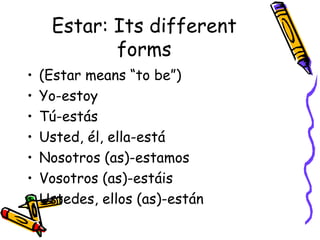
Estar: Its different forms (Estar means “to be”) Yo-estoy Tú-estás Usted, él, ella-está Nosotros (as)-estamos Vosotros (as)-estáis Ustedes, ellos (as)-están
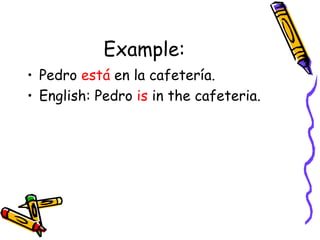
Example: Pedro  está  en la cafetería. English: Pedro  is  in the cafeteria.
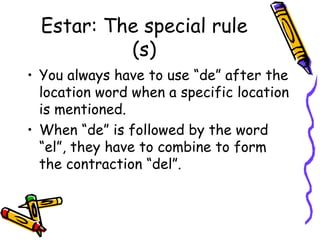
Estar: The special rule (s) You always have to use “de” after the location word when a specific location is mentioned. When “de” is followed by the word “el”, they have to combine to form the contraction “del”.
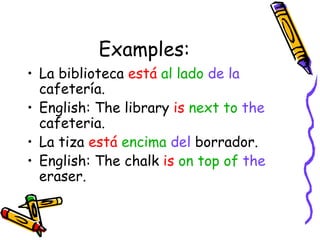
Examples: La biblioteca  está   al lado   de la  cafetería. English: The library  is   next to   the  cafeteria. La tiza  está  encima   del  borrador. English: The chalk  is   on top of   the  eraser.
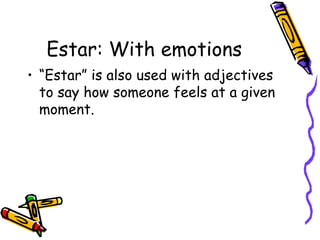
Estar: With emotions “ Estar” is also used with adjectives to say how someone feels at a given moment.
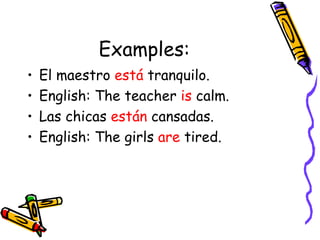
Examples: El maestro  está  tranquilo. English: The teacher  is  calm. Las chicas  están  cansadas. English: The girls  are  tired.
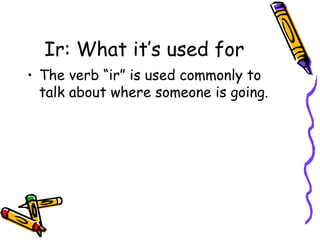
Ir: What it’s used for The verb “ir” is used commonly to talk about where someone is going.
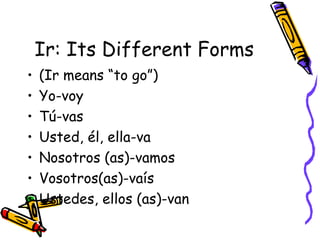
Ir: Its Different Forms (Ir means “to go”) Yo-voy Tú-vas Usted, él, ella-va Nosotros (as)-vamos Vosotros(as)-vaís Ustedes, ellos (as)-van
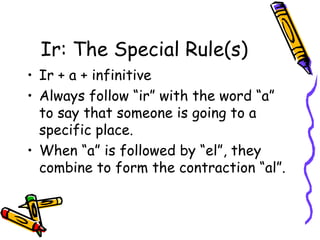
Ir: The Special Rule(s) Ir + a + infinitive Always follow “ir” with the word “a” to say that someone is going to a specific place. When “a” is followed by “el”, they combine to form the contraction “al”.
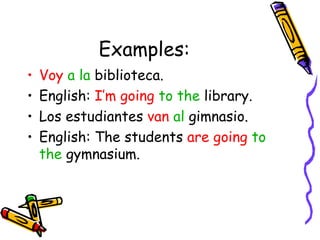
Examples: Voy   a la  biblioteca. English:  I’m going   to the  library. Los estudiantes  van   al  gimnasio. English: The students  are going   to the  gymnasium.
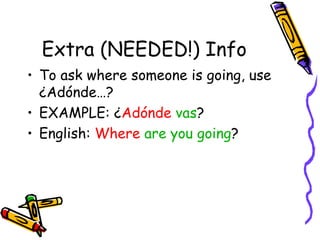
Extra (NEEDED!) Info To ask where someone is going, use ¿Adónde…? EXAMPLE: ¿ Adónde   vas ? English:  Where   are you going ?

Sheridan's spanish powerpoint

  • 1.
    How to use“ir” and “estar” in Spanish By: Sheridan Ice
  • 2.
    Estar: What it’sused for. The verb “estar” is used to indicate locations and say how people feel. Like pretty much all Spanish verbs, it has a different form depending on the pronoun.
  • 3.
    Estar: Its differentforms (Estar means “to be”) Yo-estoy Tú-estás Usted, él, ella-está Nosotros (as)-estamos Vosotros (as)-estáis Ustedes, ellos (as)-están
  • 4.
    Example: Pedro está en la cafetería. English: Pedro is in the cafeteria.
  • 5.
    Estar: The specialrule (s) You always have to use “de” after the location word when a specific location is mentioned. When “de” is followed by the word “el”, they have to combine to form the contraction “del”.
  • 6.
    Examples: La biblioteca está al lado de la cafetería. English: The library is next to the cafeteria. La tiza está encima del borrador. English: The chalk is on top of the eraser.
  • 7.
    Estar: With emotions“ Estar” is also used with adjectives to say how someone feels at a given moment.
  • 8.
    Examples: El maestro está tranquilo. English: The teacher is calm. Las chicas están cansadas. English: The girls are tired.
  • 9.
    Ir: What it’sused for The verb “ir” is used commonly to talk about where someone is going.
  • 10.
    Ir: Its DifferentForms (Ir means “to go”) Yo-voy Tú-vas Usted, él, ella-va Nosotros (as)-vamos Vosotros(as)-vaís Ustedes, ellos (as)-van
  • 11.
    Ir: The SpecialRule(s) Ir + a + infinitive Always follow “ir” with the word “a” to say that someone is going to a specific place. When “a” is followed by “el”, they combine to form the contraction “al”.
  • 12.
    Examples: Voy a la biblioteca. English: I’m going to the library. Los estudiantes van al gimnasio. English: The students are going to the gymnasium.
  • 13.
    Extra (NEEDED!) InfoTo ask where someone is going, use ¿Adónde…? EXAMPLE: ¿ Adónde vas ? English: Where are you going ?