VERB TO BEVERB TO BE
(SER O ESTAR)(SER O ESTAR)
POSITIVE FORM (+)POSITIVE FORM (+)
NEGATIVE FORM (-)NEGATIVE FORM (-)
QUESTIONS (?)QUESTIONS (?)
VERB BE (+) FULL FORMVERB BE (+) FULL FORM
 I (subject pronoun)I (subject pronoun) AM (verb)AM (verb)
 YOUYOU AREARE
 HEHE ISIS
 SHESHE ISIS
 ITIT ISIS
 WEWE AREARE
 YOUYOU AREARE
 THEYTHEY AREARE
VERB BE (+)VERB BE (+)
CONTRACTED/SHORT FORMCONTRACTED/SHORT FORM
 II´M´M
 YOUYOU’RE’RE
 HEHE’S’S
 SHESHE’S’S
 ITIT’S’S
 WEWE’RE’RE
 YOUYOU’RE’RE
 THEYTHEY’RE’RE
VERB BE (+)VERB BE (+)
 You ALWAYS have to use a SUBJECTYou ALWAYS have to use a SUBJECT
PRONOUN with a verb:PRONOUN with a verb: HE is PeterHE is Peter NOTNOT isis
PeterPeter
 II is always written in capital letters:is always written in capital letters: I amI am
your English teacheryour English teacher NOTNOT i am youri am your
English teacher.English teacher.
 UseUse HEHE for afor a manman,, SHESHE for afor a womanwoman,, ITIT
for afor a thingthing oror animalanimal in thein the singular: He issingular: He is
my father. She is my friend Mary. It is a bigmy father. She is my friend Mary. It is a big
dogdog..
 YOUYOU is used for the singular (tú, usted) andis used for the singular (tú, usted) and
for the plural (vosotros, ustedes)for the plural (vosotros, ustedes)
 UseUse THEYTHEY forfor peoplepeople,, animalsanimals andand thingsthings
in thein the plural: They are my friends Mary andplural: They are my friends Mary and
Peter. They are booksPeter. They are books..
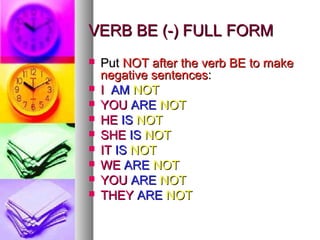
VERB BE (-) FULL FORMVERB BE (-) FULL FORM
 PutPut NOTNOT after the verb BE to makeafter the verb BE to make
negative sentencesnegative sentences::
 II AMAM NOTNOT
 YOUYOU AREARE NOTNOT
 HEHE ISIS NOTNOT
 SHESHE ISIS NOTNOT
 ITIT ISIS NOTNOT
 WEWE AREARE NOTNOT
 YOUYOU AREARE NOTNOT
 THEYTHEY AREARE NOTNOT
VERB BE (-)VERB BE (-)
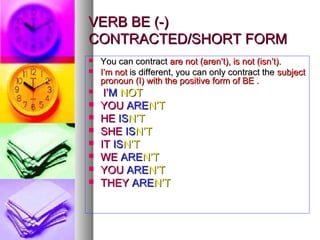
CONTRACTED/SHORT FORMCONTRACTED/SHORT FORM
 You can contractYou can contract are not (aren’t), is not (isn’t).are not (aren’t), is not (isn’t).
 I’m notI’m not is different, you can only contract theis different, you can only contract the subjectsubject
pronoun (I)pronoun (I) with the positive form of BE .with the positive form of BE .
 I’I’MM NOTNOT
 YOUYOU AREAREN’TN’T
 HEHE ISISN’TN’T
 SHESHE ISISN’TN’T
 ITIT ISISN’TN’T
 WEWE AREAREN’TN’T
 YOUYOU AREAREN’TN’T
 THEYTHEY AREAREN’TN’T
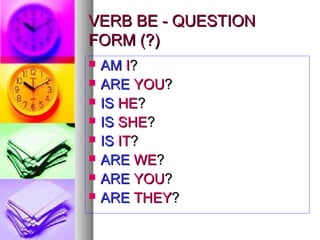
VERB BE - QUESTIONVERB BE - QUESTION
FORM (?)FORM (?)
 AMAM II??
 AREARE YOUYOU??
 ISIS HEHE??
 ISIS SHESHE??
 ISIS ITIT??
 AREARE WEWE??
 AREARE YOUYOU??
 AREARE THEYTHEY??
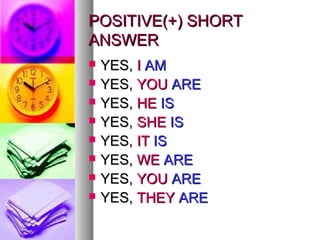
POSITIVE(+) SHORTPOSITIVE(+) SHORT
ANSWERANSWER
 YES,YES, II AMAM
 YES,YES, YOUYOU AREARE
 YES,YES, HEHE ISIS
 YES,YES, SHESHE ISIS
 YES,YES, ITIT ISIS
 YES,YES, WEWE AREARE
 YES,YES, YOUYOU AREARE
 YES,YES, THEYTHEY AREARE
NEGATIVE (-) SHORTNEGATIVE (-) SHORT
ANSWERANSWER
 NO,NO, II’M’M NOTNOT
 NO,NO, YOUYOU AREAREN’TN’T
 NO,NO, HEHE ISISN’TN’T
 NO,NO, SHESHE ISISN’TN’T
 NO,NO, ITIT ISISN’TN’T
 NO,NO, WEWE AREAREN’TN’T
 NO,NO, YOUYOU AREAREN’TN’T
 NO,NO, THEYTHEY AREAREN’TN’T
QUESTIONS & ANSWERSQUESTIONS & ANSWERS
 In questions put the verb TO BEIn questions put the verb TO BE
(AM, ARE, IS)(AM, ARE, IS) beforebefore THETHE
PRONOUS (I, YOU, etc.):PRONOUS (I, YOU, etc.):
Are you English? NOT You areAre you English? NOT You are
English?English?
 Do not use contractions in positiveDo not use contractions in positive
short answers:short answers: Are you Spanish?Are you Spanish?
Yes, I amYes, I am NOTNOT Yes, I’m.Yes, I’m.
 In negative answers, you can useIn negative answers, you can use
both full or contracted forms:both full or contracted forms: Are youAre you
Irish? No, I am notIrish? No, I am not oror No, I’m not.No, I’m not.

Verb to be (Ser o estar )

  • 1.
    VERB TO BEVERBTO BE (SER O ESTAR)(SER O ESTAR) POSITIVE FORM (+)POSITIVE FORM (+) NEGATIVE FORM (-)NEGATIVE FORM (-) QUESTIONS (?)QUESTIONS (?)
  • 2.
    VERB BE (+)FULL FORMVERB BE (+) FULL FORM  I (subject pronoun)I (subject pronoun) AM (verb)AM (verb)  YOUYOU AREARE  HEHE ISIS  SHESHE ISIS  ITIT ISIS  WEWE AREARE  YOUYOU AREARE  THEYTHEY AREARE
  • 3.
    VERB BE (+)VERBBE (+) CONTRACTED/SHORT FORMCONTRACTED/SHORT FORM  II´M´M  YOUYOU’RE’RE  HEHE’S’S  SHESHE’S’S  ITIT’S’S  WEWE’RE’RE  YOUYOU’RE’RE  THEYTHEY’RE’RE
  • 4.
    VERB BE (+)VERBBE (+)  You ALWAYS have to use a SUBJECTYou ALWAYS have to use a SUBJECT PRONOUN with a verb:PRONOUN with a verb: HE is PeterHE is Peter NOTNOT isis PeterPeter  II is always written in capital letters:is always written in capital letters: I amI am your English teacheryour English teacher NOTNOT i am youri am your English teacher.English teacher.  UseUse HEHE for afor a manman,, SHESHE for afor a womanwoman,, ITIT for afor a thingthing oror animalanimal in thein the singular: He issingular: He is my father. She is my friend Mary. It is a bigmy father. She is my friend Mary. It is a big dogdog..  YOUYOU is used for the singular (tú, usted) andis used for the singular (tú, usted) and for the plural (vosotros, ustedes)for the plural (vosotros, ustedes)  UseUse THEYTHEY forfor peoplepeople,, animalsanimals andand thingsthings in thein the plural: They are my friends Mary andplural: They are my friends Mary and Peter. They are booksPeter. They are books..
  • 5.
    VERB BE (-)FULL FORMVERB BE (-) FULL FORM  PutPut NOTNOT after the verb BE to makeafter the verb BE to make negative sentencesnegative sentences::  II AMAM NOTNOT  YOUYOU AREARE NOTNOT  HEHE ISIS NOTNOT  SHESHE ISIS NOTNOT  ITIT ISIS NOTNOT  WEWE AREARE NOTNOT  YOUYOU AREARE NOTNOT  THEYTHEY AREARE NOTNOT
  • 6.
    VERB BE (-)VERBBE (-) CONTRACTED/SHORT FORMCONTRACTED/SHORT FORM  You can contractYou can contract are not (aren’t), is not (isn’t).are not (aren’t), is not (isn’t).  I’m notI’m not is different, you can only contract theis different, you can only contract the subjectsubject pronoun (I)pronoun (I) with the positive form of BE .with the positive form of BE .  I’I’MM NOTNOT  YOUYOU AREAREN’TN’T  HEHE ISISN’TN’T  SHESHE ISISN’TN’T  ITIT ISISN’TN’T  WEWE AREAREN’TN’T  YOUYOU AREAREN’TN’T  THEYTHEY AREAREN’TN’T
  • 7.
    VERB BE -QUESTIONVERB BE - QUESTION FORM (?)FORM (?)  AMAM II??  AREARE YOUYOU??  ISIS HEHE??  ISIS SHESHE??  ISIS ITIT??  AREARE WEWE??  AREARE YOUYOU??  AREARE THEYTHEY??
  • 8.
    POSITIVE(+) SHORTPOSITIVE(+) SHORT ANSWERANSWER YES,YES, II AMAM  YES,YES, YOUYOU AREARE  YES,YES, HEHE ISIS  YES,YES, SHESHE ISIS  YES,YES, ITIT ISIS  YES,YES, WEWE AREARE  YES,YES, YOUYOU AREARE  YES,YES, THEYTHEY AREARE
  • 9.
    NEGATIVE (-) SHORTNEGATIVE(-) SHORT ANSWERANSWER  NO,NO, II’M’M NOTNOT  NO,NO, YOUYOU AREAREN’TN’T  NO,NO, HEHE ISISN’TN’T  NO,NO, SHESHE ISISN’TN’T  NO,NO, ITIT ISISN’TN’T  NO,NO, WEWE AREAREN’TN’T  NO,NO, YOUYOU AREAREN’TN’T  NO,NO, THEYTHEY AREAREN’TN’T
  • 10.
    QUESTIONS & ANSWERSQUESTIONS& ANSWERS  In questions put the verb TO BEIn questions put the verb TO BE (AM, ARE, IS)(AM, ARE, IS) beforebefore THETHE PRONOUS (I, YOU, etc.):PRONOUS (I, YOU, etc.): Are you English? NOT You areAre you English? NOT You are English?English?  Do not use contractions in positiveDo not use contractions in positive short answers:short answers: Are you Spanish?Are you Spanish? Yes, I amYes, I am NOTNOT Yes, I’m.Yes, I’m.  In negative answers, you can useIn negative answers, you can use both full or contracted forms:both full or contracted forms: Are youAre you Irish? No, I am notIrish? No, I am not oror No, I’m not.No, I’m not.