

10/28/2013

SharePoint
Adoption & Governance
Business Value Realization

presented by

Dave Healey
dhealey@chrysalisbts.com
(206) 734-9414
@chrysalisbts
Welcome & Introductions
Who are you?
•
•
•
•
•
•

Name
Title
Company
What is your level of familiarity with SharePoint?
What challenges are you facing?
What do you hope to get out of today’s session?

@chrysalisbts
Welcome & Introductions
Chrysalis | Business Technology Solutions
• Bridging the divide between Business Transformation objectives & IT Solution infrastructure
• BI and Performance Management,
• Business Process Optimization,
• ECM, Access, Search, Content Delivery
• IT Strategy, Architecture, Governance,
• Mobile Enablement
• Project & Portfolio Management
• Managed Services and Support
• Mentoring, Training
Presentation Team
Dave Healey, Managing Partner
• 20 years industry experience
• Knowledge & Information Mgmt
• Microsoft Corporation
• Accenture (InnovaPost)

Andrew Hopkins, Principal Consultant
• 22 years industry experience
• Enterprise Information Management
• Microsoft Corporation
• Lexis Nexus

@chrysalisbts
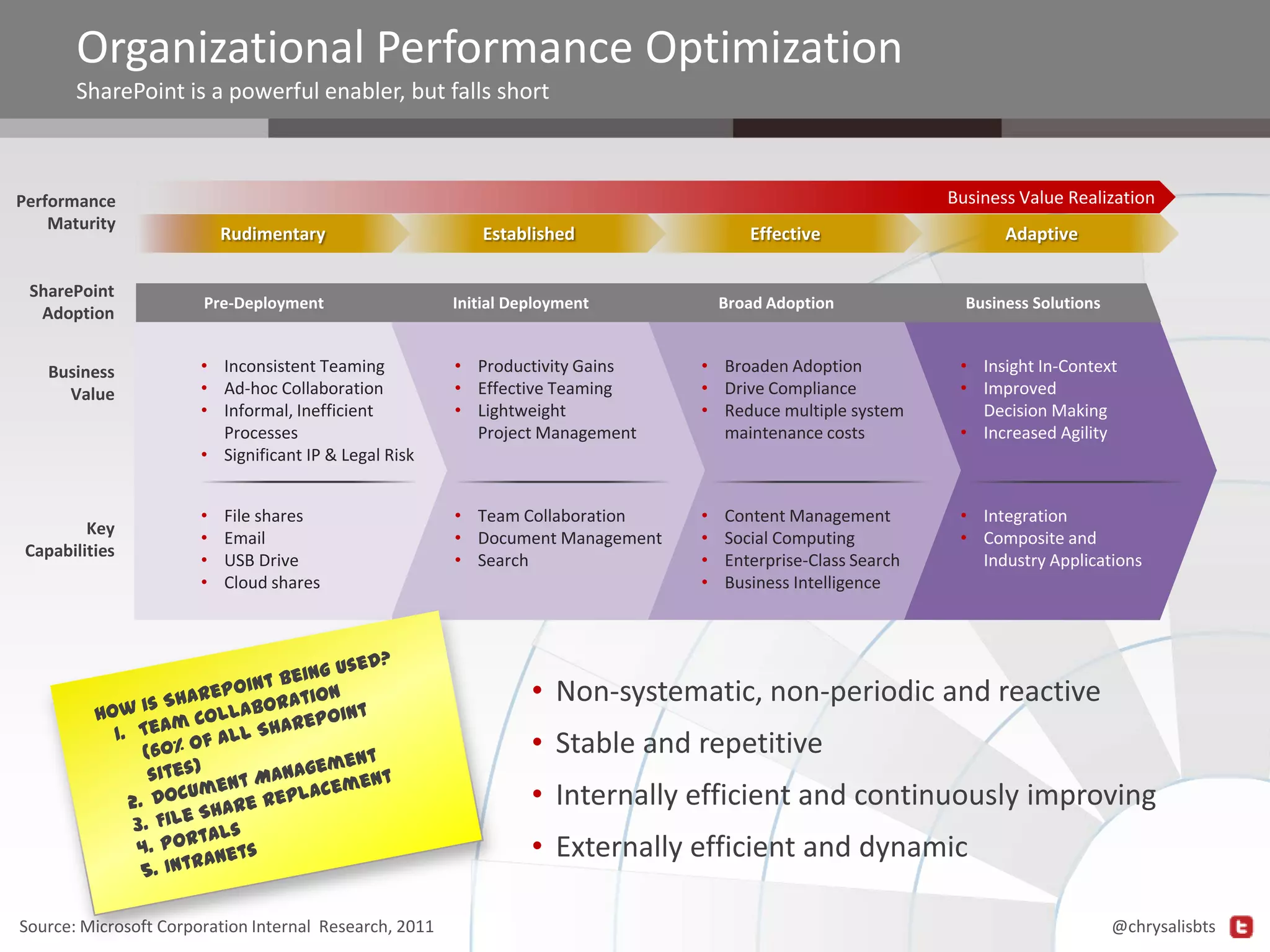
Organizational Performance Optimization
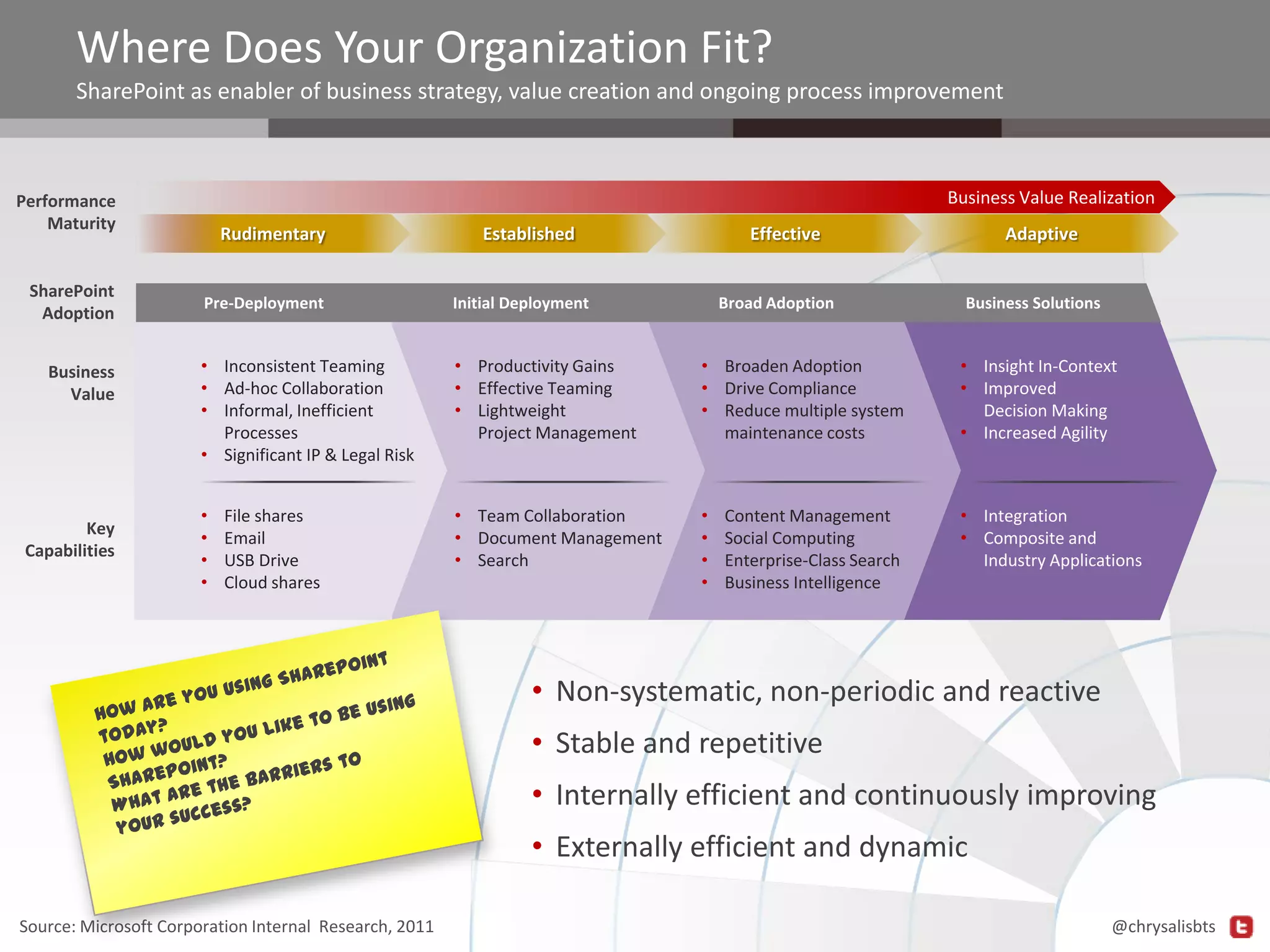
SharePoint is a powerful enabler, but falls short

Business Value Realization

Performance
Maturity

SharePoint
Adoption
Business
Value

Key
Capabilities

Rudimentary

Established

Effective

Pre-Deployment

Initial Deployment

• Inconsistent Teaming
• Ad-hoc Collaboration
• Informal, Inefficient
Processes
• Significant IP & Legal Risk

• Productivity Gains
• Effective Teaming
• Lightweight
Project Management

• Broaden Adoption
• Drive Compliance
• Reduce multiple system
maintenance costs

• Insight In-Context
• Improved
Decision Making
• Increased Agility

•
•
•
•

• Team Collaboration
• Document Management
• Search

•
•
•
•

• Integration
• Composite and
Industry Applications

File shares
Email
USB Drive
Cloud shares

Broad Adoption

Adaptive

Content Management
Social Computing
Enterprise-Class Search
Business Intelligence

Business Solutions

• Non-systematic, non-periodic and reactive
• Stable and repetitive
• Internally efficient and continuously improving
• Externally efficient and dynamic
Source: Microsoft Corporation Internal Research, 2011

@chrysalisbts
Where Does Your Organization Fit?
SharePoint as enabler of business strategy, value creation and ongoing process improvement

Business Value Realization

Performance
Maturity

SharePoint
Adoption
Business
Value

Key
Capabilities

Rudimentary

Established

Effective

Pre-Deployment

Initial Deployment

• Inconsistent Teaming
• Ad-hoc Collaboration
• Informal, Inefficient
Processes
• Significant IP & Legal Risk

• Productivity Gains
• Effective Teaming
• Lightweight
Project Management

• Broaden Adoption
• Drive Compliance
• Reduce multiple system
maintenance costs

• Insight In-Context
• Improved
Decision Making
• Increased Agility

•
•
•
•

• Team Collaboration
• Document Management
• Search

•
•
•
•

• Integration
• Composite and
Industry Applications

File shares
Email
USB Drive
Cloud shares

Broad Adoption

Adaptive

Content Management
Social Computing
Enterprise-Class Search
Business Intelligence

Business Solutions

• Non-systematic, non-periodic and reactive
• Stable and repetitive
• Internally efficient and continuously improving
• Externally efficient and dynamic
Source: Microsoft Corporation Internal Research, 2011

@chrysalisbts
How is Success Defined?
Business perspective on Return on Investment

Highly Effective Usage

Successful Implementation

Software Is Deployed

Other
Other
0

Source: TSIA / Neochanges / Sand Hill Group

10

20

30

40

50

60

70

80

@chrysalisbts
Delivering On Effective Usage
Value is realized through utilization

Process Alignment
Organizational Change
Software Functionality
Effective User
Adoption 69%

Source: TSIA / Neochanges / Sand Hill Group

Effective User Adoption

@chrysalisbts
Barriers to Value Realization
Processes, culture and people issues

Organizational or Employee Issues

Business Process Integration

Technology Integration

Technology Capabilities

0

Source: Cisco Systems Momentum Research Group

10

20

30

40

50

60

@chrysalisbts
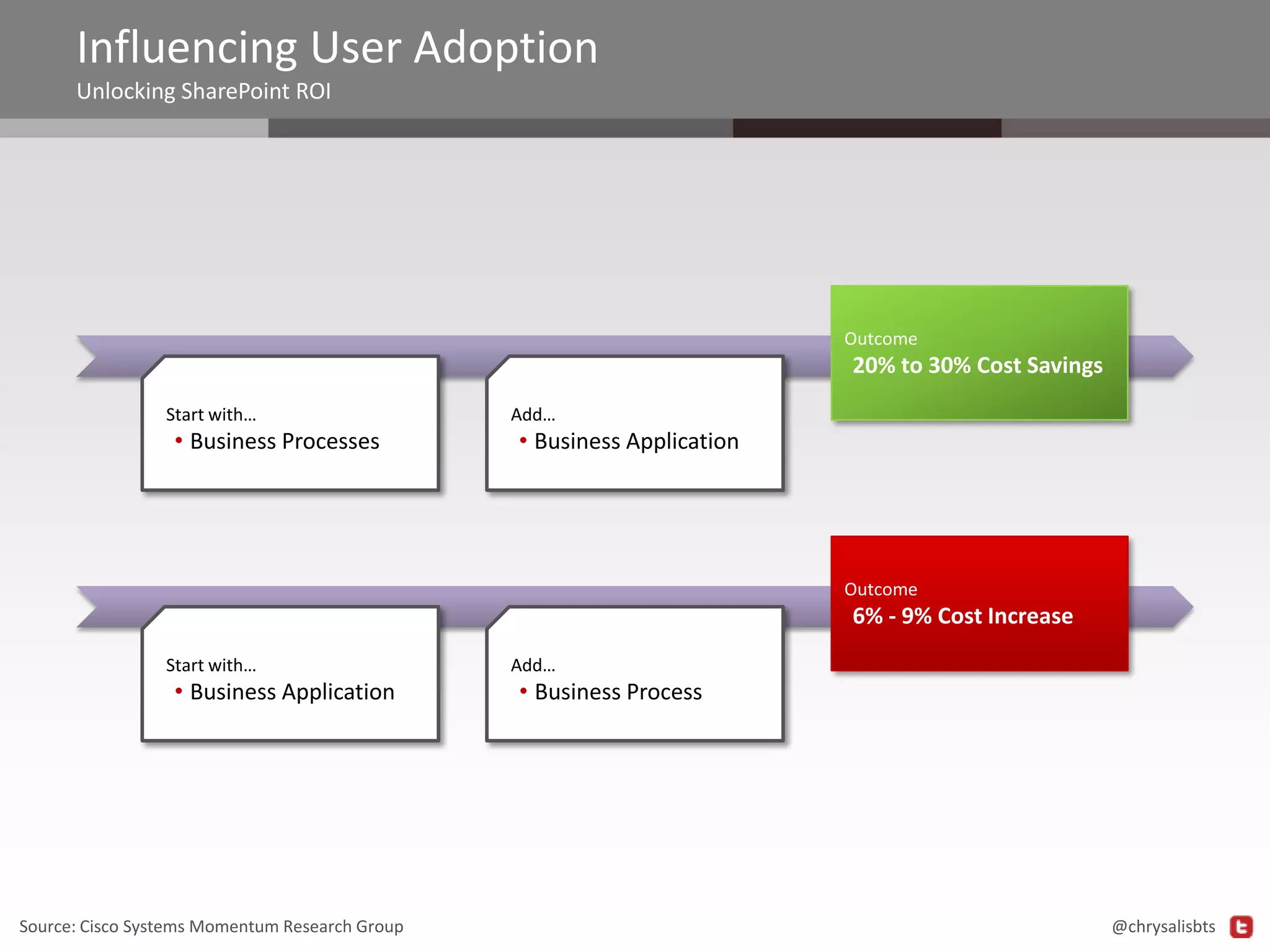
Influencing User Adoption
Unlocking SharePoint ROI

Outcome

20% to 30% Cost Savings
Start with…

• Business Processes

Add…

• Business Application

Outcome

6% - 9% Cost Increase
Start with…

• Business Application

Source: Cisco Systems Momentum Research Group

Add…

• Business Process

@chrysalisbts
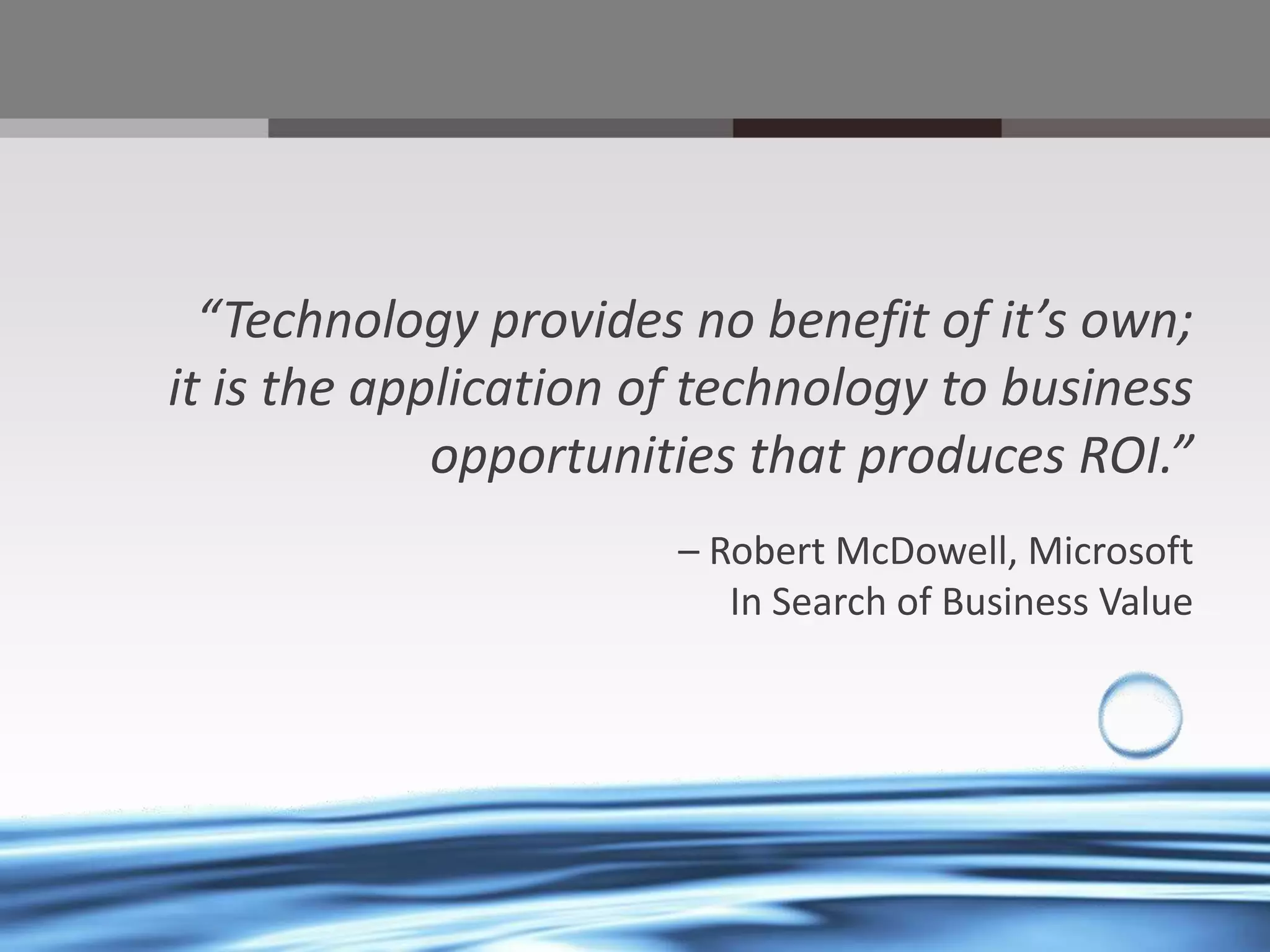
“Technology provides no benefit of it’s own;
it is the application of technology to business
opportunities that produces ROI.”
– Robert McDowell, Microsoft
In Search of Business Value

@chrysalisbts
“So why is SharePoint Adoption Lagging?”
– Dave Healey

@chrysalisbts
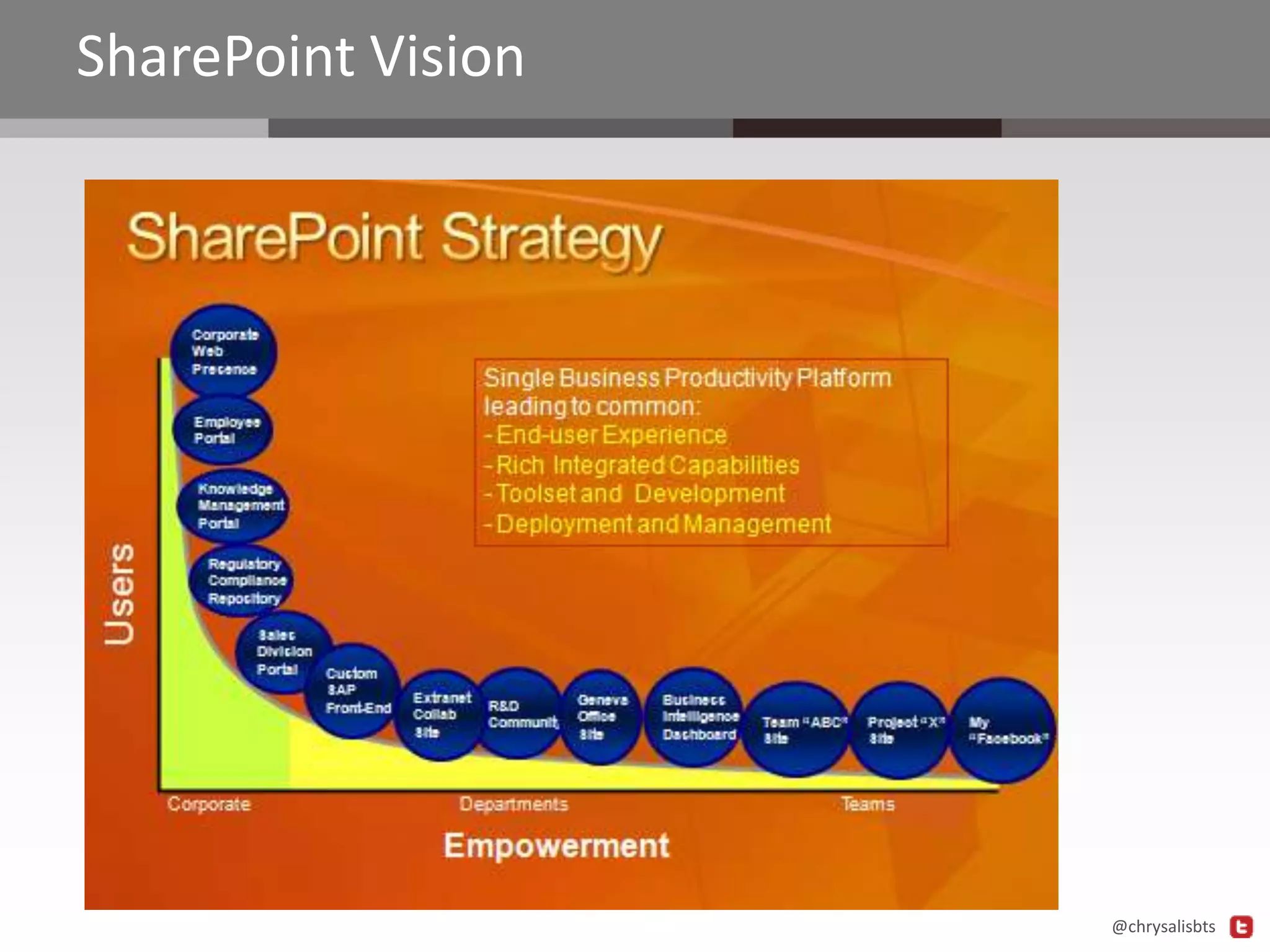
SharePoint Vision

@chrysalisbts
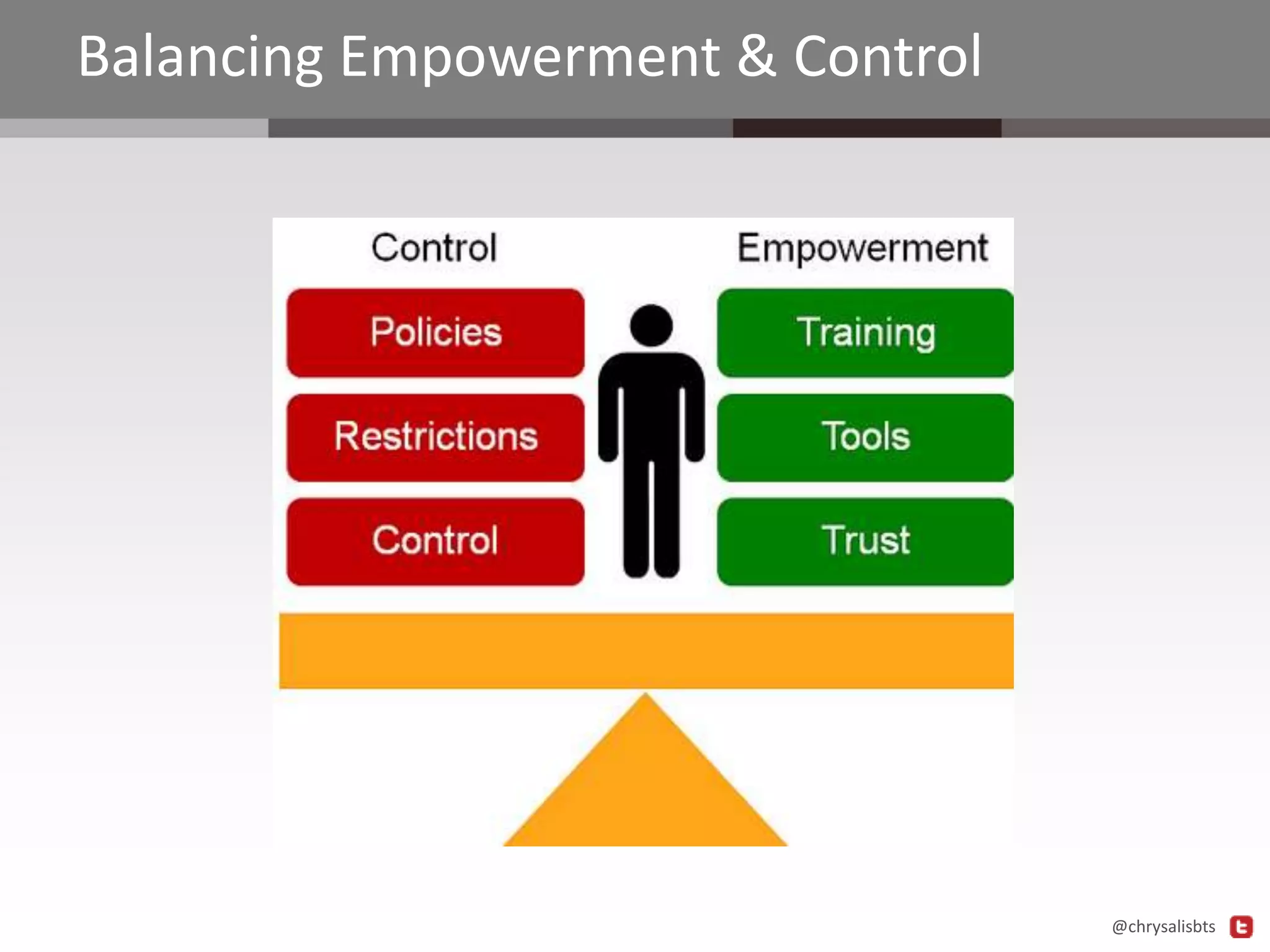
Balancing Empowerment & Control

@chrysalisbts
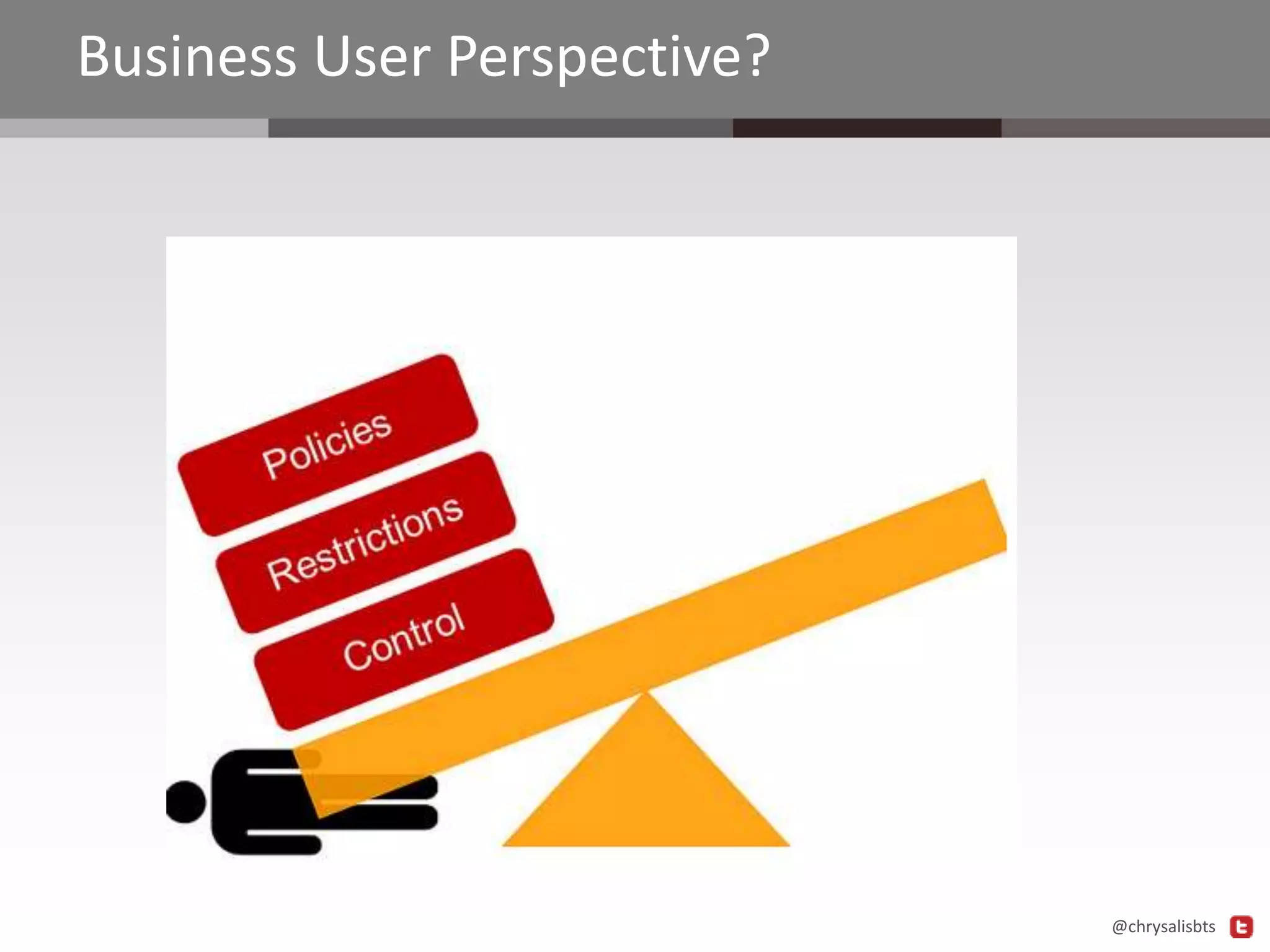
Business User Perspective?

@chrysalisbts
Successful SharePoint

UNLOCKING SHAREPOINT ROI
SHIFTING OUR PERSPECTIVE ON TECHNOLOGY PROJECTS

@chrysalisbts
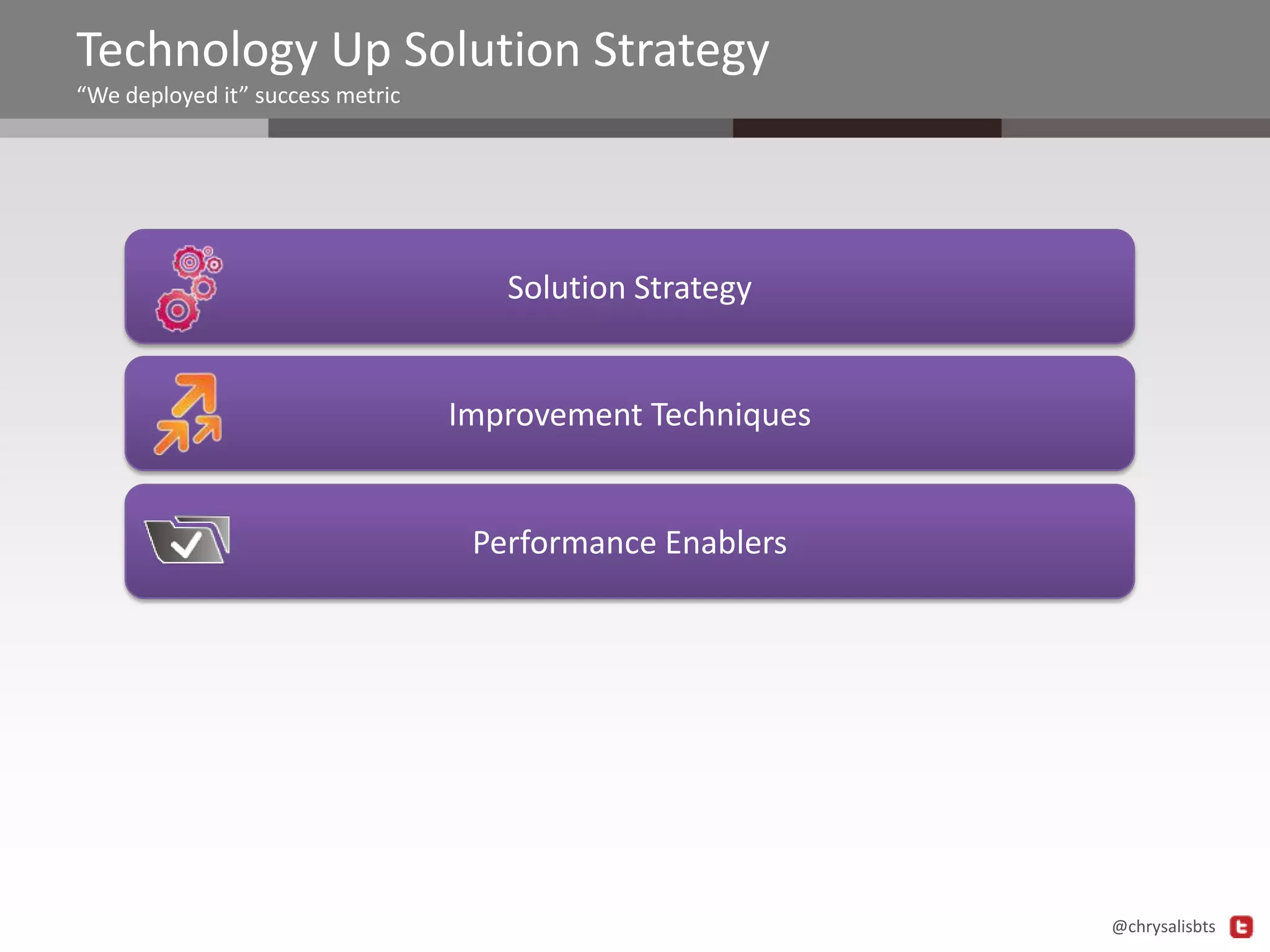
Technology Up Solution Strategy
“We deployed it” success metric

Solution Strategy

Improvement Techniques

Performance Enablers

@chrysalisbts
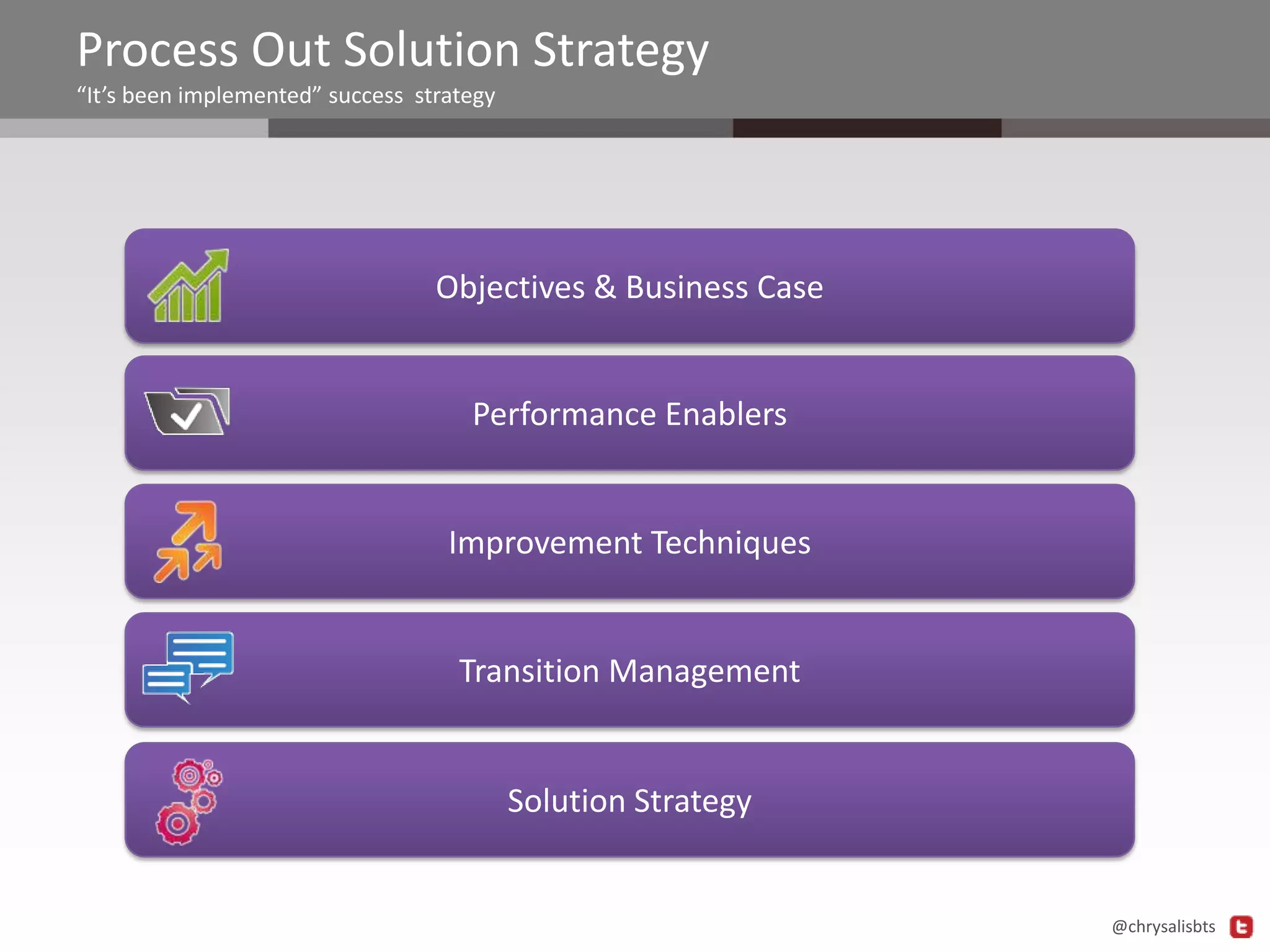
Process Out Solution Strategy
“It’s been implemented” success strategy

Objectives & Business Case

Performance Enablers

Improvement Techniques

Transition Management

Solution Strategy

@chrysalisbts
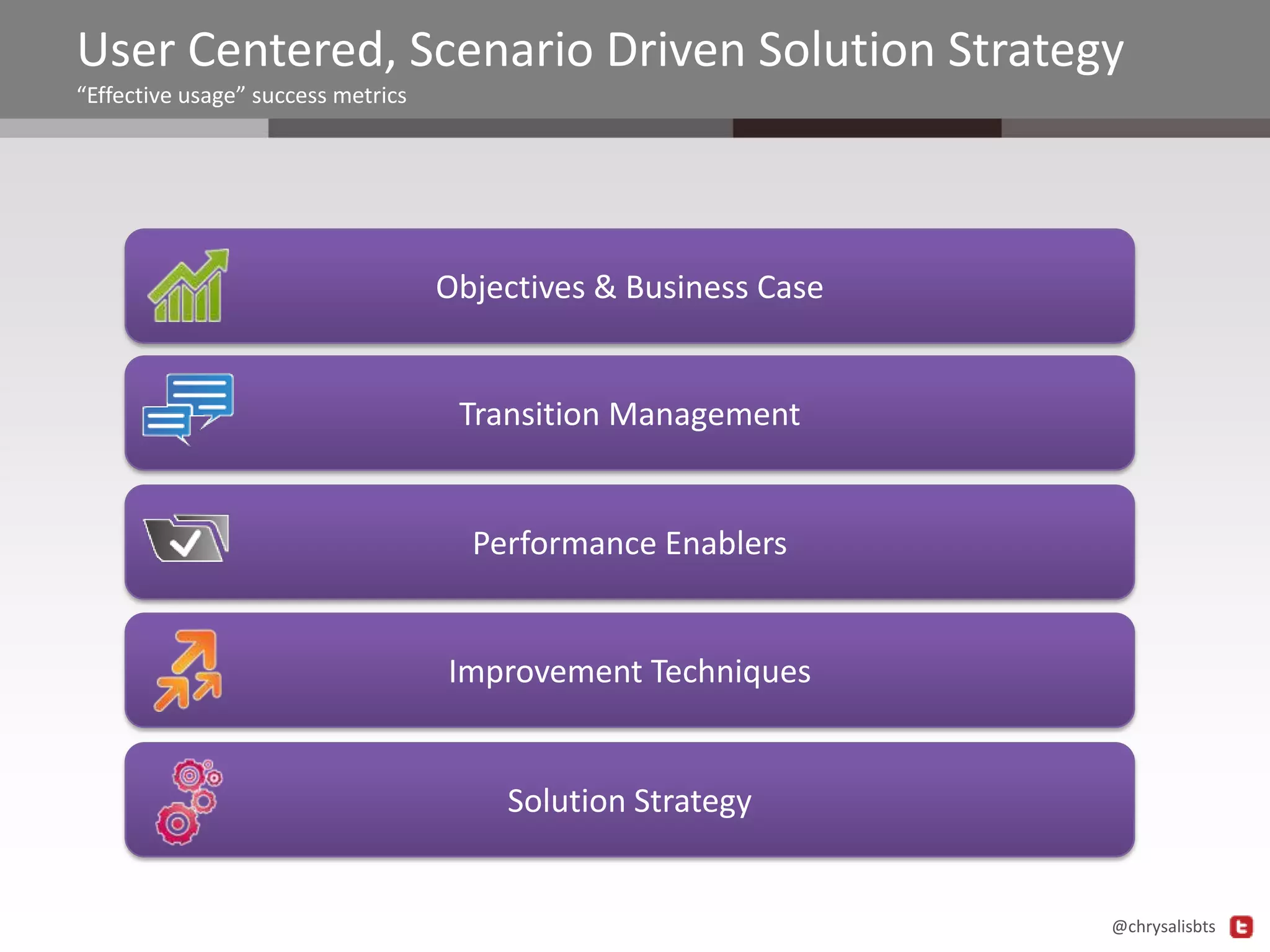
User Centered, Scenario Driven Solution Strategy
“Effective usage” success metrics

Objectives & Business Case

Transition Management

Performance Enablers

Improvement Techniques

Solution Strategy

@chrysalisbts
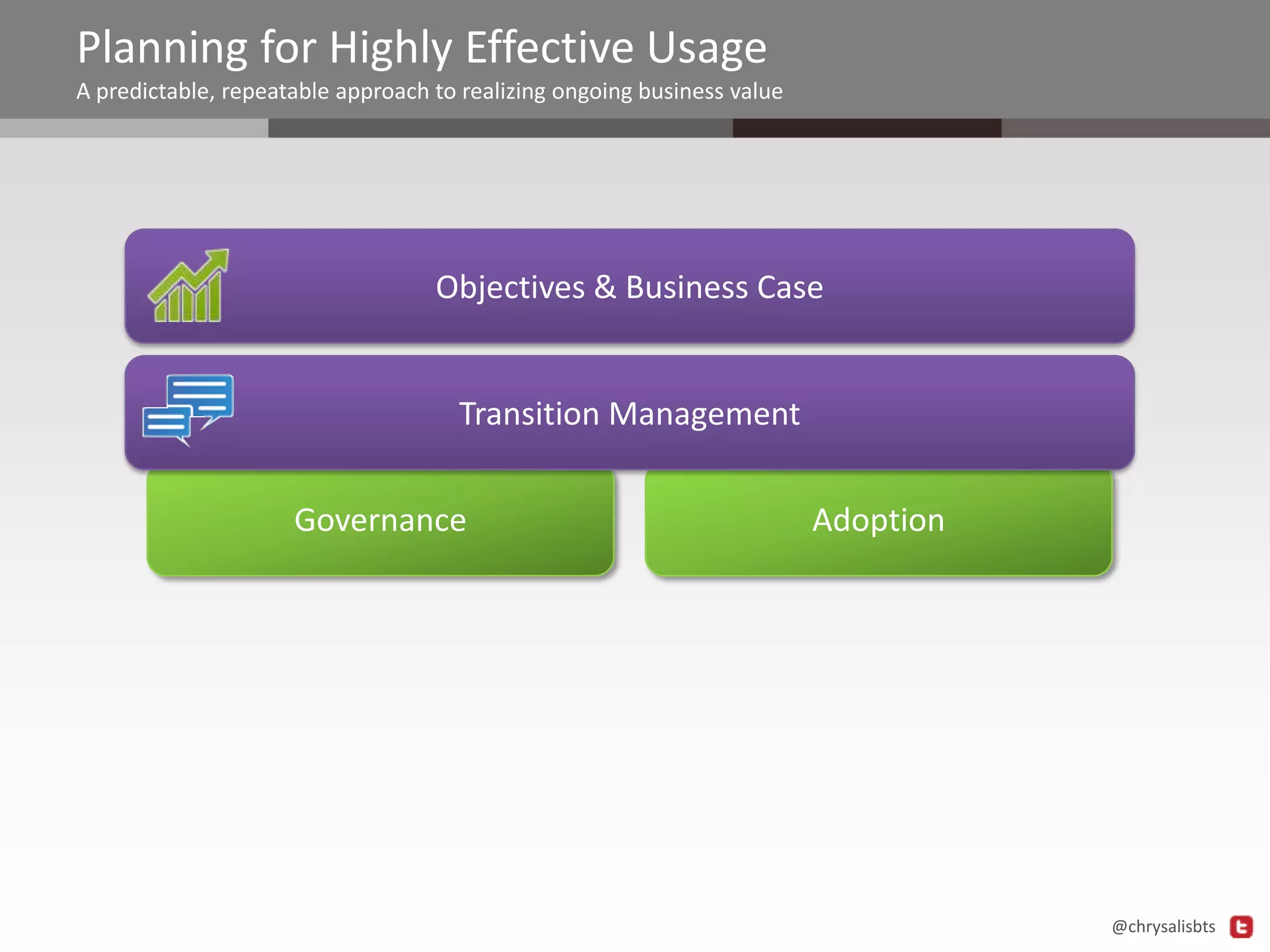
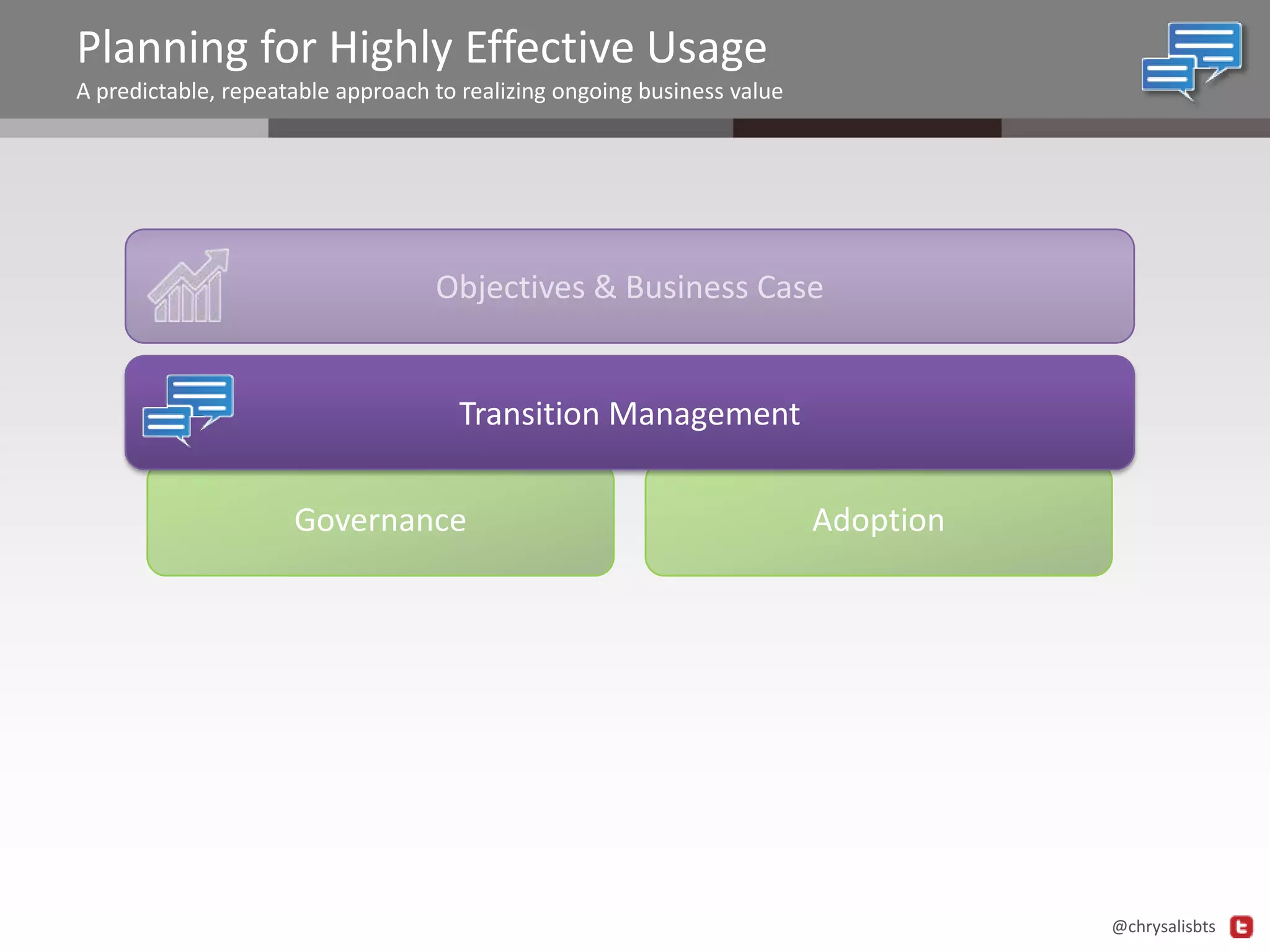
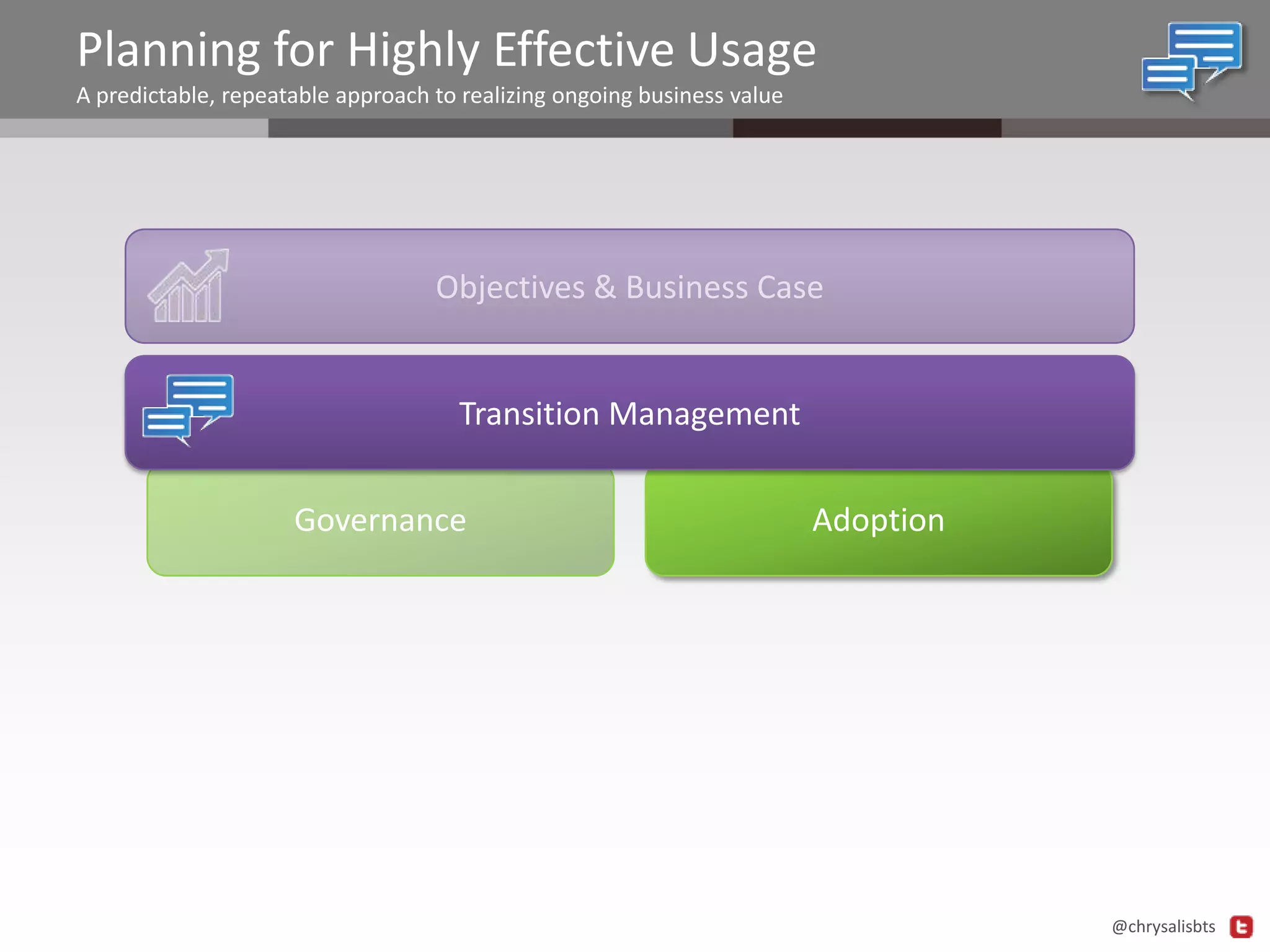
Planning for Highly Effective Usage
A predictable, repeatable approach to realizing ongoing business value

Objectives & Business Case

Transition Management

Governance

Adoption

@chrysalisbts
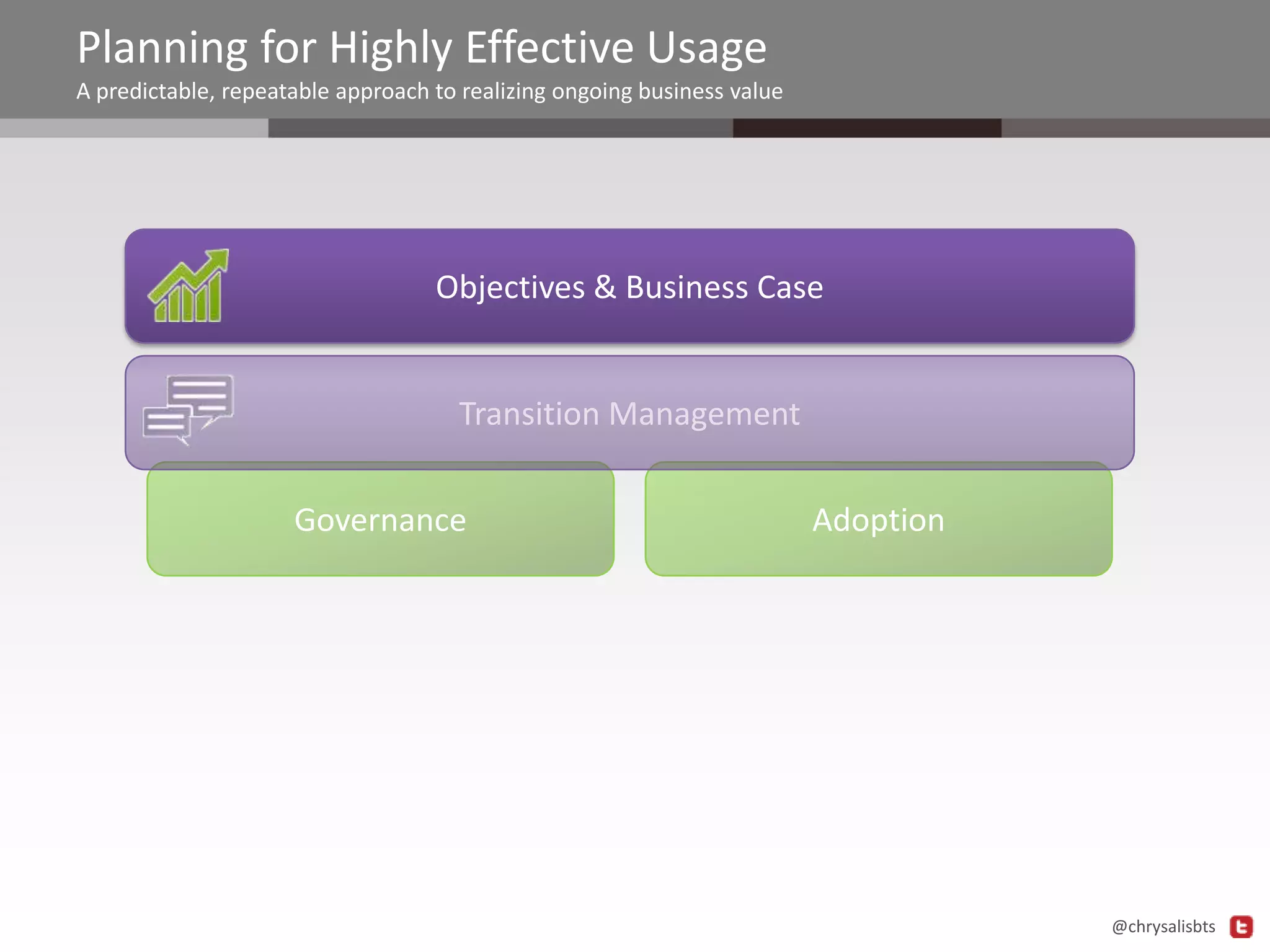
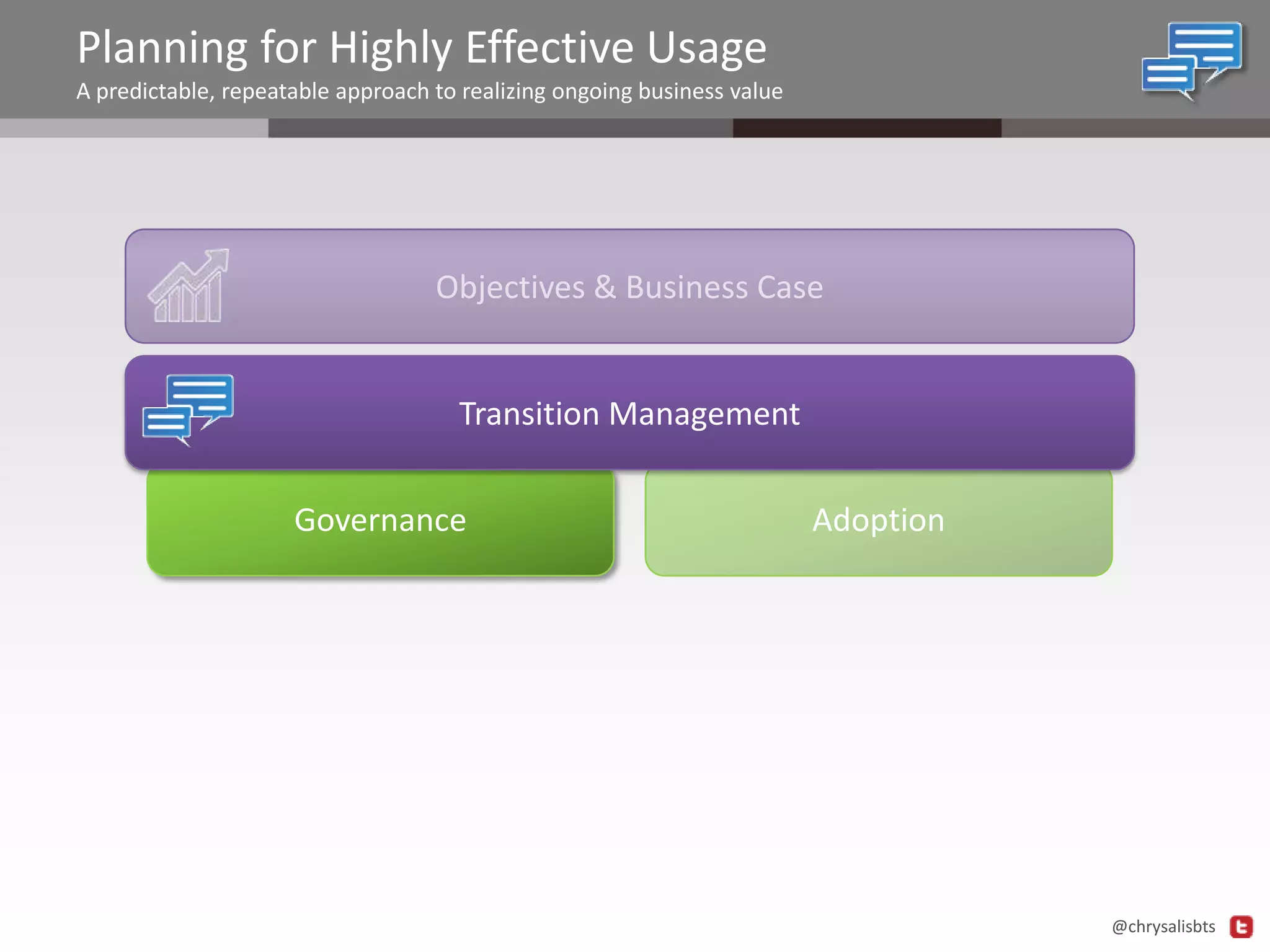
Planning for Highly Effective Usage
A predictable, repeatable approach to realizing ongoing business value

Objectives & Business Case

Transition Management

Governance

Adoption

@chrysalisbts
Executive Sponsorship
Key to long term success

• Do executives understand the value SharePoint
will bring to the organization?
• SharePoint is a Business Platform

• Lack of understanding of how SharePoint can
deliver business value is the culprit
• Executives want the benefits, but fail to make the
investments that are necessary

• Find Your Executive Champion
@chrysalisbts
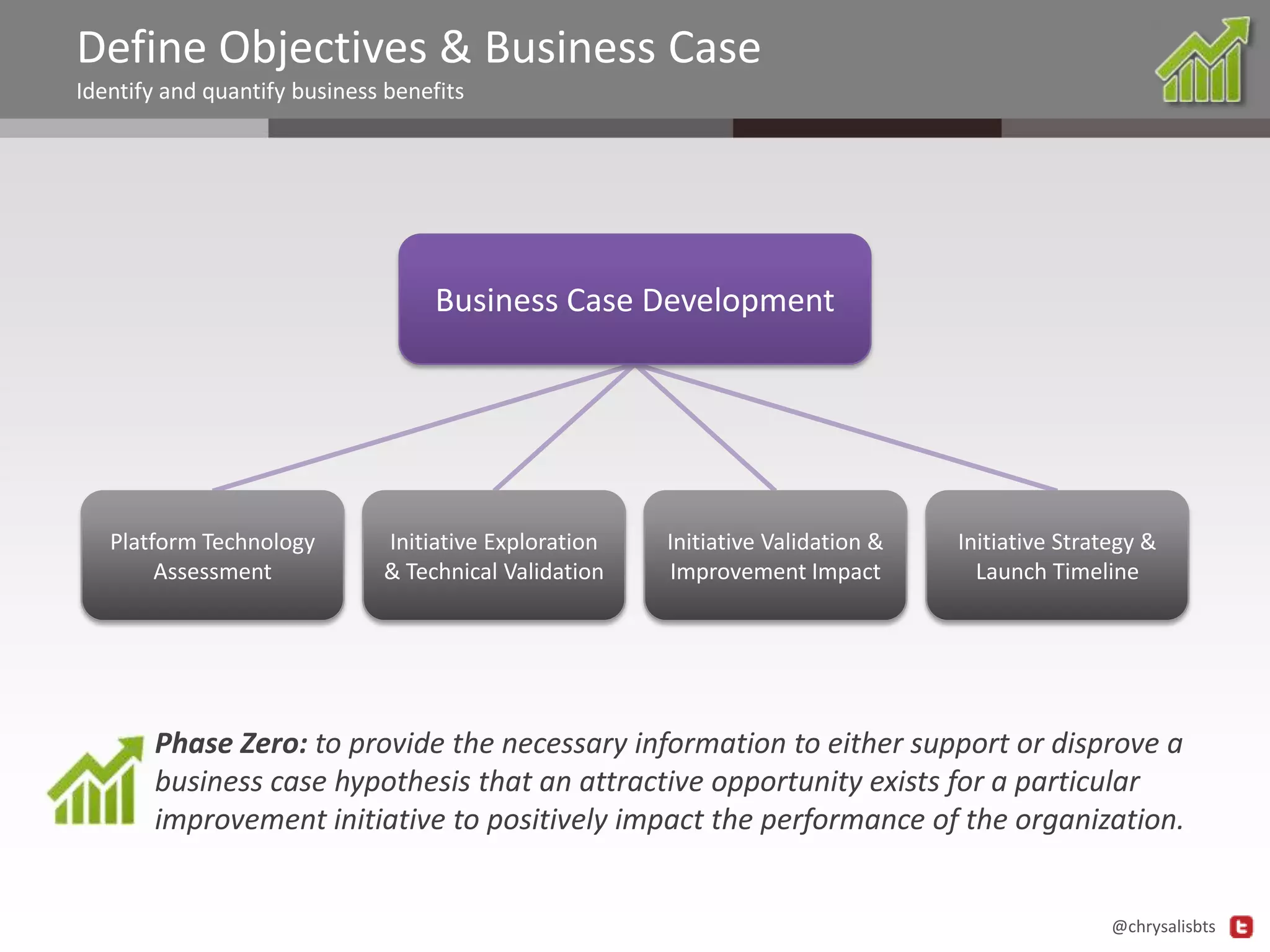
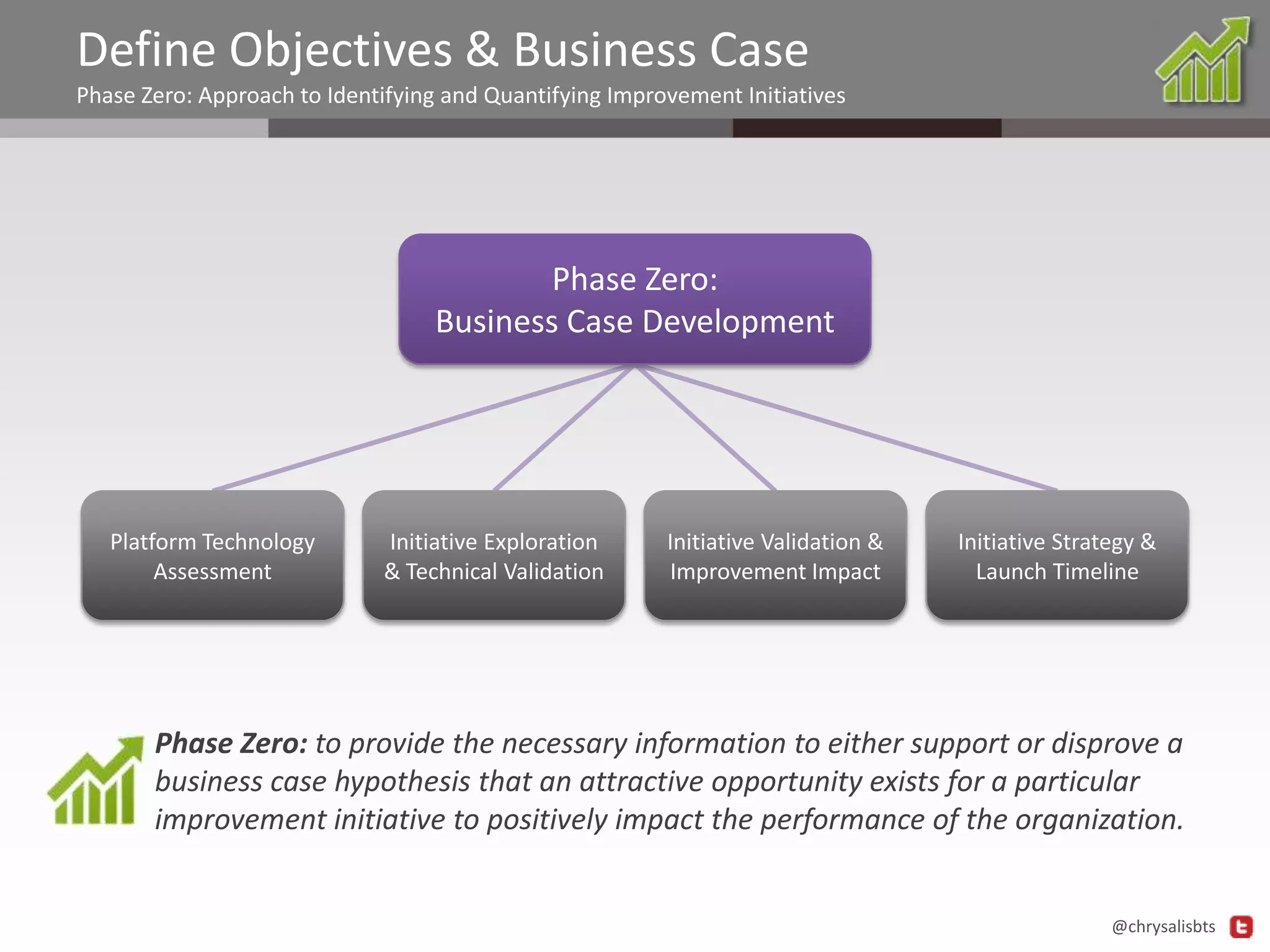
Define Objectives & Business Case
Identify and quantify business benefits

Business Case Development

Platform Technology
Assessment

Initiative Exploration
& Technical Validation

Initiative Validation &
Improvement Impact

Initiative Strategy &
Launch Timeline

Phase Zero: to provide the necessary information to either support or disprove a
business case hypothesis that an attractive opportunity exists for a particular
improvement initiative to positively impact the performance of the organization.

@chrysalisbts
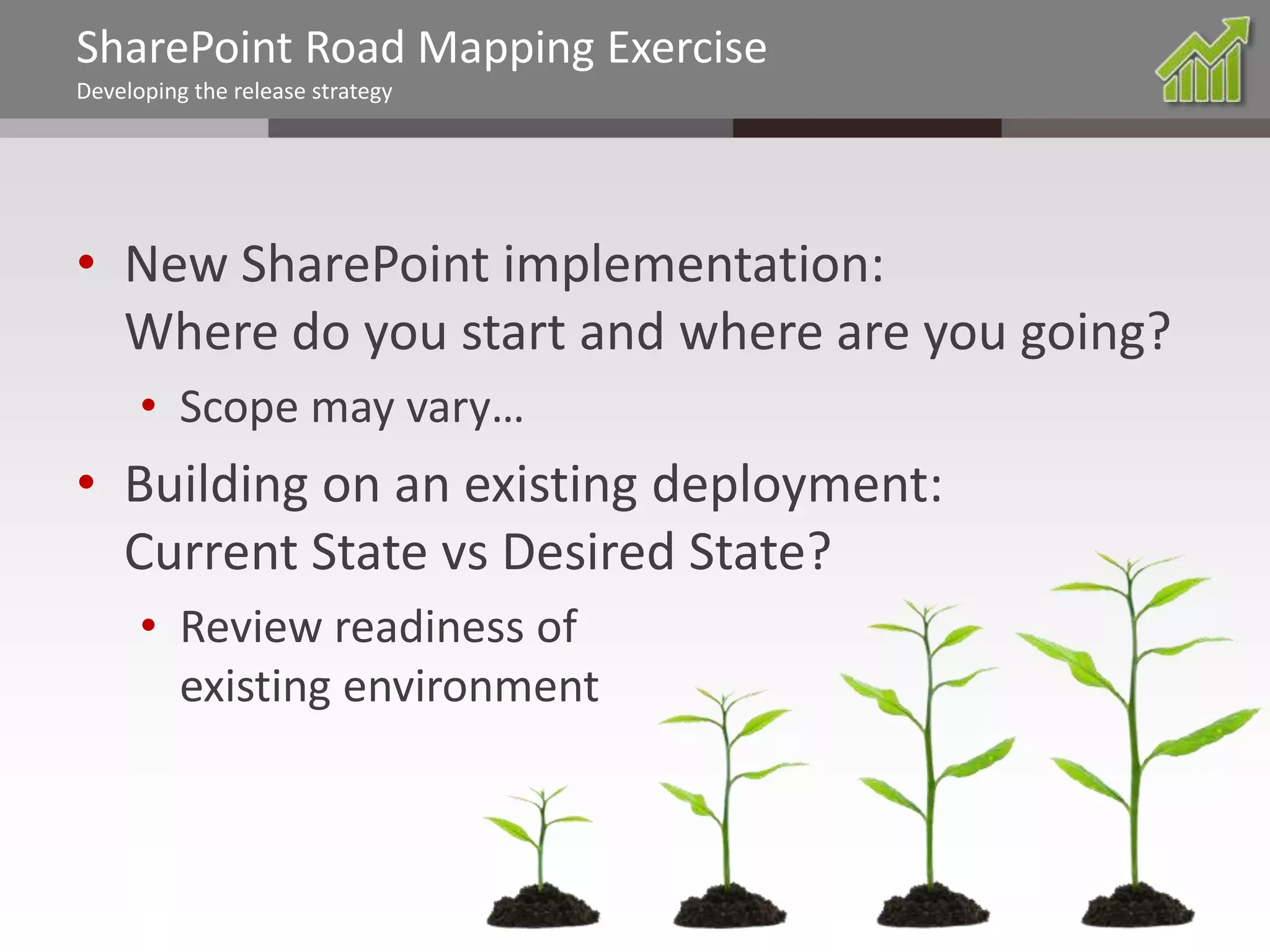
SharePoint Road Mapping Exercise
Developing the release strategy

• New SharePoint implementation:
Where do you start and where are you going?
• Scope may vary…

• Building on an existing deployment:
Current State vs Desired State?
• Review readiness of
existing environment

@chrysalisbts
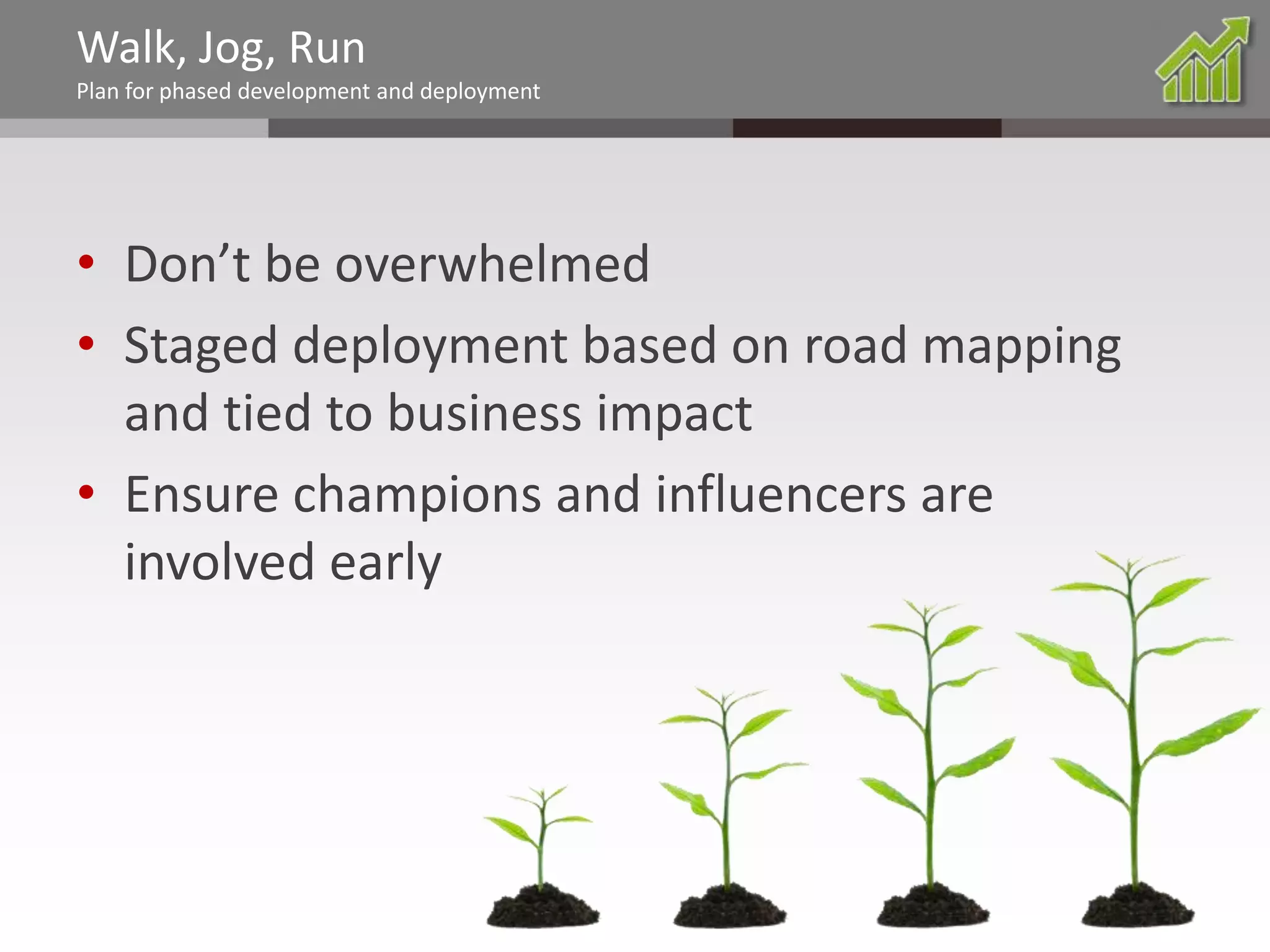
Walk, Jog, Run
Plan for phased development and deployment

• Don’t be overwhelmed
• Staged deployment based on road mapping
and tied to business impact
• Ensure champions and influencers are
involved early

@chrysalisbts
Planning for Highly Effective Usage
A predictable, repeatable approach to realizing ongoing business value

Objectives & Business Case

Transition Management

Governance

Adoption

@chrysalisbts
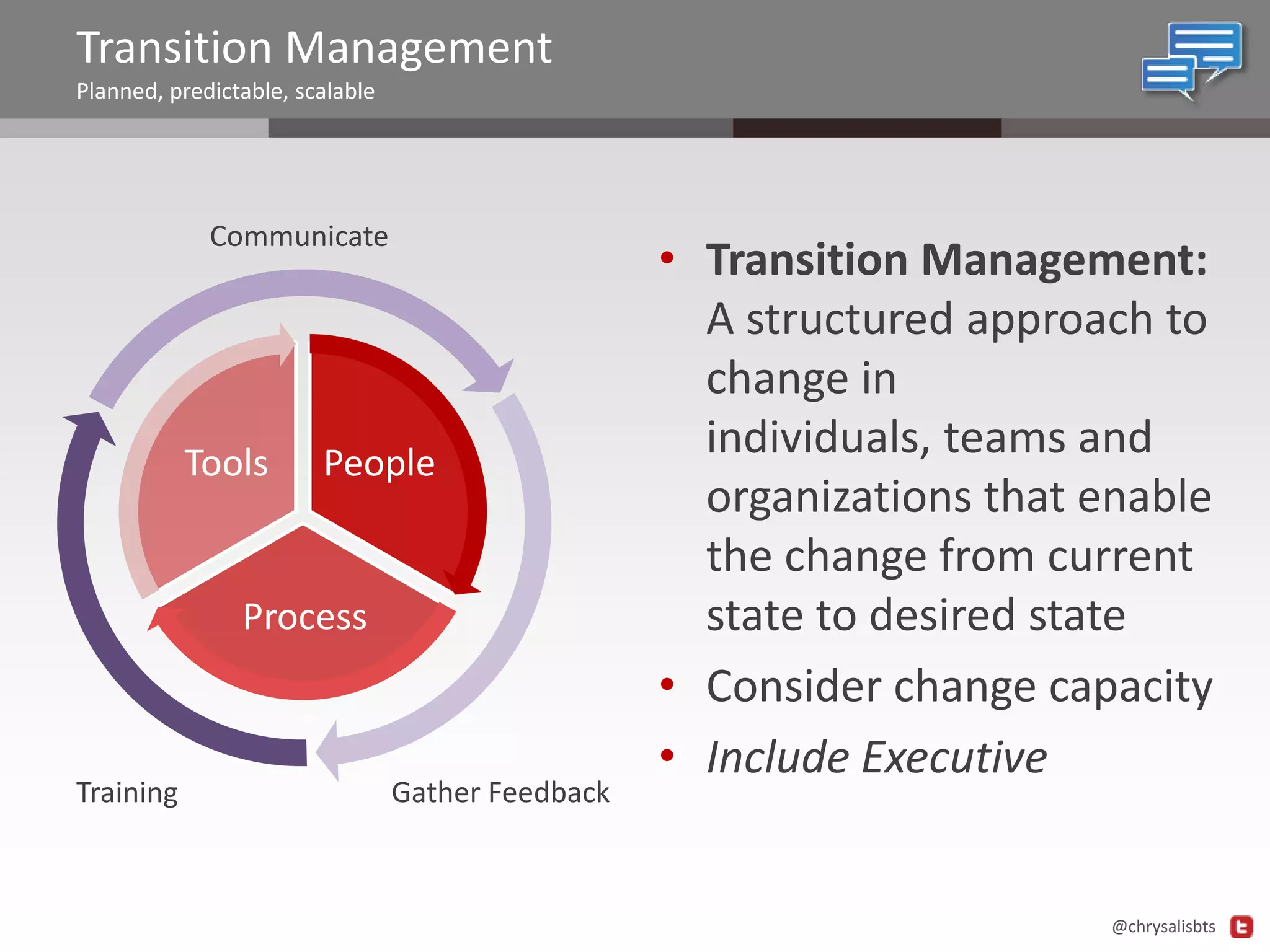
Transition Management
Planned, predictable, scalable

Communicate

Tools

People

Process

Training

Gather Feedback

• Transition Management:
A structured approach to
change in
individuals, teams and
organizations that enable
the change from current
state to desired state
• Consider change capacity
• Include Executive

@chrysalisbts
Planning for Highly Effective Usage
A predictable, repeatable approach to realizing ongoing business value

Objectives & Business Case

Transition Management

Governance

Adoption

@chrysalisbts
Governance Plan
Carefully designed to ensure adoption

• Governance is not a one time event
• Governance = Communication
• Establish Governance Board
(SharePoint Oversight Committee)
• Consider organizational representation thoughtfully
• Communicate participation protocols

• Balance control and empowerment
• Underpins training strategy
• Accept feedback, adapt

• Integrate, Evolve
• Adjunct to overall IT Governance
• Build your plan, work the plan

@chrysalisbts
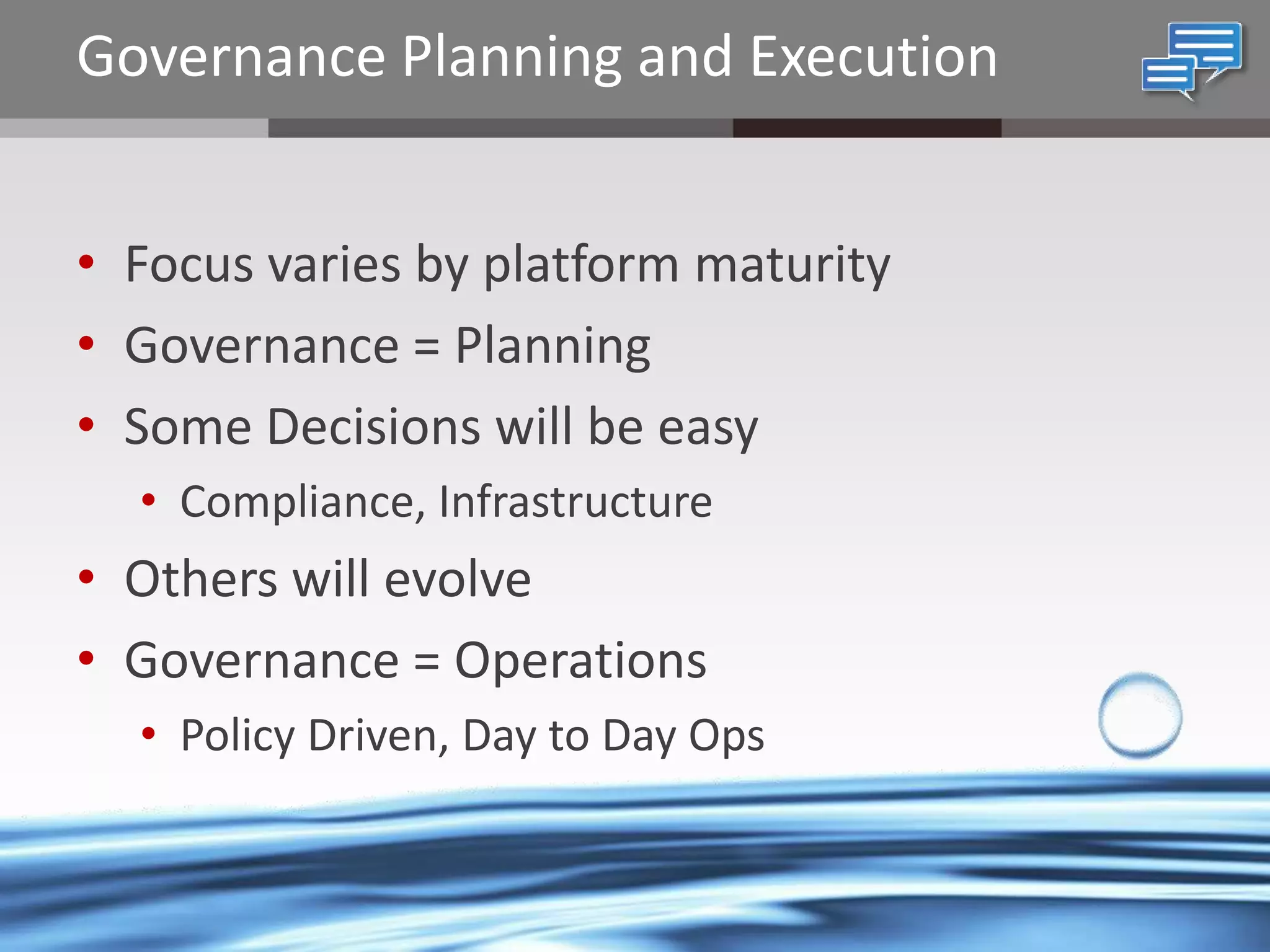
Governance Planning and Execution
• Focus varies by platform maturity
• Governance = Planning
• Some Decisions will be easy
• Compliance, Infrastructure

• Others will evolve
• Governance = Operations
• Policy Driven, Day to Day Ops

@chrysalisbts
Resources and Skillsets
• Do not underestimate resources requirements
and training needs
• SharePoint teams often built from internal
resources Administrators
•
•
•
•
•

Developers
Architects
Business Analysts
Business (SharePoint) Administrators
Business Users

• Consider training needs and modes
@chrysalisbts
Planning for Highly Effective Usage
A predictable, repeatable approach to realizing ongoing business value

Objectives & Business Case

Transition Management

Governance

Adoption

@chrysalisbts
Governance is Inclusive
Adoption strategies

• Involve the business
• SharePoint is a Business Platform by and for users

• Designed the plan to empower users
•
•
•
•

How to participate in governance board
How to request new capabilities
How to develop a business case
Communicate!

@chrysalisbts
Involve Leadership in Information Architecture
Adoption strategies

• Involve business decision makers in design
• Build awareness and understanding of platform
capabilities and support needs

• Business perspective reflected in taxonomy
• Improve usability and information findability

• Engage in UX and CRPs
• Develop ownership and commitment to success

• Communicate with and through your busienss
advocates
@chrysalisbts
Document, Deliver, Train
Anticipate and prepare for readiness

• Training cannot be an afterthought
• Work the roadmap to anticipate training
requirements

• Provide documentation
• FAQs, docs, wikis, status and schedule, contact

• Relevant training approach, mode
• Don’t forget to train on process change

• Communicate timeline and expectations
@chrysalisbts
&
@chrysalisbts
Contact

Dave Healey
• dhealey@chrysalisbts.com
• @dhealey27
• (206) 734-9414

@chrysalisbts
presented by

Dave Healey
dhealey@chrysalisbts.com
(206) 734-9414
@chrysalisbts
SharePoint Adoption & Governance

SUPPORT SLIDES

@chrysalisbts
Define Objectives & Business Case
Phase Zero: Approach to Identifying and Quantifying Improvement Initiatives

Phase Zero:
Business Case Development

Platform Technology
Assessment

Initiative Exploration
& Technical Validation

Initiative Validation &
Improvement Impact

Initiative Strategy &
Launch Timeline

Phase Zero: to provide the necessary information to either support or disprove a
business case hypothesis that an attractive opportunity exists for a particular
improvement initiative to positively impact the performance of the organization.

@chrysalisbts
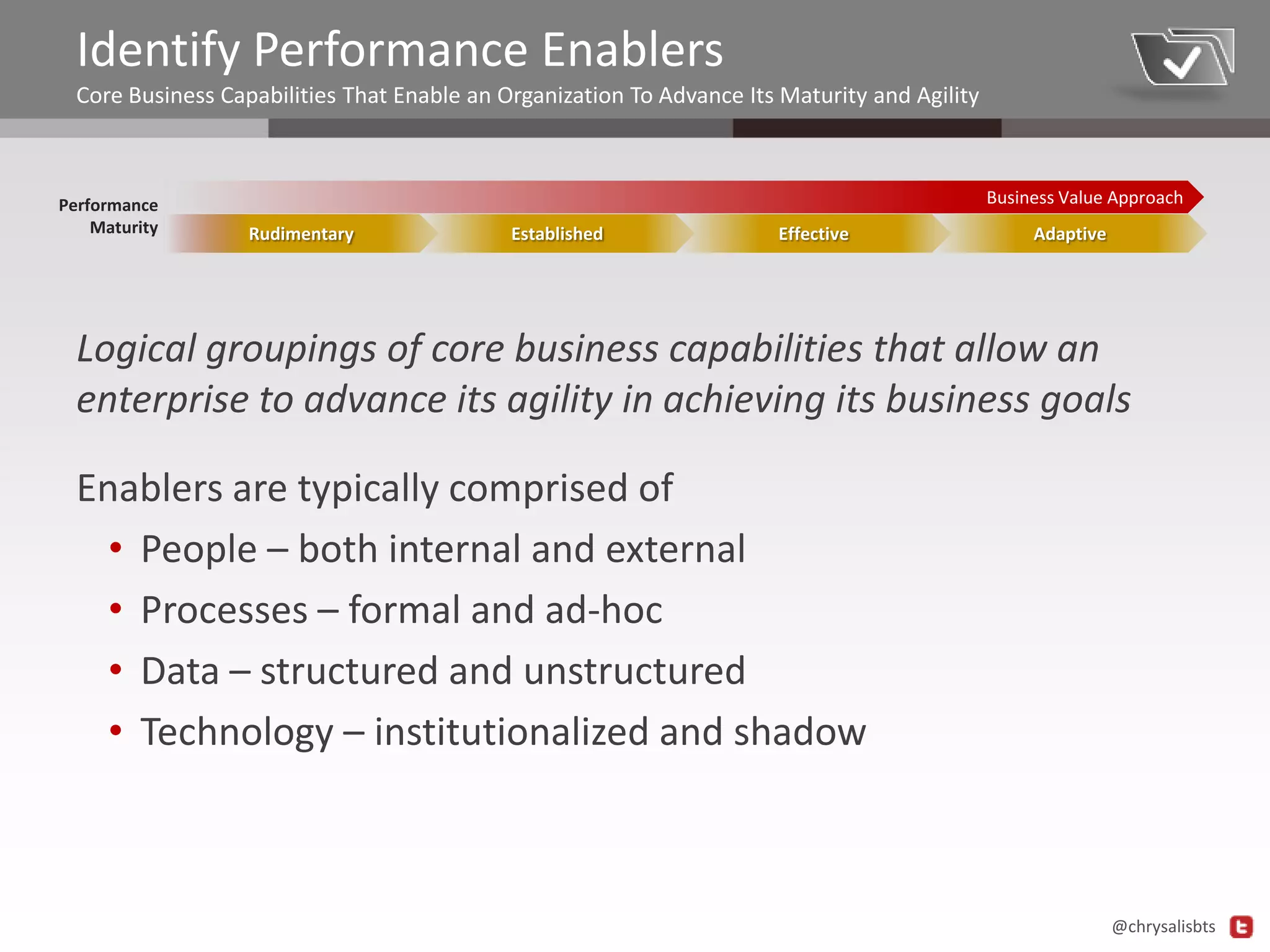
Identify Performance Enablers
Core Business Capabilities That Enable an Organization To Advance Its Maturity and Agility

Performance
Maturity

Business Value Approach
Rudimentary

Established

Effective

Adaptive

Logical groupings of core business capabilities that allow an
enterprise to advance its agility in achieving its business goals
Enablers are typically comprised of
• People – both internal and external
• Processes – formal and ad-hoc
• Data – structured and unstructured
• Technology – institutionalized and shadow

@chrysalisbts
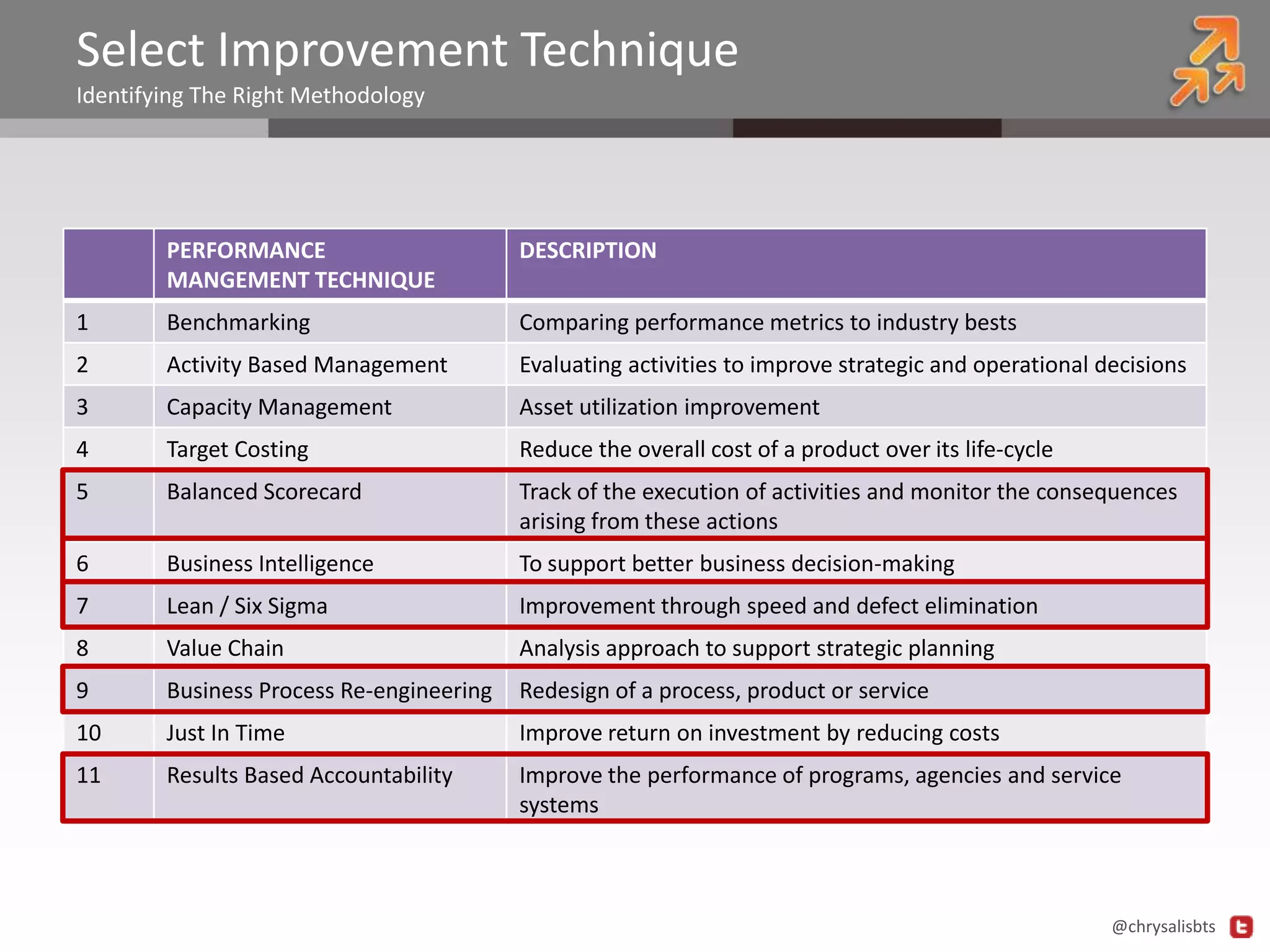
Select Improvement Technique
Identifying The Right Methodology

PERFORMANCE
MANGEMENT TECHNIQUE

DESCRIPTION

1

Benchmarking

Comparing performance metrics to industry bests

2

Activity Based Management

Evaluating activities to improve strategic and operational decisions

3

Capacity Management

Asset utilization improvement

4

Target Costing

Reduce the overall cost of a product over its life-cycle

5

Balanced Scorecard

Track of the execution of activities and monitor the consequences
arising from these actions

6

Business Intelligence

To support better business decision-making

7

Lean / Six Sigma

Improvement through speed and defect elimination

8

Value Chain

Analysis approach to support strategic planning

9

Business Process Re-engineering

Redesign of a process, product or service

10

Just In Time

Improve return on investment by reducing costs

11

Results Based Accountability

Improve the performance of programs, agencies and service
systems

@chrysalisbts
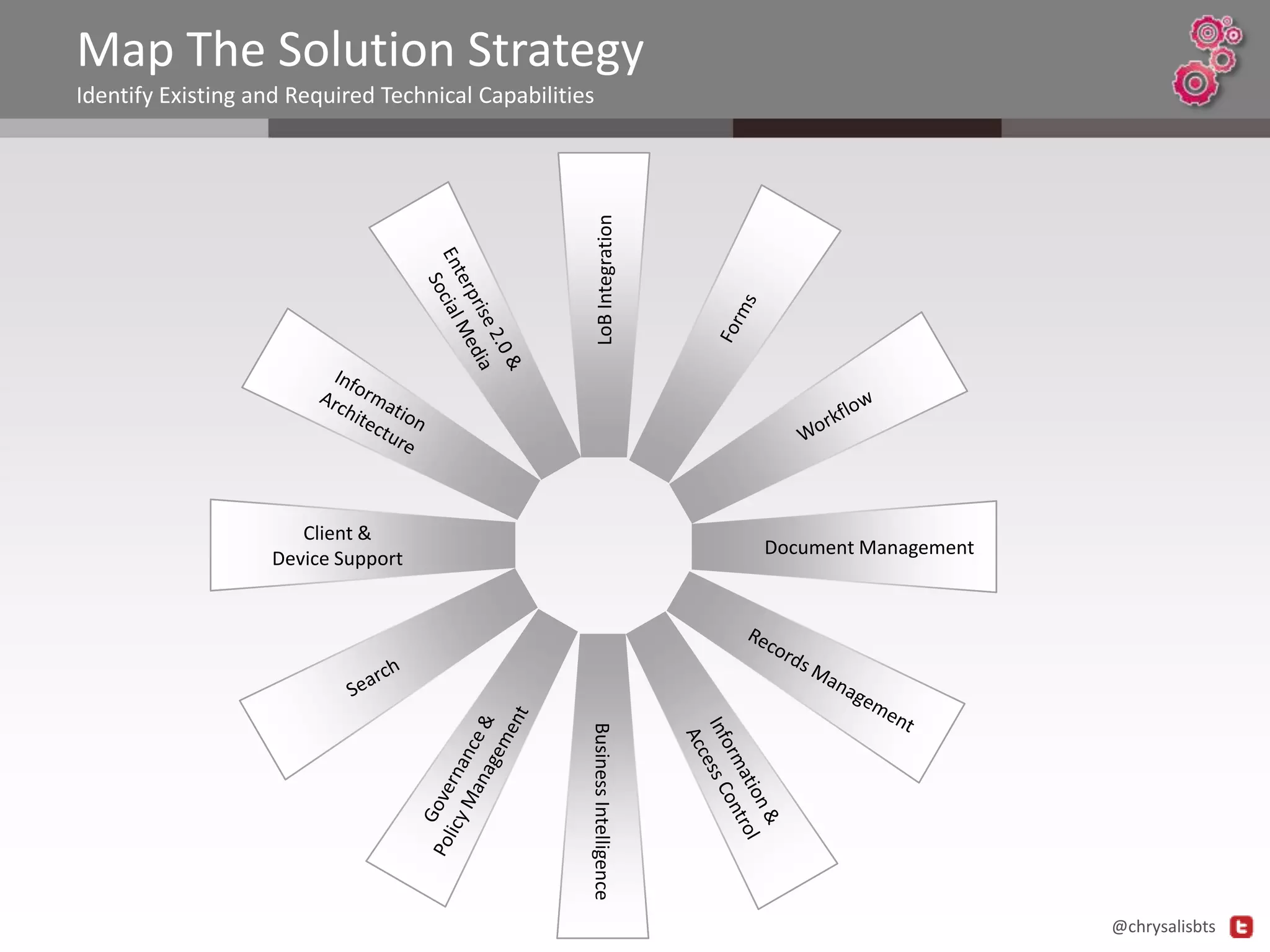
Map The Solution Strategy

LoB Integration

Identify Existing and Required Technical Capabilities

Client &
Device Support

Document Management

Business Intelligence
@chrysalisbts
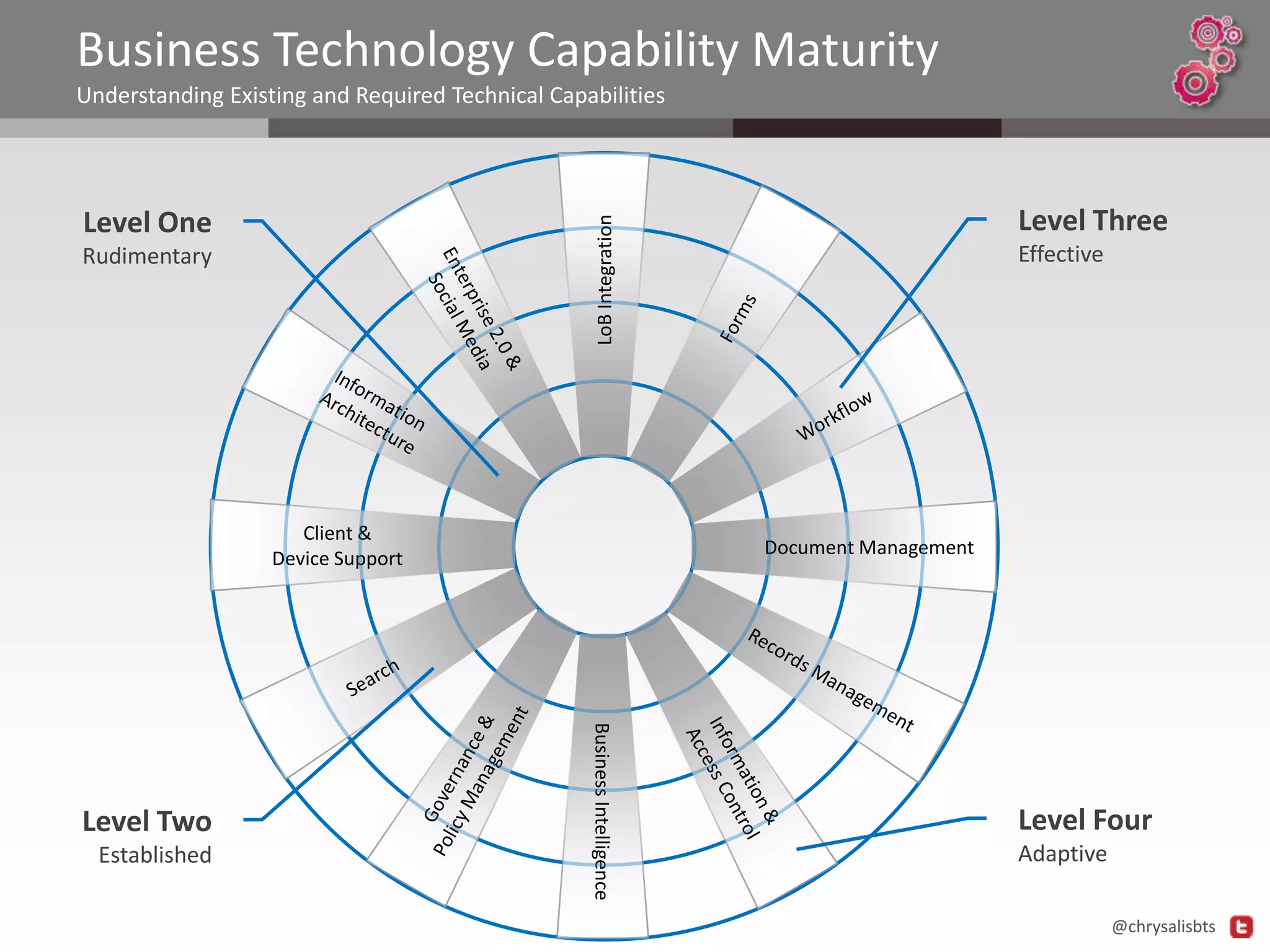
Business Technology Capability Maturity
Understanding Existing and Required Technical Capabilities

Rudimentary

Client &
Device Support

Established

Effective

Document Management

Business Intelligence

Level Two

Level Three

LoB Integration

Level One

Level Four
Adaptive
@chrysalisbts
SharePoint Adoption & Governance
Can you have it all?

Delivering successful SharePoint implementations can be challenging and far too many
suffer from a less than desired Return on Investment.
Successful SharePoint is best thought of as a team sport requiring cooperation and
partnership between the business, IT and end-user communities collaborating to
balance the need for governance, process and adoption.
This session is designed to help teams responsible for the success of SharePoint and
discusses proven methods and best practices for driving adoption while enabling and
supporting governance requirements.
This session will highlight strategies for:
• Establishing an effective cross organization SharePoint team,
• Aligning SharePoint solutions to organizational goals and priorities,
• Engaging executive sponsors, stakeholders, and SharePoint champions,
• Planning end-user training and communications, and
• Managing the technology platform and governance plan.

@chrysalisbts
SharePoint Adoption & Governance
Can you have it all?

Delivering successful SharePoint implementations can be challenging and far too many
suffer from a less than desired Return on Investment.
Successful SharePoint is best thought of as a team sport requiring cooperation and
partnership between the business, IT and end-user communities collaborating to
balance the need for governance, process and adoption.
This session is designed to help teams responsible for the success of SharePoint and
discusses proven methods and best practices for driving adoption while enabling and
supporting governance requirements.
This session will highlight strategies for:
• Establishing an effective cross organization SharePoint team,
• Aligning SharePoint solutions to organizational goals and priorities,
• Engaging executive sponsors, stakeholders, and SharePoint champions,
• Planning end-user training and communications, and
• Managing the technology platform and governance plan.

@chrysalisbts

SharePoint Adoption and Governance

  • 1.
    10/28/2013 SharePoint Adoption & Governance BusinessValue Realization presented by Dave Healey dhealey@chrysalisbts.com (206) 734-9414 @chrysalisbts
  • 2.
    Welcome & Introductions Whoare you? • • • • • • Name Title Company What is your level of familiarity with SharePoint? What challenges are you facing? What do you hope to get out of today’s session? @chrysalisbts
  • 3.
    Welcome & Introductions Chrysalis| Business Technology Solutions • Bridging the divide between Business Transformation objectives & IT Solution infrastructure • BI and Performance Management, • Business Process Optimization, • ECM, Access, Search, Content Delivery • IT Strategy, Architecture, Governance, • Mobile Enablement • Project & Portfolio Management • Managed Services and Support • Mentoring, Training Presentation Team Dave Healey, Managing Partner • 20 years industry experience • Knowledge & Information Mgmt • Microsoft Corporation • Accenture (InnovaPost) Andrew Hopkins, Principal Consultant • 22 years industry experience • Enterprise Information Management • Microsoft Corporation • Lexis Nexus @chrysalisbts
  • 4.
    Organizational Performance Optimization SharePointis a powerful enabler, but falls short Business Value Realization Performance Maturity SharePoint Adoption Business Value Key Capabilities Rudimentary Established Effective Pre-Deployment Initial Deployment • Inconsistent Teaming • Ad-hoc Collaboration • Informal, Inefficient Processes • Significant IP & Legal Risk • Productivity Gains • Effective Teaming • Lightweight Project Management • Broaden Adoption • Drive Compliance • Reduce multiple system maintenance costs • Insight In-Context • Improved Decision Making • Increased Agility • • • • • Team Collaboration • Document Management • Search • • • • • Integration • Composite and Industry Applications File shares Email USB Drive Cloud shares Broad Adoption Adaptive Content Management Social Computing Enterprise-Class Search Business Intelligence Business Solutions • Non-systematic, non-periodic and reactive • Stable and repetitive • Internally efficient and continuously improving • Externally efficient and dynamic Source: Microsoft Corporation Internal Research, 2011 @chrysalisbts
  • 5.
    Where Does YourOrganization Fit? SharePoint as enabler of business strategy, value creation and ongoing process improvement Business Value Realization Performance Maturity SharePoint Adoption Business Value Key Capabilities Rudimentary Established Effective Pre-Deployment Initial Deployment • Inconsistent Teaming • Ad-hoc Collaboration • Informal, Inefficient Processes • Significant IP & Legal Risk • Productivity Gains • Effective Teaming • Lightweight Project Management • Broaden Adoption • Drive Compliance • Reduce multiple system maintenance costs • Insight In-Context • Improved Decision Making • Increased Agility • • • • • Team Collaboration • Document Management • Search • • • • • Integration • Composite and Industry Applications File shares Email USB Drive Cloud shares Broad Adoption Adaptive Content Management Social Computing Enterprise-Class Search Business Intelligence Business Solutions • Non-systematic, non-periodic and reactive • Stable and repetitive • Internally efficient and continuously improving • Externally efficient and dynamic Source: Microsoft Corporation Internal Research, 2011 @chrysalisbts
  • 6.
    How is SuccessDefined? Business perspective on Return on Investment Highly Effective Usage Highly Effective Usage Successful Implementation Successful Implementation Software Is Deployed Software Is Deployed Other Other 0 Source: TSIA / Neochanges / Sand Hill Group 10 20 30 40 50 60 70 80 @chrysalisbts
  • 7.
    Delivering On EffectiveUsage Value is realized through utilization Process Alignment Organizational Change Software Functionality Effective User Adoption 69% Source: TSIA / Neochanges / Sand Hill Group Effective User Adoption @chrysalisbts
  • 8.
    Barriers to ValueRealization Processes, culture and people issues Organizational or Employee Issues Business Process Integration Technology Integration Technology Capabilities 0 Source: Cisco Systems Momentum Research Group 10 20 30 40 50 60 @chrysalisbts
  • 9.
    Influencing User Adoption UnlockingSharePoint ROI Outcome 20% to 30% Cost Savings Start with… • Business Processes Add… • Business Application Outcome 6% - 9% Cost Increase Start with… • Business Application Source: Cisco Systems Momentum Research Group Add… • Business Process @chrysalisbts
  • 10.
    “Technology provides nobenefit of it’s own; it is the application of technology to business opportunities that produces ROI.” – Robert McDowell, Microsoft In Search of Business Value @chrysalisbts
  • 11.
    “So why isSharePoint Adoption Lagging?” – Dave Healey @chrysalisbts
  • 12.
  • 13.
    Balancing Empowerment &Control @chrysalisbts
  • 14.
  • 15.
    Successful SharePoint UNLOCKING SHAREPOINTROI SHIFTING OUR PERSPECTIVE ON TECHNOLOGY PROJECTS @chrysalisbts
  • 16.
    Technology Up SolutionStrategy “We deployed it” success metric Solution Strategy Improvement Techniques Performance Enablers @chrysalisbts
  • 17.
    Process Out SolutionStrategy “It’s been implemented” success strategy Objectives & Business Case Performance Enablers Improvement Techniques Transition Management Solution Strategy @chrysalisbts
  • 18.
    User Centered, ScenarioDriven Solution Strategy “Effective usage” success metrics Objectives & Business Case Transition Management Performance Enablers Improvement Techniques Solution Strategy @chrysalisbts
  • 19.
    Planning for HighlyEffective Usage A predictable, repeatable approach to realizing ongoing business value Objectives & Business Case Transition Management Governance Adoption @chrysalisbts
  • 20.
    Planning for HighlyEffective Usage A predictable, repeatable approach to realizing ongoing business value Objectives & Business Case Transition Management Governance Adoption @chrysalisbts
  • 21.
    Executive Sponsorship Key tolong term success • Do executives understand the value SharePoint will bring to the organization? • SharePoint is a Business Platform • Lack of understanding of how SharePoint can deliver business value is the culprit • Executives want the benefits, but fail to make the investments that are necessary • Find Your Executive Champion @chrysalisbts
  • 22.
    Define Objectives &Business Case Identify and quantify business benefits Business Case Development Platform Technology Assessment Initiative Exploration & Technical Validation Initiative Validation & Improvement Impact Initiative Strategy & Launch Timeline Phase Zero: to provide the necessary information to either support or disprove a business case hypothesis that an attractive opportunity exists for a particular improvement initiative to positively impact the performance of the organization. @chrysalisbts
  • 23.
    SharePoint Road MappingExercise Developing the release strategy • New SharePoint implementation: Where do you start and where are you going? • Scope may vary… • Building on an existing deployment: Current State vs Desired State? • Review readiness of existing environment @chrysalisbts
  • 24.
    Walk, Jog, Run Planfor phased development and deployment • Don’t be overwhelmed • Staged deployment based on road mapping and tied to business impact • Ensure champions and influencers are involved early @chrysalisbts
  • 25.
    Planning for HighlyEffective Usage A predictable, repeatable approach to realizing ongoing business value Objectives & Business Case Transition Management Governance Adoption @chrysalisbts
  • 26.
    Transition Management Planned, predictable,scalable Communicate Tools People Process Training Gather Feedback • Transition Management: A structured approach to change in individuals, teams and organizations that enable the change from current state to desired state • Consider change capacity • Include Executive @chrysalisbts
  • 27.
    Planning for HighlyEffective Usage A predictable, repeatable approach to realizing ongoing business value Objectives & Business Case Transition Management Governance Adoption @chrysalisbts
  • 28.
    Governance Plan Carefully designedto ensure adoption • Governance is not a one time event • Governance = Communication • Establish Governance Board (SharePoint Oversight Committee) • Consider organizational representation thoughtfully • Communicate participation protocols • Balance control and empowerment • Underpins training strategy • Accept feedback, adapt • Integrate, Evolve • Adjunct to overall IT Governance • Build your plan, work the plan @chrysalisbts
  • 29.
    Governance Planning andExecution • Focus varies by platform maturity • Governance = Planning • Some Decisions will be easy • Compliance, Infrastructure • Others will evolve • Governance = Operations • Policy Driven, Day to Day Ops @chrysalisbts
  • 30.
    Resources and Skillsets •Do not underestimate resources requirements and training needs • SharePoint teams often built from internal resources Administrators • • • • • Developers Architects Business Analysts Business (SharePoint) Administrators Business Users • Consider training needs and modes @chrysalisbts
  • 31.
    Planning for HighlyEffective Usage A predictable, repeatable approach to realizing ongoing business value Objectives & Business Case Transition Management Governance Adoption @chrysalisbts
  • 32.
    Governance is Inclusive Adoptionstrategies • Involve the business • SharePoint is a Business Platform by and for users • Designed the plan to empower users • • • • How to participate in governance board How to request new capabilities How to develop a business case Communicate! @chrysalisbts
  • 33.
    Involve Leadership inInformation Architecture Adoption strategies • Involve business decision makers in design • Build awareness and understanding of platform capabilities and support needs • Business perspective reflected in taxonomy • Improve usability and information findability • Engage in UX and CRPs • Develop ownership and commitment to success • Communicate with and through your busienss advocates @chrysalisbts
  • 34.
    Document, Deliver, Train Anticipateand prepare for readiness • Training cannot be an afterthought • Work the roadmap to anticipate training requirements • Provide documentation • FAQs, docs, wikis, status and schedule, contact • Relevant training approach, mode • Don’t forget to train on process change • Communicate timeline and expectations @chrysalisbts
  • 35.
  • 36.
    Contact Dave Healey • dhealey@chrysalisbts.com •@dhealey27 • (206) 734-9414 @chrysalisbts
  • 37.
  • 38.
    SharePoint Adoption &Governance SUPPORT SLIDES @chrysalisbts
  • 39.
    Define Objectives &Business Case Phase Zero: Approach to Identifying and Quantifying Improvement Initiatives Phase Zero: Business Case Development Platform Technology Assessment Initiative Exploration & Technical Validation Initiative Validation & Improvement Impact Initiative Strategy & Launch Timeline Phase Zero: to provide the necessary information to either support or disprove a business case hypothesis that an attractive opportunity exists for a particular improvement initiative to positively impact the performance of the organization. @chrysalisbts
  • 40.
    Identify Performance Enablers CoreBusiness Capabilities That Enable an Organization To Advance Its Maturity and Agility Performance Maturity Business Value Approach Rudimentary Established Effective Adaptive Logical groupings of core business capabilities that allow an enterprise to advance its agility in achieving its business goals Enablers are typically comprised of • People – both internal and external • Processes – formal and ad-hoc • Data – structured and unstructured • Technology – institutionalized and shadow @chrysalisbts
  • 41.
    Select Improvement Technique IdentifyingThe Right Methodology PERFORMANCE MANGEMENT TECHNIQUE DESCRIPTION 1 Benchmarking Comparing performance metrics to industry bests 2 Activity Based Management Evaluating activities to improve strategic and operational decisions 3 Capacity Management Asset utilization improvement 4 Target Costing Reduce the overall cost of a product over its life-cycle 5 Balanced Scorecard Track of the execution of activities and monitor the consequences arising from these actions 6 Business Intelligence To support better business decision-making 7 Lean / Six Sigma Improvement through speed and defect elimination 8 Value Chain Analysis approach to support strategic planning 9 Business Process Re-engineering Redesign of a process, product or service 10 Just In Time Improve return on investment by reducing costs 11 Results Based Accountability Improve the performance of programs, agencies and service systems @chrysalisbts
  • 42.
    Map The SolutionStrategy LoB Integration Identify Existing and Required Technical Capabilities Client & Device Support Document Management Business Intelligence @chrysalisbts
  • 43.
    Business Technology CapabilityMaturity Understanding Existing and Required Technical Capabilities Rudimentary Client & Device Support Established Effective Document Management Business Intelligence Level Two Level Three LoB Integration Level One Level Four Adaptive @chrysalisbts
  • 44.
    SharePoint Adoption &Governance Can you have it all? Delivering successful SharePoint implementations can be challenging and far too many suffer from a less than desired Return on Investment. Successful SharePoint is best thought of as a team sport requiring cooperation and partnership between the business, IT and end-user communities collaborating to balance the need for governance, process and adoption. This session is designed to help teams responsible for the success of SharePoint and discusses proven methods and best practices for driving adoption while enabling and supporting governance requirements. This session will highlight strategies for: • Establishing an effective cross organization SharePoint team, • Aligning SharePoint solutions to organizational goals and priorities, • Engaging executive sponsors, stakeholders, and SharePoint champions, • Planning end-user training and communications, and • Managing the technology platform and governance plan. @chrysalisbts
  • 45.
    SharePoint Adoption &Governance Can you have it all? Delivering successful SharePoint implementations can be challenging and far too many suffer from a less than desired Return on Investment. Successful SharePoint is best thought of as a team sport requiring cooperation and partnership between the business, IT and end-user communities collaborating to balance the need for governance, process and adoption. This session is designed to help teams responsible for the success of SharePoint and discusses proven methods and best practices for driving adoption while enabling and supporting governance requirements. This session will highlight strategies for: • Establishing an effective cross organization SharePoint team, • Aligning SharePoint solutions to organizational goals and priorities, • Engaging executive sponsors, stakeholders, and SharePoint champions, • Planning end-user training and communications, and • Managing the technology platform and governance plan. @chrysalisbts

Editor's Notes

  • #2 Adoption and governance are critical components in an overall SharePoint strategy. Without them full utility of SharePoint, and therfore business value realization, cannot be achieved. Value realization = “highly effective usage”.Highly effective usage requires a partnership between IT and the business working together to identify high value scenarios and implement them using SharePoint technologies.Governance and Adoptions plans are in essence the agreements between business and IT that will ensure highly effective usage and therefore business value realization.
  • #3 Who is business?Who is IT?
  • #4 Dave Healey is Managing Partner at Chrysalis BTS and I have been working with Enterprise Business Applications and Information Management Systems for almost twenty years. He’s been working with SharePoint space since 2001 in a broad variety of process improvement scenarios, organization types and sizes.Also spent almost five years on the SharePoint Server and SQL Server product teams at Microsoft CorpHas developed a systematic approach to extending, enhancing and improving enterprise systems and processes leveraging the almost ubiquitous SharePoint platform.Looking forward to sharing insight and specific project successes and lessons learned. Hope you feel comfortable asking questions, sharing your own insights and engaging with the community.
  • #6 Most organization are not returning the full value on their investments and therefore the business is not realizing it’s full potential return of their people, process, data and technology resources. SharePoint is poorly understood and significantly underutilized as an enabler of business strategy, value creation and ongoing process improvement.Why??What does this mean for existingapplications?1. Rudimentary – non-systematic, non-periodic and reactive2. Established – stable and repetitive3. Effective – internally efficient and continuously improving4. Adaptive – externally efficient and dynamicHow does SharePoint fit the Adaptive Technology Capability Mold? Can SharePoint be employed to address these requirements?BackupThe first persona is a phase we call initial deployment. This phase is aimed at providing a better way for people to work together. They have a place to store and share information that’s a much better experience than storing files through email or putting things on file shares or sharing files externally through file-sharing services. They have search capabilities that they never had before because all the content has been centralized in one place and indexed and made available to everyone in a secure fashion. Typically here we see pretty solid productivity gains along with more effective teaming and lightweight project management. But at the same time, they’ve also noticed a couple of interesting things going on. First of all there may be hundreds or thousands or tens of thousands of individual sites popping up in the organization. Many companies haven’t necessarily provisioned for scale in their environment. So what you see in the end user experience is bottlenecks in the system. And on top of that, there are concerns about the information out there and how it’s being used and managed and who has access to it. And so while there are great benefits that come from this phase, there’s also opportunity to make it far more effective. The next phase of the SharePoint journey is the customer who has really made a strategic bet on SharePoint from the start. It’s an organization looking to maximize the value of the out-of-the-box SharePoint experience. They’re looking to drive deeper workloads such as social computing, content management, more enterprise-class search, and business intelligence. They take a look at the core repository of knowledge and information and consider security and workflow, approvals and who has access to files and when. What kind of attributes are being applied to make it easier to find, sort through, and manage content over time. How you build taxonomy around the content. How you manage metadata to supply to the content to make the information in SharePoint easier to find and share. The last customer persona is the customer who has gone above and beyond. Now they really start to explore SharePoint as an application platform. They look at what it means to surface relevant business information in context to people within a SharePoint environment because that’s where people are spending a lot of time. That makes it a logical place to start to surface information from ERP, CRM, and systems such as SAP or PeopleSoft and so on through a single enterprise portal; SharePoint. On top of that, they build tailored applications. So now they’re taking advantage of SharePoint as a place to get better insight into what’s happening within the business, they’re starting to look at horizontal and industry capabilities that can be delivered through SharePoint. And in that space they have a number of options going on where they can decide whether or not they want to build custom codes, buy off-the-shelf solutions from our broad ISV ecosystem or build no-code or declarative solutions by empowering end users to do more themselves.
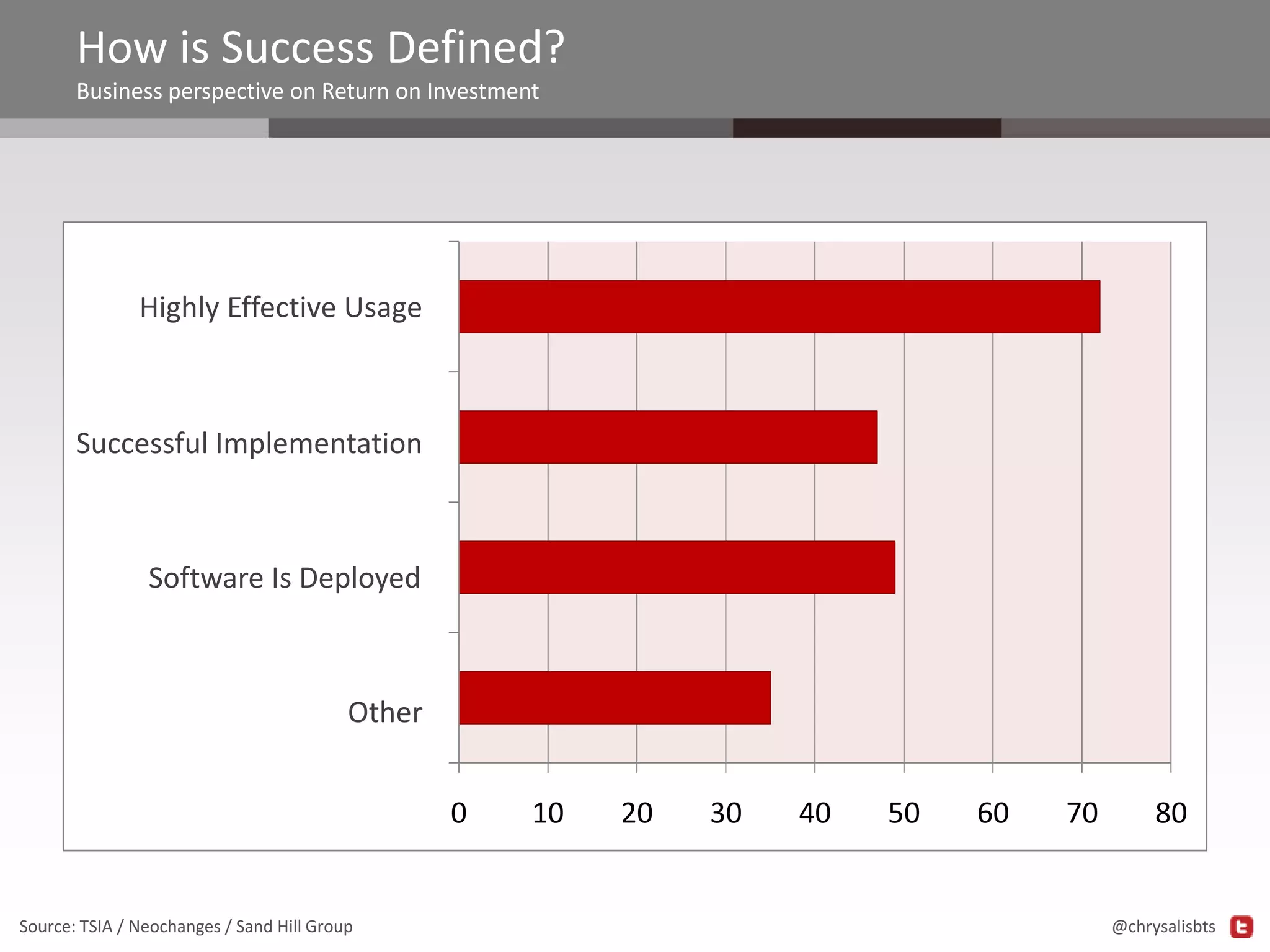
  • #8 Complexity Avalanche – J.B. WoodThe vast majority of those executives said that they view value realization, far more than product deploymentUtilization is the primary method by which asset performance is measured
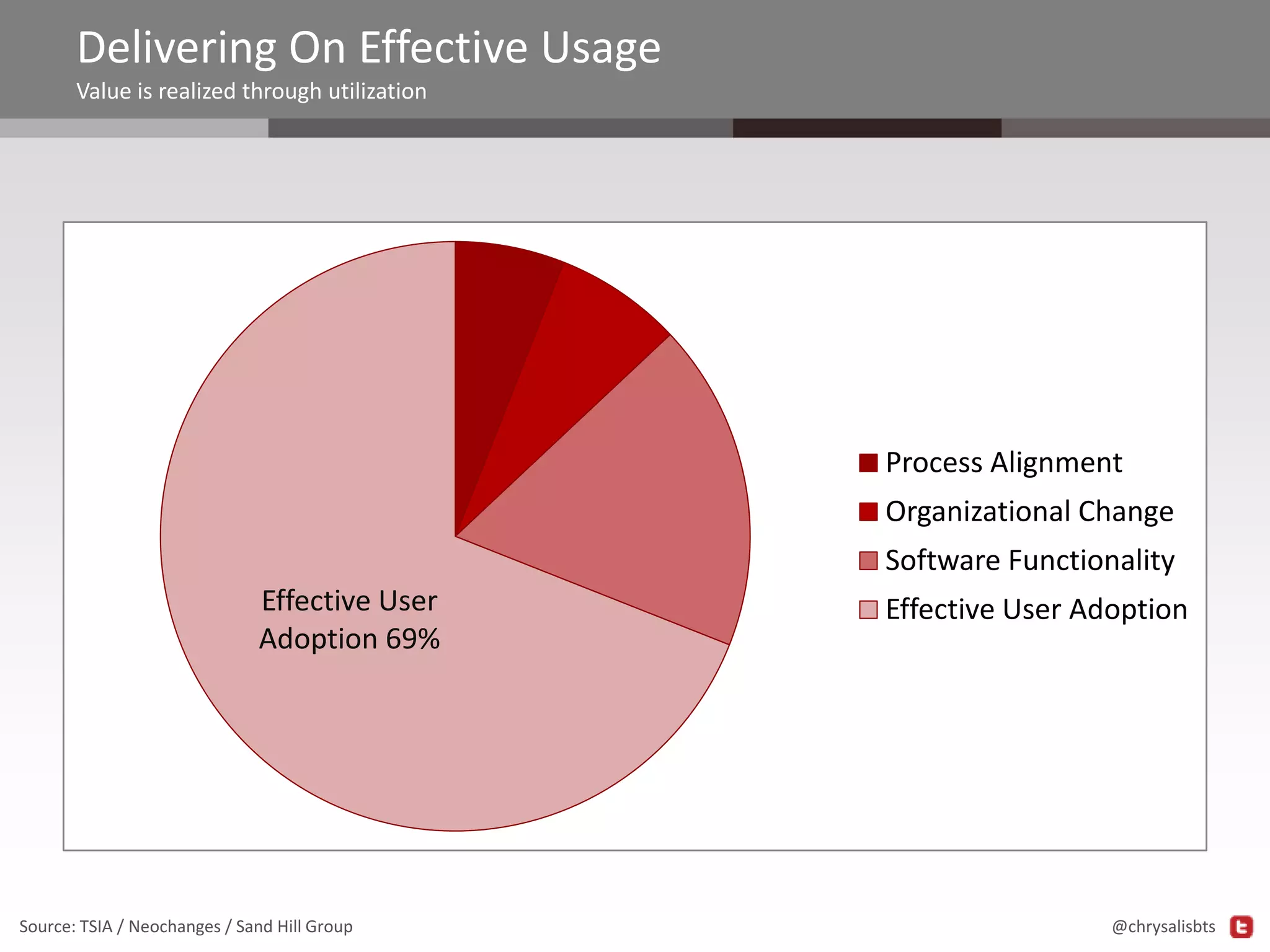
  • #9 Complexity Avalanche – J.B. WoodTechnology customers today are developing a different take on success, consciously or not. It's increasingly about whether the products key features are actually being used and delivering their potential value. This is about the right use, the best use, the optimal use.  Of enterprise IT executives surveyed, 69% said the number one driver of value realization was "effective user adoption." Only 18% defined value as functionality.
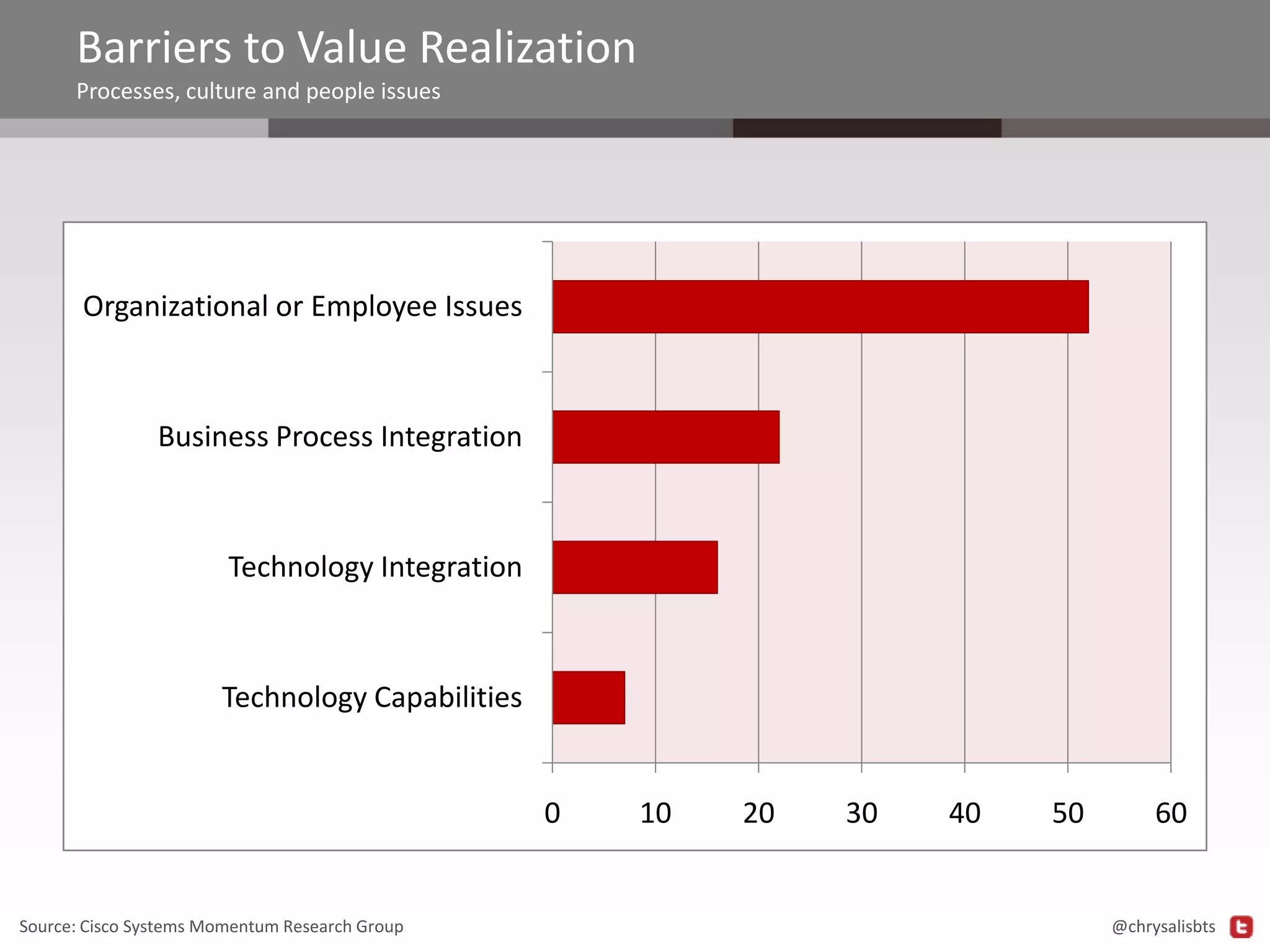
  • #10 Complexity Avalanche – J.B. WoodIt's not that the technology lacks capabilities or that it doesn't integrate, it's about processes, culture and people, basically barriers to end-user adoption. It’s not that these issues are constrained only to IT, take the basic example of the remote control in your living room for example
  • #11 Complexity Avalanche – J.B. WoodThe order in which you take action on a project, change the internal business process first and then implement the application versus implement the application and THEN change the business process, had a huge impact on the cost effectiveness of the total project. For those companies who changed the business process first, the total project resulted in an average cost savings of 20% to 30%. But those who implemented the technology first actually had their cost increase an average of 6% to 9% percent. By forcing the organization to change their processes first, the changes actually got made and adding the applications was easy. But go the other way around and the pressure on the process changes often get lost. Because the application implementation is complete, the whole project can be depressurized. The vendor pulls out and the customer is left working around the application instead of through it actually adding processes and using alternatives to the application to survive because they haven't fully adapted the organization and gotten end-users to adopt the features. This gap is robbing the organization of their promised productivity and of their cost-saving. This is why Lean Six Sigma works so well. It forces companies to “lean out” the process first to eliminate the non-value-added steps thus making it easier to change.
  • #12 IT can only do so much in deploying the right tools for the right requirements. There comes a point at which the business must take the lead in employ a strategy that more fully employs existing investments in pursuit of process improvement.It is not enough to simply state “IT is a blocker” and go outside the company to get your next product solution when it already exists internally.
  • #13 IT can only do so much in deploying the right tools for the right requirements. There comes a point at which the business must take the lead in employ a strategy that more fully employs existing investments in pursuit of process improvement.It is not enough to simply state “IT is a blocker” and go outside the company to get your next product solution when it already exists internally.
  • #17 For the most part, end-user adoption isn't nearly as successful as it should be. Research suggests that this is one of the main reasons that as much as two thirds of IT investments fail to achieve their intended business results. Let's look at a few examples. According to the TSIA survey, 50% of software functionality paid for and licensed by organizations is not actually used.A whopping 83% of SMB owners in a recent AMI Partners survey say that getting staff to use the software was their biggest CRM challenge.Of healthcare organizations that have computerized physician order entry (CPOE) capabilities, only 19% have physicians entering 50% or more of their orders. And almost 60% have physicians entering less than 10% of their orders. Products that don't get used don't deliver value. In many cases that value can be quantified. In healthcare, for example, a number of studies indicate that CPOE can have a significant economic impact. Each major CPOE user could potentially save a healthcare organization $100,000 or more per year. A typical 500 bed facility could realize savings of more than $10 million per year, but only if physicians use the technology. There's also a definitive link between the adoption of CPOE systems and patient safety. The Institute of Medicine attributes between 44,000 and 98,000 deaths per year to medication errors, and believes that CPOE can be a powerful tool for preventing such errors.
  • #18 Establishing a consistent, comprehensive and repeatable approach to driving performance improvement with SharePoint technologies
  • #19 Technology forward approach to solutions, often from IT.Can work well in some scenarios, particularly infrastructureData WarehousingMailVoIPEtc.It is common to see IT take a technology first approach and rollout SharePoint with little consideration for the user impact.How most projects really workHow do you know you’ve been successful? - no successmetrics? No defined desired business aoutcome. - lack of a business case - how do we ready the team support and execute? - no change managementThis is the “We deployed it” success model”
  • #20 This is a standard approach to driving improvement and therefore ROI in an organization. We’ve used it in varying forms for 20+ years with a variety of customers, size, industries.However the two areas most often overlooked and leading to less than satisfactory ROI are the objectives and business case and transition management - both of which speak directly governance and adoptionRun through the overall process on once then focus on the twoThis is the “successful implementation” model.
  • #21 How it really needs to be.What are the objectives.How are we going to affect our objectives?In a system to system IT project transition management is not such a big deal.But w SP it’s person to person, person to team, team to person, person to system and system to person transition management is a big deal.This is the “highly effective usage” model.
  • #22 This is the focus of our talk today. - Highly effective usage.
  • #23 This is the focus of our talk today. - Highly effective usage.Adoption includes executive. It has to make as much sense to them as to any “end-user”.
  • #24 Common theme among IT departments is that SharePoint doesn’t get enough executive attention and supportExecutives want the benefits, but fail to make the investments that are necessaryLack of understanding of how SharePoint can deliver business value is the culpritWhat are you trying to accomplish and why?What is the value? If it is quantifiable, then half the battle is wonWhen executives understand the Return portion of the equation, it is much easier to get them to commit to the Investment side
  • #25 The business case is the foundation of the initiative. I recommend it for every major phase and any significant component.What is the expected business impact?How will we measure it?What resources do we need to realize this impact?When will we be done?How do we know if we need to course correct?The old idiom “look before you leap” describes a cautious approach that can serve your firm well as you contemplate embarking on a new program. When doing an internal innovation / performance improvement project executing a Phase Zero diligence is the best way to generate confidence that a real business opportunity exists and that viable technologies can be employed to address it.Goal – The goal of Phase Zero is to provide the necessary information to either support or disprove a business case hypothesis. Specifically, that an attractive opportunity exists for a particular improvement initiative to positively impact the performance of the organization. It is important that the Phase Zero effort focuses on presenting actionable information to the decision maker so that a clean go/no-go decision can be taken.Platform Technology Assessment – This work aims to answer the questions, “What is the maturity level of the technology?”, “What are the risks going forward?” and “Are we ready for prime time”? A thorough understanding of where the technology stands vis-à-vis its readiness for application is the primary goal of the effort. Using the assessment process to project when the technology will be ready to reliably meet every day performance needs will tell you much about the scale of the development effort, program timeline, required investment and chances for success.Improvement Opportunity Exploration & Technical Validation – An exploration of the opportunity map and associated improvement techniques forms the basis for understanding what the potential opportunities for improvement are. Contextual inquiry, use scenario generation and technical feasibility analysis are useful in further defining the concepts and describing the engineering road map for eventual development. Since we need to build a realistic business case, our emphasis should be on presenting concepts that establish confidence both technically and fully meet perceived end-user needs. Opportunity Validation & Performance Improvement Impact – A Phase Zero effort is not a formal market research effort. Rather a base line validation of the most attractive improvement opportunities and is driven by interviews with a few key stakeholders leaders. Would these people champion the initiative in the organization? Would they support the improvement initiative in a meeting of their peers? Would they employ the resulting program or technology solution? Is the value understood? Along side this validation activity, a first order effort aimed at understanding the measurable performance improvement impacts is undertaken. The goal is to generate just enough information to establish the magnitude and character of the business opportunity. Initiative Strategy & Launch Timeline – A first pass initiative launch strategy aimed at creating a preliminary project road map, features and needs matrix and associated alternatives analysis rounds out the information needed to support a valid business case for a new initiative. It is worth repeating, that the knowledge generated in a Phase Zero effort should be detailed enough that it is actionable by internal senior management considering a new initiative. Focusing on providing just enough data to properly inform a go/ no-go decision will help bound the effort and ensures the efficient use of limited resources.
  • #26 “What all do we want to use SharePoint for”: intranet, extranet, Internet, collaboration, search, etc… Scope may be defined when organizations have decided what their entry point is. The same approach can and should still be used within those smaller scopes to define specific user needs and priorities.
  • #27 Walk, Jog, Run is the approach to start simple and build on that to make more robust solutions over time. This allows organizations to not get dragged down by trying to do too much in too little time. It generally also allows solutions to get in users’ hands sooner – maybe not the full solution, but progress. It’s better than waiting longer for everything – it also gives users a glimpse into the solution before it’s fully baked, allowing tweaks and corrections sooner in the development cycle.
  • #28 This is the focus of our talk today. - Highly effective usage.
  • #29 This is governance all up. Read the definition.I emphasis transition management over change management as Change Management implies a statis start and a static end positon.The reality os that a platform like SP drives fairly continuous and organic change. Contrast a big ERP implementation vs a platform like SP.ERP it is a highly governed environment. Very controlled. There will be a final and steady state.- SP is at it’s best when there is not steady state, users are continuously finding ways to improve the business and their activities with itNeed a governance and adoption model that support this reality.Hence the emphasis on transition management, state to state to state verses simple change management
  • #30 This is the focus of our talk today. - Highly effective usage.
  • #32 Governance is something that will evolve and be refined over time as the organization and staff resources go through the SharePoint ‘maturity model’ and as more features and solutions are implemented Different stages have different governance needs:Pre-implementation – More planning, less operational focusOperational – Less planning, more day-to-day needsEffective communication throughout…Because SharePoint is so big and complex – this is why we see so many people talking about it. It’s why you’ll hear vendors talking about it – they have products to help you manage SharePoint – addressing these governance issuesThis is where SharePoint ‘Architect’ type resources can assist… (but what does ‘architect’ mean? – understand the background and perspective your resources are coming from: IT Pro strengths, Dev-centric, etc… Personal biases will play a part and be evident – everyone has the ‘hammer’ they are comfortable with… Compliance may be dictated by regulatory rules (SOX, HIPAA, etc…) or existing internal policiesInfrastructure methodology may already be defined in your organization (SQL management, AD, etc…) SharePoint is just another app/platform that needs to follow the rules Still review any existing infrastructure policies. SharePoint may have unique needs that may lead to updating existing policies or creating exceptions for SharePoint.What will you name your environment?On Premises, in the cloud, or hybrid?Virtual, physical, or both?Is AD ready? Profile importsSecurity groupsSearch?Just the beginning… The tactical/operational componentDependencies are derived from your SharePoint Roadmap and planning outcomeThis space has a number of 3rd party vendors addressing the management needsA lot of the operational topics tend to get thrown to IT to define and manage, but just like creating solutions they should be defined by the business. For example, what is an ‘acceptable’ down time for outages? If the system goes down, what is acceptable data loss – within the last business day? Up to the minute? Idera, AvePoint, Quest,Axcelar, etc… Server health and maintenanceDay-to-day requests and support(New) Project work vs. Support effortsStaffing and resource managementClarity and transparency in communicationSite request and provisioningTemplatesPermissionsWho to contact for questionsResources for assistance with solution development. Out of boxSharePoint Designer.NET Development
  • #42 The old idiom “look before you leap” describes a cautious approach that can serve your firm well as you contemplate embarking on a new program. When doing an internal innovation / performance improvement project executing a Phase Zero diligence is the best way to generate confidence that a real business opportunity exists and that viable technologies can be employed to address it.Goal – The goal of Phase Zero is to provide the necessary information to either support or disprove a business case hypothesis. Specifically, that an attractive opportunity exists for a particular improvement initiative to positively impact the performance of the organization. It is important that the Phase Zero effort focuses on presenting actionable information to the decision maker so that a clean go/no-go decision can be taken.Platform Technology Assessment – This work aims to answer the questions, “What is the maturity level of the technology?”, “What are the risks going forward?” and “Are we ready for prime time”? A thorough understanding of where the technology stands vis-à-vis its readiness for application is the primary goal of the effort. Using the assessment process to project when the technology will be ready to reliably meet every day performance needs will tell you much about the scale of the development effort, program timeline, required investment and chances for success.Improvement Opportunity Exploration & Technical Validation – An exploration of the opportunity map and associated improvement techniques forms the basis for understanding what the potential opportunities for improvement are. Contextual inquiry, use scenario generation and technical feasibility analysis are useful in further defining the concepts and describing the engineering road map for eventual development. Since we need to build a realistic business case, our emphasis should be on presenting concepts that establish confidence both technically and fully meet perceived end-user needs. Opportunity Validation & Performance Improvement Impact – A Phase Zero effort is not a formal market research effort. Rather a base line validation of the most attractive improvement opportunities and is driven by interviews with a few key stakeholders leaders. Would these people champion the initiative in the organization? Would they support the improvement initiative in a meeting of their peers? Would they employ the resulting program or technology solution? Is the value understood? Along side this validation activity, a first order effort aimed at understanding the measurable performance improvement impacts is undertaken. The goal is to generate just enough information to establish the magnitude and character of the business opportunity. Initiative Strategy & Launch Timeline – A first pass initiative launch strategy aimed at creating a preliminary project road map, features and needs matrix and associated alternatives analysis rounds out the information needed to support a valid business case for a new initiative. It is worth repeating, that the knowledge generated in a Phase Zero effort should be detailed enough that it is actionable by internal senior management considering a new initiative. Focusing on providing just enough data to properly inform a go/ no-go decision will help bound the effort and ensures the efficient use of limited resources.
  • #43 Performance EnablersLogical groupings of core business capabilities that allow an enterprise to advance its level of maturity and agility in achieving its business goalsThere are a certain set of capabilities common across every organization that are chartered with helping the organization achieve its strategic objectives. These enablers may be unique in the individual makeup but they are fairly standard in high level context. The Enablers are usually made up ofPeople (internal and external),Processes (formal and ad-hoc)Information (structured and unstructured) andTechnology (institutionalized and shadow).Most performance improvement initiatives are designed to improve the maturity of the individual or multiple enablers and their constituent parts. Understanding which enablers your initiative will impact will help you identify the components you will be working with and help define your improvement strategy including improvement Technique identification and Solution Strategy.
  • #44 There are a broad variety of improvement techniques with specific and valuable benefits and domains of applicability.However there remain a number of challenges associated with trying to achieve performance improvements promised by these approachesPeopleCultural change, resistance (change management)Use familiar and deployed toolsProcessPerformance improvement methodologies, techniques and tools are deeply specialized and usually target at a single domainAddress a single narrow perspective (process) of the businessDon’t consider other related parts of the businessOften create disparate, disconnected, incompatible technologies to be managed by IT operationsTechnologyIT resource availability and commitmentUse familiar and deployed toolsBudget availabilityUse tools you already own, integrate w existing systems
  • #45 LoB IntegrationAbstract business logic from underlying data while maintaining location, structure, format and sync rulesFormsDesign, logic and management functions to govern creation and execution of forms based applicationsWorkflowRules based automation of business processes involving people, documents, tasks, information or systemsDocument ManagementStrategies, methods and tools to manage the document lifecycle related to organizational processesRecords ManagementThe maintenance of organizational records according to the value of the record rather than its physical formatInformation & AccessProvisions protection of and rights based access to an organizations critical and sensitive information assetsBusiness IntelligenceThe transformation of raw data into meaningful information allowing users to make informed decisionsGovernance & PolicyPolicies, roles, responsibilities and processes to control how technologies are employed in businessSearchIndexes data and documents from a variety of sources to enable users to find information and people Client & Device SupportEnables users to access the system from within their preferred toolset, desktop application or mobile deviceInformation ArchitectureA set of methods and tools that identify and organize information in a purposeful and service-oriented wayE2.0 & Social MediaThe use of advanced capabilities to enable and streamline business process while enhancing collaboration
  • #46 Level One, RudimentaryNon-systematic, non-periodic, reactiveLevel Two, EstablishedStable and repetitiveLevel Three, EffectiveInternally efficient and continuously improving Level Four, AdaptiveExternally Efficient and Dynamic