CS3255 Information Organization Lecture 5: Library Catalogues: From Traditional to Next-Generation
References Breeding, Marshall, “Next-Generation Library Catalogs,”  Library Technology Reports , v.43, n.4 (Jul/Aug 2007),  available online at  http://www.techsource.ala.org/ltr/  (accessed 11 Sep 2007) Taylor, Arlene G.,  Introduction to Cataloging and Classification , 10 th  ed. Westport, Conn. : Libraries Unlimited, 2006. Furrie, Betty,  Understanding MARC Bibliographic: Machine-Readable Catalogs , 7 th  ed. Washington, D.C. : Cataloging Distribution Services, Library of Congress, in conjunction with The Follett Software Co., c2003,  available online at  http://www.loc.gov/marc/umb/  (accessed 11 Sep 2007)
Today’s Agenda Traditional Library Catalogue Scope of the Library Catalogue Purpose of the Library Catalogue Underlying Standards Problems with TLC Next-Generation Library Catalogue Federated Search or Metasearch Delivering Content to the User Enriched Content Faceted Navigation Web 2.0: Enabling User Contributions Other Features Putting Them All Together Q&A
Traditional Library Catalogue
Scope of the Library Catalogue Books – includes print and electronic books Multimedia materials – CDs, DVDs, etc. Newspapers, magazines, and professional & scholarly journals – described at title level, not individual issues/articles Others – such as musical scores, microfilms, etc.
Purpose of the Library Catalogue 4 user tasks: To  find  entities that correspond to the user’s stated search criteria … To  identify  an entity … To  select  an entity that is appropriate to the user’s needs … To acquire or  obtain  access to the entity described … Extracted from:  Functional Requirements for Bibliographic Records, Final Report , IFLA Study Group on the Functional Requirements for Bibliographic Records (Munchen: K.G. Saur, 1998); also available:  http://www.ifla.org/VII/s13/frbr/frbr.htm  (accessed 6 Sep 2007).
Underlying Standards Descriptive Cataloguing: AACR2 (Anglo-American Cataloging Rules, version 2) Subject Cataloguing: Library of Congress Subject Headings Library of Congress Classification Scheme Encoding: MARC21 (MAchine Readable Cataloging) – Bibliographic, Authority, Holdings, Classification & Community
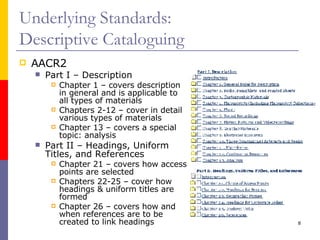
Underlying Standards: Descriptive Cataloguing AACR2 Part I – Description Chapter 1 – covers description in general and is applicable to all types of materials Chapters 2-12 – cover in detail various types of materials Chapter 13 – covers a special topic: analysis Part II – Headings, Uniform Titles, and References Chapter 21 – covers how access points are selected Chapters 22-25 – cover how headings & uniform titles are formed Chapter 26 – covers how and when references are to be created to link headings
Underlying Standards: Subject Cataloguing Subject Headings Controlled list of subject concept term or phrase  used in catalogue records to: Identify pertinent material on a given subject Enable user to find material on related subjects E.g., Library of Congress Subject Headings Classification Provides orderly access to the shelves by bringing related items together in a helpful sequence from the general to the specific E.g., Library of Congress Classification Scheme
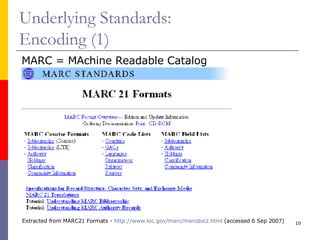
Underlying Standards: Encoding (1) Extracted from MARC21 Formats -  http://www.loc.gov/marc/marcdocz.html  (accessed 6 Sep 2007) MARC = MAchine Readable Catalog
Underlying Standards: Encoding (2) Understanding MARC Bibliographic http://www.loc.gov/marc/umb/  (accessed 6 Sep 2007) Part III: MARC Terms and Their Definitions  ( http://www.loc.gov/marc/umb/um01to06.html#part3 ) Part VII: A Summary of Commonly Used MARC21 Fields  ( http://www.loc.gov/marc/umb/um07to10.html#part7 ) Part XI: A Sample Record in Various Formats  ( http://www.loc.gov/marc/umb/um11to12.html#part11 )
Problems with TLC Complex search interface Not consistent with user interface conventions Unable to rank results by relevancy Limited in scope Tied more to print materials Unable to deliver online content Lack social network features
Next-Generation  Library Catalogue
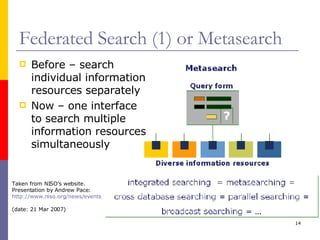
Federated Search (1) or Metasearch Before – search individual information resources separately Now – one interface to search multiple information resources simultaneously Taken from NISO’s website. Presentation by Andrew Pace:  http://www.niso.org/news/events_workshops/OpenURL-05-ppts/2-1-pace.ppt   (date: 21 Mar 2007)
Federated Search (2) How it works? Back-end communication through search protocols to send query and receive results ANSI/NISO Z39.50  ( http://www.loc.gov/z3950/agency/ ) XML Others Front-end processing and presentation of result sets Presenting results in a standard format and structure De-duplication – i.e. consolidation of identical entries from multiple targets Sorting and display Sample Site
Federated Search (3) Issues Speed of performance limited by slowest responding target Time-outs Minimal no. of targets Limiting no. of items requested Sorting & ranking Based on initial set of records retrieved Separate from the Library Catalogue
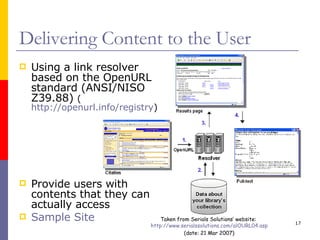
Delivering Content to the User Using a link resolver based on the OpenURL standard (ANSI/NISO Z39.88)  ( http://openurl.info/registry ) Provide users with contents that they can actually access Sample Site Taken from Serials Solutions’ website:  http://www.serialssolutions.com/alOURL04.asp   (date: 21 Mar 2007)
Enriched Content Contents include: Cover art images, such as book jackets, movie cases, etc. Table of contents MARC or Non-MARC Searchable or Not Summaries Reviews Sources: Syndetic Solutions  ( http://www.syndetics.com )
Faceted Navigation Using facets to narrow down results Facets derived from bibliographic information in the Library Catalogue Visual appeal Sample Sites
Web 2.0:  Enabling User Contributions User ratings & reviews Expressing opinions regarding works in the catalogue User tagging Assigning informal terms to items of interest “ Folksonomy” as a supplement to traditional subject headings provided by libraries Blogs & RSS Means to deliver information to users Lists of new items Lists of relevant items Sample Sites
Other Features Keyword Searching Google-like simple search box Relevancy Most important items appear first followed by those of diminishing relevancy “Did you mean …?” Detect common spelling errors Suggest a term that will work Recommendations “Users that borrowed X also borrowed Y”
Putting Them All Together New discovery & delivery interface providing access to all of the content and services offered by a Library Through harvesting additional contents into local index Through incorporating federated-search into interface Interface characteristics Simple search box AJAX technology to dynamically request and present additional information without having to redisplay the entire page Incorporate features such as Relevancy ranking, Popular choices, Faceted navigation, Tag cloud, “Did you mean …?”, User-contributed content, Enriched content, etc. Sample Site
Q & A Thank you! Tan Kah Ching Senior Librarian Automation & Asset Organisation NUS Libraries [email_address]

Library Catalogues: from Traditional to Next-Generation

  • 1.
    CS3255 Information OrganizationLecture 5: Library Catalogues: From Traditional to Next-Generation
  • 2.
    References Breeding, Marshall,“Next-Generation Library Catalogs,” Library Technology Reports , v.43, n.4 (Jul/Aug 2007), available online at http://www.techsource.ala.org/ltr/ (accessed 11 Sep 2007) Taylor, Arlene G., Introduction to Cataloging and Classification , 10 th ed. Westport, Conn. : Libraries Unlimited, 2006. Furrie, Betty, Understanding MARC Bibliographic: Machine-Readable Catalogs , 7 th ed. Washington, D.C. : Cataloging Distribution Services, Library of Congress, in conjunction with The Follett Software Co., c2003, available online at http://www.loc.gov/marc/umb/ (accessed 11 Sep 2007)
  • 3.
    Today’s Agenda TraditionalLibrary Catalogue Scope of the Library Catalogue Purpose of the Library Catalogue Underlying Standards Problems with TLC Next-Generation Library Catalogue Federated Search or Metasearch Delivering Content to the User Enriched Content Faceted Navigation Web 2.0: Enabling User Contributions Other Features Putting Them All Together Q&A
  • 4.
  • 5.
    Scope of theLibrary Catalogue Books – includes print and electronic books Multimedia materials – CDs, DVDs, etc. Newspapers, magazines, and professional & scholarly journals – described at title level, not individual issues/articles Others – such as musical scores, microfilms, etc.
  • 6.
    Purpose of theLibrary Catalogue 4 user tasks: To find entities that correspond to the user’s stated search criteria … To identify an entity … To select an entity that is appropriate to the user’s needs … To acquire or obtain access to the entity described … Extracted from: Functional Requirements for Bibliographic Records, Final Report , IFLA Study Group on the Functional Requirements for Bibliographic Records (Munchen: K.G. Saur, 1998); also available: http://www.ifla.org/VII/s13/frbr/frbr.htm (accessed 6 Sep 2007).
  • 7.
    Underlying Standards DescriptiveCataloguing: AACR2 (Anglo-American Cataloging Rules, version 2) Subject Cataloguing: Library of Congress Subject Headings Library of Congress Classification Scheme Encoding: MARC21 (MAchine Readable Cataloging) – Bibliographic, Authority, Holdings, Classification & Community
  • 8.
    Underlying Standards: DescriptiveCataloguing AACR2 Part I – Description Chapter 1 – covers description in general and is applicable to all types of materials Chapters 2-12 – cover in detail various types of materials Chapter 13 – covers a special topic: analysis Part II – Headings, Uniform Titles, and References Chapter 21 – covers how access points are selected Chapters 22-25 – cover how headings & uniform titles are formed Chapter 26 – covers how and when references are to be created to link headings
  • 9.
    Underlying Standards: SubjectCataloguing Subject Headings Controlled list of subject concept term or phrase used in catalogue records to: Identify pertinent material on a given subject Enable user to find material on related subjects E.g., Library of Congress Subject Headings Classification Provides orderly access to the shelves by bringing related items together in a helpful sequence from the general to the specific E.g., Library of Congress Classification Scheme
  • 10.
    Underlying Standards: Encoding(1) Extracted from MARC21 Formats - http://www.loc.gov/marc/marcdocz.html (accessed 6 Sep 2007) MARC = MAchine Readable Catalog
  • 11.
    Underlying Standards: Encoding(2) Understanding MARC Bibliographic http://www.loc.gov/marc/umb/ (accessed 6 Sep 2007) Part III: MARC Terms and Their Definitions ( http://www.loc.gov/marc/umb/um01to06.html#part3 ) Part VII: A Summary of Commonly Used MARC21 Fields ( http://www.loc.gov/marc/umb/um07to10.html#part7 ) Part XI: A Sample Record in Various Formats ( http://www.loc.gov/marc/umb/um11to12.html#part11 )
  • 12.
    Problems with TLCComplex search interface Not consistent with user interface conventions Unable to rank results by relevancy Limited in scope Tied more to print materials Unable to deliver online content Lack social network features
  • 13.
  • 14.
    Federated Search (1)or Metasearch Before – search individual information resources separately Now – one interface to search multiple information resources simultaneously Taken from NISO’s website. Presentation by Andrew Pace: http://www.niso.org/news/events_workshops/OpenURL-05-ppts/2-1-pace.ppt (date: 21 Mar 2007)
  • 15.
    Federated Search (2)How it works? Back-end communication through search protocols to send query and receive results ANSI/NISO Z39.50 ( http://www.loc.gov/z3950/agency/ ) XML Others Front-end processing and presentation of result sets Presenting results in a standard format and structure De-duplication – i.e. consolidation of identical entries from multiple targets Sorting and display Sample Site
  • 16.
    Federated Search (3)Issues Speed of performance limited by slowest responding target Time-outs Minimal no. of targets Limiting no. of items requested Sorting & ranking Based on initial set of records retrieved Separate from the Library Catalogue
  • 17.
    Delivering Content tothe User Using a link resolver based on the OpenURL standard (ANSI/NISO Z39.88) ( http://openurl.info/registry ) Provide users with contents that they can actually access Sample Site Taken from Serials Solutions’ website: http://www.serialssolutions.com/alOURL04.asp (date: 21 Mar 2007)
  • 18.
    Enriched Content Contentsinclude: Cover art images, such as book jackets, movie cases, etc. Table of contents MARC or Non-MARC Searchable or Not Summaries Reviews Sources: Syndetic Solutions ( http://www.syndetics.com )
  • 19.
    Faceted Navigation Usingfacets to narrow down results Facets derived from bibliographic information in the Library Catalogue Visual appeal Sample Sites
  • 20.
    Web 2.0: Enabling User Contributions User ratings & reviews Expressing opinions regarding works in the catalogue User tagging Assigning informal terms to items of interest “ Folksonomy” as a supplement to traditional subject headings provided by libraries Blogs & RSS Means to deliver information to users Lists of new items Lists of relevant items Sample Sites
  • 21.
    Other Features KeywordSearching Google-like simple search box Relevancy Most important items appear first followed by those of diminishing relevancy “Did you mean …?” Detect common spelling errors Suggest a term that will work Recommendations “Users that borrowed X also borrowed Y”
  • 22.
    Putting Them AllTogether New discovery & delivery interface providing access to all of the content and services offered by a Library Through harvesting additional contents into local index Through incorporating federated-search into interface Interface characteristics Simple search box AJAX technology to dynamically request and present additional information without having to redisplay the entire page Incorporate features such as Relevancy ranking, Popular choices, Faceted navigation, Tag cloud, “Did you mean …?”, User-contributed content, Enriched content, etc. Sample Site
  • 23.
    Q & AThank you! Tan Kah Ching Senior Librarian Automation & Asset Organisation NUS Libraries [email_address]