SHARE-BASED
PAYMENTS
Share-based Compensation Plans
Share-based compensation plan is an arrangement
whereby an employee is given compensation in return for
services rendered in the form of the entity’s equity
instruments or cash based on the fair value of the entity’s
equity instruments or a choice of settlement between
equity instrument and cash. Examples:
• Employee share options (equity-settled)
• Employee share appreciation rights (cash settled)
• Compensation plans with a choice of settlement between
(1) and (2) above
Scope of PFRS 2
1. Equity-settled share-based payment transaction – is a
transaction whereby an entity acquires goods or services
and instead of paying in cash the entity issues its own
shares of stocks or share options; or
2. Cash-settled share-based payment transaction – is a
transaction whereby an entity acquires goods or services
and incurs an obligation to pay cash at an amount that is
based on the fair value of equity instruments; or
3. Choice between equity-settled and cash-settled
Definition of Terms
Equity instrument granted is the right (conditional or unconditional) to an equity instrument of the entity
conferred by the entity on another party under a share-based payment arrangement.
Share option is a contract that gives the holder the right, but not the obligation, to subscribe to the entity’s
shares at a fixed or determinable price for a specified period of time. Some share options given to employees
may not require any subscription price, meaning shares will be issued to the employees in consideration
merely for services rendered.
Measurement date is the date at which the fair value of the equity instruments granted is measured for the
purposes of PFRS 2.
a. For transactions with non-employees, the measurement date is the date when the entity receives the
good or service.
b. For transactions with employees and others providing similar services, the measurement date is grant
date.
Grant date is the date at which the entity and the counterparty agree to a share-based payment arrangement,
being when the entity and the counterparty have a shared understanding of the terms and conditions of the
arrangement.
Intrinsic value is the difference between the fair value of the shares to which the counterparty has the
conditional or unconditional right to subscribe or the right to receive and the subscription price (if any) that
the counterparty is required to pay for those shares.
Definition of Terms
Performance condition is a vesting condition that requires:
a. The counterparty to complete a specified period of service
b. Specified performance targets to be met
The period of achieving the performance targets:
a. Shall not exceed beyond the end of the service period
b. May start before the service period on the condition that the commencement date of the performance target
is not substantially before the commencement of the service period
A performance target is defined by reference to:
a. The entity’s own operations or the operations or activities of another entity in the same group (includes
shares and share options; also known as non-market condition)
b. The price of the entity’s equity instruments or the equity instruments of another entity in the same group
(includes shares and share options; also known as market condition)
Service condition is a vesting condition that requires the counterparty to complete a specified period of
service during which services are provided to the entity.
Vest means to become an entitlement. Under a share-based payment arrangement, a counterparty’s right to
receive cash, other assets, or equity instruments of the entity vests when the counterparty’s entitlement is no
longer conditional on the satisfaction of any vesting condition.
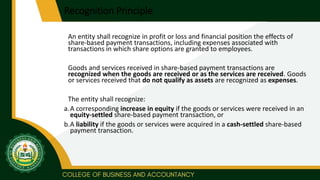
Recognition Principle
An entity shall recognize in profit or loss and financial position the effects of
share-based payment transactions, including expenses associated with
transactions in which share options are granted to employees.
Goods and services received in share-based payment transactions are
recognized when the goods are received or as the services are received. Goods
or services received that do not qualify as assets are recognized as expenses.
The entity shall recognize:
a.A corresponding increase in equity if the goods or services were received in an
equity-settled share-based payment transaction, or
b.A liability if the goods or services were acquired in a cash-settled share-based
payment transaction.
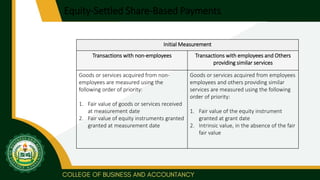
Equity-Settled Share-Based Payments
Initial Measurement
Transactions with non-employees Transactions with employees and Others
providing similar services
Goods or services acquired from non-
employees are measured using the
following order of priority:
1. Fair value of goods or services received
at measurement date
2. Fair value of equity instruments granted
granted at measurement date
Goods or services acquired from employees
employees and others providing similar
services are measured using the following
order of priority:
1. Fair value of the equity instrument
granted at grant date
2. Intrinsic value, in the absence of the fair
fair value
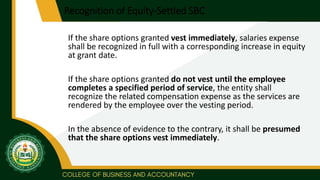
Recognition of Equity-Settled SBC
If the share options granted vest immediately, salaries expense
shall be recognized in full with a corresponding increase in equity
at grant date.
If the share options granted do not vest until the employee
completes a specified period of service, the entity shall
recognize the related compensation expense as the services are
rendered by the employee over the vesting period.
In the absence of evidence to the contrary, it shall be presumed
that the share options vest immediately.
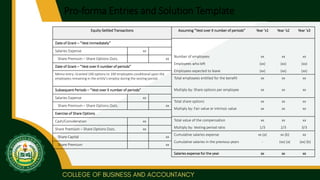
Pro-forma Entries and Solution Template
Assuming “Vest over X number of periods” Year ‘x1 Year ‘x2 Year ‘x3
Number of employees xx xx xx
Employees who left (xx) (xx) (xx)
Employees expected to leave (xx) (xx) (xx)
Total employees entitled for the benefit xx xx xx
Multiply by: Share options per employee xx xx xx
Total share options xx xx xx
Multiply by: Fair value or intrinsic value xx xx xx
Total value of the compensation xx xx xx
Multiply by: Vesting period ratio 1/3 2/3 3/3
Cumulative salaries expense xx (a) xx (b) xx
Cumulative salaries in the previous years - (xx) (a) (xx) (b)
Salaries expense for the year xx xx xx
Equity-Settled Transactions
Date of Grant – “Vest immediately”
Salaries Expense xx
Share Premium – Share Options Outs. xx
Date of Grant – “Vest over X number of periods”
Memo entry: Granted 100 options to 100 employees conditional upon the
employees remaining in the entity’s employ during the vesting period.
Subsequent Periods – “Vest over X number of periods”
Salaries Expense xx
Share Premium – Share Options Outs. xx
Exercise of Share Options
Cash/Consideration xx
Share Premium – Share Options Outs. xx
Share Capital xx
Share Premium xx
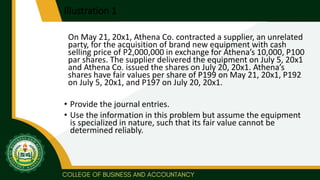
Illustration 1
On May 21, 20x1, Athena Co. contracted a supplier, an unrelated
party, for the acquisition of brand new equipment with cash
selling price of P2,000,000 in exchange for Athena’s 10,000, P100
par shares. The supplier delivered the equipment on July 5, 20x1
and Athena Co. issued the shares on July 20, 20x1. Athena’s
shares have fair values per share of P199 on May 21, 20x1, P192
on July 5, 20x1, and P197 on July 20, 20x1.
• Provide the journal entries.
• Use the information in this problem but assume the equipment
is specialized in nature, such that its fair value cannot be
determined reliably.
Illustration 1
May. 21,
20x1 No entry
July 5,
20x1
Equipment (cash selling price)
Subscribed capital (10,000 x ₱100)
Share premium
2,000,000
1,000,000
1,000,000
July 21,
20x1
Subscribed capital
Share capital
1,000,000
1,000,000
May. 21,
20x1
No entry
July 5,
20x1
Equipment (10,000 x ₱192)
Subscribed capital (10,000 x ₱100)
Share premium
1,920,000
1,000,000
920,000
July 21,
20x1
Subscribed capital
Share capital
1,000,000
1,000,000
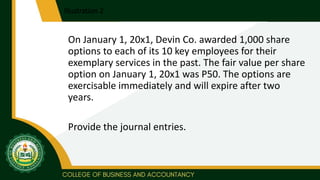
Illustration 2
On January 1, 20x1, Devin Co. awarded 1,000 share
options to each of its 10 key employees for their
exemplary services in the past. The fair value per share
option on January 1, 20x1 was P50. The options are
exercisable immediately and will expire after two
years.
Provide the journal entries.
Illustration 2
Jan. 1,
20x1
Salaries expense (1,000 x 10 x ₱50)
Share premium - sh. options outstanding
500,000
500,000
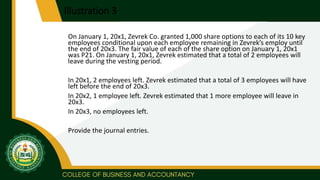
Illustration 3
On January 1, 20x1, Zevrek Co. granted 1,000 share options to each of its 10 key
employees conditional upon each employee remaining in Zevrek’s employ until
the end of 20x3. The fair value of each of the share option on January 1, 20x1
was P21. On January 1, 20x1, Zevrek estimated that a total of 2 employees will
leave during the vesting period.
In 20x1, 2 employees left. Zevrek estimated that a total of 3 employees will have
left before the end of 20x3.
In 20x2, 1 employee left. Zevrek estimated that 1 more employee will leave in
20x3.
In 20x3, no employees left.
Provide the journal entries.
Illustration 3
Jan. 1,
20x1
Memo entry
Dec. 31,
20x1
Salaries expense – share options
(10 – 3) x 1,000 x 21 x 1/3
Share premium – sh. options outstanding
49,000
49,000
Dec. 31,
20x2
Salaries expense – share options
[(10 – 2 – 1 - 1) x 1,000 x 21 x 2/3] – 49,000
Share premium – sh. options outstanding
35,000
35,000
Dec. 31,
20x3
Salaries expense – share options
[(10 - 2 - 1 - 0) x 1,000 x 21 x 3/3] - 49K - 35K
Share premium – sh. options outstanding
63,000
63,000
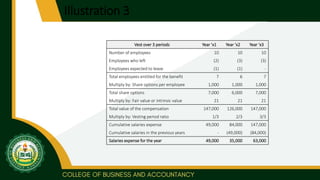
Illustration 3
Vest over 3 periods Year ‘x1 Year ‘x2 Year ‘x3
Number of employees 10 10 10
Employees who left (2) (3) (3)
Employees expected to leave (1) (1) -
Total employees entitled for the benefit 7 6 7
Multiply by: Share options per employee 1,000 1,000 1,000
Total share options 7,000 6,000 7,000
Multiply by: Fair value or intrinsic value 21 21 21
Total value of the compensation 147,000 126,000 147,000
Multiply by: Vesting period ratio 1/3 2/3 3/3
Cumulative salaries expense 49,000 84,000 147,000
Cumulative salaries in the previous years - (49,000) (84,000)
Salaries expense for the year 49,000 35,000 63,000
Illustration 4
On January 1, 20x1, John Co. granted 1,000 share options to each of its 10 key employees
conditional upon each employee completing a 3-year service. The exercise price is P100; however,
this amount decreases to P50 if the company’s sales increase at an average of at least 20% over
the 3-year period. The following were the fair value estimates:
a. If the exercise price is P100, the fair value per share option is P21.
b. If the exercise price is P50, the fair value per share option is P71.
In 20x1, sales increased by 18% and 1 employee left. Two more employees are expected to leave
before the end of 20x3.
In 20x2, sales increased by 19%. No employees left but it was still expected that 2 more
employees will leave.
In 20x3, the sales increased by 23% and 1 employee left.
Provide the journal entries.
Illustration 4
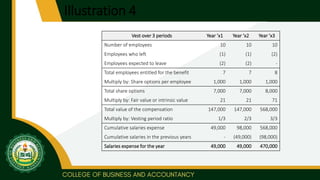
Vest over 3 periods Year ‘x1 Year ‘x2 Year ‘x3
Number of employees 10 10 10
Employees who left (1) (1) (2)
Employees expected to leave (2) (2) -
Total employees entitled for the benefit 7 7 8
Multiply by: Share options per employee 1,000 1,000 1,000
Total share options 7,000 7,000 8,000
Multiply by: Fair value or intrinsic value 21 21 71
Total value of the compensation 147,000 147,000 568,000
Multiply by: Vesting period ratio 1/3 2/3 3/3
Cumulative salaries expense 49,000 98,000 568,000
Cumulative salaries in the previous years - (49,000) (98,000)
Salaries expense for the year 49,000 49,000 470,000
Illustration 4
Jan. 1,
20x1
Memo entry
Dec. 31,
20x1
Salaries expense – share options
(10 – 1 - 2) x 1,000 x 21 x 1/3
Share premium – sh. options outstanding
49,000
49,000
Dec. 31,
20x2
Salaries expense – share options
[(10 – 1 – 0 - 2) x 1,000 x 21 x 2/3] – 49,000
Share premium – sh. options outstanding
49,000
49,000
Dec. 31,
20x3
Salaries expense – share options
[(10 – 1 – 0 - 1) x 1,000 x 71 x 3/3] – 49K – 49K
Share premium – sh. options outstanding
470,000
470,000
Illustration 5
On January 1, 20x1, John Co. granted 1,000 share options to each of its 10 key
employees conditional upon each employee completing a 3-year service and the
company’s share price increasing to at least P100 by the end of 20x3. The fair
value per share option on January 1, 20x1, after considering both the
possibilities that the share price target will and will not be achieved, was P21.
In 20x1, the year-end share price was P90 and 1 employee left. One more
employee was expected to leave before the end of 20x3.
In 20x2, the year-end share price was P99 and 1 employee left. The entity
estimated that, in total, 3 employees will have left before the end of 20x3.
In 20x3, the year-end share price was P89. No employee left.
Provide the journal entries.
Illustration 5
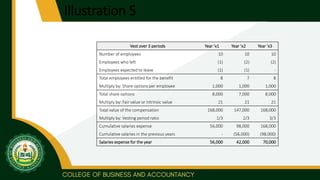
Vest over 3 periods Year ‘x1 Year ‘x2 Year ‘x3
Number of employees 10 10 10
Employees who left (1) (2) (2)
Employees expected to leave (1) (1) -
Total employees entitled for the benefit 8 7 8
Multiply by: Share options per employee 1,000 1,000 1,000
Total share options 8,000 7,000 8,000
Multiply by: Fair value or intrinsic value 21 21 21
Total value of the compensation 168,000 147,000 168,000
Multiply by: Vesting period ratio 1/3 2/3 3/3
Cumulative salaries expense 56,000 98,000 168,000
Cumulative salaries in the previous years - (56,000) (98,000)
Salaries expense for the year 56,000 42,000 70,000
Illustration 5
Jan. 1, 20x1 Memo entry
Dec. 31,
20x1
Salaries expense – share options
(10 – 1 - 1) x 1,000 x 21 x 1/3
Share premium – sh. options outstanding
56,000
56,000
Dec. 31,
20x2
Salaries expense – share options
[(10 – 3) x 1,000 x 21 x 2/3] – 56,000
Share premium – sh. options outstanding
42,000
42,000
Dec. 31,
20x3
Salaries expense – share options
[(10 – 1 – 1 - 0) x 1,000 x 21 x 3/3] – 56K – 42K
Share premium – sh. options outstanding
70,000
70,000
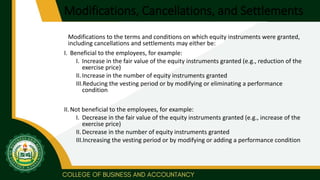
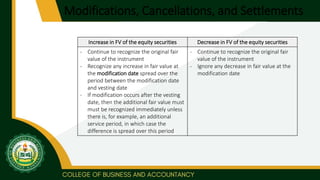
Modifications, Cancellations, and Settlements
Modifications to the terms and conditions on which equity instruments were granted,
including cancellations and settlements may either be:
I. Beneficial to the employees, for example:
I. Increase in the fair value of the equity instruments granted (e.g., reduction of the
exercise price)
II.Increase in the number of equity instruments granted
III.Reducing the vesting period or by modifying or eliminating a performance
condition
II.Not beneficial to the employees, for example:
I. Decrease in the fair value of the equity instruments granted (e.g., increase of the
exercise price)
II.Decrease in the number of equity instruments granted
III.Increasing the vesting period or by modifying or adding a performance condition
Modifications, Cancellations, and Settlements
Increase in FV of the equity securities Decrease in FV of the equity securities
- Continue to recognize the original fair
value of the instrument
- Recognize any increase in fair value at
the modification date spread over the
period between the modification date
and vesting date
- If modification occurs after the vesting
date, then the additional fair value must
must be recognized immediately unless
there is, for example, an additional
service period, in which case the
difference is spread over this period
- Continue to recognize the original fair
value of the instrument
- Ignore any decrease in fair value at the
modification date
Modifications, Cancellations, and Settlements
Increase in the number of equity securities Decrease in the number of equity securities
- Continue to recognize the original fair value of
of the instrument
- Recognize any increase in the number of
instruments granted at the modification date
spread over the period between the
modification date and vesting date
- If modification occurs after the vesting date,
then the additional number of instruments
must be recognized immediately unless there
is, for example, an additional service period, in
in which case the difference is spread over
this period
- Accounted for as a cancellation of that portion
portion of the grant
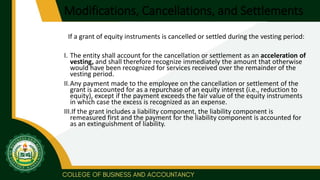
Modifications, Cancellations, and Settlements
If a grant of equity instruments is cancelled or settled during the vesting period:
I. The entity shall account for the cancellation or settlement as an acceleration of
vesting, and shall therefore recognize immediately the amount that otherwise
would have been recognized for services received over the remainder of the
vesting period.
II.Any payment made to the employee on the cancellation or settlement of the
grant is accounted for as a repurchase of an equity interest (i.e., reduction to
equity), except if the payment exceeds the fair value of the equity instruments
in which case the excess is recognized as an expense.
III.If the grant includes a liability component, the liability component is
remeasured first and the payment for the liability component is accounted for
as an extinguishment of liability.
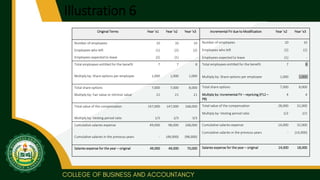
Illustration 6
On January 1, 20x1, John Co. granted 1,000 share options to each of its 10 key
employees conditional upon each employee completing a 3-year service. The
fair value per share option on January 1, 20x1 was P21.
In 20x1, 1 employee left. On December 31, 20x1, the share price has dropped,
and John Co. repriced the share options. The fair value per share option before
the repricing was P8, while the fair value after the repricing was P12. The
repriced share options will vest at the end of 20x3. John Co. estimated that an
additional 2 employees will leave in the next two years.
In 20x2, one employee left. John Co. continues to estimate the employee
departures at a total of three.
In 20x3, no employee left.
Provide the journal entries.
Illustration 6
Original Terms Year ‘x1 Year ‘x2 Year ‘x3
Number of employees 10 10 10
Employees who left (1) (2) (2)
Employees expected to leave (2) (1) -
Total employees entitled for the benefit 7 7 8
Multiply by: Share options per employee 1,000 1,000 1,000
Total share options 7,000 7,000 8,000
Multiply by: Fair value or intrinsic value 21 21 21
Total value of the compensation 147,000 147,000 168,000
Multiply by: Vesting period ratio 1/3 2/3 3/3
Cumulative salaries expense 49,000 98,000 168,000
Cumulative salaries in the previous years - (49,000) (98,000)
Salaries expense for the year – original 49,000 49,000 70,000
Incremental FV due to Modification Year ‘x2 Year ‘x3
Number of employees 10 10
Employees who left (2) (2)
Employees expected to leave (1) -
Total employees entitled for the benefit 7 8
Multiply by: Share options per employee 1,000 1,000
Total share options 7,000 8,000
Multiply by: Incremental FV – repricing (P12 –
P8)
4 4
Total value of the compensation 28,000 32,000
Multiply by: Vesting period ratio 1/2 2/2
Cumulative salaries expense 14,000 32,000
Cumulative salaries in the previous years - (14,000)
Salaries expense for the year – original 14,000 18,000
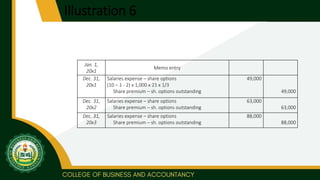
Illustration 6
Jan. 1,
20x1
Memo entry
Dec. 31,
20x1
Salaries expense – share options
(10 – 1 - 2) x 1,000 x 21 x 1/3
Share premium – sh. options outstanding
49,000
49,000
Dec. 31,
20x2
Salaries expense – share options
Share premium – sh. options outstanding
63,000
63,000
Dec. 31,
20x3
Salaries expense – share options
Share premium – sh. options outstanding
88,000
88,000
Illustration 7
On January 1, 20x1, John Co. granted 1,000 share options to each of its 10 key
employees conditional upon each employee completing a 3-year service. The fair value
per share option on January 1, 20x1 was P21.
In 20x1, 1 employee left. On December 31, 20x1, the share price has dropped, and John
Co. repriced the share options and added an exercise price of P20. The fair value per
share option before the repricing was P8, while the fair value after the repricing was P2.
The repriced share options will vest at the end of 20x3. John Co. estimated that an
additional 2 employees will leave in the next two years.
In 20x2, one employee left. John Co. continues to estimate the employee departures at
a total of three.
In 20x3, no employee left.
Provide the journal entries.
Illustration 7
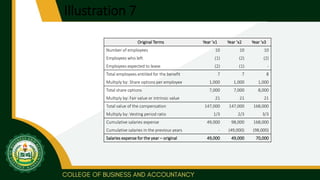
Original Terms Year ‘x1 Year ‘x2 Year ‘x3
Number of employees 10 10 10
Employees who left (1) (2) (2)
Employees expected to leave (2) (1) -
Total employees entitled for the benefit 7 7 8
Multiply by: Share options per employee 1,000 1,000 1,000
Total share options 7,000 7,000 8,000
Multiply by: Fair value or intrinsic value 21 21 21
Total value of the compensation 147,000 147,000 168,000
Multiply by: Vesting period ratio 1/3 2/3 3/3
Cumulative salaries expense 49,000 98,000 168,000
Cumulative salaries in the previous years - (49,000) (98,000)
Salaries expense for the year – original 49,000 49,000 70,000
Illustration 7
Jan. 1,
20x1
Memo entry
Dec. 31,
20x1
Salaries expense – share options
(10 – 1 - 2) x 1,000 x 21 x 1/3
Share premium – sh. options outstanding
49,000
49,000
Dec. 31,
20x2
Salaries expense – share options
[(10 – 3) x 1,000 x 21 x 2/3] – 49,000
Share premium – sh. options outstanding
49,000
49,000
Dec. 31,
20x3
Salaries expense – share options
[(10 – 1 – 1 - 0) x 1,000 x 21 x 3/3] – 49K – 49K
Share premium – sh. options outstanding
70,000
70,000
Illustration 8
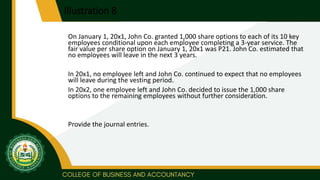
On January 1, 20x1, John Co. granted 1,000 share options to each of its 10 key
employees conditional upon each employee completing a 3-year service. The
fair value per share option on January 1, 20x1 was P21. John Co. estimated that
no employees will leave in the next 3 years.
In 20x1, no employee left and John Co. continued to expect that no employees
will leave during the vesting period.
In 20x2, one employee left and John Co. decided to issue the 1,000 share
options to the remaining employees without further consideration.
Provide the journal entries.
Illustration 8
Jan. 1,
20x1
Memo entry
Dec. 31,
20x1
Salaries expense – share options
(10 – 0) x 1,000 x 21 x 1/3
Share premium – sh. options outstanding
70,000
70,000
Dec. 31,
20x2
Salaries expense – share options
[(10 – 1) x 1,000 x 21] – 70,000
Share premium – sh. options outstanding
119,000
119,000
Illustration 9
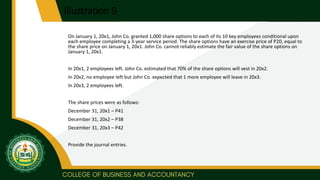
On January 1, 20x1, John Co. granted 1,000 share options to each of its 10 key employees conditional upon
each employee completing a 3-year service period. The share options have an exercise price of P20, equal to
the share price on January 1, 20x1. John Co. cannot reliably estimate the fair value of the share options on
January 1, 20x1.
In 20x1, 2 employees left. John Co. estimated that 70% of the share options will vest in 20x2.
In 20x2, no employee left but John Co. expected that 1 more employee will leave in 20x3.
In 20x3, 2 employees left.
The share prices were as follows:
December 31, 20x1 – P41
December 31, 20x2 – P38
December 31, 20x3 – P42
Provide the journal entries.
Illustration 9
Jan. 1, 20x1 Memo entry
Dec. 31,
20x1
Salaries expense – share options
[10 x 1,000 x 70% x (41 – 20) x 1/3]
Share premium – sh. options outstanding
49,000
49,000
Dec. 31,
20x2
Salaries expense – share options
[(10 – 2 – 0 – 1) x 1,000 x (38 – 20) x 2/3] – 49K
Share premium – sh. options outstanding
35,000
35,000
Dec. 31,
20x3
Salaries expense – share options
[(10 – 2 – 0 – 2) x 1,000 x (42 – 20) x 3/3] – 49K – 35K
Share premium – sh. options outstanding
48,000
48,000
Cash-Settled Share-Based Payments
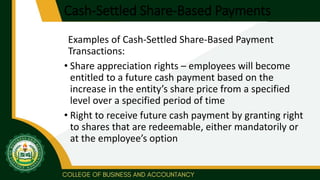
Examples of Cash-Settled Share-Based Payment
Transactions:
• Share appreciation rights – employees will become
entitled to a future cash payment based on the
increase in the entity’s share price from a specified
level over a specified period of time
• Right to receive future cash payment by granting right
to shares that are redeemable, either mandatorily or
at the employee’s option
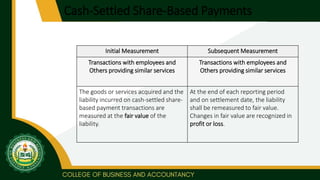
Cash-Settled Share-Based Payments
Initial Measurement Subsequent Measurement
Transactions with employees and
Others providing similar services
Transactions with employees and
Others providing similar services
The goods or services acquired and the
liability incurred on cash-settled share-
based payment transactions are
measured at the fair value of the
liability.
At the end of each reporting period
and on settlement date, the liability
shall be remeasured to fair value.
Changes in fair value are recognized in
profit or loss.
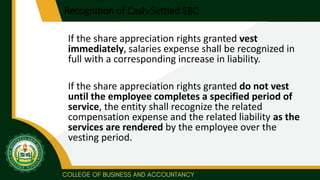
Recognition of Cash-Settled SBC
If the share appreciation rights granted vest
immediately, salaries expense shall be recognized in
full with a corresponding increase in liability.
If the share appreciation rights granted do not vest
until the employee completes a specified period of
service, the entity shall recognize the related
compensation expense and the related liability as the
services are rendered by the employee over the
vesting period.
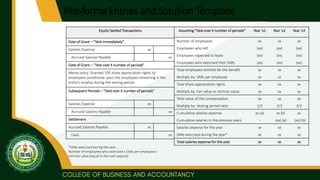
Pro-forma Entries and Solution Template
Assuming “Vest over X number of periods” Year ‘x1 Year ‘x2 Year ‘x3
Number of employees xx xx xx
Employees who left (xx) (xx) (xx)
Employees expected to leave (xx) (xx) (xx)
Employees who exercised their SARs (xx) (xx) (xx)
Total employees entitled for the benefit xx xx xx
Multiply by: SARs per employee xx xx xx
Total share appreciation rights xx xx xx
Multiply by: Fair value or intrinsic value xx xx xx
Total value of the compensation xx xx xx
Multiply by: Vesting period ratio 1/3 2/3 3/3
Cumulative salaries expense xx (a) xx (b) xx
Cumulative salaries in the previous years - (xx) (a) (xx) (b)
Salaries expense for the year xx xx xx
SARs exercised during the year* xx xx xx
Total salaries expense for the year xx xx xx
Equity-Settled Transactions
Date of Grant – “Vest immediately”
Salaries Expense xx
Accrued Salaries Payable xx
Date of Grant – “Vest over X number of periods”
Memo entry: Granted 100 share appreciation rights to
employees conditional upon the employees remaining in the
entity’s employ during the vesting period.
Subsequent Periods – “Vest over X number of periods”
Salaries Expense xx
Accrued Salaries Payable xx
Settlement
Accrued Salaries Payable xx
Cash xx
*SARs exercised during the year:
Number of employees who exercised x SARs per employee x
intrinsic value (equal to the cash payout)
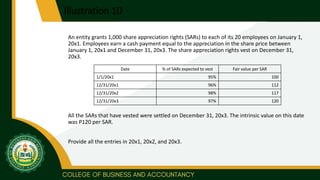
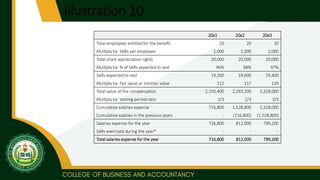
Illustration 10
An entity grants 1,000 share appreciation rights (SARs) to each of its 20 employees on January 1,
20x1. Employees earn a cash payment equal to the appreciation in the share price between
January 1, 20x1 and December 31, 20x3. The share appreciation rights vest on December 31,
20x3.
All the SARs that have vested were settled on December 31, 20x3. The intrinsic value on this date
was P120 per SAR.
Provide all the entries in 20x1, 20x2, and 20x3.
Date % of SARs expected to vest Fair value per SAR
1/1/20x1 95% 100
12/31/20x1 96% 112
12/31/20x2 98% 117
12/31/20x3 97% 120
Illustration 10
20x1 20x2 20x3
Total employees entitled for the benefit 20 20 20
Multiply by: SARs per employee 1,000 1,000 1,000
Total share appreciation rights 20,000 20,000 20,000
Multiply by: % of SARs expected to vest 96% 98% 97%
SARs expected to vest 19,200 19,600 19,400
Multiply by: Fair value or intrinsic value 112 117 120
Total value of the compensation 2,150,400 2,293,200 2,328,000
Multiply by: Vesting period ratio 1/3 2/3 3/3
Cumulative salaries expense 716,800 1,528,800 2,328,000
Cumulative salaries in the previous years - (716,800) (1,528,800)
Salaries expense for the year 716,800 812,000 799,200
SARs exercised during the year* - - -
Total salaries expense for the year 716,800 812,000 799,200
Illustration 10
Jan. 1, 20x1 Memo entry
Dec. 31, 20x1 Salaries expense (1,000 x 20 x 96% x 112 x 1/3)
Accrued salaries payable
716,800
716,800
Dec. 31, 20x2 Salaries expense (1,000 x 20 x 98% x 117 x 2/3) – 716,800
Accrued salaries payable
812,000
812,000
Dec. 31, 20x3 Salaries expense (1,000 x 20 x 97% x 120 x 3/3) – 716,800 – 812,000
Accrued salaries payable
799,200
799,200
Accrued salaries payable
Cash
2,328,000
2,328,000
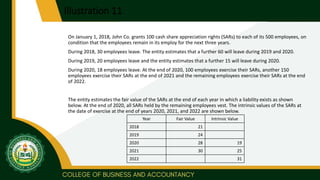
Illustration 11
On January 1, 2018, John Co. grants 100 cash share appreciation rights (SARs) to each of its 500 employees, on
condition that the employees remain in its employ for the next three years.
During 2018, 30 employees leave. The entity estimates that a further 60 will leave during 2019 and 2020.
During 2019, 20 employees leave and the entity estimates that a further 15 will leave during 2020.
During 2020, 18 employees leave. At the end of 2020, 100 employees exercise their SARs, another 150
employees exercise their SARs at the end of 2021 and the remaining employees exercise their SARs at the end
of 2022.
The entity estimates the fair value of the SARs at the end of each year in which a liability exists as shown
below. At the end of 2020, all SARs held by the remaining employees vest. The intrinsic values of the SARs at
the date of exercise at the end of years 2020, 2021, and 2022 are shown below.
Year Fair Value Intrinsic Value
2018 21
2019 24
2020 28 19
2021 30 25
2022 31
Illustration 11
2018 2019 2020 2021 2022
Number of employees 500 500 500 500 500
Employees who left (30) (50) (68) (68) (68)
Employees expected to leave (60) (15) - - -
Employees who exercised their SARs - - (100) (250) (432)
Total employees entitled for the benefit 410 435 332 182 -
Multiply by: SARs per employee 100 100 100 100 100
Total share appreciation rights 41,000 43,500 33,200 18,200 -
Multiply by: Fair value or intrinsic value 21 24 28 30 -
Total value of the compensation 861,000 1,044,000 929,600 546,000 -
Multiply by: Vesting period ratio 1/3 2/3 3/3 1 1
Cumulative salaries expense 287,000 696,000 929,600 546,000 -
Cumulative salaries in the previous years - (287,000) (696,000) (929,600) (546,000)
Salaries expense for the year 287,000 409,000 233,600 (383,600) (546,000)
SARs exercised on 2020 (100 x 100 x 19) - - 190,000 - -
SARs exercised on 2021 (100 x 150 x 25) - - - 375,000 -
SARs exercised on 2022 (100 x 182 x 31) - - - - 564,200
Total salaries expense for the year 287,000 409,000 423,600 (8,600) 18,200
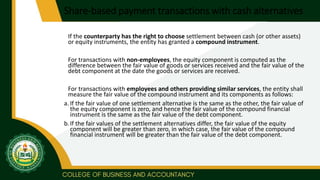
Share-based payment transactions with cash alternatives
If the counterparty has the right to choose settlement between cash (or other assets)
or equity instruments, the entity has granted a compound instrument.
For transactions with non-employees, the equity component is computed as the
difference between the fair value of goods or services received and the fair value of the
debt component at the date the goods or services are received.
For transactions with employees and others providing similar services, the entity shall
measure the fair value of the compound instrument and its components as follows:
a. If the fair value of one settlement alternative is the same as the other, the fair value of
the equity component is zero, and hence the fair value of the compound financial
instrument is the same as the fair value of the debt component.
b.If the fair values of the settlement alternatives differ, the fair value of the equity
component will be greater than zero, in which case, the fair value of the compound
financial instrument will be greater than the fair value of the debt component.
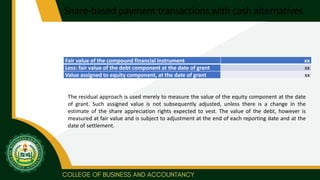
Share-based payment transactions with cash alternatives
Fair value of the compound financial instrument xx
Less: fair value of the debt component at the date of grant xx
Value assigned to equity component, at the date of grant xx
The residual approach is used merely to measure the value of the equity component at the date
of grant. Such assigned value is not subsequently adjusted, unless there is a change in the
estimate of the share appreciation rights expected to vest. The value of the debt, however is
measured at fair value and is subject to adjustment at the end of each reporting date and at the
date of settlement.
Share-based payment transactions with cash alternatives
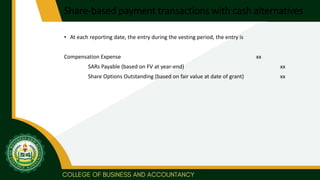
• At each reporting date, the entry during the vesting period, the entry is
Compensation Expense xx
SARs Payable (based on FV at year-end) xx
Share Options Outstanding (based on fair value at date of grant) xx
Share-based payment transactions with cash alternatives
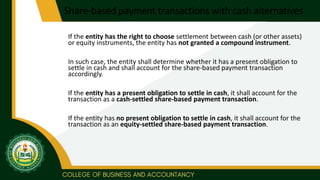
If the entity has the right to choose settlement between cash (or other assets)
or equity instruments, the entity has not granted a compound instrument.
In such case, the entity shall determine whether it has a present obligation to
settle in cash and shall account for the share-based payment transaction
accordingly.
If the entity has a present obligation to settle in cash, it shall account for the
transaction as a cash-settled share-based payment transaction.
If the entity has no present obligation to settle in cash, it shall account for the
transaction as an equity-settled share-based payment transaction.
Illustration
On January 1, 2020, an entity granted to its chief operations officer the
right to choose either 5,000 ordinary shares or to receive cash payment
equal to 4,000 shares. The grant is conditional upon completion of two
years of service. The entity estimates that the value of the share
alternative at the date of grant is P60 per share. Par value per share is P40.
The fair values per share at January 1, 2020, December 31, 2020, and
December 31, 2021 are P65, P68, and P72, respectively. The officer
exercised his rights on June 30, 2022 when the market price of each share
is P75.
Illustration
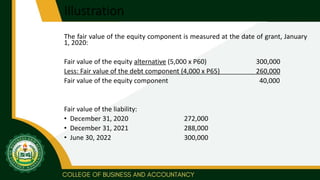
The fair value of the equity component is measured at the date of grant, January
1, 2020:
Fair value of the equity alternative (5,000 x P60) 300,000
Less: Fair value of the debt component (4,000 x P65) 260,000
Fair value of the equity component 40,000
Fair value of the liability:
• December 31, 2020 272,000
• December 31, 2021 288,000
• June 30, 2022 300,000
Illustration
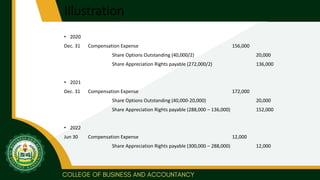
• 2020
Dec. 31 Compensation Expense 156,000
Share Options Outstanding (40,000/2) 20,000
Share Appreciation Rights payable (272,000/2) 136,000
• 2021
Dec. 31 Compensation Expense 172,000
Share Options Outstanding (40,000-20,000) 20,000
Share Appreciation Rights payable (288,000 – 136,000) 152,000
• 2022
Jun 30 Compensation Expense 12,000
Share Appreciation Rights payable (300,000 – 288,000) 12,000
Illustration
• After the previous entries, the balances of the debt and equity are as
follows:
Share Appreciation Rights Payable P300,000
Share Options Outstanding 40,000
• The balance of the debt is the fair value at the date of settlement, while
the balance of the equity is the fair value at the date of grant.
Illustration
• If the officer chooses the cash settlement, the transaction is recorded as:
June 30 Share Appreciation Rights Payable 300,000
Share Options Outstanding 40,000
Cash 300,000
Share Premium from Unexercised Share Options 40,000
• If the officer, on the other hand, opted for the equity alternative, the settlement is
recorded as
June 30 Share Appreciation Rights Payable 300,000
Share Options Outstanding 40,000
Ordinary Share Capital (5,000 x 40) 200,000
Share Premium – Ordinary Share 140,000
- End -

Share Based Payment.pptx

  • 1.
  • 2.
    Share-based Compensation Plans Share-basedcompensation plan is an arrangement whereby an employee is given compensation in return for services rendered in the form of the entity’s equity instruments or cash based on the fair value of the entity’s equity instruments or a choice of settlement between equity instrument and cash. Examples: • Employee share options (equity-settled) • Employee share appreciation rights (cash settled) • Compensation plans with a choice of settlement between (1) and (2) above
  • 3.
    Scope of PFRS2 1. Equity-settled share-based payment transaction – is a transaction whereby an entity acquires goods or services and instead of paying in cash the entity issues its own shares of stocks or share options; or 2. Cash-settled share-based payment transaction – is a transaction whereby an entity acquires goods or services and incurs an obligation to pay cash at an amount that is based on the fair value of equity instruments; or 3. Choice between equity-settled and cash-settled
  • 4.
    Definition of Terms Equityinstrument granted is the right (conditional or unconditional) to an equity instrument of the entity conferred by the entity on another party under a share-based payment arrangement. Share option is a contract that gives the holder the right, but not the obligation, to subscribe to the entity’s shares at a fixed or determinable price for a specified period of time. Some share options given to employees may not require any subscription price, meaning shares will be issued to the employees in consideration merely for services rendered. Measurement date is the date at which the fair value of the equity instruments granted is measured for the purposes of PFRS 2. a. For transactions with non-employees, the measurement date is the date when the entity receives the good or service. b. For transactions with employees and others providing similar services, the measurement date is grant date. Grant date is the date at which the entity and the counterparty agree to a share-based payment arrangement, being when the entity and the counterparty have a shared understanding of the terms and conditions of the arrangement. Intrinsic value is the difference between the fair value of the shares to which the counterparty has the conditional or unconditional right to subscribe or the right to receive and the subscription price (if any) that the counterparty is required to pay for those shares.
  • 5.
    Definition of Terms Performancecondition is a vesting condition that requires: a. The counterparty to complete a specified period of service b. Specified performance targets to be met The period of achieving the performance targets: a. Shall not exceed beyond the end of the service period b. May start before the service period on the condition that the commencement date of the performance target is not substantially before the commencement of the service period A performance target is defined by reference to: a. The entity’s own operations or the operations or activities of another entity in the same group (includes shares and share options; also known as non-market condition) b. The price of the entity’s equity instruments or the equity instruments of another entity in the same group (includes shares and share options; also known as market condition) Service condition is a vesting condition that requires the counterparty to complete a specified period of service during which services are provided to the entity. Vest means to become an entitlement. Under a share-based payment arrangement, a counterparty’s right to receive cash, other assets, or equity instruments of the entity vests when the counterparty’s entitlement is no longer conditional on the satisfaction of any vesting condition.
  • 6.
    Recognition Principle An entityshall recognize in profit or loss and financial position the effects of share-based payment transactions, including expenses associated with transactions in which share options are granted to employees. Goods and services received in share-based payment transactions are recognized when the goods are received or as the services are received. Goods or services received that do not qualify as assets are recognized as expenses. The entity shall recognize: a.A corresponding increase in equity if the goods or services were received in an equity-settled share-based payment transaction, or b.A liability if the goods or services were acquired in a cash-settled share-based payment transaction.
  • 7.
    Equity-Settled Share-Based Payments InitialMeasurement Transactions with non-employees Transactions with employees and Others providing similar services Goods or services acquired from non- employees are measured using the following order of priority: 1. Fair value of goods or services received at measurement date 2. Fair value of equity instruments granted granted at measurement date Goods or services acquired from employees employees and others providing similar services are measured using the following order of priority: 1. Fair value of the equity instrument granted at grant date 2. Intrinsic value, in the absence of the fair fair value
  • 8.
    Recognition of Equity-SettledSBC If the share options granted vest immediately, salaries expense shall be recognized in full with a corresponding increase in equity at grant date. If the share options granted do not vest until the employee completes a specified period of service, the entity shall recognize the related compensation expense as the services are rendered by the employee over the vesting period. In the absence of evidence to the contrary, it shall be presumed that the share options vest immediately.
  • 9.
    Pro-forma Entries andSolution Template Assuming “Vest over X number of periods” Year ‘x1 Year ‘x2 Year ‘x3 Number of employees xx xx xx Employees who left (xx) (xx) (xx) Employees expected to leave (xx) (xx) (xx) Total employees entitled for the benefit xx xx xx Multiply by: Share options per employee xx xx xx Total share options xx xx xx Multiply by: Fair value or intrinsic value xx xx xx Total value of the compensation xx xx xx Multiply by: Vesting period ratio 1/3 2/3 3/3 Cumulative salaries expense xx (a) xx (b) xx Cumulative salaries in the previous years - (xx) (a) (xx) (b) Salaries expense for the year xx xx xx Equity-Settled Transactions Date of Grant – “Vest immediately” Salaries Expense xx Share Premium – Share Options Outs. xx Date of Grant – “Vest over X number of periods” Memo entry: Granted 100 options to 100 employees conditional upon the employees remaining in the entity’s employ during the vesting period. Subsequent Periods – “Vest over X number of periods” Salaries Expense xx Share Premium – Share Options Outs. xx Exercise of Share Options Cash/Consideration xx Share Premium – Share Options Outs. xx Share Capital xx Share Premium xx
  • 10.
    Illustration 1 On May21, 20x1, Athena Co. contracted a supplier, an unrelated party, for the acquisition of brand new equipment with cash selling price of P2,000,000 in exchange for Athena’s 10,000, P100 par shares. The supplier delivered the equipment on July 5, 20x1 and Athena Co. issued the shares on July 20, 20x1. Athena’s shares have fair values per share of P199 on May 21, 20x1, P192 on July 5, 20x1, and P197 on July 20, 20x1. • Provide the journal entries. • Use the information in this problem but assume the equipment is specialized in nature, such that its fair value cannot be determined reliably.
  • 11.
    Illustration 1 May. 21, 20x1No entry July 5, 20x1 Equipment (cash selling price) Subscribed capital (10,000 x ₱100) Share premium 2,000,000 1,000,000 1,000,000 July 21, 20x1 Subscribed capital Share capital 1,000,000 1,000,000 May. 21, 20x1 No entry July 5, 20x1 Equipment (10,000 x ₱192) Subscribed capital (10,000 x ₱100) Share premium 1,920,000 1,000,000 920,000 July 21, 20x1 Subscribed capital Share capital 1,000,000 1,000,000
  • 12.
    Illustration 2 On January1, 20x1, Devin Co. awarded 1,000 share options to each of its 10 key employees for their exemplary services in the past. The fair value per share option on January 1, 20x1 was P50. The options are exercisable immediately and will expire after two years. Provide the journal entries.
  • 13.
    Illustration 2 Jan. 1, 20x1 Salariesexpense (1,000 x 10 x ₱50) Share premium - sh. options outstanding 500,000 500,000
  • 14.
    Illustration 3 On January1, 20x1, Zevrek Co. granted 1,000 share options to each of its 10 key employees conditional upon each employee remaining in Zevrek’s employ until the end of 20x3. The fair value of each of the share option on January 1, 20x1 was P21. On January 1, 20x1, Zevrek estimated that a total of 2 employees will leave during the vesting period. In 20x1, 2 employees left. Zevrek estimated that a total of 3 employees will have left before the end of 20x3. In 20x2, 1 employee left. Zevrek estimated that 1 more employee will leave in 20x3. In 20x3, no employees left. Provide the journal entries.
  • 15.
    Illustration 3 Jan. 1, 20x1 Memoentry Dec. 31, 20x1 Salaries expense – share options (10 – 3) x 1,000 x 21 x 1/3 Share premium – sh. options outstanding 49,000 49,000 Dec. 31, 20x2 Salaries expense – share options [(10 – 2 – 1 - 1) x 1,000 x 21 x 2/3] – 49,000 Share premium – sh. options outstanding 35,000 35,000 Dec. 31, 20x3 Salaries expense – share options [(10 - 2 - 1 - 0) x 1,000 x 21 x 3/3] - 49K - 35K Share premium – sh. options outstanding 63,000 63,000
  • 16.
    Illustration 3 Vest over3 periods Year ‘x1 Year ‘x2 Year ‘x3 Number of employees 10 10 10 Employees who left (2) (3) (3) Employees expected to leave (1) (1) - Total employees entitled for the benefit 7 6 7 Multiply by: Share options per employee 1,000 1,000 1,000 Total share options 7,000 6,000 7,000 Multiply by: Fair value or intrinsic value 21 21 21 Total value of the compensation 147,000 126,000 147,000 Multiply by: Vesting period ratio 1/3 2/3 3/3 Cumulative salaries expense 49,000 84,000 147,000 Cumulative salaries in the previous years - (49,000) (84,000) Salaries expense for the year 49,000 35,000 63,000
  • 17.
    Illustration 4 On January1, 20x1, John Co. granted 1,000 share options to each of its 10 key employees conditional upon each employee completing a 3-year service. The exercise price is P100; however, this amount decreases to P50 if the company’s sales increase at an average of at least 20% over the 3-year period. The following were the fair value estimates: a. If the exercise price is P100, the fair value per share option is P21. b. If the exercise price is P50, the fair value per share option is P71. In 20x1, sales increased by 18% and 1 employee left. Two more employees are expected to leave before the end of 20x3. In 20x2, sales increased by 19%. No employees left but it was still expected that 2 more employees will leave. In 20x3, the sales increased by 23% and 1 employee left. Provide the journal entries.
  • 18.
    Illustration 4 Vest over3 periods Year ‘x1 Year ‘x2 Year ‘x3 Number of employees 10 10 10 Employees who left (1) (1) (2) Employees expected to leave (2) (2) - Total employees entitled for the benefit 7 7 8 Multiply by: Share options per employee 1,000 1,000 1,000 Total share options 7,000 7,000 8,000 Multiply by: Fair value or intrinsic value 21 21 71 Total value of the compensation 147,000 147,000 568,000 Multiply by: Vesting period ratio 1/3 2/3 3/3 Cumulative salaries expense 49,000 98,000 568,000 Cumulative salaries in the previous years - (49,000) (98,000) Salaries expense for the year 49,000 49,000 470,000
  • 19.
    Illustration 4 Jan. 1, 20x1 Memoentry Dec. 31, 20x1 Salaries expense – share options (10 – 1 - 2) x 1,000 x 21 x 1/3 Share premium – sh. options outstanding 49,000 49,000 Dec. 31, 20x2 Salaries expense – share options [(10 – 1 – 0 - 2) x 1,000 x 21 x 2/3] – 49,000 Share premium – sh. options outstanding 49,000 49,000 Dec. 31, 20x3 Salaries expense – share options [(10 – 1 – 0 - 1) x 1,000 x 71 x 3/3] – 49K – 49K Share premium – sh. options outstanding 470,000 470,000
  • 20.
    Illustration 5 On January1, 20x1, John Co. granted 1,000 share options to each of its 10 key employees conditional upon each employee completing a 3-year service and the company’s share price increasing to at least P100 by the end of 20x3. The fair value per share option on January 1, 20x1, after considering both the possibilities that the share price target will and will not be achieved, was P21. In 20x1, the year-end share price was P90 and 1 employee left. One more employee was expected to leave before the end of 20x3. In 20x2, the year-end share price was P99 and 1 employee left. The entity estimated that, in total, 3 employees will have left before the end of 20x3. In 20x3, the year-end share price was P89. No employee left. Provide the journal entries.
  • 21.
    Illustration 5 Vest over3 periods Year ‘x1 Year ‘x2 Year ‘x3 Number of employees 10 10 10 Employees who left (1) (2) (2) Employees expected to leave (1) (1) - Total employees entitled for the benefit 8 7 8 Multiply by: Share options per employee 1,000 1,000 1,000 Total share options 8,000 7,000 8,000 Multiply by: Fair value or intrinsic value 21 21 21 Total value of the compensation 168,000 147,000 168,000 Multiply by: Vesting period ratio 1/3 2/3 3/3 Cumulative salaries expense 56,000 98,000 168,000 Cumulative salaries in the previous years - (56,000) (98,000) Salaries expense for the year 56,000 42,000 70,000
  • 22.
    Illustration 5 Jan. 1,20x1 Memo entry Dec. 31, 20x1 Salaries expense – share options (10 – 1 - 1) x 1,000 x 21 x 1/3 Share premium – sh. options outstanding 56,000 56,000 Dec. 31, 20x2 Salaries expense – share options [(10 – 3) x 1,000 x 21 x 2/3] – 56,000 Share premium – sh. options outstanding 42,000 42,000 Dec. 31, 20x3 Salaries expense – share options [(10 – 1 – 1 - 0) x 1,000 x 21 x 3/3] – 56K – 42K Share premium – sh. options outstanding 70,000 70,000
  • 23.
    Modifications, Cancellations, andSettlements Modifications to the terms and conditions on which equity instruments were granted, including cancellations and settlements may either be: I. Beneficial to the employees, for example: I. Increase in the fair value of the equity instruments granted (e.g., reduction of the exercise price) II.Increase in the number of equity instruments granted III.Reducing the vesting period or by modifying or eliminating a performance condition II.Not beneficial to the employees, for example: I. Decrease in the fair value of the equity instruments granted (e.g., increase of the exercise price) II.Decrease in the number of equity instruments granted III.Increasing the vesting period or by modifying or adding a performance condition
  • 24.
    Modifications, Cancellations, andSettlements Increase in FV of the equity securities Decrease in FV of the equity securities - Continue to recognize the original fair value of the instrument - Recognize any increase in fair value at the modification date spread over the period between the modification date and vesting date - If modification occurs after the vesting date, then the additional fair value must must be recognized immediately unless there is, for example, an additional service period, in which case the difference is spread over this period - Continue to recognize the original fair value of the instrument - Ignore any decrease in fair value at the modification date
  • 25.
    Modifications, Cancellations, andSettlements Increase in the number of equity securities Decrease in the number of equity securities - Continue to recognize the original fair value of of the instrument - Recognize any increase in the number of instruments granted at the modification date spread over the period between the modification date and vesting date - If modification occurs after the vesting date, then the additional number of instruments must be recognized immediately unless there is, for example, an additional service period, in in which case the difference is spread over this period - Accounted for as a cancellation of that portion portion of the grant
  • 26.
    Modifications, Cancellations, andSettlements If a grant of equity instruments is cancelled or settled during the vesting period: I. The entity shall account for the cancellation or settlement as an acceleration of vesting, and shall therefore recognize immediately the amount that otherwise would have been recognized for services received over the remainder of the vesting period. II.Any payment made to the employee on the cancellation or settlement of the grant is accounted for as a repurchase of an equity interest (i.e., reduction to equity), except if the payment exceeds the fair value of the equity instruments in which case the excess is recognized as an expense. III.If the grant includes a liability component, the liability component is remeasured first and the payment for the liability component is accounted for as an extinguishment of liability.
  • 27.
    Illustration 6 On January1, 20x1, John Co. granted 1,000 share options to each of its 10 key employees conditional upon each employee completing a 3-year service. The fair value per share option on January 1, 20x1 was P21. In 20x1, 1 employee left. On December 31, 20x1, the share price has dropped, and John Co. repriced the share options. The fair value per share option before the repricing was P8, while the fair value after the repricing was P12. The repriced share options will vest at the end of 20x3. John Co. estimated that an additional 2 employees will leave in the next two years. In 20x2, one employee left. John Co. continues to estimate the employee departures at a total of three. In 20x3, no employee left. Provide the journal entries.
  • 28.
    Illustration 6 Original TermsYear ‘x1 Year ‘x2 Year ‘x3 Number of employees 10 10 10 Employees who left (1) (2) (2) Employees expected to leave (2) (1) - Total employees entitled for the benefit 7 7 8 Multiply by: Share options per employee 1,000 1,000 1,000 Total share options 7,000 7,000 8,000 Multiply by: Fair value or intrinsic value 21 21 21 Total value of the compensation 147,000 147,000 168,000 Multiply by: Vesting period ratio 1/3 2/3 3/3 Cumulative salaries expense 49,000 98,000 168,000 Cumulative salaries in the previous years - (49,000) (98,000) Salaries expense for the year – original 49,000 49,000 70,000 Incremental FV due to Modification Year ‘x2 Year ‘x3 Number of employees 10 10 Employees who left (2) (2) Employees expected to leave (1) - Total employees entitled for the benefit 7 8 Multiply by: Share options per employee 1,000 1,000 Total share options 7,000 8,000 Multiply by: Incremental FV – repricing (P12 – P8) 4 4 Total value of the compensation 28,000 32,000 Multiply by: Vesting period ratio 1/2 2/2 Cumulative salaries expense 14,000 32,000 Cumulative salaries in the previous years - (14,000) Salaries expense for the year – original 14,000 18,000
  • 29.
    Illustration 6 Jan. 1, 20x1 Memoentry Dec. 31, 20x1 Salaries expense – share options (10 – 1 - 2) x 1,000 x 21 x 1/3 Share premium – sh. options outstanding 49,000 49,000 Dec. 31, 20x2 Salaries expense – share options Share premium – sh. options outstanding 63,000 63,000 Dec. 31, 20x3 Salaries expense – share options Share premium – sh. options outstanding 88,000 88,000
  • 30.
    Illustration 7 On January1, 20x1, John Co. granted 1,000 share options to each of its 10 key employees conditional upon each employee completing a 3-year service. The fair value per share option on January 1, 20x1 was P21. In 20x1, 1 employee left. On December 31, 20x1, the share price has dropped, and John Co. repriced the share options and added an exercise price of P20. The fair value per share option before the repricing was P8, while the fair value after the repricing was P2. The repriced share options will vest at the end of 20x3. John Co. estimated that an additional 2 employees will leave in the next two years. In 20x2, one employee left. John Co. continues to estimate the employee departures at a total of three. In 20x3, no employee left. Provide the journal entries.
  • 31.
    Illustration 7 Original TermsYear ‘x1 Year ‘x2 Year ‘x3 Number of employees 10 10 10 Employees who left (1) (2) (2) Employees expected to leave (2) (1) - Total employees entitled for the benefit 7 7 8 Multiply by: Share options per employee 1,000 1,000 1,000 Total share options 7,000 7,000 8,000 Multiply by: Fair value or intrinsic value 21 21 21 Total value of the compensation 147,000 147,000 168,000 Multiply by: Vesting period ratio 1/3 2/3 3/3 Cumulative salaries expense 49,000 98,000 168,000 Cumulative salaries in the previous years - (49,000) (98,000) Salaries expense for the year – original 49,000 49,000 70,000
  • 32.
    Illustration 7 Jan. 1, 20x1 Memoentry Dec. 31, 20x1 Salaries expense – share options (10 – 1 - 2) x 1,000 x 21 x 1/3 Share premium – sh. options outstanding 49,000 49,000 Dec. 31, 20x2 Salaries expense – share options [(10 – 3) x 1,000 x 21 x 2/3] – 49,000 Share premium – sh. options outstanding 49,000 49,000 Dec. 31, 20x3 Salaries expense – share options [(10 – 1 – 1 - 0) x 1,000 x 21 x 3/3] – 49K – 49K Share premium – sh. options outstanding 70,000 70,000
  • 33.
    Illustration 8 On January1, 20x1, John Co. granted 1,000 share options to each of its 10 key employees conditional upon each employee completing a 3-year service. The fair value per share option on January 1, 20x1 was P21. John Co. estimated that no employees will leave in the next 3 years. In 20x1, no employee left and John Co. continued to expect that no employees will leave during the vesting period. In 20x2, one employee left and John Co. decided to issue the 1,000 share options to the remaining employees without further consideration. Provide the journal entries.
  • 34.
    Illustration 8 Jan. 1, 20x1 Memoentry Dec. 31, 20x1 Salaries expense – share options (10 – 0) x 1,000 x 21 x 1/3 Share premium – sh. options outstanding 70,000 70,000 Dec. 31, 20x2 Salaries expense – share options [(10 – 1) x 1,000 x 21] – 70,000 Share premium – sh. options outstanding 119,000 119,000
  • 35.
    Illustration 9 On January1, 20x1, John Co. granted 1,000 share options to each of its 10 key employees conditional upon each employee completing a 3-year service period. The share options have an exercise price of P20, equal to the share price on January 1, 20x1. John Co. cannot reliably estimate the fair value of the share options on January 1, 20x1. In 20x1, 2 employees left. John Co. estimated that 70% of the share options will vest in 20x2. In 20x2, no employee left but John Co. expected that 1 more employee will leave in 20x3. In 20x3, 2 employees left. The share prices were as follows: December 31, 20x1 – P41 December 31, 20x2 – P38 December 31, 20x3 – P42 Provide the journal entries.
  • 36.
    Illustration 9 Jan. 1,20x1 Memo entry Dec. 31, 20x1 Salaries expense – share options [10 x 1,000 x 70% x (41 – 20) x 1/3] Share premium – sh. options outstanding 49,000 49,000 Dec. 31, 20x2 Salaries expense – share options [(10 – 2 – 0 – 1) x 1,000 x (38 – 20) x 2/3] – 49K Share premium – sh. options outstanding 35,000 35,000 Dec. 31, 20x3 Salaries expense – share options [(10 – 2 – 0 – 2) x 1,000 x (42 – 20) x 3/3] – 49K – 35K Share premium – sh. options outstanding 48,000 48,000
  • 37.
    Cash-Settled Share-Based Payments Examplesof Cash-Settled Share-Based Payment Transactions: • Share appreciation rights – employees will become entitled to a future cash payment based on the increase in the entity’s share price from a specified level over a specified period of time • Right to receive future cash payment by granting right to shares that are redeemable, either mandatorily or at the employee’s option
  • 38.
    Cash-Settled Share-Based Payments InitialMeasurement Subsequent Measurement Transactions with employees and Others providing similar services Transactions with employees and Others providing similar services The goods or services acquired and the liability incurred on cash-settled share- based payment transactions are measured at the fair value of the liability. At the end of each reporting period and on settlement date, the liability shall be remeasured to fair value. Changes in fair value are recognized in profit or loss.
  • 39.
    Recognition of Cash-SettledSBC If the share appreciation rights granted vest immediately, salaries expense shall be recognized in full with a corresponding increase in liability. If the share appreciation rights granted do not vest until the employee completes a specified period of service, the entity shall recognize the related compensation expense and the related liability as the services are rendered by the employee over the vesting period.
  • 40.
    Pro-forma Entries andSolution Template Assuming “Vest over X number of periods” Year ‘x1 Year ‘x2 Year ‘x3 Number of employees xx xx xx Employees who left (xx) (xx) (xx) Employees expected to leave (xx) (xx) (xx) Employees who exercised their SARs (xx) (xx) (xx) Total employees entitled for the benefit xx xx xx Multiply by: SARs per employee xx xx xx Total share appreciation rights xx xx xx Multiply by: Fair value or intrinsic value xx xx xx Total value of the compensation xx xx xx Multiply by: Vesting period ratio 1/3 2/3 3/3 Cumulative salaries expense xx (a) xx (b) xx Cumulative salaries in the previous years - (xx) (a) (xx) (b) Salaries expense for the year xx xx xx SARs exercised during the year* xx xx xx Total salaries expense for the year xx xx xx Equity-Settled Transactions Date of Grant – “Vest immediately” Salaries Expense xx Accrued Salaries Payable xx Date of Grant – “Vest over X number of periods” Memo entry: Granted 100 share appreciation rights to employees conditional upon the employees remaining in the entity’s employ during the vesting period. Subsequent Periods – “Vest over X number of periods” Salaries Expense xx Accrued Salaries Payable xx Settlement Accrued Salaries Payable xx Cash xx *SARs exercised during the year: Number of employees who exercised x SARs per employee x intrinsic value (equal to the cash payout)
  • 41.
    Illustration 10 An entitygrants 1,000 share appreciation rights (SARs) to each of its 20 employees on January 1, 20x1. Employees earn a cash payment equal to the appreciation in the share price between January 1, 20x1 and December 31, 20x3. The share appreciation rights vest on December 31, 20x3. All the SARs that have vested were settled on December 31, 20x3. The intrinsic value on this date was P120 per SAR. Provide all the entries in 20x1, 20x2, and 20x3. Date % of SARs expected to vest Fair value per SAR 1/1/20x1 95% 100 12/31/20x1 96% 112 12/31/20x2 98% 117 12/31/20x3 97% 120
  • 42.
    Illustration 10 20x1 20x220x3 Total employees entitled for the benefit 20 20 20 Multiply by: SARs per employee 1,000 1,000 1,000 Total share appreciation rights 20,000 20,000 20,000 Multiply by: % of SARs expected to vest 96% 98% 97% SARs expected to vest 19,200 19,600 19,400 Multiply by: Fair value or intrinsic value 112 117 120 Total value of the compensation 2,150,400 2,293,200 2,328,000 Multiply by: Vesting period ratio 1/3 2/3 3/3 Cumulative salaries expense 716,800 1,528,800 2,328,000 Cumulative salaries in the previous years - (716,800) (1,528,800) Salaries expense for the year 716,800 812,000 799,200 SARs exercised during the year* - - - Total salaries expense for the year 716,800 812,000 799,200
  • 43.
    Illustration 10 Jan. 1,20x1 Memo entry Dec. 31, 20x1 Salaries expense (1,000 x 20 x 96% x 112 x 1/3) Accrued salaries payable 716,800 716,800 Dec. 31, 20x2 Salaries expense (1,000 x 20 x 98% x 117 x 2/3) – 716,800 Accrued salaries payable 812,000 812,000 Dec. 31, 20x3 Salaries expense (1,000 x 20 x 97% x 120 x 3/3) – 716,800 – 812,000 Accrued salaries payable 799,200 799,200 Accrued salaries payable Cash 2,328,000 2,328,000
  • 44.
    Illustration 11 On January1, 2018, John Co. grants 100 cash share appreciation rights (SARs) to each of its 500 employees, on condition that the employees remain in its employ for the next three years. During 2018, 30 employees leave. The entity estimates that a further 60 will leave during 2019 and 2020. During 2019, 20 employees leave and the entity estimates that a further 15 will leave during 2020. During 2020, 18 employees leave. At the end of 2020, 100 employees exercise their SARs, another 150 employees exercise their SARs at the end of 2021 and the remaining employees exercise their SARs at the end of 2022. The entity estimates the fair value of the SARs at the end of each year in which a liability exists as shown below. At the end of 2020, all SARs held by the remaining employees vest. The intrinsic values of the SARs at the date of exercise at the end of years 2020, 2021, and 2022 are shown below. Year Fair Value Intrinsic Value 2018 21 2019 24 2020 28 19 2021 30 25 2022 31
  • 45.
    Illustration 11 2018 20192020 2021 2022 Number of employees 500 500 500 500 500 Employees who left (30) (50) (68) (68) (68) Employees expected to leave (60) (15) - - - Employees who exercised their SARs - - (100) (250) (432) Total employees entitled for the benefit 410 435 332 182 - Multiply by: SARs per employee 100 100 100 100 100 Total share appreciation rights 41,000 43,500 33,200 18,200 - Multiply by: Fair value or intrinsic value 21 24 28 30 - Total value of the compensation 861,000 1,044,000 929,600 546,000 - Multiply by: Vesting period ratio 1/3 2/3 3/3 1 1 Cumulative salaries expense 287,000 696,000 929,600 546,000 - Cumulative salaries in the previous years - (287,000) (696,000) (929,600) (546,000) Salaries expense for the year 287,000 409,000 233,600 (383,600) (546,000) SARs exercised on 2020 (100 x 100 x 19) - - 190,000 - - SARs exercised on 2021 (100 x 150 x 25) - - - 375,000 - SARs exercised on 2022 (100 x 182 x 31) - - - - 564,200 Total salaries expense for the year 287,000 409,000 423,600 (8,600) 18,200
  • 46.
    Share-based payment transactionswith cash alternatives If the counterparty has the right to choose settlement between cash (or other assets) or equity instruments, the entity has granted a compound instrument. For transactions with non-employees, the equity component is computed as the difference between the fair value of goods or services received and the fair value of the debt component at the date the goods or services are received. For transactions with employees and others providing similar services, the entity shall measure the fair value of the compound instrument and its components as follows: a. If the fair value of one settlement alternative is the same as the other, the fair value of the equity component is zero, and hence the fair value of the compound financial instrument is the same as the fair value of the debt component. b.If the fair values of the settlement alternatives differ, the fair value of the equity component will be greater than zero, in which case, the fair value of the compound financial instrument will be greater than the fair value of the debt component.
  • 47.
    Share-based payment transactionswith cash alternatives Fair value of the compound financial instrument xx Less: fair value of the debt component at the date of grant xx Value assigned to equity component, at the date of grant xx The residual approach is used merely to measure the value of the equity component at the date of grant. Such assigned value is not subsequently adjusted, unless there is a change in the estimate of the share appreciation rights expected to vest. The value of the debt, however is measured at fair value and is subject to adjustment at the end of each reporting date and at the date of settlement.
  • 48.
    Share-based payment transactionswith cash alternatives • At each reporting date, the entry during the vesting period, the entry is Compensation Expense xx SARs Payable (based on FV at year-end) xx Share Options Outstanding (based on fair value at date of grant) xx
  • 49.
    Share-based payment transactionswith cash alternatives If the entity has the right to choose settlement between cash (or other assets) or equity instruments, the entity has not granted a compound instrument. In such case, the entity shall determine whether it has a present obligation to settle in cash and shall account for the share-based payment transaction accordingly. If the entity has a present obligation to settle in cash, it shall account for the transaction as a cash-settled share-based payment transaction. If the entity has no present obligation to settle in cash, it shall account for the transaction as an equity-settled share-based payment transaction.
  • 50.
    Illustration On January 1,2020, an entity granted to its chief operations officer the right to choose either 5,000 ordinary shares or to receive cash payment equal to 4,000 shares. The grant is conditional upon completion of two years of service. The entity estimates that the value of the share alternative at the date of grant is P60 per share. Par value per share is P40. The fair values per share at January 1, 2020, December 31, 2020, and December 31, 2021 are P65, P68, and P72, respectively. The officer exercised his rights on June 30, 2022 when the market price of each share is P75.
  • 51.
    Illustration The fair valueof the equity component is measured at the date of grant, January 1, 2020: Fair value of the equity alternative (5,000 x P60) 300,000 Less: Fair value of the debt component (4,000 x P65) 260,000 Fair value of the equity component 40,000 Fair value of the liability: • December 31, 2020 272,000 • December 31, 2021 288,000 • June 30, 2022 300,000
  • 52.
    Illustration • 2020 Dec. 31Compensation Expense 156,000 Share Options Outstanding (40,000/2) 20,000 Share Appreciation Rights payable (272,000/2) 136,000 • 2021 Dec. 31 Compensation Expense 172,000 Share Options Outstanding (40,000-20,000) 20,000 Share Appreciation Rights payable (288,000 – 136,000) 152,000 • 2022 Jun 30 Compensation Expense 12,000 Share Appreciation Rights payable (300,000 – 288,000) 12,000
  • 53.
    Illustration • After theprevious entries, the balances of the debt and equity are as follows: Share Appreciation Rights Payable P300,000 Share Options Outstanding 40,000 • The balance of the debt is the fair value at the date of settlement, while the balance of the equity is the fair value at the date of grant.
  • 54.
    Illustration • If theofficer chooses the cash settlement, the transaction is recorded as: June 30 Share Appreciation Rights Payable 300,000 Share Options Outstanding 40,000 Cash 300,000 Share Premium from Unexercised Share Options 40,000 • If the officer, on the other hand, opted for the equity alternative, the settlement is recorded as June 30 Share Appreciation Rights Payable 300,000 Share Options Outstanding 40,000 Ordinary Share Capital (5,000 x 40) 200,000 Share Premium – Ordinary Share 140,000
  • 55.