Advanced Accounting
Chapter 2: Consolidation of Financial
Information
Lecturer: Mohamed Abdi
Introduction
• When financial statements represent one more
corporation, refer to them as consolidated
financial statements.
• In this chapter, we first present expansions
through corporate takeovers and present an of
the overview of the consolidation process.
• Then we present the specifics of the acquisition
methods of accounting for business combinations
where the acquirer obtains complete ownership
of an other firm.
Reasons Firms Combine
• Vertical integration
• Cost savings
• Quick entry into new markets
• Economies of scale
• More attractive financing opportunities
• Diversification of business risk
• Business Expansion
• Increasingly competitive environment
Business Combinations
 Separate organizations tied together through
common control under common management are
combined into a single entity.
 FASB Accounting Standards Codification (ASC)
Business Combinations (Topic 805) and
 Consolidation (Topic 810) provide guidance using the
“acquisition method”.
 The acquisition method embraces a fair value
measurement attribute that reflects the FASB’s
increasing emphasis on fair value for measuring and
assessing business activity.
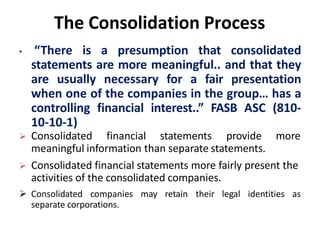
The Consolidation Process
• “There is a presumption that consolidated
statements are more meaningful.. and that they
are usually necessary for a fair presentation
when one of the companies in the group… has a
controlling financial interest..” FASB ASC (810-
10-10-1)
 Consolidated financial statements provide more
meaningful information than separate statements.
 Consolidated financial statements more fairly present the
activities of the consolidated companies.
 Consolidated companies may retain their legal identities as
separate corporations.
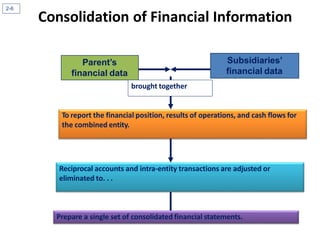
Consolidation of Financial Information
Subsidiaries’
financial data
Prepare a single set of consolidated financial statements.
Parent’s
financial data
2-6
Reciprocal accounts and intra-entity transactions are adjusted or
eliminated to. . .
brought together
To report the financial position, results of operations, and cash flows for
the combined entity.
Business Combinations
• Business combinations . . .
 can be
events in which an acquirer obtains control
achieved through transactions or
over
one or more businesses.
 Create single economic entities.
 Can be formed by a variety of events but can
differ widely in legal form.
 Require consolidated financial statements.
Business Combinations—Creating a
Single Economic Entity
1. One company obtains the assets, and often the
liabilities, of another company in exchange for
cash, other assets, liabilities, stock, or a
combination of these. The second organization
normally dissolves itself as a legal corporation.
• Thus, only the acquiring company remains in
existence, having absorbed the acquired net
assets directly into its own operations. Any
business combination in which only one of the
original companies continues to exist is referred
to in legal terms as a statutory merger.
Cont….
• 2. One company obtains all of the capital stock of
another in exchange for cash, other assets,
liabilities, stock, or a combination of these. After
gaining control, the acquiring company can
decide to transfer all assets and liabilities to its
own financial records with the second company
being dissolved as a separate corporation.
• The business combination is, once again, a
statutory merger because only one of the
companies maintains legal existence
Cont…
3. Two or more companies transfer
either their assets or their capital
stock to a newly formed corporation.
• Both original companies are
dissolved, leaving only the new
organization in existence. A business
combination effected in this manner
is a statutory consolidation.
4. One company achieves legal control over another by
acquiring a majority of voting stock. Although control
is present, no dissolution takes place; each company
remains in existence as an incorporated operation.
• Because the asset and liability account balances are
not physically combined as in statutory mergers and
consolidations, each company continues to maintain an
independent accounting system. To
combination, the acquiring company
takeover transaction into its own
reflect the
enters the
records by
establishing a single investment asset account.
Cont…
• A final vehicle for control of another
business entity does not involve a
majority voting stock interest or direct
ownership of assets.
• Control of a variable interest entity (VIE)
by design often does not rest with its
equity holders. Instead, control is
exercised through contractual
arrangements
The Acquisition Method
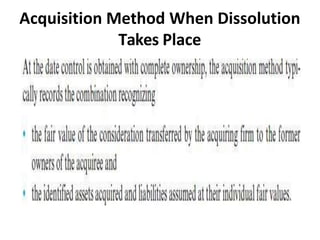
• Applying the acquisition method typically
involves recognizing and measuring:
• the consideration transferred for the
acquired business and any non-controlling
interest.
• the separately identified assets acquired
and liabilities assumed.
• goodwill, or a gain from a bargain purchase.
FASB ASC:
• The consideration transferred in a business
combination shall be measured at fair value,
which shall be calculated as the sum of the
acquisition-date fair values of the assets
transferred by the acquirer, the liabilities
incurred by the acquirer to former owners of
the acquiree, and the equity interests issued
by the acquirer. (FASB ASC para. 805-30-30-7)
Assets Acquired and Liabilities Assumed
• A fundamental principle of the acquisition method is
that an acquirer must identify the assets acquired and
the liabilities assumed in the business combination.
• Fair value, as defined by GAAP, is the price that would
transferring a liability in
be received from selling an asset or paid for
an orderly transaction
between market participants at the measurement
date. However, determining the acquisition-date fair
values of the individual assets acquired and liabilities
assumed can prove challenging. To estimate fair values,
three sets of valuation techniques are typically
employed: the market approach, the income approach,
and the cost approach.
Cont…
• Market Approach recognizes that fair values
can be estimated using other market
transactions involving similar assets or
liabilities.
• Income Approach relies on multiperiod
estimates of future cash flows projected to be
generated by an asset.
• Cost Approach estimates fair values by
reference to the current cost of replacing an
asset with another of comparable economic
utility.
Procedures for Consolidating
Financial Information
1. Acquisition
takes place.
2. Acquisition
method when dissolution
method when separate
incorporation is maintained.
Acquisition Method When Dissolution
Takes Place
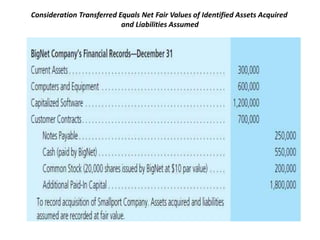
Consideration Transferred Equals Net Fair Values of Identified Assets Acquired
and Liabilities Assumed
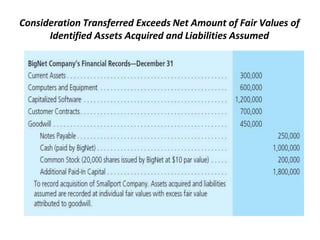
Consideration Transferred Exceeds Net Amount of Fair Values of
Identified Assets Acquired and Liabilities Assumed
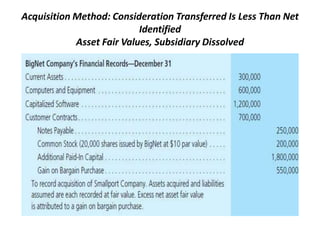
Acquisition Method: Consideration Transferred Is Less Than Net
Identified
Asset Fair Values, Subsidiary Dissolved
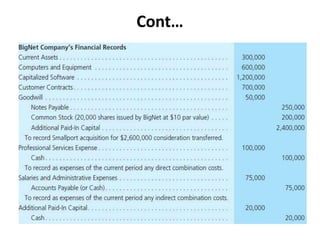
Related Costs of Business Combinations
• Three additional categories of costs typically
accompany business combinations, regardless of
whether dissolution takes place.
• First, firms often engage attorneys, accountants,
investment bankers, and other professionals for
combination-related services.
• The acquisition method does not consider such
expenditures as part of the fair value received by
the acquirer. Therefore, professional service fees
are expensed in the period incurred.
Cont…
• The second category concerns an acquiring
firm’s internal costs. Examples include
secretarial and management time allocated to
the acquisition activity. Such indirect costs are
reported as current year expenses, too.
• Finally, amounts incurred to register and issue
securities in connection with a business
combination simply reduce the otherwise
determinable fair value of the securities.
Cont…
The Acquisition Method When Separate Incorporation
Is Maintained
• When dissolution does not occur, the
acquiring company does not physically record
the acquired assets and liabilities.
• Because dissolution does not occur, each
company maintains independent record-
keeping.
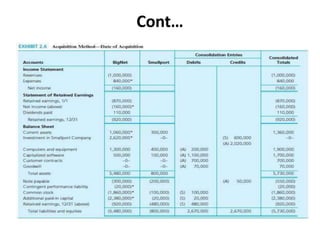
• To facilitate the preparation of consolidated
financial statements, a worksheet and
consolidation entries are employed using data
gathered from these separate companies.
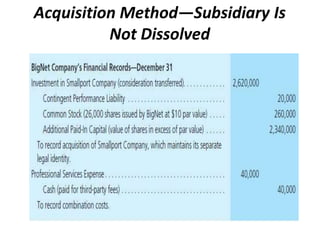
Acquisition Method—Subsidiary Is
Not Dissolved
Cont…
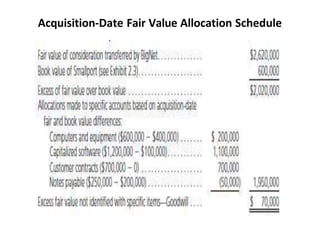
Acquisition-Date Fair Value Allocation Schedule
Preexisting Goodwill on Subsidiary’s
Books
• However, in many cases, an acquired firm has an
unidentifiable asset (i.e., goodwill recorded on its
books in connection with a previous business
combination of its own).
• A question arises as to the parent’s treatment of
this preexisting goodwill on the newly acquired
subsidiary’s books.
• By its very nature, such preexisting goodwill is not
considered identifiable by the parent. Therefore,
the new owner simply ignores it in allocating the
acquisition-datefair value.
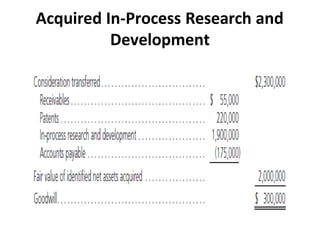
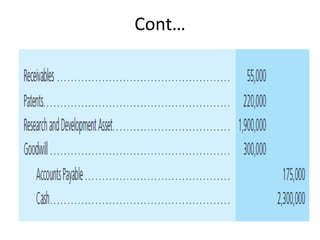
Acquired In-Process Research and
Development
Cont…
End of chapter two
Thank you

chapter two: advanced accounting two.pptx

  • 1.
    Advanced Accounting Chapter 2:Consolidation of Financial Information Lecturer: Mohamed Abdi
  • 2.
    Introduction • When financialstatements represent one more corporation, refer to them as consolidated financial statements. • In this chapter, we first present expansions through corporate takeovers and present an of the overview of the consolidation process. • Then we present the specifics of the acquisition methods of accounting for business combinations where the acquirer obtains complete ownership of an other firm.
  • 3.
    Reasons Firms Combine •Vertical integration • Cost savings • Quick entry into new markets • Economies of scale • More attractive financing opportunities • Diversification of business risk • Business Expansion • Increasingly competitive environment
  • 4.
    Business Combinations  Separateorganizations tied together through common control under common management are combined into a single entity.  FASB Accounting Standards Codification (ASC) Business Combinations (Topic 805) and  Consolidation (Topic 810) provide guidance using the “acquisition method”.  The acquisition method embraces a fair value measurement attribute that reflects the FASB’s increasing emphasis on fair value for measuring and assessing business activity.
  • 5.
    The Consolidation Process •“There is a presumption that consolidated statements are more meaningful.. and that they are usually necessary for a fair presentation when one of the companies in the group… has a controlling financial interest..” FASB ASC (810- 10-10-1)  Consolidated financial statements provide more meaningful information than separate statements.  Consolidated financial statements more fairly present the activities of the consolidated companies.  Consolidated companies may retain their legal identities as separate corporations.
  • 6.
    Consolidation of FinancialInformation Subsidiaries’ financial data Prepare a single set of consolidated financial statements. Parent’s financial data 2-6 Reciprocal accounts and intra-entity transactions are adjusted or eliminated to. . . brought together To report the financial position, results of operations, and cash flows for the combined entity.
  • 7.
    Business Combinations • Businesscombinations . . .  can be events in which an acquirer obtains control achieved through transactions or over one or more businesses.  Create single economic entities.  Can be formed by a variety of events but can differ widely in legal form.  Require consolidated financial statements.
  • 8.
    Business Combinations—Creating a SingleEconomic Entity 1. One company obtains the assets, and often the liabilities, of another company in exchange for cash, other assets, liabilities, stock, or a combination of these. The second organization normally dissolves itself as a legal corporation. • Thus, only the acquiring company remains in existence, having absorbed the acquired net assets directly into its own operations. Any business combination in which only one of the original companies continues to exist is referred to in legal terms as a statutory merger.
  • 9.
    Cont…. • 2. Onecompany obtains all of the capital stock of another in exchange for cash, other assets, liabilities, stock, or a combination of these. After gaining control, the acquiring company can decide to transfer all assets and liabilities to its own financial records with the second company being dissolved as a separate corporation. • The business combination is, once again, a statutory merger because only one of the companies maintains legal existence
  • 10.
    Cont… 3. Two ormore companies transfer either their assets or their capital stock to a newly formed corporation. • Both original companies are dissolved, leaving only the new organization in existence. A business combination effected in this manner is a statutory consolidation.
  • 11.
    4. One companyachieves legal control over another by acquiring a majority of voting stock. Although control is present, no dissolution takes place; each company remains in existence as an incorporated operation. • Because the asset and liability account balances are not physically combined as in statutory mergers and consolidations, each company continues to maintain an independent accounting system. To combination, the acquiring company takeover transaction into its own reflect the enters the records by establishing a single investment asset account.
  • 12.
    Cont… • A finalvehicle for control of another business entity does not involve a majority voting stock interest or direct ownership of assets. • Control of a variable interest entity (VIE) by design often does not rest with its equity holders. Instead, control is exercised through contractual arrangements
  • 13.
    The Acquisition Method •Applying the acquisition method typically involves recognizing and measuring: • the consideration transferred for the acquired business and any non-controlling interest. • the separately identified assets acquired and liabilities assumed. • goodwill, or a gain from a bargain purchase.
  • 14.
    FASB ASC: • Theconsideration transferred in a business combination shall be measured at fair value, which shall be calculated as the sum of the acquisition-date fair values of the assets transferred by the acquirer, the liabilities incurred by the acquirer to former owners of the acquiree, and the equity interests issued by the acquirer. (FASB ASC para. 805-30-30-7)
  • 15.
    Assets Acquired andLiabilities Assumed • A fundamental principle of the acquisition method is that an acquirer must identify the assets acquired and the liabilities assumed in the business combination. • Fair value, as defined by GAAP, is the price that would transferring a liability in be received from selling an asset or paid for an orderly transaction between market participants at the measurement date. However, determining the acquisition-date fair values of the individual assets acquired and liabilities assumed can prove challenging. To estimate fair values, three sets of valuation techniques are typically employed: the market approach, the income approach, and the cost approach.
  • 16.
    Cont… • Market Approachrecognizes that fair values can be estimated using other market transactions involving similar assets or liabilities. • Income Approach relies on multiperiod estimates of future cash flows projected to be generated by an asset. • Cost Approach estimates fair values by reference to the current cost of replacing an asset with another of comparable economic utility.
  • 17.
    Procedures for Consolidating FinancialInformation 1. Acquisition takes place. 2. Acquisition method when dissolution method when separate incorporation is maintained.
  • 18.
    Acquisition Method WhenDissolution Takes Place
  • 19.
    Consideration Transferred EqualsNet Fair Values of Identified Assets Acquired and Liabilities Assumed
  • 20.
    Consideration Transferred ExceedsNet Amount of Fair Values of Identified Assets Acquired and Liabilities Assumed
  • 21.
    Acquisition Method: ConsiderationTransferred Is Less Than Net Identified Asset Fair Values, Subsidiary Dissolved
  • 22.
    Related Costs ofBusiness Combinations • Three additional categories of costs typically accompany business combinations, regardless of whether dissolution takes place. • First, firms often engage attorneys, accountants, investment bankers, and other professionals for combination-related services. • The acquisition method does not consider such expenditures as part of the fair value received by the acquirer. Therefore, professional service fees are expensed in the period incurred.
  • 23.
    Cont… • The secondcategory concerns an acquiring firm’s internal costs. Examples include secretarial and management time allocated to the acquisition activity. Such indirect costs are reported as current year expenses, too. • Finally, amounts incurred to register and issue securities in connection with a business combination simply reduce the otherwise determinable fair value of the securities.
  • 24.
  • 25.
    The Acquisition MethodWhen Separate Incorporation Is Maintained • When dissolution does not occur, the acquiring company does not physically record the acquired assets and liabilities. • Because dissolution does not occur, each company maintains independent record- keeping. • To facilitate the preparation of consolidated financial statements, a worksheet and consolidation entries are employed using data gathered from these separate companies.
  • 26.
  • 27.
  • 28.
    Acquisition-Date Fair ValueAllocation Schedule
  • 29.
    Preexisting Goodwill onSubsidiary’s Books • However, in many cases, an acquired firm has an unidentifiable asset (i.e., goodwill recorded on its books in connection with a previous business combination of its own). • A question arises as to the parent’s treatment of this preexisting goodwill on the newly acquired subsidiary’s books. • By its very nature, such preexisting goodwill is not considered identifiable by the parent. Therefore, the new owner simply ignores it in allocating the acquisition-datefair value.
  • 30.
  • 31.
  • 32.
    End of chaptertwo Thank you