IFRS 3business combinations
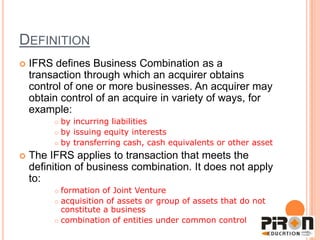
DefinitionIFRS defines Business Combination as a transaction through which an acquirer obtains control of one or more businesses. An acquirer may  obtain control of an acquire in variety of ways, for example:by incurring liabilitiesby issuing equity interestsby transferring cash, cash equivalents or other assetThe IFRS applies to transaction that meets the definition of business combination. It does not apply to:formation of Joint Ventureacquisition of assets or group of assets that do not constitute a businesscombination of entities under common control
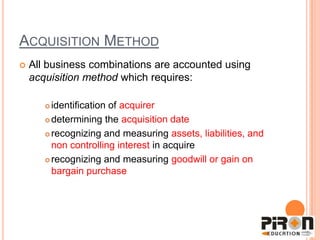
Acquisition MethodAll business combinations are accounted using acquisition method which requires:identification of acquirerdetermining the acquisition daterecognizing and measuring assets, liabilities, and non controlling interest in acquirerecognizing and measuring goodwill or gain on bargain purchase
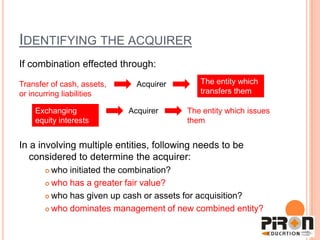
Identifying the acquirerIf combination effected through:In a involving multiple entities, following needs to be considered to determine the acquirer:who initiated the combination?who has a greater fair value?who has given up cash or assets for acquisition?who dominates management of new combined entity?The entity which transfers themTransfer of cash, assets, or incurring liabilitiesAcquirerExchanging equity interestsAcquirerThe entity which issues them
Acquisition DateThe date on which the acquirer effectively obtains the control of acquire is the acquisition dateIt is generally the date on which the acquirer legally transfers the consideration to the acquiree – closing date.But acquirer might obtain control before or after closing date, in which case the date on which it obtains control becomes acquisition date.
Recognition of Assets and LiabilitiesAn acquirer should recognize identifiable assets, liabilities and contingent liabilities if:In case of asset other than intangible asset, it is probable that associated future economic benefits will flow to the acquirer and its value can be measured reliably.In case of liability other than contingent liability, it is probable that an outflow of economic resources will be required to settle the obligation and its value can be estimated reliably.In case of intangible asset or contingent liability, if its value can be measured reliably.In case of contingent liability , if it is a present obligation arising from past event and its value can be measured reliably

IFRS 3 - Business Combinations

  • 1.
  • 2.
    DefinitionIFRS defines BusinessCombination as a transaction through which an acquirer obtains control of one or more businesses. An acquirer may obtain control of an acquire in variety of ways, for example:by incurring liabilitiesby issuing equity interestsby transferring cash, cash equivalents or other assetThe IFRS applies to transaction that meets the definition of business combination. It does not apply to:formation of Joint Ventureacquisition of assets or group of assets that do not constitute a businesscombination of entities under common control
  • 3.
    Acquisition MethodAll businesscombinations are accounted using acquisition method which requires:identification of acquirerdetermining the acquisition daterecognizing and measuring assets, liabilities, and non controlling interest in acquirerecognizing and measuring goodwill or gain on bargain purchase
  • 4.
    Identifying the acquirerIfcombination effected through:In a involving multiple entities, following needs to be considered to determine the acquirer:who initiated the combination?who has a greater fair value?who has given up cash or assets for acquisition?who dominates management of new combined entity?The entity which transfers themTransfer of cash, assets, or incurring liabilitiesAcquirerExchanging equity interestsAcquirerThe entity which issues them
  • 5.
    Acquisition DateThe dateon which the acquirer effectively obtains the control of acquire is the acquisition dateIt is generally the date on which the acquirer legally transfers the consideration to the acquiree – closing date.But acquirer might obtain control before or after closing date, in which case the date on which it obtains control becomes acquisition date.
  • 6.
    Recognition of Assetsand LiabilitiesAn acquirer should recognize identifiable assets, liabilities and contingent liabilities if:In case of asset other than intangible asset, it is probable that associated future economic benefits will flow to the acquirer and its value can be measured reliably.In case of liability other than contingent liability, it is probable that an outflow of economic resources will be required to settle the obligation and its value can be estimated reliably.In case of intangible asset or contingent liability, if its value can be measured reliably.In case of contingent liability , if it is a present obligation arising from past event and its value can be measured reliably