ACCOUNTING FOR  EQUITY COMPENSATION BARBARA BAKSA , Executive Director/National Association of Stock Plan Professionals WIL BECKER, Managing Director/Chartwell Capital Solutions JEREMY WRIGHT, VP, Customer Services / Two Step Software, Inc.   2009 NCEO/Beyster Institute Employee Ownership Conference Portland, OR :  April 22-24, 2009 : Hilton Portland & Executive Tower
OVERVIEW OF FAS 123(R) BARBARA BAKSA , Executive Director/National Association of Stock Plan Professionals
OVERVIEW OF FAS 123(R) Stock plans can be  compensatory  vs.  non-compensatory Compensatory plans result in an income statement expense; non-compensatory plans do not Requirements for non-compensatory status:  Discount of 5% or less  No look-back  Plan must be offered to substantially all employees Most forms of stock compensation are compensatory Stock options and appreciation rights Restricted stock/units Most section 423 ESPPs ESOPs are outside the scope of 123(R)
OVERVIEW OF FAS 123(R) Measurement date  Date on which expense is calculated for the grant Typically the grant date* Expense Fair value of the arrangement Restricted stock and units:  Generally equal to FMV of stock (less any amount paid by employee) Stock options and SARs: Trading prices of similar arrangements If no similar arrangements are traded, estimated using an option pricing model * For arrangements that are settled in stock and granted to employees.
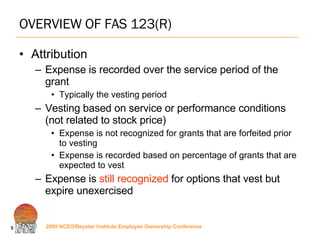
OVERVIEW OF FAS 123(R) Attribution Expense is recorded over the service period of the grant Typically the vesting period Vesting based on service or performance conditions (not related to stock price) Expense is not recognized for grants that are forfeited prior to vesting Expense is recorded based on percentage of grants that are expected to vest Expense is  still recognized  for options that vest but expire unexercised
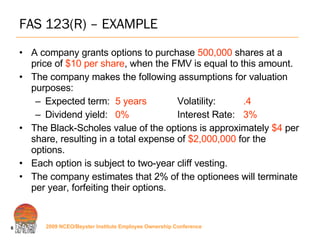
FAS 123(R) – EXAMPLE A company grants options to purchase  500,000  shares at a price of  $10 per share , when the FMV is equal to this amount.  The company makes the following assumptions for valuation purposes: Expected term: 5 years Volatility:  .4 Dividend yield: 0% Interest Rate: 3% The Black-Scholes value of the options is approximately  $4  per share, resulting in a total expense of  $2,000,000  for the options. Each option is subject to two-year cliff vesting. The company estimates that 2% of the optionees will terminate per year, forfeiting their options.
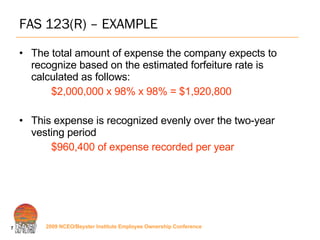
FAS 123(R) – EXAMPLE The total amount of expense the company expects to recognize based on the estimated forfeiture rate is calculated as follows: $2,000,000 x 98% x 98% = $1,920,800 This expense is recognized evenly over the two-year vesting period $960,400 of expense recorded per year
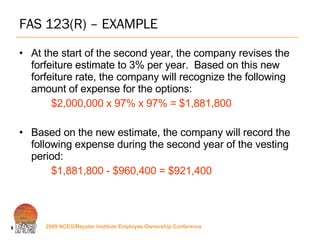
FAS 123(R) – EXAMPLE At the start of the second year, the company revises the forfeiture estimate to 3% per year.  Based on this new forfeiture rate, the company will recognize the following amount of expense for the options: $2,000,000 x 97% x 97% = $1,881,800 Based on the new estimate, the company will record the following expense during the second year of the vesting period: $1,881,800 - $960,400 = $921,400
FAS 123(R) – NON-EMPLOYEES Grants to  non-employees Applies to: Consultants, independent contractors, etc. Does not include outside directors Measurement date is  vest date , not grant date Expense is recorded over vesting period just as for grants to employees Based on estimates of fair value True up to final calculation of fair value at vest
ACCOUNTING FOR TAX EFFECTS Must reconcile expense recorded for stock compensation to tax benefits realized Track tax benefit of each arrangement to expense recognized for that arrangement Expense = Fair value at grant Tax Benefit NQSOs and SARs:  Spread at exercise Restricted stock/RSUs:  Spread at vest Unless 83(b) election is filed, then no reconciliation is necessary ISOs: Spread at exercise or actual gain upon sale (benefit isn’t realized until employee sells stock and then only if sale is a disqualify disposition)
ACCOUNTING FOR TAX EFFECTS Reconciling tax benefit to expense Non-qualified arrangements Record deferred tax asset as arrangement vests based on fair value True up to actual outcome when tax benefit is realized If benefit  exceeds   expense, record excess to paid-in-capital If benefit is  less than  expense, short-fall is recorded to paid-in-capital or treated as additional tax expense ISOs No tax benefit is assumed prior to realization If company realizes a tax benefit, tax expense is reduced at that that time Only to extent of expense recognized, excess benefits are treated as paid-in-capital
OPTION VALUATION WIL BECKER, Managing Director/Chartwell Capital Solutions
WHAT ARE WE VALUING? The option But we also will need the value of the underlying security or the company’s equity value 409A vs. 123(R)
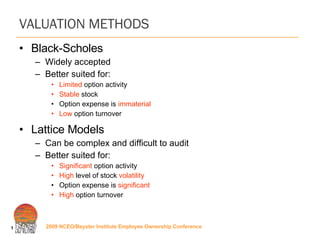
VALUATION METHODS Black-Scholes Widely accepted Better suited for: Limited  option activity Stable  stock Option expense is  immaterial Low  option turnover Lattice Models Can be complex and difficult to audit Better suited for: Significant  option activity High  level of stock  volatility Option expense is  significant   High  option turnover
BLACK-SCHOLES INPUTS Exercise price Risk free rate Underlying stock price Expected term Expected volatility
PRICE AND RATE Exercise price Base exercise price at time of issuance  Risk free rate  Government backed securities Download from  http://federalreserve.gov/datadownload/Choose.aspx?rel=H.15 Should match expected term
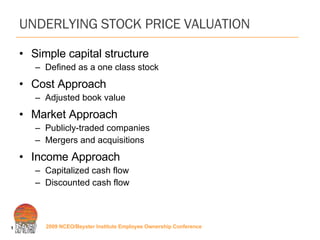
UNDERLYING STOCK PRICE VALUATION Simple capital structure Defined as a one class stock Cost Approach Adjusted book value Market Approach Publicly-traded companies Mergers and acquisitions Income Approach Capitalized cash flow Discounted cash flow
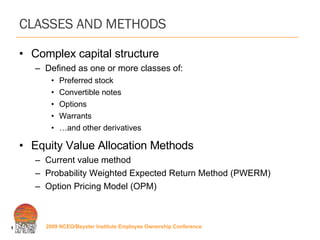
CLASSES AND METHODS Complex capital structure Defined as one or more classes of: Preferred stock Convertible notes Options Warrants … and other derivatives Equity Value Allocation Methods Current value method Probability Weighted Expected Return Method (PWERM) Option Pricing Model (OPM)
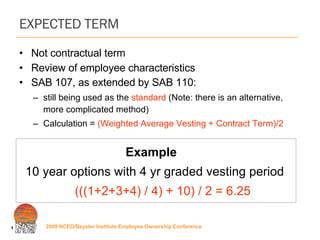
EXPECTED TERM Not contractual term Review of employee characteristics SAB 107, as extended by SAB 110: still being used as the  standard  (Note: there is an alternative, more complicated method) Calculation =  (Weighted Average Vesting + Contract Term)/2 Example   10 year options with 4 yr graded vesting period (((1+2+3+4) / 4) + 10) / 2 = 6.25
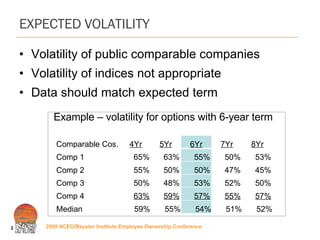
EXPECTED VOLATILITY Volatility of public comparable companies Volatility of indices not appropriate Data should match expected term   Example – volatility for options with 6-year term Comparable Cos. 4Yr 5Yr 6Yr 7Yr 8Yr Comp 1 65% 63% 55% 50% 53% Comp 2 55% 50% 50% 47% 45% Comp 3 50% 48% 53% 52% 50% Comp 4 63% 59% 57% 55% 57% Median 59% 55% 54% 51% 52%
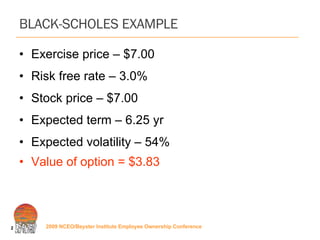
BLACK-SCHOLES EXAMPLE Exercise price – $7.00 Risk free rate – 3.0% Stock price – $7.00 Expected term – 6.25 yr Expected volatility – 54% Value of option = $3.83
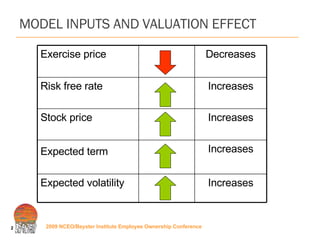
MODEL INPUTS AND VALUATION EFFECT Exercise price Decreases Risk free rate Increases Stock price Increases Expected term Increases Expected volatility Increases
BEST PRACTICES AND  AUTOMATION JEREMY WRIGHT, VP, Customer Services / Two Step Software, Inc.
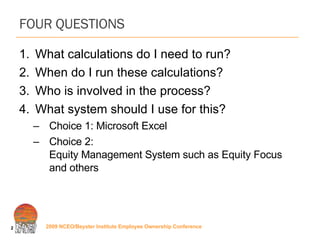
FOUR QUESTIONS What calculations do I need to run? When do I run these calculations? Who is involved in the process? What system should I use for this? Choice 1: Microsoft Excel Choice 2:  Equity Management System such as Equity Focus and others
CALCULATION 1: BLACK-SCHOLES (BSM) Calculation Plenty of Excel calculators on the web All Equity Management Systems can handle it for you Complexity does not come in the actual calculation, but instead : In keeping track of this data overtime Determining the inputs and tracking back-up information
BSM INPUT 1: EXPECTED TERM SAB 107 calculation can be done in Excel, but all systems will do this automatically for you Back-Up Details Needed Justification: not having enough  historical data  to accurately do the alternative method A sample of the calculation used to determine the weighted average vesting
BSM INPUT 2: INTEREST RATE Interest Rate Most systems can download these for you,  and  track over time If your expected term is something like 6.25, you need to  average  the 5 and 7 year terms until you get to a 6.25 result Back-Up Details   A spreadsheet or  report  showing the interest rates downloaded from the Federal Reserve If your expected term is not a year in the spreadsheet, an  example of the calculation  being used to get to the averages
BSM INPUT 3: VOLATILITY Volatility Go to  Yahoo finance  to download their daily stock prices Two Step provides a spreadsheet that you can  feed your peers’ daily closing prices  into for historical volatility calculations.   Email me at  [email_address]  and I’ll send you a download link.  Back-Up Details   A list of your peer companies Any changes in your peers from last year A spreadsheet showing the auditor how you came up with your volatility
CALCULATION 2: AMORTIZATION SCHEDULE Total Value: Number Granted * Fair Value Per Share calculated by BSM The Total Value is then amortized over the service period, but this amount is haircut by your forfeiture rate You will need to track the following for each option grant: The total  fair value  for that grant The  forfeiture rate  applied to that grant The  expensing schedule  on grant The expense recognized  each year  for each grant
CALCULATION 2: AMORTIZATION SCHEDULE Forfeiture Rate If you have enough historical data, this can be calculated based on the  percentage of shares forfeited against grants in each year  of grant. Most systems have a forfeiture rate report that can pull this data for you Use this to:  (a) determine your forfeiture rate for grants going forward (b) compare the forfeiture rate you used against your actual percentage of forfeitures to determine how a true-up will affect your expensing
CALCULATION 2: AMORTIZATION SCHEDULE True-Up Routine   Catch-up all the expensing you need to do within a year  based on actual number of forfeitures (pre-vest cancellations) and actual vesting events If your forfeiture rate estimate is close to your actual forfeitures: little difference in your actual expensing.  If not, could result in: a credit or  taking more expense At the end of the service period, you will have expensed the total value
YOUR FAS 123R RESPONSIBILITIES …  AND WHEN TO DO THEM Determine your Black-Scholes Inputs Determine your Forfeiture Rate Run your expense Report to your Auditor
YOUR FAS 123R RESPONSIBILITIES …  AND WHEN TO DO THEM Determine your Black-Scholes Inputs If you can justify it to your auditor, determine these at the beginning of each fiscal year use throughout the fiscal year Most accurate way is to determine these on each grant date.  An equity management system will help you do this Store documentation on how you determined each of these inputs Determine your Forfeiture Rate Calculate at the beginning of the fiscal year  use for all grants in that year Calculate at the end of the fiscal year to determine if your estimate was good and if you: (a) need to adjust the rate going forward and  (b) true-up your grants to ensure you are taking enough expense NOTE: Some true-up every year Store documentation on how you calculated this rate
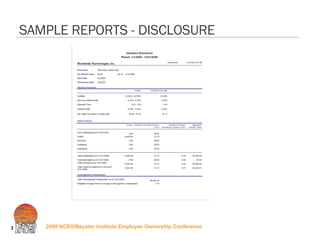
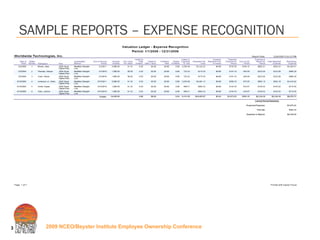
YOUR FAS 123R RESPONSIBILITIES …  AND WHEN TO DO THEM Run your expense Review that all grants are in the system and are accurate Review that all forfeitures are correctly entered (since these will result in a credit) Perform a true-up if needed Review the expense recognition Report to your Auditor End of each fiscal year Minimum disclosures are listed in section A240 of FAS 123R; Next slide has a sample of a equity management system report listing these disclosures Provide as much back-up detail as possible on how you came to these numbers.  This is where keeping good documentation will come in handy
SAMPLE REPORTS - DISCLOSURE
SAMPLE REPORTS – EXPENSE RECOGNITION
THE PLAYERS Stock Administrator Typical Players: HR department, Outside law firm, in-house paralegal Responsibilities: Create paperwork for optionees, process grants, exercises, and cancellations No direct FAS 123R work, but their work feeds directly into the company’s FAS 123R responsibilities Finance Typical Player: CFO, Controller Responsibilities: Determine variables for BSM, generate fair value and expense recognition schedules for grants, run expensing reports to give to auditor Auditor
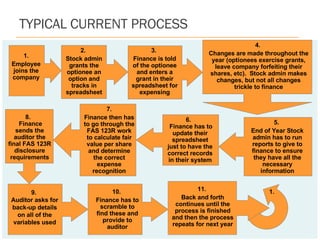
TYPICAL CURRENT PROCESS 1. Employee joins the company 2.  Stock admin grants the optionee an option and tracks in spreadsheet 3.  Finance is told of the optionee and enters a grant in their spreadsheet for expensing 4.  Changes are made throughout the year (optionees exercise grants, leave company forfeiting their shares, etc).  Stock admin makes changes, but not all changes trickle to finance 6.   Finance has to update their spreadsheet just to have the correct records in their system 7. Finance then has to go through the FAS 123R work to calculate fair value per share and determine the correct expense recognition 8.   Finance sends the auditor the final FAS 123R disclosure requirements 9.  Auditor asks for back-up details on all of the variables used 11.  Back and forth continues until the process is finished and then the process repeats for next year 10.  Finance has to scramble to find these and provide to auditor 5.  End of Year Stock admin has to run reports to give to finance to ensure they have all the necessary information 1.
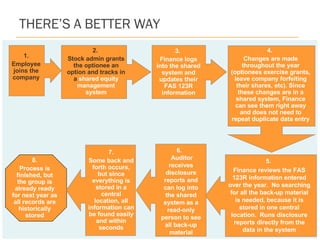
THERE’S A BETTER WAY 1. Employee joins the company 2.  Stock admin grants the optionee an option and tracks in a  shared equity management system 3.  Finance logs into the shared system and updates their FAS 123R information 4.  Changes are made throughout the year (optionees exercise grants, leave company forfeiting their shares, etc). Since these changes are in a shared system, Finance can see them right away and does not need to repeat duplicate data entry 6.   Auditor receives disclosure reports and can log into the shared system as a read-only person to see all back-up material 8. Process is finished, but the group is already ready for next year as all records are historically stored 5.  Finance reviews the FAS 123R information entered over the year.  No searching for all the back-up material is needed, because it is stored in one central location.  Runs disclosure reports directly from the data in the system 7. Some back and forth occurs, but since everything is stored in a central location, all information can be found easily and within seconds
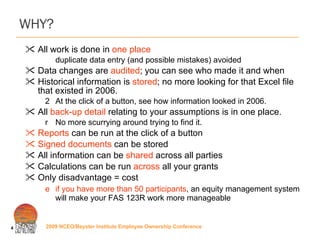
WHY? All work is done in  one place duplicate data entry (and possible mistakes) avoided Data changes are  audited ; you can see who made it and when Historical information is  stored ; no more looking for that Excel file that existed in 2006.  At the click of a button, see how information looked in 2006. All  back-up detail  relating to your assumptions is in one place.  No more scurrying around trying to find it. Reports  can be run at the click of a button Signed documents  can be stored All information can be  shared  across all parties Calculations can be run  across  all your grants  Only disadvantage = cost if you have more than 50 participants , an equity management system will make your FAS 123R work more manageable
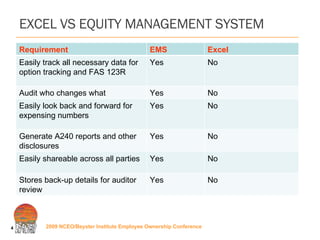
EXCEL VS EQUITY MANAGEMENT SYSTEM Requirement EMS Excel Easily track all necessary data for option tracking and FAS 123R Yes No Audit who changes what Yes No Easily look back and forward for expensing numbers Yes No Generate A240 reports and other disclosures Yes No Easily shareable across all parties Yes No Stores back-up details for auditor review Yes No
CONTACT INFORMATION Barbara Baksa  Email:  [email_address] Blog:  www.naspp.com/blog Web:  www.naspp.com   Wil Becker Email:  [email_address]   Web:  www.chartwellcapitalsolutions.com   Jeremy Wright Email:  [email_address] Twitter:  www.twitter.com/jeremyswright   Web:  www.twostep.com
Thank You

Accounting For Equity Compensation

  • 1.
    ACCOUNTING FOR EQUITY COMPENSATION BARBARA BAKSA , Executive Director/National Association of Stock Plan Professionals WIL BECKER, Managing Director/Chartwell Capital Solutions JEREMY WRIGHT, VP, Customer Services / Two Step Software, Inc. 2009 NCEO/Beyster Institute Employee Ownership Conference Portland, OR : April 22-24, 2009 : Hilton Portland & Executive Tower
  • 2.
    OVERVIEW OF FAS123(R) BARBARA BAKSA , Executive Director/National Association of Stock Plan Professionals
  • 3.
    OVERVIEW OF FAS123(R) Stock plans can be compensatory vs. non-compensatory Compensatory plans result in an income statement expense; non-compensatory plans do not Requirements for non-compensatory status: Discount of 5% or less No look-back Plan must be offered to substantially all employees Most forms of stock compensation are compensatory Stock options and appreciation rights Restricted stock/units Most section 423 ESPPs ESOPs are outside the scope of 123(R)
  • 4.
    OVERVIEW OF FAS123(R) Measurement date Date on which expense is calculated for the grant Typically the grant date* Expense Fair value of the arrangement Restricted stock and units: Generally equal to FMV of stock (less any amount paid by employee) Stock options and SARs: Trading prices of similar arrangements If no similar arrangements are traded, estimated using an option pricing model * For arrangements that are settled in stock and granted to employees.
  • 5.
    OVERVIEW OF FAS123(R) Attribution Expense is recorded over the service period of the grant Typically the vesting period Vesting based on service or performance conditions (not related to stock price) Expense is not recognized for grants that are forfeited prior to vesting Expense is recorded based on percentage of grants that are expected to vest Expense is still recognized for options that vest but expire unexercised
  • 6.
    FAS 123(R) –EXAMPLE A company grants options to purchase 500,000 shares at a price of $10 per share , when the FMV is equal to this amount. The company makes the following assumptions for valuation purposes: Expected term: 5 years Volatility: .4 Dividend yield: 0% Interest Rate: 3% The Black-Scholes value of the options is approximately $4 per share, resulting in a total expense of $2,000,000 for the options. Each option is subject to two-year cliff vesting. The company estimates that 2% of the optionees will terminate per year, forfeiting their options.
  • 7.
    FAS 123(R) –EXAMPLE The total amount of expense the company expects to recognize based on the estimated forfeiture rate is calculated as follows: $2,000,000 x 98% x 98% = $1,920,800 This expense is recognized evenly over the two-year vesting period $960,400 of expense recorded per year
  • 8.
    FAS 123(R) –EXAMPLE At the start of the second year, the company revises the forfeiture estimate to 3% per year. Based on this new forfeiture rate, the company will recognize the following amount of expense for the options: $2,000,000 x 97% x 97% = $1,881,800 Based on the new estimate, the company will record the following expense during the second year of the vesting period: $1,881,800 - $960,400 = $921,400
  • 9.
    FAS 123(R) –NON-EMPLOYEES Grants to non-employees Applies to: Consultants, independent contractors, etc. Does not include outside directors Measurement date is vest date , not grant date Expense is recorded over vesting period just as for grants to employees Based on estimates of fair value True up to final calculation of fair value at vest
  • 10.
    ACCOUNTING FOR TAXEFFECTS Must reconcile expense recorded for stock compensation to tax benefits realized Track tax benefit of each arrangement to expense recognized for that arrangement Expense = Fair value at grant Tax Benefit NQSOs and SARs: Spread at exercise Restricted stock/RSUs: Spread at vest Unless 83(b) election is filed, then no reconciliation is necessary ISOs: Spread at exercise or actual gain upon sale (benefit isn’t realized until employee sells stock and then only if sale is a disqualify disposition)
  • 11.
    ACCOUNTING FOR TAXEFFECTS Reconciling tax benefit to expense Non-qualified arrangements Record deferred tax asset as arrangement vests based on fair value True up to actual outcome when tax benefit is realized If benefit exceeds expense, record excess to paid-in-capital If benefit is less than expense, short-fall is recorded to paid-in-capital or treated as additional tax expense ISOs No tax benefit is assumed prior to realization If company realizes a tax benefit, tax expense is reduced at that that time Only to extent of expense recognized, excess benefits are treated as paid-in-capital
  • 12.
    OPTION VALUATION WILBECKER, Managing Director/Chartwell Capital Solutions
  • 13.
    WHAT ARE WEVALUING? The option But we also will need the value of the underlying security or the company’s equity value 409A vs. 123(R)
  • 14.
    VALUATION METHODS Black-ScholesWidely accepted Better suited for: Limited option activity Stable stock Option expense is immaterial Low option turnover Lattice Models Can be complex and difficult to audit Better suited for: Significant option activity High level of stock volatility Option expense is significant High option turnover
  • 15.
    BLACK-SCHOLES INPUTS Exerciseprice Risk free rate Underlying stock price Expected term Expected volatility
  • 16.
    PRICE AND RATEExercise price Base exercise price at time of issuance Risk free rate Government backed securities Download from http://federalreserve.gov/datadownload/Choose.aspx?rel=H.15 Should match expected term
  • 17.
    UNDERLYING STOCK PRICEVALUATION Simple capital structure Defined as a one class stock Cost Approach Adjusted book value Market Approach Publicly-traded companies Mergers and acquisitions Income Approach Capitalized cash flow Discounted cash flow
  • 18.
    CLASSES AND METHODSComplex capital structure Defined as one or more classes of: Preferred stock Convertible notes Options Warrants … and other derivatives Equity Value Allocation Methods Current value method Probability Weighted Expected Return Method (PWERM) Option Pricing Model (OPM)
  • 19.
    EXPECTED TERM Notcontractual term Review of employee characteristics SAB 107, as extended by SAB 110: still being used as the standard (Note: there is an alternative, more complicated method) Calculation = (Weighted Average Vesting + Contract Term)/2 Example 10 year options with 4 yr graded vesting period (((1+2+3+4) / 4) + 10) / 2 = 6.25
  • 20.
    EXPECTED VOLATILITY Volatilityof public comparable companies Volatility of indices not appropriate Data should match expected term Example – volatility for options with 6-year term Comparable Cos. 4Yr 5Yr 6Yr 7Yr 8Yr Comp 1 65% 63% 55% 50% 53% Comp 2 55% 50% 50% 47% 45% Comp 3 50% 48% 53% 52% 50% Comp 4 63% 59% 57% 55% 57% Median 59% 55% 54% 51% 52%
  • 21.
    BLACK-SCHOLES EXAMPLE Exerciseprice – $7.00 Risk free rate – 3.0% Stock price – $7.00 Expected term – 6.25 yr Expected volatility – 54% Value of option = $3.83
  • 22.
    MODEL INPUTS ANDVALUATION EFFECT Exercise price Decreases Risk free rate Increases Stock price Increases Expected term Increases Expected volatility Increases
  • 23.
    BEST PRACTICES AND AUTOMATION JEREMY WRIGHT, VP, Customer Services / Two Step Software, Inc.
  • 24.
    FOUR QUESTIONS Whatcalculations do I need to run? When do I run these calculations? Who is involved in the process? What system should I use for this? Choice 1: Microsoft Excel Choice 2: Equity Management System such as Equity Focus and others
  • 25.
    CALCULATION 1: BLACK-SCHOLES(BSM) Calculation Plenty of Excel calculators on the web All Equity Management Systems can handle it for you Complexity does not come in the actual calculation, but instead : In keeping track of this data overtime Determining the inputs and tracking back-up information
  • 26.
    BSM INPUT 1:EXPECTED TERM SAB 107 calculation can be done in Excel, but all systems will do this automatically for you Back-Up Details Needed Justification: not having enough historical data to accurately do the alternative method A sample of the calculation used to determine the weighted average vesting
  • 27.
    BSM INPUT 2:INTEREST RATE Interest Rate Most systems can download these for you, and track over time If your expected term is something like 6.25, you need to average the 5 and 7 year terms until you get to a 6.25 result Back-Up Details A spreadsheet or report showing the interest rates downloaded from the Federal Reserve If your expected term is not a year in the spreadsheet, an example of the calculation being used to get to the averages
  • 28.
    BSM INPUT 3:VOLATILITY Volatility Go to Yahoo finance to download their daily stock prices Two Step provides a spreadsheet that you can feed your peers’ daily closing prices into for historical volatility calculations. Email me at [email_address] and I’ll send you a download link. Back-Up Details A list of your peer companies Any changes in your peers from last year A spreadsheet showing the auditor how you came up with your volatility
  • 29.
    CALCULATION 2: AMORTIZATIONSCHEDULE Total Value: Number Granted * Fair Value Per Share calculated by BSM The Total Value is then amortized over the service period, but this amount is haircut by your forfeiture rate You will need to track the following for each option grant: The total fair value for that grant The forfeiture rate applied to that grant The expensing schedule on grant The expense recognized each year for each grant
  • 30.
    CALCULATION 2: AMORTIZATIONSCHEDULE Forfeiture Rate If you have enough historical data, this can be calculated based on the percentage of shares forfeited against grants in each year of grant. Most systems have a forfeiture rate report that can pull this data for you Use this to: (a) determine your forfeiture rate for grants going forward (b) compare the forfeiture rate you used against your actual percentage of forfeitures to determine how a true-up will affect your expensing
  • 31.
    CALCULATION 2: AMORTIZATIONSCHEDULE True-Up Routine Catch-up all the expensing you need to do within a year based on actual number of forfeitures (pre-vest cancellations) and actual vesting events If your forfeiture rate estimate is close to your actual forfeitures: little difference in your actual expensing. If not, could result in: a credit or taking more expense At the end of the service period, you will have expensed the total value
  • 32.
    YOUR FAS 123RRESPONSIBILITIES … AND WHEN TO DO THEM Determine your Black-Scholes Inputs Determine your Forfeiture Rate Run your expense Report to your Auditor
  • 33.
    YOUR FAS 123RRESPONSIBILITIES … AND WHEN TO DO THEM Determine your Black-Scholes Inputs If you can justify it to your auditor, determine these at the beginning of each fiscal year use throughout the fiscal year Most accurate way is to determine these on each grant date. An equity management system will help you do this Store documentation on how you determined each of these inputs Determine your Forfeiture Rate Calculate at the beginning of the fiscal year use for all grants in that year Calculate at the end of the fiscal year to determine if your estimate was good and if you: (a) need to adjust the rate going forward and (b) true-up your grants to ensure you are taking enough expense NOTE: Some true-up every year Store documentation on how you calculated this rate
  • 34.
    YOUR FAS 123RRESPONSIBILITIES … AND WHEN TO DO THEM Run your expense Review that all grants are in the system and are accurate Review that all forfeitures are correctly entered (since these will result in a credit) Perform a true-up if needed Review the expense recognition Report to your Auditor End of each fiscal year Minimum disclosures are listed in section A240 of FAS 123R; Next slide has a sample of a equity management system report listing these disclosures Provide as much back-up detail as possible on how you came to these numbers. This is where keeping good documentation will come in handy
  • 35.
    SAMPLE REPORTS -DISCLOSURE
  • 36.
    SAMPLE REPORTS –EXPENSE RECOGNITION
  • 37.
    THE PLAYERS StockAdministrator Typical Players: HR department, Outside law firm, in-house paralegal Responsibilities: Create paperwork for optionees, process grants, exercises, and cancellations No direct FAS 123R work, but their work feeds directly into the company’s FAS 123R responsibilities Finance Typical Player: CFO, Controller Responsibilities: Determine variables for BSM, generate fair value and expense recognition schedules for grants, run expensing reports to give to auditor Auditor
  • 38.
    TYPICAL CURRENT PROCESS1. Employee joins the company 2. Stock admin grants the optionee an option and tracks in spreadsheet 3. Finance is told of the optionee and enters a grant in their spreadsheet for expensing 4. Changes are made throughout the year (optionees exercise grants, leave company forfeiting their shares, etc). Stock admin makes changes, but not all changes trickle to finance 6. Finance has to update their spreadsheet just to have the correct records in their system 7. Finance then has to go through the FAS 123R work to calculate fair value per share and determine the correct expense recognition 8. Finance sends the auditor the final FAS 123R disclosure requirements 9. Auditor asks for back-up details on all of the variables used 11. Back and forth continues until the process is finished and then the process repeats for next year 10. Finance has to scramble to find these and provide to auditor 5. End of Year Stock admin has to run reports to give to finance to ensure they have all the necessary information 1.
  • 39.
    THERE’S A BETTERWAY 1. Employee joins the company 2. Stock admin grants the optionee an option and tracks in a shared equity management system 3. Finance logs into the shared system and updates their FAS 123R information 4. Changes are made throughout the year (optionees exercise grants, leave company forfeiting their shares, etc). Since these changes are in a shared system, Finance can see them right away and does not need to repeat duplicate data entry 6. Auditor receives disclosure reports and can log into the shared system as a read-only person to see all back-up material 8. Process is finished, but the group is already ready for next year as all records are historically stored 5. Finance reviews the FAS 123R information entered over the year. No searching for all the back-up material is needed, because it is stored in one central location. Runs disclosure reports directly from the data in the system 7. Some back and forth occurs, but since everything is stored in a central location, all information can be found easily and within seconds
  • 40.
    WHY? All workis done in one place duplicate data entry (and possible mistakes) avoided Data changes are audited ; you can see who made it and when Historical information is stored ; no more looking for that Excel file that existed in 2006. At the click of a button, see how information looked in 2006. All back-up detail relating to your assumptions is in one place. No more scurrying around trying to find it. Reports can be run at the click of a button Signed documents can be stored All information can be shared across all parties Calculations can be run across all your grants Only disadvantage = cost if you have more than 50 participants , an equity management system will make your FAS 123R work more manageable
  • 41.
    EXCEL VS EQUITYMANAGEMENT SYSTEM Requirement EMS Excel Easily track all necessary data for option tracking and FAS 123R Yes No Audit who changes what Yes No Easily look back and forward for expensing numbers Yes No Generate A240 reports and other disclosures Yes No Easily shareable across all parties Yes No Stores back-up details for auditor review Yes No
  • 42.
    CONTACT INFORMATION BarbaraBaksa Email: [email_address] Blog: www.naspp.com/blog Web: www.naspp.com Wil Becker Email: [email_address] Web: www.chartwellcapitalsolutions.com Jeremy Wright Email: [email_address] Twitter: www.twitter.com/jeremyswright Web: www.twostep.com
  • 43.