Applying IFRS Standards 4th Edition Picker Test
Bank download
https://testbankfan.com/product/applying-ifrs-standards-4th-
edition-picker-test-bank/
Find test banks or solution manuals at testbankfan.com today!
Here are some recommended products for you. Click the link to
download, or explore more at testbankfan.com
Applying IFRS Standards 4th Edition Picker Solutions
Manual
https://testbankfan.com/product/applying-ifrs-standards-4th-edition-
picker-solutions-manual/
Reading Understanding and Applying Nursing Research 4th
Edition Fain Test Bank
https://testbankfan.com/product/reading-understanding-and-applying-
nursing-research-4th-edition-fain-test-bank/
Cognitive Psychology Applying The Science of the Mind 4th
Edition Robinson-Riegler Test Bank
https://testbankfan.com/product/cognitive-psychology-applying-the-
science-of-the-mind-4th-edition-robinson-riegler-test-bank/
Advanced Engineering Mathematics 2nd Edition Greenberg
Solutions Manual
https://testbankfan.com/product/advanced-engineering-mathematics-2nd-
edition-greenberg-solutions-manual/
Strategic Analysis and Action 8th Edition Crossan Test
Bank
https://testbankfan.com/product/strategic-analysis-and-action-8th-
edition-crossan-test-bank/
Intermediate Microeconomics 1st Edition Mochrie Solutions
Manual
https://testbankfan.com/product/intermediate-microeconomics-1st-
edition-mochrie-solutions-manual/
Practical Financial Management 7th Edition Lasher Test
Bank
https://testbankfan.com/product/practical-financial-management-7th-
edition-lasher-test-bank/
Taxation of Business Entities 4th Edition Spilker Test
Bank
https://testbankfan.com/product/taxation-of-business-entities-4th-
edition-spilker-test-bank/
Exploring Biological Anthropology The Essentials Books a
la Carte 3rd Edition Stanford Test Bank
https://testbankfan.com/product/exploring-biological-anthropology-the-
essentials-books-a-la-carte-3rd-edition-stanford-test-bank/
Communications Law Liberties Restraints and the Modern
Media 6th Edition Zelezny Test Bank
https://testbankfan.com/product/communications-law-liberties-
restraints-and-the-modern-media-6th-edition-zelezny-test-bank/
Testbank
to accompany
Applying IFRS®
Standards 4e
Ruth Picker, Kerry Clark, John Dunn, David Kolitz, Gilad
Livne, Janice Loftus, Leo van der Tas
Prepared by
John Sweeting, Emma Holmes and
Elisabetta Barone
John Wiley & Sons, Ltd 2016
Chapter 8 Share-based payment
© John Wiley & Sons, Ltd 2016 8.2
CHAPTER 8
Share-based payment
Learning Objectives
8.1 Explain the objective and scope of IFRS 2
8.2 Distinguish between cash-settled and equity-settled share-based payment transactions
8.3 Demonstrate how equity-settled and cash settled share-based payment transactions are
recognised
8.4 Explain how equity-settled share-based payment transactions are measured
8.5 Explain the concept of vesting through differentiating between vesting and non-vesting
conditions
8.6 Explain the concept of a share option reload feature
8.7 Explain how modifications to granted equity instruments are treated
8.8 Demonstrate how cash-settled share-based payment transactions are measured
8.9 Describe and apply the disclosure requirements of IFRS 2.
Test Bank to accompany Applying IFRS Standards 4e
© John Wiley & Sons, Ltd 2016 8.3
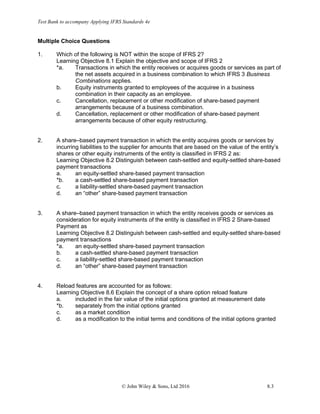
Multiple Choice Questions
1. Which of the following is NOT within the scope of IFRS 2?
Learning Objective 8.1 Explain the objective and scope of IFRS 2
*a. Transactions in which the entity receives or acquires goods or services as part of
the net assets acquired in a business combination to which IFRS 3 Business
Combinations applies.
b. Equity instruments granted to employees of the acquiree in a business
combination in their capacity as an employee.
c. Cancellation, replacement or other modification of share-based payment
arrangements because of a business combination.
d. Cancellation, replacement or other modification of share-based payment
arrangements because of other equity restructuring.
2. A share–based payment transaction in which the entity acquires goods or services by
incurring liabilities to the supplier for amounts that are based on the value of the entity’s
shares or other equity instruments of the entity is classified in IFRS 2 as:
Learning Objective 8.2 Distinguish between cash-settled and equity-settled share-based
payment transactions
a. an equity-settled share-based payment transaction
*b. a cash-settled share-based payment transaction
c. a liability-settled share-based payment transaction
d. an “other” share-based payment transaction
3. A share–based payment transaction in which the entity receives goods or services as
consideration for equity instruments of the entity is classified in IFRS 2 Share-based
Payment as
Learning Objective 8.2 Distinguish between cash-settled and equity-settled share-based
payment transactions
*a. an equity-settled share-based payment transaction
b. a cash-settled share-based payment transaction
c. a liability-settled share-based payment transaction
d. an “other” share-based payment transaction
4. Reload features are accounted for as follows:
Learning Objective 8.6 Explain the concept of a share option reload feature
a. included in the fair value of the initial options granted at measurement date
*b. separately from the initial options granted
c. as a market condition
d. as a modification to the initial terms and conditions of the initial options granted
Chapter 8 Share-based payment
© John Wiley & Sons, Ltd 2016 8.4
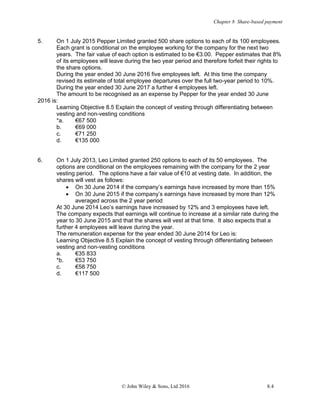
5. On 1 July 2015 Pepper Limited granted 500 share options to each of its 100 employees.
Each grant is conditional on the employee working for the company for the next two
years. The fair value of each option is estimated to be €3.00. Pepper estimates that 8%
of its employees will leave during the two year period and therefore forfeit their rights to
the share options.
During the year ended 30 June 2016 five employees left. At this time the company
revised its estimate of total employee departures over the full two-year period to 10%.
During the year ended 30 June 2017 a further 4 employees left.
The amount to be recognised as an expense by Pepper for the year ended 30 June
2016 is:
Learning Objective 8.5 Explain the concept of vesting through differentiating between
vesting and non-vesting conditions
*a. €67 500
b. €69 000
c. €71 250
d. €135 000
6. On 1 July 2013, Leo Limited granted 250 options to each of its 50 employees. The
options are conditional on the employees remaining with the company for the 2 year
vesting period. The options have a fair value of €10 at vesting date. In addition, the
shares will vest as follows:
• On 30 June 2014 if the company’s earnings have increased by more than 15%
• On 30 June 2015 if the company’s earnings have increased by more than 12%
averaged across the 2 year period
At 30 June 2014 Leo’s earnings have increased by 12% and 3 employees have left.
The company expects that earnings will continue to increase at a similar rate during the
year to 30 June 2015 and that the shares will vest at that time. It also expects that a
further 4 employees will leave during the year.
The remuneration expense for the year ended 30 June 2014 for Leo is:
Learning Objective 8.5 Explain the concept of vesting through differentiating between
vesting and non-vesting conditions
a. €35 833
*b. €53 750
c. €58 750
d. €117 500
Test Bank to accompany Applying IFRS Standards 4e
© John Wiley & Sons, Ltd 2016 8.5
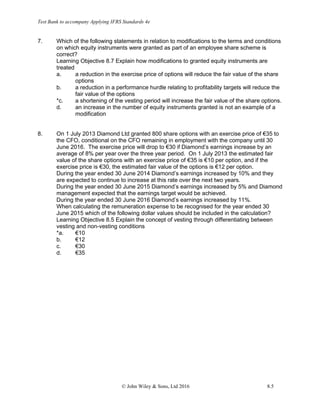
7. Which of the following statements in relation to modifications to the terms and conditions
on which equity instruments were granted as part of an employee share scheme is
correct?
Learning Objective 8.7 Explain how modifications to granted equity instruments are
treated
a. a reduction in the exercise price of options will reduce the fair value of the share
options
b. a reduction in a performance hurdle relating to profitability targets will reduce the
fair value of the options
*c. a shortening of the vesting period will increase the fair value of the share options.
d. an increase in the number of equity instruments granted is not an example of a
modification
8. On 1 July 2013 Diamond Ltd granted 800 share options with an exercise price of €35 to
the CFO, conditional on the CFO remaining in employment with the company until 30
June 2016. The exercise price will drop to €30 if Diamond’s earnings increase by an
average of 8% per year over the three year period. On 1 July 2013 the estimated fair
value of the share options with an exercise price of €35 is €10 per option, and if the
exercise price is €30, the estimated fair value of the options is €12 per option.
During the year ended 30 June 2014 Diamond’s earnings increased by 10% and they
are expected to continue to increase at this rate over the next two years.
During the year ended 30 June 2015 Diamond’s earnings increased by 5% and Diamond
management expected that the earnings target would be achieved.
During the year ended 30 June 2016 Diamond’s earnings increased by 11%.
When calculating the remuneration expense to be recognised for the year ended 30
June 2015 which of the following dollar values should be included in the calculation?
Learning Objective 8.5 Explain the concept of vesting through differentiating between
vesting and non-vesting conditions
*a. €10
b. €12
c. €30
d. €35
Chapter 8 Share-based payment
© John Wiley & Sons, Ltd 2016 8.6
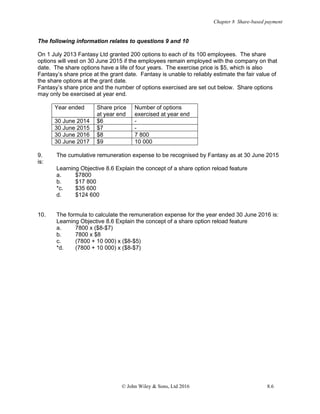
The following information relates to questions 9 and 10
On 1 July 2013 Fantasy Ltd granted 200 options to each of its 100 employees. The share
options will vest on 30 June 2015 if the employees remain employed with the company on that
date. The share options have a life of four years. The exercise price is $5, which is also
Fantasy’s share price at the grant date. Fantasy is unable to reliably estimate the fair value of
the share options at the grant date.
Fantasy’s share price and the number of options exercised are set out below. Share options
may only be exercised at year end.
Year ended Share price
at year end
Number of options
exercised at year end
30 June 2014 $6 -
30 June 2015 $7 -
30 June 2016 $8 7 800
30 June 2017 $9 10 000
9. The cumulative remuneration expense to be recognised by Fantasy as at 30 June 2015
is:
Learning Objective 8.6 Explain the concept of a share option reload feature
a. $7800
b. $17 800
*c. $35 600
d. $124 600
10. The formula to calculate the remuneration expense for the year ended 30 June 2016 is:
Learning Objective 8.6 Explain the concept of a share option reload feature
a. 7800 x ($8-$7)
b. 7800 x $8
c. (7800 + 10 000) x ($8-$5)
*d. (7800 + 10 000) x ($8-$7)
Test Bank to accompany Applying IFRS Standards 4e
© John Wiley & Sons, Ltd 2016 8.7
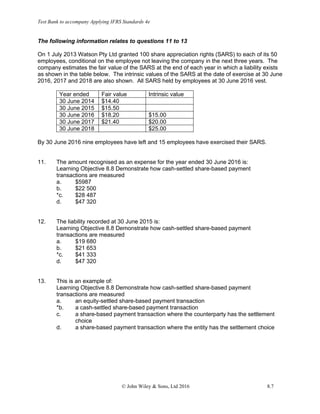
The following information relates to questions 11 to 13
On 1 July 2013 Watson Pty Ltd granted 100 share appreciation rights (SARS) to each of its 50
employees, conditional on the employee not leaving the company in the next three years. The
company estimates the fair value of the SARS at the end of each year in which a liability exists
as shown in the table below. The intrinsic values of the SARS at the date of exercise at 30 June
2016, 2017 and 2018 are also shown. All SARS held by employees at 30 June 2016 vest.
Year ended Fair value Intrinsic value
30 June 2014 $14.40
30 June 2015 $15.50
30 June 2016 $18.20 $15.00
30 June 2017 $21.40 $20.00
30 June 2018 $25.00
By 30 June 2016 nine employees have left and 15 employees have exercised their SARS.
11. The amount recognised as an expense for the year ended 30 June 2016 is:
Learning Objective 8.8 Demonstrate how cash-settled share-based payment
transactions are measured
a. $5987
b. $22 500
*c. $28 487
d. $47 320
12. The liability recorded at 30 June 2015 is:
Learning Objective 8.8 Demonstrate how cash-settled share-based payment
transactions are measured
a. $19 680
b. $21 653
*c. $41 333
d. $47 320
13. This is an example of:
Learning Objective 8.8 Demonstrate how cash-settled share-based payment
transactions are measured
a. an equity-settled share-based payment transaction
*b. a cash-settled share-based payment transaction
c. a share-based payment transaction where the counterparty has the settlement
choice
d. a share-based payment transaction where the entity has the settlement choice
Chapter 8 Share-based payment
© John Wiley & Sons, Ltd 2016 8.8
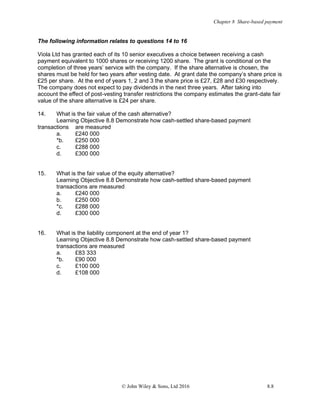
The following information relates to questions 14 to 16
Viola Ltd has granted each of its 10 senior executives a choice between receiving a cash
payment equivalent to 1000 shares or receiving 1200 share. The grant is conditional on the
completion of three years’ service with the company. If the share alternative is chosen, the
shares must be held for two years after vesting date. At grant date the company’s share price is
£25 per share. At the end of years 1, 2 and 3 the share price is £27, £28 and £30 respectively.
The company does not expect to pay dividends in the next three years. After taking into
account the effect of post-vesting transfer restrictions the company estimates the grant-date fair
value of the share alternative is £24 per share.
14. What is the fair value of the cash alternative?
Learning Objective 8.8 Demonstrate how cash-settled share-based payment
transactions are measured
a. £240 000
*b. £250 000
c. £288 000
d. £300 000
15. What is the fair value of the equity alternative?
Learning Objective 8.8 Demonstrate how cash-settled share-based payment
transactions are measured
a. £240 000
b. £250 000
*c. £288 000
d. £300 000
16. What is the liability component at the end of year 1?
Learning Objective 8.8 Demonstrate how cash-settled share-based payment
transactions are measured
a. £83 333
*b. £90 000
c. £100 000
d. £108 000
Test Bank to accompany Applying IFRS Standards 4e
© John Wiley & Sons, Ltd 2016 8.9
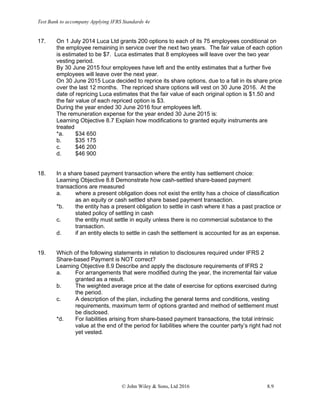
17. On 1 July 2014 Luca Ltd grants 200 options to each of its 75 employees conditional on
the employee remaining in service over the next two years. The fair value of each option
is estimated to be $7. Luca estimates that 8 employees will leave over the two year
vesting period.
By 30 June 2015 four employees have left and the entity estimates that a further five
employees will leave over the next year.
On 30 June 2015 Luca decided to reprice its share options, due to a fall in its share price
over the last 12 months. The repriced share options will vest on 30 June 2016. At the
date of repricing Luca estimates that the fair value of each original option is $1.50 and
the fair value of each repriced option is $3.
During the year ended 30 June 2016 four employees left.
The remuneration expense for the year ended 30 June 2015 is:
Learning Objective 8.7 Explain how modifications to granted equity instruments are
treated
*a. $34 650
b. $35 175
c. $46 200
d. $46 900
18. In a share based payment transaction where the entity has settlement choice:
Learning Objective 8.8 Demonstrate how cash-settled share-based payment
transactions are measured
a. where a present obligation does not exist the entity has a choice of classification
as an equity or cash settled share based payment transaction.
*b. the entity has a present obligation to settle in cash where it has a past practice or
stated policy of settling in cash
c. the entity must settle in equity unless there is no commercial substance to the
transaction.
d. if an entity elects to settle in cash the settlement is accounted for as an expense.
19. Which of the following statements in relation to disclosures required under IFRS 2
Share-based Payment is NOT correct?
Learning Objective 8.9 Describe and apply the disclosure requirements of IFRS 2
a. For arrangements that were modified during the year, the incremental fair value
granted as a result.
b. The weighted average price at the date of exercise for options exercised during
the period.
c. A description of the plan, including the general terms and conditions, vesting
requirements, maximum term of options granted and method of settlement must
be disclosed.
*d. For liabilities arising from share-based payment transactions, the total intrinsic
value at the end of the period for liabilities where the counter party’s right had not
yet vested.
Chapter 8 Share-based payment
© John Wiley & Sons, Ltd 2016 8.10
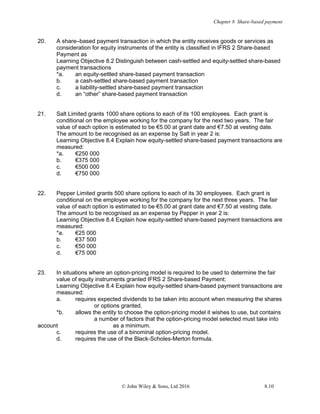
20. A share–based payment transaction in which the entity receives goods or services as
consideration for equity instruments of the entity is classified in IFRS 2 Share-based
Payment as
Learning Objective 8.2 Distinguish between cash-settled and equity-settled share-based
payment transactions
*a. an equity-settled share-based payment transaction
b. a cash-settled share-based payment transaction
c. a liability-settled share-based payment transaction
d. an “other” share-based payment transaction
21. Salt Limited grants 1000 share options to each of its 100 employees. Each grant is
conditional on the employee working for the company for the next two years. The fair
value of each option is estimated to be €5.00 at grant date and €7.50 at vesting date.
The amount to be recognised as an expense by Salt in year 2 is:
Learning Objective 8.4 Explain how equity-settled share-based payment transactions are
measured:
*a. €250 000
b. €375 000
c. €500 000
d. €750 000
22. Pepper Limited grants 500 share options to each of its 30 employees. Each grant is
conditional on the employee working for the company for the next three years. The fair
value of each option is estimated to be €5.00 at grant date and €7.50 at vesting date.
The amount to be recognised as an expense by Pepper in year 2 is:
Learning Objective 8.4 Explain how equity-settled share-based payment transactions are
measured:
*a. €25 000
b. €37 500
c. €50 000
d. €75 000
23. In situations where an option-pricing model is required to be used to determine the fair
value of equity instruments granted IFRS 2 Share-based Payment:
Learning Objective 8.4 Explain how equity-settled share-based payment transactions are
measured:
a. requires expected dividends to be taken into account when measuring the shares
or options granted.
*b. allows the entity to choose the option-pricing model it wishes to use, but contains
a number of factors that the option-pricing model selected must take into
account as a minimum.
c. requires the use of a binominal option-pricing model.
d. requires the use of the Black-Scholes-Merton formula.
Test Bank to accompany Applying IFRS Standards 4e
© John Wiley & Sons, Ltd 2016 8.11
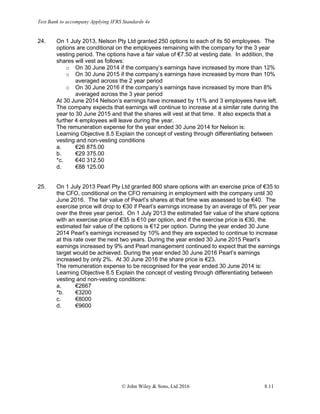
24. On 1 July 2013, Nelson Pty Ltd granted 250 options to each of its 50 employees. The
options are conditional on the employees remaining with the company for the 3 year
vesting period. The options have a fair value of €7.50 at vesting date. In addition, the
shares will vest as follows:
o On 30 June 2014 if the company’s earnings have increased by more than 12%
o On 30 June 2015 if the company’s earnings have increased by more than 10%
averaged across the 2 year period
o On 30 June 2016 if the company’s earnings have increased by more than 8%
averaged across the 3 year period
At 30 June 2014 Nelson’s earnings have increased by 11% and 3 employees have left.
The company expects that earnings will continue to increase at a similar rate during the
year to 30 June 2015 and that the shares will vest at that time. It also expects that a
further 4 employees will leave during the year.
The remuneration expense for the year ended 30 June 2014 for Nelson is:
Learning Objective 8.5 Explain the concept of vesting through differentiating between
vesting and non-vesting conditions
a. €26 875.00
b. €29 375.00
*c. €40 312.50
d. €88 125.00
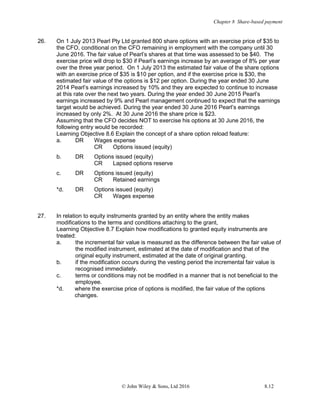
25. On 1 July 2013 Pearl Pty Ltd granted 800 share options with an exercise price of €35 to
the CFO, conditional on the CFO remaining in employment with the company until 30
June 2016. The fair value of Pearl’s shares at that time was assessed to be €40. The
exercise price will drop to €30 if Pearl’s earnings increase by an average of 8% per year
over the three year period. On 1 July 2013 the estimated fair value of the share options
with an exercise price of €35 is €10 per option, and if the exercise price is €30, the
estimated fair value of the options is €12 per option. During the year ended 30 June
2014 Pearl’s earnings increased by 10% and they are expected to continue to increase
at this rate over the next two years. During the year ended 30 June 2015 Pearl’s
earnings increased by 9% and Pearl management continued to expect that the earnings
target would be achieved. During the year ended 30 June 2016 Pearl’s earnings
increased by only 2%. At 30 June 2016 the share price is €23.
The remuneration expense to be recognised for the year ended 30 June 2014 is:
Learning Objective 8.5 Explain the concept of vesting through differentiating between
vesting and non-vesting conditions:
a. €2667
*b. €3200
c. €8000
d. €9600
Chapter 8 Share-based payment
© John Wiley & Sons, Ltd 2016 8.12
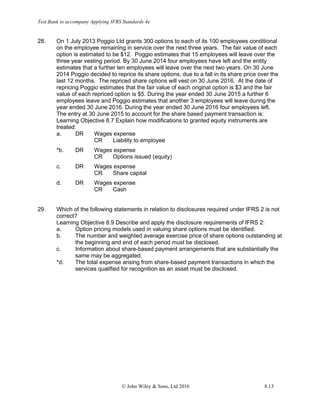
26. On 1 July 2013 Pearl Pty Ltd granted 800 share options with an exercise price of $35 to
the CFO, conditional on the CFO remaining in employment with the company until 30
June 2016. The fair value of Pearl’s shares at that time was assessed to be $40. The
exercise price will drop to $30 if Pearl’s earnings increase by an average of 8% per year
over the three year period. On 1 July 2013 the estimated fair value of the share options
with an exercise price of $35 is $10 per option, and if the exercise price is $30, the
estimated fair value of the options is $12 per option. During the year ended 30 June
2014 Pearl’s earnings increased by 10% and they are expected to continue to increase
at this rate over the next two years. During the year ended 30 June 2015 Pearl’s
earnings increased by 9% and Pearl management continued to expect that the earnings
target would be achieved. During the year ended 30 June 2016 Pearl’s earnings
increased by only 2%. At 30 June 2016 the share price is $23.
Assuming that the CFO decides NOT to exercise his options at 30 June 2016, the
following entry would be recorded:
Learning Objective 8.6 Explain the concept of a share option reload feature:
a. DR Wages expense
CR Options issued (equity)
b. DR Options issued (equity)
CR Lapsed options reserve
c. DR Options issued (equity)
CR Retained earnings
*d. DR Options issued (equity)
CR Wages expense
27. In relation to equity instruments granted by an entity where the entity makes
modifications to the terms and conditions attaching to the grant,
Learning Objective 8.7 Explain how modifications to granted equity instruments are
treated:
a. the incremental fair value is measured as the difference between the fair value of
the modified instrument, estimated at the date of modification and that of the
original equity instrument, estimated at the date of original granting.
b. if the modification occurs during the vesting period the incremental fair value is
recognised immediately.
c. terms or conditions may not be modified in a manner that is not beneficial to the
employee.
*d. where the exercise price of options is modified, the fair value of the options
changes.
Test Bank to accompany Applying IFRS Standards 4e
© John Wiley & Sons, Ltd 2016 8.13
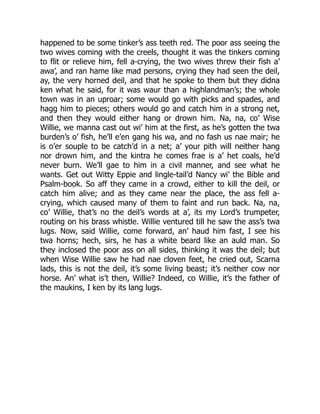
28. On 1 July 2013 Poggio Ltd grants 300 options to each of its 100 employees conditional
on the employee remaining in service over the next three years. The fair value of each
option is estimated to be $12. Poggio estimates that 15 employees will leave over the
three year vesting period. By 30 June 2014 four employees have left and the entity
estimates that a further ten employees will leave over the next two years. On 30 June
2014 Poggio decided to reprice its share options, due to a fall in its share price over the
last 12 months. The repriced share options will vest on 30 June 2016. At the date of
repricing Poggio estimates that the fair value of each original option is $3 and the fair
value of each repriced option is $5. During the year ended 30 June 2015 a further 6
employees leave and Poggio estimates that another 3 employees will leave during the
year ended 30 June 2016. During the year ended 30 June 2016 four employees left.
The entry at 30 June 2015 to account for the share based payment transaction is:
Learning Objective 8.7 Explain how modifications to granted equity instruments are
treated:
a. DR Wages expense
CR Liability to employee
*b. DR Wages expense
CR Options issued (equity)
c. DR Wages expense
CR Share capital
d. DR Wages expense
CR Cash
29. Which of the following statements in relation to disclosures required under IFRS 2 is not
correct?
Learning Objective 8.9 Describe and apply the disclosure requirements of IFRS 2:
a. Option pricing models used in valuing share options must be identified.
b. The number and weighted average exercise price of share options outstanding at
the beginning and end of each period must be disclosed.
c. Information about share-based payment arrangements that are substantially the
same may be aggregated.
*d. The total expense arising from share-based payment transactions in which the
services qualified for recognition as an asset must be disclosed.
Random documents with unrelated
content Scribd suggests to you:
happened to be some tinker’s ass teeth red. The poor ass seeing the
two wives coming with the creels, thought it was the tinkers coming
to flit or relieve him, fell a-crying, the two wives threw their fish a’
awa’, and ran hame like mad persons, crying they had seen the deil,
ay, the very horned deil, and that he spoke to them but they didna
ken what he said, for it was waur than a highlandman’s; the whole
town was in an uproar; some would go with picks and spades, and
hagg him to pieces; others would go and catch him in a strong net,
and then they would either hang or drown him. Na, na, co’ Wise
Willie, we manna cast out wi’ him at the first, as he’s gotten the twa
burden’s o’ fish, he’ll e’en gang his wa, and no fash us nae mair; he
is o’er souple to be catch’d in a net; a’ your pith will neither hang
nor drown him, and the kintra he comes frae is a’ het coals, he’d
never burn. We’ll gae to him in a civil manner, and see what he
wants. Get out Witty Eppie and lingle-tail’d Nancy wi’ the Bible and
Psalm-book. So aff they came in a crowd, either to kill the deil, or
catch him alive; and as they came near the place, the ass fell a-
crying, which caused many of them to faint and run back. Na, na,
co’ Willie, that’s no the deil’s words at a’, its my Lord’s trumpeter,
routing on his brass whistle. Willie ventured till he saw the ass’s twa
lugs. Now, said Willie, come forward, an’ haud him fast, I see his
twa horns; hech, sirs, he has a white beard like an auld man. So
they inclosed the poor ass on all sides, thinking it was the deil; but
when Wise Willie saw he had nae cloven feet, he cried out, Scarna
lads, this is not the deil, it’s some living beast; it’s neither cow nor
horse. An’ what is’t then, Willie? Indeed, co Willie, it’s the father of
the maukins, I ken by its lang lugs.
Now some say this history is too satirical, but it is according to the
knowledge of those times, not to say one place by another. The old
wives will tell you yet of many such stories of the devil appearing to
their grandfathers and grandmothers, and dead wives coming back
again to visit their families long after being dead. So this Buchaven
was once noted for droll exploits; but it is now become better
known, and a place that produces the hardiest sailors of any town
on the Scots coast. Yet many of the old people in it still retain the
old tincture of their ancient and uncultivated speech, such as Be-go,
laddie; they are also of a fiery nature, for if you ask any of their
wives where their college stands, they’ll tell you, if your nose was in
their a—e, your mouth would be at the door of it.
Now, it happened when Wise Willie turned old, he took a great
swelling in his wame, and casting up his kail, collops, and cauld fish,
that nothing could stand on his stomach; and a stout stomach he
had for crabs heads, and scate broo, or brose in a bridal morning;
yet it fail’d him, and he fell sick. None could cure him, nor tell what
ail’d him, till a mountebank stage doctor came to Kircaldy that could
judge by people’s piss the trouble of their person. Wise Willie
hearing of his fame, pissed into the bottle, and sent it away with his
daughter. The bottle being uncorked, his daughter spilt it by the way,
and to conceal her sloth in so doing, pissed in it herself, and on she
goes till she came to the stage-doctor, when she cried out aloud, Sir
Doctor, Sir Doctor, here is a bottle of my father’s wash, he has a sair
guts, and needs na drite ony, but spues a’ he eats. It’s true I tell
you, my dow. The doctor looks at it, then says, it’s not your father’s
surely, it’s your mither’s. The deil’s in the man, said she, divna I ken
my father frae my mother. Then, said he, he is with child. The deil’s
in the man, co’ she, for my mither bare a’ de bairns before; dat’s no
true, sir, fegs ye’re a great liar. Hame she comes, and tell’d Willie,
her father, that the doctor said he was wi’ bairn. O waes me, co’
Willie, for I hae a muckle wame, an’ I fear its owre true. O plague on
you, Janet, for ye’re the father o’t, an’ I am sure to die in the
bearing o’t. Witty Eppie was sent for, as she was a houdie, an’ she
fand a’ Willie’s wame, to be sure about it. Indeed, co’ Eppie, ye’re
the first man ere I saw wi’ bairn before. and how ye’ll bare it, troth I
dinna ken, but I would drink salt sea-water and drown it in my guts
—for if men get ance the gate o’ bearing weans themselves, they’ll
need nae mair wives. So Willie drank sea-water till his guts was like
to rive, and out he got to ease himself among the kail; and with the
terrible noise of his farting, up starts a maukin behind him, who
thought it was shot. Willie seeing her jump o’er the dyke, thought it
was a child brought forth, and cried out, come back, my dear, and
be christened, and dinna rin to the hills to be a pagan. So Willie
grew better every day thereafter, being brought to bed in the kail
yard; but his daughter was brought to bed some months after, which
was the cause of the doctor’s mistake.
Now Wise Willie had a daughter called Rolling Coughing Jenny,
because she spak thick, sax words at three times, half sense and
half nonsense, as her own records will bear witness. She being with
child, and delivered of a bonnie lassie; and all the wives in the town
cried out be-go, laddie, it’s just like its ain father, lang Sandy Tason
(or Thomson), we ken by his lang nose; for Sandy had a great
muckle red nose, like a labster’s tae, bowed at the point like a
hawk’s neb, and Sandy himself said that it was surely his, or some
other body’s; but he had used a’ his bir at the getting o’t to try his
abilities, being the first time ever he was at sic a business before;
and when he had done a’ that man could do at it, he said it was
nonsense; and shame fa’ him, but he would rather row his boat
round the Bass and back again, or he’d do the like again; for Wise
Willie gade wude at the bairn, and said it had mair ill nature than
the auldest wife in the town, for it pissed the bed, skirl’d like a wild
cat, & kept him frae his night’s rest; the auld hags about the town
ca’d him Sandy the bairn’s daddy; and a’ the young gillie-gaukies o’
lasses held out their fingers and cried, Ti hi hi, Sandy, the Kirk will
kittle your hips for that: And after a’ the blear-eye’d bell-man came
bladering about the buttock meal, summoned him and her before
the haly band—a court that was held in the Kirk on Saturday
morning—and all the herd laddies round about cried, Ay, ay, Sandy,
pay the bull-siller, or we’ll cut the cow’s tail awa’. So poor Sandy
suffered sadly in the flesh, besides the penalty and Kirk penance.
But Wise Willie had pity on them, and gade wi’ them to the Kirk-
court, what learned fouk call the Session. Jenny was first called
upon, and in she goes where a’ the haly band was convened, elders
and younger deacons, and dog payers, keeping the door, the
cankerdest carles that could be gotten between Dysart and Duddy-
side—white heads and bald heads sitting wantin’ bonnets, wi’ their
white headed staffs, and hodden grey jockey-coats about them.
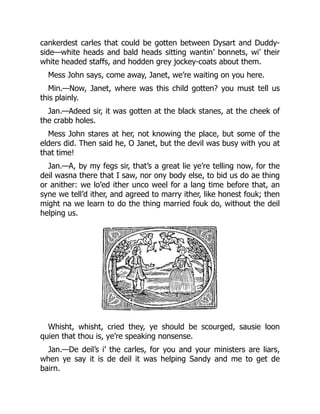
Mess John says, come away, Janet, we’re waiting on you here.
Min.—Now, Janet, where was this child gotten? you must tell us
this plainly.
Jan.—Adeed sir, it was gotten at the black stanes, at the cheek of
the crabb holes.
Mess John stares at her, not knowing the place, but some of the
elders did. Then said he, O Janet, but the devil was busy with you at
that time!
Jan.—A, by my fegs sir, that’s a great lie ye’re telling now, for the
deil wasna there that I saw, nor ony body else, to bid us do ae thing
or anither: we lo’ed ither unco weel for a lang time before that, an
syne we tell’d ither, and agreed to marry ither, like honest fouk; then
might na we learn to do the thing married fouk do, without the deil
helping us.
Whisht, whisht, cried they, ye should be scourged, sausie loon
quien that thou is, ye’re speaking nonsense.
Jan.—De deil’s i’ the carles, for you and your ministers are liars,
when ye say it is de deil it was helping Sandy and me to get de
bairn.
Come, come, said they, pay down the Kirk-dues, and come back to
the stool the morn; the price is four pound, and a groat to the bell-
man.
Jan.—The auld thief speed the darth o’t, sir, far less might sair you
and your bell-man baith. O but this be a world indeed, when poor
honest fouk maun pay for making use o’ their ain a—! Ye misca the
poor deil a-hint his back, an’ gies him the wyte of a de ill in de
kintry, bastard bairns and every thing; and if it be say as ye say, ye
may thank de deil for that four pound and a groat I hae gien you;
that gars your pat play brown, an gets you jockey-coats, and purl-
handed sarks, and white-headed staves, when my father’s pot
wallops up nought but bear and blue water.
The woman is mad, said they, for this money is all given to the
poor of the parish!!
Jan.—The poor of the parish! Feint a hate ye gie to them but we
pickles o’ pease-meal, didna I see their pocks? an’ the minister’s wife
gies naething ava to unco beggars, but bids them gae to their ain
parishes; and yet ye’ll tak the purse frae us for naething but playing
the loon a wee or we be married, and syne cock them up to be
looked on, and laugh’d at by every body: a deil speed you and your
justice, sir. Hute tute, ye’re a’ coming on me like a wheen colly dogs,
hunting awa a poor raggit chapman frae the door. So out she goes
cursing and greeting.
Sandy is next called upon, and in he goes.
Min.—Now, Saunders, you must tell us how this child was gotten.
San.—A now, Mess John, sir, ye hae bairns o’ your ain, how did ye
get them? But yours are a’ laddies, and mine is but a lassie; if you
tell me how you get your laddies, I’ll tell you how I got my lassie,
and then we’ll be baith alike good o’ the business.
The minister looks at him and says, Hute, tute, Saunders, lay
down four pund and a groat, and come back the morn to the stool,
and give satisfaction to the congregation; you had more need to be
seeking repentance for that abominable sin of uncleanness than
speaking so to me.
San.—Well, here’s your siller, sir, I hae gotten but poor penny-
worths for’t, an’ ye tell me to repent for’t; what, the auld thief,
needs I repent! when I’m gaun to marry the woman, an’ then I’ll
hae to do’t o’er again every day, or there’ll be nae peace in the
house; figs, it’s nonsense to pay siller, repent, and do’t again, too: a
fine advice, indeed, master minister! and that’s the way the like o’
you live.
Now, sir, says Wise Willie, ye manna put them on the black creepy
till they be married; they’ve suffered enough at ae time.
A-weel, a-weel, said they, but they must marry very soon.
I, true, says Sandy, ye’ll be wanting mair clink; foul haet ye do for
naething here.
The next exploit was an action at law against the goodman of
Muiredge, a farmer, who lived near by, that kept sheep and swine.
His sheep came down and broke their yards, and ate up their kail.
The wild hares they thought belonged to the man, as they ran to his
house when they were hunted. The swine came very often in about
their houses, seeking fish guts, and ony thing they could get. So it
happened, when one of the children was sitting easing itself, that
one of the swine tumbled it over, and bit a piece out of its backside!
The whole town rose in an uproar against poor grunkie, as they
called her, and takes her before Wise Willie. Willie took an axe and
cut two or three inches off her long nose. Now, says Willie, I trow I
hae made thee something like anither beast: thou had sic a lang
mouth before, it wad a frighted a very deil to look at ye; but now
your fac’d like a little horse or cow. The poor sow ran home roaring,
all blood, and wanting the nose; which caused Muiredge to warn
them in before my Lord. So the wives that had their kail eaten
appeared first in the court, complaining against Muiredge. Indeed,
my Lord, said they, Muiredge is no a good man, when he is sic an ill
neighbour. He keeps black hares an’ white hares, little wee brown-
backed hares wi’ white arses, and loose waggin horns; they creep in
at our gush-holes, an’ does the like; when we cry, pussie, pussie,
they rin hame to Muiredge: but I’ll gar my colly had them by the
foot, an’ I’ll had them by the horn, an’ pull the hair aff them, and
send ’em hame wanting the skin, as he did Sowen Tammie’s wee
Sandy, for codin o’ his pease, he took aff the poor laddie’s coat, and
sae did he e’en. And Willie said, if ye were a sow, my Lord, and me
sitting driting, and you to bite my arse, sudna I hae amends o’ you
for that? Odd, my Lord, ye wadna hae a bit out o’ your arse for
twinty marks. Ye maun e’en gar Muiredge gie ten marks to buy a
plaster to heal the poor bit wean’s arse again.
Well said, Willie, says my Lord; but who put on the sow’s nose
again.
A, fegs, my Lord, said Willie, she’s honester like wantin’t, an’ she’ll
bite nae mair arses wi’t. An ye had hane a nose, my Lord, as lang as
the sow, ye’d been obliged to ony body it wad cut a piece aft.
A gentleman coming past near their town, asked one of their
wives where their college stood? Said she, gie me a shilling an’ I’ll
let you see baith sides o’t. He gives her the shilling, thinking to see
something curious. Now, says she, there’s the one side of your
shilling, and there’s the other; so it is mine now.
There was a custom in Buckey-harbour, when they got a hearty
drink, that they went down to dance among the boats; two or three
of the oldest went into a boat to see the residence, and when they
admitted a burgher, there was also a dance. One day they admitted
gly’d Rob, who was a warlock, and made them all stop their dancing,
for which he was carried before Wise Willie to answer for that, for
which he was banished to the Isle of May, to carry coals to the Light
House.
T H E
DOMINIE DEPOSED,
WITH THE SEQUEL.
B Y W I L L I A M F O R B E S , A . M .
LATE SCHOOLMASTER AT PETERCOULTER.
TO WHICH IS ADDED,
MAGGY JOHNSTON’S ELEGY.
GLASGOW:
PRINTED FOR THE BOOKSELLERS.
PREFACE.
If this offend when ye peruse,
Pray, reader, let this me excuse,
Myself I only here accuse,
Who am the cause,
That e’er ye had this piece of news
To split your jaws.
For had I right the gully guided,
And wi’ a wife mysel’ provided,
To keep me frae that wae betide it,
That’s kent to a’,
I’d stay’d at hame, or near beside it;
Now that’s awa’.
Be wiser then, and do what’s right,
And mind your business wi’ might,
Lest unexpected gloomy night,
Should you surround
An’ mingle a’ your pleasure bright,
Wi’ grief profound.
And, bonny lasses, mind this rhyme,
As true as three and sax mak nine,
If ye commit ye ken what crime,
And turn unweel,
There’ll something wamble in your wame
Just like an eel.
THE
DOMINIE DEPOSED.
PART I.
Some Dominies are sae bias’d,
That o’er the dyke themsells they cast,
They drink an’ rant, an’ live sae fast,
This drives them on,
To draw a weapon at the last,
That sticks Mess John.
Thus going on from day to day,
Neglecting still to watch and pray,
And teach the little anes A, B, C,
An’ Pater Noster,
Quite ither thoughts our Lettergae,
Begins to foster.
For, laying by baith fear and shame,
They slily venture on that game,
All Fours, I think, they call’t by name,
Baith auld an’ rife,
Than in the play, Mess John is slain
Wi’ his ain knife.
’Tis kind, therefore, I winna strive
My doughty deeds here to descrive,
A lightsome life still did I thrive,
Did never itch,
By out an’ in abouts to drive,
For to mak rich.
I ne’er laid money up in store,
Into a hole behind the door,
A shilling, penny, less or more,
I aye did scatter,
’Tis just, now, I should drink, therefore,
Sma’ beer or water.
I never sooner siller got,
But a’ my pouches it would plot,
And scorch them fair, it was sae hot;
Then to get clear
Of it, I swill’d it down my throat,
In ale or beer.
Thus, a’ my failing was my glass,
An’ anes to please a bonny lass,
I, like a silly amorous ass,
Drew forth my gully,
A ’ th h ’ th h t th fi t
An’ through an’ through at the first pass,
Ran Mr. Willy.
Sae far this mad, though merry fit,
I was sair vexed, and forced to flit,
They plagu’d me sae wi’ pay and sit,
Quo’ they, You thief,
How durst you try to steal a bit
Forbidden beef?
O then, I humbly plead that vos,
Would make it your continual mos,
Wi’ hearts sincere an’ open os,
You’d often pray,
A tali malo libera nos,
O Dominie.
For, hark, I’ll tell you what they think,
Since I left handling pen an’ ink:
Wae worth that weary soup o’ drink
He lik’d sae weel,
He drank it a’, left not a clink
His throat to swill.
He lik’d, still sitting on his doup,
To view the pint or cutty stoup,
And sometimes lasses overcoup,
Upo’ their keels,
This made the lad at length to loup,
And tak his heels.
Then was it not a grand presumption,
To ca’ him doctor o’ the function?
He dealt too much in barley-unction
For his profession:
He never took a good injunction
Frae kirk or session.
An’ to attend, he was not willing,
His school, sae lang’s he had a shilling,
But lov’d to be where there was filling
Good punch or ale,
For him to rise was just like killing
Or first to fail.
His fishing-wand, his sneeshing box,
A fowling piece, to shoot muir cocks,
An’ hunting hare through craigs and rocks
An hunting hare through craigs and rocks,
This was his game,
Still left the young anes, so the fox
Might worry them.
When he committed a’ these tricks,
For which he weel deserv’d his licks,
Wi’ red-coats he did intermix,
When he foresaw
The punishment the kirk inflicts
On fowks that fa’.
Then to his thrift he bade adieu,
When wi’ his tail he stopp’d his mou’,
He changed his coat to red and blue,
An’ like a sot
Did the poor Clerk convert into
A Royal Scot.
An’ now fowks use me at their wills,
My name is blawn out o’er the hills,
At banquets, feasts, a’ mouths it fills,
’Twixt each, Here’s t’ thee,
’Tis sore traduc’d at kilns and mills,
And common smithy.
Then, Dominies, I you beseech,
Keep very far from Bacchus’ reach,
He drown’d a’ my cares to preach,
Wi’ his ma’t-bree,
I’ve wore sair banes by mony a bleech
O’ his tap-tree.
If venus does possess your mind,
Her antics ten times warse ye’ll find,
For to ill tricks she’s sae inclin’d,
For praticks past,
She blew me here before the wind:
Cauld be her cast.
Within years less than half a dizen,
She made poor Maggy lie in jizen,
When little Jock brake out of prison
On gude yule-day,
This of my quiet cut the wisen,
Whan he wan gae.
Let readers then tak better heed,
et eade s t e ta bette eed,
For fear they kiss mair than they read,
In case they wear the sacken weed,
For fornication,
Or leave the priest-craft shot to dead
For procreation.
The maist o’ them, like blind an’ lame,
Have nae aversion to the game,
But better ’twere to tak her hame,
Their pot to cook,
An’ teach his boys to write a theme,
And mind their book.
Then may they sit at hame, an’ please,
Themselves wi’ gathering in their fees,
While I must face mine enemies,
Or shaw my dock:
There’s odds ’twixt handling pens wi’ ease
An’ a firelock.
Sae shall they never mount the stool,
Whereon the lasses greet an’ howl,
Tho’ deil a tear, scarce fair or foul,
Comes o’er their cheeks;
Their mind’s not there, ’tis spinning wool,
Or mending breeks.
The Kirk then pardons no such prots,
They must tell down good five pounds scots,
Though they should pledge their petticoats,
An’ gae arse bare;
The least price there is twenty groats,
An’ prigging fair.
If then the lad does not her wed,
Poor Meg some feigned tears maun shed,
Her minny crooks her mou’ and dad,
They fart an’ fling;
“O wow that e’er I made the bed,”
Then does she sing.
Thus for her Maidenhead she moans,
Bewailing what is past;
Her pitcher’s dash’d against the stones,
And broken at the last.
PART II.
A’ Maids, therefore, I do bemoan,
Betwixt the rivers Dee and Don,
If anes they get a taste o’ yon,
Though by the laird,
The toy-mutch maun then gae on,
Nae mair bare-hair’d.
Yet wanton Venus, that she-b—h,
Does a’ our senses sae bewitch,
An’ fires our blood wi’ sic an itch,
That aftentimes,
There is nae help but to commit,
Some ill-far’d crimes.
Yet some they are sae very willing,
At ony time they’ll tak’ a shilling,
But he that learnt them first that spelling,
Or Meg or Nell,
Be sure, to him they’ll lay an egg in;
This some can tell.
Unthinking things! it is their creed,
If some sic things be done wi’ speed,
They’re safe, ’tis help in time o’ need,
Nae after-claps:
Tho’ nine months aft brings quick or dead,
Into their laps.
Experience thus makes me speak,
I ance was hooked wi’ the cleek,
I almost had beshit my breek,
When Maggy told,
That by her saul, not e’en a week
Young Jack would hold.
She was sae stiff she cou’d not loot;
Your pranks she says, are now found out,
The kirk and you maun hae a bout;
Ill mat you fare,
’Tis a’ your ain, you need na doubt
Ilk hilt an hair.
Alas that e’er I saw your face,
I can nae langer hide the case;
Had I foreseen this sad disgrace,
Nae man nor you,
Sh ’d ’ h t i l
Shou’d e’er hae met me in yon place,
Or kiss’d my mou’.
O Dominie, you’re dispossest,
Ye hae defil’d your holy nest,
The warld sees ye hae transgrest,
I’m at my time,
Ye dare nae mair, now do your best
Let gae the rhyme.
Ohon! how weel I might hae kent,
When first to you I gae consent,
Wi’ me to mak your merriment,
How a’ would be:
Alas! that e’er my loom I lent
That day to thee.
Wae to the night I first began
To mix my moggans wi’ thee man:
’Tis needless now to curse or ban,
But deil hae me,
Ye’ll pay an’ sit, for sit ye can,
An’ that ye’ll see.
I heard her as I heard her not,
But time and place had quite forgot,
I guess’d Young Jack fell to my lot;
For I could tell,
It was too short her petticoat,
By half an ell.
Wi’ blubber’d cheeks, and watry nose,
Her weary story she did close;
I said the best, and aff she goes
Just like a thief,
An’ took a glass to interpose,
’Twixt mirth and grief.
Yet would hae gi’en my ha’f year’s fee,
Had Maggy then been jesting me,
Had tartan purry, meal an’ bree,
Or buttr’y brose,
Been kilting up her petticoats
Aboon her hose.
But time that tries such praticks past,
Brought me out o’er the coals fu’ fast;
Poor Maggy took a sudden blast
Welcome to our website – the perfect destination for book lovers and
knowledge seekers. We believe that every book holds a new world,
offering opportunities for learning, discovery, and personal growth.
That’s why we are dedicated to bringing you a diverse collection of
books, ranging from classic literature and specialized publications to
self-development guides and children's books.
More than just a book-buying platform, we strive to be a bridge
connecting you with timeless cultural and intellectual values. With an
elegant, user-friendly interface and a smart search system, you can
quickly find the books that best suit your interests. Additionally,
our special promotions and home delivery services help you save time
and fully enjoy the joy of reading.
Join us on a journey of knowledge exploration, passion nurturing, and
personal growth every day!
testbankfan.com

Applying IFRS Standards 4th Edition Picker Test Bank

  • 1.
    Applying IFRS Standards4th Edition Picker Test Bank download https://testbankfan.com/product/applying-ifrs-standards-4th- edition-picker-test-bank/ Find test banks or solution manuals at testbankfan.com today!
  • 2.
    Here are somerecommended products for you. Click the link to download, or explore more at testbankfan.com Applying IFRS Standards 4th Edition Picker Solutions Manual https://testbankfan.com/product/applying-ifrs-standards-4th-edition- picker-solutions-manual/ Reading Understanding and Applying Nursing Research 4th Edition Fain Test Bank https://testbankfan.com/product/reading-understanding-and-applying- nursing-research-4th-edition-fain-test-bank/ Cognitive Psychology Applying The Science of the Mind 4th Edition Robinson-Riegler Test Bank https://testbankfan.com/product/cognitive-psychology-applying-the- science-of-the-mind-4th-edition-robinson-riegler-test-bank/ Advanced Engineering Mathematics 2nd Edition Greenberg Solutions Manual https://testbankfan.com/product/advanced-engineering-mathematics-2nd- edition-greenberg-solutions-manual/
  • 3.
    Strategic Analysis andAction 8th Edition Crossan Test Bank https://testbankfan.com/product/strategic-analysis-and-action-8th- edition-crossan-test-bank/ Intermediate Microeconomics 1st Edition Mochrie Solutions Manual https://testbankfan.com/product/intermediate-microeconomics-1st- edition-mochrie-solutions-manual/ Practical Financial Management 7th Edition Lasher Test Bank https://testbankfan.com/product/practical-financial-management-7th- edition-lasher-test-bank/ Taxation of Business Entities 4th Edition Spilker Test Bank https://testbankfan.com/product/taxation-of-business-entities-4th- edition-spilker-test-bank/ Exploring Biological Anthropology The Essentials Books a la Carte 3rd Edition Stanford Test Bank https://testbankfan.com/product/exploring-biological-anthropology-the- essentials-books-a-la-carte-3rd-edition-stanford-test-bank/
  • 4.
    Communications Law LibertiesRestraints and the Modern Media 6th Edition Zelezny Test Bank https://testbankfan.com/product/communications-law-liberties- restraints-and-the-modern-media-6th-edition-zelezny-test-bank/
  • 5.
    Testbank to accompany Applying IFRS® Standards4e Ruth Picker, Kerry Clark, John Dunn, David Kolitz, Gilad Livne, Janice Loftus, Leo van der Tas Prepared by John Sweeting, Emma Holmes and Elisabetta Barone John Wiley & Sons, Ltd 2016
  • 6.
    Chapter 8 Share-basedpayment © John Wiley & Sons, Ltd 2016 8.2 CHAPTER 8 Share-based payment Learning Objectives 8.1 Explain the objective and scope of IFRS 2 8.2 Distinguish between cash-settled and equity-settled share-based payment transactions 8.3 Demonstrate how equity-settled and cash settled share-based payment transactions are recognised 8.4 Explain how equity-settled share-based payment transactions are measured 8.5 Explain the concept of vesting through differentiating between vesting and non-vesting conditions 8.6 Explain the concept of a share option reload feature 8.7 Explain how modifications to granted equity instruments are treated 8.8 Demonstrate how cash-settled share-based payment transactions are measured 8.9 Describe and apply the disclosure requirements of IFRS 2.
  • 7.
    Test Bank toaccompany Applying IFRS Standards 4e © John Wiley & Sons, Ltd 2016 8.3 Multiple Choice Questions 1. Which of the following is NOT within the scope of IFRS 2? Learning Objective 8.1 Explain the objective and scope of IFRS 2 *a. Transactions in which the entity receives or acquires goods or services as part of the net assets acquired in a business combination to which IFRS 3 Business Combinations applies. b. Equity instruments granted to employees of the acquiree in a business combination in their capacity as an employee. c. Cancellation, replacement or other modification of share-based payment arrangements because of a business combination. d. Cancellation, replacement or other modification of share-based payment arrangements because of other equity restructuring. 2. A share–based payment transaction in which the entity acquires goods or services by incurring liabilities to the supplier for amounts that are based on the value of the entity’s shares or other equity instruments of the entity is classified in IFRS 2 as: Learning Objective 8.2 Distinguish between cash-settled and equity-settled share-based payment transactions a. an equity-settled share-based payment transaction *b. a cash-settled share-based payment transaction c. a liability-settled share-based payment transaction d. an “other” share-based payment transaction 3. A share–based payment transaction in which the entity receives goods or services as consideration for equity instruments of the entity is classified in IFRS 2 Share-based Payment as Learning Objective 8.2 Distinguish between cash-settled and equity-settled share-based payment transactions *a. an equity-settled share-based payment transaction b. a cash-settled share-based payment transaction c. a liability-settled share-based payment transaction d. an “other” share-based payment transaction 4. Reload features are accounted for as follows: Learning Objective 8.6 Explain the concept of a share option reload feature a. included in the fair value of the initial options granted at measurement date *b. separately from the initial options granted c. as a market condition d. as a modification to the initial terms and conditions of the initial options granted
  • 8.
    Chapter 8 Share-basedpayment © John Wiley & Sons, Ltd 2016 8.4 5. On 1 July 2015 Pepper Limited granted 500 share options to each of its 100 employees. Each grant is conditional on the employee working for the company for the next two years. The fair value of each option is estimated to be €3.00. Pepper estimates that 8% of its employees will leave during the two year period and therefore forfeit their rights to the share options. During the year ended 30 June 2016 five employees left. At this time the company revised its estimate of total employee departures over the full two-year period to 10%. During the year ended 30 June 2017 a further 4 employees left. The amount to be recognised as an expense by Pepper for the year ended 30 June 2016 is: Learning Objective 8.5 Explain the concept of vesting through differentiating between vesting and non-vesting conditions *a. €67 500 b. €69 000 c. €71 250 d. €135 000 6. On 1 July 2013, Leo Limited granted 250 options to each of its 50 employees. The options are conditional on the employees remaining with the company for the 2 year vesting period. The options have a fair value of €10 at vesting date. In addition, the shares will vest as follows: • On 30 June 2014 if the company’s earnings have increased by more than 15% • On 30 June 2015 if the company’s earnings have increased by more than 12% averaged across the 2 year period At 30 June 2014 Leo’s earnings have increased by 12% and 3 employees have left. The company expects that earnings will continue to increase at a similar rate during the year to 30 June 2015 and that the shares will vest at that time. It also expects that a further 4 employees will leave during the year. The remuneration expense for the year ended 30 June 2014 for Leo is: Learning Objective 8.5 Explain the concept of vesting through differentiating between vesting and non-vesting conditions a. €35 833 *b. €53 750 c. €58 750 d. €117 500
  • 9.
    Test Bank toaccompany Applying IFRS Standards 4e © John Wiley & Sons, Ltd 2016 8.5 7. Which of the following statements in relation to modifications to the terms and conditions on which equity instruments were granted as part of an employee share scheme is correct? Learning Objective 8.7 Explain how modifications to granted equity instruments are treated a. a reduction in the exercise price of options will reduce the fair value of the share options b. a reduction in a performance hurdle relating to profitability targets will reduce the fair value of the options *c. a shortening of the vesting period will increase the fair value of the share options. d. an increase in the number of equity instruments granted is not an example of a modification 8. On 1 July 2013 Diamond Ltd granted 800 share options with an exercise price of €35 to the CFO, conditional on the CFO remaining in employment with the company until 30 June 2016. The exercise price will drop to €30 if Diamond’s earnings increase by an average of 8% per year over the three year period. On 1 July 2013 the estimated fair value of the share options with an exercise price of €35 is €10 per option, and if the exercise price is €30, the estimated fair value of the options is €12 per option. During the year ended 30 June 2014 Diamond’s earnings increased by 10% and they are expected to continue to increase at this rate over the next two years. During the year ended 30 June 2015 Diamond’s earnings increased by 5% and Diamond management expected that the earnings target would be achieved. During the year ended 30 June 2016 Diamond’s earnings increased by 11%. When calculating the remuneration expense to be recognised for the year ended 30 June 2015 which of the following dollar values should be included in the calculation? Learning Objective 8.5 Explain the concept of vesting through differentiating between vesting and non-vesting conditions *a. €10 b. €12 c. €30 d. €35
  • 10.
    Chapter 8 Share-basedpayment © John Wiley & Sons, Ltd 2016 8.6 The following information relates to questions 9 and 10 On 1 July 2013 Fantasy Ltd granted 200 options to each of its 100 employees. The share options will vest on 30 June 2015 if the employees remain employed with the company on that date. The share options have a life of four years. The exercise price is $5, which is also Fantasy’s share price at the grant date. Fantasy is unable to reliably estimate the fair value of the share options at the grant date. Fantasy’s share price and the number of options exercised are set out below. Share options may only be exercised at year end. Year ended Share price at year end Number of options exercised at year end 30 June 2014 $6 - 30 June 2015 $7 - 30 June 2016 $8 7 800 30 June 2017 $9 10 000 9. The cumulative remuneration expense to be recognised by Fantasy as at 30 June 2015 is: Learning Objective 8.6 Explain the concept of a share option reload feature a. $7800 b. $17 800 *c. $35 600 d. $124 600 10. The formula to calculate the remuneration expense for the year ended 30 June 2016 is: Learning Objective 8.6 Explain the concept of a share option reload feature a. 7800 x ($8-$7) b. 7800 x $8 c. (7800 + 10 000) x ($8-$5) *d. (7800 + 10 000) x ($8-$7)
  • 11.
    Test Bank toaccompany Applying IFRS Standards 4e © John Wiley & Sons, Ltd 2016 8.7 The following information relates to questions 11 to 13 On 1 July 2013 Watson Pty Ltd granted 100 share appreciation rights (SARS) to each of its 50 employees, conditional on the employee not leaving the company in the next three years. The company estimates the fair value of the SARS at the end of each year in which a liability exists as shown in the table below. The intrinsic values of the SARS at the date of exercise at 30 June 2016, 2017 and 2018 are also shown. All SARS held by employees at 30 June 2016 vest. Year ended Fair value Intrinsic value 30 June 2014 $14.40 30 June 2015 $15.50 30 June 2016 $18.20 $15.00 30 June 2017 $21.40 $20.00 30 June 2018 $25.00 By 30 June 2016 nine employees have left and 15 employees have exercised their SARS. 11. The amount recognised as an expense for the year ended 30 June 2016 is: Learning Objective 8.8 Demonstrate how cash-settled share-based payment transactions are measured a. $5987 b. $22 500 *c. $28 487 d. $47 320 12. The liability recorded at 30 June 2015 is: Learning Objective 8.8 Demonstrate how cash-settled share-based payment transactions are measured a. $19 680 b. $21 653 *c. $41 333 d. $47 320 13. This is an example of: Learning Objective 8.8 Demonstrate how cash-settled share-based payment transactions are measured a. an equity-settled share-based payment transaction *b. a cash-settled share-based payment transaction c. a share-based payment transaction where the counterparty has the settlement choice d. a share-based payment transaction where the entity has the settlement choice
  • 12.
    Chapter 8 Share-basedpayment © John Wiley & Sons, Ltd 2016 8.8 The following information relates to questions 14 to 16 Viola Ltd has granted each of its 10 senior executives a choice between receiving a cash payment equivalent to 1000 shares or receiving 1200 share. The grant is conditional on the completion of three years’ service with the company. If the share alternative is chosen, the shares must be held for two years after vesting date. At grant date the company’s share price is £25 per share. At the end of years 1, 2 and 3 the share price is £27, £28 and £30 respectively. The company does not expect to pay dividends in the next three years. After taking into account the effect of post-vesting transfer restrictions the company estimates the grant-date fair value of the share alternative is £24 per share. 14. What is the fair value of the cash alternative? Learning Objective 8.8 Demonstrate how cash-settled share-based payment transactions are measured a. £240 000 *b. £250 000 c. £288 000 d. £300 000 15. What is the fair value of the equity alternative? Learning Objective 8.8 Demonstrate how cash-settled share-based payment transactions are measured a. £240 000 b. £250 000 *c. £288 000 d. £300 000 16. What is the liability component at the end of year 1? Learning Objective 8.8 Demonstrate how cash-settled share-based payment transactions are measured a. £83 333 *b. £90 000 c. £100 000 d. £108 000
  • 13.
    Test Bank toaccompany Applying IFRS Standards 4e © John Wiley & Sons, Ltd 2016 8.9 17. On 1 July 2014 Luca Ltd grants 200 options to each of its 75 employees conditional on the employee remaining in service over the next two years. The fair value of each option is estimated to be $7. Luca estimates that 8 employees will leave over the two year vesting period. By 30 June 2015 four employees have left and the entity estimates that a further five employees will leave over the next year. On 30 June 2015 Luca decided to reprice its share options, due to a fall in its share price over the last 12 months. The repriced share options will vest on 30 June 2016. At the date of repricing Luca estimates that the fair value of each original option is $1.50 and the fair value of each repriced option is $3. During the year ended 30 June 2016 four employees left. The remuneration expense for the year ended 30 June 2015 is: Learning Objective 8.7 Explain how modifications to granted equity instruments are treated *a. $34 650 b. $35 175 c. $46 200 d. $46 900 18. In a share based payment transaction where the entity has settlement choice: Learning Objective 8.8 Demonstrate how cash-settled share-based payment transactions are measured a. where a present obligation does not exist the entity has a choice of classification as an equity or cash settled share based payment transaction. *b. the entity has a present obligation to settle in cash where it has a past practice or stated policy of settling in cash c. the entity must settle in equity unless there is no commercial substance to the transaction. d. if an entity elects to settle in cash the settlement is accounted for as an expense. 19. Which of the following statements in relation to disclosures required under IFRS 2 Share-based Payment is NOT correct? Learning Objective 8.9 Describe and apply the disclosure requirements of IFRS 2 a. For arrangements that were modified during the year, the incremental fair value granted as a result. b. The weighted average price at the date of exercise for options exercised during the period. c. A description of the plan, including the general terms and conditions, vesting requirements, maximum term of options granted and method of settlement must be disclosed. *d. For liabilities arising from share-based payment transactions, the total intrinsic value at the end of the period for liabilities where the counter party’s right had not yet vested.
  • 14.
    Chapter 8 Share-basedpayment © John Wiley & Sons, Ltd 2016 8.10 20. A share–based payment transaction in which the entity receives goods or services as consideration for equity instruments of the entity is classified in IFRS 2 Share-based Payment as Learning Objective 8.2 Distinguish between cash-settled and equity-settled share-based payment transactions *a. an equity-settled share-based payment transaction b. a cash-settled share-based payment transaction c. a liability-settled share-based payment transaction d. an “other” share-based payment transaction 21. Salt Limited grants 1000 share options to each of its 100 employees. Each grant is conditional on the employee working for the company for the next two years. The fair value of each option is estimated to be €5.00 at grant date and €7.50 at vesting date. The amount to be recognised as an expense by Salt in year 2 is: Learning Objective 8.4 Explain how equity-settled share-based payment transactions are measured: *a. €250 000 b. €375 000 c. €500 000 d. €750 000 22. Pepper Limited grants 500 share options to each of its 30 employees. Each grant is conditional on the employee working for the company for the next three years. The fair value of each option is estimated to be €5.00 at grant date and €7.50 at vesting date. The amount to be recognised as an expense by Pepper in year 2 is: Learning Objective 8.4 Explain how equity-settled share-based payment transactions are measured: *a. €25 000 b. €37 500 c. €50 000 d. €75 000 23. In situations where an option-pricing model is required to be used to determine the fair value of equity instruments granted IFRS 2 Share-based Payment: Learning Objective 8.4 Explain how equity-settled share-based payment transactions are measured: a. requires expected dividends to be taken into account when measuring the shares or options granted. *b. allows the entity to choose the option-pricing model it wishes to use, but contains a number of factors that the option-pricing model selected must take into account as a minimum. c. requires the use of a binominal option-pricing model. d. requires the use of the Black-Scholes-Merton formula.
  • 15.
    Test Bank toaccompany Applying IFRS Standards 4e © John Wiley & Sons, Ltd 2016 8.11 24. On 1 July 2013, Nelson Pty Ltd granted 250 options to each of its 50 employees. The options are conditional on the employees remaining with the company for the 3 year vesting period. The options have a fair value of €7.50 at vesting date. In addition, the shares will vest as follows: o On 30 June 2014 if the company’s earnings have increased by more than 12% o On 30 June 2015 if the company’s earnings have increased by more than 10% averaged across the 2 year period o On 30 June 2016 if the company’s earnings have increased by more than 8% averaged across the 3 year period At 30 June 2014 Nelson’s earnings have increased by 11% and 3 employees have left. The company expects that earnings will continue to increase at a similar rate during the year to 30 June 2015 and that the shares will vest at that time. It also expects that a further 4 employees will leave during the year. The remuneration expense for the year ended 30 June 2014 for Nelson is: Learning Objective 8.5 Explain the concept of vesting through differentiating between vesting and non-vesting conditions a. €26 875.00 b. €29 375.00 *c. €40 312.50 d. €88 125.00 25. On 1 July 2013 Pearl Pty Ltd granted 800 share options with an exercise price of €35 to the CFO, conditional on the CFO remaining in employment with the company until 30 June 2016. The fair value of Pearl’s shares at that time was assessed to be €40. The exercise price will drop to €30 if Pearl’s earnings increase by an average of 8% per year over the three year period. On 1 July 2013 the estimated fair value of the share options with an exercise price of €35 is €10 per option, and if the exercise price is €30, the estimated fair value of the options is €12 per option. During the year ended 30 June 2014 Pearl’s earnings increased by 10% and they are expected to continue to increase at this rate over the next two years. During the year ended 30 June 2015 Pearl’s earnings increased by 9% and Pearl management continued to expect that the earnings target would be achieved. During the year ended 30 June 2016 Pearl’s earnings increased by only 2%. At 30 June 2016 the share price is €23. The remuneration expense to be recognised for the year ended 30 June 2014 is: Learning Objective 8.5 Explain the concept of vesting through differentiating between vesting and non-vesting conditions: a. €2667 *b. €3200 c. €8000 d. €9600
  • 16.
    Chapter 8 Share-basedpayment © John Wiley & Sons, Ltd 2016 8.12 26. On 1 July 2013 Pearl Pty Ltd granted 800 share options with an exercise price of $35 to the CFO, conditional on the CFO remaining in employment with the company until 30 June 2016. The fair value of Pearl’s shares at that time was assessed to be $40. The exercise price will drop to $30 if Pearl’s earnings increase by an average of 8% per year over the three year period. On 1 July 2013 the estimated fair value of the share options with an exercise price of $35 is $10 per option, and if the exercise price is $30, the estimated fair value of the options is $12 per option. During the year ended 30 June 2014 Pearl’s earnings increased by 10% and they are expected to continue to increase at this rate over the next two years. During the year ended 30 June 2015 Pearl’s earnings increased by 9% and Pearl management continued to expect that the earnings target would be achieved. During the year ended 30 June 2016 Pearl’s earnings increased by only 2%. At 30 June 2016 the share price is $23. Assuming that the CFO decides NOT to exercise his options at 30 June 2016, the following entry would be recorded: Learning Objective 8.6 Explain the concept of a share option reload feature: a. DR Wages expense CR Options issued (equity) b. DR Options issued (equity) CR Lapsed options reserve c. DR Options issued (equity) CR Retained earnings *d. DR Options issued (equity) CR Wages expense 27. In relation to equity instruments granted by an entity where the entity makes modifications to the terms and conditions attaching to the grant, Learning Objective 8.7 Explain how modifications to granted equity instruments are treated: a. the incremental fair value is measured as the difference between the fair value of the modified instrument, estimated at the date of modification and that of the original equity instrument, estimated at the date of original granting. b. if the modification occurs during the vesting period the incremental fair value is recognised immediately. c. terms or conditions may not be modified in a manner that is not beneficial to the employee. *d. where the exercise price of options is modified, the fair value of the options changes.
  • 17.
    Test Bank toaccompany Applying IFRS Standards 4e © John Wiley & Sons, Ltd 2016 8.13 28. On 1 July 2013 Poggio Ltd grants 300 options to each of its 100 employees conditional on the employee remaining in service over the next three years. The fair value of each option is estimated to be $12. Poggio estimates that 15 employees will leave over the three year vesting period. By 30 June 2014 four employees have left and the entity estimates that a further ten employees will leave over the next two years. On 30 June 2014 Poggio decided to reprice its share options, due to a fall in its share price over the last 12 months. The repriced share options will vest on 30 June 2016. At the date of repricing Poggio estimates that the fair value of each original option is $3 and the fair value of each repriced option is $5. During the year ended 30 June 2015 a further 6 employees leave and Poggio estimates that another 3 employees will leave during the year ended 30 June 2016. During the year ended 30 June 2016 four employees left. The entry at 30 June 2015 to account for the share based payment transaction is: Learning Objective 8.7 Explain how modifications to granted equity instruments are treated: a. DR Wages expense CR Liability to employee *b. DR Wages expense CR Options issued (equity) c. DR Wages expense CR Share capital d. DR Wages expense CR Cash 29. Which of the following statements in relation to disclosures required under IFRS 2 is not correct? Learning Objective 8.9 Describe and apply the disclosure requirements of IFRS 2: a. Option pricing models used in valuing share options must be identified. b. The number and weighted average exercise price of share options outstanding at the beginning and end of each period must be disclosed. c. Information about share-based payment arrangements that are substantially the same may be aggregated. *d. The total expense arising from share-based payment transactions in which the services qualified for recognition as an asset must be disclosed.
  • 18.
    Random documents withunrelated content Scribd suggests to you:
  • 19.
    happened to besome tinker’s ass teeth red. The poor ass seeing the two wives coming with the creels, thought it was the tinkers coming to flit or relieve him, fell a-crying, the two wives threw their fish a’ awa’, and ran hame like mad persons, crying they had seen the deil, ay, the very horned deil, and that he spoke to them but they didna ken what he said, for it was waur than a highlandman’s; the whole town was in an uproar; some would go with picks and spades, and hagg him to pieces; others would go and catch him in a strong net, and then they would either hang or drown him. Na, na, co’ Wise Willie, we manna cast out wi’ him at the first, as he’s gotten the twa burden’s o’ fish, he’ll e’en gang his wa, and no fash us nae mair; he is o’er souple to be catch’d in a net; a’ your pith will neither hang nor drown him, and the kintra he comes frae is a’ het coals, he’d never burn. We’ll gae to him in a civil manner, and see what he wants. Get out Witty Eppie and lingle-tail’d Nancy wi’ the Bible and Psalm-book. So aff they came in a crowd, either to kill the deil, or catch him alive; and as they came near the place, the ass fell a- crying, which caused many of them to faint and run back. Na, na, co’ Willie, that’s no the deil’s words at a’, its my Lord’s trumpeter, routing on his brass whistle. Willie ventured till he saw the ass’s twa lugs. Now, said Willie, come forward, an’ haud him fast, I see his twa horns; hech, sirs, he has a white beard like an auld man. So they inclosed the poor ass on all sides, thinking it was the deil; but when Wise Willie saw he had nae cloven feet, he cried out, Scarna lads, this is not the deil, it’s some living beast; it’s neither cow nor horse. An’ what is’t then, Willie? Indeed, co Willie, it’s the father of the maukins, I ken by its lang lugs.
  • 20.
    Now some saythis history is too satirical, but it is according to the knowledge of those times, not to say one place by another. The old wives will tell you yet of many such stories of the devil appearing to their grandfathers and grandmothers, and dead wives coming back again to visit their families long after being dead. So this Buchaven was once noted for droll exploits; but it is now become better known, and a place that produces the hardiest sailors of any town on the Scots coast. Yet many of the old people in it still retain the old tincture of their ancient and uncultivated speech, such as Be-go, laddie; they are also of a fiery nature, for if you ask any of their wives where their college stands, they’ll tell you, if your nose was in their a—e, your mouth would be at the door of it. Now, it happened when Wise Willie turned old, he took a great swelling in his wame, and casting up his kail, collops, and cauld fish, that nothing could stand on his stomach; and a stout stomach he had for crabs heads, and scate broo, or brose in a bridal morning; yet it fail’d him, and he fell sick. None could cure him, nor tell what ail’d him, till a mountebank stage doctor came to Kircaldy that could judge by people’s piss the trouble of their person. Wise Willie hearing of his fame, pissed into the bottle, and sent it away with his daughter. The bottle being uncorked, his daughter spilt it by the way, and to conceal her sloth in so doing, pissed in it herself, and on she goes till she came to the stage-doctor, when she cried out aloud, Sir
  • 21.
    Doctor, Sir Doctor,here is a bottle of my father’s wash, he has a sair guts, and needs na drite ony, but spues a’ he eats. It’s true I tell you, my dow. The doctor looks at it, then says, it’s not your father’s surely, it’s your mither’s. The deil’s in the man, said she, divna I ken my father frae my mother. Then, said he, he is with child. The deil’s in the man, co’ she, for my mither bare a’ de bairns before; dat’s no true, sir, fegs ye’re a great liar. Hame she comes, and tell’d Willie, her father, that the doctor said he was wi’ bairn. O waes me, co’ Willie, for I hae a muckle wame, an’ I fear its owre true. O plague on you, Janet, for ye’re the father o’t, an’ I am sure to die in the bearing o’t. Witty Eppie was sent for, as she was a houdie, an’ she fand a’ Willie’s wame, to be sure about it. Indeed, co’ Eppie, ye’re the first man ere I saw wi’ bairn before. and how ye’ll bare it, troth I dinna ken, but I would drink salt sea-water and drown it in my guts —for if men get ance the gate o’ bearing weans themselves, they’ll need nae mair wives. So Willie drank sea-water till his guts was like to rive, and out he got to ease himself among the kail; and with the terrible noise of his farting, up starts a maukin behind him, who thought it was shot. Willie seeing her jump o’er the dyke, thought it was a child brought forth, and cried out, come back, my dear, and be christened, and dinna rin to the hills to be a pagan. So Willie grew better every day thereafter, being brought to bed in the kail yard; but his daughter was brought to bed some months after, which was the cause of the doctor’s mistake. Now Wise Willie had a daughter called Rolling Coughing Jenny, because she spak thick, sax words at three times, half sense and half nonsense, as her own records will bear witness. She being with child, and delivered of a bonnie lassie; and all the wives in the town cried out be-go, laddie, it’s just like its ain father, lang Sandy Tason (or Thomson), we ken by his lang nose; for Sandy had a great muckle red nose, like a labster’s tae, bowed at the point like a hawk’s neb, and Sandy himself said that it was surely his, or some other body’s; but he had used a’ his bir at the getting o’t to try his abilities, being the first time ever he was at sic a business before;
  • 22.
    and when hehad done a’ that man could do at it, he said it was nonsense; and shame fa’ him, but he would rather row his boat round the Bass and back again, or he’d do the like again; for Wise Willie gade wude at the bairn, and said it had mair ill nature than the auldest wife in the town, for it pissed the bed, skirl’d like a wild cat, & kept him frae his night’s rest; the auld hags about the town ca’d him Sandy the bairn’s daddy; and a’ the young gillie-gaukies o’ lasses held out their fingers and cried, Ti hi hi, Sandy, the Kirk will kittle your hips for that: And after a’ the blear-eye’d bell-man came bladering about the buttock meal, summoned him and her before the haly band—a court that was held in the Kirk on Saturday morning—and all the herd laddies round about cried, Ay, ay, Sandy, pay the bull-siller, or we’ll cut the cow’s tail awa’. So poor Sandy suffered sadly in the flesh, besides the penalty and Kirk penance. But Wise Willie had pity on them, and gade wi’ them to the Kirk- court, what learned fouk call the Session. Jenny was first called upon, and in she goes where a’ the haly band was convened, elders and younger deacons, and dog payers, keeping the door, the
  • 23.
    cankerdest carles thatcould be gotten between Dysart and Duddy- side—white heads and bald heads sitting wantin’ bonnets, wi’ their white headed staffs, and hodden grey jockey-coats about them. Mess John says, come away, Janet, we’re waiting on you here. Min.—Now, Janet, where was this child gotten? you must tell us this plainly. Jan.—Adeed sir, it was gotten at the black stanes, at the cheek of the crabb holes. Mess John stares at her, not knowing the place, but some of the elders did. Then said he, O Janet, but the devil was busy with you at that time! Jan.—A, by my fegs sir, that’s a great lie ye’re telling now, for the deil wasna there that I saw, nor ony body else, to bid us do ae thing or anither: we lo’ed ither unco weel for a lang time before that, an syne we tell’d ither, and agreed to marry ither, like honest fouk; then might na we learn to do the thing married fouk do, without the deil helping us. Whisht, whisht, cried they, ye should be scourged, sausie loon quien that thou is, ye’re speaking nonsense. Jan.—De deil’s i’ the carles, for you and your ministers are liars, when ye say it is de deil it was helping Sandy and me to get de bairn.
  • 24.
    Come, come, saidthey, pay down the Kirk-dues, and come back to the stool the morn; the price is four pound, and a groat to the bell- man. Jan.—The auld thief speed the darth o’t, sir, far less might sair you and your bell-man baith. O but this be a world indeed, when poor honest fouk maun pay for making use o’ their ain a—! Ye misca the poor deil a-hint his back, an’ gies him the wyte of a de ill in de kintry, bastard bairns and every thing; and if it be say as ye say, ye may thank de deil for that four pound and a groat I hae gien you; that gars your pat play brown, an gets you jockey-coats, and purl- handed sarks, and white-headed staves, when my father’s pot wallops up nought but bear and blue water. The woman is mad, said they, for this money is all given to the poor of the parish!! Jan.—The poor of the parish! Feint a hate ye gie to them but we pickles o’ pease-meal, didna I see their pocks? an’ the minister’s wife gies naething ava to unco beggars, but bids them gae to their ain parishes; and yet ye’ll tak the purse frae us for naething but playing the loon a wee or we be married, and syne cock them up to be looked on, and laugh’d at by every body: a deil speed you and your justice, sir. Hute tute, ye’re a’ coming on me like a wheen colly dogs, hunting awa a poor raggit chapman frae the door. So out she goes cursing and greeting. Sandy is next called upon, and in he goes. Min.—Now, Saunders, you must tell us how this child was gotten. San.—A now, Mess John, sir, ye hae bairns o’ your ain, how did ye get them? But yours are a’ laddies, and mine is but a lassie; if you tell me how you get your laddies, I’ll tell you how I got my lassie, and then we’ll be baith alike good o’ the business. The minister looks at him and says, Hute, tute, Saunders, lay down four pund and a groat, and come back the morn to the stool, and give satisfaction to the congregation; you had more need to be
  • 25.
    seeking repentance forthat abominable sin of uncleanness than speaking so to me. San.—Well, here’s your siller, sir, I hae gotten but poor penny- worths for’t, an’ ye tell me to repent for’t; what, the auld thief, needs I repent! when I’m gaun to marry the woman, an’ then I’ll hae to do’t o’er again every day, or there’ll be nae peace in the house; figs, it’s nonsense to pay siller, repent, and do’t again, too: a fine advice, indeed, master minister! and that’s the way the like o’ you live. Now, sir, says Wise Willie, ye manna put them on the black creepy till they be married; they’ve suffered enough at ae time. A-weel, a-weel, said they, but they must marry very soon. I, true, says Sandy, ye’ll be wanting mair clink; foul haet ye do for naething here. The next exploit was an action at law against the goodman of Muiredge, a farmer, who lived near by, that kept sheep and swine. His sheep came down and broke their yards, and ate up their kail. The wild hares they thought belonged to the man, as they ran to his house when they were hunted. The swine came very often in about their houses, seeking fish guts, and ony thing they could get. So it happened, when one of the children was sitting easing itself, that one of the swine tumbled it over, and bit a piece out of its backside! The whole town rose in an uproar against poor grunkie, as they called her, and takes her before Wise Willie. Willie took an axe and cut two or three inches off her long nose. Now, says Willie, I trow I hae made thee something like anither beast: thou had sic a lang mouth before, it wad a frighted a very deil to look at ye; but now your fac’d like a little horse or cow. The poor sow ran home roaring, all blood, and wanting the nose; which caused Muiredge to warn them in before my Lord. So the wives that had their kail eaten appeared first in the court, complaining against Muiredge. Indeed, my Lord, said they, Muiredge is no a good man, when he is sic an ill neighbour. He keeps black hares an’ white hares, little wee brown-
  • 26.
    backed hares wi’white arses, and loose waggin horns; they creep in at our gush-holes, an’ does the like; when we cry, pussie, pussie, they rin hame to Muiredge: but I’ll gar my colly had them by the foot, an’ I’ll had them by the horn, an’ pull the hair aff them, and send ’em hame wanting the skin, as he did Sowen Tammie’s wee Sandy, for codin o’ his pease, he took aff the poor laddie’s coat, and sae did he e’en. And Willie said, if ye were a sow, my Lord, and me sitting driting, and you to bite my arse, sudna I hae amends o’ you for that? Odd, my Lord, ye wadna hae a bit out o’ your arse for twinty marks. Ye maun e’en gar Muiredge gie ten marks to buy a plaster to heal the poor bit wean’s arse again. Well said, Willie, says my Lord; but who put on the sow’s nose again. A, fegs, my Lord, said Willie, she’s honester like wantin’t, an’ she’ll bite nae mair arses wi’t. An ye had hane a nose, my Lord, as lang as the sow, ye’d been obliged to ony body it wad cut a piece aft. A gentleman coming past near their town, asked one of their wives where their college stood? Said she, gie me a shilling an’ I’ll let you see baith sides o’t. He gives her the shilling, thinking to see something curious. Now, says she, there’s the one side of your shilling, and there’s the other; so it is mine now. There was a custom in Buckey-harbour, when they got a hearty drink, that they went down to dance among the boats; two or three of the oldest went into a boat to see the residence, and when they admitted a burgher, there was also a dance. One day they admitted gly’d Rob, who was a warlock, and made them all stop their dancing, for which he was carried before Wise Willie to answer for that, for
  • 27.
    which he wasbanished to the Isle of May, to carry coals to the Light House.
  • 29.
    T H E DOMINIEDEPOSED, WITH THE SEQUEL. B Y W I L L I A M F O R B E S , A . M . LATE SCHOOLMASTER AT PETERCOULTER. TO WHICH IS ADDED, MAGGY JOHNSTON’S ELEGY. GLASGOW: PRINTED FOR THE BOOKSELLERS.
  • 30.
    PREFACE. If this offendwhen ye peruse, Pray, reader, let this me excuse, Myself I only here accuse, Who am the cause, That e’er ye had this piece of news To split your jaws. For had I right the gully guided, And wi’ a wife mysel’ provided, To keep me frae that wae betide it, That’s kent to a’, I’d stay’d at hame, or near beside it; Now that’s awa’. Be wiser then, and do what’s right, And mind your business wi’ might, Lest unexpected gloomy night, Should you surround An’ mingle a’ your pleasure bright, Wi’ grief profound. And, bonny lasses, mind this rhyme, As true as three and sax mak nine, If ye commit ye ken what crime, And turn unweel, There’ll something wamble in your wame Just like an eel.
  • 31.
  • 32.
    Some Dominies aresae bias’d, That o’er the dyke themsells they cast, They drink an’ rant, an’ live sae fast, This drives them on, To draw a weapon at the last, That sticks Mess John. Thus going on from day to day, Neglecting still to watch and pray, And teach the little anes A, B, C, An’ Pater Noster, Quite ither thoughts our Lettergae, Begins to foster. For, laying by baith fear and shame, They slily venture on that game, All Fours, I think, they call’t by name, Baith auld an’ rife, Than in the play, Mess John is slain Wi’ his ain knife. ’Tis kind, therefore, I winna strive My doughty deeds here to descrive, A lightsome life still did I thrive, Did never itch, By out an’ in abouts to drive, For to mak rich. I ne’er laid money up in store, Into a hole behind the door, A shilling, penny, less or more, I aye did scatter, ’Tis just, now, I should drink, therefore, Sma’ beer or water. I never sooner siller got, But a’ my pouches it would plot, And scorch them fair, it was sae hot; Then to get clear Of it, I swill’d it down my throat, In ale or beer. Thus, a’ my failing was my glass, An’ anes to please a bonny lass, I, like a silly amorous ass, Drew forth my gully, A ’ th h ’ th h t th fi t
  • 33.
    An’ through an’through at the first pass, Ran Mr. Willy. Sae far this mad, though merry fit, I was sair vexed, and forced to flit, They plagu’d me sae wi’ pay and sit, Quo’ they, You thief, How durst you try to steal a bit Forbidden beef? O then, I humbly plead that vos, Would make it your continual mos, Wi’ hearts sincere an’ open os, You’d often pray, A tali malo libera nos, O Dominie. For, hark, I’ll tell you what they think, Since I left handling pen an’ ink: Wae worth that weary soup o’ drink He lik’d sae weel, He drank it a’, left not a clink His throat to swill. He lik’d, still sitting on his doup, To view the pint or cutty stoup, And sometimes lasses overcoup, Upo’ their keels, This made the lad at length to loup, And tak his heels. Then was it not a grand presumption, To ca’ him doctor o’ the function? He dealt too much in barley-unction For his profession: He never took a good injunction Frae kirk or session. An’ to attend, he was not willing, His school, sae lang’s he had a shilling, But lov’d to be where there was filling Good punch or ale, For him to rise was just like killing Or first to fail. His fishing-wand, his sneeshing box, A fowling piece, to shoot muir cocks, An’ hunting hare through craigs and rocks
  • 34.
    An hunting harethrough craigs and rocks, This was his game, Still left the young anes, so the fox Might worry them. When he committed a’ these tricks, For which he weel deserv’d his licks, Wi’ red-coats he did intermix, When he foresaw The punishment the kirk inflicts On fowks that fa’. Then to his thrift he bade adieu, When wi’ his tail he stopp’d his mou’, He changed his coat to red and blue, An’ like a sot Did the poor Clerk convert into A Royal Scot. An’ now fowks use me at their wills, My name is blawn out o’er the hills, At banquets, feasts, a’ mouths it fills, ’Twixt each, Here’s t’ thee, ’Tis sore traduc’d at kilns and mills, And common smithy. Then, Dominies, I you beseech, Keep very far from Bacchus’ reach, He drown’d a’ my cares to preach, Wi’ his ma’t-bree, I’ve wore sair banes by mony a bleech O’ his tap-tree. If venus does possess your mind, Her antics ten times warse ye’ll find, For to ill tricks she’s sae inclin’d, For praticks past, She blew me here before the wind: Cauld be her cast. Within years less than half a dizen, She made poor Maggy lie in jizen, When little Jock brake out of prison On gude yule-day, This of my quiet cut the wisen, Whan he wan gae. Let readers then tak better heed,
  • 35.
    et eade st e ta bette eed, For fear they kiss mair than they read, In case they wear the sacken weed, For fornication, Or leave the priest-craft shot to dead For procreation. The maist o’ them, like blind an’ lame, Have nae aversion to the game, But better ’twere to tak her hame, Their pot to cook, An’ teach his boys to write a theme, And mind their book. Then may they sit at hame, an’ please, Themselves wi’ gathering in their fees, While I must face mine enemies, Or shaw my dock: There’s odds ’twixt handling pens wi’ ease An’ a firelock. Sae shall they never mount the stool, Whereon the lasses greet an’ howl, Tho’ deil a tear, scarce fair or foul, Comes o’er their cheeks; Their mind’s not there, ’tis spinning wool, Or mending breeks. The Kirk then pardons no such prots, They must tell down good five pounds scots, Though they should pledge their petticoats, An’ gae arse bare; The least price there is twenty groats, An’ prigging fair. If then the lad does not her wed, Poor Meg some feigned tears maun shed, Her minny crooks her mou’ and dad, They fart an’ fling; “O wow that e’er I made the bed,” Then does she sing. Thus for her Maidenhead she moans, Bewailing what is past; Her pitcher’s dash’d against the stones, And broken at the last.
  • 36.
  • 37.
    A’ Maids, therefore,I do bemoan, Betwixt the rivers Dee and Don, If anes they get a taste o’ yon, Though by the laird, The toy-mutch maun then gae on, Nae mair bare-hair’d. Yet wanton Venus, that she-b—h, Does a’ our senses sae bewitch, An’ fires our blood wi’ sic an itch, That aftentimes, There is nae help but to commit, Some ill-far’d crimes. Yet some they are sae very willing, At ony time they’ll tak’ a shilling, But he that learnt them first that spelling, Or Meg or Nell, Be sure, to him they’ll lay an egg in; This some can tell. Unthinking things! it is their creed, If some sic things be done wi’ speed, They’re safe, ’tis help in time o’ need, Nae after-claps: Tho’ nine months aft brings quick or dead, Into their laps. Experience thus makes me speak, I ance was hooked wi’ the cleek, I almost had beshit my breek, When Maggy told, That by her saul, not e’en a week Young Jack would hold. She was sae stiff she cou’d not loot; Your pranks she says, are now found out, The kirk and you maun hae a bout; Ill mat you fare, ’Tis a’ your ain, you need na doubt Ilk hilt an hair. Alas that e’er I saw your face, I can nae langer hide the case; Had I foreseen this sad disgrace, Nae man nor you, Sh ’d ’ h t i l
  • 38.
    Shou’d e’er haemet me in yon place, Or kiss’d my mou’. O Dominie, you’re dispossest, Ye hae defil’d your holy nest, The warld sees ye hae transgrest, I’m at my time, Ye dare nae mair, now do your best Let gae the rhyme. Ohon! how weel I might hae kent, When first to you I gae consent, Wi’ me to mak your merriment, How a’ would be: Alas! that e’er my loom I lent That day to thee. Wae to the night I first began To mix my moggans wi’ thee man: ’Tis needless now to curse or ban, But deil hae me, Ye’ll pay an’ sit, for sit ye can, An’ that ye’ll see. I heard her as I heard her not, But time and place had quite forgot, I guess’d Young Jack fell to my lot; For I could tell, It was too short her petticoat, By half an ell. Wi’ blubber’d cheeks, and watry nose, Her weary story she did close; I said the best, and aff she goes Just like a thief, An’ took a glass to interpose, ’Twixt mirth and grief. Yet would hae gi’en my ha’f year’s fee, Had Maggy then been jesting me, Had tartan purry, meal an’ bree, Or buttr’y brose, Been kilting up her petticoats Aboon her hose. But time that tries such praticks past, Brought me out o’er the coals fu’ fast; Poor Maggy took a sudden blast
  • 39.
    Welcome to ourwebsite – the perfect destination for book lovers and knowledge seekers. We believe that every book holds a new world, offering opportunities for learning, discovery, and personal growth. That’s why we are dedicated to bringing you a diverse collection of books, ranging from classic literature and specialized publications to self-development guides and children's books. More than just a book-buying platform, we strive to be a bridge connecting you with timeless cultural and intellectual values. With an elegant, user-friendly interface and a smart search system, you can quickly find the books that best suit your interests. Additionally, our special promotions and home delivery services help you save time and fully enjoy the joy of reading. Join us on a journey of knowledge exploration, passion nurturing, and personal growth every day! testbankfan.com