Friday, November 10, 2023 1
ACCOUNTING FOR AGRICULTURE
AAUSC IFRS Project Office
2
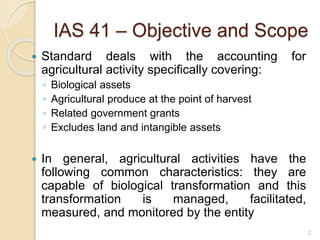
IAS 41 – Objective and Scope
 Standard deals with the accounting for
agricultural activity specifically covering:
◦ Biological assets
◦ Agricultural produce at the point of harvest
◦ Related government grants
◦ Excludes land and intangible assets
 In general, agricultural activities have the
following common characteristics: they are
capable of biological transformation and this
transformation is managed, facilitated,
measured, and monitored by the entity
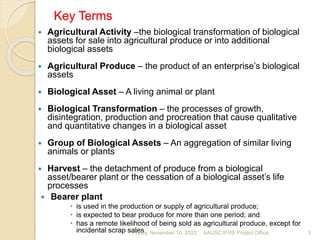
Key Terms
 Agricultural Activity –the biological transformation of biological
assets for sale into agricultural produce or into additional
biological assets
 Agricultural Produce – the product of an enterprise’s biological
assets
 Biological Asset – A living animal or plant
 Biological Transformation – the processes of growth,
disintegration, production and procreation that cause qualitative
and quantitative changes in a biological asset
 Group of Biological Assets – An aggregation of similar living
animals or plants
 Harvest – the detachment of produce from a biological
asset/bearer plant or the cessation of a biological asset’s life
processes
 Bearer plant
 is used in the production or supply of agricultural produce;
 is expected to bear produce for more than one period; and
 has a remote likelihood of being sold as agricultural produce, except for
incidental scrap sales
Friday, November 10, 2023 3
AAUSC IFRS Project Office
4
4
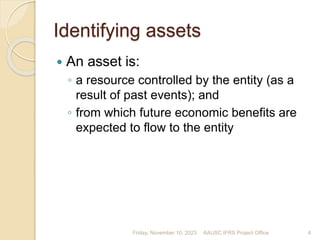
Identifying assets
 An asset is:
◦ a resource controlled by the entity (as a
result of past events); and
◦ from which future economic benefits are
expected to flow to the entity
Friday, November 10, 2023 4
AAUSC IFRS Project Office
5
5
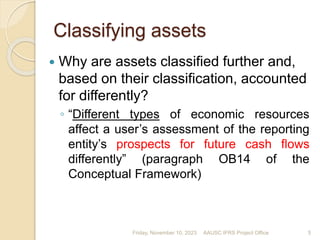
Classifying assets
 Why are assets classified further and,
based on their classification, accounted
for differently?
◦ “Different types of economic resources
affect a user’s assessment of the reporting
entity’s prospects for future cash flows
differently” (paragraph OB14 of the
Conceptual Framework)
Friday, November 10, 2023 5
AAUSC IFRS Project Office
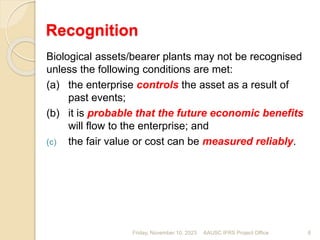
Recognition
Biological assets/bearer plants may not be recognised
unless the following conditions are met:
(a) the enterprise controls the asset as a result of
past events;
(b) it is probable that the future economic benefits
will flow to the enterprise; and
(c) the fair value or cost can be measured reliably.
Friday, November 10, 2023 6
AAUSC IFRS Project Office
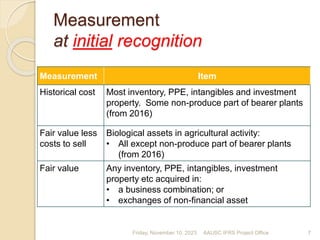
Measurement
at initial recognition
Measurement Item
Historical cost Most inventory, PPE, intangibles and investment
property. Some non-produce part of bearer plants
(from 2016)
Fair value less
costs to sell
Biological assets in agricultural activity:
• All except non-produce part of bearer plants
(from 2016)
Fair value Any inventory, PPE, intangibles, investment
property etc acquired in:
• a business combination; or
• exchanges of non-financial asset
Friday, November 10, 2023 7
AAUSC IFRS Project Office
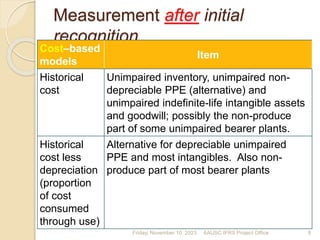
Measurement after initial
recognition
Cost–based
models
Item
Historical
cost
Unimpaired inventory, unimpaired non-
depreciable PPE (alternative) and
unimpaired indefinite-life intangible assets
and goodwill; possibly the non-produce
part of some unimpaired bearer plants.
Historical
cost less
depreciation
(proportion
of cost
consumed
through use)
Alternative for depreciable unimpaired
PPE and most intangibles. Also non-
produce part of most bearer plants
Friday, November 10, 2023 8
AAUSC IFRS Project Office
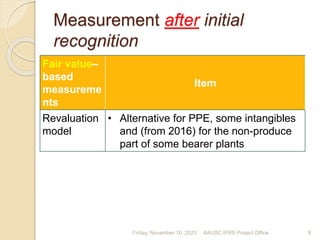
Measurement after initial
recognition
Fair value–
based
measureme
nts
Item
Revaluation
model
• Alternative for PPE, some intangibles
and (from 2016) for the non-produce
part of some bearer plants
Friday, November 10, 2023 9
AAUSC IFRS Project Office
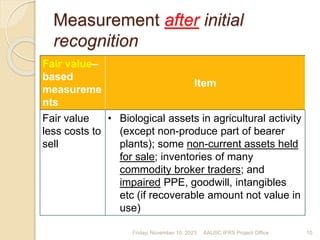
Measurement after initial
recognition
Fair value–
based
measureme
nts
Item
Fair value
less costs to
sell
• Biological assets in agricultural activity
(except non-produce part of bearer
plants); some non-current assets held
for sale; inventories of many
commodity broker traders; and
impaired PPE, goodwill, intangibles
etc (if recoverable amount not value in
use)
Friday, November 10, 2023 10
AAUSC IFRS Project Office
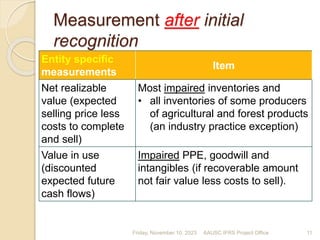
Measurement after initial
recognition
Entity specific
measurements
Item
Net realizable
value (expected
selling price less
costs to complete
and sell)
Most impaired inventories and
• all inventories of some producers
of agricultural and forest products
(an industry practice exception)
Value in use
(discounted
expected future
cash flows)
Impaired PPE, goodwill and
intangibles (if recoverable amount
not fair value less costs to sell).
Friday, November 10, 2023 11
AAUSC IFRS Project Office
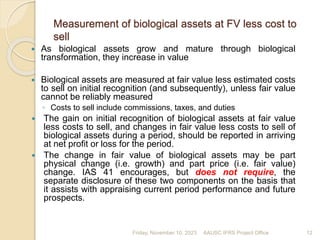
Measurement of biological assets at FV less cost to
sell
 As biological assets grow and mature through biological
transformation, they increase in value
 Biological assets are measured at fair value less estimated costs
to sell on initial recognition (and subsequently), unless fair value
cannot be reliably measured
◦ Costs to sell include commissions, taxes, and duties
 The gain on initial recognition of biological assets at fair value
less costs to sell, and changes in fair value less costs to sell of
biological assets during a period, should be reported in arriving
at net profit or loss for the period.
 The change in fair value of biological assets may be part
physical change (i.e. growth) and part price (i.e. fair value)
change. IAS 41 encourages, but does not require, the
separate disclosure of these two components on the basis that
it assists with appraising current period performance and future
prospects.
Friday, November 10, 2023 12
AAUSC IFRS Project Office
Example: Measurement of biological assets at FV
less cost to sell
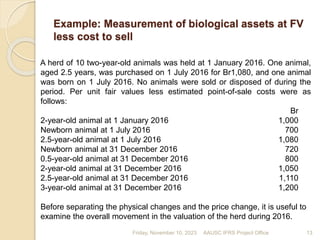
A herd of 10 two-year-old animals was held at 1 January 2016. One animal,
aged 2.5 years, was purchased on 1 July 2016 for Br1,080, and one animal
was born on 1 July 2016. No animals were sold or disposed of during the
period. Per unit fair values less estimated point-of-sale costs were as
follows:
Br
2-year-old animal at 1 January 2016 1,000
Newborn animal at 1 July 2016 700
2.5-year-old animal at 1 July 2016 1,080
Newborn animal at 31 December 2016 720
0.5-year-old animal at 31 December 2016 800
2-year-old animal at 31 December 2016 1,050
2.5-year-old animal at 31 December 2016 1,110
3-year-old animal at 31 December 2016 1,200
Before separating the physical changes and the price change, it is useful to
examine the overall movement in the valuation of the herd during 2016.
Friday, November 10, 2023 13
AAUSC IFRS Project Office
Example: Measurement of biological assets at FV
less cost to sell
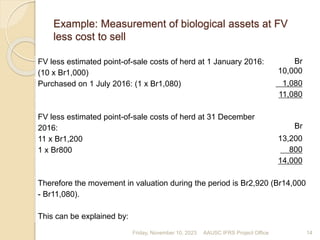
FV less estimated point-of-sale costs of herd at 1 January 2016:
(10 x Br1,000)
Br
10,000
Purchased on 1 July 2016: (1 x Br1,080) 1,080
11,080
FV less estimated point-of-sale costs of herd at 31 December
2016: Br
11 x Br1,200 13,200
1 x Br800 800
14,000
Therefore the movement in valuation during the period is Br2,920 (Br14,000
- Br11,080).
This can be explained by:
Friday, November 10, 2023 14
AAUSC IFRS Project Office
Example: Measurement of biological assets at FV
less cost to sell
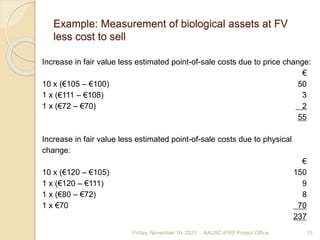
Increase in fair value less estimated point-of-sale costs due to price change:
€
10 x (€105 – €100) 50
1 x (€111 – €108) 3
1 x (€72 – €70) 2
55
Increase in fair value less estimated point-of-sale costs due to physical
change:
€
10 x (€120 – €105) 150
1 x (€120 – €111) 9
1 x (€80 – €72) 8
1 x €70 70
237
Friday, November 10, 2023 15
AAUSC IFRS Project Office
16
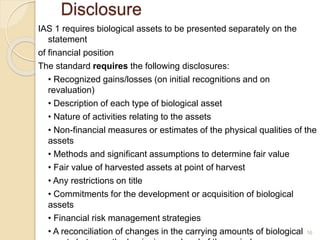
Disclosure
IAS 1 requires biological assets to be presented separately on the
statement
of financial position
The standard requires the following disclosures:
• Recognized gains/losses (on initial recognitions and on
revaluation)
• Description of each type of biological asset
• Nature of activities relating to the assets
• Non-financial measures or estimates of the physical qualities of the
assets
• Methods and significant assumptions to determine fair value
• Fair value of harvested assets at point of harvest
• Any restrictions on title
• Commitments for the development or acquisition of biological
assets
• Financial risk management strategies
• A reconciliation of changes in the carrying amounts of biological
The End
Friday, November 10, 2023 17
AAUSC IFRS Project Office

Accounting for Agriculture.pptx

  • 1.
    Friday, November 10,2023 1 ACCOUNTING FOR AGRICULTURE AAUSC IFRS Project Office
  • 2.
    2 IAS 41 –Objective and Scope  Standard deals with the accounting for agricultural activity specifically covering: ◦ Biological assets ◦ Agricultural produce at the point of harvest ◦ Related government grants ◦ Excludes land and intangible assets  In general, agricultural activities have the following common characteristics: they are capable of biological transformation and this transformation is managed, facilitated, measured, and monitored by the entity
  • 3.
    Key Terms  AgriculturalActivity –the biological transformation of biological assets for sale into agricultural produce or into additional biological assets  Agricultural Produce – the product of an enterprise’s biological assets  Biological Asset – A living animal or plant  Biological Transformation – the processes of growth, disintegration, production and procreation that cause qualitative and quantitative changes in a biological asset  Group of Biological Assets – An aggregation of similar living animals or plants  Harvest – the detachment of produce from a biological asset/bearer plant or the cessation of a biological asset’s life processes  Bearer plant  is used in the production or supply of agricultural produce;  is expected to bear produce for more than one period; and  has a remote likelihood of being sold as agricultural produce, except for incidental scrap sales Friday, November 10, 2023 3 AAUSC IFRS Project Office
  • 4.
    4 4 Identifying assets  Anasset is: ◦ a resource controlled by the entity (as a result of past events); and ◦ from which future economic benefits are expected to flow to the entity Friday, November 10, 2023 4 AAUSC IFRS Project Office
  • 5.
    5 5 Classifying assets  Whyare assets classified further and, based on their classification, accounted for differently? ◦ “Different types of economic resources affect a user’s assessment of the reporting entity’s prospects for future cash flows differently” (paragraph OB14 of the Conceptual Framework) Friday, November 10, 2023 5 AAUSC IFRS Project Office
  • 6.
    Recognition Biological assets/bearer plantsmay not be recognised unless the following conditions are met: (a) the enterprise controls the asset as a result of past events; (b) it is probable that the future economic benefits will flow to the enterprise; and (c) the fair value or cost can be measured reliably. Friday, November 10, 2023 6 AAUSC IFRS Project Office
  • 7.
    Measurement at initial recognition MeasurementItem Historical cost Most inventory, PPE, intangibles and investment property. Some non-produce part of bearer plants (from 2016) Fair value less costs to sell Biological assets in agricultural activity: • All except non-produce part of bearer plants (from 2016) Fair value Any inventory, PPE, intangibles, investment property etc acquired in: • a business combination; or • exchanges of non-financial asset Friday, November 10, 2023 7 AAUSC IFRS Project Office
  • 8.
    Measurement after initial recognition Cost–based models Item Historical cost Unimpairedinventory, unimpaired non- depreciable PPE (alternative) and unimpaired indefinite-life intangible assets and goodwill; possibly the non-produce part of some unimpaired bearer plants. Historical cost less depreciation (proportion of cost consumed through use) Alternative for depreciable unimpaired PPE and most intangibles. Also non- produce part of most bearer plants Friday, November 10, 2023 8 AAUSC IFRS Project Office
  • 9.
    Measurement after initial recognition Fairvalue– based measureme nts Item Revaluation model • Alternative for PPE, some intangibles and (from 2016) for the non-produce part of some bearer plants Friday, November 10, 2023 9 AAUSC IFRS Project Office
  • 10.
    Measurement after initial recognition Fairvalue– based measureme nts Item Fair value less costs to sell • Biological assets in agricultural activity (except non-produce part of bearer plants); some non-current assets held for sale; inventories of many commodity broker traders; and impaired PPE, goodwill, intangibles etc (if recoverable amount not value in use) Friday, November 10, 2023 10 AAUSC IFRS Project Office
  • 11.
    Measurement after initial recognition Entityspecific measurements Item Net realizable value (expected selling price less costs to complete and sell) Most impaired inventories and • all inventories of some producers of agricultural and forest products (an industry practice exception) Value in use (discounted expected future cash flows) Impaired PPE, goodwill and intangibles (if recoverable amount not fair value less costs to sell). Friday, November 10, 2023 11 AAUSC IFRS Project Office
  • 12.
    Measurement of biologicalassets at FV less cost to sell  As biological assets grow and mature through biological transformation, they increase in value  Biological assets are measured at fair value less estimated costs to sell on initial recognition (and subsequently), unless fair value cannot be reliably measured ◦ Costs to sell include commissions, taxes, and duties  The gain on initial recognition of biological assets at fair value less costs to sell, and changes in fair value less costs to sell of biological assets during a period, should be reported in arriving at net profit or loss for the period.  The change in fair value of biological assets may be part physical change (i.e. growth) and part price (i.e. fair value) change. IAS 41 encourages, but does not require, the separate disclosure of these two components on the basis that it assists with appraising current period performance and future prospects. Friday, November 10, 2023 12 AAUSC IFRS Project Office
  • 13.
    Example: Measurement ofbiological assets at FV less cost to sell A herd of 10 two-year-old animals was held at 1 January 2016. One animal, aged 2.5 years, was purchased on 1 July 2016 for Br1,080, and one animal was born on 1 July 2016. No animals were sold or disposed of during the period. Per unit fair values less estimated point-of-sale costs were as follows: Br 2-year-old animal at 1 January 2016 1,000 Newborn animal at 1 July 2016 700 2.5-year-old animal at 1 July 2016 1,080 Newborn animal at 31 December 2016 720 0.5-year-old animal at 31 December 2016 800 2-year-old animal at 31 December 2016 1,050 2.5-year-old animal at 31 December 2016 1,110 3-year-old animal at 31 December 2016 1,200 Before separating the physical changes and the price change, it is useful to examine the overall movement in the valuation of the herd during 2016. Friday, November 10, 2023 13 AAUSC IFRS Project Office
  • 14.
    Example: Measurement ofbiological assets at FV less cost to sell FV less estimated point-of-sale costs of herd at 1 January 2016: (10 x Br1,000) Br 10,000 Purchased on 1 July 2016: (1 x Br1,080) 1,080 11,080 FV less estimated point-of-sale costs of herd at 31 December 2016: Br 11 x Br1,200 13,200 1 x Br800 800 14,000 Therefore the movement in valuation during the period is Br2,920 (Br14,000 - Br11,080). This can be explained by: Friday, November 10, 2023 14 AAUSC IFRS Project Office
  • 15.
    Example: Measurement ofbiological assets at FV less cost to sell Increase in fair value less estimated point-of-sale costs due to price change: € 10 x (€105 – €100) 50 1 x (€111 – €108) 3 1 x (€72 – €70) 2 55 Increase in fair value less estimated point-of-sale costs due to physical change: € 10 x (€120 – €105) 150 1 x (€120 – €111) 9 1 x (€80 – €72) 8 1 x €70 70 237 Friday, November 10, 2023 15 AAUSC IFRS Project Office
  • 16.
    16 Disclosure IAS 1 requiresbiological assets to be presented separately on the statement of financial position The standard requires the following disclosures: • Recognized gains/losses (on initial recognitions and on revaluation) • Description of each type of biological asset • Nature of activities relating to the assets • Non-financial measures or estimates of the physical qualities of the assets • Methods and significant assumptions to determine fair value • Fair value of harvested assets at point of harvest • Any restrictions on title • Commitments for the development or acquisition of biological assets • Financial risk management strategies • A reconciliation of changes in the carrying amounts of biological
  • 17.
    The End Friday, November10, 2023 17 AAUSC IFRS Project Office