IOSR Journal of Business and Management (IOSR-JBM)
e-ISSN: 2278-487X, p-ISSN: 2319-7668. Volume 9, Issue 5 (Mar. - Apr. 2013), PP 18-27
www.iosrjournals.org
www.iosrjournals.org 18 | Page
The Current Status of SEZ, India
S. Chandrachud1
, Asst. Professor, VELS University, Chennai
Dr. N. Gajalakshmi2
, Asst. Prof. S.D.N.B.V College for women, Chennai
I. Introduction
SEZ, the acronym of Special Economic Zone. SEZ is a geographical region that has economic laws
different from a country‟s generally applicable economic laws, for the purpose of economic development and
growth with the help of foreign investment. Literally SEZ means, a geographically demarcated region that has
economic laws that are more liberal than the country‟s typical economic laws and where all the units therein
have specific privileges. SEZs are specifically delineated duty-free enclaves and are deemed to be foreign
territory for the purposes of trade operations, duties and tariffs.1
The Present paper attempts to measure the level of economic quake felt by Indian economy in the 21st
century with the subheading SEZ – In Global context, SEZ - In Indian context, Comparison of State-wise
approvals of SEZ and Sector-wise approval of SEZ and concluded with role of SEZ in Units Approvals, Export
performance, Employment generation and Investment.
SEZ – In Global Context
According to world bank estimate, as on 2007, there are 3000 projects taking place in SEZs across 120
countries worldwide and it has been grown in reap and bounds in the recent past. In 1896, the first industrial
Park was set up in Manchester, called Free Trade Zone, designed to promote the free trade, conceptually
improved by Hong Kong during the Post-Second world War, created economic quake elsewhere thereafter. In
1929, the first Special Economic Zone which was called as Special Zone was introduced in Spain with the
intention of improving the exports by value addition to the raw materials available in that country, conceptually
improved by Deng Xiaoping, revolutionary veteran of China, for the past three decades, gave an economic
quake to the concept of SEZ from1979. He used the SEZ as the economic quake to attain the success of his
liberalized economic policies. Later the other developing countries, like UAE, Jordan, Philippines, Malaysia,
Russia, Kazakhstan and South Korea are also chosen the Chinese path in their economies in terms of economic
liberalization. Even most of the countries in south Asia – Nepal, Bangladesh, Sri Lanka and Pakistan have tried
to promote their export.
SEZ – In Indian Context
Right from the beginning of 21st
century, India has progressively opened up its economy to face the
new challenges effectively and utilize the opportunities positively. Considering the importance to enhance
foreign investment and promote exports from the country. Realizing the need that the field of business play
must be available to domestic enterprises and manufacturers to be competitive globally, the government had
announced the introduction of Special Economic Zones (SEZs) policy on April 2000, through a revision in the
Export and Import policy (EXIM) 1997-2002. The objective of SEZs include making available goods and
services free of taxes and duties supported by integrated infrastructure for export production, quick approval
mechanisms, and a package of incentives to attract foreign and domestic investments for promoting exports. The
SEZ policy suffers from lack of central legislation, rigid labour laws and multi clearance of approval etc. In
order to overcome such lacunae, the government of India enacted SEZ act 2005 to give a long term and stable
policy framework with minimum regulation. It came into force from February 2006. The main objectives of the
SEZs are:
(a) Generation of additional economic activity;
(b) Promotion of exports of goods and services;
(c) Promotion of investment from domestic and foreign sources;
(d) Creation of employment opportunities;
(e) Development of infrastructure facilities.2
In fact, India was the first Asian country to recognize the importance and effectiveness of Export
Processing Zone (EPZ) and the first EPZ came into being in 1965 in Kandla, Gujarat. But, since then there has
not been done much to the strengthening of EPZs in India. In 2000, therefore, the government replaced the
earlier regime of EPZ by a new scheme of SEZs, which encompassed a number of potential benefits that were
missing in the earlier scheme. In May 2005, the SEZ Act2 was passed by the Parliament and SEZ Rules 3 came
into force from February 10, 2006, which not only simplified procedures but also extended single window
The Current Status of SEZ India
www.iosrjournals.org 19 | Page
clearance for matters relating to Central as well as state governments. The SEZ Rules provide for different
minimum land requirement for different class of SEZs. The promotion of SEZs is expected to tackle wide range
of structural bottlenecks created by monetary, fiscal, taxation, trade, tariff and labour policies, aside from
overcoming complex procedures and infrastructure deficiencies (Aggarwal, 2006). It has been argued that since
development of infrastructure requires huge capital investment and as implementation of structural reforms is
time-consuming process, the establishment of SEZs would be the only realistic strategy governing the process of
industrialization. Although SEZs offer numerous benefits, there are also various positive as well as negative
features associated with the establishment of SEZs in India. It is, therefore, essential to analyse not only the
potential benefits of SEZs but also the likely impact of establishment of SEZs on agricultural production,
employment, water and food security.
Salient Features of SEZ Act
SEZs in India are not only expected to bring large flow of foreign direct investment but also domestic
investment, which will help in generating additional economic activity in the form of creating employment
opportunities, infrastructure development and enhancing productive capacity as well as capabilities. The salient
features of the SEZ Act mainly revolve around
a) Satisfying the needs of all major stakeholders in an SEZ, including developers, operators, suppliers,
residents, etc.,
b) Making provisions of single window clearance mechanism
c) Providing attractive fiscal incentive package,
d) Establishing free trade and warehousing zones with a view to develop internationally competitive
infrastructure facilities to augment import and export of commodities
e) Setting up of off shore banking units, and
f) Facilitating public private participation towards development of infrastructure.
The SEZ Rules provide for different minimum land requirement for different class of SEZs. Every SEZ
is divided into a processing area where alone the SEZ units would come up and the non-processing area where
the supporting infrastructure is to be created. The main purpose of framing SEZ rules to provide:
a) " Simplified procedures for development, operation, and maintenance of the Special Economic Zones and
for setting up units and conducting business in SEZs;
b) Single window clearance for setting up of an SEZ;
c) Single window clearance for setting up a unit in a Special Economic Zone;
d) Single Window clearance on matters relating to Central as well as State Governments;
e) Simplified compliance procedures and documentation with an emphasis on self certification
In order to attract investments into the SEZs in India, number of incentives and facilities have been
offered to the SEZs are duty free import and domestic procurement of goods for development, operation and
maintenance of SEZ units, 100% Income tax exemption on export income for SEZ units under section 10AA of
the Income Tax Act for first 5 years thereafter 50% of the ploughed back export profit for next 5 years,
exemption from minimum alternate tax under section 115JB of the Income Tax Act, External Commercial
borrowing by SEZ units up to US $.500 million in a year without any maturity restrictions through recognized
banking channels, exemption from Central Sales Tax, single window clearance for Central and state level
approvals and exemption from state sales tax and other levies as extended by the respective State Government.
In addition to that there are certain major incentives and facilities available to SEZ developers, right
from, exemption from customs and excise duties for development of SEZs for authorized operations approved
by the BOA, Income tax exemption on the income derived from the business of development of the SEZ in a
block of 10 years in 15 years under section 80-IAB of the Income Tax Act, exemption from minimum alternate
tax under 115JB of the Income Tax Act, exemption from dividend distribution tax under Section 115O of the
Income Tax Act, exemption from Central Sales Tax (CST) up to exemption from Service Tax (Section 7, 26
and Second schedule of SEZ Act) etc. (GOI, 2011)
A successful SEZ investment in India would benefit by noting the following investment related issues:
a) relief and rehabilitation of the displaced people is a serious issue;
b) investors need to attract the attention of state governments, and the investors and the concerned state
governments must discover synergies, which they find mutually worth pursuing;
c) investors should stay out of partisan politics because ruling parties frequently lose power in India; and
d) it helps if the concerned state has ministers in central ministries who can help clear infrastructure
projects such as roads, ports, airports and rail connections favorable to investors in that state.
The Current Status of SEZ India
www.iosrjournals.org 20 | Page
II. Review of Literature
a) Madani (1999) reports that a 1981 survey in the Dominican republic found that SEZ wages were the main
source of income for 38% of Women working in the zones and that almost half of them were single,
divorced or widows
b) “Quality practices are investment in competitive resources and capabilities which bring competitiveness to
the firm, by enhancing reliability, in the eye of customers through superior firm performance” Krajewski
and Ritzman (1996), Khalil (2000)
c) “the SEZ wages reported to be lower than the wages in the Non-SEZ area” Pakistan (Kemel 2001) and Haiti
(Heron 2004)
d) “Management capacity as an investment in resources and capabilities makes progress towards
competitiveness of a firm”. Priyanto (2006), Verma (2002)
e) “The production capacity and utilisation is an investment in competitive resources that provide
competitiveness to the firm by superior performance.” Bavani (2006)
f) “Firms benefit from local production externalities, which exist when a firm's production possibilities
depend on the actions of other firms located in the same region.” Hanson (2001), Henderson (2003), and
Agarwal (2004).
g) “Vision is one of the abilities of the entrepreneur to steer the firm ahead in the competitions” Vasant Desai
(2006)
h) “Providing hassle free environment to run business is one of the objectives of SEZ exim policy.” Madani
(1999) and Exim policy (2002-2007), SEZ Act, Ministry of Commerce, India
i) “Ability to procure goods from outside is one of the prinicipal benefits of creating export” Agarwal (2004)
and Ministry of India.
j) “Special Economic Zones in India – An Introduction” ASIEN, 106, January 2008 Jona Aravind Dohrmann,
k) Location strategy for competitiveness of Special Economic Zones in India – A Generic Framework, by
Tarun Dhingra, Dr. Ambalika Sinha, and Dr. Tripti Singh³
III. State wise Break up of SEZ
Different states have different SEZ stories to tell. While some have done exceedingly well, others seem
to be going nowhere.
Table 1 State wise distribution of SEZ Approvals
State or Union Territory Formal approvals In Principle approval Notified SEZ
Andra Pradesh 109 6 76
Chandigarh 2 0 2
Chattisgarh 1 1 1
Delhi 3 0 0
Dadra & Nagar Haveli 2 0 1
Goa 7 0 3
Gujarat 47 7 32
Hariyana 46 3 35
Jharkhand 1 0 1
Karnataka 62 1 41
Kerala 29 0 20
Madhya Pradesh 19 2 6
Maharshta 103 16 64
Nagaland 2 0 1
Orrisa 10 1 5
Pondicherry 1 1 0
Punjab 8 0 2
Rajasthan 10 1 10
Tamilnadu 69 6 53
Uttar Pradesh 34 1 21
Uttarkhand 2 0 1
West Bengal 20 3 11
Grand Total 588 49 386
Source: Ministry of Commerce and Industry, SEZ in India, GOI
The Current Status of SEZ India
www.iosrjournals.org 21 | Page
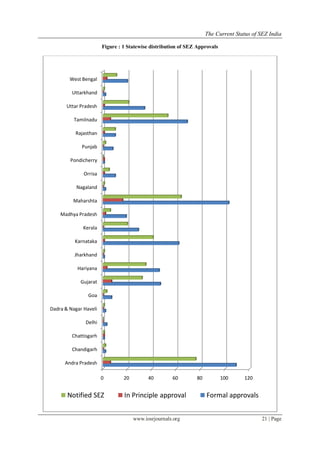
Figure : 1 Statewise distribution of SEZ Approvals
0 20 40 60 80 100 120
Andra Pradesh
Chandigarh
Chattisgarh
Delhi
Dadra & Nagar Haveli
Goa
Gujarat
Hariyana
Jharkhand
Karnataka
Kerala
Madhya Pradesh
Maharshta
Nagaland
Orrisa
Pondicherry
Punjab
Rajasthan
Tamilnadu
Uttar Pradesh
Uttarkhand
West Bengal
Notified SEZ In Principle approval Formal approvals
The Current Status of SEZ India
www.iosrjournals.org 22 | Page
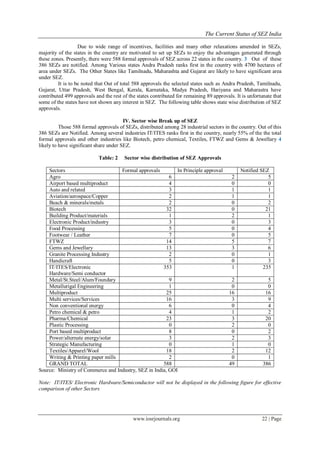
Due to wide range of incentives, facilities and many other relaxations amended in SEZs,
majority of the states in the country are motivated to set up SEZs to enjoy the advantages generated through
these zones. Presently, there were 588 formal approvals of SEZ across 22 states in the country. 3 Out of these
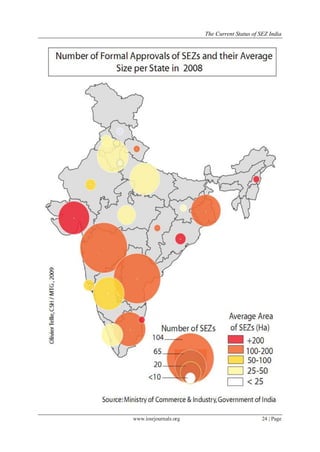
386 SEZs are notified. Among Various states Andra Pradesh ranks first in the country with 4700 hectares of
area under SEZs. The Other States like Tamilnadu, Maharashta and Gujarat are likely to have significant area
under SEZ.
It is to be noted that Out of total 588 approvals the selected states such as Andra Pradesh, Tamilnadu,
Gujarat, Uttar Pradesh, West Bengal, Kerala, Karnataka, Madya Pradesh, Hariyana and Maharastra have
contributed 499 approvals and the rest of the states contributed for remaining 89 approvals. It is unfortunate that
some of the states have not shown any interest in SEZ. The following table shows state wise distribution of SEZ
approvals.
IV. Sector wise Break up of SEZ
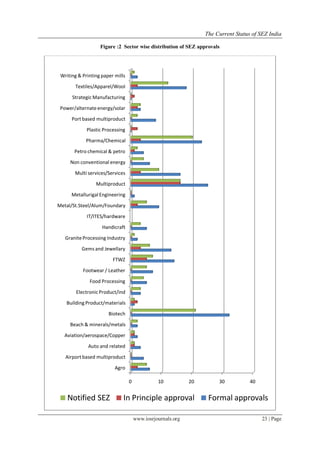
Those 588 formal approvals of SEZs, distributed among 28 industrial sectors in the country. Out of this
386 SEZs are Notified. Among several industries IT/ITES ranks first in the country, nearly 55% of the the total
formal approvals and other industries like Biotech, petro chemical, Textiles, FTWZ and Gems & Jewellary 4
likely to have significant share under SEZ.
Table: 2 Sector wise distribution of SEZ Approvals
Sectors Formal approvals In Principle approval Notified SEZ
Agro 6 2 5
Airport based multiproduct 4 0 0
Auto and related 3 1 1
Aviation/aerospace/Copper 2 1 1
Beach & minerals/metals 2 0 2
Biotech 32 0 21
Building Product/materials 1 2 1
Electronic Product/industry 3 0 3
Food Processing 5 0 4
Footwear / Leather 7 0 5
FTWZ 14 5 7
Gems and Jewellary 13 3 6
Granite Processing Industry 2 0 1
Handicraft 5 0 3
IT/ITES/Electronic
Hardware/Semi conductor
353 1 235
Metal/St.Steel/Alum/Foundary 9 2 5
Metallurigal Engineering 1 0 0
Multiproduct 25 16 16
Multi services/Services 16 3 9
Non conventional energy 6 0 4
Petro chemical & petro 4 1 2
Pharma/Chemical 23 3 20
Plastic Processing 0 2 0
Port based multiproduct 8 0 2
Power/alternate energy/solar 3 2 3
Strategic Manufacturing 0 1 0
Textiles/Apparel/Wool 18 2 12
Writing & Printing paper mills 2 0 1
GRAND TOTAL 588 49 386
Source: Ministry of Commerce and Industry, SEZ in India, GOI
Note: IT/ITES/ Electronic Hardware/Semiconductor will not be displayed in the following figure for effective
comparison of other Sectors
The Current Status of SEZ India
www.iosrjournals.org 23 | Page
Figure :2 Sector wise distribution of SEZ approvals
0 10 20 30 40
Agro
Airport based multiproduct
Auto and related
Aviation/aerospace/Copper
Beach & minerals/metals
Biotech
Building Product/materials
ElectronicProduct/ind
Food Processing
Footwear / Leather
FTWZ
Gems and Jewellary
GraniteProcessing Industry
Handicraft
IT/ITES/hardware
Metal/St.Steel/Alum/Foundary
MetallurigalEngineering
Multiproduct
Multi services/Services
Non conventional energy
Petro chemical & petro
Pharma/Chemical
Plastic Processing
Port based multiproduct
Power/alternateenergy/solar
StrategicManufacturing
Textiles/Apparel/Wool
Writing & Printing paper mills
Notified SEZ In Principle approval Formal approvals
The Current Status of SEZ India
www.iosrjournals.org 24 | Page
The Current Status of SEZ India
www.iosrjournals.org 25 | Page
The Current Status of SEZ India
www.iosrjournals.org 26 | Page
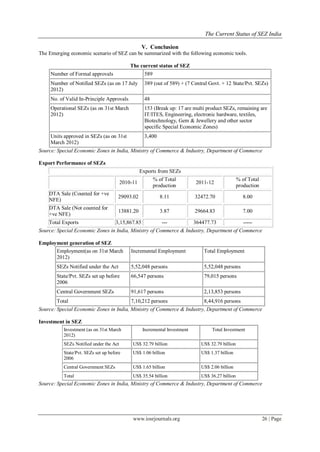
V. Conclusion
The Emerging economic scenario of SEZ can be summarized with the following economic tools.
The current status of SEZ
Number of Formal approvals 589
Number of Notified SEZs (as on 17 July
2012)
389 (out of 589) + (7 Central Govt. + 12 State/Pvt. SEZs)
No. of Valid In-Principle Approvals 48
Operational SEZs (as on 31st March
2012)
153 (Break up: 17 are multi product SEZs, remaining are
IT/ITES, Engineering, electronic hardware, textiles,
Biotechnology, Gem & Jewellery and other sector
specific Special Economic Zones)
Units approved in SEZs (as on 31st
March 2012)
3,400
Source: Special Economic Zones in India, Ministry of Commerce & Industry, Department of Commerce
Export Performance of SEZs
Exports from SEZs
2010-11
% of Total
production
2011-12
% of Total
production
DTA Sale (Counted for +ve
NFE)
29093.02 8.11 32472.70 8.00
DTA Sale (Not counted for
+ve NFE)
13881.20 3.87 29664.83 7.00
Total Exports 3,15,867.85 --- 364477.73 -----
Source: Special Economic Zones in India, Ministry of Commerce & Industry, Department of Commerce
Employment generation of SEZ
Employment(as on 31st March
2012)
Incremental Employment Total Employment
SEZs Notified under the Act 5,52,048 persons 5,52,048 persons
State/Pvt. SEZs set up before
2006
66,547 persons 79,015 persons
Central Government SEZs 91,617 persons 2,13,853 persons
Total 7,10,212 persons 8,44,916 persons
Source: Special Economic Zones in India, Ministry of Commerce & Industry, Department of Commerce
Investment in SEZ
Investment (as on 31st March
2012)
Incremental Investment Total Investment
SEZs Notified under the Act US$ 32.79 billion US$ 32.79 billion
State/Pvt. SEZs set up before
2006
US$ 1.06 billion US$ 1.37 billion
Central Government SEZs US$ 1.65 billion US$ 2.06 billion
Total US$ 35.54 billion US$ 36.27 billion
Source: Special Economic Zones in India, Ministry of Commerce & Industry, Department of Commerce
The Current Status of SEZ India
www.iosrjournals.org 27 | Page
VI. End Notes
1. Special Economic Zone (SEZ) is defined as "a specifically delineated duty free enclave and shall be deemed
to be foreign territory for the purposes of trade operations and duties and tariffs". SEZs are an
acknowledgement of the potential of export-led development strategy in accelerating economic growth.
2. Taken from the introduction to Special Economic Zones in India: http://www.sezindia.nic.in/
HTMLS/about.htm (last viewed on 12th July 2007).
3. As on October13, 2011, there were 588 formal approvals of SEZs in the country. Out of this, 386 SEZs
were notified. The number of valid In-Principle approvals was 49
4. The new law allows the SEZs to have area of the order of 1000 hectares for multi-product zones, 100
hectares for product specific zones and only 10 hectares for IT, gems and jewellery and biotechnology
zones.
References
[1]. Aggarwal Aradhana (2004). Export Processing Zones in India: Analysis of the Export Performance. - Working Paper No. 148. New
Delhi: ICRIER.
[2]. Aggarwal, Aradhna (2006), „Special Economic Zones:Revisiting the Policy Debate‟, Economic and Political Weekly, November 4,
pp. 4533-4536.
[3]. Arora, O P (2003). Compilation of Circulars on EPZ/SEZ/EOU issued by CBEC, DGFT & RBI. Published byM/s Anmkur Arora
Associates.
[4]. Aseem Shrivastava (2007), http://www.infochangeindia.org/analysis 167.jsp) raises the following questions regarding the SEZs.
[5]. Ashok Upadhyay (2005), Special Economic Zones--An idea whose time has lapsed, Business Line, Tuesday, December 20.
[6]. Asian Productivity Organization (1983), Economic and Social Impacts of Export Processing Zones in Asia, APO, Tokyo.
[7]. Bhandari, Anup Kumar and Pradip Maiti (2007). Efficiency of Indian Manufacturing Firms: Textile Industry as a Case Study.
International Journal of Business and Economics, 6 (1): 71-88.
[8]. Goldar, B, V S Ranganathan and R Banga (2003). Ownership and Efficiency in Engineering Firms in Indian, 1990-91 to 1999-2000.
ICRIER working Paper No. 115.
[9]. Grasset, Jeremy and Frederic Landy (2007). Special Economic Zones in India–Between International Integration and Real Estate
Speculation. Man and Development , 29 (4): 63-74.
[10]. IIFT (1990). Exports Processing Zones in India: A Case Study of Kandla Free Trade Zone. Indian Institute of Foreign Trade
Occasional Paper. New Delhi.
[11]. Kambhampati Uma S (2003). Trade Reforms and Efficiency of Firms in India. Oxford Development Studies, 31(2): 219-33.
[12]. Kumar, Ranjan (2006), „SEZ: Capturing me Foreign Market‟,Southern Economist, September, Vol. 45.
[13]. Tantri, Malini L (2010): “Effectiveness of SEZs over EPZs Structure: The Performance at Aggregate Level”, ISEC Working Paper
248, Institute for Social and Economic Change (ISEC), Bangalore
[14]. Trivedi Pushpa (2004): “An Inter State perspective on Manufacturing Productivity in India: 1980-81 to 2000-01”, Indian Economic
Review, 39(1): 203-237
[15]. Venugopal Dhoot (2007), ASSOCHAM Guidelines to improve SEZs, India Real Estate forum 7th March. Wall, David (1991),
Special Economic Zones in Chinathe Administrative and Regulatory Framework, Research School of Pacific Studies, The Australian
National University.
[16]. www.mepz.com
[17]. www.sez.nic.in

C0951827

  • 1.
    IOSR Journal ofBusiness and Management (IOSR-JBM) e-ISSN: 2278-487X, p-ISSN: 2319-7668. Volume 9, Issue 5 (Mar. - Apr. 2013), PP 18-27 www.iosrjournals.org www.iosrjournals.org 18 | Page The Current Status of SEZ, India S. Chandrachud1 , Asst. Professor, VELS University, Chennai Dr. N. Gajalakshmi2 , Asst. Prof. S.D.N.B.V College for women, Chennai I. Introduction SEZ, the acronym of Special Economic Zone. SEZ is a geographical region that has economic laws different from a country‟s generally applicable economic laws, for the purpose of economic development and growth with the help of foreign investment. Literally SEZ means, a geographically demarcated region that has economic laws that are more liberal than the country‟s typical economic laws and where all the units therein have specific privileges. SEZs are specifically delineated duty-free enclaves and are deemed to be foreign territory for the purposes of trade operations, duties and tariffs.1 The Present paper attempts to measure the level of economic quake felt by Indian economy in the 21st century with the subheading SEZ – In Global context, SEZ - In Indian context, Comparison of State-wise approvals of SEZ and Sector-wise approval of SEZ and concluded with role of SEZ in Units Approvals, Export performance, Employment generation and Investment. SEZ – In Global Context According to world bank estimate, as on 2007, there are 3000 projects taking place in SEZs across 120 countries worldwide and it has been grown in reap and bounds in the recent past. In 1896, the first industrial Park was set up in Manchester, called Free Trade Zone, designed to promote the free trade, conceptually improved by Hong Kong during the Post-Second world War, created economic quake elsewhere thereafter. In 1929, the first Special Economic Zone which was called as Special Zone was introduced in Spain with the intention of improving the exports by value addition to the raw materials available in that country, conceptually improved by Deng Xiaoping, revolutionary veteran of China, for the past three decades, gave an economic quake to the concept of SEZ from1979. He used the SEZ as the economic quake to attain the success of his liberalized economic policies. Later the other developing countries, like UAE, Jordan, Philippines, Malaysia, Russia, Kazakhstan and South Korea are also chosen the Chinese path in their economies in terms of economic liberalization. Even most of the countries in south Asia – Nepal, Bangladesh, Sri Lanka and Pakistan have tried to promote their export. SEZ – In Indian Context Right from the beginning of 21st century, India has progressively opened up its economy to face the new challenges effectively and utilize the opportunities positively. Considering the importance to enhance foreign investment and promote exports from the country. Realizing the need that the field of business play must be available to domestic enterprises and manufacturers to be competitive globally, the government had announced the introduction of Special Economic Zones (SEZs) policy on April 2000, through a revision in the Export and Import policy (EXIM) 1997-2002. The objective of SEZs include making available goods and services free of taxes and duties supported by integrated infrastructure for export production, quick approval mechanisms, and a package of incentives to attract foreign and domestic investments for promoting exports. The SEZ policy suffers from lack of central legislation, rigid labour laws and multi clearance of approval etc. In order to overcome such lacunae, the government of India enacted SEZ act 2005 to give a long term and stable policy framework with minimum regulation. It came into force from February 2006. The main objectives of the SEZs are: (a) Generation of additional economic activity; (b) Promotion of exports of goods and services; (c) Promotion of investment from domestic and foreign sources; (d) Creation of employment opportunities; (e) Development of infrastructure facilities.2 In fact, India was the first Asian country to recognize the importance and effectiveness of Export Processing Zone (EPZ) and the first EPZ came into being in 1965 in Kandla, Gujarat. But, since then there has not been done much to the strengthening of EPZs in India. In 2000, therefore, the government replaced the earlier regime of EPZ by a new scheme of SEZs, which encompassed a number of potential benefits that were missing in the earlier scheme. In May 2005, the SEZ Act2 was passed by the Parliament and SEZ Rules 3 came into force from February 10, 2006, which not only simplified procedures but also extended single window
  • 2.
    The Current Statusof SEZ India www.iosrjournals.org 19 | Page clearance for matters relating to Central as well as state governments. The SEZ Rules provide for different minimum land requirement for different class of SEZs. The promotion of SEZs is expected to tackle wide range of structural bottlenecks created by monetary, fiscal, taxation, trade, tariff and labour policies, aside from overcoming complex procedures and infrastructure deficiencies (Aggarwal, 2006). It has been argued that since development of infrastructure requires huge capital investment and as implementation of structural reforms is time-consuming process, the establishment of SEZs would be the only realistic strategy governing the process of industrialization. Although SEZs offer numerous benefits, there are also various positive as well as negative features associated with the establishment of SEZs in India. It is, therefore, essential to analyse not only the potential benefits of SEZs but also the likely impact of establishment of SEZs on agricultural production, employment, water and food security. Salient Features of SEZ Act SEZs in India are not only expected to bring large flow of foreign direct investment but also domestic investment, which will help in generating additional economic activity in the form of creating employment opportunities, infrastructure development and enhancing productive capacity as well as capabilities. The salient features of the SEZ Act mainly revolve around a) Satisfying the needs of all major stakeholders in an SEZ, including developers, operators, suppliers, residents, etc., b) Making provisions of single window clearance mechanism c) Providing attractive fiscal incentive package, d) Establishing free trade and warehousing zones with a view to develop internationally competitive infrastructure facilities to augment import and export of commodities e) Setting up of off shore banking units, and f) Facilitating public private participation towards development of infrastructure. The SEZ Rules provide for different minimum land requirement for different class of SEZs. Every SEZ is divided into a processing area where alone the SEZ units would come up and the non-processing area where the supporting infrastructure is to be created. The main purpose of framing SEZ rules to provide: a) " Simplified procedures for development, operation, and maintenance of the Special Economic Zones and for setting up units and conducting business in SEZs; b) Single window clearance for setting up of an SEZ; c) Single window clearance for setting up a unit in a Special Economic Zone; d) Single Window clearance on matters relating to Central as well as State Governments; e) Simplified compliance procedures and documentation with an emphasis on self certification In order to attract investments into the SEZs in India, number of incentives and facilities have been offered to the SEZs are duty free import and domestic procurement of goods for development, operation and maintenance of SEZ units, 100% Income tax exemption on export income for SEZ units under section 10AA of the Income Tax Act for first 5 years thereafter 50% of the ploughed back export profit for next 5 years, exemption from minimum alternate tax under section 115JB of the Income Tax Act, External Commercial borrowing by SEZ units up to US $.500 million in a year without any maturity restrictions through recognized banking channels, exemption from Central Sales Tax, single window clearance for Central and state level approvals and exemption from state sales tax and other levies as extended by the respective State Government. In addition to that there are certain major incentives and facilities available to SEZ developers, right from, exemption from customs and excise duties for development of SEZs for authorized operations approved by the BOA, Income tax exemption on the income derived from the business of development of the SEZ in a block of 10 years in 15 years under section 80-IAB of the Income Tax Act, exemption from minimum alternate tax under 115JB of the Income Tax Act, exemption from dividend distribution tax under Section 115O of the Income Tax Act, exemption from Central Sales Tax (CST) up to exemption from Service Tax (Section 7, 26 and Second schedule of SEZ Act) etc. (GOI, 2011) A successful SEZ investment in India would benefit by noting the following investment related issues: a) relief and rehabilitation of the displaced people is a serious issue; b) investors need to attract the attention of state governments, and the investors and the concerned state governments must discover synergies, which they find mutually worth pursuing; c) investors should stay out of partisan politics because ruling parties frequently lose power in India; and d) it helps if the concerned state has ministers in central ministries who can help clear infrastructure projects such as roads, ports, airports and rail connections favorable to investors in that state.
  • 3.
    The Current Statusof SEZ India www.iosrjournals.org 20 | Page II. Review of Literature a) Madani (1999) reports that a 1981 survey in the Dominican republic found that SEZ wages were the main source of income for 38% of Women working in the zones and that almost half of them were single, divorced or widows b) “Quality practices are investment in competitive resources and capabilities which bring competitiveness to the firm, by enhancing reliability, in the eye of customers through superior firm performance” Krajewski and Ritzman (1996), Khalil (2000) c) “the SEZ wages reported to be lower than the wages in the Non-SEZ area” Pakistan (Kemel 2001) and Haiti (Heron 2004) d) “Management capacity as an investment in resources and capabilities makes progress towards competitiveness of a firm”. Priyanto (2006), Verma (2002) e) “The production capacity and utilisation is an investment in competitive resources that provide competitiveness to the firm by superior performance.” Bavani (2006) f) “Firms benefit from local production externalities, which exist when a firm's production possibilities depend on the actions of other firms located in the same region.” Hanson (2001), Henderson (2003), and Agarwal (2004). g) “Vision is one of the abilities of the entrepreneur to steer the firm ahead in the competitions” Vasant Desai (2006) h) “Providing hassle free environment to run business is one of the objectives of SEZ exim policy.” Madani (1999) and Exim policy (2002-2007), SEZ Act, Ministry of Commerce, India i) “Ability to procure goods from outside is one of the prinicipal benefits of creating export” Agarwal (2004) and Ministry of India. j) “Special Economic Zones in India – An Introduction” ASIEN, 106, January 2008 Jona Aravind Dohrmann, k) Location strategy for competitiveness of Special Economic Zones in India – A Generic Framework, by Tarun Dhingra, Dr. Ambalika Sinha, and Dr. Tripti Singh³ III. State wise Break up of SEZ Different states have different SEZ stories to tell. While some have done exceedingly well, others seem to be going nowhere. Table 1 State wise distribution of SEZ Approvals State or Union Territory Formal approvals In Principle approval Notified SEZ Andra Pradesh 109 6 76 Chandigarh 2 0 2 Chattisgarh 1 1 1 Delhi 3 0 0 Dadra & Nagar Haveli 2 0 1 Goa 7 0 3 Gujarat 47 7 32 Hariyana 46 3 35 Jharkhand 1 0 1 Karnataka 62 1 41 Kerala 29 0 20 Madhya Pradesh 19 2 6 Maharshta 103 16 64 Nagaland 2 0 1 Orrisa 10 1 5 Pondicherry 1 1 0 Punjab 8 0 2 Rajasthan 10 1 10 Tamilnadu 69 6 53 Uttar Pradesh 34 1 21 Uttarkhand 2 0 1 West Bengal 20 3 11 Grand Total 588 49 386 Source: Ministry of Commerce and Industry, SEZ in India, GOI
  • 4.
    The Current Statusof SEZ India www.iosrjournals.org 21 | Page Figure : 1 Statewise distribution of SEZ Approvals 0 20 40 60 80 100 120 Andra Pradesh Chandigarh Chattisgarh Delhi Dadra & Nagar Haveli Goa Gujarat Hariyana Jharkhand Karnataka Kerala Madhya Pradesh Maharshta Nagaland Orrisa Pondicherry Punjab Rajasthan Tamilnadu Uttar Pradesh Uttarkhand West Bengal Notified SEZ In Principle approval Formal approvals
  • 5.
    The Current Statusof SEZ India www.iosrjournals.org 22 | Page Due to wide range of incentives, facilities and many other relaxations amended in SEZs, majority of the states in the country are motivated to set up SEZs to enjoy the advantages generated through these zones. Presently, there were 588 formal approvals of SEZ across 22 states in the country. 3 Out of these 386 SEZs are notified. Among Various states Andra Pradesh ranks first in the country with 4700 hectares of area under SEZs. The Other States like Tamilnadu, Maharashta and Gujarat are likely to have significant area under SEZ. It is to be noted that Out of total 588 approvals the selected states such as Andra Pradesh, Tamilnadu, Gujarat, Uttar Pradesh, West Bengal, Kerala, Karnataka, Madya Pradesh, Hariyana and Maharastra have contributed 499 approvals and the rest of the states contributed for remaining 89 approvals. It is unfortunate that some of the states have not shown any interest in SEZ. The following table shows state wise distribution of SEZ approvals. IV. Sector wise Break up of SEZ Those 588 formal approvals of SEZs, distributed among 28 industrial sectors in the country. Out of this 386 SEZs are Notified. Among several industries IT/ITES ranks first in the country, nearly 55% of the the total formal approvals and other industries like Biotech, petro chemical, Textiles, FTWZ and Gems & Jewellary 4 likely to have significant share under SEZ. Table: 2 Sector wise distribution of SEZ Approvals Sectors Formal approvals In Principle approval Notified SEZ Agro 6 2 5 Airport based multiproduct 4 0 0 Auto and related 3 1 1 Aviation/aerospace/Copper 2 1 1 Beach & minerals/metals 2 0 2 Biotech 32 0 21 Building Product/materials 1 2 1 Electronic Product/industry 3 0 3 Food Processing 5 0 4 Footwear / Leather 7 0 5 FTWZ 14 5 7 Gems and Jewellary 13 3 6 Granite Processing Industry 2 0 1 Handicraft 5 0 3 IT/ITES/Electronic Hardware/Semi conductor 353 1 235 Metal/St.Steel/Alum/Foundary 9 2 5 Metallurigal Engineering 1 0 0 Multiproduct 25 16 16 Multi services/Services 16 3 9 Non conventional energy 6 0 4 Petro chemical & petro 4 1 2 Pharma/Chemical 23 3 20 Plastic Processing 0 2 0 Port based multiproduct 8 0 2 Power/alternate energy/solar 3 2 3 Strategic Manufacturing 0 1 0 Textiles/Apparel/Wool 18 2 12 Writing & Printing paper mills 2 0 1 GRAND TOTAL 588 49 386 Source: Ministry of Commerce and Industry, SEZ in India, GOI Note: IT/ITES/ Electronic Hardware/Semiconductor will not be displayed in the following figure for effective comparison of other Sectors
  • 6.
    The Current Statusof SEZ India www.iosrjournals.org 23 | Page Figure :2 Sector wise distribution of SEZ approvals 0 10 20 30 40 Agro Airport based multiproduct Auto and related Aviation/aerospace/Copper Beach & minerals/metals Biotech Building Product/materials ElectronicProduct/ind Food Processing Footwear / Leather FTWZ Gems and Jewellary GraniteProcessing Industry Handicraft IT/ITES/hardware Metal/St.Steel/Alum/Foundary MetallurigalEngineering Multiproduct Multi services/Services Non conventional energy Petro chemical & petro Pharma/Chemical Plastic Processing Port based multiproduct Power/alternateenergy/solar StrategicManufacturing Textiles/Apparel/Wool Writing & Printing paper mills Notified SEZ In Principle approval Formal approvals
  • 7.
    The Current Statusof SEZ India www.iosrjournals.org 24 | Page
  • 8.
    The Current Statusof SEZ India www.iosrjournals.org 25 | Page
  • 9.
    The Current Statusof SEZ India www.iosrjournals.org 26 | Page V. Conclusion The Emerging economic scenario of SEZ can be summarized with the following economic tools. The current status of SEZ Number of Formal approvals 589 Number of Notified SEZs (as on 17 July 2012) 389 (out of 589) + (7 Central Govt. + 12 State/Pvt. SEZs) No. of Valid In-Principle Approvals 48 Operational SEZs (as on 31st March 2012) 153 (Break up: 17 are multi product SEZs, remaining are IT/ITES, Engineering, electronic hardware, textiles, Biotechnology, Gem & Jewellery and other sector specific Special Economic Zones) Units approved in SEZs (as on 31st March 2012) 3,400 Source: Special Economic Zones in India, Ministry of Commerce & Industry, Department of Commerce Export Performance of SEZs Exports from SEZs 2010-11 % of Total production 2011-12 % of Total production DTA Sale (Counted for +ve NFE) 29093.02 8.11 32472.70 8.00 DTA Sale (Not counted for +ve NFE) 13881.20 3.87 29664.83 7.00 Total Exports 3,15,867.85 --- 364477.73 ----- Source: Special Economic Zones in India, Ministry of Commerce & Industry, Department of Commerce Employment generation of SEZ Employment(as on 31st March 2012) Incremental Employment Total Employment SEZs Notified under the Act 5,52,048 persons 5,52,048 persons State/Pvt. SEZs set up before 2006 66,547 persons 79,015 persons Central Government SEZs 91,617 persons 2,13,853 persons Total 7,10,212 persons 8,44,916 persons Source: Special Economic Zones in India, Ministry of Commerce & Industry, Department of Commerce Investment in SEZ Investment (as on 31st March 2012) Incremental Investment Total Investment SEZs Notified under the Act US$ 32.79 billion US$ 32.79 billion State/Pvt. SEZs set up before 2006 US$ 1.06 billion US$ 1.37 billion Central Government SEZs US$ 1.65 billion US$ 2.06 billion Total US$ 35.54 billion US$ 36.27 billion Source: Special Economic Zones in India, Ministry of Commerce & Industry, Department of Commerce
  • 10.
    The Current Statusof SEZ India www.iosrjournals.org 27 | Page VI. End Notes 1. Special Economic Zone (SEZ) is defined as "a specifically delineated duty free enclave and shall be deemed to be foreign territory for the purposes of trade operations and duties and tariffs". SEZs are an acknowledgement of the potential of export-led development strategy in accelerating economic growth. 2. Taken from the introduction to Special Economic Zones in India: http://www.sezindia.nic.in/ HTMLS/about.htm (last viewed on 12th July 2007). 3. As on October13, 2011, there were 588 formal approvals of SEZs in the country. Out of this, 386 SEZs were notified. The number of valid In-Principle approvals was 49 4. The new law allows the SEZs to have area of the order of 1000 hectares for multi-product zones, 100 hectares for product specific zones and only 10 hectares for IT, gems and jewellery and biotechnology zones. References [1]. Aggarwal Aradhana (2004). Export Processing Zones in India: Analysis of the Export Performance. - Working Paper No. 148. New Delhi: ICRIER. [2]. Aggarwal, Aradhna (2006), „Special Economic Zones:Revisiting the Policy Debate‟, Economic and Political Weekly, November 4, pp. 4533-4536. [3]. Arora, O P (2003). Compilation of Circulars on EPZ/SEZ/EOU issued by CBEC, DGFT & RBI. Published byM/s Anmkur Arora Associates. [4]. Aseem Shrivastava (2007), http://www.infochangeindia.org/analysis 167.jsp) raises the following questions regarding the SEZs. [5]. Ashok Upadhyay (2005), Special Economic Zones--An idea whose time has lapsed, Business Line, Tuesday, December 20. [6]. Asian Productivity Organization (1983), Economic and Social Impacts of Export Processing Zones in Asia, APO, Tokyo. [7]. Bhandari, Anup Kumar and Pradip Maiti (2007). Efficiency of Indian Manufacturing Firms: Textile Industry as a Case Study. International Journal of Business and Economics, 6 (1): 71-88. [8]. Goldar, B, V S Ranganathan and R Banga (2003). Ownership and Efficiency in Engineering Firms in Indian, 1990-91 to 1999-2000. ICRIER working Paper No. 115. [9]. Grasset, Jeremy and Frederic Landy (2007). Special Economic Zones in India–Between International Integration and Real Estate Speculation. Man and Development , 29 (4): 63-74. [10]. IIFT (1990). Exports Processing Zones in India: A Case Study of Kandla Free Trade Zone. Indian Institute of Foreign Trade Occasional Paper. New Delhi. [11]. Kambhampati Uma S (2003). Trade Reforms and Efficiency of Firms in India. Oxford Development Studies, 31(2): 219-33. [12]. Kumar, Ranjan (2006), „SEZ: Capturing me Foreign Market‟,Southern Economist, September, Vol. 45. [13]. Tantri, Malini L (2010): “Effectiveness of SEZs over EPZs Structure: The Performance at Aggregate Level”, ISEC Working Paper 248, Institute for Social and Economic Change (ISEC), Bangalore [14]. Trivedi Pushpa (2004): “An Inter State perspective on Manufacturing Productivity in India: 1980-81 to 2000-01”, Indian Economic Review, 39(1): 203-237 [15]. Venugopal Dhoot (2007), ASSOCHAM Guidelines to improve SEZs, India Real Estate forum 7th March. Wall, David (1991), Special Economic Zones in Chinathe Administrative and Regulatory Framework, Research School of Pacific Studies, The Australian National University. [16]. www.mepz.com [17]. www.sez.nic.in