Made by – Praveen kr. Yadav
Enroll No.-04113403818
BA.LLB,2nd year,Sec-A
Cheating
 Section 415 – Whoever, by deceiving any
person, fraudently or dishonestly induces
the person so deceived to deliver any
property to any person, or to consent that
any person shall retain any property, or
intentionally induces the person so
deceived to do or omit to do anything
which he would not do or omit if he were
so deceived, and which act or omission
causes or is likely to cause damage or
harm that person in body, mind, reputation
or property, is said to “cheat”.
Scope of Section 415
 Whoever by deceiving any person
1. Fraudently or dishonestly induces the person so
deceived
• To deliver any property or
• To consent that any person shall retain any
property or
2. (a) Intentionally induces the person so deceived to do
or omit to do anything which he would not do or
omit if he were not so deceived
(b) Which act or omission causes or is likely to cause damage or
harm to that person in body,mind,reputation
 Thus s.415 has two alternate parts, while in
the first part the person must ‘dishonestly’ or
‘fraudently’ induce the complainant to deliver
any property in the second part, the person
should intentionally induce the complainant
to do or omit to do a thing.
 In first part the inducement should be
dishonest and fraudulent & in second part
the inducement should be intentional.
 It is however not necessary that deception
should be by express words but it may be by
conduct or implied in nature of transaction
itself.
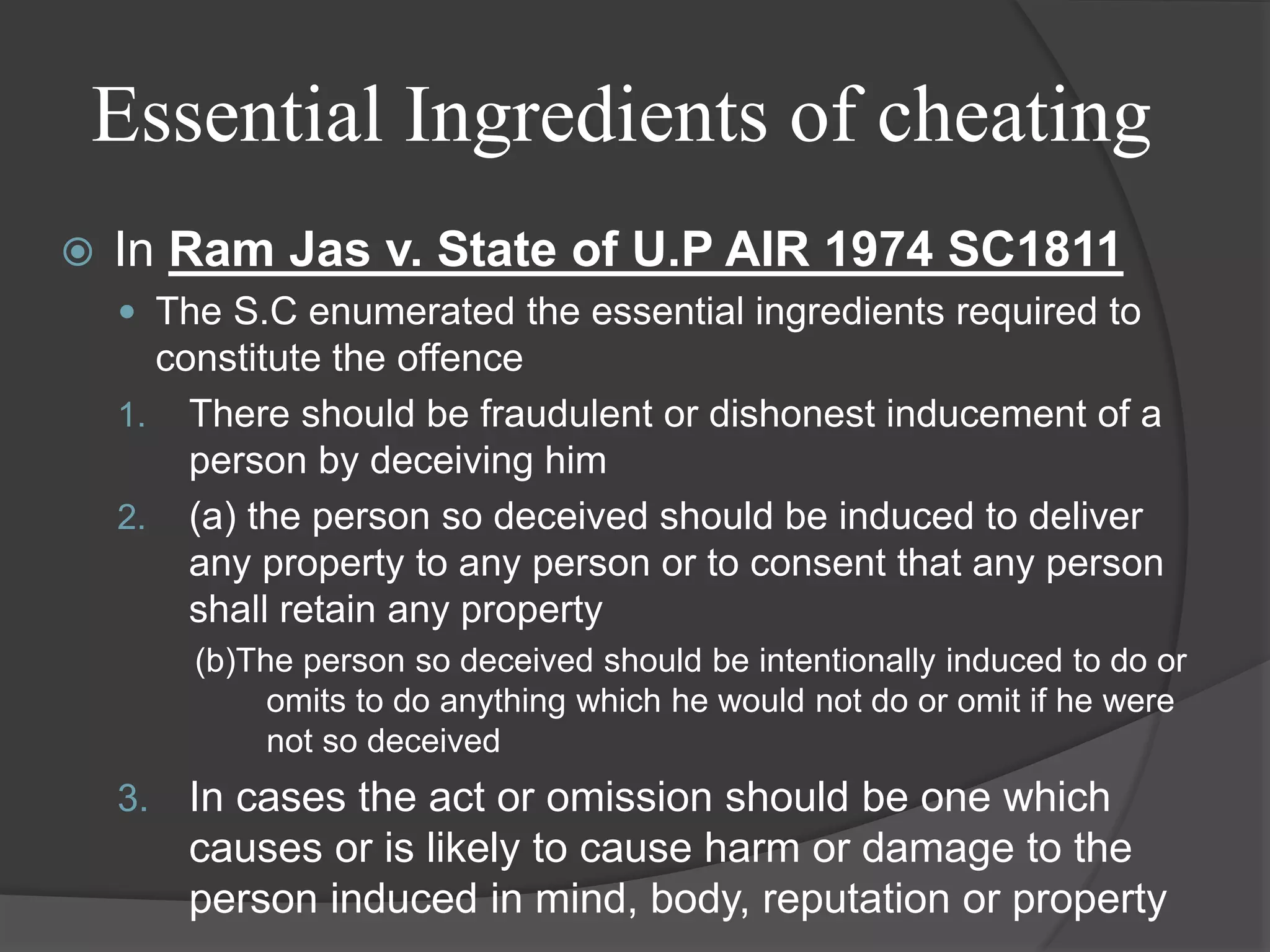
Essential Ingredients of cheating
 In Ram Jas v. State of U.P AIR 1974 SC1811
 The S.C enumerated the essential ingredients required to
constitute the offence
1. There should be fraudulent or dishonest inducement of a
person by deceiving him
2. (a) the person so deceived should be induced to deliver
any property to any person or to consent that any person
shall retain any property
(b)The person so deceived should be intentionally induced to do or
omits to do anything which he would not do or omit if he were
not so deceived
3. In cases the act or omission should be one which
causes or is likely to cause harm or damage to the
person induced in mind, body, reputation or property
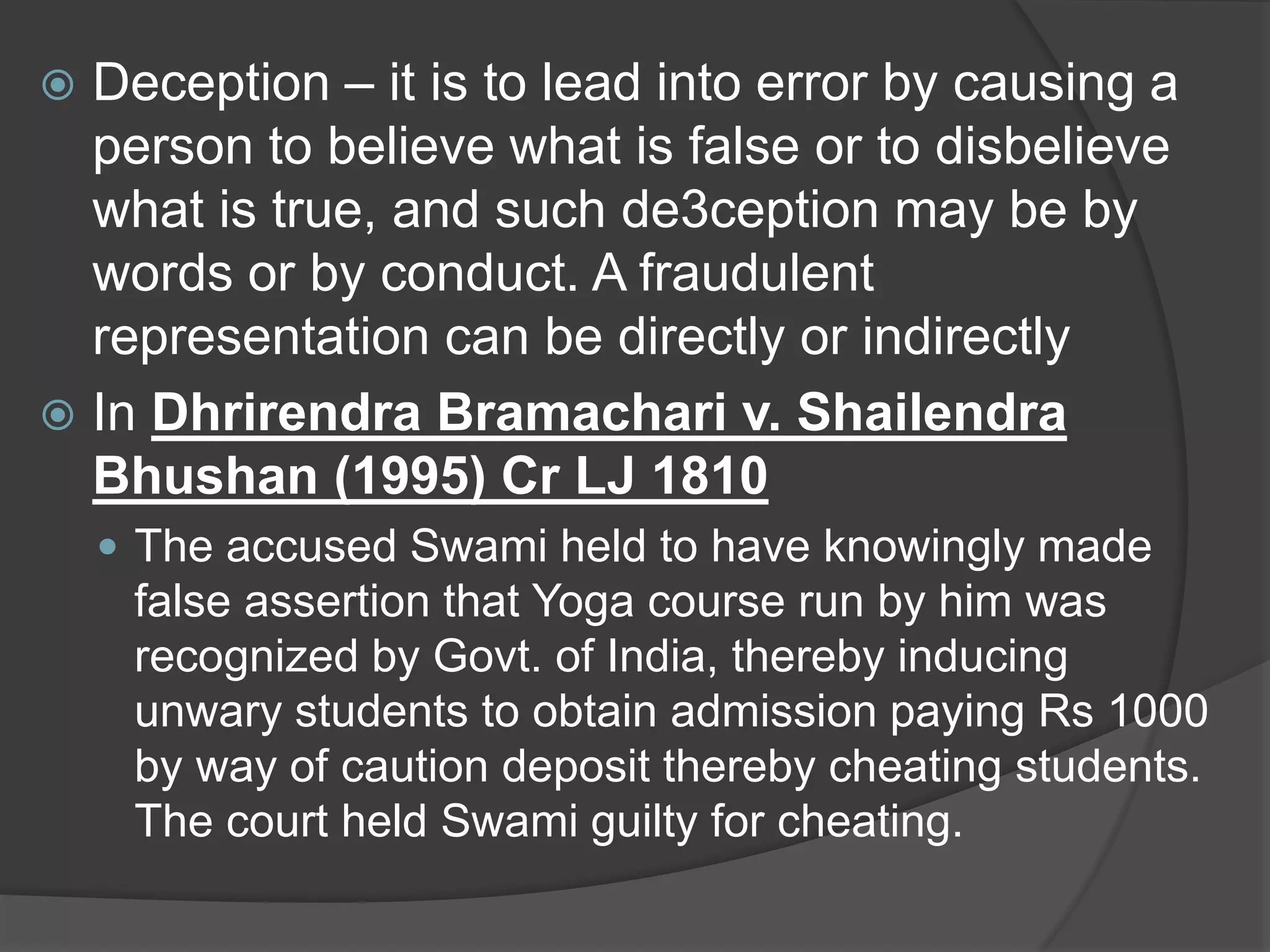
 Deception – it is to lead into error by causing a
person to believe what is false or to disbelieve
what is true, and such de3ception may be by
words or by conduct. A fraudulent
representation can be directly or indirectly
 In Dhrirendra Bramachari v. Shailendra
Bhushan (1995) Cr LJ 1810
 The accused Swami held to have knowingly made
false assertion that Yoga course run by him was
recognized by Govt. of India, thereby inducing
unwary students to obtain admission paying Rs 1000
by way of caution deposit thereby cheating students.
The court held Swami guilty for cheating.
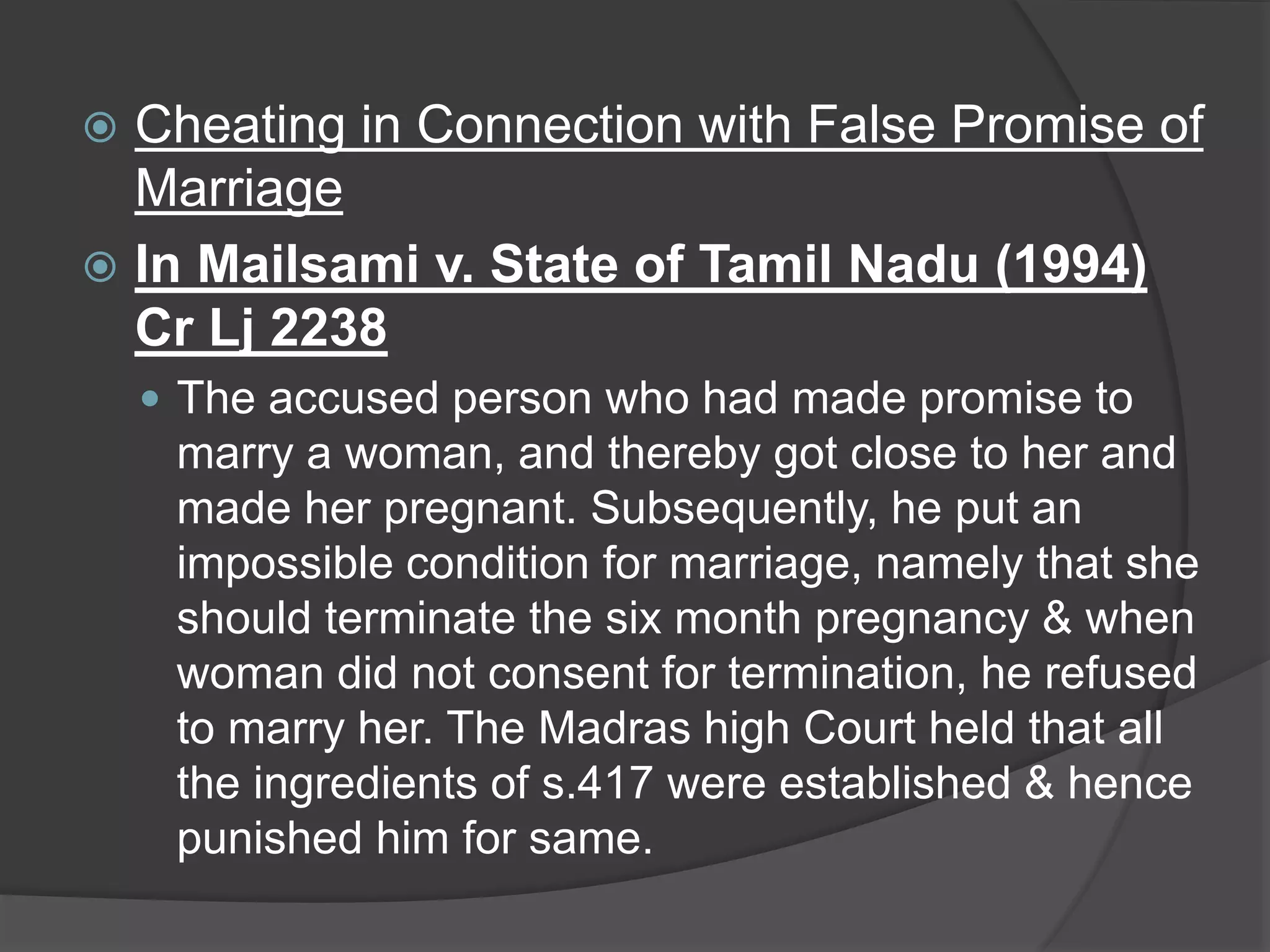
 Cheating in Connection with False Promise of
Marriage
 In Mailsami v. State of Tamil Nadu (1994)
Cr Lj 2238
 The accused person who had made promise to
marry a woman, and thereby got close to her and
made her pregnant. Subsequently, he put an
impossible condition for marriage, namely that she
should terminate the six month pregnancy & when
woman did not consent for termination, he refused
to marry her. The Madras high Court held that all
the ingredients of s.417 were established & hence
punished him for same.
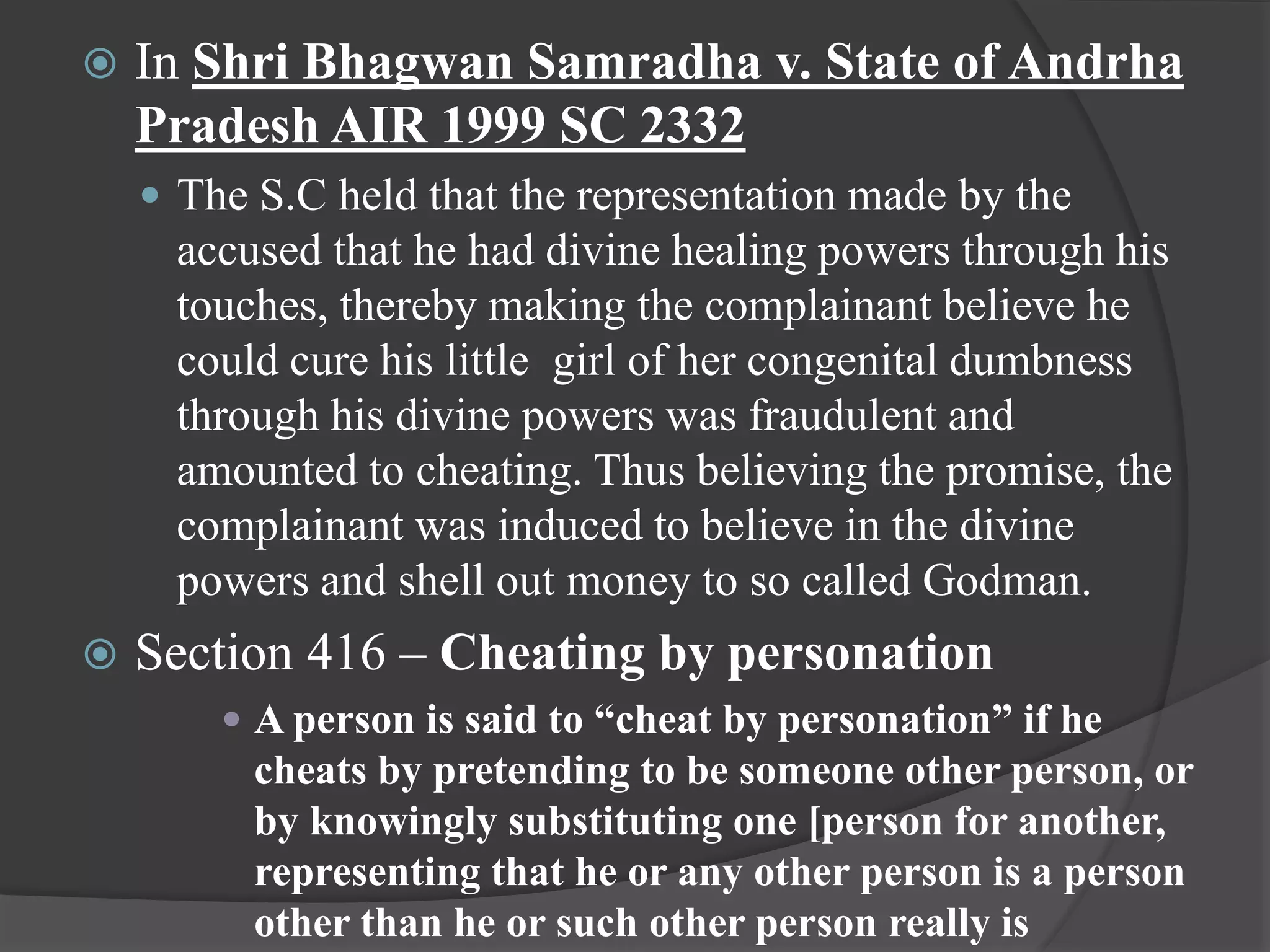
 In Shri Bhagwan Samradha v. State of Andrha
Pradesh AIR 1999 SC 2332
 The S.C held that the representation made by the
accused that he had divine healing powers through his
touches, thereby making the complainant believe he
could cure his little girl of her congenital dumbness
through his divine powers was fraudulent and
amounted to cheating. Thus believing the promise, the
complainant was induced to believe in the divine
powers and shell out money to so called Godman.
 Section 416 – Cheating by personation
 A person is said to “cheat by personation” if he
cheats by pretending to be someone other person, or
by knowingly substituting one [person for another,
representing that he or any other person is a person
other than he or such other person really is
 Section 417. Punishment for cheating
 Whoever cheats shall be punished with
imprisonment of either description for a
term which may extend to one year, or with
fine, or with both.
Section 418 cheating with
knowledge
INGREDIENTS
1. The accussed cheated a person
whose intrests he was under a
legal obligation to protect or
under a contract bound to
protect.
2. The accussed knew that he was
likely to cause wrongful loss to
such a person.
SECTION 419 Punishment for
cheating by personation
 whoever cheats by personation shall be
pumished with imprisonment of either
descvriptyion for a term which ,may be extend
to three years or with fine or with both.
Section 420
 whoever cheats and thereby dishonestly
induces the person deceived to deliver any
property to any person or to make , alter or to
destroy the whole or any part of valuable
security or anything which is signed or sealed
and which is capable of being converted into
valuable security shall be punished with
imprisonment of either description for a term
which may extend to seven years and shall
also be liable to fine.
INGREDIENTS OF SECTION
420
 That the representation made by the accused
was false
 that the accused knew that the representation
was the false at the very time when it was made.
 the accused made the representation with the
dishonest intention of deceiving the person for
whom it was made.
 that the accused thereby induced that person to
deliver any property or to do or to omit to do
something which he would otherwise not have
done or omitted.
CASE LAWS
 In Sushil kumar Dutta vs. State of West Bengal
AIR 1954 SC 724 the accused projecting himself
as a Schedule caste candidate appeared at
Indian Administration Service examination and
obtained an appointment in that cadre on the of
false representation . Held , conviction under
SECTION 420 is justified since he did not belong
to schedule caste.
 In Statew of UP. Vs Jyoti Prasad AIR
1962 ALL. 582 . A represented to run
educational institutions and pretended
that they were recognised by the govt.
Certificates conferring degrees were
issued on payment of money with the
examination held. A was held guilty
under SECTION 420 of IPC.
THANKYOU

Cheating final ipc ppt

  • 1.
    Made by –Praveen kr. Yadav Enroll No.-04113403818 BA.LLB,2nd year,Sec-A
  • 2.
    Cheating  Section 415– Whoever, by deceiving any person, fraudently or dishonestly induces the person so deceived to deliver any property to any person, or to consent that any person shall retain any property, or intentionally induces the person so deceived to do or omit to do anything which he would not do or omit if he were so deceived, and which act or omission causes or is likely to cause damage or harm that person in body, mind, reputation or property, is said to “cheat”.
  • 3.
    Scope of Section415  Whoever by deceiving any person 1. Fraudently or dishonestly induces the person so deceived • To deliver any property or • To consent that any person shall retain any property or 2. (a) Intentionally induces the person so deceived to do or omit to do anything which he would not do or omit if he were not so deceived (b) Which act or omission causes or is likely to cause damage or harm to that person in body,mind,reputation
  • 4.
     Thus s.415has two alternate parts, while in the first part the person must ‘dishonestly’ or ‘fraudently’ induce the complainant to deliver any property in the second part, the person should intentionally induce the complainant to do or omit to do a thing.  In first part the inducement should be dishonest and fraudulent & in second part the inducement should be intentional.  It is however not necessary that deception should be by express words but it may be by conduct or implied in nature of transaction itself.
  • 5.
    Essential Ingredients ofcheating  In Ram Jas v. State of U.P AIR 1974 SC1811  The S.C enumerated the essential ingredients required to constitute the offence 1. There should be fraudulent or dishonest inducement of a person by deceiving him 2. (a) the person so deceived should be induced to deliver any property to any person or to consent that any person shall retain any property (b)The person so deceived should be intentionally induced to do or omits to do anything which he would not do or omit if he were not so deceived 3. In cases the act or omission should be one which causes or is likely to cause harm or damage to the person induced in mind, body, reputation or property
  • 6.
     Deception –it is to lead into error by causing a person to believe what is false or to disbelieve what is true, and such de3ception may be by words or by conduct. A fraudulent representation can be directly or indirectly  In Dhrirendra Bramachari v. Shailendra Bhushan (1995) Cr LJ 1810  The accused Swami held to have knowingly made false assertion that Yoga course run by him was recognized by Govt. of India, thereby inducing unwary students to obtain admission paying Rs 1000 by way of caution deposit thereby cheating students. The court held Swami guilty for cheating.
  • 7.
     Cheating inConnection with False Promise of Marriage  In Mailsami v. State of Tamil Nadu (1994) Cr Lj 2238  The accused person who had made promise to marry a woman, and thereby got close to her and made her pregnant. Subsequently, he put an impossible condition for marriage, namely that she should terminate the six month pregnancy & when woman did not consent for termination, he refused to marry her. The Madras high Court held that all the ingredients of s.417 were established & hence punished him for same.
  • 8.
     In ShriBhagwan Samradha v. State of Andrha Pradesh AIR 1999 SC 2332  The S.C held that the representation made by the accused that he had divine healing powers through his touches, thereby making the complainant believe he could cure his little girl of her congenital dumbness through his divine powers was fraudulent and amounted to cheating. Thus believing the promise, the complainant was induced to believe in the divine powers and shell out money to so called Godman.  Section 416 – Cheating by personation  A person is said to “cheat by personation” if he cheats by pretending to be someone other person, or by knowingly substituting one [person for another, representing that he or any other person is a person other than he or such other person really is
  • 9.
     Section 417.Punishment for cheating  Whoever cheats shall be punished with imprisonment of either description for a term which may extend to one year, or with fine, or with both.
  • 10.
    Section 418 cheatingwith knowledge INGREDIENTS 1. The accussed cheated a person whose intrests he was under a legal obligation to protect or under a contract bound to protect. 2. The accussed knew that he was likely to cause wrongful loss to such a person.
  • 11.
    SECTION 419 Punishmentfor cheating by personation  whoever cheats by personation shall be pumished with imprisonment of either descvriptyion for a term which ,may be extend to three years or with fine or with both.
  • 12.
    Section 420  whoevercheats and thereby dishonestly induces the person deceived to deliver any property to any person or to make , alter or to destroy the whole or any part of valuable security or anything which is signed or sealed and which is capable of being converted into valuable security shall be punished with imprisonment of either description for a term which may extend to seven years and shall also be liable to fine.
  • 13.
    INGREDIENTS OF SECTION 420 That the representation made by the accused was false  that the accused knew that the representation was the false at the very time when it was made.  the accused made the representation with the dishonest intention of deceiving the person for whom it was made.  that the accused thereby induced that person to deliver any property or to do or to omit to do something which he would otherwise not have done or omitted.
  • 14.
    CASE LAWS  InSushil kumar Dutta vs. State of West Bengal AIR 1954 SC 724 the accused projecting himself as a Schedule caste candidate appeared at Indian Administration Service examination and obtained an appointment in that cadre on the of false representation . Held , conviction under SECTION 420 is justified since he did not belong to schedule caste.
  • 15.
     In Statewof UP. Vs Jyoti Prasad AIR 1962 ALL. 582 . A represented to run educational institutions and pretended that they were recognised by the govt. Certificates conferring degrees were issued on payment of money with the examination held. A was held guilty under SECTION 420 of IPC.
  • 16.