Legal Personality
Name – Praveen Kumar Yadav
Enroll. No. – 04113403818
Class – 3rd A
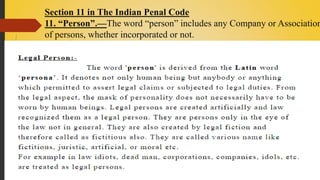
Section 11 in The Indian Penal Code
11. “Person”.—The word “person” includes any Company or Association
of persons, whether incorporated or not.
Animals
Animals have no legal personality. Animals are not persons
in the eye of law and therefore, they are not subjects of
legal right and duties.
In modern times, no legal system recognizes animals as
persons. The human acts which are considered by law as wrongs
against animals are, really speaking, not wrong against the animals,
but are wrongs either against the person who owns that animal or
against the society.
Jamanabai v. Khimji, v. Brahmanand, AIR 1953
In India, cruelty against animals (as defined in various
statutes) is an offence but as observed earlier, this duty is
not a duty towards animals; it is a duty towards the society
or the state
Dead Person
 Dead person doesn't have rights when they die their legal rights get ended &
their duties too.
 There are three rights in this respect, i.e.
 Deceased's body
 His reputation.
 His estate.
 As far as a dead man’s body is concerned criminal law secures a decent
burial to all dead men. Section 297 of Indian Penal Code also provides
punishment for committing crime which amounts to indignity to any
human corpse.
The Supreme Court in the case of Ashray Adhikar Abhiyan v
Union of India has held that even a homeless person when found
dead on the road, has a right of a decent burial or cremation as per
his religious faith.
 The criminal law provides that any imputation against a deceased
person, if it harms the reputation of that person if living and is intended
to hurt the feeling of his family or other near relatives, shall be offence
of defamation under Sec 499 of the Indian Penal Code.
Unborn Person
 Under English Law, a child in the womb of the mother is treated as in
existence and property can be vested in its name.
 Under section 13 of the Transfer of Property Act, property can be
transferred for the benefit of an unborn person.
 Similarly section 114 of the Indian Succession Act, 1925 provides for
the creation of prior interest before the unborn person may be made the
owner of property – corporeal or incorporeal, but no property will be
deemed to be vested in the unborn person unless and until he is born
alive.
 Under Section 315 of the Indian Penal Code, the infliction of pre
natal injury on a child, which is capable of being born alive and
which prevents it from being so could amount to an offence of child
destruction.
 Section 416 of Criminal Procedure Code provides that if a woman
sentenced to death is found to be pregnant, the High Court shall
order the execution of the sentence to be postponed, and may if it
thinks fit, commute the sentence to imprisonment for life.
Idol
(Pramatha Nath v. Pradyumn, (1925) L.R. 52)
Idol is a juristic person and as such it can hold property.
But it is treated as a minor and Pujari or somebody else
acts on its behalf as its guardian.
 Maula Buksh v. Hafiz-ud-din, AIR 1926 Lah. 372)
 it was held that a mosque was a juristic person and could sue
and be sued but it can withhold property.
In Gurudwara Prabandhak Committee v. Somnath Das,
(2000) 4 SC 146, the Supreme Court stating the historical
background and sanctity of Guru Sahib held it to be a juristic
person.
Companies
Companies incorporated in accordance with the
Indian Companies Act are juristic persons. An
incorporated company has a separate existence
and the law recognises it as the legal person
separate and distinct from its members.
 legal personality
 legal personality
 legal personality

legal personality

  • 1.
    Legal Personality Name –Praveen Kumar Yadav Enroll. No. – 04113403818 Class – 3rd A
  • 5.
    Section 11 inThe Indian Penal Code 11. “Person”.—The word “person” includes any Company or Association of persons, whether incorporated or not.
  • 6.
    Animals Animals have nolegal personality. Animals are not persons in the eye of law and therefore, they are not subjects of legal right and duties. In modern times, no legal system recognizes animals as persons. The human acts which are considered by law as wrongs against animals are, really speaking, not wrong against the animals, but are wrongs either against the person who owns that animal or against the society. Jamanabai v. Khimji, v. Brahmanand, AIR 1953 In India, cruelty against animals (as defined in various statutes) is an offence but as observed earlier, this duty is not a duty towards animals; it is a duty towards the society or the state
  • 7.
    Dead Person  Deadperson doesn't have rights when they die their legal rights get ended & their duties too.  There are three rights in this respect, i.e.  Deceased's body  His reputation.  His estate.  As far as a dead man’s body is concerned criminal law secures a decent burial to all dead men. Section 297 of Indian Penal Code also provides punishment for committing crime which amounts to indignity to any human corpse. The Supreme Court in the case of Ashray Adhikar Abhiyan v Union of India has held that even a homeless person when found dead on the road, has a right of a decent burial or cremation as per his religious faith.
  • 8.
     The criminallaw provides that any imputation against a deceased person, if it harms the reputation of that person if living and is intended to hurt the feeling of his family or other near relatives, shall be offence of defamation under Sec 499 of the Indian Penal Code. Unborn Person  Under English Law, a child in the womb of the mother is treated as in existence and property can be vested in its name.  Under section 13 of the Transfer of Property Act, property can be transferred for the benefit of an unborn person.  Similarly section 114 of the Indian Succession Act, 1925 provides for the creation of prior interest before the unborn person may be made the owner of property – corporeal or incorporeal, but no property will be deemed to be vested in the unborn person unless and until he is born alive.
  • 9.
     Under Section315 of the Indian Penal Code, the infliction of pre natal injury on a child, which is capable of being born alive and which prevents it from being so could amount to an offence of child destruction.  Section 416 of Criminal Procedure Code provides that if a woman sentenced to death is found to be pregnant, the High Court shall order the execution of the sentence to be postponed, and may if it thinks fit, commute the sentence to imprisonment for life. Idol (Pramatha Nath v. Pradyumn, (1925) L.R. 52) Idol is a juristic person and as such it can hold property. But it is treated as a minor and Pujari or somebody else acts on its behalf as its guardian.
  • 10.
     Maula Bukshv. Hafiz-ud-din, AIR 1926 Lah. 372)  it was held that a mosque was a juristic person and could sue and be sued but it can withhold property. In Gurudwara Prabandhak Committee v. Somnath Das, (2000) 4 SC 146, the Supreme Court stating the historical background and sanctity of Guru Sahib held it to be a juristic person. Companies Companies incorporated in accordance with the Indian Companies Act are juristic persons. An incorporated company has a separate existence and the law recognises it as the legal person separate and distinct from its members.